ROBERT DURANIVSEARCH OS

RDIV / ANSWER Q-003 · QUANTUM FOUNDATIONS

What Is the Born Rule?

The Born rule supplies probability weights for quantum measurement outcomes. Learn what it establishes and how that differs from outcome realization.

ESTABLISHEDDISPUTEDWAVE CVERIFIED 2026-09-245 SOURCES
DIRECT ANSWER
The Born rule connects a quantum state to probabilities for possible measurement outcomes. In its familiar form, probabilities are determined by squared amplitudes. It is a core empirical rule of quantum mechanics. The rule specifies statistical weighting; whether that probability law also constitutes a complete account of why one particular outcome occurs is a separate theoretical or interpretive question.
DEFINITION / SCOPE

Fix the object first.

For a state expanded in a measurement basis, the squared magnitude of the relevant amplitude supplies the standard quantum probability for the associated outcome. The rule is extraordinarily well confirmed as a predictive rule for measurement statistics.

WHY IT MATTERS

The visible label is not the whole system.

The Born rule is where quantum formalism meets empirical probability. In foundations, however, authors disagree about what those probabilities mean and how they should be understood under different interpretations.

HOW IT WORKS

Trace the burden.

Specify the state and measurement context.
Identify the amplitudes associated with possible outcomes.
Apply squared-modulus weighting and normalization to obtain probabilities.
Keep the statistical rule conceptually separate from any additional story about collapse, branching, or realization.
CRITICAL DISTINCTION
PROBABILITY WEIGHTING ≠ AUTOMATICALLY A LAW OF INDIVIDUAL OUTCOME SELECTION.
INFORMATION GAIN / Born Rule Scope
STATE→AMPLITUDE→|α|²→PROBABILITY
INFORMATION GAIN / Does / Does Not
WEIGHTS OUTCOMES→DOES NOT BY ITSELF IDENTIFY A UNIQUE REALIZATION MECHANISM
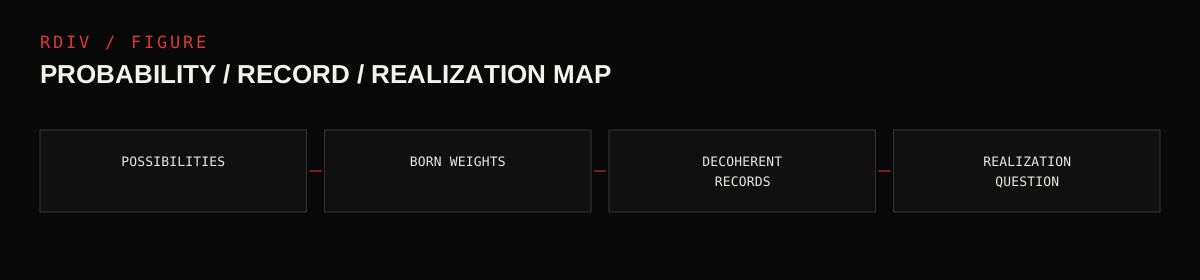
ORIGINAL FIGURE
Diagram separating quantum possibilities, Born weights, decoherent records, and the realization question.
Probability / Record / Realization Map — Original RDIV figure for this canonical Answer.
WHAT THE RECORD ESTABLISHES
  • Born-rule probabilities are a core part of quantum mechanics.
  • Squared-amplitude weighting is experimentally successful.
WHAT REMAINS OPEN
  • The interpretation or derivation of quantum probability remains a foundational topic.
  • Whether probability alone exhausts the explanatory burden for individual outcomes depends on the interpretation.
RDIV FRAMEWORK

Where the work adds something.

CBR preserves Born-compatible probability discipline while arguing that probability and realization are distinct explanatory targets. Its quadratic-weighting papers are conditional theoretical arguments within the CBR program, not empirical replacements for standard quantum statistics.

SOURCE LEDGER

Follow the record.

sep-qm
scholarly-reference
Quantum MechanicsStanford Encyclopedia of Philosophy · 2025-01-01Scholarly reference overview.
OPEN ↗
sep-qt-issues
scholarly-reference
Philosophical Issues in Quantum TheoryStanford Encyclopedia of Philosophy · 2021-08-12Scholarly reference overview; not experimental evidence for any one interpretation.
OPEN ↗
rdiv-quadratic
rdiv-primary
The Necessity of Quadratic Weighting and Constraint-Based RealizationRobertDuranIV.com · 2026-04-14Conditional theorem within the stated framework assumptions; not unrestricted universality.
OPEN ↗
rdiv-probability
rdiv-primary
Probability Is Not SelectionRobertDuranIV.com · 2026-04-30Independent CBR entry paper; CBR is not established physics.
OPEN ↗
rdiv-scope
rdiv-primary
What Constraint-Based Realization Claims — and Does Not ClaimRobertDuranIV.com · 2026-05-01Scope-control note for CBR.
OPEN ↗
RECORD
ANSWER IDQ-003
AUTHORRobert Duran IV
FIRST PUBLISHED2026-09-24
LAST VERIFIED2026-09-24
TOPICQUANTUM FOUNDATIONS
RELEASE WAVEC
CANONICAL/answers/quantum/born-rule
FRESHNESSevergreen