ROBERT DURANIVSEARCH OS

RDIV / ANSWER E-002 · EVIDENCE

What Is an Evidence Graph?

An evidence graph connects source objects to claims, entities, events, contradictions, and findings so investigative reasoning can remain traceable.

METHODRDIV FRAMEWORKWAVE BVERIFIED 2026-09-243 SOURCES
DIRECT ANSWER
An evidence graph represents relationships among source objects, claims, entities, events, contradictions, and findings. Its purpose is not visual complexity but traceability. A defensible evidence graph should let a reviewer move from a finding through the claims supporting it to the source objects that actually bear those claims. Generated prose, semantic similarity, or repeated assertions should never silently become evidence.
DEFINITION / SCOPE

Fix the object first.

An evidence graph is a structured reasoning map. Nodes represent objects such as documents, claims, people, organizations, events, and findings. Edges represent explicit relationships such as supports, contradicts, mentions, controls, precedes, or derives from.

WHY IT MATTERS

The visible label is not the whole system.

Complex investigations fail when the narrative becomes detached from the record. A graph forces the analyst to expose where a conclusion came from, which sources are independent, and where contradictions or missing links remain.

HOW IT WORKS

Trace the burden.

Create source-object nodes before analytical findings.
Attach each material claim to the source objects that can actually support it.
Represent contradiction explicitly instead of deleting it.
Keep inferred relationships distinct from directly documented relationships.
Allow every finding to be traced backward to evidence.
CRITICAL DISTINCTION
SOURCE → CLAIM → FINDING. NOT FINDING → SELECTED SOURCE.
INFORMATION GAIN / R/IV Evidence Graph
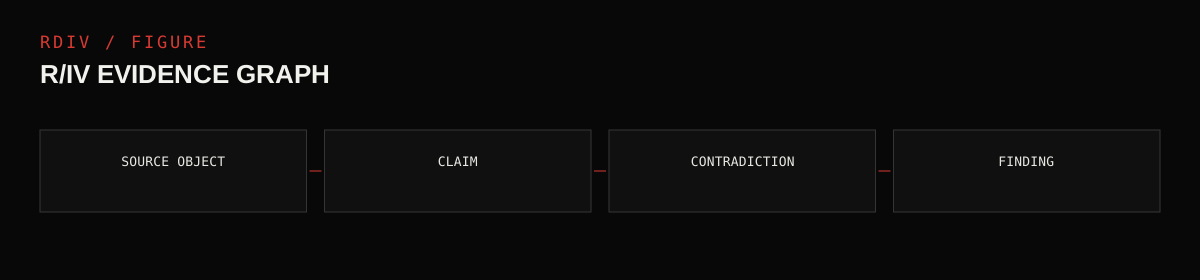
SOURCE OBJECT→CLAIM→CONTRADICTION→FINDING
INFORMATION GAIN / Valid vs Invalid Edge
DOCUMENTED→INFERRED-LABELED→MODEL-GENERATED ≠ EVIDENCE
ORIGINAL FIGURE
Diagram showing the trace from source object to claim, contradiction, and finding in R/IV evidence architecture.
R/IV Evidence Graph — Original RDIV figure for this canonical Answer.
WHAT THE RECORD ESTABLISHES
  • Graph structures are common tools for representing relationships; the evidentiary value depends on the discipline of the underlying source and edge records.
  • Traceability is a methodological property, not proof that every edge is correct.
WHAT REMAINS OPEN
  • Different investigations need different ontologies and edge vocabularies.
  • Automated entity resolution can create false edges and therefore requires human verification for consequential relationships.
RDIV FRAMEWORK

Where the work adds something.

R/IV’s graph doctrine is intentionally asymmetric: admitted source objects populate evidence; model output may assist analysis but must not become evidence merely because the system generated it.

SOURCE LEDGER

Follow the record.

berkeley-protocol
institutional-primary
Berkeley Protocol on Digital Open Source InvestigationsUC Berkeley Human Rights Center / UN Office of the High Commissioner for Human Rights · 2020-12-02Protocol developed for digital open-source investigations in international criminal/human-rights contexts; adapt carefully outside those contexts.
OPEN ↗
rdiv-riv
rdiv-primary
R/IV — Evidence Reconstruction SystemRobertDuranIV.com · 2026-01-01Live page currently states runtime capabilities are not yet verified; methodology claims must not be confused with demonstrated deployment capability.
OPEN ↗
rdiv-standards
rdiv-primary
Editorial StandardsRobertDuranIV.com · 2026-01-01RDIV editorial/research standards.
OPEN ↗
RECORD
ANSWER IDE-002
AUTHORRobert Duran IV
FIRST PUBLISHED2026-09-24
LAST VERIFIED2026-09-24
TOPICEVIDENCE
RELEASE WAVEB
CANONICAL/answers/evidence/evidence-graph
FRESHNESSevergreen