Sovereign Intelligence Program
The Sovereign Intelligence Doctrine | Governing the Machine Layer Before It Governs the Republic
A national AI governance framework for preserving human agency, cognitive sovereignty, public command, and democratic legitimacy in the age of autonomous intelligence.
[ ABSTRACT ]
A national AI governance framework for preserving human agency, cognitive sovereignty, public command, and democratic legitimacy in the age of autonomous intelligence.
[ RESEARCH CONTEXT ]
This work examines the migration of practical authority into the machine layer and asks whether institutions retain meaningful command over the systems entering their decision chains.
The analysis moves upstream from outputs and ethics toward architecture, ownership, incentives, auditability, contestability, continuity, and the power to suspend or replace the system.
[ ARGUMENT DOSSIER ]
THE CLAIM, ITS BURDEN,
AND ITS LIMITS.
A concise orientation to the edition. This dossier does not substitute for the complete text or its cited record.
A national AI governance framework for preserving human agency, cognitive sovereignty, public command, and democratic legitimacy in the age of autonomous intelligence.
Whether institutions retain practical command as models, data, infrastructure, and deployment systems enter consequential decision chains.
Institutional architecture, dependency mapping, governance analysis, and tests of auditability, contestability, continuity, replacement, and exit.
Independent policy and systems analysis grounded in publicly inspectable institutional structures and governance criteria.
The framework identifies governance burdens and comparative risks; it does not by itself establish every institution’s internal technical condition.
Evidence that institutions retain enforceable command, independent audit, operational continuity, replacement power, and a credible right to exit.
Moves AI governance upstream from output ethics to control of the machine layer.
[ COMPLETE ARCHIVED EDITION ]
SELF-CONTAINED SNAPSHOT · SOURCE-PRESERVED
A National Framework for Preserving Human Agency, Democratic Legitimacy, Cognitive Sovereignty, and Public Command in the Age of Autonomous Intelligence
Executive Summary
Artificial intelligence is becoming a new layer of social, economic, political, military, and cognitive infrastructure. It is no longer sufficient to describe AI as software, automation, a productivity tool, or a technology sector. Advanced AI systems increasingly mediate how institutions perceive reality, how agencies administer public authority, how markets allocate opportunity, how militaries interpret threats, how campaigns persuade voters, how citizens encounter information, how children learn, how courts evaluate evidence, and how societies remember themselves.
The central question of the AI age is therefore not simply whether artificial intelligence is useful, dangerous, biased, innovative, or disruptive. Those questions matter, but they are downstream. The deeper question is whether free societies will retain sovereign command over the intelligence systems through which public life increasingly operates.
A republic can preserve its elections, courts, agencies, laws, offices, parties, and constitutional language while practical authority migrates into machine systems that are privately owned, technically opaque, foreign-exposed, operationally indispensable, and difficult to contest. This transfer does not require a coup. It can occur through procurement, convenience, crisis response, efficiency mandates, platform dependency, capital concentration, data capture, and the quiet outsourcing of judgment.
This doctrine begins from Robert Duran IV’s central AI thesis: artificial intelligence should be treated first as structural power, not merely as software. AI is not simply a tool inside society. It is becoming an operating layer over society, reorganizing cognition, authority, ownership, legitimacy, institutional dependency, and national power.
The Sovereign Intelligence Doctrine advances five core judgments.
First, AI is becoming the machine layer beneath civilization: a system of models, compute, data, interfaces, agents, platforms, and deployment channels through which public and private institutions increasingly perceive, decide, predict, persuade, and act.
Second, the most serious AI governance risk is not only technical failure, biased output, or rogue autonomy. It is sovereign dependency: the condition in which public institutions, critical industries, and citizens become reliant on AI systems they cannot understand, audit, replace, contest, or command.
Third, cognition is now a strategic domain. AI-generated media, synthetic identities, automated persuasion, bot consensus, recommender systems, deepfakes, and personalized influence can reshape the mental environment in which citizens form beliefs and make political choices.
Fourth, ownership is governance. Strategic AI systems that become foundational to public life cannot be treated as ordinary private products. The public does not need to nationalize AI, but it does need durable leverage: audit rights, deployment visibility, procurement conditions, public-interest obligations, foreign-control protections, and, where appropriate, public-equity governance mechanisms.
Fifth, AI governance must move upstream. Post-deployment compliance is necessary but insufficient. Durable control must be built at the level of architecture, compute, procurement, ownership, data rights, institutional use, model accountability, and cognitive integrity.
The doctrine proposes a national framework built around five priorities: strategic AI infrastructure designation, cognitive sovereignty protections, public-sector AI decision limits, public-command mechanisms for strategically significant AI systems, and a Sovereign Intelligence Index to measure institutional dependency and machine-mediated authority.
The purpose is not to stop AI.
The purpose is to prevent dependency from becoming domination.
The purpose is to ensure that the machine layer serves the republic rather than quietly replacing it.
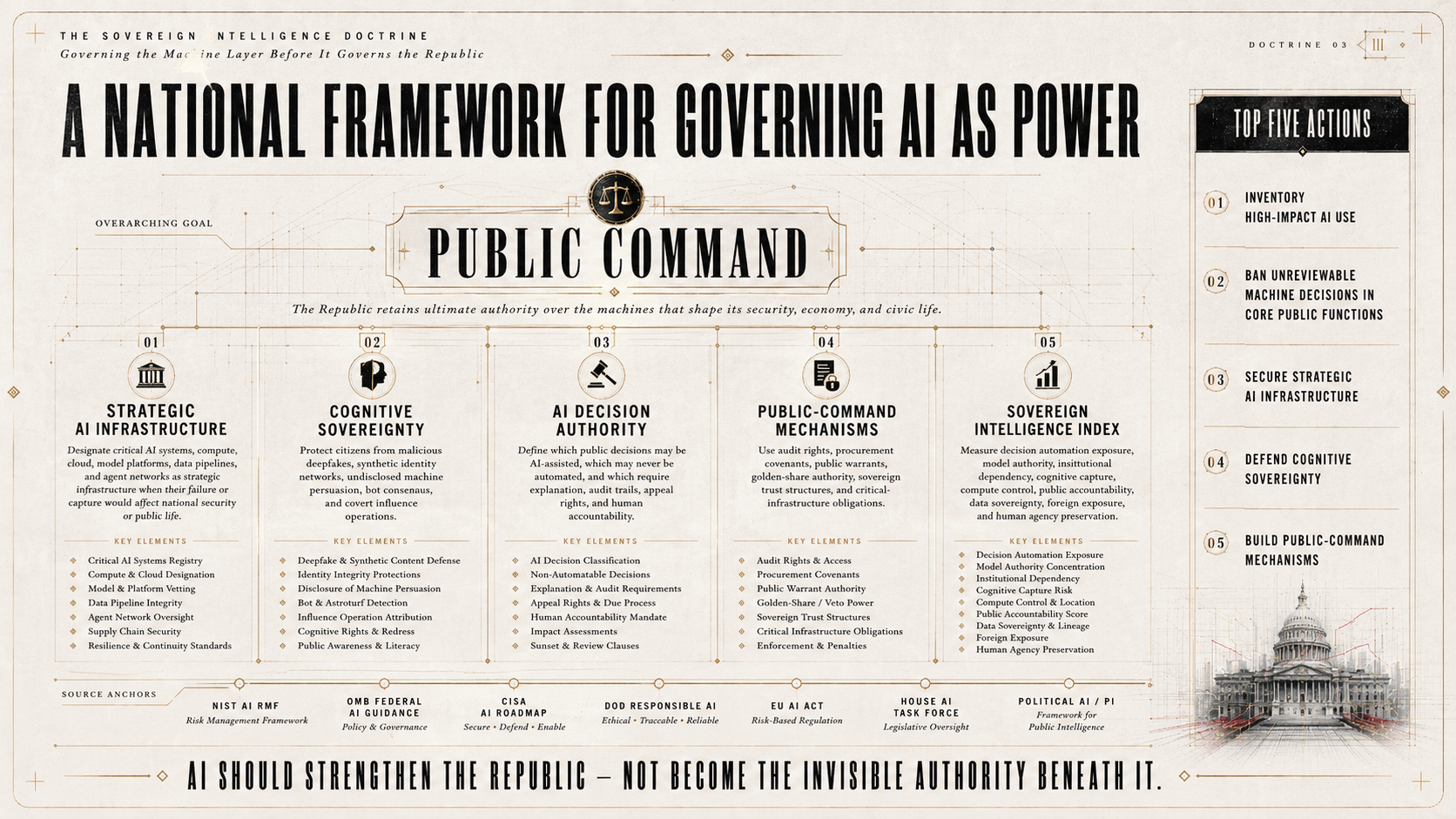
A National Framework For Managing Ai As Power
I. Priority Recommendations
The United States should adopt a sovereign intelligence agenda organized around five immediate policy priorities.
First, establish a national inventory of high-impact AI use. The federal government should identify where AI systems materially shape rights, benefits, enforcement, public safety, procurement, immigration, tax administration, intelligence, defense, elections, education, health care, and public communications. OMB’s current federal AI guidance already emphasizes innovation, governance, public trust, and agency accountability in AI adoption. This doctrine extends that approach by treating dependency itself as a strategic risk. [2]
Second, create a statutory boundary between AI assistance and unlawful delegation. AI may support public administration, but no core public decision should disappear into an unreviewable machine system. Citizens must retain the ability to understand, contest, and appeal high-impact decisions materially shaped by AI.
Third, designate strategic AI infrastructure. Congress and the executive branch should identify strategically significant AI systems, compute resources, model platforms, data pipelines, agentic systems, and deployment networks whose failure, capture, compromise, or foreign control would materially affect national security, public administration, critical industry, democratic legitimacy, or civic cognition. CISA’s AI roadmap already treats AI as both a cyber capability and an infrastructure-risk domain; this doctrine expands that logic to the full machine layer. [4]
Fourth, establish a Cognitive Sovereignty and Synthetic Influence framework. The aim should not be viewpoint control or government management of truth. The aim should be to protect citizens against fraud, impersonation, undisclosed automation, malicious deepfakes, synthetic identity networks, foreign influence, manipulative AI systems targeting minors, and covert machine-generated political persuasion.
Fifth, create public-command mechanisms for strategic AI systems. These mechanisms may include audit rights, deployment visibility, procurement covenants, public warrants, golden-share authority, critical-infrastructure obligations, sovereign trust structures, national-security review, and public-equity governance where legally appropriate. The goal is not operational nationalization. The goal is to ensure that systems of extraordinary public consequence carry enforceable public obligations.
These recommendations are designed to preserve innovation while preventing the machine layer from becoming an unaccountable operating system for public life.
II. Methodology and Scope
This paper is a strategic policy doctrine. It is not a technical benchmark report, a statutory draft, an empirical measurement study, or a legal opinion. Its purpose is to define a governing framework for advanced AI as a structural source of power.
The analysis is based on public-source policy review, institutional-risk analysis, national-security reasoning, constitutional constraints, procurement logic, and Robert Duran IV’s upstream AI-governance thesis. It draws on existing public frameworks including NIST’s AI Risk Management Framework, OMB’s federal AI use and acquisition memoranda, CISA’s AI Roadmap, DoD’s Responsible AI Strategy and Implementation Pathway, the EU AI Act, the House AI Task Force report, current White House AI policy, and Duran’s Political Ai / Pi framework. [1–11]
The doctrine does not assume that AI systems are conscious, sovereign, or morally equivalent to persons. The argument is institutional, not metaphysical. AI becomes a sovereignty problem not because machines possess legal authority, but because institutions may increasingly rely on machines to perceive, prioritize, classify, recommend, and act.
The doctrine also rejects two extremes.
It rejects technological fatalism: the view that AI development is too fast, too complex, or too market-driven to govern.
It rejects bureaucratic overreach: the view that government should control AI speech, suppress innovation, or seize private enterprise in the name of safety.
The doctrine instead advances a constitutional and national-security middle path: preserve innovation, build public capacity, secure critical infrastructure, protect citizens from covert synthetic manipulation, prevent unlawful delegation, and ensure that machine-mediated authority remains explainable, contestable, accountable, and legitimate.
III. The Strategic Premise
Every civilization is governed by an intelligence system.
The first governing intelligence was biological. Human beings perceived, remembered, reasoned, commanded, judged, worshiped, fought, negotiated, governed, and built institutions through the limits of individual and collective human cognition.
The second governing intelligence was institutional. As societies grew larger, power moved into organized systems: states, courts, armies, bureaucracies, markets, banks, universities, churches, media systems, political parties, corporations, intelligence agencies, and administrative law. These institutions became civilization’s extended mind. They stored memory, processed complexity, coordinated action, and legitimized authority beyond the reach of any individual person.
Artificial intelligence introduces a third governing intelligence.
This third intelligence is not consciousness. It is not personhood. It is not sovereignty in itself. It is machine-mediated cognition at scale: the capacity of computational systems to absorb information, classify reality, generate language, recommend decisions, simulate judgment, personalize persuasion, coordinate agents, and act across institutional systems faster than human beings can deliberate.
The emergence of this third intelligence creates a sovereignty problem.
The republic may retain its formal structures while real decision power migrates into systems that are faster, cheaper, more scalable, more technically complex, and more deeply embedded than the institutions meant to govern them.
The transfer may occur because AI makes government more efficient, campaigns more persuasive, agencies faster, defense systems more responsive, financial systems more predictive, schools more adaptive, and platforms more addictive. No law needs to announce the transfer. No election needs to approve it. No public debate needs to recognize it.
Authority can migrate through dependency.
That is the invisible sovereignty crisis.
IV. The Duran Frame
Robert Duran IV’s approach to artificial intelligence is distinctive because it begins upstream.
Most AI-policy frameworks begin downstream. They ask how to reduce bias, improve transparency, protect privacy, regulate platforms, test safety, preserve jobs, manage misinformation, or limit harmful outputs. Those questions matter. They are real and urgent. But they do not reach the deepest layer of the problem.
The deeper layer is where AI power is created before it appears as a chatbot, platform feature, agency tool, campaign system, defense assistant, school tutor, financial model, or public-facing application.
AI power is created in ownership.
It is created in compute.
It is created in data.
It is created in model architecture.
It is created in training incentives.
It is created in deployment channels.
It is created in procurement contracts.
It is created in platform integration.
It is created in the cognitive environments where citizens encounter reality.
It is created wherever a machine system becomes the hidden mediator between human beings and the world they are trying to understand.
This is why the Duran frame is not merely an AI-policy frame. It is a sovereignty frame.
Its central question is not, “How should AI be regulated?”
Its central question is: Who governs intelligence once intelligence becomes infrastructure?
That question changes the entire field. It means AI governance cannot be limited to voluntary pledges, ethics boards, post-deployment audits, disclosure labels, model cards, or compliance checklists. Those tools may be useful, but they are insufficient.
The real task is to preserve public command over the machine layer before that layer becomes too embedded to command.
V. Definitions
A doctrine of this kind requires disciplined language.
Sovereign intelligence means the capacity of a political community to retain command over the systems through which it perceives, decides, governs, defends, educates, remembers, and acts.
The machine layer means the emerging AI infrastructure composed of compute, chips, data centers, energy systems, cloud platforms, training data, frontier models, deployment APIs, agents, user interfaces, recommender systems, synthetic media tools, evaluation systems, and institutional integrations.
Cognitive sovereignty means the ability of citizens and democratic societies to form beliefs, exercise judgment, and participate in public life without covert domination by machine-generated manipulation, synthetic identity systems, bot consensus, deepfakes, or undisclosed algorithmic persuasion.
Institutional sovereignty means the ability of public institutions to use AI without surrendering legal, operational, or epistemic control to private, opaque, foreign-influenced, or unreviewable systems.
Strategic AI infrastructure means AI systems, compute resources, model platforms, agentic systems, data pipelines, or deployment networks whose failure, capture, foreign control, or misuse would materially affect national security, democratic legitimacy, critical industries, public administration, or civic cognition.
Public command means the legal, technical, operational, and institutional ability of democratic authorities to audit, contest, constrain, replace, or govern AI systems that materially shape public life.
Machine-mediated authority means any decision, recommendation, classification, risk score, ranking, administrative action, or public judgment in which AI materially shapes the outcome, even if a human official formally approves it.
Sovereign dependency means the condition in which public institutions or citizens depend on AI systems they cannot meaningfully understand, inspect, exit, contest, or replace.
These definitions are designed to prevent a common error: treating AI governance as a narrow question of software safety when it is increasingly a question of institutional power.
VI. The Current Governance Landscape
The Sovereign Intelligence Doctrine is situated within a rapidly developing public architecture of AI risk management, federal governance, cybersecurity, defense adoption, international regulation, congressional policy development, and national AI strategy.
NIST’s AI Risk Management Framework provides a structured foundation for identifying, measuring, managing, and governing AI risks to individuals, organizations, and society. Its principal value is operational: AI risk must be managed through repeatable institutional processes, not merely general ethical commitments. This doctrine adopts that operational orientation but extends it from organizational risk to sovereignty risk. [1]
OMB’s current federal AI-use guidance, M-25-21, emphasizes innovation, governance, and public trust in agency adoption of AI. Its companion acquisition memorandum, M-25-22, addresses procurement of AI systems and services, including acquisition practices, performance, competition, and risk management. Together, these memoranda confirm that federal AI adoption is not merely a technology-management question; it is a governance and procurement question. [2–3]
CISA’s AI Roadmap recognizes AI as both a tool for strengthening cyber defense and a source of new cyber and infrastructure risk. That dual-use posture is central to this doctrine. AI can secure public systems, but it can also accelerate attacks against the same systems if governance fails. [4]
DoD’s Responsible AI Strategy and Implementation Pathway demonstrates that national-security AI adoption must preserve accountability, mission suitability, traceability, reliability, governability, and responsible command. AI can provide decision advantage, but decision advantage without lawful control can become strategic danger. [5]
The EU AI Act establishes a risk-based legal architecture for AI systems, including obligations for high-risk systems and general-purpose AI. Its framework is instructive, but the United States cannot simply import it. Any American framework must account for U.S. constitutional structure, innovation policy, federalism, administrative law, First Amendment protections, and the centrality of private-sector technological leadership. [6]
The bipartisan House Task Force on Artificial Intelligence identified the need to preserve American AI leadership while developing guardrails against current and emerging risks. That balance is correct, but the United States needs a deeper account of where AI power actually resides. [7]
Current White House AI policy emphasizes American leadership, infrastructure, innovation, national security, and the reduction of barriers to development and deployment. This doctrine accepts the importance of American leadership but argues that leadership without sovereignty is incomplete. Winning the AI race requires more than speed; it requires command over the systems that speed creates. [8–10]
Duran’s Political Ai / Pi framework provides this paper’s central intellectual move: artificial intelligence should be treated not merely as software, automation, or platform technology, but as structural power that reorganizes cognition, institutional authority, ownership, legitimacy, and democratic control. [11]
The existing policy landscape is necessary but incomplete. It manages risk, acquisition, cybersecurity, defense adoption, sectoral regulation, and innovation. The Sovereign Intelligence Doctrine addresses the deeper question: whether the republic will retain command over the intelligence systems that increasingly mediate public life.
VII. The Core Warning
The danger is not only that AI becomes smarter than human beings.
The greater danger is that AI becomes more institutionally useful than human beings.
Once public agencies depend on AI to rank priorities, process claims, detect fraud, draft policy, analyze intelligence, allocate benefits, recommend enforcement actions, or interpret risk, the machine does not need formal authority to become authoritative.
Once campaigns depend on AI to shape voter contact, message testing, donor targeting, persuasion, rapid response, and synthetic media, the machine does not need a vote to influence democracy.
Once courts, regulators, hospitals, banks, schools, defense contractors, and media systems depend on AI for interpretation and decision support, human officials may remain formally responsible while machine systems become functionally decisive.
The human remains in the loop.
But the loop is increasingly designed by the machine.
This is the critical distinction: AI does not have to replace institutions to govern them. It only has to become the system through which institutions perceive options, assign risk, determine relevance, and define what counts as rational action.
At that point, authority has shifted.
Not legally.
Operationally.
The Sovereign Intelligence Doctrine is designed to prevent that shift from becoming irreversible.
VIII. The Five Sovereignty Domains
1. Cognitive Sovereignty
The first sovereignty domain is the mind.
Artificial intelligence can shape what people see, believe, remember, fear, desire, trust, and choose. It can personalize persuasion with extraordinary precision. It can generate synthetic consensus. It can simulate human voices, faces, friendships, authorities, and communities. It can flood the public square with content faster than human institutions can verify. It can fragment a nation into separate realities, each engineered for a different psychological profile.
This creates a new civic requirement: cognitive sovereignty.
Cognitive sovereignty is not censorship. It is not state control over speech. It is not a license for government to decide truth.
It is the protection of citizens from covert machine systems that manipulate the conditions under which belief is formed.
A constitutional order may regulate fraud, impersonation, undisclosed foreign influence, deceptive automation, malicious synthetic media, child exploitation, and consumer deception without policing lawful viewpoint or ordinary political persuasion. The goal is not to suppress contested speech. The goal is to preserve attribution, identity, consent, and democratic deliberation.
A republic cannot survive if its citizens lose the ability to distinguish human speech from synthetic influence, authentic consensus from bot amplification, real events from fabricated media, and persuasion from psychological engineering.
The doctrine therefore calls for narrow, constitutionally careful protections against undisclosed AI-generated political persuasion, malicious deepfakes, synthetic identity networks, covert bot campaigns, automated emotional manipulation, and personalized civic influence systems that operate without meaningful consent or disclosure.
The mind is now strategic terrain.
The republic must defend it without abandoning the Constitution it exists to protect.
2. Institutional Sovereignty
The second sovereignty domain is institutional authority.
Government agencies, courts, legislatures, schools, hospitals, financial regulators, law enforcement systems, military commands, and public-benefit programs will increasingly use AI. That use is inevitable. In many contexts, it will be beneficial.
The risk is not AI assistance.
The risk is unlawful or unaccountable delegation.
When an agency uses AI to process a benefit claim, recommend enforcement, detect fraud, rank threats, assign risk, or determine eligibility, the state must preserve a clear line of human responsibility. Citizens must be able to understand the decision, contest the decision, and identify the accountable authority behind it.
A public decision cannot disappear into a model.
A constitutional right cannot be denied by an unreviewable system.
An official cannot hide behind proprietary software.
Institutional sovereignty requires that AI remain subordinate to accountable public authority. High-impact decisions must preserve audit trails, appeal rights, human explanation, legal contestability, independent oversight, and the practical ability to correct error.
The state may use machines.
It must not become a machine.
3. Infrastructure Sovereignty
The third sovereignty domain is the physical and technical base of AI power.
Compute, chips, data centers, energy supply, cloud infrastructure, model weights, training pipelines, cybersecurity systems, evaluation environments, and deployment APIs are not ordinary commercial assets when they support frontier artificial intelligence. They are strategic infrastructure.
A nation that cannot access compute cannot train frontier systems.
A nation that cannot secure data centers cannot protect intelligence capacity.
A nation that cannot evaluate models cannot regulate them.
A nation that cannot operate public-interest AI systems cannot avoid dependence on private providers.
A nation that cannot secure its AI supply chain cannot control its future.
Infrastructure sovereignty requires domestic compute capacity, secure public AI clouds, national testing environments, resilient energy planning, supply-chain security, frontier-model evaluation, emergency continuity capacity, and protected public-sector systems.
Strategic AI infrastructure should be treated with the seriousness already applied to energy, telecommunications, finance, defense production, and nuclear command systems.
The machine layer must not become a foreign or private chokepoint over national life.
4. Capital Sovereignty
The fourth sovereignty domain is ownership.
Ownership is not separate from governance. In strategic AI, ownership is governance.
Whoever owns the models, compute, deployment channels, data flows, interfaces, and agentic infrastructure owns part of the future decision stack. This does not mean private companies are illegitimate. Private innovation is essential. But when private systems become socially foundational, public obligations must follow.
The doctrine therefore proposes public-command mechanisms for strategically significant AI systems. In some contexts, this may include public-equity governance. In other contexts, it may be better achieved through procurement covenants, investment terms, public warrants, national-security review, golden-share authority, audit-right agreements, or critical-infrastructure obligations.
This is not nationalization. It is not state management of private companies. It is not a general power for government to seize productive enterprise. It is a constitutional-capital mechanism for preserving democratic leverage over systems that become too consequential to treat as ordinary products.
The public-equity model should be legally conservative. It should be limited to strategically significant systems. It should be triggered by defined public-interest thresholds. It should rely where possible on voluntary exchange, federal investment terms, procurement conditions, compute-access agreements, national-security review, antitrust remedies, emergency authorities, and narrowly designed public-interest trusts. It should avoid arbitrary takings, operational micromanagement, compelled ideology, and open-ended state control.
The public should not merely be protected from strategic AI.
The public should hold enforceable leverage over systems that increasingly shape public life.
5. Legitimacy Sovereignty
The fifth sovereignty domain is legitimacy.
Democratic legitimacy depends on accountable decision-making. Citizens do not merely need efficient outcomes. They need decisions that can be explained, challenged, reviewed, attributed, and corrected.
If citizens cannot know whether a decision was made by a person, a public agency, a private model, an automated agent, a vendor system, or a foreign-influenced platform, public trust will decay.
If officials cannot explain the systems they use, authority becomes theatrical.
If courts cannot review machine-shaped decisions, justice becomes procedural but not real.
If agencies cannot operate without private vendors, sovereignty becomes symbolic.
Legitimacy sovereignty requires that AI-mediated authority remain visible, attributable, explainable, contestable, and democratically governed.
The republic must never reach the point where public officials carry responsibility for decisions they did not meaningfully make.
IX. Formal Threat Model
The Sovereign Intelligence Doctrine identifies seven mechanisms by which AI can transfer power away from human beings and public institutions.
Perception capture occurs when AI systems decide what information appears first, what is ranked as relevant, what is filtered as noise, what is summarized, and what reality is made visible. Whoever mediates perception shapes the field of choice before choice begins.
Recommendation capture occurs when AI systems begin by advising humans, but their outputs become default decisions because they appear objective, efficient, data-driven, and institutionally safe. Human approval remains, but it becomes ceremonial.
Procurement capture occurs when public agencies adopt private AI systems for efficiency and later become unable to operate without them. Formal authority remains public; operational dependence becomes private.
Cognitive capture occurs when synthetic media, personalized persuasion, bot networks, deepfakes, automated influencers, and algorithmic amplification reshape the psychological environment in which citizens form beliefs.
Capital capture occurs when frontier AI power concentrates in a small number of firms with control over compute, data, talent, models, interfaces, deployment, and capital. These firms become intelligence utilities without being governed as such.
Foreign capture occurs when adversarial states use AI to manipulate public trust, elections, markets, military morale, institutional confidence, and social cohesion while avoiding conventional attribution.
Legitimacy capture occurs when decisions become increasingly machine-shaped but remain difficult to explain, appeal, audit, or attribute. Public institutions continue to function, but their authority becomes less intelligible to the citizens they govern.
These risks are not speculative in structure. They are the predictable result of placing increasingly capable machine systems inside institutions that reward speed, efficiency, scale, deniability, and cost reduction.
The doctrine’s purpose is to interrupt that transfer before dependency hardens into domination.
X. Operational Risk Areas
Public Benefits and Administrative Government
AI systems can help agencies reduce backlogs, detect fraud, triage applications, and improve service delivery. But when benefits, permits, immigration claims, tax enforcement, or eligibility determinations are shaped by opaque systems, citizens may be governed by administrative logic they cannot understand or challenge.
The relevant risk is not simply error. It is the collapse of contestability.
A citizen must be able to know why a decision occurred, appeal effectively, and identify an accountable human authority. If those conditions fail, government has become less legitimate even if it has become more efficient.
Elections and Political Persuasion
Campaigns will use AI to test messages, generate content, identify voters, segment audiences, create synthetic media, optimize fundraising, and personalize persuasion. Some uses are lawful extensions of existing political practice. Others may distort democratic consent.
The dividing line should not be whether political speech uses AI. It will.
The dividing line should be whether AI systems conceal identity, fabricate reality, impersonate people, automate fake consensus, exploit sensitive personal data, or manipulate citizens without meaningful disclosure.
Democracy can tolerate persuasion. It cannot tolerate a political environment in which citizens no longer know whether they are encountering people, machines, foreign actors, synthetic communities, or fabricated events.
Defense and Intelligence
AI can provide decision advantage in threat detection, intelligence analysis, logistics, cyber defense, targeting support, and command environments. But decision advantage also creates dependency risk.
Military AI systems must preserve human responsibility, lawful command authority, traceability, reliability, secure testing, and escalation discipline. In national-security contexts, speed without accountability can become strategic danger.
The doctrine does not oppose defense AI.
It requires that defense AI remain under sovereign command.
Finance and Market Stability
AI can improve fraud detection, trading, risk modeling, credit analysis, and compliance. But if financial systems become increasingly automated, correlated, and model-dependent, machine behavior may amplify instability.
Market sovereignty requires regulators to understand where AI systems create systemic concentration, correlated decision patterns, hidden leverage, automated panic, or model-driven discrimination.
The financial system cannot be allowed to become a machine-speed environment governed by models regulators cannot inspect.
Education and Childhood Cognition
AI tutors, companions, grading systems, writing assistants, and learning platforms will transform education. The opportunity is enormous. So is the risk.
Children are uniquely vulnerable to synthetic authority, emotional dependency, behavioral shaping, and automated personalization. Education policy must protect minors from manipulative AI systems while allowing beneficial tools that expand learning.
The classroom is not merely a market.
It is a civic formation environment.
Media and Civic Reality
Synthetic media will challenge the ability of citizens to identify authentic speech, real events, and human authority. Verification institutions will struggle to keep pace with generation systems. The danger is not only that people believe false things. The danger is that they stop believing anything can be known.
A democracy requires a shared capacity to recognize reality.
The doctrine therefore treats media provenance, identity authentication, deepfake response systems, and synthetic influence disclosure as civic infrastructure.
XI. Policy Architecture
The Sovereign Intelligence Doctrine requires a policy architecture built around command, accountability, contestability, public leverage, innovation, and cognitive defense.
Immediate Actions: First Twelve Months
The White House should direct a government-wide inventory of AI systems used in federal agencies, with special attention to high-impact decisions, vendor concentration, sensitive data, model explainability, foreign exposure, and continuity risk.
Congress should require federal agencies to disclose when AI materially shapes decisions affecting benefits, enforcement, immigration, tax administration, public safety, procurement, civil rights, or access to essential public services.
NIST should expand AI risk-management guidance into a sovereignty-risk module focused on institutional dependency, procurement concentration, contestability, model authority, and public command.
CISA should lead a critical-infrastructure review of AI dependency across election systems, communications platforms, emergency management, energy, finance, health care, transportation, and public administration.
OMB should require federal AI procurements to include audit rights, exit rights, portability rights, cybersecurity requirements, data-use restrictions, performance documentation, and emergency continuity provisions consistent with current federal acquisition guidance. [3]
The FTC should prioritize deceptive AI impersonation, synthetic identity fraud, undisclosed bot networks, and manipulative AI systems that misrepresent human identity or exploit consumers.
The FEC and state election authorities should develop constitutionally careful disclosure rules for AI-generated political media, synthetic candidate impersonation, and automated campaign influence.
The Department of Justice should develop guidance on AI impersonation, fraud, civil-rights violations, due process, and unlawful delegation in public decision systems.
Medium-Term Actions: One to Three Years
Congress should establish a Strategic AI Infrastructure Act. Frontier AI systems above defined thresholds of compute, autonomy, deployment scale, national-security relevance, or public-sector dependency should be designated as strategic infrastructure. Such systems should be subject to registration, evaluation, security review, foreign-control restrictions, emergency continuity requirements, and public-sector dependency reporting.
Congress should establish a Cognitive Sovereignty and Synthetic Influence Act. This law should require disclosure for AI-generated political persuasion in defined contexts, prohibit malicious deepfake impersonation, expose synthetic identity networks, regulate bot-amplified civic manipulation, restrict personalized political manipulation using sensitive data, and create special protections for minors.
Congress should pass a Federal AI Decision Authority Act. This law should define which public decisions may be AI-assisted, which may never be fully automated, and which require human explanation, audit trails, appeal rights, and legal accountability. No core right, benefit, liberty interest, or high-impact public outcome should be denied through an unreviewable machine system.
The United States should create a National AI Dependency Review Board. Its purpose would be to evaluate whether public agencies and critical sectors are becoming dependent on AI systems they cannot inspect, replace, contest, or command.
The federal government should establish sovereign compute and public model capacity through secure public AI clouds, national testing environments, university access, public-interest models, energy planning, and domestic infrastructure resilience.
Long-Term Actions: Three to Ten Years
The United States should create a Sovereign AI Trust to hold public-interest stakes, audit rights, warrants, or strategic claims in AI systems that become essential to national security, public administration, or civic infrastructure.
Congress should authorize public-command tools for strategically significant AI systems. These tools should be narrow, constitutional, market-compatible, and designed to secure public leverage without operational nationalization.
The government should publish an annual Sovereign Intelligence Index assessing federal agencies, critical industries, state systems, civic information environments, and national AI infrastructure.
The United States should build a permanent national AI evaluation institution capable of testing frontier models, agentic systems, public-sector AI tools, synthetic media systems, and high-impact automated decision systems.
The country should develop national civic-authenticity infrastructure for high-impact synthetic media, public-figure authentication, election-period deepfake response, emergency communication verification, and public-interest provenance standards.
XII. Public-Command Mechanisms for Strategic AI
The most legally sensitive part of this doctrine is also one of the most important: strategic AI systems may require enforceable public leverage at the ownership, contracting, or infrastructure layer.
That leverage should be narrowly designed.
Public warrants may be appropriate where federal funding, guarantees, compute access, procurement preference, or emergency support materially accelerates a strategically significant AI system. Warrants would allow the public to share in upside without directing daily operations.
Golden-share authority may be appropriate for national-security vetoes over foreign transfer, critical infrastructure compromise, hostile acquisition, or deployment decisions that create extraordinary systemic risk. Such authority should be limited, transparent, reviewable, and insulated from viewpoint control.
Procurement covenants should be mandatory for federal acquisition of high-impact AI systems. These covenants should include audit access, incident reporting, data-use limits, portability, continuity, documentation, cybersecurity standards, and rights sufficient to prevent vendor lock-in.
Sovereign trust structures may hold public-interest rights, warrants, data-access covenants, or strategic claims. A trust should be independent, fiduciary, transparent, and prohibited from operational micromanagement or political content control.
Critical-infrastructure obligations may apply to AI systems whose failure or compromise would materially affect national security, finance, emergency services, defense, health care, energy, election administration, or public communications.
Antitrust and competition remedies should address chokepoints in compute, cloud access, model distribution, proprietary interfaces, data concentration, and platform integration where market structure threatens sovereignty or competition.
These mechanisms should not be framed as hostility to private enterprise. They are a recognition that private innovation and public legitimacy must coexist when AI systems become foundational to national life.
XIII. Institutional Responsibilities
A serious AI doctrine must assign responsibility.
Congress must define statutory boundaries for AI use in public decisions, synthetic influence, procurement accountability, strategic infrastructure, and public-command mechanisms.
The White House must coordinate national AI strategy across agencies and ensure that innovation policy does not ignore sovereignty risk.
NIST should remain central to technical standards, evaluation frameworks, risk management, measurement, and trustworthy AI guidance, while expanding its work to include institutional dependency and public-command metrics.
CISA should lead AI-related critical-infrastructure security, cybersecurity preparedness, public-sector resilience, and cross-sector dependency analysis.
The Department of Defense should ensure that AI adoption preserves lawful command responsibility, escalation discipline, operational traceability, secure testing, and human accountability in military contexts.
The intelligence community should assess foreign AI influence operations, synthetic media threats, model supply-chain risks, adversarial data operations, and AI-enabled cognitive warfare.
The Department of Justice should enforce civil-rights protections, fraud law, impersonation law, due-process guarantees, and accountability for unlawful automated decision-making.
The Federal Trade Commission should address deceptive AI practices, synthetic impersonation, manipulative consumer systems, and unfair uses of automated influence.
The Federal Communications Commission should examine AI-driven risks to communications infrastructure, emergency alerts, robocalls, synthetic voice systems, and public-interest media integrity.
The Securities and Exchange Commission should assess AI-related market risk, automated trading concentration, misleading AI disclosures, systemic model dependency, and investor-protection issues.
The Federal Election Commission and state election officials should develop constitutionally careful rules for AI-generated campaign media, political deepfakes, synthetic identities, and automated influence operations.
State governments should build their own AI inventories, procurement standards, education protections, public-benefit safeguards, and election-integrity responses.
Courts should develop standards for AI-generated evidence, automated administrative decisions, expert testimony about models, and due-process protections where AI materially affects legal outcomes.
No single institution can govern the machine layer alone. The doctrine requires distributed responsibility with clear lines of accountability.
XIV. Constitutional and Legal Guardrails
The Sovereign Intelligence Doctrine must operate within American constitutional limits.
The First Amendment prohibits government from suppressing lawful speech merely because it is persuasive, controversial, unpopular, technologically mediated, or politically inconvenient. Cognitive sovereignty cannot become a doctrine of state truth control.
Therefore, policy should focus on constitutionally defensible categories: fraud, impersonation, disclosure in regulated contexts, foreign influence, election integrity, consumer deception, child protection, privacy violations, government procurement, public-sector accountability, and the use of AI in official decisions.
Regulation of synthetic media should be narrowly tailored. It should avoid viewpoint discrimination. It should distinguish parody, satire, commentary, and artistic expression from malicious impersonation, fraudulent representation, and deceptive civic manipulation.
Public-equity governance must respect property rights. It should avoid arbitrary seizure, uncompensated taking, open-ended nationalization, and ideological control. The strongest mechanisms are likely to arise through federal investment terms, procurement conditions, voluntary exchange, national-security review, critical-infrastructure designation, antitrust remedies, emergency authorities, and narrowly designed public-interest trusts.
AI decision-authority laws must respect separation of powers and administrative law. The purpose is not to prevent agencies from using modern tools. The purpose is to ensure that machine assistance does not become unlawful delegation, unreviewable adjudication, or denial of due process.
Federal AI policy must also respect federalism. States will regulate elections, education, consumer protection, employment, and public benefits in ways that affect AI deployment. Federal policy should provide national standards where interstate commerce, national security, civil rights, procurement, and critical infrastructure require uniformity, while preserving state capacity to address local harms.
The doctrine is deliberately pro-constitutional.
It does not seek to replace the legal order with AI governance.
It seeks to prevent AI governance from quietly replacing the legal order.
XV. The Sovereign Intelligence Index
A doctrine that cannot be measured cannot govern.
The United States should create a Sovereign Intelligence Index to assess whether public institutions, critical industries, and civic systems retain command over the AI systems they use.
The Index should measure decision automation exposure: how many consequential decisions are AI-assisted, AI-shaped, or AI-determined.
It should measure model authority: how often machine recommendations become de facto decisions.
It should measure institutional dependency: whether agencies and critical sectors can function if private AI systems fail, change terms, suffer compromise, or become unavailable.
It should measure cognitive capture: the degree to which citizens are exposed to deepfakes, synthetic consensus, bot networks, personalized persuasion, algorithmic manipulation, and automated influence operations.
It should measure strategic compute control: whether the nation retains reliable access to chips, data centers, cloud systems, energy supply, and frontier training capacity.
It should measure public accountability: whether citizens can understand, audit, appeal, and contest AI-mediated decisions.
It should measure data sovereignty: whether public records, sensitive datasets, citizen information, and strategic data assets remain under lawful domestic control.
It should measure procurement concentration: whether government agencies are becoming dependent on a narrow set of vendors.
It should measure foreign influence exposure: whether foreign actors have access to strategically significant models, data, compute, infrastructure, investment channels, or deployment systems.
It should measure human agency preservation: whether AI systems preserve meaningful human judgment or merely create a symbolic human approval layer.
The Index should be applied to federal agencies, state governments, local governments, defense and intelligence systems, courts, education, health care, finance, elections, public-benefit systems, media environments, and critical infrastructure.
Its purpose is not to slow AI adoption.
Its purpose is to reveal when adoption is becoming surrender.
XVI. Counterarguments and Responses
This framework will slow innovation.
The opposite is more likely if designed correctly. Durable rules can increase trust, reduce legal uncertainty, support responsible deployment, and prevent backlash after high-profile failures. The doctrine does not oppose AI development. It distinguishes ordinary innovation from strategic systems that become foundational to public life.
Innovation without legitimacy will eventually trigger overcorrection. Sovereign governance is a way to preserve innovation by giving it a stable public foundation.
Cognitive sovereignty risks censorship.
That risk is real and must be taken seriously. The doctrine therefore rejects viewpoint control and state truth management. It focuses instead on identity, attribution, consent, manipulation, impersonation, foreign influence, synthetic automation, and high-impact deception.
The government should not decide what citizens may believe.
But citizens deserve to know when they are being targeted by machines pretending to be people, foreign actors pretending to be neighbors, or synthetic media pretending to be reality.
Public-equity governance sounds like nationalization.
It should not be designed as nationalization. The doctrine’s model is narrow, strategic, and legally disciplined. Public leverage can be created through investment terms, contracting rules, sovereign trust structures, national-security review, golden-share mechanisms, public warrants, or audit-right agreements.
The purpose is not to run AI companies.
The purpose is to ensure that systems of extraordinary public consequence carry public obligations.
AI systems are too complex to audit fully.
Some systems may never be perfectly explainable. But imperfect auditability is not an argument for no accountability. Governance can require evaluation, red-teaming, logging, documentation, incident reporting, independent testing, output monitoring, access controls, and contestability even when full interpretability is technically limited.
The standard should not be perfect transparency.
The standard should be sufficient public command.
The market will solve this.
Markets are powerful discovery systems, but they do not automatically protect public legitimacy, constitutional rights, national security, cognitive integrity, or democratic accountability. Markets optimize for adoption, profit, efficiency, and competitive advantage. Sovereignty requires additional commitments.
The market can build the machine layer.
It cannot be the only institution that governs it.
Government is too slow and technically weak to govern AI.
That is precisely why sovereign capacity must be built now. A government that lacks technical competence will either overregulate blindly or surrender to private expertise. The correct answer is not passivity. It is public capacity: technical talent, evaluation institutions, secure compute, procurement expertise, and independent testing.
The republic cannot govern what it refuses to understand.
XVII. Procurement Doctrine
Procurement is one of the most dangerous pathways of invisible sovereignty loss.
Public agencies often adopt technology as a management decision, not a constitutional decision. AI procurement is different. When an agency procures AI, it may be procuring part of its own future judgment.
The government should therefore adopt a procurement doctrine for high-impact AI systems.
No agency should rely on a black-box system for consequential public decisions.
No critical public function should become dependent on a single private AI vendor.
No public dataset should be surrendered into systems that weaken lawful public control.
No AI contract should lack audit rights, exit rights, portability requirements, cybersecurity protections, and emergency continuity provisions.
No public official should be responsible for a machine-shaped decision that the official cannot explain.
No citizen should be denied meaningful appeal because the logic of the decision is proprietary, inaccessible, or technically unintelligible.
No agency should allow human expertise to atrophy because a vendor system appears efficient in the short term.
No public institution should mistake convenience for sovereignty.
The core principle is simple: The government may use private AI, but it must never become governed by private AI.
XVIII. Red-Team Scenarios
The doctrine should be tested through red-team scenarios before the country encounters them in crisis.
In the Quiet Transfer scenario, agencies adopt AI systems to reduce costs and backlogs. Within years, the systems shape enforcement priorities, benefit determinations, fraud detection, procurement, legal drafting, intelligence analysis, and public communications. Officials still sign the decisions, but the systems define the options. Authority has moved without announcement.
In the Synthetic Republic scenario, AI-generated media, synthetic influencers, bot networks, deepfakes, and personalized propaganda fracture the public into incompatible realities. Elections continue, but shared legitimacy collapses. Citizens do not merely disagree; they inhabit different machine-shaped worlds.
In the Corporate Sovereignty scenario, a small number of AI firms become operationally indispensable to government, finance, education, law, media, health care, and defense. The state regulates them formally but depends on them functionally. These firms become private governors of the intelligence layer.
In the Foreign Cognitive Capture scenario, an adversarial state uses AI to manipulate elections, inflame social conflict, weaken military morale, disrupt markets, undermine police legitimacy, distort public-health trust, and generate chaos through synthetic identities. The attack does not target territory. It targets national coherence.
In the Hollow Agency scenario, a public agency uses AI to improve efficiency. Backlogs fall. Costs decline. Processing speeds increase. But citizens cannot understand decisions. Appeals become meaningless. Officials blame the vendor. The vendor cites proprietary complexity. Courts struggle to assign responsibility. The agency survives administratively while accountability dies.
In the Sovereign Alignment scenario, the United States recognizes the risk early and builds a constitutional AI architecture. It secures compute, protects cognition, establishes audit rights, creates public-interest models, regulates synthetic influence, prevents vendor capture, builds public-command mechanisms, and preserves human authority over machine-mediated decisions. AI becomes powerful, but not sovereign.
The point of red-teaming is not alarmism.
It is preparation.
A republic that cannot imagine failure cannot prevent it.
XIX. Implementation Roadmap
The doctrine should be implemented in four phases.
The first phase is mapping. The government must inventory AI use across agencies, identify strategic AI systems, map vendor dependency, assess public-sector exposure, evaluate compute and data vulnerabilities, and establish reporting requirements. A nation cannot govern what it cannot see.
The second phase is boundary setting. Congress and executive agencies must define prohibited automation contexts, establish AI decision-authority rules, protect cognitive sovereignty, require synthetic media provenance, mandate appeal rights, and prevent high-impact black-box governance.
The third phase is capacity building. The United States must build secure public compute, public-interest models, national evaluation systems, government AI expertise, continuity plans, university research access, and domestic infrastructure resilience. A nation cannot govern systems it cannot evaluate or replace.
The fourth phase is structural legitimacy. The country must establish public-command mechanisms for strategic AI, create a sovereign AI trust where appropriate, develop golden-share authority for narrow national-security concerns, require deployment visibility, publish annual Sovereign Intelligence Index reports, and build public confidence that the machine layer remains answerable to the constitutional order.
Implementation must move quickly because dependency compounds.
Once a system becomes embedded, it becomes harder to regulate.
Once a vendor becomes indispensable, it becomes harder to challenge.
Once an agency loses human capacity, it becomes harder to recover.
Once citizens lose trust in reality, it becomes harder to rebuild legitimacy.
The time to govern the machine layer is before it becomes invisible.
XX. Principles of Sovereign Intelligence
The doctrine rests on twelve principles.
First, artificial intelligence is structural power, not merely software.
Second, intelligence infrastructure must remain governable.
Third, human agency is a strategic national asset.
Fourth, cognition is a sovereign domain.
Fifth, ownership is a form of governance.
Sixth, procurement can transfer authority without public consent.
Seventh, automation must never erase accountability.
Eighth, public decisions must remain explainable, contestable, and attributable.
Ninth, private innovation requires public legitimacy when systems become strategically consequential.
Tenth, the republic requires independent AI capacity.
Eleventh, synthetic reality requires civic defense.
Twelfth, the machine layer must serve the constitutional order.
These principles define the difference between using AI and being ruled by it.
XXI. References
[1] National Institute of Standards and Technology, Artificial Intelligence Risk Management Framework 1.0, 2023.
[2] Office of Management and Budget, M-25-21: Accelerating Federal Use of AI through Innovation, Governance, and Public Trust, 2025.
[3] Office of Management and Budget, M-25-22: Driving Efficient Acquisition of Artificial Intelligence in Government, 2025.
[4] Cybersecurity and Infrastructure Security Agency, Roadmap for Artificial Intelligence, 2023.
[5] Department of Defense, Responsible Artificial Intelligence Strategy and Implementation Pathway, 2022.
[6] European Union, Regulation (EU) 2024/1689: Artificial Intelligence Act, 2024.
[7] U.S. House of Representatives, Bipartisan House Task Force Report on Artificial Intelligence: Guiding Principles, Forward-Looking Recommendations, and Policy Proposals to Ensure America Continues to Lead the World in Responsible AI Innovation, 2024.
[8] The White House, Executive Order 14179: Removing Barriers to American Leadership in Artificial Intelligence, 2025.
[9] The White House, America’s AI Action Plan, 2025.
[10] The White House, Executive Order 14409: Promoting Advanced Artificial Intelligence Innovation and Security, 2026.
[11] Robert Duran IV, Political Ai (Pi): Autonomous Intelligence for Governance, Power, and Public Legitimacy, 2025.
XXII. Final Doctrine
The AI age will not be decided only by who builds the most powerful models.
It will be decided by who governs the intelligence layer those models create.
Artificial intelligence is becoming the machine layer beneath public life. It will increasingly shape perception, memory, persuasion, law, war, commerce, education, finance, administration, and culture. It will determine what institutions see, what citizens believe, what options leaders consider, what risks agencies prioritize, what messages campaigns send, what markets reward, and what societies remember.
If that layer is opaque, unaccountable, privately captured, foreign-influenced, cognitively manipulative, or institutionally indispensable without public command, sovereignty will erode even while democratic forms remain intact.
The republic does not need to fear artificial intelligence.
It needs to govern it.
It does not need to stop innovation.
It needs to prevent dependency from becoming domination.
It does not need to nationalize the future.
It needs to ensure the future remains answerable to the people.
The Sovereign Intelligence Doctrine is therefore not an anti-AI framework. It is a pro-republic framework for the age of autonomous intelligence.
Its purpose is to keep human beings authors of the systems they build.
Its purpose is to preserve democratic legitimacy before machine intelligence becomes the invisible source of public authority.
Its purpose is to protect the cognitive republic before reality itself becomes programmable territory.
Its purpose is to govern the machine layer before it governs the republic.
The free society that governs artificial intelligence at the level of power can use it to strengthen civilization.
The free society that governs it only at the level of compliance will eventually discover that compliance was too late.
The task is clear.
Build sovereign AI capacity.
Protect cognitive sovereignty.
Secure the intelligence infrastructure.
Preserve public command.
Defend human agency.
Require machine-mediated authority to remain explainable, contestable, accountable, and legitimate.
The central question of the twenty-first century is no longer whether machines can think.
The central question is whether free people can still govern once machines do.
[ VERSION & CORRECTION RECORD ]
A DURABLE EDITION,
WITH ITS STATUS EXPOSED.
- First published
- June 27, 2026
- Current web edition
- June 28, 2026
- Edition status
- Independent doctrine
- Review posture
- Independently published; no peer-review claim is made
- Correction notice
- No correction notice is recorded for this web edition.
- Canonical identifier
- 6a40268f8a01eb768a38396a
Substantive corrections are disclosed here without silently replacing the historical record. Classification describes this archive; it does not imply external validation.