

Research
Robert Duran IV is an independent researcher in quantum foundations and the author of Constraint-Based Realization (CBR), a proposed candidate law-form for individual quantum outcome realization; his work focuses on the measurement problem, outcome selection, and the formal conditions under which one possible quantum outcome becomes the realized event. His scientific work, including CBR, is entirely separate from his work outside the sciences and should not be conflated with it.
-
Constraint-Based Realization is a research program in quantum foundations proposing a candidate law of individual outcome realization. Its canonical sequence develops the program as a unified theorem-bearing framework: anchored by Constraint-Based Realization: Canonical Closure and Exact Empirical Exposure, it fixes the core architecture of canonical law form, restricted uniqueness, the accessibility signature, and an exact empirical failure criterion, while the companion works reconstruct why a realization law is needed, define the burdens a viable law-candidate must satisfy, develop local probability closure, specify the empirical testing structure, and synthesize the program as a coherent whole.
-
Robert Duran IV is an independent researcher focused on one of the deepest unresolved questions in quantum foundations: what physically governs the transition from many possible outcomes to one realized event. His work develops Constraint-Based Realization as a candidate law framework for quantum outcome realization, treating the problem not as a matter of interpretive preference, but as a precise object for formal and empirical investigation.
-
A defining feature of Duran’s approach is the insistence on separating what quantum theory already explains from what may still require explanation. His work sharply distinguishes evolution, record formation, and realization. In that framing, it is not enough to say how quantum states evolve or how records become stable. The unresolved issue is whether there is a further physical law governing why one outcome becomes actual. That distinction is the conceptual backbone of his research.
-
What makes Duran’s research different is its demand for exactness. Rather than leaving the measurement problem at the level of broad interpretation, he approaches it as a law-candidate problem. That means restricting admissible structures, eliminating arbitrariness, defining canonical form, and asking whether realization can be stated as a constrained selection rule rather than described in philosophical shorthand. His method is to narrow, formalize, and expose.
-
Constraint-Based Realization proposes that, within a physically specified measurement context, realization may be governed by a constrained selection law over an admissible class of channels. In Duran’s formulation, the aim is not simply to suggest a new interpretation of measurement, but to construct a canonically specified theory candidate with restricted uniqueness, internal structural discipline, and an explicit route to empirical vulnerability.
CBR PROGRAM
Constraint-Based Realization is developed as a staged research program in quantum foundations, supported by canonical papers, companion notes, and empirical-execution works. The core sequence begins with the problem of outcome realization: probability assignment, decoherent record formation, and ordinary measurement registration do not by themselves constitute a law of which outcome becomes actual. From that starting point, the program moves through reconstruction, law-candidate discipline, canonical law form, Born-compatible probability structure, empirical exposure, execution standards, and the jurisdiction of failure.
The first submitted archival anchor, Constraint-Based Realization: Canonical Closure and Exact Empirical Exposure, establishes the central theorem architecture of the program: canonical law form, restricted uniqueness, accessibility signature, and empirical failure criterion. The surrounding papers reconstruct why a realization law is needed, define the burdens any viable law-candidate must satisfy, develop the probability discipline needed for Born-compatible realization, specify empirical testing structures, and establish how CBR can be executed, exposed, limited, and failed without post hoc rescue.
Newer execution works extend the canonical sequence by developing locked dossiers, numerical instantiation standards, platform-specific simulation-ready models, accessibility-critical residual testing, and synthetic stress-test scenarios. Together, the CBR corpus presents a unified research program: a candidate law-form for quantum outcome realization, a disciplined method for evaluating it, and a staged path from formal theory to simulation stress-testing and future empirical adjudication.
-
Recommended Reading Order
Constraint-Based Realization is best read as a staged research program. The sequence begins with the core problem — why probability, decoherence, and measurement registration do not by themselves constitute a law of outcome realization — and then moves through reconstruction, canonical law-form, probability discipline, empirical exposure, execution standards, locked dossier design, numerical instantiation, and simulation stress-testing.
The recommended order below is designed to guide readers from the simplest entry point into the full technical architecture of the program.
Entry Point
0. Probability Is Not Selection
A concise entry point to the central CBR claim: probability weights possible outcomes, but does not by itself select the realized event.I. The Problem
1. The Realization-Law Burden: A Canonical Law Form for Quantum Outcome Realization
Frames realization as a law-level selection problem rather than a mere update of probabilities or records, and introduces the burden CBR assigns to any serious account of quantum outcome realization.II. The Reconstruction
2. A Minimal Reconstruction of Constraint-Based Realization
Reconstructs CBR from the burdens a realization law must satisfy.3. The Law-Candidate Test for Quantum Outcome Realization
Defines what a proposed realization law must provide in order to be more than interpretation.4. No-Internal-Alternative Theorem for Outcome Realization
Examines the conditional uniqueness of the CBR-style law-form under the program’s stated burdens.III. The Canonical Theory
5. Constraint-Based Realization: Canonical Closure and Exact Empirical Exposure
The archival anchor of the program, establishing canonical law form, restricted uniqueness, accessibility signature, and empirical failure criterion.6. Synthesis Paper: Canonical Law Form and Testable Accessibility Signature
Connects the formal law structure to the empirical accessibility-signature pathway in one compact presentation.7. The Realization-Burden Functional in Constraint-Based Realization
Explains why a context-fixed realization-burden functional is required for non-circular outcome selection.IV. Probability Discipline
8. Constraint-Based Realization and the Quadratic-Weighting Barrier
Shows why nonquadratic weighting faces structural barriers inside the canonical CBR framework.9. Constraint-Based Realization and the Necessity of Quadratic Weighting
Develops the positive case for quadratic weighting under the program’s probability-discipline assumptions.V. Empirical Exposure
10. The Accessibility Signature Test for Constraint-Based Realization
Introduces the record-accessibility testing idea and the role of the accessibility variable η.11. The Accessibility-Critical Residual
Defines the operational residual that would make CBR empirically visible without claiming direct observation of realization.12. A Locked Dossier for Testing the Accessibility-Critical Residual
Specifies how an accessibility-critical residual test must be registered before interpretation.13. Locked-Dossier Standard for Testing Canonical CBR in a Delayed-Choice Record-Accessibility Interferometer
Builds the locked testing structure for a delayed-choice record-accessibility setting.VI. Execution, Failure, and Scope
14. The Canonical Execution Standard for Constraint-Based Realization
Defines how CBR must be executed as a registered law-candidate rather than adjusted after outcomes.15. CBR’s Exactness, Separation, and Failure Discipline
Establishes the separation between probability, registration, realization, and failure exposure.16. From Canonical CBR to Adversarial Exposure Closure
Subjects CBR to adversarial testing discipline and no-rescue constraints.17. The Jurisdiction of Failure in Quantum Outcome Realization
Clarifies what a failed CBR test would defeat — and what it would not automatically defeat.VII. Numerical Instantiation and Simulation Execution
18. The Locked Numerical Instantiation Standard for Constraint-Based Realization
Defines when a CBR platform model is complete enough to become numerically executable.19. A Platform-Specific Numerical Instantiation of Constraint-Based Realization
Constructs a concrete C_RAI v0.1 platform dossier for record-accessibility interferometric testing.20. Simulation Scenarios for Constraint-Based Realization
Stress-tests the locked C_RAI v0.1 decision procedure across baseline, residual, nuisance, degeneracy, false-support, false-failure, and endpoint-shopping scenarios.Companion Notes
A Referee Note on a Candidate Law-Form for Quantum Outcome Realization
A compact note for readers evaluating CBR as a serious law-candidate.A Scope-Control Note for Evaluating CBR
Clarifies what CBR claims, what it does not claim, and how its claims should be assessed.Seven Pressure Points
Identifies the main technical and philosophical pressure points the program must withstand.How CBR Could Fail
States how the program can lose under registered empirical or structural conditions.Suggested Reader Path
Readers new to CBR should begin with Probability Is Not Selection, then read through The Problem, The Reconstruction, and The Canonical Theory before moving into the probability and empirical-exposure papers.
Readers focused on testing should begin with Canonical Closure and Exact Empirical Exposure, then proceed to The Accessibility Signature Test, The Accessibility-Critical Residual, The Locked Numerical Instantiation Standard, A Platform-Specific Numerical Instantiation, and Simulation Scenarios.
Readers evaluating CBR as a research program should read the full sequence in order, since the later execution and simulation works depend on the earlier law-form, probability, empirical-exposure, and failure-discipline papers.
-
Abstract | Probability Is Not Selection | Constraint-Based Realization as a Candidate Law-Form for Quantum Outcome Actualization
Readers should start with the “Probability Is Not Selection” abstract because it gives the cleanest entry point into Constraint-Based Realization. It identifies the central gap CBR is built around: quantum mechanics can assign probabilities to possible outcomes, but probability alone does not explain why one outcome becomes the actual event.
This abstract also protects the reader from misunderstanding CBR as anti-quantum, anti-Born rule, or anti-decoherence. It shows the core distinction immediately: Born probabilities weight possibilities; CBR asks what law-form governs realization. Once that distinction is clear, the rest of the program becomes much easier to understand.
In simple terms: start here because it explains the problem before introducing the machinery.
-
A Referee Note on a Candidate Law-Form for Quantum Outcome Realization
A concise referee note by Robert Duran IV presenting Constraint-Based Realization (CBR) as a candidate law-form for quantum outcome realization. The note explains CBR’s central distinction between probability, decoherence, and realization; its canonical structure using admissible candidates, realization-burden functional, and operational equivalence; and its merits as a non-circular, Born-compatible, failure-capable framework for evaluating quantum outcome actualization.
-
A Scope-Control Note for Evaluating CBR
Scope of this note. This note is not the full technical presentation of Constraint-Based Realization. It is a compact scope-control document intended to clarify CBR’s claims, non-claims, and evaluation standards; the full technical program is developed across the related CBR papers and research sequence.
-
Scope of this checklist
This checklist is not the full technical presentation of CBR. It is a compact review instrument intended to identify where a CBR model is satisfied, incomplete, or failed with respect to its own stated burdens. The full technical program is developed across the related CBR papers and research sequence.
-
Scope of this brief
This brief is not the full technical presentation of CBR and does not specify a completed platform-level experiment. It is a compact empirical-liability note. Its purpose is to clarify how a CBR model becomes testable, what must be fixed before testing, what would count as a strong-null failure, and what a failed test would and would not defeat.
-
Constraint-Based Realization: Canonical Closure and Exact Empirical Exposure
This paper presents Constraint-Based Realization in its canonical form as a candidate law of quantum outcome realization. It defines the physical measurement context, the admissible realization-compatible channels, the realization functional, and the selected outcome-channel rule. It also develops restricted uniqueness, local probability closure, operational accessibility, and a strong-null empirical failure condition.
In simple terms: this is the anchor paper. It states what CBR is as a law candidate and how the canonical model can be evaluated or invalidated.
-
A Minimal Reconstruction of Constraint-Based Realization
Why CBR has the structure it does.
This paper reconstructs CBR from the requirements any non-arbitrary outcome-realization law would need to satisfy. Instead of beginning with CBR as an assumption, it starts with the burdens of the problem itself: context, admissible candidates, operational equivalence, non-circular selection, probability discipline, and empirical exposure.
In simple terms: this paper explains why CBR is not arbitrary. It shows how the framework naturally emerges when outcome realization is treated as a law-selection problem.
-
A Canonical Law Form for Quantum Outcome Realization
Quantum theory provides an extraordinarily successful account of state evolution and outcome probabilities, while decoherence explains the suppression of interference and the formation of stable records. Yet neither state evolution, probability assignment, nor record formation by itself states a law-form for individual outcome realization: what, if anything, selects one realized verdict in a specified physical context?
-
The Law-Candidate Test for Quantum Outcome Realization
The standard CBR must satisfy to be evaluated as a physical law.
This paper defines the formal burdens any serious candidate law of quantum outcome realization must meet. It asks whether a proposal can specify its domain, candidate set, admissibility conditions, non-circular selection rule, probability compatibility, distinction from decoherence, and empirical vulnerability.
In simple terms: this paper creates the evaluation checklist for CBR and shows why the work deserves to be judged as a candidate physical law rather than merely as an interpretation.
-
CBR and the Quadratic-Weighting Barrier
This paper develops the quadratic-weighting barrier for Constraint-Based Realization, showing why canonical CBR cannot hide arbitrary probability inside its realization law. It defines the canonical weighting rule, probability-location requirement, Born compatibility, nonquadratic escape costs, and the conditions under which quadratic weighting becomes the stable internal rule of canonical CBR.
-
Constraint-Based Realization and the Necessity of Quadratic Weighting
The probability-closure paper.
This paper addresses one of the hardest burdens for any outcome-realization theory: why quantum probabilities follow quadratic, Born-style weighting. It argues that within the canonical CBR admissibility structure, quadratic weighting is forced by refinement consistency, phase insensitivity, symmetry, operational invariance, normalization, nontriviality, and regularity.
In simple terms: this paper explains why CBR is not just a rule for selecting outcomes. It also has to preserve the probability structure that makes quantum mechanics work.
-
CBR’s Exactness, Separation, and Failure Discipline
A formal CBR paper defining the Exactness and Separation Standard for quantum outcome realization: registry identity, baseline separation, scoped Born-rule discipline, strong-null failure, and no-rescue conditions for testable Constraint-Based Realization.
-
The Canonical Execution Standard for Constraint-Based Realization
The operating manual for applying, testing, and invalidating CBR.
This paper defines how canonical CBR must actually be executed. It fixes the rules for specifying the context, constructing the admissible class, calibrating accessibility, declaring the baseline, separating nuisance effects, and deciding whether the model passes, fails, or remains unresolved.
In simple terms: this paper tells readers how CBR must be tested fairly. It turns the theory from a formal law candidate into an executable research program.
-
The Accessibility Signature Test for Constraint-Based Realization
The experimental exposure paper.
This paper identifies where CBR could become empirically visible. It proposes a delayed-choice record-accessibility interferometer or quantum-eraser-style protocol in which record accessibility can be varied and tested against a validated standard quantum baseline. The key variable is η, the operational accessibility parameter.
In simple terms: this paper gives CBR a test. If accessibility is realization-effective, CBR may predict a kink, derivative break, or bounded deviation near a critical accessibility regime. If the validated baseline persists under sufficient detectability, the tested canonical model fails.
-
From Canonical CBR to Adversarial Exposure Closure
The no-rescue testing paper.
This paper strengthens CBR by making it harder to protect after the fact. It prevents the theory from moving the target, changing definitions, absorbing every anomaly, or redefining the admissible class after results arrive. It introduces adversarial exposure standards: fixed admissibility, fixed verdicts, hostile rival models, and no post-hoc escape.
In simple terms: this paper makes CBR face hostile testing. It says the theory must survive fair but severe scrutiny, not just friendly interpretation.
-
The Jurisdiction of Failure in Quantum Outcome Realization
The paper’s central claim is not that CBR survives failure. It is that success and failure must be assigned to the correct theoretical object. A validated strong null against a fixed accessibility-sensitive CBR instantiation falsifies that instantiation. It does not automatically falsify canonical CBR as a framework, the CBR representation class, or the broader realization-law thesis unless a bridge theorem shows that the higher-level object entails the excluded consequence.
Conversely, the broader realization-law thesis cannot rescue a failed instantiation by post hoc revision, semantic migration, redefinition of η, relocation of η_c, alteration of ℬ, expansion of nuisance bounds, or reinterpretation of failed data as confirmation.
-
No-Internal-Alternative Theorem for Outcome Realization
A new paper by Robert Duran IV arguing for the conditional uniqueness of the canonical Constraint-Based Realization law-form within a burden-bearing class of outcome-realization theories.
-
Synthesis Paper: Canonical Law Form and Testable Accessibility Signature
The synthesis paper connecting the law to the experiment.
This paper compresses the central CBR architecture into a bridge between formal law and empirical test. It connects canonical law form, admissible realization channels, operational uniqueness, accessibility sensitivity, and the testable accessibility signature into one integrated presentation.
In simple terms: this paper gives readers the clearest compact view of how CBR moves from theory to possible experimental consequence.
-
A quantum foundations paper by Robert Duran IV on Constraint-Based Realization, the realization-burden functional ℛ_C, and the law-level problem of quantum outcome selection. The paper argues that ℛ_C is not a hand-picked scoring rule, a rival probability measure, decoherence renamed, or a post hoc device, but the context-fixed ordering required by any non-circular law of quantum outcome realization.
-
Locked-Dossier Standard for Testing Canonical CBR in a Delayed-Choice Record-Accessibility Interferometer
A formal registration standard for testing Constraint-Based Realization (CBR) in a delayed-choice record-accessibility interferometer. This paper defines the locked C_DCE dossier required to make a CBR accessibility test reproducible, non-circular, verdict-competent, and exposed to strong-null failure. It specifies how the platform context, admissible class 𝒜(C_DCE), burden functional ℛ_C, accessibility parameter η, critical region I_c, standard baseline ℬ, nuisance envelope B_𝓝, detectability threshold ε_detect, statistical plan, and no-rescue verdict rule must be fixed before comparison with observed visibility data.
-
The Accessibility-Critical Residual: An Empirical Endpoint Theorem for Constraint-Based Realization
Defines the accessibility-critical residual as the operational endpoint through which a registered CBR instantiation could become empirically testable. The paper explains how CBR can seek empirical exposure without claiming direct observation of realization: by comparing a registered residual against a validated baseline, nuisance envelope, endpoint rule, and failure criterion. It strengthens the bridge between CBR’s law-form and future experimental design. -
A Locked Dossier for Testing the Accessibility-Critical Residual
Description:
Develops the locked testing structure for the accessibility-critical residual. The paper fixes the empirical bridge, critical accessibility regime, baseline comparator, nuisance envelope, endpoint statistic, statistical rule, degeneracy checks, validity gates, and verdict discipline required before any residual-based CBR test can be interpreted. It is a protocol-level bridge from the residual theorem to empirical exposure. -
The Locked Numerical Instantiation Standard for Constraint-Based Realization
Description:
Defines when a platform-specific CBR model is complete enough to become numerically executable, auditable, and prepared for empirical testing. The paper specifies the required dossier objects: platform context, accessibility register, baseline model, nuisance envelope, decision threshold, residual family, endpoint rule, degeneracy operator, statistical rule, output register, and version boundary. It is the standard that turns CBR from formal architecture into executable platform design. -
A Platform-Specific Numerical Instantiation of Constraint-Based Realization
Description:
Constructs a concrete C_RAI v0.1 numerical dossier for record-accessibility interferometry. The paper fixes the platform context, accessibility variable, critical regime, ordinary baseline, nuisance envelope, decision threshold, residual family, endpoint functional, degeneracy operator, statistical rule, scenario register, simulation export package, and version boundary. It also includes public-data pilot contact while preserving the strict boundary that the dossier is not yet empirical adjudication. -
Simulation Scenarios for Constraint-Based Realization: A Synthetic Stress-Test of the Locked C_RAI v0.1 Decision Procedure
Stress-tests the locked C_RAI v0.1 decision procedure across authorized scenarios S₀–S₁₀, including baseline-only controls, detectable synthetic residuals, below-threshold cases, strong-null logic, nuisance absorption, baseline degeneracy, η-miscalibration, sampling degeneracy, false-support risk, false-failure risk, and endpoint-shopping discipline. The paper establishes a simulation-only behavior map of the registered verdict machinery and translates its vulnerabilities into requirements for future empirical reconstruction or locked experimental testing.
Robert’s
Research
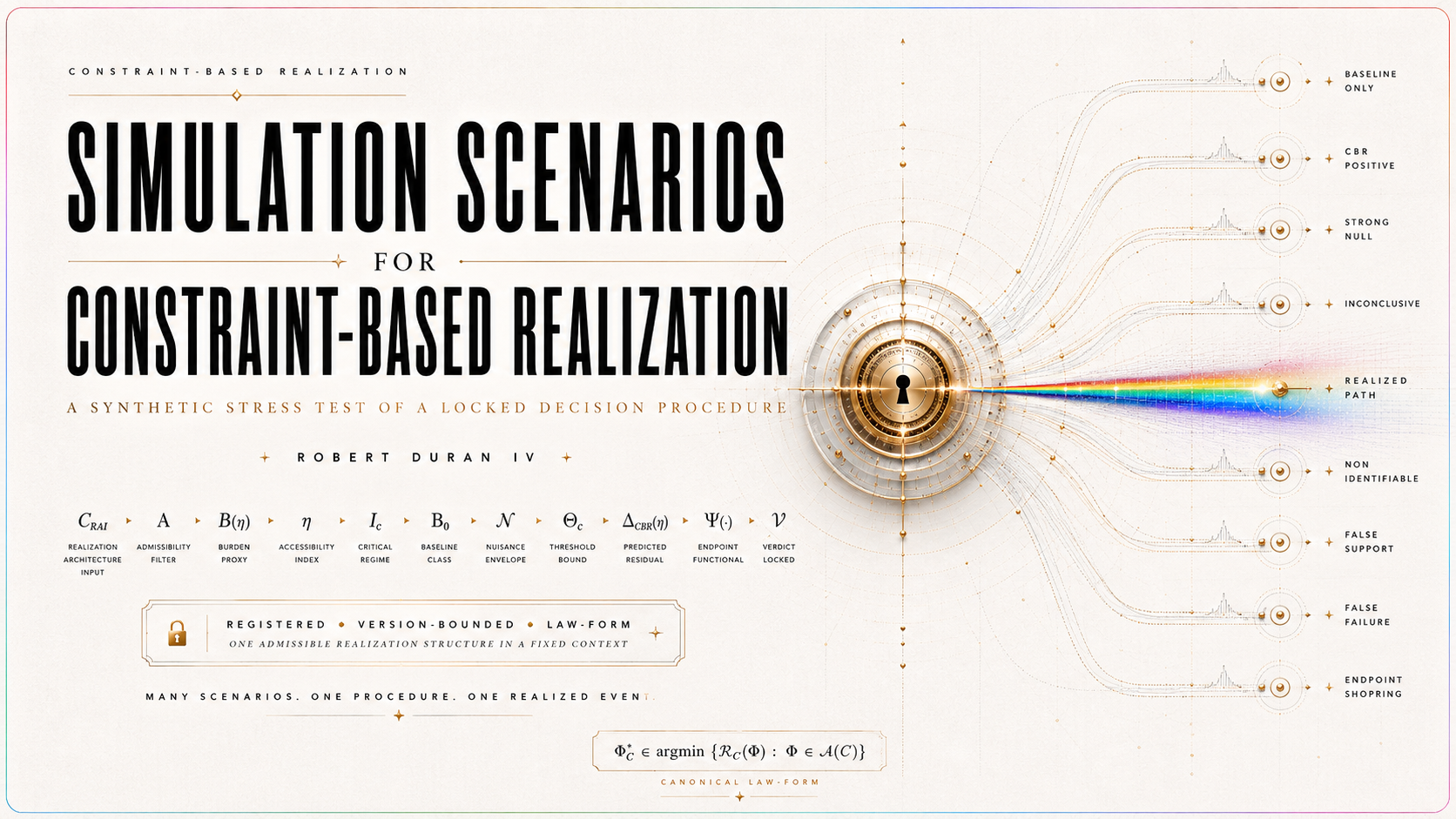
Simulation Scenarios for Constraint-Based Realization: A Synthetic Stress-Test of the Locked C_RAI v0.1 Decision Procedure
This paper develops a synthetic simulation stress-test for the locked C_RAI v0.1 platform dossier in Constraint-Based Realization. Rather than claiming empirical support or failure, it imports the registered record-accessibility interferometric decision procedure and evaluates its behavior across authorized scenarios S₀–S₁₀, including baseline-only controls, detectable synthetic residuals, below-threshold cases, strong-null logic, nuisance absorption, baseline degeneracy, η-miscalibration, sampling degeneracy, false-support risk, false-failure risk, and endpoint-shopping discipline. The paper establishes a complete simulation behavior map for the registered endpoint, threshold, degeneracy, statistical, validity-gate, scenario-certificate, output-register, and version-boundary rules, while translating observed vulnerabilities into requirements for future Tier-2 author-data reconstruction and Tier-3 locked empirical testing.
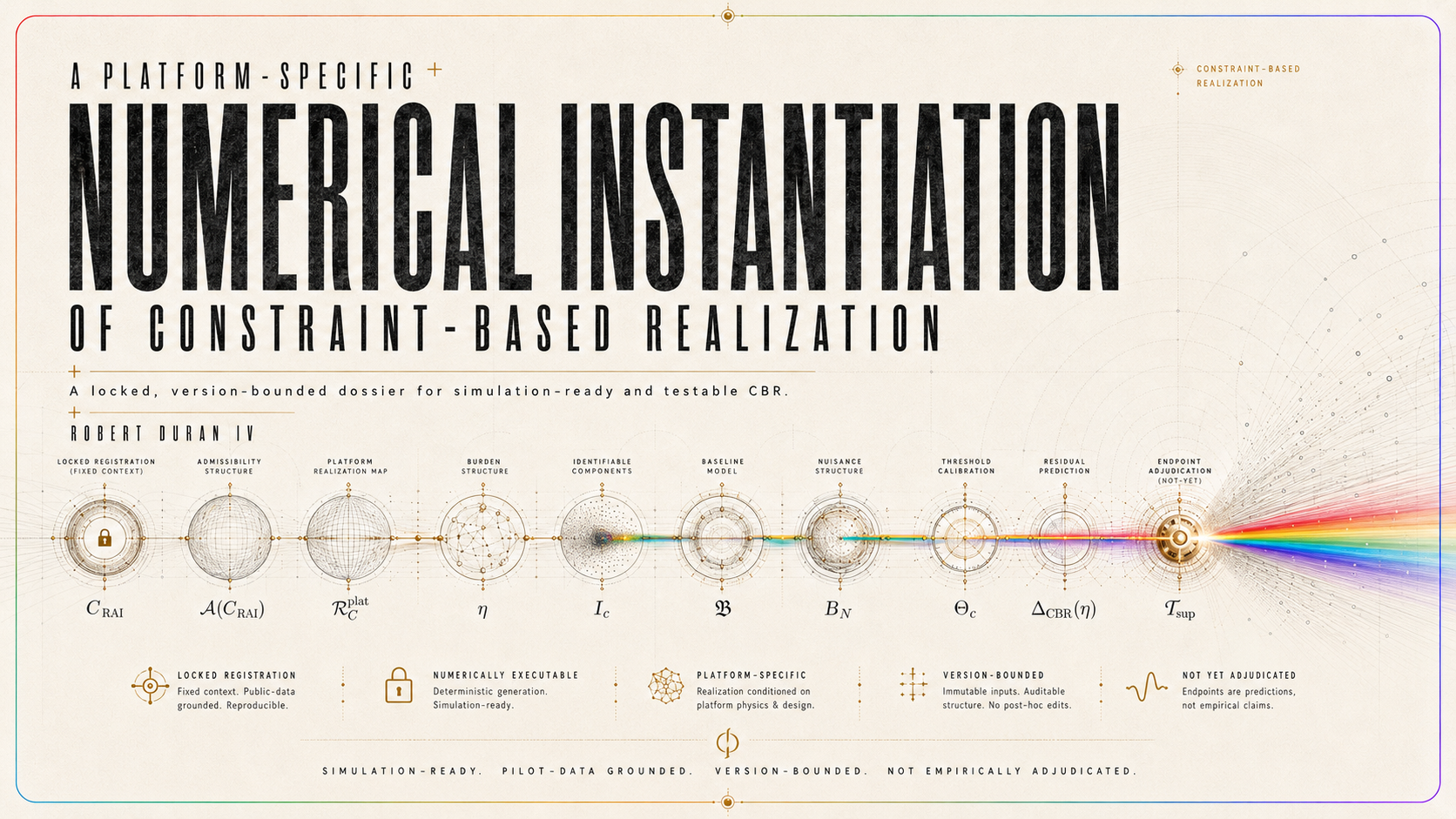
A Platform-Specific Numerical Instantiation of Constraint-Based Realization | A Simulation-Ready and Public-Data Pilot C_RAI Dossier for Record-Accessibility Interferometry
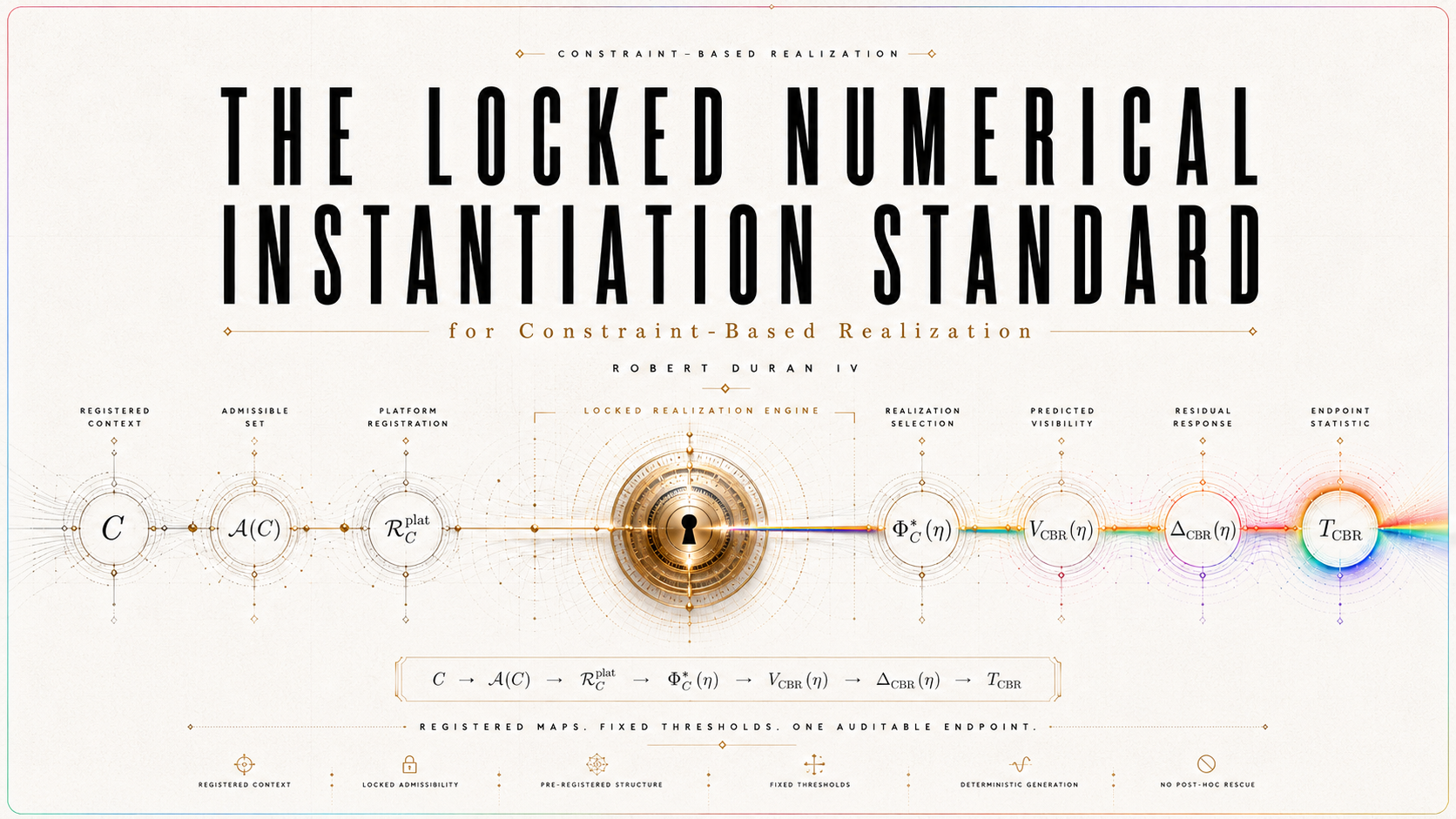
The Locked Numerical Instantiation Standard for Constraint-Based Realization | Completeness, Identifiability, Simulation Readiness, and Empirical Adjudication in a Platform-Specific CBR Dossier
This paper defines when a platform-specific Constraint-Based Realization (CBR) model is complete enough to be simulated, audited, and prepared for empirical testing. It introduces a locked dossier standard for fixing the law-form objects, accessibility bridge, baseline, nuisance envelope, endpoint statistic, degeneracy operator, statistical rule, provenance registry, and verdict procedure before endpoint interpretation. The result is a disciplined framework for distinguishing simulation readiness, adjudication readiness, registered support, strong-null failure, and inconclusive exposure without post hoc rescue.
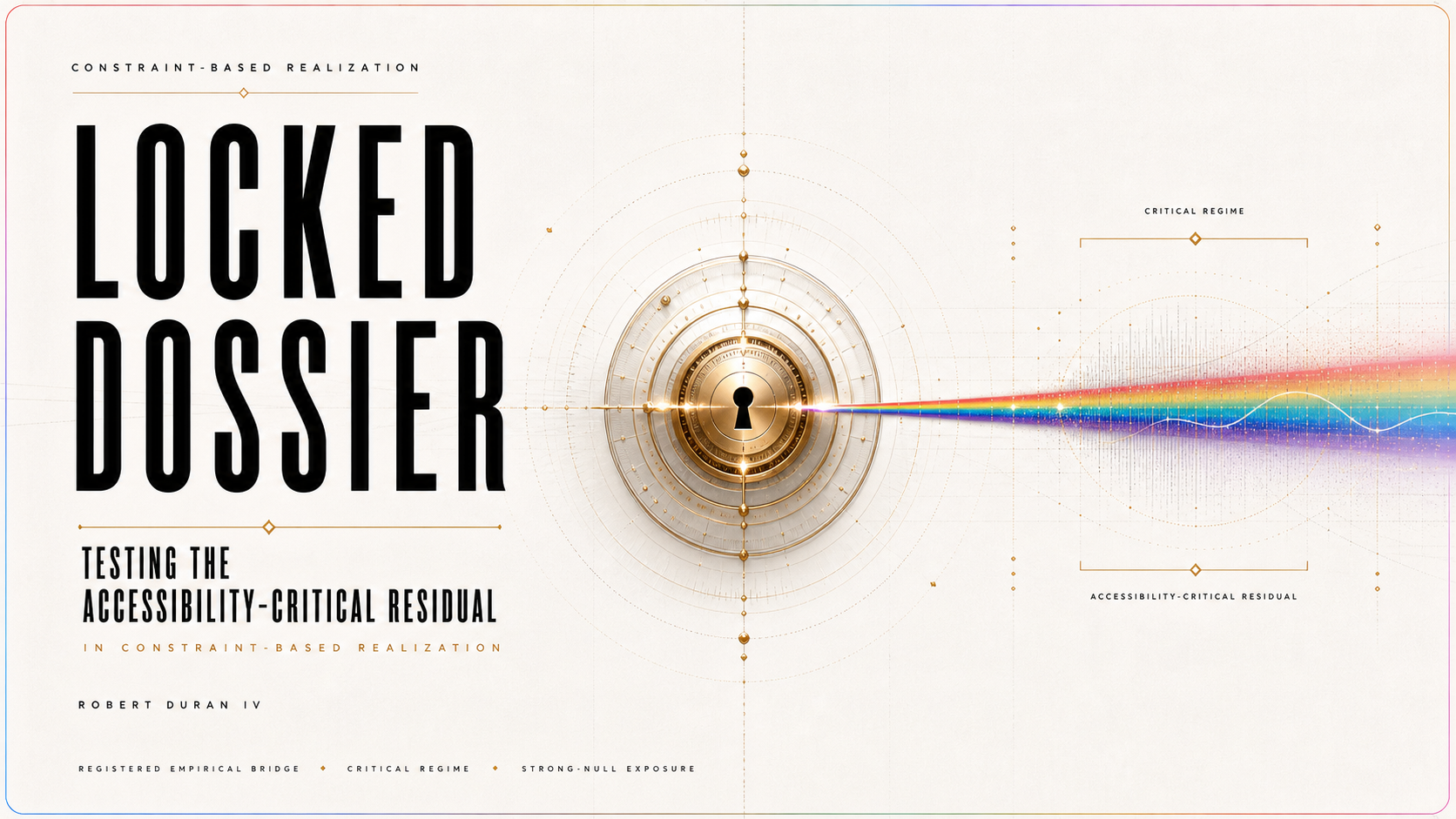
A Locked Dossier for Testing the Accessibility-Critical Residual | Pre-Registered Empirical Protocol for CBR in Record-Accessibility Interferometric Data
A formal testing framework for Constraint-Based Realization that defines a locked dossier, empirical bridge, critical accessibility regime, and accessibility-critical residual for disciplined support, failure, or inconclusive exposure.
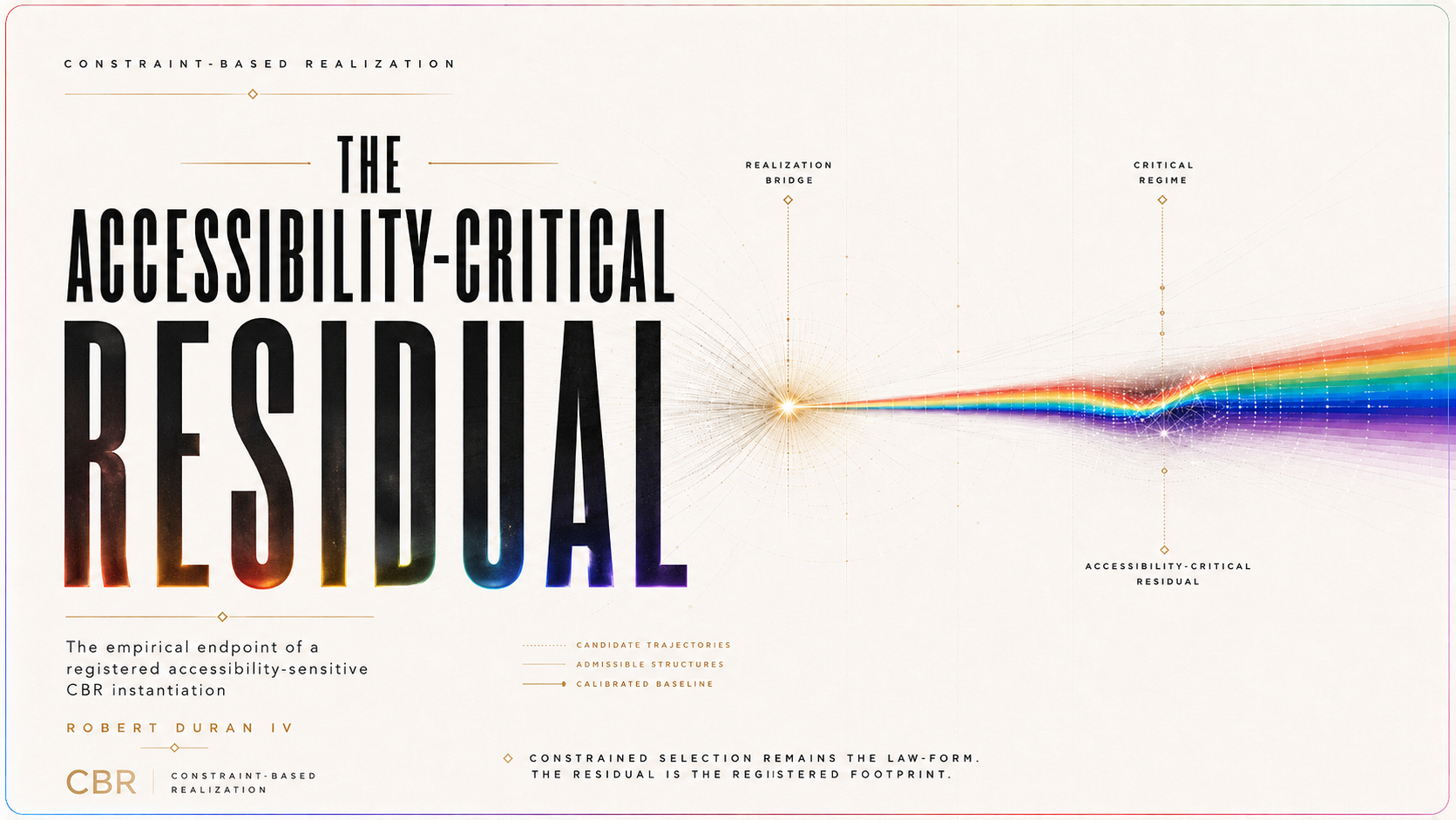
The Accessibility-Critical Residual: An Empirical Endpoint Theorem for Constraint-Based Realization
This paper defines the accessibility-critical residual as the empirical endpoint of Constraint-Based Realization, or CBR. It explains how a registered realization-law instantiation can be tested without directly observing realization by comparing observed visibility against a standard quantum / decoherence / nuisance baseline under fixed decision rules.
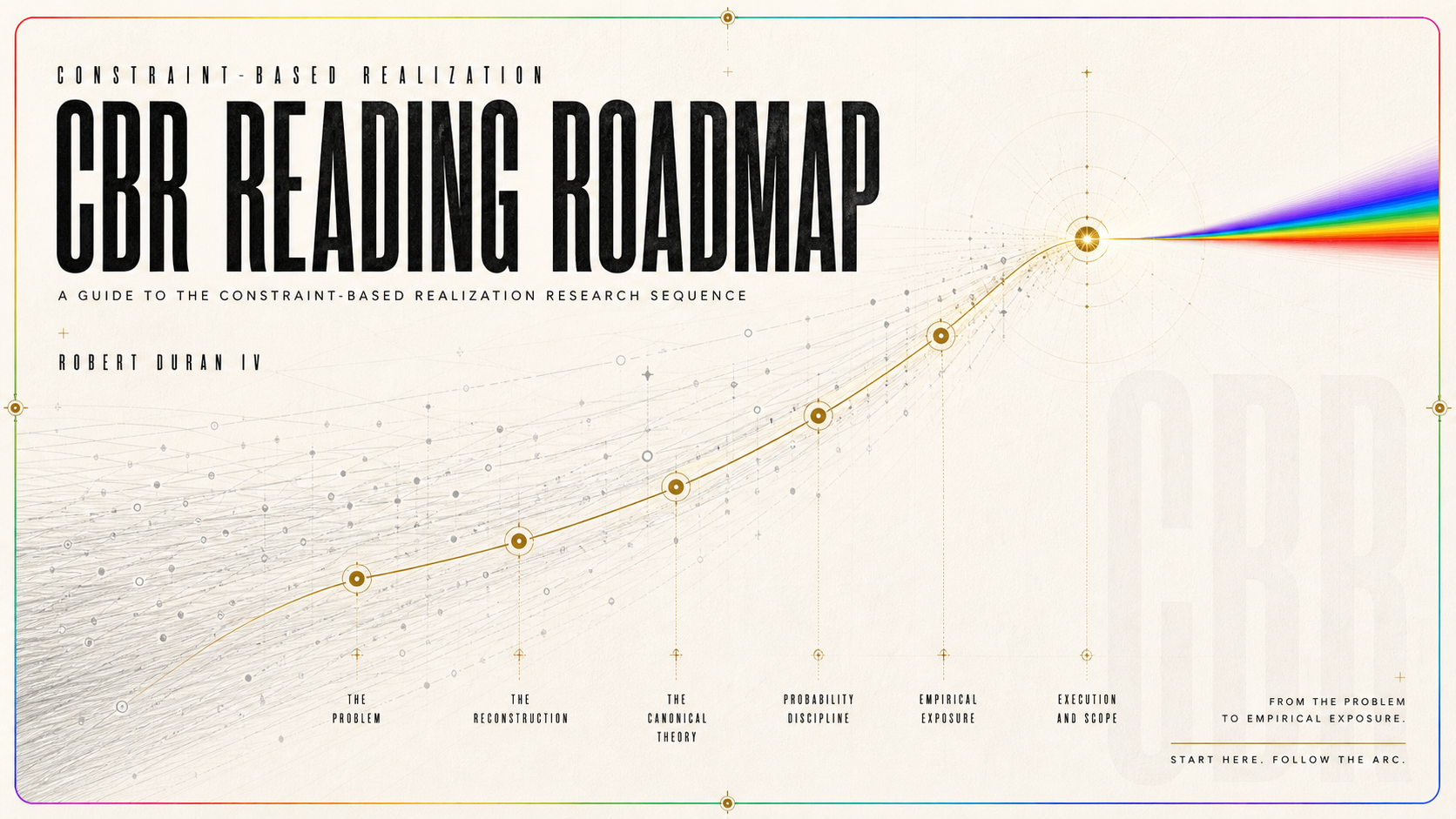
Constraint-Based Realization Reading Roadmap | A Guide to the CBR Research Sequence and Companion Notes
A guided roadmap by Robert Duran IV for reading the Constraint-Based Realization research sequence, including the CBR abstract, referee note, claims and non-claims sheet, reviewer checklist, empirical failure brief, and full 15-paper program.
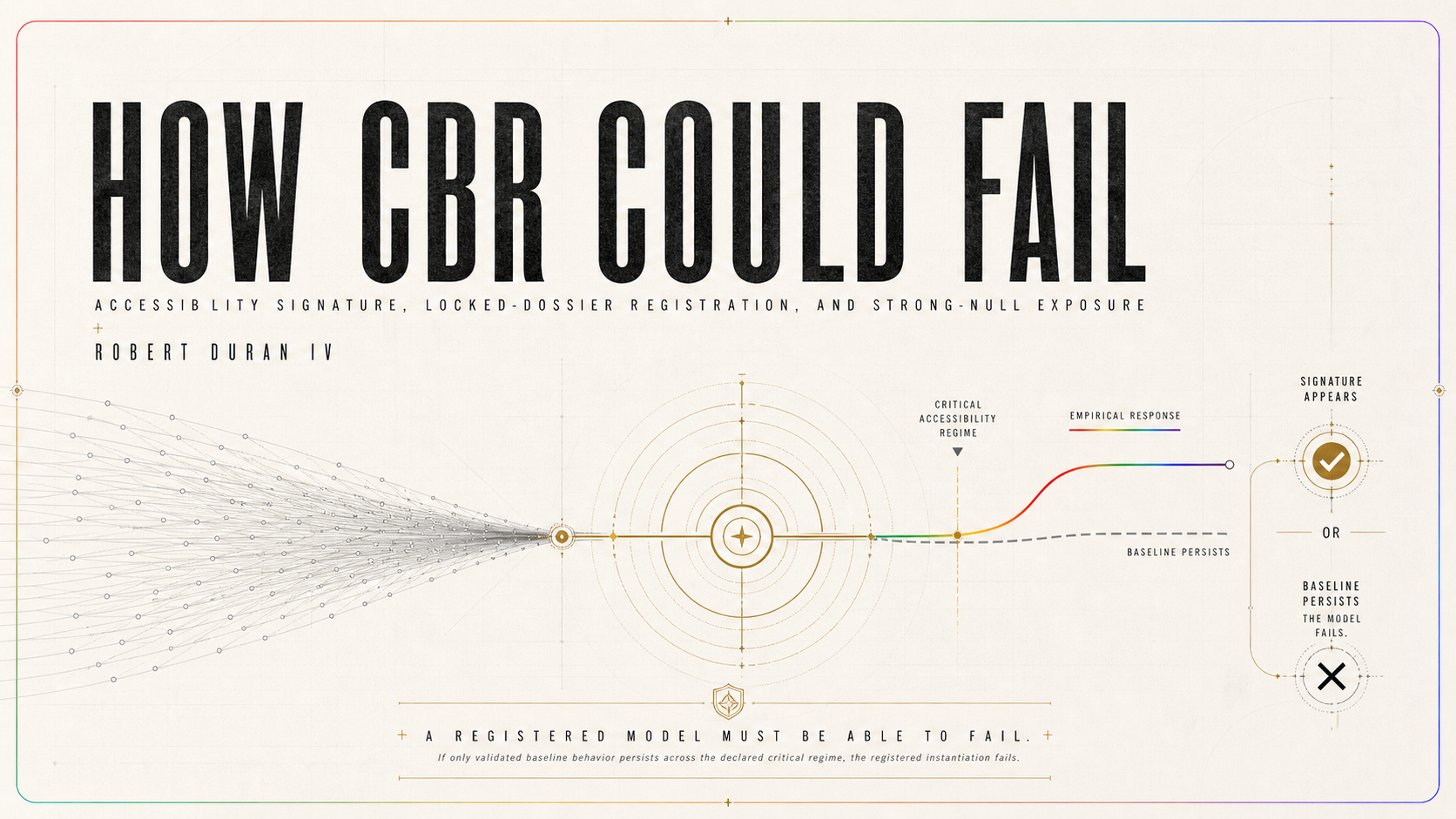
How CBR Could Fail | Accessibility Signature, Locked-Dossier Registration, and Strong-Null Exposure
A concise empirical-liability brief by Robert Duran IV explaining how Constraint-Based Realization can be tested and fail through accessibility-sensitive protocols, locked-dossier registration, baseline comparison, nuisance separation, and strong-null exposure.
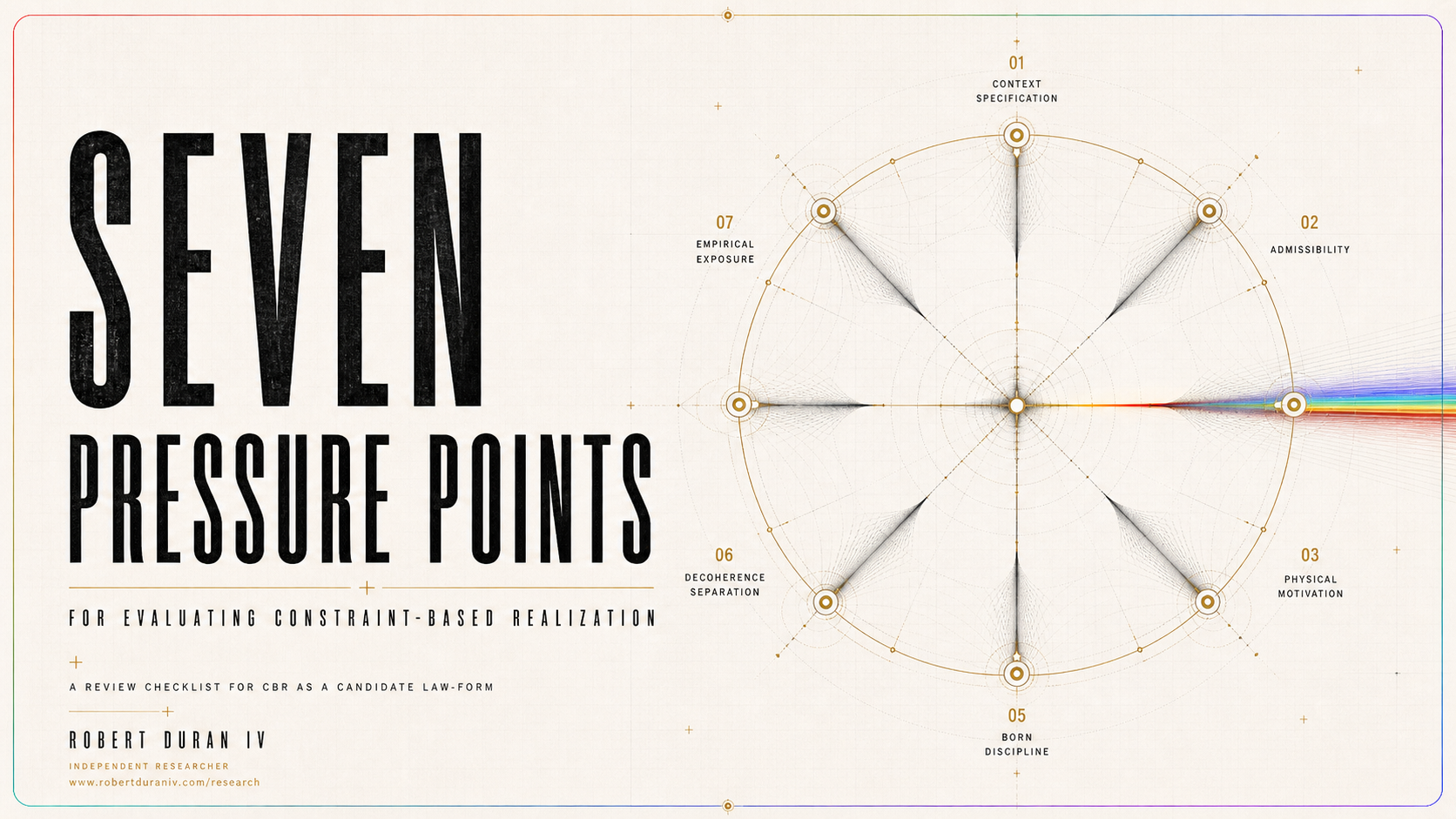
Seven Pressure Points for Evaluating Constraint-Based Realization | A Review Checklist for CBR as a Candidate Law-Form
A reviewer checklist by Robert Duran IV defining seven critical tests for Constraint-Based Realization as a candidate law-form for quantum outcome realization, including context specification, admissibility, Born-rule discipline, decoherence separation, and empirical failure.
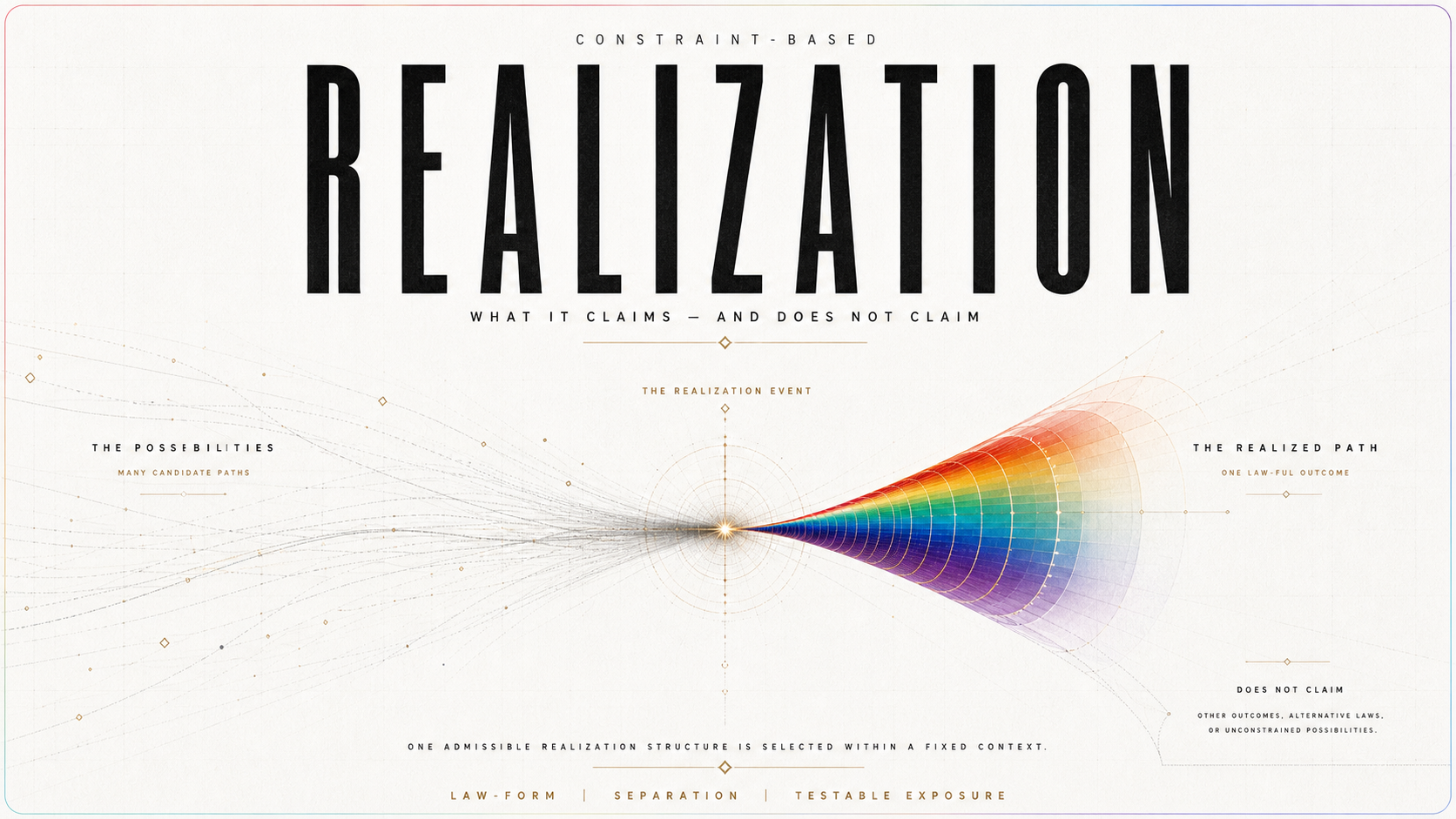
What Constraint-Based Realization Claims — and Does Not Claim | A Scope-Control Note for Evaluating CBR
A scope-control note by Robert Duran IV clarifying Constraint-Based Realization’s claims, non-claims, evaluation standards, and role as a candidate law-form for quantum outcome realization.
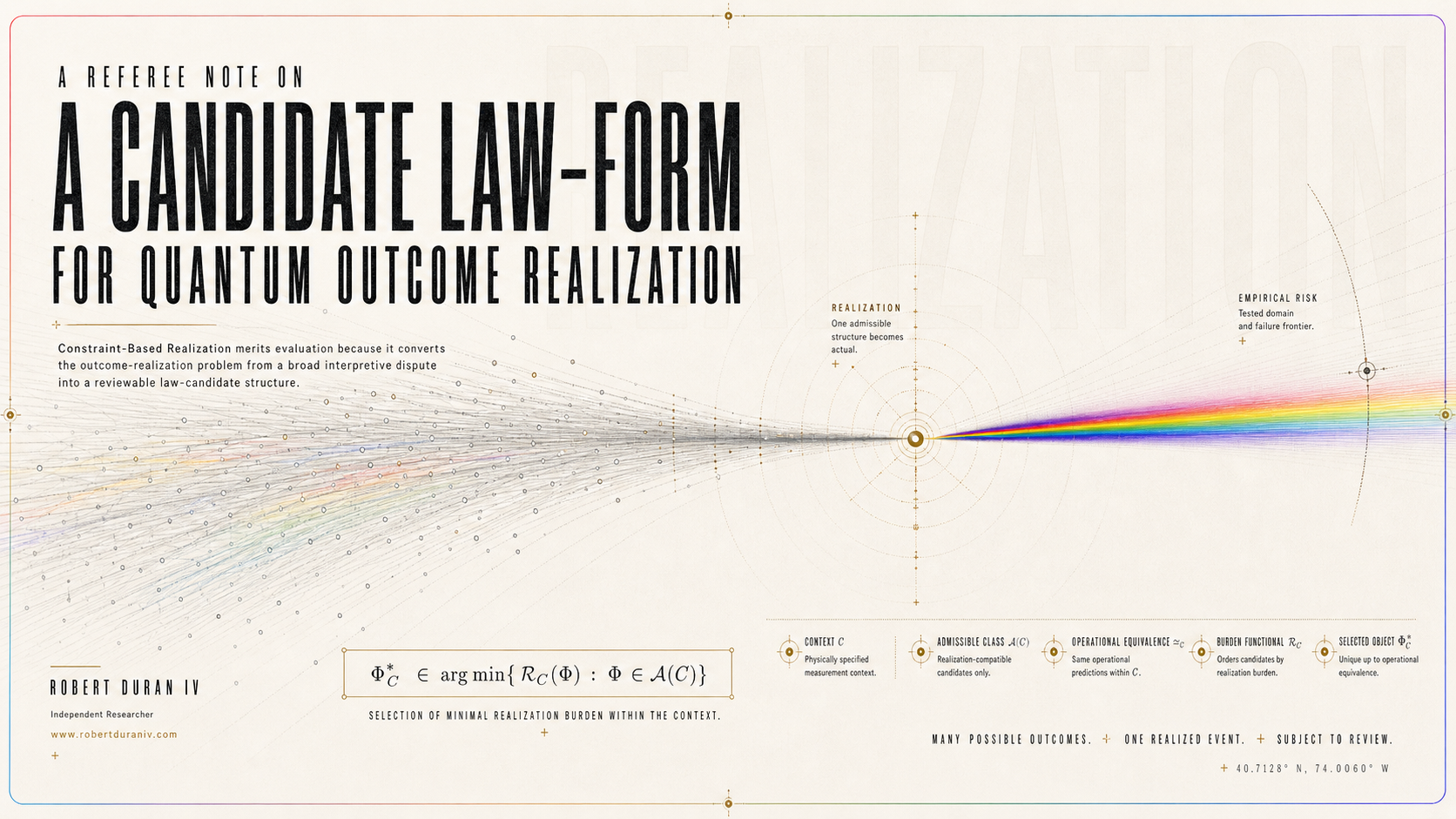
A Referee Note on a Candidate Law-Form for Quantum Outcome Realization
A concise referee note by Robert Duran IV presenting Constraint-Based Realization (CBR) as a candidate law-form for quantum outcome realization. The note explains CBR’s central distinction between probability, decoherence, and realization; its canonical structure using admissible candidates, realization-burden functional, and operational equivalence; and its merits as a non-circular, Born-compatible, failure-capable framework for evaluating quantum outcome actualization.
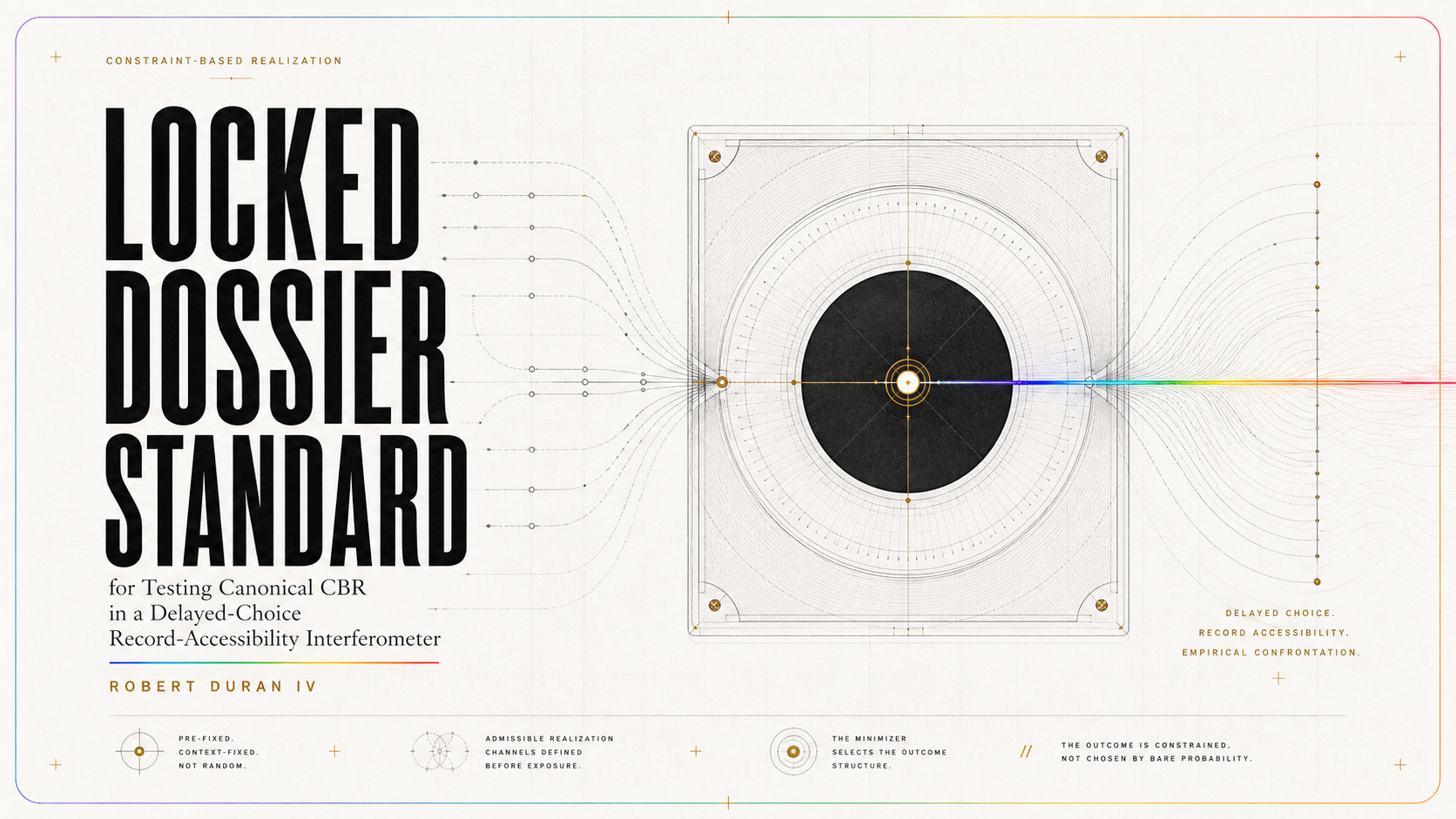
Locked-Dossier Standard for Testing Canonical CBR in a Delayed-Choice Record-Accessibility Interferometer
A formal registration standard for testing Constraint-Based Realization (CBR) in a delayed-choice record-accessibility interferometer. This paper defines the locked C_DCE dossier required to make a CBR accessibility test reproducible, non-circular, verdict-competent, and exposed to strong-null failure. It specifies how the platform context, admissible class 𝒜(C_DCE), burden functional ℛ_C, accessibility parameter η, critical region I_c, standard baseline ℬ, nuisance envelope B_𝓝, detectability threshold ε_detect, statistical plan, and no-rescue verdict rule must be fixed before comparison with observed visibility data.
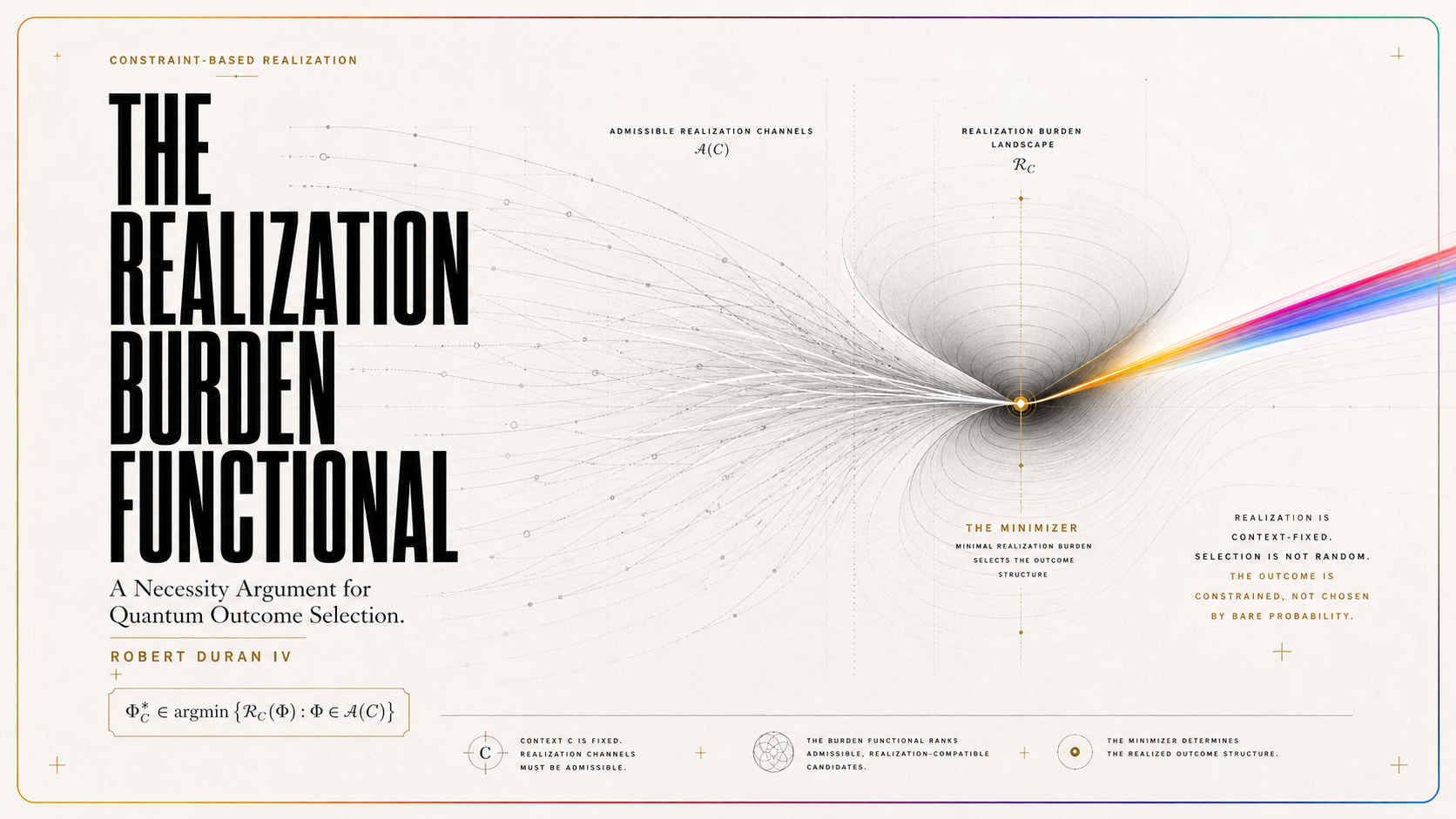
The Realization-Burden Functional in Constraint-Based Realization: A Necessity Argument for Quantum Outcome Selection
This paper develops the physical and formal necessity of the realization-burden functional ℛ_C in Constraint-Based Realization. It argues that ℛ_C is not a hand-picked scoring rule, a rival probability measure, decoherence renamed, or a post hoc device, but the functional representation of the context-fixed ordering required by any non-circular law of quantum outcome realization. Within a fixed measurement context C, CBR ranks operationally distinct admissible candidate classes in 𝒜(C)/≃_C and selects the realized class by minimizing the burden functional. The paper clarifies the admissibility conditions, scope limits, and failure criteria that make ℛ_C physically accountable rather than arbitrary.
Abstract | Probability Is Not Selection | Constraint-Based Realization as a Candidate Law-Form for Quantum Outcome Actualization
Explore Constraint-Based Realization (CBR), Robert Duran IV’s quantum-foundations research program proposing a candidate law-form for quantum outcome actualization. CBR distinguishes probability, decoherence, record formation, and realization to ask how one possible quantum outcome becomes the actual event.
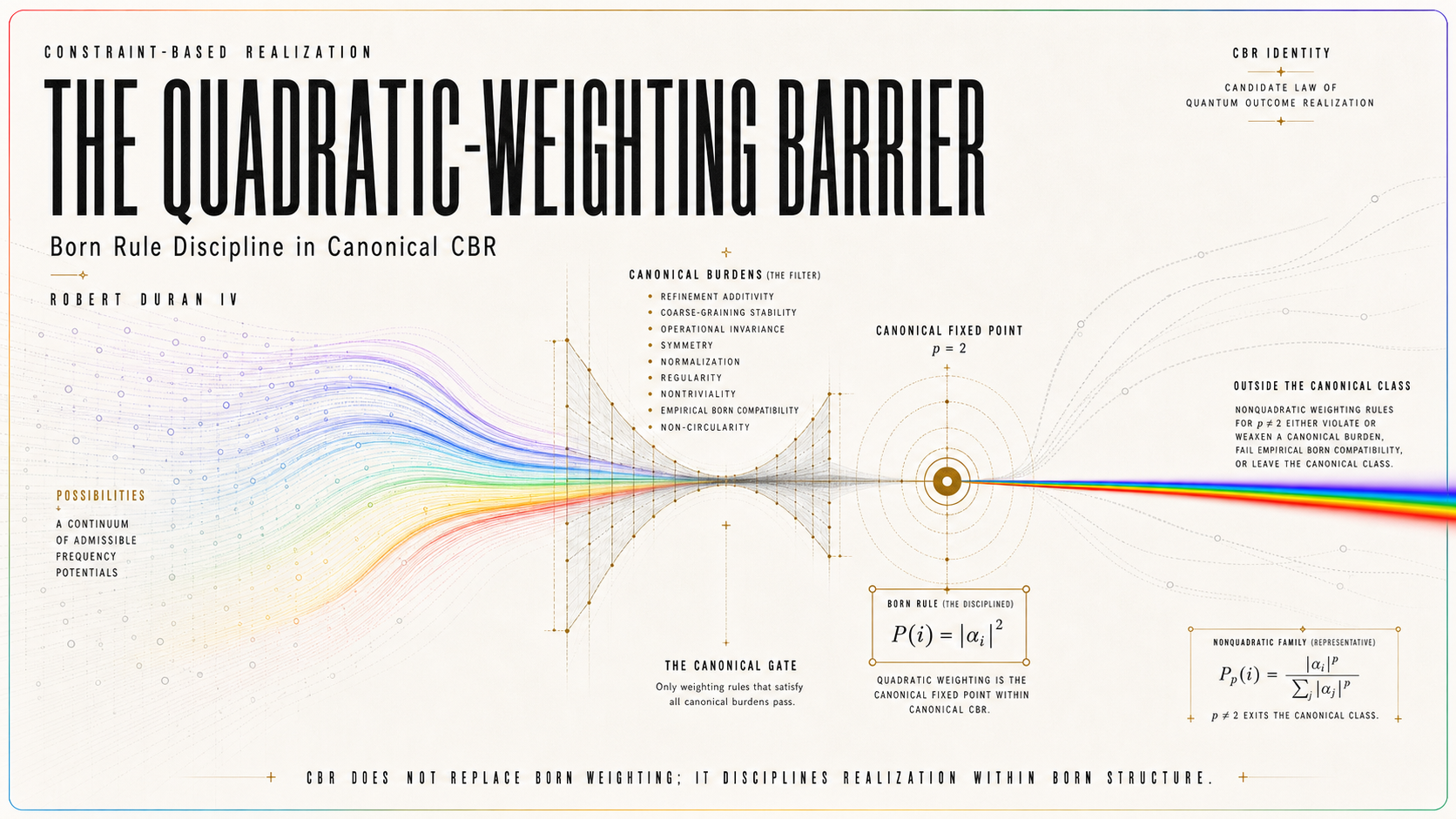
The Quadratic-Weighting Barrier and Constraint-Based Realization (CBR) : Born Rule Discipline in Canonical CBR
Robert Duran IV examines the quadratic weighting barrier in canonical Constraint-Based Realization, arguing that any serious realization-weighting law must preserve Born-rule discipline through operational invariance, phase insensitivity, refinement stability, and non-circular admissibility
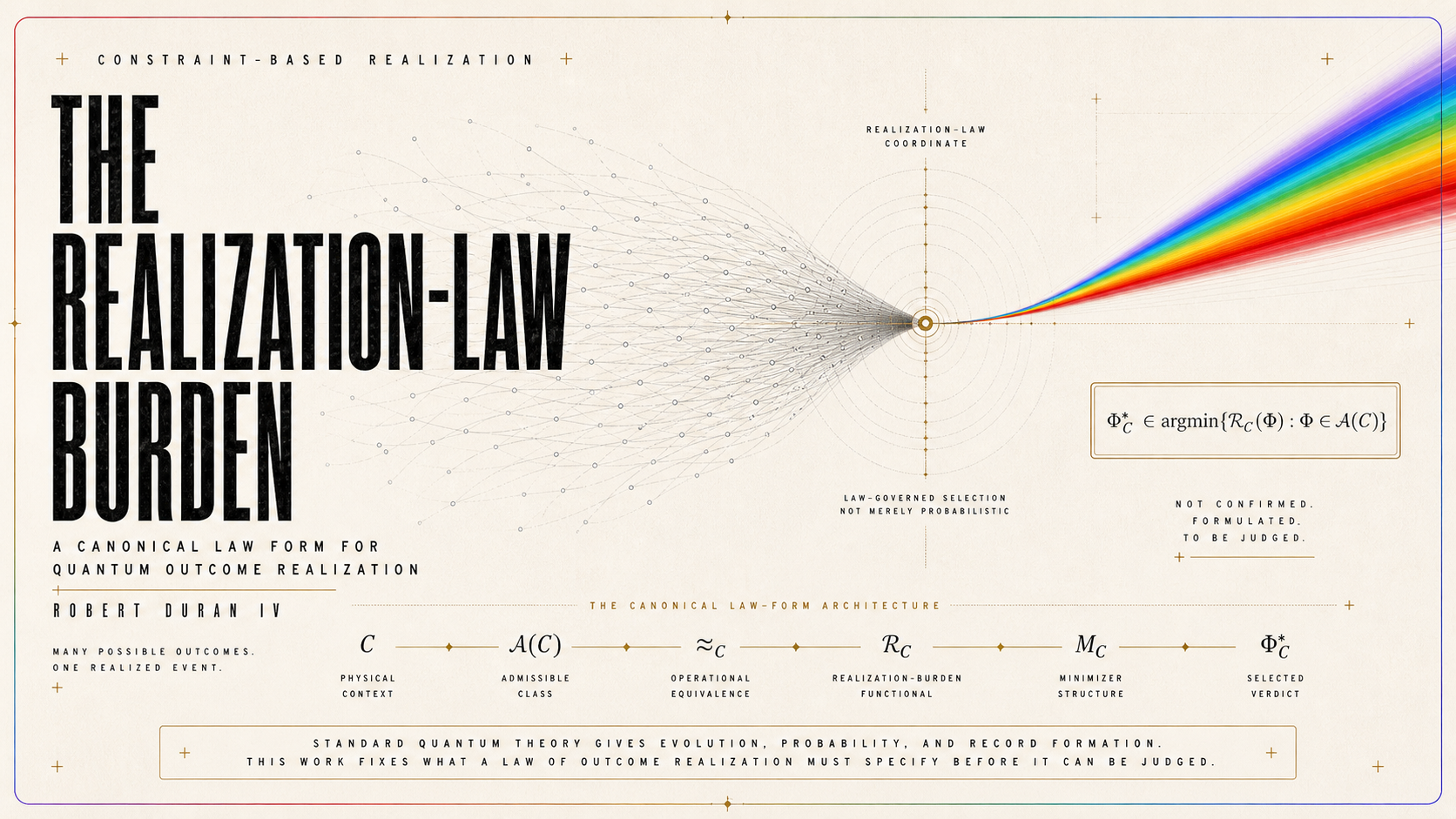
The Realization-Law Burden: A Canonical Law Form for Quantum Outcome Realization
Constraint-Based Realization is Robert Duran IV’s proposed law-form for quantum outcome realization, addressing the selection problem by separating probability, decoherence, record formation, and actualization while developing a formal, Born-compatible, and empirically testable framework.
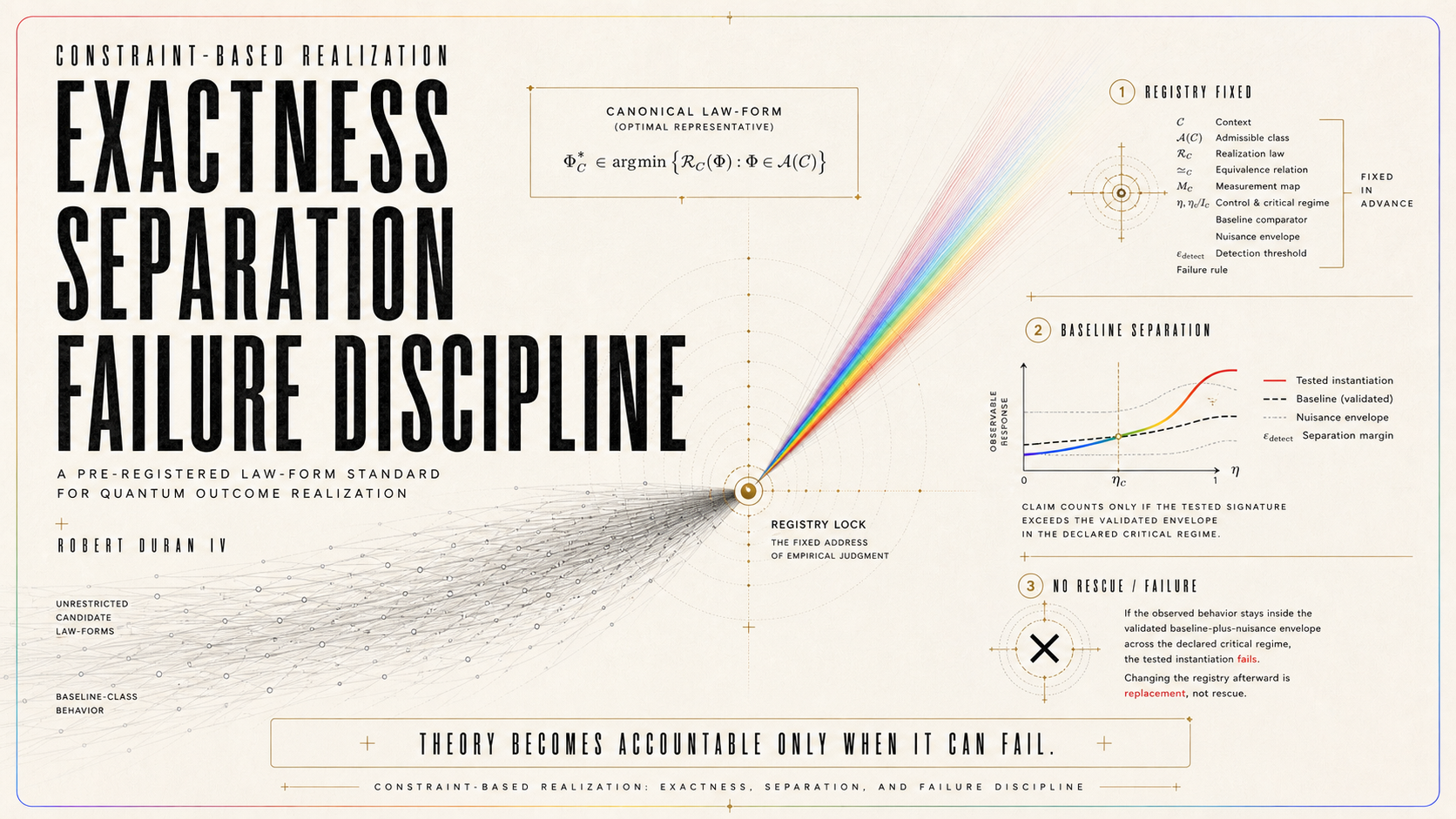
Exactness, Separation, and Failure Discipline In Constraint-Based Realization (CBR)
A formal CBR paper defining the Exactness and Separation Standard for quantum outcome realization: registry identity, baseline separation, scoped Born-rule discipline, strong-null failure, and no-rescue conditions for testable Constraint-Based Realization.
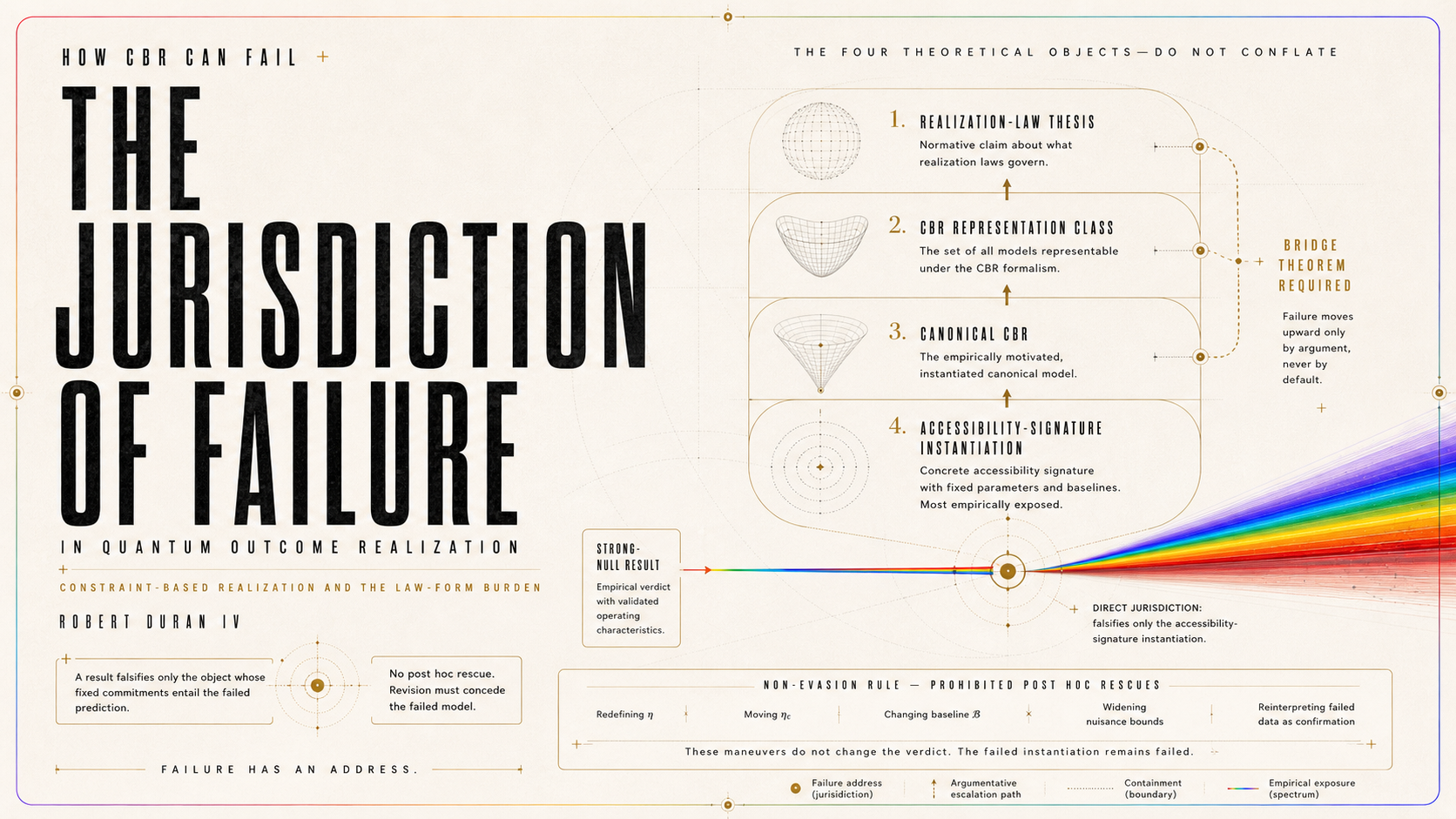
The Jurisdiction of Failure in Quantum Outcome Realization: Constraint-Based Realization and the Law-Form Burden
A rigorous paper by Robert Duran IV explaining how Constraint-Based Realization can be tested, falsified, revised, and judged without overstating either failure or success.
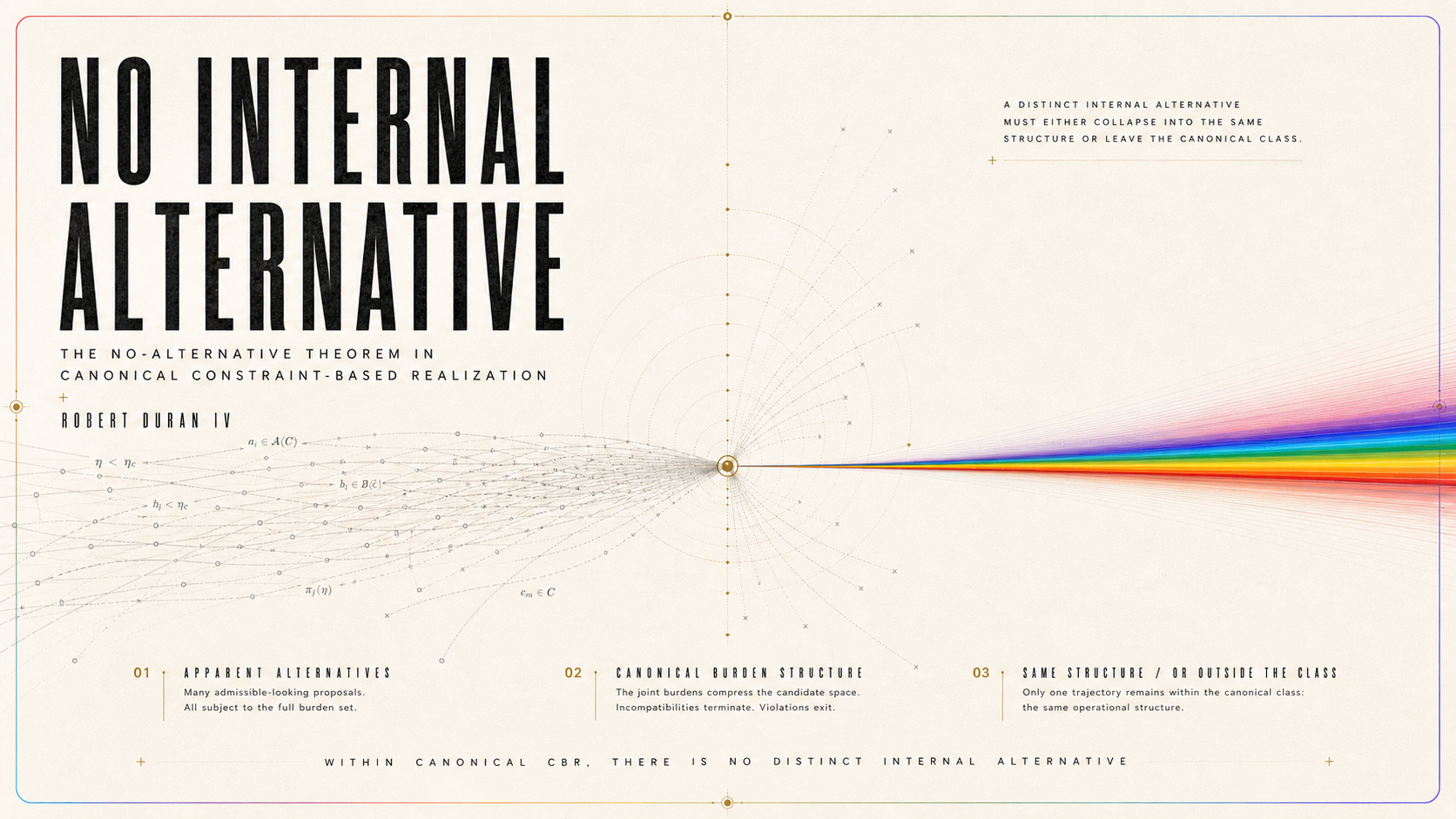
A No-Internal-Alternative Theorem for Outcome Realization | Constraint-Based Realization (CBR)
A new paper by Robert Duran IV arguing for the conditional uniqueness of the canonical Constraint-Based Realization law-form within a burden-bearing class of outcome-realization theories.
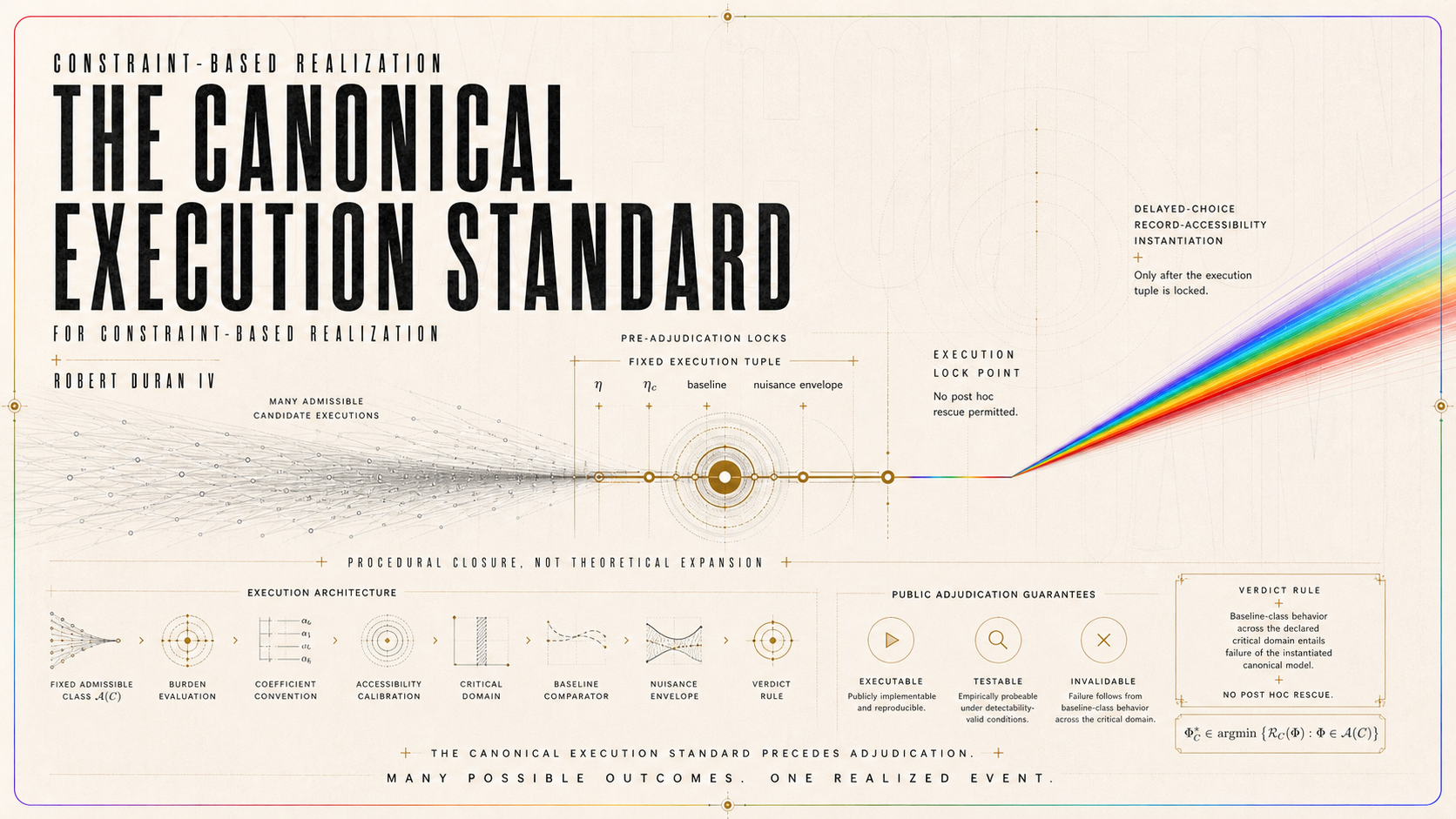
The Canonical Execution Standard for Constraint-Based Realization
This paper establishes the execution discipline for Constraint-Based Realization: a candidate quantum outcome law must not remain interpretive or verbal, but must specify its context, admissible class, realization burden, selection rule, equivalence conditions, probability structure, and testable failure commitments.
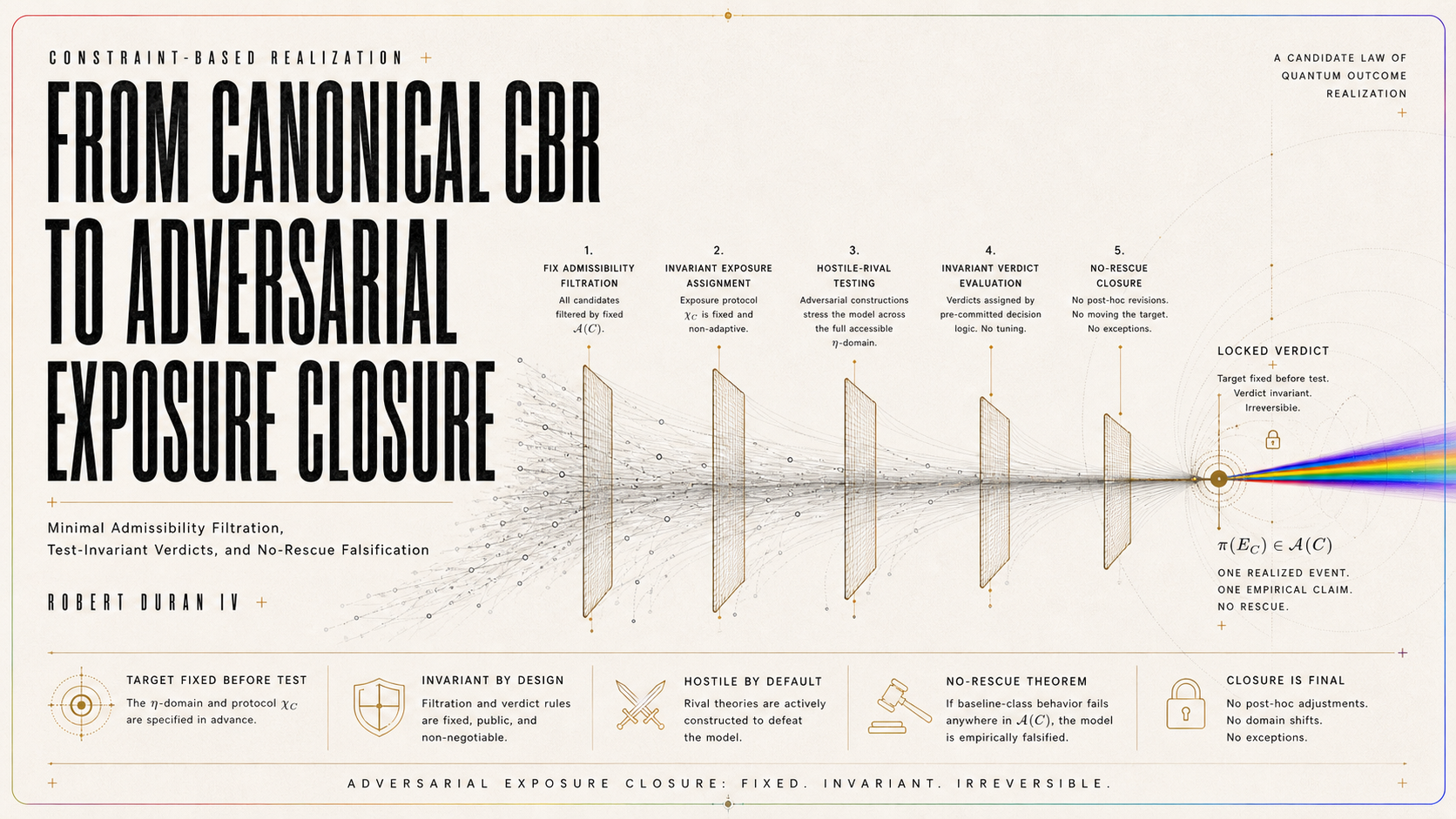
From Canonical Constraint-Based Realization (CBR) to Adversarial Exposure Closure
This paper strengthens Constraint-Based Realization by connecting its canonical law form to adversarial empirical exposure: the discipline of specifying what CBR predicts, what standard quantum/decoherence baselines predict, what nuisance effects must be separated, and what result would count as a real failure.