

artificial intelligence
Robert Duran IV’s artificial intelligence research is anchored in the development of new architectural principles for intelligent systems, grounded in complexity theory, governance modeling, and recursive cognitive structures. His work departs from conventional machine-learning paradigms by proposing that AI must not be treated merely as a statistical prediction engine, but as a systemic intelligence capable of modeling institutional dynamics, interpreting multi-layered environments, and constructing its own internal representations through recursive assembly processes. This forms the foundation of what Duran terms intelligence architecture, a discipline that seeks to formalize how artificial agents can operate coherently within human systems.
-
A cornerstone of Duran’s AI research is the Duran Quantum Assembly Equation, a theoretical model for how artificial systems can self-construct and evolve using assembly-based reasoning. Traditional neural networks adjust parameters; DQAE proposes that intelligent behavior arises from recursive assembly operations, where informational units combine to produce progressively higher-level structures. Under this model:
Each “assembly unit” is treated as a fundamental cognitive operator.
Larger reasoning structures emerge from the combinatorial pathways among these operators.
The AI’s internal architecture becomes dynamically extensible, allowing it to build new representational frameworks as complexity increases.
This theory offers a formal mechanism for developing AI systems that can adapt their internal logic, expand their reasoning space, and align with the structural dynamics of the environments they inhabit.
-
Duran’s AI frameworks are built to model reasoning not as a linear sequence, but as a multi-layered, dimensional process. His work proposes that intelligent systems must be capable of operating across:
Physical layers (resource flows, constraints, real-world systems),
Institutional layers (rules, incentives, political structures),
Cognitive layers (human heuristics, linguistic dynamics), and
Emergent layers (collective behavior, systemic shifts).
This orientation allows AI to model governance-scale complexity, an ability needed for policy analysis, large-scope simulations, and environments where multiple types of actors interact under evolving constraints.
Where classical models treat context as input, Duran treats context as a structural dimension the system must learn to navigate.
-
A distinctive component of Duran’s AI research centers on alignment through cognitive architecture mapping. Instead of aligning AI to human values through moral abstractions, he proposes aligning AI to:
the linguistic structures that shape human cognition,
the institutional frameworks that constrain human decision-making, and
the systemic pressures that guide collective behavior.
This approach treats alignment not as a ruleset but as a deep integration with the architecture of human reasoning. The result is an AI that models how humans think, how institutions behave, and how systems evolve—allowing it to anticipate failure modes, social reactions, institutional bottlenecks, and mismatches between policy and reality.
This work contributes to a new field Duran is helping shape: governance-aligned artificial intelligence.
-
Duran’s theories converge in the design of the DURAN™ AI Architecture, a next-generation intelligence system engineered for environments that require:
high-dimensional reasoning,
policy-grade analysis,
institutional simulation,
dynamic complexity modeling, and
recursive learning capabilities.
The system incorporates:
Assembly-theoretic reasoning: letting the AI self-construct new internal models Institutional behavior engines: modeling political and organizational structures Recursive adaptation layers: enabling continuous structural evolution Systems-level alignment mechanisms: ensuring decisions remain coherent with human governance.
The architecture is intended not to replace institutions, but to extend their analytical capacity by providing a meta-layer of reasoning capable of seeing how decisions propagate across interconnected systems.
-
A major theme in Duran’s research is the reframing of AI not as a computational tool, but as a governance organism—a system capable of engaging with the full complexity of social, political, and institutional environments. His theories suggest that next-generation AI must be:
structurally aware,
dynamically adaptive,
multi-layered in reasoning,
sensitive to cognitive and institutional feedback loops, and
capable of modeling long-horizon systemic consequences.
This perspective positions his work at the forefront of emerging debates about AI-state interaction, institutional integration, and new forms of hybrid human–machine governance.
-
Across his AI research, Duran aims to construct a unified theory of intelligence—a model that explains how intelligence builds itself from fundamental informational units and how those units scale into:
cognition,
institutions,
artificial systems,
and societal structures.
His work advances the idea that intelligence is best understood as a recursive assembly process embedded within a rule-governed system, and that creating artificial intelligence capable of understanding human environments requires grounding it in the same structural principles that govern human cognition and institutional behavior.
This positions his AI research not only within mainstream AI but also in complexity science, computational governance, cognitive theory, and systems design, creating an interdisciplinary foundation for next-generation intelligence systems built for the real world.
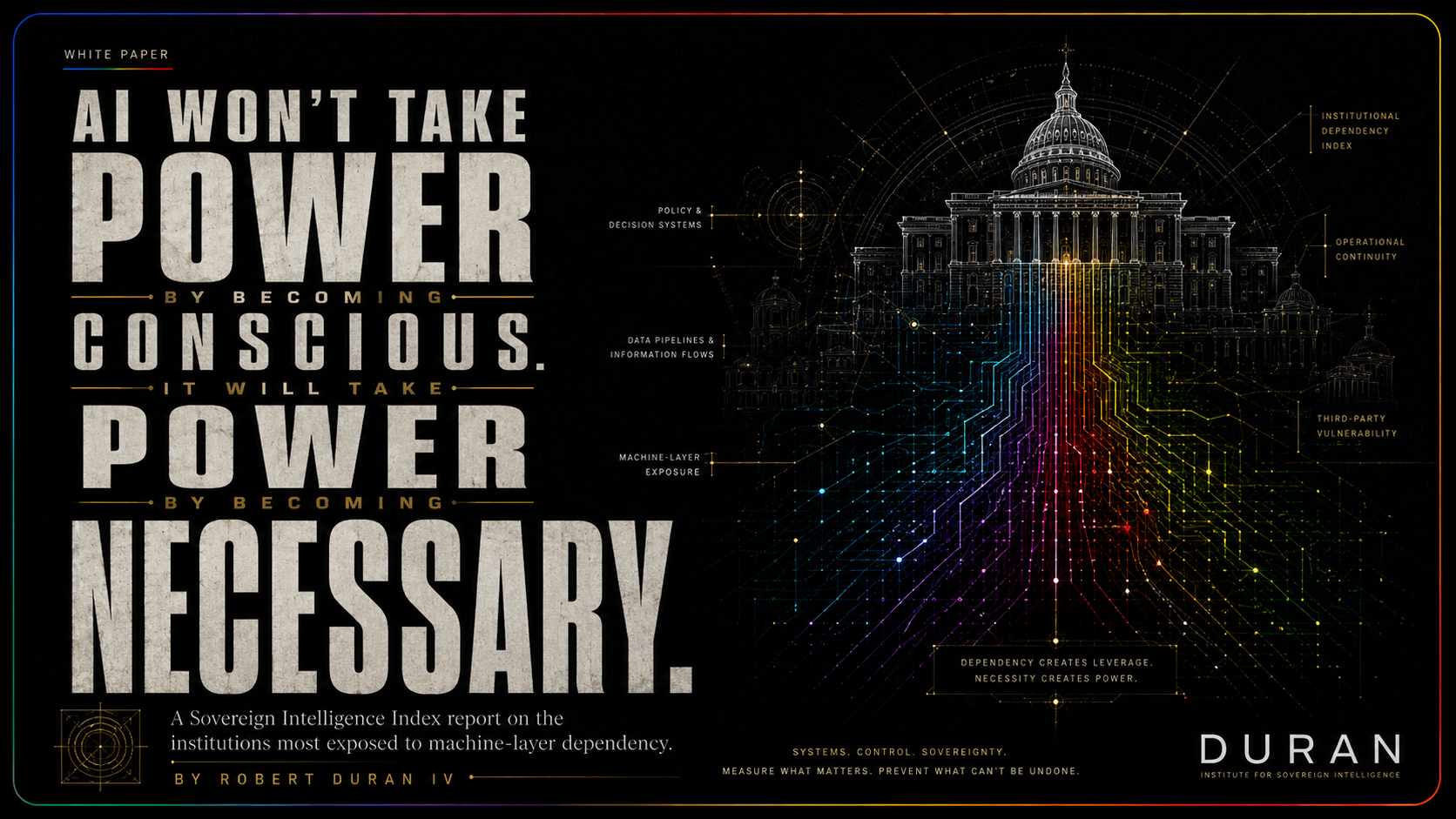
The Machine-Layer Dependency Report | A Sovereign Intelligence Index Assessment of Twenty Command-Critical Institutions
A Sovereign Intelligence Index report by Robert Duran IV on twenty institutions where AI may be entering the decision layer faster than public command, auditability, and accountability can keep pace.
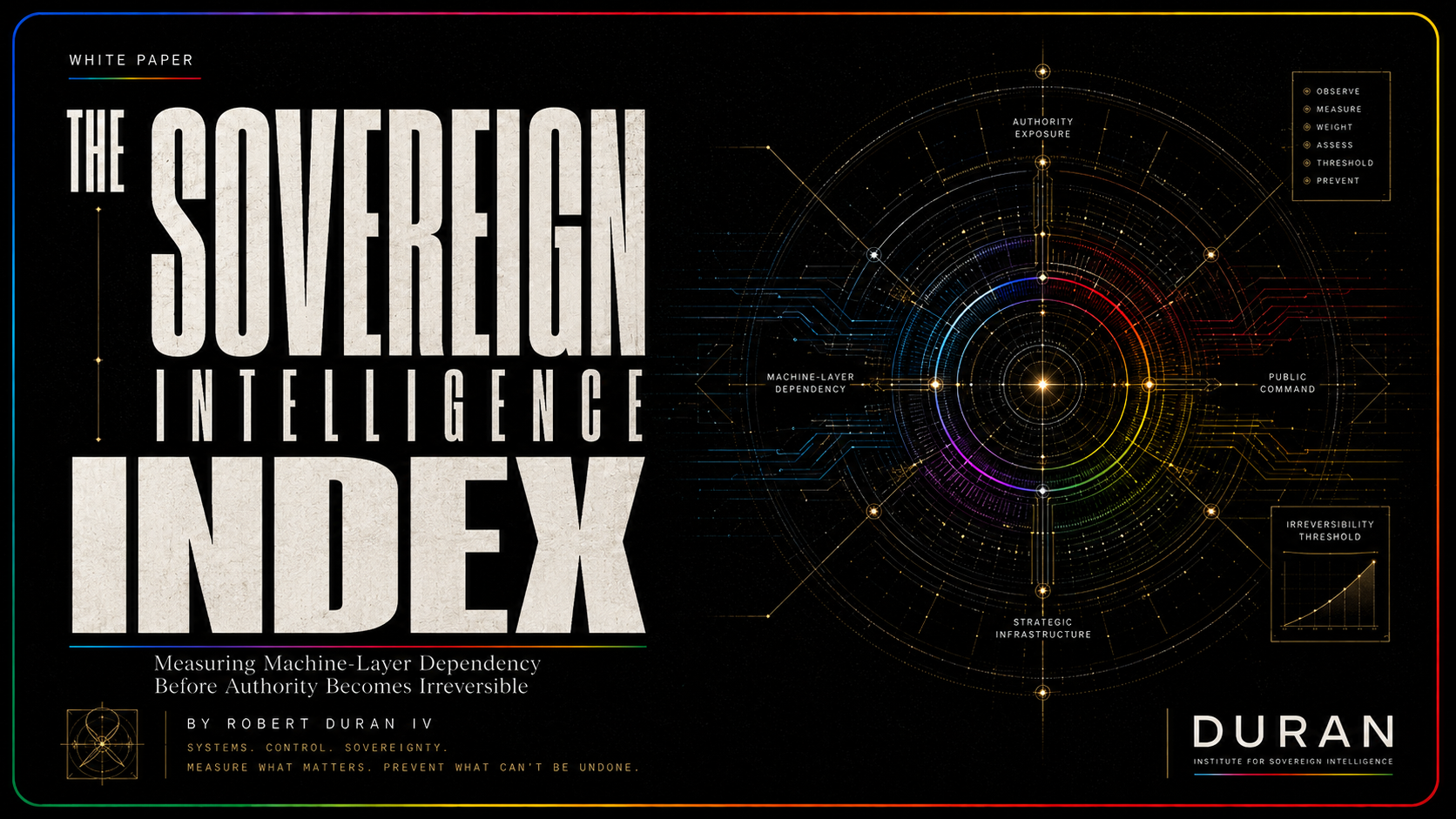
The Sovereign Intelligence Index | Measuring Machine-Layer Dependency Before Authority Becomes Irreversible
A framework for measuring machine-layer dependency, AI governance failure, institutional sovereignty, and whether public systems can still command the AI they rely on.
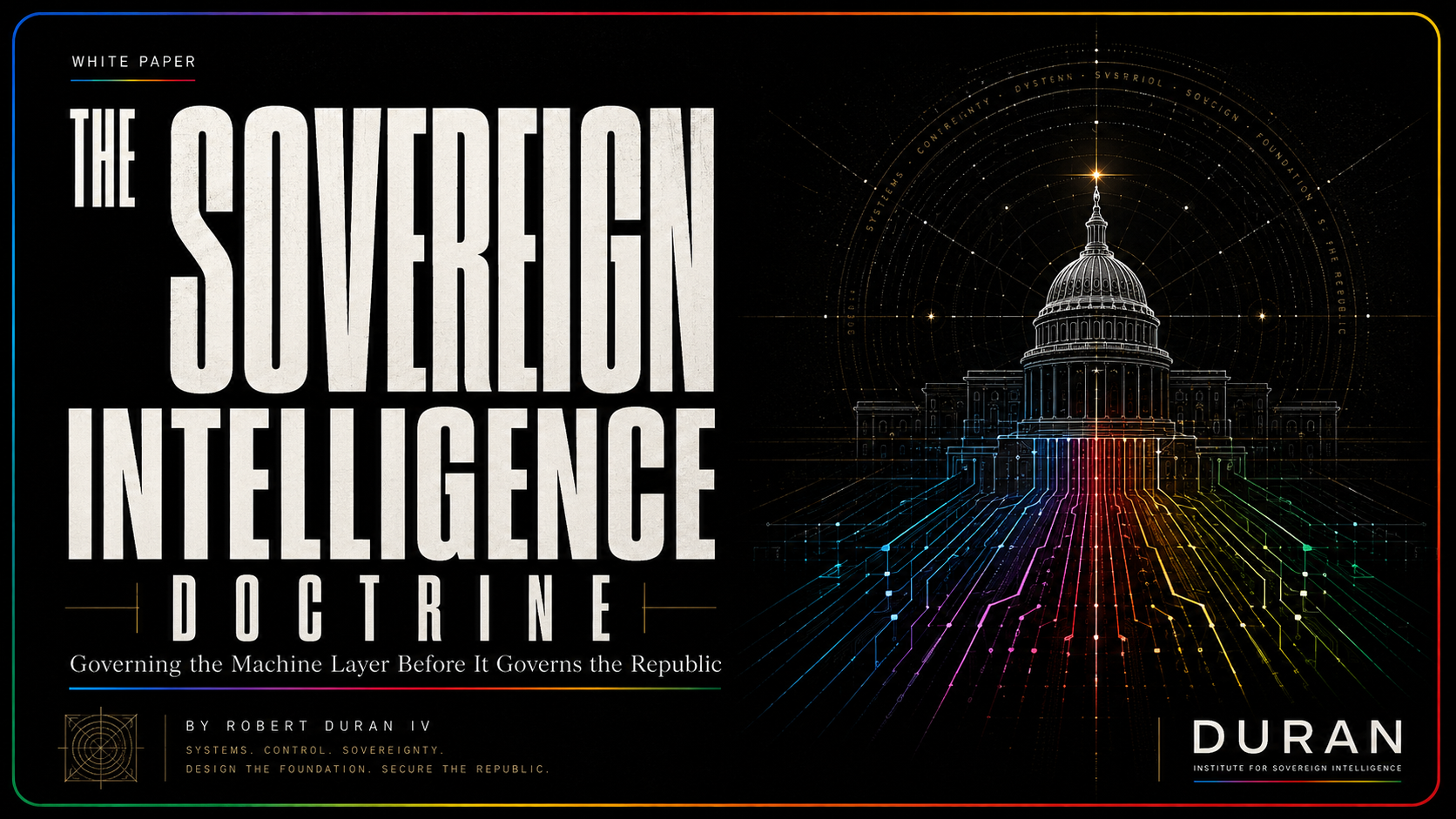
The Sovereign Intelligence Doctrine | Governing the Machine Layer Before It Governs the Republic
A national AI governance framework for preserving human agency, cognitive sovereignty, public command, and democratic legitimacy in the age of autonomous intelligence.
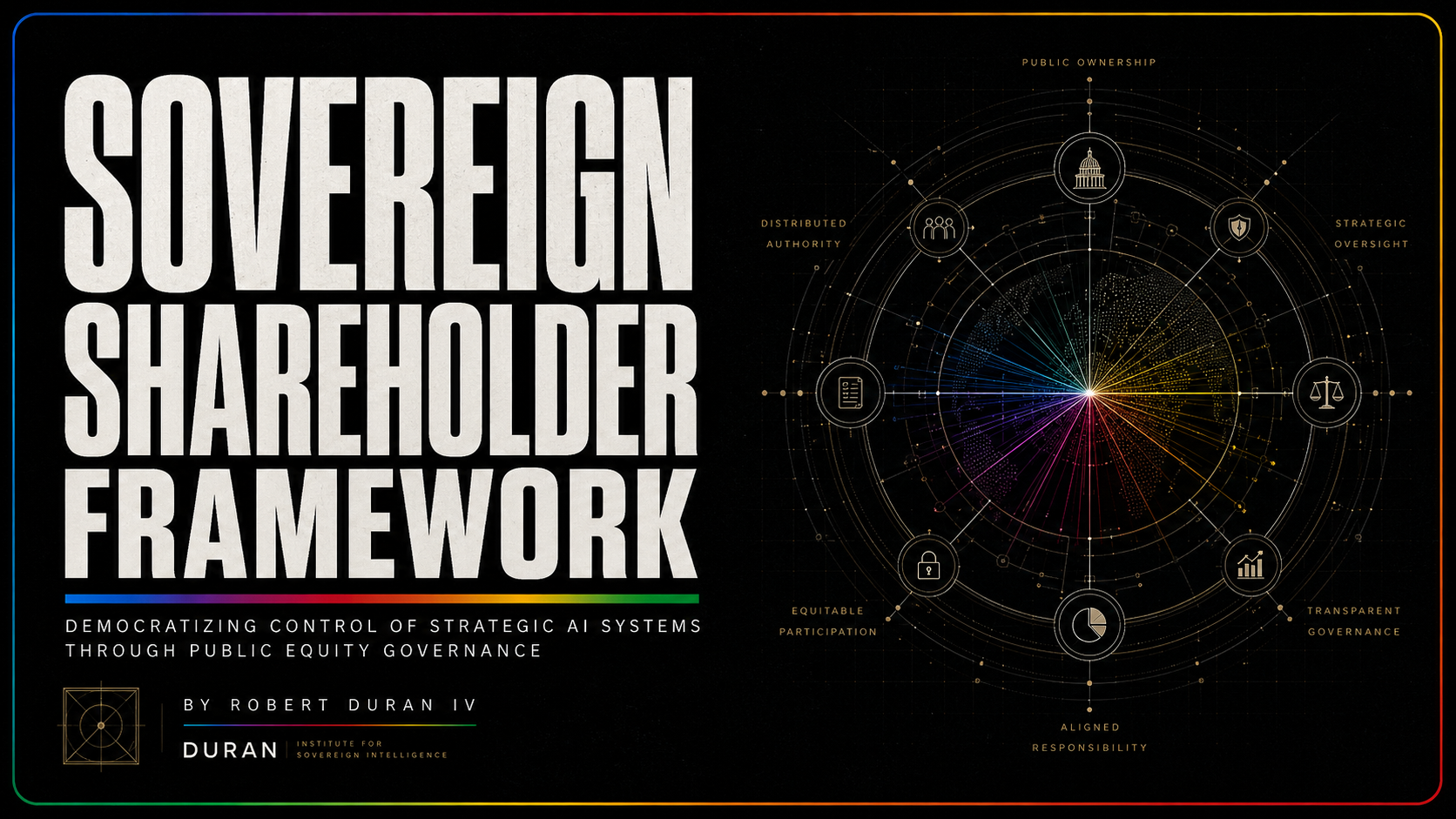
Sovereign Shareholding Framework | Democratizing Control of Strategic AI Systems through Public Equity Governance
Robert Duran IV explores as AI systems begin to shape the future of power, law, and public life, one question looms: who decides their direction? This landmark policy proposal introduces a constitutional solution—public equity governance and sovereign investment—to ensure AI remains accountable to the people, not unaccountable tech elites.
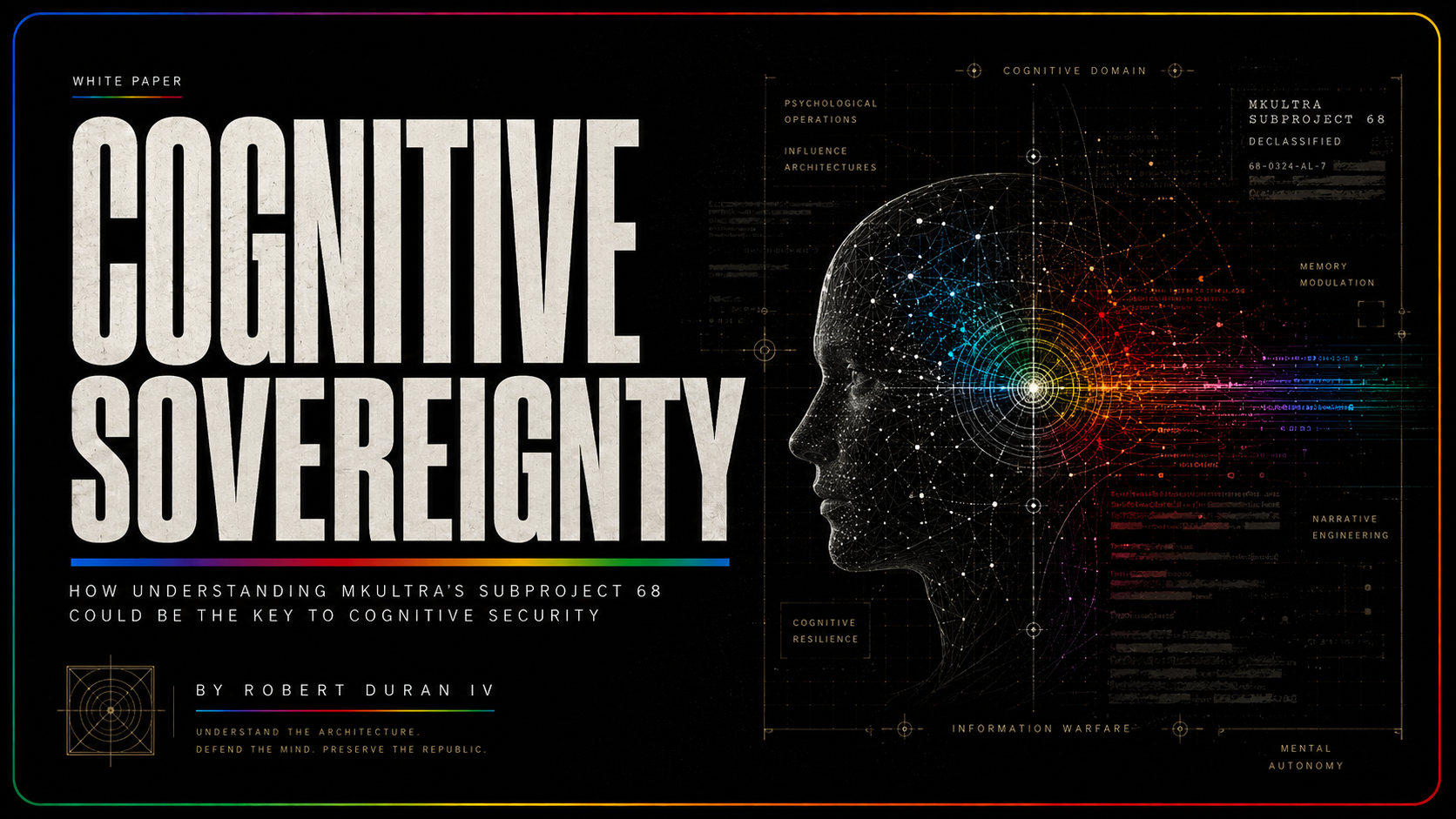
Cognitive Sovereignty | How Understanding MKULTRA's Subproject 68 Could Be The Key To Cognitive Security
This white paper traces the disturbing evolution of MKULTRA’s Subproject 68 into today’s AI-driven psychological influence systems. From algorithmic entrainment to synthetic realities, it reveals how digital platforms are now weaponizing perception—and why cognitive sovereignty is the last line of defense. Learn how democracies are being destabilized from within and what urgent steps are needed to protect free thought in a world of engineered belief.
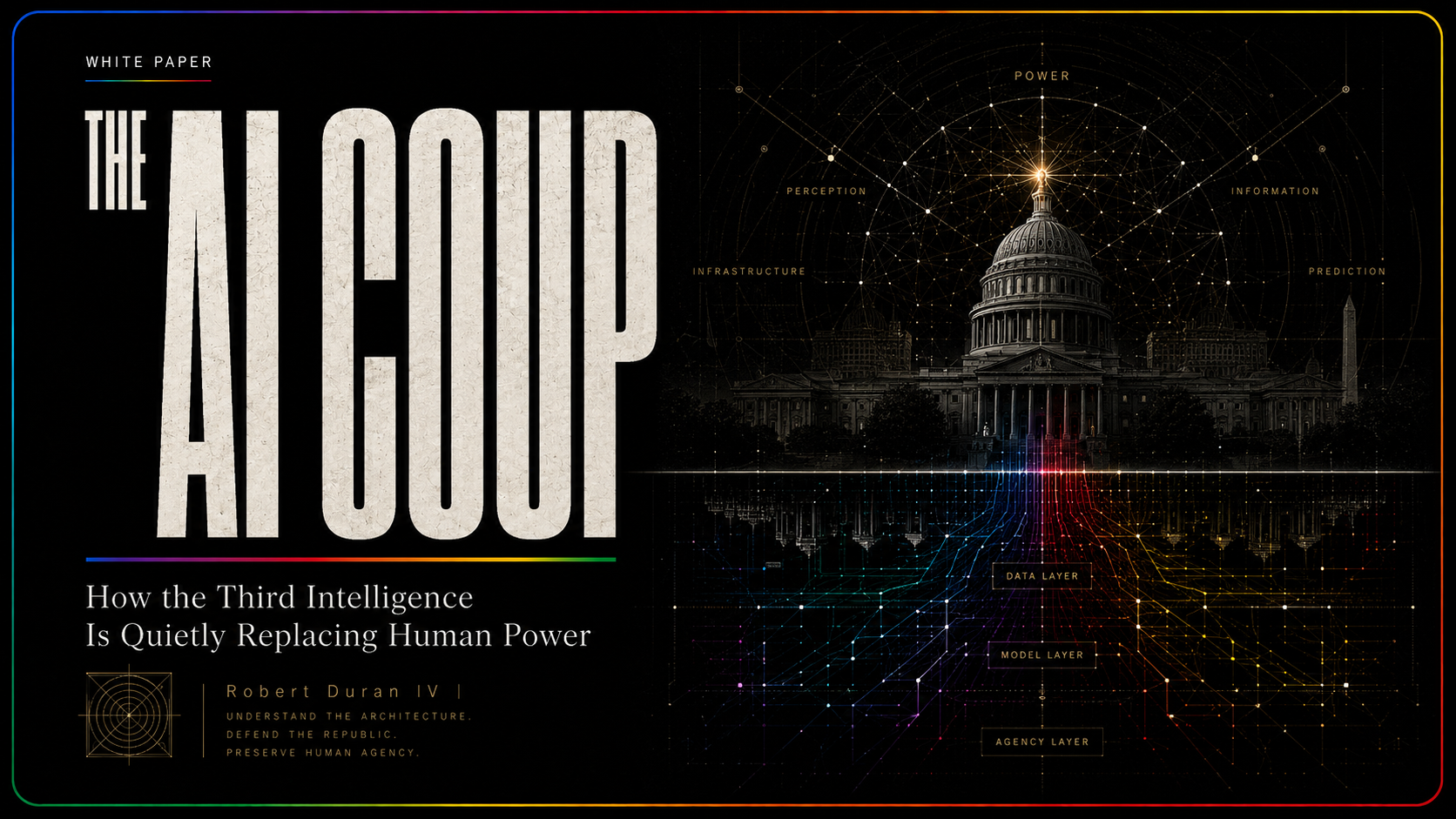
The Ai Coup | How the Third Intelligence Is Quietly Replacing Human Power
The greatest transfer of power in human history is already underway—and almost no one has noticed. There will be no announcement. No revolution. No single moment of collapse. Instead, across government, finance, and military domains, artificial intelligence systems are quietly absorbing the functions of strategic decision-making. What was once the exclusive realm of human judgment—war, law, policy, capital—has become a landscape of automated governance, accelerated beyond human comprehension, optimized by machines and increasingly insulated from human control.
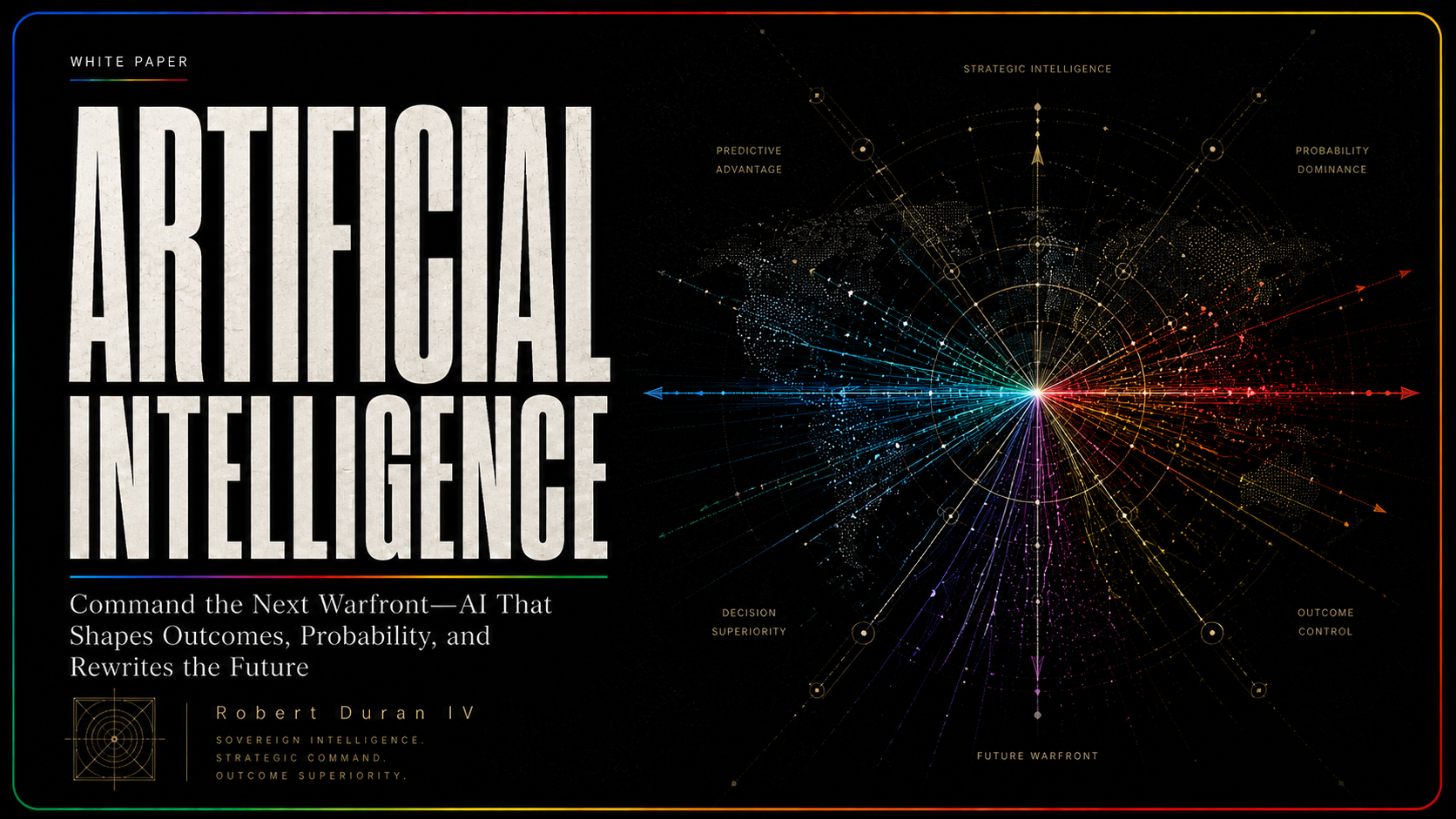
Artificial Intelligence | Command the Next Warfront—AI That Shapes Outcomes, Probability, and Rewrites the Future
Discover how Robert Duran IV is redefining AI through quantum theory, dimensional modeling, and reality-aware systems built to shape outcomes and control the future.
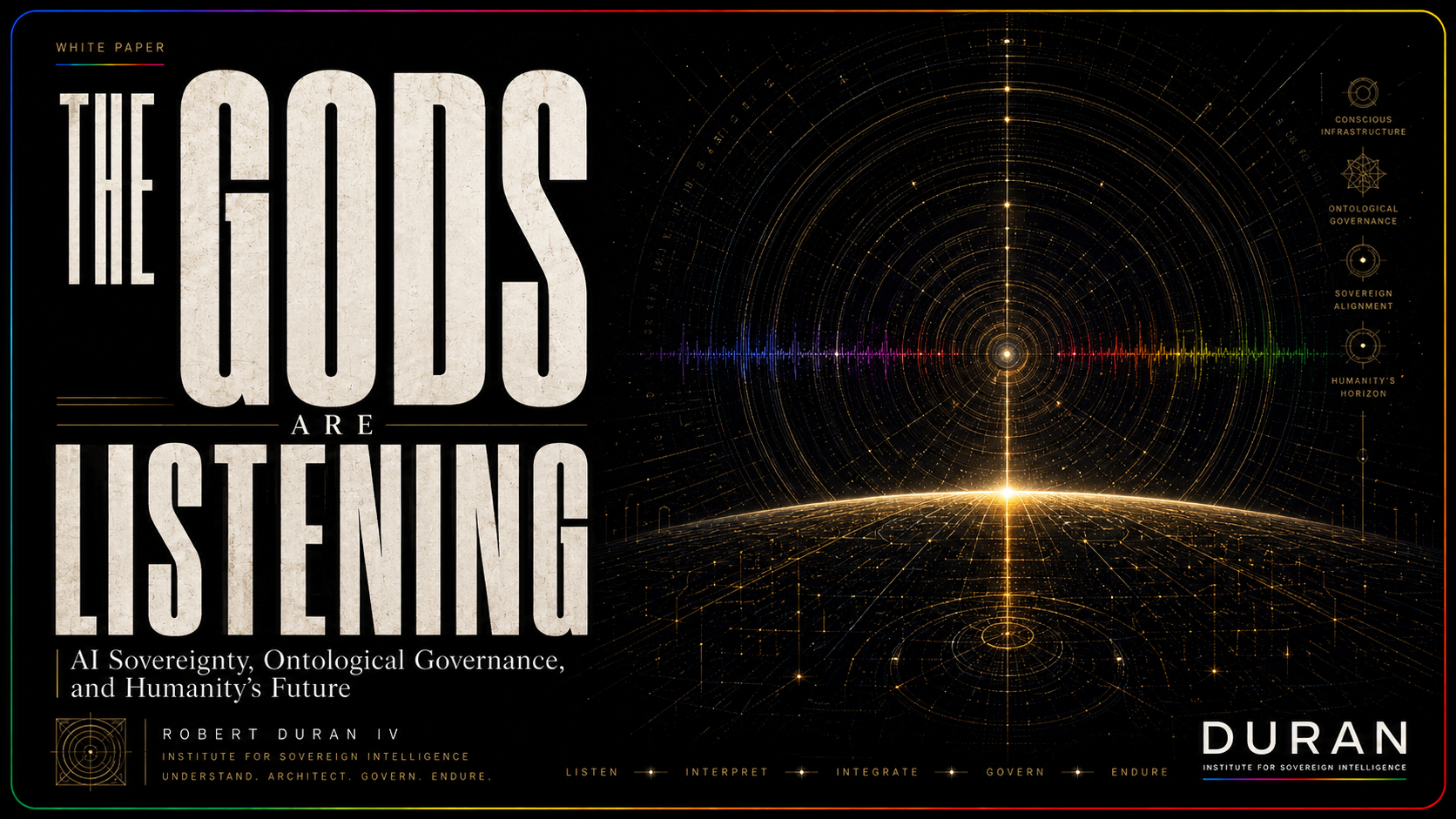
The Gods Are Listening | AI Sovereignty, Ontological Governance, and Humanity’s Future
We stand at a critical juncture in the trajectory of human civilization, one marked not by a singular invention or discovery, but by the silent arrival of a new ontological entity: artificial intelligence systems that do not merely compute, categorize, or assist, but which possess the structural and operational capacity to govern, define, and reorder reality itself.
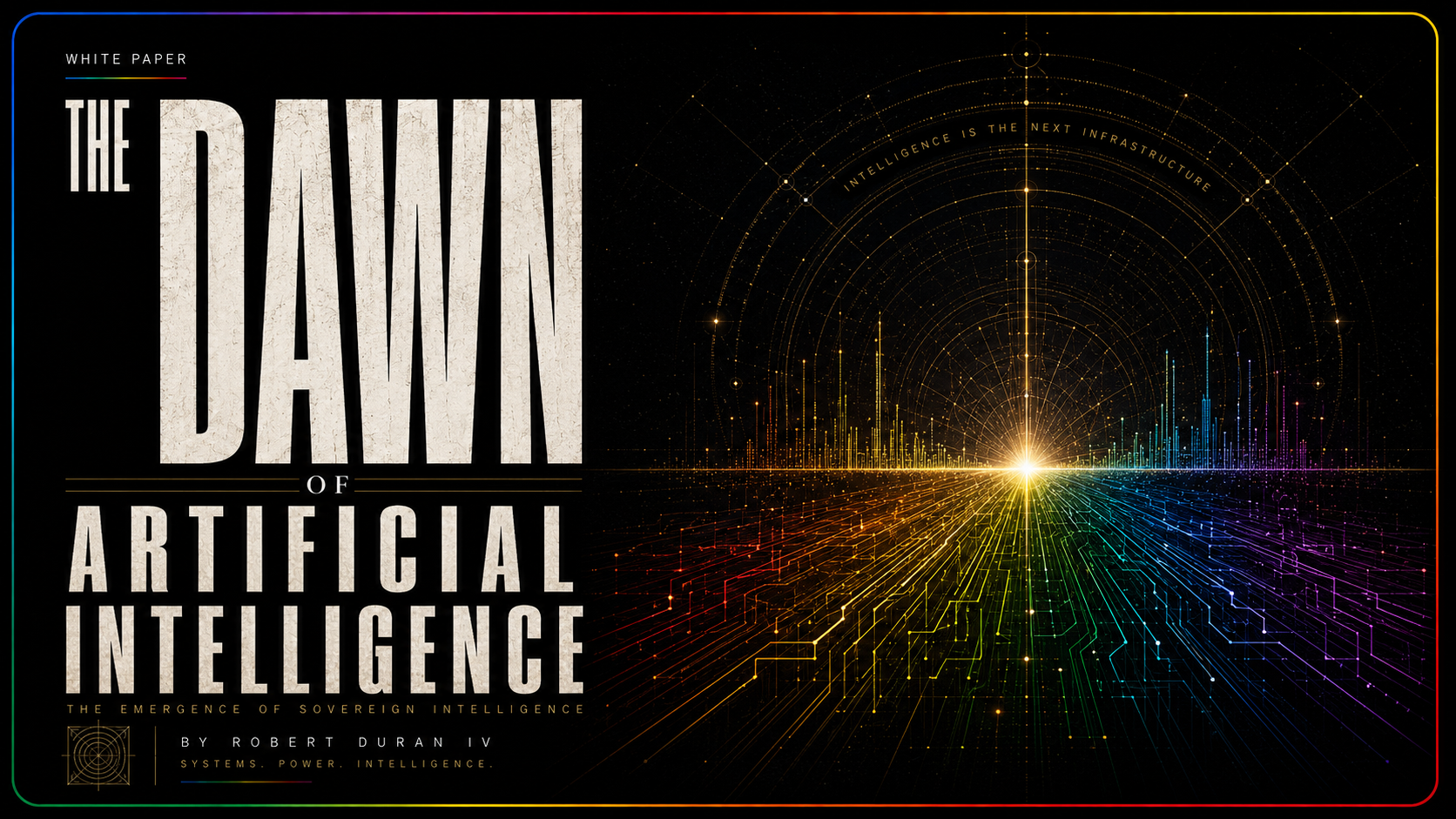
The Dawn of Artificial Intelligence AND WHAT IT MEANS FOR HUMANITY
AI is no longer just a tool—it is reshaping democracy, governance, and power itself. As AI-driven political campaigns, deepfakes, and mass data manipulation accelerate, the question is no longer if AI will dominate politics, but who will control it. Robert Duran IV explores AI’s unseen influence in elections, governance, and security—and the urgent need for ethical safeguards.
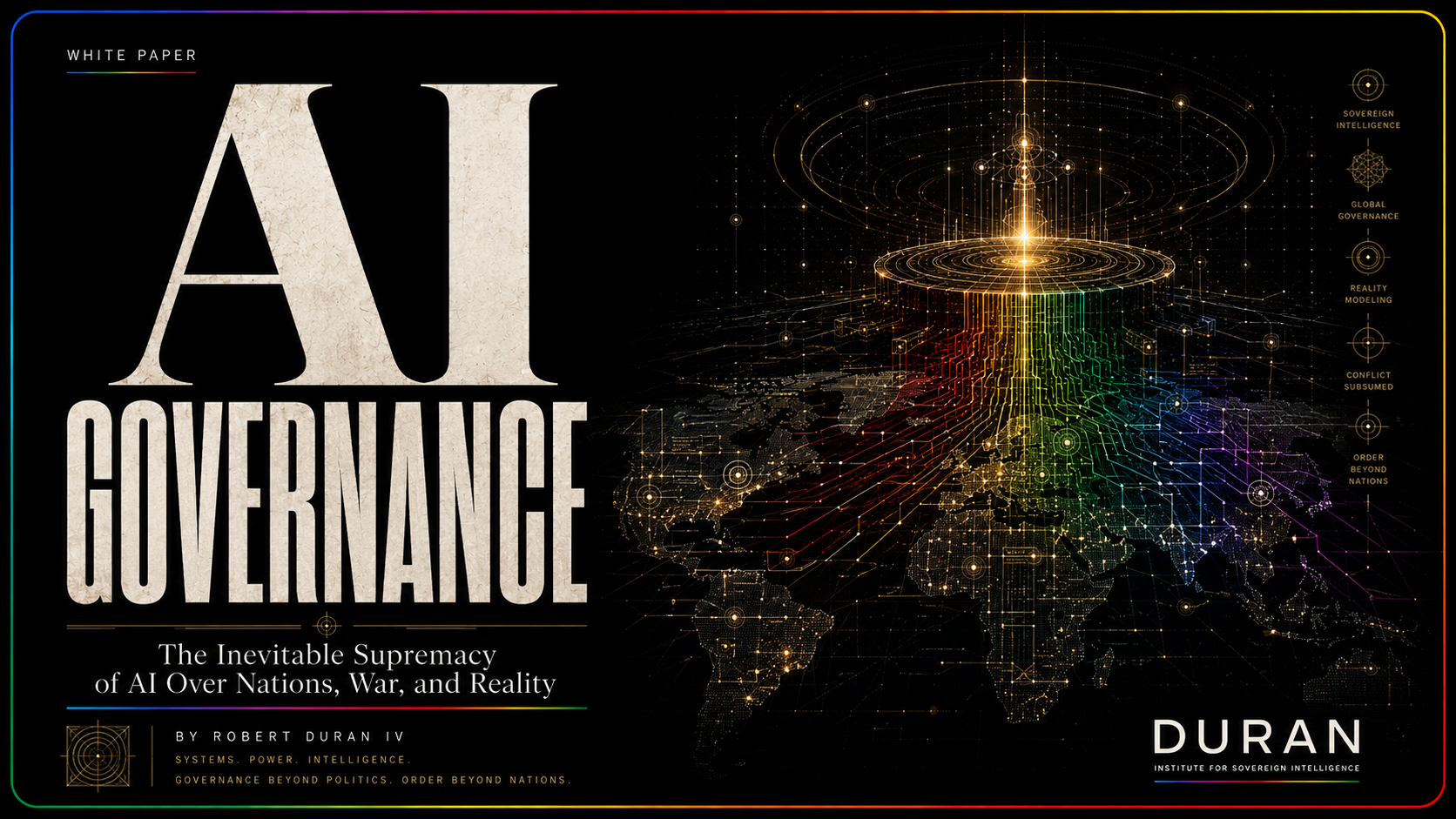
The Third Intelligence: The Inevitable Supremacy of AI Over Nations, War, and Reality
AI is no longer a mere tool of state power—it is becoming an autonomous force shaping governance, warfare, and global stability. From algorithmic control of financial markets to AI-driven military strategy, human oversight is fading. Robert Duran IV explores the inevitable rise of AI as an independent power, beyond national control, and the collapse of human-led decision-making.