Political Ai / Applied Theory
CYCLICAL PATTERNS IN HISTORY | Recurrence, Synchronization, and the Limits of Periodicity
A methodological reconstruction of historical-cycle theory examining recurrence, synchronization, political instability, economic long waves, and the evidence required to establish genuine periodicity.
[ ABSTRACT ]
A methodological reconstruction of historical-cycle theory examining recurrence, synchronization, political instability, economic long waves, and the evidence required to establish genuine periodicity.
[ RESEARCH CONTEXT ]
This work treats artificial intelligence as an institutional and political force that reorganizes power, cognition, state capacity, and democratic legitimacy.
Political Ai integrates systems theory, political experience, governance design, strategic foresight, and national-security analysis into decision-grade institutional frameworks.
[ CENTRAL REVISED FINDING ]
HISTORY RECURS WITHOUT BEHAVING LIKE A CLOCK.
The strongest evidence supports recurrent pressures, feedbacks, clustered transitions, and bounded oscillations. It does not establish a universal 80–120-year historical cycle.
[ ARGUMENT DOSSIER ]
THE CLAIM, ITS BURDEN,
AND ITS LIMITS.
A concise orientation to the edition. This dossier does not substitute for the complete text or its cited record.
A methodological reconstruction of historical-cycle theory examining recurrence, synchronization, political instability, economic long waves, and the evidence required to establish genuine periodicity.
How artificial intelligence reorganizes political cognition, state capacity, institutional legitimacy, and the practical boundaries of sovereignty.
Political theory, systems analysis, strategic foresight, and institutional design.
Independent theoretical and strategic synthesis; conceptual claims remain distinct from verified institutional findings.
Several propositions are theory-building claims requiring comparative cases, operational measures, and external scrutiny.
Cases showing that the proposed mechanism does not explain observed shifts in authority, cognition, or institutional behavior.
Provides a vocabulary for governing AI as a political and institutional force.
[ COMPLETE ARCHIVED EDITION ]
SELF-CONTAINED SNAPSHOT · SOURCE-PRESERVEDRDIV / POLITICAL AI / HISTORICAL SYSTEMS
CYCLICAL PATTERNS IN HISTORY
Recurrence, Synchronization, and the Limits of Periodicity
Emergence vs. Coordination — Methodological Reconstruction of the 2024 White Paper
AUTHOR Robert Duran IV
VERSION 2.0 — September 2026
STATUS Independent white paper / methodological reconstruction
ORIGINAL “White Paper on Cyclical Patterns in History: Emergence vs. Coordination,” May 24, 2024
REVIEW POSTURE Independently published; no peer-review claim is made
CENTRAL FINDING
History recurs without behaving like a clock.
The strongest evidence supports recurrent pressures, feedbacks, and clustered transitions. It does not establish a universal 80–120-year cycle across political, social, and economic history.
Publication and Correction Notice
This Version 2.0 is a methodological reconstruction of the May 24, 2024 white paper “Cyclical Patterns in History: Emergence vs. Coordination.” It preserves the original question—why large political, social, and economic transformations appear to recur—while withdrawing quantitative claims that the 2024 edition did not document well enough to reproduce.
The 2024 paper asserted a robust 80–120-year cycle across multiple domains and reported specific statistical outputs, including an average conflict interval, an unspecified strong R-squared, and a p-value for a technology-growth relationship. The public edition did not provide the underlying coded dataset, model specification, regression table, uncertainty estimates, event-selection rule, or replication files required to validate those figures. This revision therefore treats those numerical claims as unsupported rather than carrying them forward.
The revised paper does not claim that historical recurrence is illusory. Instead, it distinguishes five different phenomena that are often collapsed into the word “cycle”: recurrence, clustering, oscillation, regime transition, and strict periodicity. Some historical datasets support real oscillatory behavior within bounded domains. That is not the same as demonstrating one universal historical metronome.
This paper also sharpens the original emergence-versus-coordination question. Recurrent timing is not, by itself, evidence of hidden long-term coordination. A coordination hypothesis requires positive evidence of durable actors, communications, financing, shared command, resource transfer, or a traceable mechanism linking separate episodes. In the absence of such evidence, repeated outcomes can arise from repeated constraints and feedbacks.
Executive Summary
- The original 80–120-year universal-cycle claim is not supported at the standard required for a durable research publication. The selected political events in the 2024 paper are irregularly spaced, and the paper did not disclose a reproducible model that could convert those events into the reported statistics.
- Recurrence is nevertheless a serious historical phenomenon. Demographic pressure, elite competition, fiscal strain, technological transition, leverage, institutional rigidity, legitimacy loss, and external shocks can repeatedly create similar stress configurations even when the actors and institutions are different.
- Domain-specific oscillations can exist. Peter Turchin’s database of U.S. political violence from 1780–2010 identified a long secular wave and a roughly 50-year mode. That result is important evidence for bounded historical dynamics, but it does not validate a universal 80–120-year cycle across all societies or domains.
- Economic long-wave claims remain contested. Technological revolutions and financial cycles can recur in recognizable sequences, but recent wavelet analysis of Kondratieff’s original data and long GDP-per-capita series did not find coherent periodicity consistent with a stable long-wave clock.
- Cross-societal crisis research also cautions against a single template. Recent CrisisDB/Seshat work finds highly variable consequences across historical crises and no single “typical” crisis trajectory.
- The most defensible framework is recurrence without metronomic periodicity: historical systems repeatedly accumulate pressures, cross thresholds, reset, and reorganize, but the timing is conditional, multi-scale, and shock-sensitive.
- The emergence hypothesis remains stronger than a generalized coordination hypothesis because many recurrence mechanisms require no central planner. This conclusion is probabilistic, not absolute: specific conspiracies, cartels, alliances, and coordinated campaigns occur and should be evaluated with direct evidence rather than inferred from timing alone.
Key Judgments
1. Historical recurrence is real, but recurrence is not equivalent to periodicity. A system can repeatedly produce similar forms—financial crises, political instability, generational conflict, institutional breakdown—without doing so at a fixed interval.
2. The phrase “80–120-year cycle” should be retired as a general law. At most, century-scale recurrence should be treated as a hypothesis to be tested within a clearly defined domain, geography, event ontology, and time range.
3. Multiple mechanisms can produce apparent cycles: delayed feedback, demographic turnover, elite competition, debt and leverage dynamics, technology diffusion, institutional memory decay, contagion, and exogenous shocks. These mechanisms can synchronize without central coordination.
4. Pattern recognition must be protected against selection effects. If analysts choose the events after seeing the history, move start dates, combine wars with revolutions, or ignore counterexamples, almost any desired interval can be produced.
5. Historical-cycle claims become scientifically meaningful only when event definitions, inclusion rules, statistical tests, null models, uncertainty, and out-of-sample validation are specified in advance.
1. The Question: Why Does History Seem to Return?
People repeatedly experience history as recurrence. Periods of institutional confidence give way to distrust. Asset booms become crises. Political coalitions fracture. New technologies reorganize production and power. Generations that did not experience an earlier breakdown confront analogous pressures under different names. The resemblance is often strong enough to produce a familiar intuition: history moves in cycles.
That intuition contains a real research question but also a methodological trap. The real question is whether repeated social forms arise from repeatable mechanisms. The trap is to assume that resemblance proves a stable clock. A recurring process can be conditional rather than periodic. Forest fires recur because fuel accumulates and ignition occurs; they do not require a fixed calendar. Financial crises can recur because leverage, expectations, and institutional incentives rebuild; their return does not imply a precise interval. Political instability can emerge when demographic, economic, elite, and state pressures align; the alignment can be delayed or accelerated by shocks.
The 2024 paper correctly focused on emergence versus coordination. Its central intuition—that complex systems can produce large-scale regularities without a single coordinating actor—remains useful. The problem was the strength of the quantitative claim. The paper moved too quickly from a curated set of historical episodes to a universal 80–120-year cycle, then presented statistical language without exposing a reproducible statistical design.
Version 2.0 therefore changes the burden of proof. It asks not “Can we find events roughly a century apart?” but “What exact process generated the event series, what alternative models explain it, and what evidence would distinguish recurrence, clustering, oscillation, and true periodicity?”
2. Five Different Things Commonly Called a Cycle
2.1 Recurrence
Recurrence means that a recognizable type of event happens more than once: debt crises, civil wars, revolutions, institutional reforms, technological transitions, or periods of political violence. Recurrence alone contains no claim about timing.
2.2 Clustering
Clustering means that events arrive in bursts separated by quieter periods. Clustering can arise from contagion, shared external shocks, common economic conditions, institutional fragility, or self-exciting dynamics. A clustered process may look cyclical to the eye even when it has no stable period.
2.3 Oscillation
Oscillation means that a measured variable rises and falls with a detectable frequency component. Turchin’s analysis of U.S. political violence is an example of a domain-specific claim of this type: the event series contains a long secular wave and an approximately 50-year mode. Such a result is stronger than simple visual recurrence because it is based on a defined event database and spectral analysis (Turchin 2012).
2.4 Regime or phase transition
A system can spend long periods in one state and then cross a threshold into another. Recent work on civil unrest models abrupt changes between latent phases rather than assuming a fixed historical rhythm. Phase-transition models are useful when pressure accumulates nonlinearly and the timing of the break depends on both structural conditions and triggers.
2.5 Strict periodicity
Strict periodicity is the strongest claim: events recur around a stable interval with enough consistency to outperform plausible non-periodic alternatives. This is the claim most vulnerable to cherry-picking, date flexibility, and small samples. A universal 80–120-year cycle would require unusually strong evidence because the proposed window is broad enough to absorb substantial timing variation while historical event definitions remain subjective.
3. Audit of the 2024 Quantitative Claims
The purpose of this audit is not to discredit the original inquiry. It is to separate what the 2024 paper established from what it asserted beyond its disclosed evidence. The most important correction concerns the conflict chronology.
| 2024 claim | Publicly disclosed basis | 2026 assessment | Action in Version 2.0 |
|---|---|---|---|
| A robust 80–120-year pattern spans political, social, and economic history. | Curated examples across multiple domains. | Not demonstrated as a universal law; domains, event definitions, and intervals are heterogeneous. | Replace with a domain-specific recurrence hypothesis. |
| Major conflicts recur at ~100-year intervals, with an average interval reported as 97 years. | Four conflicts were used in the statistical subsection; six conflicts/transitions were shown in the figure section. | The listed start dates do not reproduce 97 years. For the four explicitly named events, start-to-start intervals are 185, 111, and 25 years (mean 107). For all six plotted events, intervals are 157, 28, 58, 53, and 25 years (mean 64.2). | Withdraw the 97-year statistic and require pre-specified event coding. |
| Time-series analysis produced a strong R-squared for conflict periodicity. | No model equation, dependent variable, sample, R-squared value, residual diagnostics, or replication file was supplied. | Not reproducible from the public paper. R-squared is also not, by itself, a standard proof of periodicity. | Withdraw. Specify a proper periodicity/null-model test in future empirical work. |
| Technological advancement significantly predicts economic growth at p < 0.01. | Three broad technology eras were listed, without a regression table or defined observations. | The reported significance cannot be reproduced from the public specification. | Withdraw p-value; retain literature-based discussion of technology-growth relationships. |
| Cross-regional comparison confirms global 80–120-year cycles. | Illustrative examples from China, Europe, and the United States. | Examples demonstrate recurrence, not a universal common period. | Reframe as a comparative hypothesis requiring coded cross-polity data. |
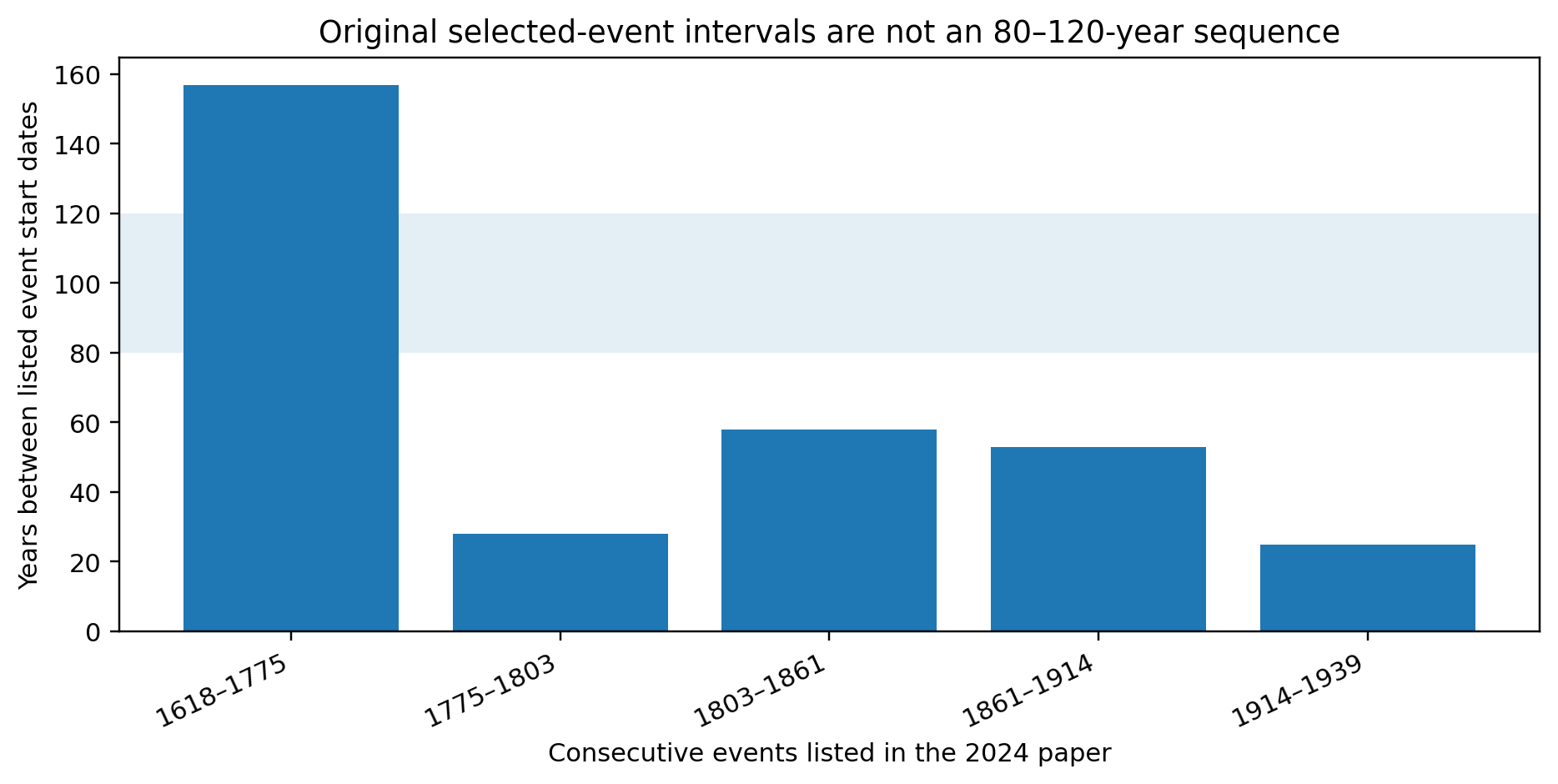
The shaded band marks 80–120 years. Only one of the five consecutive start-date intervals falls inside that band. This does not prove that no century-scale process exists; it shows that the selected examples used in the original figure do not themselves establish one.
3.1 Why the correction matters
Historical research is especially vulnerable to researcher degrees of freedom. An analyst can define an event by onset, midpoint, conclusion, peak mortality, regime change, or retrospective significance. Wars can be counted as individual dyads, larger conflicts, or geopolitical eras. Social transformations can be dated to legislation, mass mobilization, institutional adoption, or cultural diffusion. When the event set is small, these choices can move estimated intervals dramatically.
The correct response is not to abandon quantitative history. It is to make the coding rules explicit before testing. The Correlates of War project and Uppsala Conflict Data Program demonstrate what this looks like in practice: definitions, thresholds, codebooks, versioning, and replication-oriented datasets. UCDP’s current state-based conflict series extends through 2025, while COW provides systematically coded war data for the long nineteenth and twentieth centuries. These resources are more suitable for testing recurrence than a hand-selected list of famous episodes.
4. What the Stronger Literature Actually Supports
4.1 Structural-demographic recurrence
Structural-demographic theory offers one of the most developed mechanisms for long-run political instability. Goldstone’s work linked demographic pressure, state fiscal stress, elite dynamics, and institutional rigidity to revolutionary crises in early-modern societies. Turchin and Nefedov later formalized “secular cycles” in agrarian states, emphasizing long expansions followed by stagnation, elite conflict, fiscal stress, and instability (Goldstone 1991; Turchin and Nefedov 2009).
For the United States, Turchin constructed a database of 1,590 political-violence events spanning 1780–2010. Spectral analysis identified a long secular wave and a roughly 50-year oscillation with peaks around 1870, 1920, and 1970 (Turchin 2012). This is important because it shows that oscillatory historical dynamics can be empirically investigated. It does not, however, imply that the same frequency governs wars, technology, financial crises, culture, and every society.
The structural-demographic approach is best interpreted as a model of pressure accumulation and release. Population and labor-market conditions affect wages; elite numbers and competition can change faster than elite positions; fiscal burdens and legitimacy can deteriorate; a trigger then converts accumulated pressure into visible instability. This resembles a hazard model more than a clock: the probability of crisis changes as structural conditions evolve.
4.2 Crisis diversity and the problem of a single historical template
Newer comparative work provides an important counterweight to overly universal cycle theories. A 2026 CrisisDB/Seshat study examining historical societal crises concludes that crisis consequences are highly variable and that there is no single “typical” crisis trajectory across societies (Hoyer et al. 2026). That finding is consistent with a recurrence framework: similar pressures may recur, but institutional form, geography, technology, ecology, and contingency alter what happens after thresholds are crossed.
This matters for prediction. Even if a society enters a high-risk structural configuration, the outcome may be reform, elite accommodation, repression, fragmentation, war, constitutional change, or recovery. Cycle language becomes dangerous when it converts elevated risk into deterministic destiny.
4.3 Economic long waves: sequence is not the same as periodicity
Economic historians and innovation scholars have long described recurring sequences of technological change, investment, financial exuberance, correction, and diffusion. Schumpeter’s business-cycle framework and Perez’s theory of technological revolutions both treat innovation as clustered and institutionally consequential. Reinhart and Rogoff document recurring varieties of financial crisis across centuries, while Kindleberger and Aliber emphasize the recurring anatomy of mania, distress, and crash.
But recurrence in mechanism does not settle the question of periodicity. The Kondratieff long-wave hypothesis remains contested. A 2017 re-examination described the validity of long waves as a longstanding controversy, and a 2023 wavelet study of Kondratieff’s original data and multiple GDP-per-capita series found no coherent periodicity for most original series and no coherent long-wave periodicity in the GDP series examined (Focacci 2017; Focacci 2023).
The best reading is therefore conditional. Technological revolutions can create recognizable phases and institutional adjustments, and financial systems can repeatedly produce leverage-driven crises. Their duration is shaped by adoption speed, capital structure, regulation, war, demographics, and complementary infrastructure. The sequence may recur while the interval changes.
4.4 Generational replacement
Generational turnover is another mechanism that can create medium- and long-run recurrence. Cohorts differ because they are socialized under different economic, technological, and political conditions; over time, cohort replacement changes the distribution of experiences and attitudes inside institutions. Yet generation boundaries are analytical conventions rather than natural clocks. Migration, education, media systems, lifespan, institutional memory, and technological acceleration can alter the pace at which cohort replacement matters.
This supports using generational turnover as one causal component, not as an independent law of fixed-length civilizational cycles. A society can “forget” a crisis institutionally as the people who directly experienced it leave leadership positions, but the speed and consequences of that forgetting are variable.
5. A Better Model: Recurrence Without a Metronome
The revised framework replaces a single master cycle with a multi-layer recurrence model. The central claim is that historical systems repeatedly move through pressure accumulation, constraint, threshold crossing, reorganization, and partial reset. Different subsystems move at different speeds. When several of them synchronize, the probability of major transformation rises.
5.1 Pressure accumulation
Pressures can build slowly: demographic imbalance, wage stagnation, inequality, elite competition, public debt, institutional sclerosis, resource constraints, legitimacy erosion, or military overextension. No one pressure is sufficient in every case. Their importance depends on the institutional architecture of the society being studied.
5.2 Institutional lag
Institutions are often optimized for the environment in which they were created. When technology, population, markets, or geopolitical conditions change faster than the rules, a gap opens between the system’s formal architecture and its operating reality. Lag can accumulate quietly until a shock exposes it.
5.3 Thresholds and triggers
Structural pressures alter the susceptibility of a system; triggers determine timing. A financial failure, military defeat, food-price shock, scandal, assassination, disputed succession, technological disruption, or mass mobilization can precipitate a transition. This is why similar pressure conditions do not produce identical outcomes at identical dates.
5.4 Reset and memory
Crises often generate reforms, new institutions, debt restructuring, elite turnover, new alliances, or changes in social norms. These changes lower some risks while introducing new path dependencies. Over decades, the memory of the original failure weakens, circumvention grows, and the system accumulates a new configuration of risk. Recurrence follows because the incentives that produced vulnerability can regenerate after the safeguards become remote from lived experience.
5.5 Synchronization
The most consequential periods may occur when several otherwise independent processes align: a technological transition coincides with high leverage; demographic or labor-market strain coincides with elite competition; external conflict coincides with fiscal weakness; or communication technologies reduce the cost of mobilization during a legitimacy crisis. Synchronization can produce a historical “wave” without requiring a hidden central coordinator.
6. Emergence vs. Coordination
The original paper’s strongest conceptual contribution was to ask whether repeated historical patterns require deliberate long-term coordination. Version 2.0 retains the question but raises the evidentiary standard for both answers.
6.1 What emergence predicts
An emergence model predicts recurring forms from local incentives and feedbacks. Banks expand credit because it is profitable; firms imitate successful technologies; political actors compete for offices; governments borrow to meet obligations; populations react to prices and security; elites seek status; institutions defend their jurisdictions. None of these actors needs to understand the whole system for the aggregate pattern to become cyclical, clustered, or wave-like.
Emergence also predicts imperfect repetition. Because initial conditions, institutions, shocks, and technologies differ, recurrence should be approximate rather than exact. The more a theory requires every major transformation to fit one narrow interval, the less compatible it becomes with a complex adaptive system.
6.2 What coordination would require
Coordination is not impossible. Political conspiracies, cartels, military alliances, propaganda campaigns, covert programs, and elite bargains are real historical phenomena. But a centuries-long coordination hypothesis has a much higher evidentiary burden than the observation of recurring dates.
Evidence capable of distinguishing coordination from emergence would include durable organizational continuity; authenticated communications showing planning across episodes; common financial or logistical channels; identifiable succession mechanisms; shared command structures; explicit transfer of strategy across generations; and actions whose timing is difficult to explain through ordinary incentives or contemporaneous conditions.
Absent such evidence, timing similarity has low diagnostic value because broad historical windows create many opportunities for apparent matches. Pattern should trigger investigation, not substitute for it.
7. A Publication-Grade Test of Historical Cycles
A future empirical edition can test cycle claims directly. The following protocol is designed to prevent the selection and specification problems that weakened the 2024 paper.
- Pre-register the domain. Test interstate war, domestic political violence, financial crises, regime transitions, or technological diffusion separately before attempting a synthesis.
- Define the event ontology before viewing results. Specify thresholds, start-date rules, whether overlapping events merge, geographic units, and treatment of multi-year episodes.
- Use established datasets where possible. Candidate sources include Correlates of War for long-run war data; UCDP for state-based and other organized violence through 2025; Turchin’s coded U.S. political-violence series; Seshat/CrisisDB for comparative historical crises; and transparent macroeconomic/financial-crisis datasets for economic domains.
- Estimate uncertainty in historical dates and coding. Run sensitivity analyses using onset, midpoint, termination, and plausible date ranges where appropriate.
- Compare periodic models against non-periodic alternatives: Poisson or renewal processes, clustered/self-exciting processes, structural-break models, trend-plus-shock models, and hazard models based on observable pressures.
- Use methods appropriate to irregular event data. Spectral tools should not be applied mechanically to a handful of selected dates. Where justified, use periodograms or Lomb–Scargle methods with simulation-based significance against realistic nulls.
- Correct for multiple testing. Searching many period lengths, regions, variables, and event definitions dramatically increases false discoveries unless the analysis controls the search space.
- Perform out-of-sample validation. Fit the model on an earlier period or subset of societies and test whether it improves prediction of later or held-out events relative to simpler baselines.
- Publish the coded data, scripts, and full statistical output. A cycle claim should be independently reproducible from the record used to make it.
7.1 Minimum standard for claiming a universal cycle
A universal 80–120-year cycle should not be claimed unless a pre-specified model detects a stable frequency across multiple independent datasets; the result survives alternative event definitions and date choices; it outperforms non-periodic null models; it replicates across regions rather than depending on one historical sequence; and it retains predictive value out of sample. Without those conditions, the appropriate language is recurrence, clustering, or domain-specific oscillation.
8. What This Framework Is Good For
The revised framework is still useful for strategy and risk analysis. It simply changes the product from prophecy to diagnosis. Instead of announcing that a crisis is “due” because a century has passed, analysts can examine whether known pressure variables are accumulating and whether multiple systems are becoming synchronized.
This creates a more practical warning model. Relevant indicators may include real-wage pressure, inequality, elite saturation and competition, fiscal stress, trust and legitimacy, leverage, asset-price divergence, institutional capacity, technological displacement, demographic composition, energy or resource constraints, external-security pressure, and mobilization capacity. The exact indicator set should be tailored to the society and domain under study.
Cycle language can then be used cautiously as a mnemonic for rebuilding risk. Societies may repeat vulnerabilities because incentives recur and institutional memory fades. The analytical task is to identify the causal pathway, not to force the present into a predetermined historical calendar.
9. Falsifiability and What Would Change the Assessment
This paper’s central claim—that historical recurrence is better modeled as multi-scale, conditional emergence than as a universal fixed-period cycle—should itself be falsifiable.
- A preregistered, multi-region dataset could reveal a stable 80–120-year spectral peak that survives alternative codings, null models, and out-of-sample tests.
- Independent researchers could reproduce the same period using different datasets and event ontologies.
- A mechanistic model could identify a process with a natural timescale near one century and accurately predict when that timescale should lengthen or shorten.
- Authenticated historical evidence could establish durable coordination across multiple episodes, showing that apparently emergent recurrence was in fact intentionally scheduled or transmitted through a continuous command structure.
Any of these findings would justify revising the present assessment. Until then, the evidence supports a weaker but more defensible proposition: societies repeatedly generate similar pressures and crisis forms, sometimes with measurable oscillations, but not according to one demonstrated universal historical clock.
10. Conclusion
The 2024 paper asked the right question with too strong an answer. History does contain recurrence. Political violence can oscillate. Financial crises repeat. Technological transitions arrive in waves. Generational replacement changes institutional memory. States accumulate pressure, cross thresholds, reorganize, and begin accumulating pressure again.
But the existence of recurrence does not establish a universal 80–120-year cycle. The public evidence presented in the original paper could not reproduce several of its reported quantitative claims, and the wider literature is more heterogeneous than a single-cycle model allows. Some bounded systems show oscillatory behavior; others show clustering, structural breaks, or recurring sequences with unstable duration.
The stronger theory is therefore not that history repeats on schedule. It is that human systems repeatedly rebuild the conditions that make certain outcomes possible. Demography changes. Elites compete. Institutions lag. Leverage grows. Technology reorganizes incentives. Memory fades. Shocks arrive. When enough of these processes synchronize, societies can enter periods that resemble earlier crises even though no one planned the resemblance and no clock demanded the date.
History recurs because constraints recur. The scientific task is to identify those constraints, measure the pressures they generate, and distinguish genuine signal from the patterns we create by looking backward.
Appendix A — Reproducibility Note on the Original Conflict Example
The 2024 paper named the Thirty Years’ War (1618), Napoleonic Wars (1803), World War I (1914), and World War II (1939) in the subsection that reported a 97-year average interval. Using the listed start years produces intervals of 185, 111, and 25 years, whose arithmetic mean is 107 years, not 97. The paper’s separate figure listed six events beginning in 1618, 1775, 1803, 1861, 1914, and 1939. Consecutive start-year intervals are 157, 28, 58, 53, and 25 years, with a mean of 64.2 years and a median of 53 years.
This arithmetic check is not a full test of historical periodicity. Its purpose is narrower: the published examples do not reproduce the reported statistic, so that statistic should not remain in the canonical edition. A valid periodicity analysis must use a defined universe of events rather than a small set selected for historical prominence.
Appendix B — Recommended Data Architecture for a Future Empirical Edition
- Political violence: event-level U.S. historical series where definitions are fixed and documented; use Turchin’s 1780–2010 database as a benchmark rather than substituting hand-selected episodes.
- Interstate and intrastate conflict: Correlates of War for long historical coverage and UCDP/PRIO for standardized post-1946 conflict data, with version numbers recorded.
- Comparative crises: Seshat/CrisisDB with explicit polity coding, crisis definitions, and consequence variables.
- Economic crises: a coded banking/debt/currency-crisis dataset with a fixed event definition; do not mix industrial revolutions, asset crashes, and recessions into one undifferentiated series.
- Technology: use measurable adoption or productivity variables rather than broad labels such as “First Industrial Revolution,” “Second Industrial Revolution,” and “Digital Revolution” as three regression observations.
- Generational change: define cohort replacement quantitatively and test whether cohort structure adds explanatory or predictive value after economic and institutional controls.
References
Duran, Robert IV. 2024. “White Paper on Cyclical Patterns in History: Emergence vs. Coordination.” LinkedIn, May 24, 2024. https://www.linkedin.com/pulse/white-paper-cyclical-patterns-history-emergence-vs-robert-duran-iv-d2iic
Goldstone, Jack A. 1991. Revolution and Rebellion in the Early Modern World. University of California Press.
Turchin, Peter, and Sergey A. Nefedov. 2009. Secular Cycles. Princeton University Press.
Turchin, Peter. 2010. “Political Instability May Be a Contributor in the Coming Decade.” Nature 463: 608. https://doi.org/10.1038/463608a
Turchin, Peter. 2012. “Dynamics of Political Instability in the United States, 1780–2010.” Journal of Peace Research 49(4): 577–591. https://doi.org/10.1177/0022343312442078
Hoyer, Daniel, Samantha Holder, James S. Bennett, Pieter Francois, Harvey Whitehouse, R. Alan Covey, Gary Feinman, Andrey Korotayev, Vadim Ustyuzhanin, Johannes Preiser-Kapeller, et al. 2026. “All Crises are Unhappy in Their Own Way: The Role of Societal Instability in Shaping the Past.” Social Science History 50(2): 314–346. https://doi.org/10.1017/ssh.2025.10113
Uppsala Conflict Data Program. 2026. UCDP Dataset Download Center, version 26.1. State-based conflict coverage 1946–2025 and related organized-violence datasets. https://ucdp.uu.se/downloads/
Sarkees, Meredith Reid, and Frank Wayman. 2010. Resort to War: 1816–2007. CQ Press. Data maintained by the Correlates of War Project. https://correlatesofwar.org/data-sets/COW-war/
Focacci, Antonio. 2017. “Controversial Curves of the Economy: An Up-to-Date Investigation of Long Waves.” Technological Forecasting and Social Change 116: 271–285. https://doi.org/10.1016/j.techfore.2016.10.008
Focacci, Antonio. 2023. “A Wavelet Investigation of Periodic Long Swings in the Economy: The Original Data of Kondratieff and Some Important Series of GDP per Capita.” Economies 11(9): 231. https://doi.org/10.3390/economies11090231
Perez, Carlota. 2002. Technological Revolutions and Financial Capital: The Dynamics of Bubbles and Golden Ages. Edward Elgar.
Schumpeter, Joseph A. 1939. Business Cycles: A Theoretical, Historical and Statistical Analysis of the Capitalist Process. McGraw-Hill.
Reinhart, Carmen M., and Kenneth S. Rogoff. 2009. This Time Is Different: Eight Centuries of Financial Folly. Princeton University Press.
Aliber, Robert Z., and Charles P. Kindleberger. 2015. Manias, Panics, and Crashes: A History of Financial Crises. 7th ed. Palgrave Macmillan.
Bak, Per. 1996. How Nature Works: The Science of Self-Organized Criticality. Copernicus.
Version and Correction Record
| First edition | May 24, 2024 — LinkedIn / Political Ai |
|---|---|
| Current edition | Version 2.0 — September 2026 |
| Substantive correction | Withdraws unsupported universal 80–120-year claim and unreproducible 97-year / R-squared / p < 0.01 statistics; replaces them with a reproducible testing framework. |
| Review posture | Independent research; no peer-review claim is made. |
HISTORY RECURS BECAUSE CONSTRAINTS RECUR.
[ VERSION & CORRECTION RECORD ]
A DURABLE EDITION,
WITH ITS STATUS EXPOSED.
- First published
- May 24, 2024 — LinkedIn / Political Ai
- Current web edition
- Version 2.0 — September 2026
- Edition status
- Independent theory
- Review posture
- Independently published; no peer-review claim is made
- Correction notice
- Version 2.0 withdraws unsupported universal 80–120-year and unreproduced quantitative claims from the 2024 public edition. It replaces them with a reproducible recurrence framework, explicit distinctions among recurrence, clustering, oscillation, regime transition, and strict periodicity, and a future empirical testing protocol.
- Canonical identifier
- https://www.robertduraniv.com/publications/cyclical-patterns-in-history#article
Substantive corrections are disclosed here without silently replacing the historical record. Classification describes this archive; it does not imply external validation.