Strategic White Papers
Trump’s Current Presidency and the Crisis of Post–World War II Globalization
Written by Robert Duran IV , this strategic white paper analyzes Donald Trump’s presidency as a rupture point in the decline of the U.S.-led postwar unipolar economic order and the transition toward multipolarity.
[ ABSTRACT ]
Written by Robert Duran IV , this strategic white paper analyzes Donald Trump’s presidency as a rupture point in the decline of the U.S.-led postwar unipolar economic order and the transition toward multipolarity.
[ RESEARCH CONTEXT ]
This paper maps a consequential structure of power and translates the analysis into a framework for public judgment, institutional response, or strategic action.
The work combines historical context, institutional analysis, systems mapping, and an explicit distinction between documented findings, inference, and forward-looking judgment.
[ ARGUMENT DOSSIER ]
THE CLAIM, ITS BURDEN,
AND ITS LIMITS.
A concise orientation to the edition. This dossier does not substitute for the complete text or its cited record.
Written by Robert Duran IV , this strategic white paper analyzes Donald Trump’s presidency as a rupture point in the decline of the U.S.-led postwar unipolar economic order and the transition toward multipolarity.
Which underlying architecture of power, dependency, or influence is producing the visible political or institutional result.
Historical context, public-record analysis, systems mapping, and an explicit separation of documented fact, inference, and strategic judgment.
Independent strategic analysis using the sources and record identified in the edition; evidentiary depth varies by paper.
A white paper can organize evidence and judgment but does not replace primary records, formal adjudication, or independent replication.
Contrary primary evidence, a more complete causal account, or documentation that defeats a central factual premise.
Translates a complex record into a framework for public judgment or strategic action.
[ COMPLETE ARCHIVED EDITION ]
SELF-CONTAINED SNAPSHOT · SOURCE-PRESERVED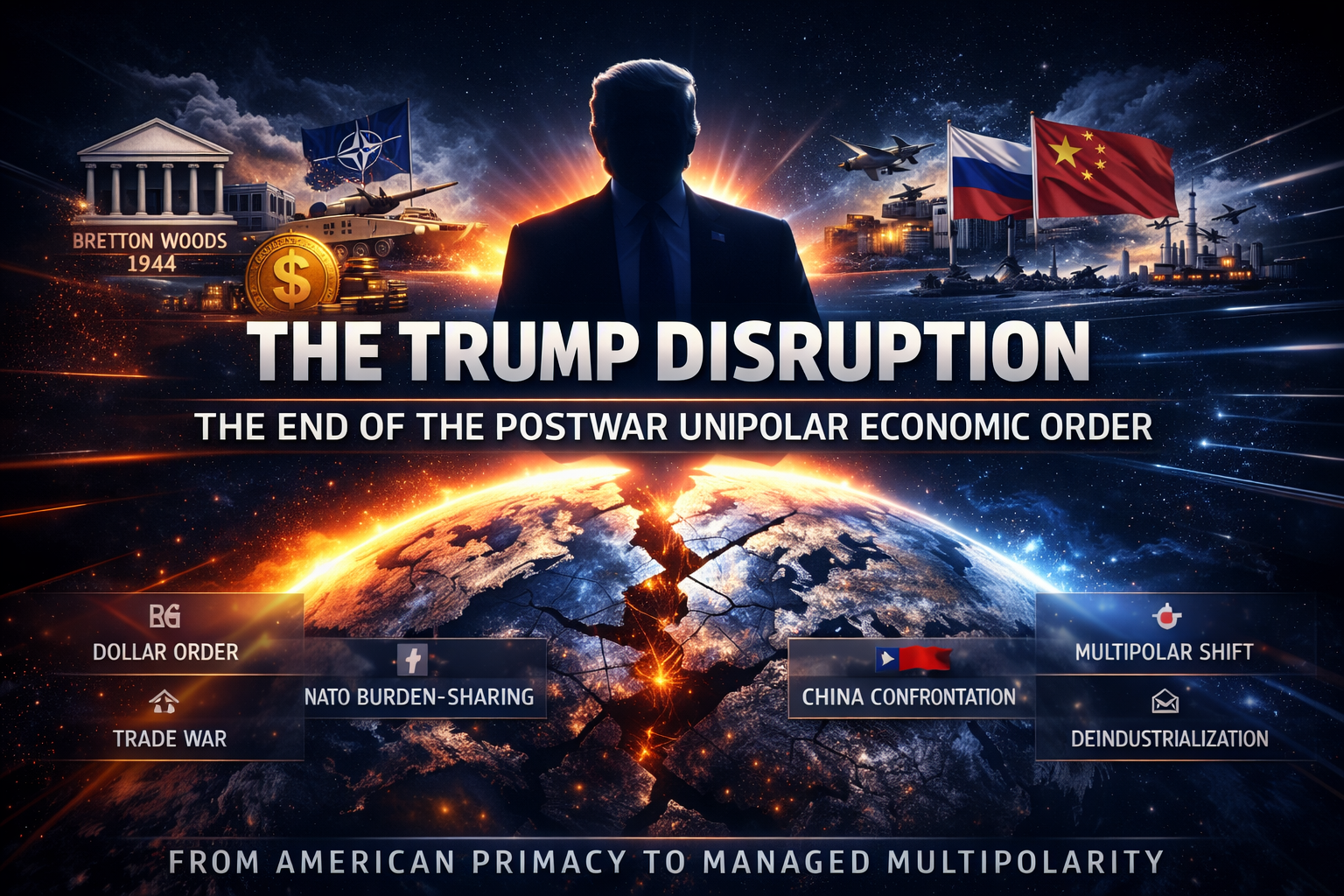
I. Executive Judgment
Donald Trump’s current presidency should be assessed as a live stress event in the crisis of post–World War II globalization. The subject is not Trump in isolation. The subject is the U.S.-led globalization model that emerged after 1945, expanded through the Cold War and post-Cold War eras, and now faces structural stress across trade, monetary policy, alliances, industrial capacity, energy, borders, digital finance, and domestic legitimacy.
Trump’s first term exposed the instability of that model. His current presidency is testing whether disruption can be converted into doctrine. The relevant question is not whether Trump personally designed the transition toward multipolarity. He did not. The more consequential question is whether the United States can manage the transition from a dollar-centered, security-backed, China-integrated, finance-heavy, supply-chain-dependent globalization model toward a more resilient economic-security order without triggering trade escalation, alliance fracture, monetary instability, authoritarian drift, or domestic breakdown.
The current policy environment makes this more than a retrospective question. The January 2025 America First Trade Policy memorandum directed federal agencies to review trade deficits, unfair practices, de minimis import rules, tariff revenue, export controls, China-related economic exposure, and the economic and national-security implications of trade policy. USTR’s 2025 trade agenda links trade policy to increasing manufacturing’s share of GDP, increasing real median household income, and reducing the goods trade deficit. NATO’s 2025 Hague commitment sets a target of investing 5 percent of GDP annually in core defense and defense/security-related spending by 2035, including at least 3.5 percent for core defense requirements.
Strategic judgment: Trump is not the architect of multipolarity. He is the political figure through whom the United States is actively renegotiating the terms of the post–World War II globalization order it once managed.
II. Definition: Post–World War II Globalization
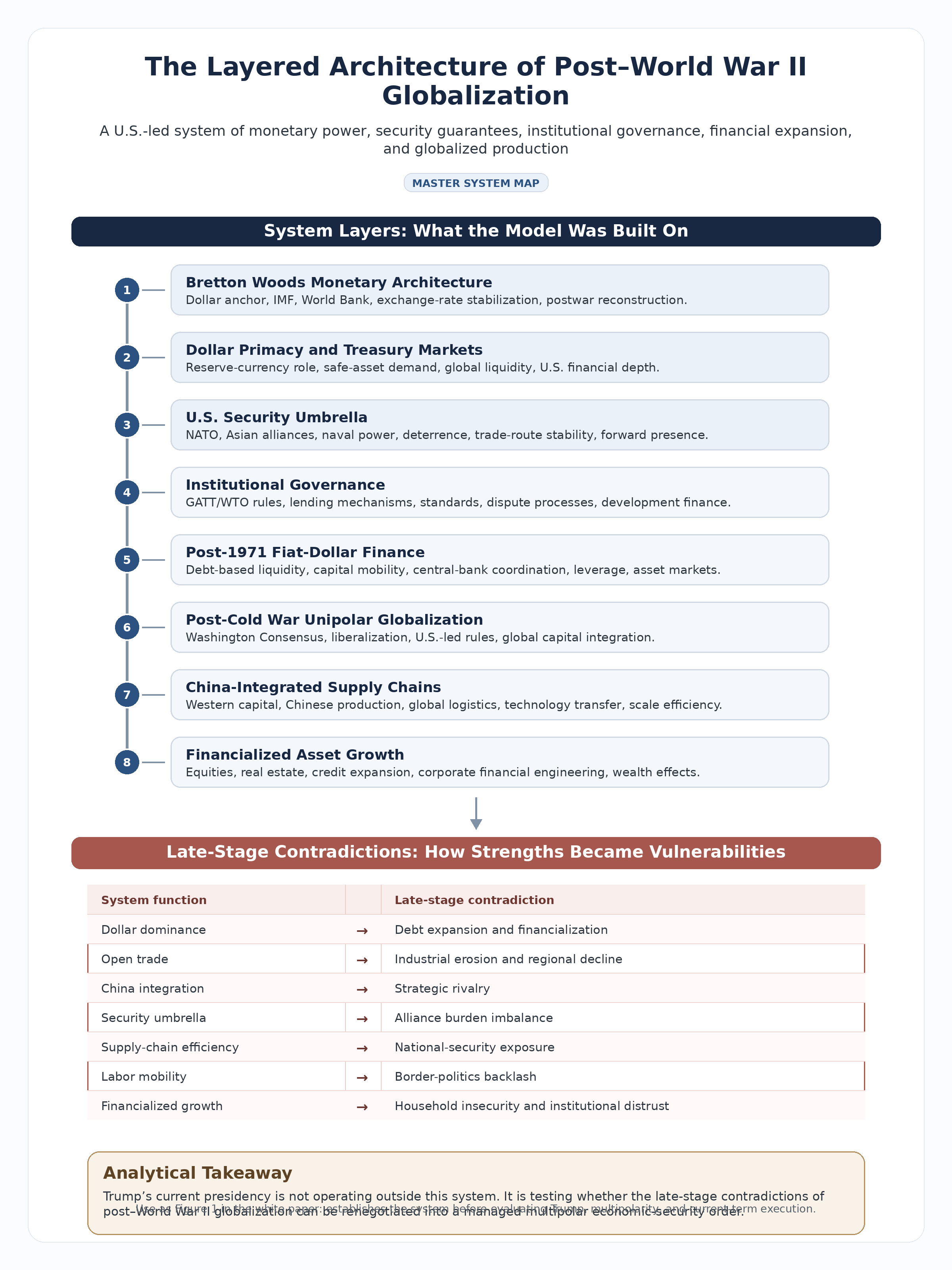
For purposes of this analysis, post–World War II globalization refers to the layered U.S.-led system that combined Bretton Woods monetary institutions, Cold War security guarantees, post-1971 dollar-financial dominance, post-Cold War unipolarity, WTO-era trade liberalization, China-integrated supply chains, and financialized asset growth.
This was not a single static order. It evolved through several phases.
The first was the Bretton Woods phase, in which the United States anchored postwar monetary reconstruction through the dollar, the IMF, the World Bank, and exchange-rate stabilization. The dollar’s centrality made U.S. monetary credibility a global public good.
The second was the Cold War security-globalization phase, in which U.S. military alliances, open Western markets, development finance, trade expansion, and dollar liquidity supported a U.S.-led capitalist bloc. Economic globalization and security strategy were inseparable: the United States supplied not only markets and liquidity, but also protection.
The third was the post-1971 fiat-dollar phase, in which the dollar remained the central global currency after formal gold convertibility ended. This made the system more flexible, but also more dependent on U.S. Treasury markets, debt-based liquidity, financial depth, central-bank coordination, and confidence in American institutions.
The fourth was the post-Cold War unipolar phase, in which the Soviet collapse, WTO expansion, China’s integration into global markets, offshored production, financial liberalization, technological integration, and global supply chains produced the high point of U.S.-led globalization.
This model produced major gains: reconstruction, trade growth, lower consumer costs, technological diffusion, financial liquidity, allied stability, and U.S. geopolitical influence. It also accumulated structural costs: industrial offshoring, debt expansion, financialization, regional inequality, trade imbalances, supply-chain fragility, reserve-currency burdens, China dependence, and declining trust among domestic constituencies that experienced globalization as loss rather than security.
Trump’s presidency should therefore be assessed not against “globalization” in the abstract, but against this specific historical model: post–World War II globalization as organized around U.S. monetary power, U.S. security guarantees, open trade, financial integration, China-linked supply chains, and post-Cold War unipolarity.
III. Basis of Analysis
This memorandum condenses a 21-section white paper developed from a broader analytical review of post–World War II globalization, Trump-era policy, and the transition from U.S.-led unipolarity toward multipolar competition. The underlying work examines Bretton Woods, the post-1971 dollar system, China’s rise, Section 301 tariffs, NATO burden-sharing, de-dollarization pressures, industrial policy, supply-chain resilience, energy and commodities, immigration and labor markets, financialization, COVID-era emergency governance, and the risks of bloc formation, digital surveillance infrastructure, and great-power rivalry.
The evidentiary base relies primarily on official and institutional sources: Federal Reserve research on dollar primacy, IMF reserve-currency and geoeconomic-fragmentation data, USTR trade-policy documents, CBO long-term fiscal projections, CRS reporting, NATO defense-spending materials, BIS analysis of digital money, IEA energy-security analysis, Treasury materials, and U.S. national-security documents.
Several current metrics frame the analysis. The Federal Reserve’s 2025 assessment reports that the dollar comprised 58 percent of disclosed global official foreign reserves in 2024, down from a peak of 72 percent in 2001, while remaining far ahead of the euro and renminbi. USTR’s 2026 trade-policy materials report that the U.S. goods trade deficit reached $1.24 trillion in 2025, while the services surplus rose to $339.5 billion. NATO states that allies committed at the 2025 Hague Summit to invest 5 percent of GDP annually in core defense and defense/security-related spending by 2035, including at least 3.5 percent for core defense requirements.
Interpretive frameworks, including Catherine Austin Fitts-style arguments about financial centralization, digital money, asset control, and public-private governance, are used as analytical lenses rather than as standalone evidence. They are useful for asking whether multipolarity decentralizes power or merely reorganizes control across competing blocs, but contested claims within that framework require independent corroboration.
IV. Analytical Caution
This memorandum does not argue that Trump personally designed the transition to multipolarity. It does not assume that every Trump policy is strategically coherent. It does not claim that tariffs automatically restore industrial capacity, that alliance pressure automatically improves security, or that disruption itself is evidence of strategy.
It also does not assume that post–World War II globalization was simply a failure. The system generated reconstruction, trade expansion, financial liquidity, technological diffusion, allied stability, and decades of American influence. Its achievements were real.
The argument is narrower and stronger: the system’s late-stage contradictions have become too large to manage through the assumptions of the post-Cold War consensus. Trump’s presidency matters because it forces those contradictions into open political and policy conflict. His first term revealed the instability of the model. His current presidency is testing whether that instability can be converted into a durable operating doctrine.
This distinction is essential. A serious analysis must avoid both anti-Trump reductionism and pro-Trump romanticism. Trump is neither an accidental aberration nor a flawless strategist. He is a volatile transitional figure operating inside a system whose underlying assumptions are failing.
V. Causal Chain
The argument proceeds through a five-step causal sequence.
First, the post–World War II globalization model produced stability and growth while creating structural dependencies. The United States supplied the reserve currency, security guarantees, market access, liquidity, and institutional leadership. This made the United States the operating center of the system, but also created dependence on U.S. debt markets, U.S. military commitments, open trade, and increasingly globalized supply chains.
Second, the post-Cold War expansion of this model intensified its contradictions. The Soviet collapse, WTO expansion, China’s market integration, global supply-chain optimization, and financial liberalization produced efficiency and growth, but also accelerated industrial offshoring, debt expansion, financialization, regional inequality, and strategic dependence on foreign production.
Third, those contradictions weakened domestic legitimacy and strategic resilience. The 2008 financial crisis damaged confidence in Western financial stewardship. China’s rise challenged the engagement consensus. Supply-chain shocks exposed fragility. Border and migration pressures became proxies for state capacity. Asset-market gains increasingly diverged from the lived experience of many workers and communities.
Fourth, Trump’s first term converted latent structural pressure into open political rupture. Trade orthodoxy, China engagement, alliance automaticity, border assumptions, energy constraints, and technocratic multilateralism were all challenged directly.
Fifth, Trump’s current presidency is testing whether rupture can become doctrine. Current policy is attempting to reprice trade, alliances, industrial policy, border control, energy security, and monetary strategy under multipolar conditions. The unresolved question is whether this becomes disciplined transition or unmanaged fragmentation.
VI. Decision Frame
The central question is not whether Trump is personally right or wrong. That framing is too narrow for a serious assessment of the current presidency. The more consequential question is whether the United States can adapt to a world in which the assumptions of post–World War II globalization no longer hold.
That system required the United States to perform several roles simultaneously: reserve-currency issuer, consumer of last resort, alliance guarantor, liquidity provider, military stabilizer, institutional sponsor, and open-market anchor. It was sustainable while the United States retained overwhelming industrial strength, broad domestic consent, unrivaled financial centrality, and a favorable distribution of global power. Those conditions have changed.
The United States remains extraordinarily powerful, but its position is more constrained. China has become a rival industrial and technological pole. Europe is under pressure to assume greater defense and energy responsibility. The dollar remains central, but reserve diversification, sanctions risk, and alternative payment systems are creating pressure at the margins. Supply chains remain global, but they are increasingly judged by resilience and political reliability rather than efficiency alone. Domestic legitimacy is no longer guaranteed.
The decision frame is therefore this:
Can the United States move from financialized, dollar-centered postwar globalization toward productive, sovereign, and alliance-based resilience without triggering systemic instability?
The old model cannot simply be restored. But the transition cannot be allowed to proceed through improvisation alone.
VII. Current Strategic Context
Trump is governing in a more advanced phase of the multipolar transition than during his first term.
During the first term, the central issue was recognition. Trump identified vulnerabilities that the post-Cold War consensus had minimized: China dependence, industrial erosion, trade deficits, allied free-riding, border disorder, and the social costs of financialized globalization. His methods were often blunt and destabilizing, but the issues he elevated proved durable.
In the current presidency, the central issue is execution. The administration is attempting to convert first-term disruption into an operating doctrine. The January 2025 America First Trade Policy memorandum directed federal agencies to review trade deficits, unfair trade practices, tariff revenue, de minimis import rules, export controls, China-related economic exposure, and trade tools linked to economic and national security. USTR’s 2025 trade agenda states that trade policy should be coordinated to increase manufacturing’s share of GDP, increase real median household income, and reduce the goods trade deficit.
The administration’s reciprocal-tariff framework also treats persistent goods trade deficits as an economic and national-security problem, stating that the January 2025 memorandum directed investigation of the causes and risks of large and persistent annual goods deficits.
The alliance environment has also moved from rhetorical pressure to institutional adjustment. NATO’s Hague commitment establishes a 5 percent GDP defense-investment target by 2035, including 3.5 percent for core defense requirements. This does not eliminate alliance tension. It raises the stakes. If allies meet the target, the U.S. security umbrella becomes more sustainable. If they do not, U.S. frustration with allied dependence will intensify.
The current environment is therefore no longer defined by whether post-WWII globalization is under strain. That is established. The live question is whether the United States can manage the transition from a dollar-centered, U.S.-secured, China-integrated, finance-heavy, supply-chain-dependent model into a more resilient multipolar economic-security architecture.
VIII. Core Thesis
Donald Trump’s presidency should be understood as a two-phase stress event in the crisis of post–World War II globalization. His first term exposed the instability of the U.S.-led model that combined dollar dominance, alliance guarantees, open trade, China-integrated supply chains, financialization, and post-Cold War unipolarity. His current presidency is testing whether that exposure can be converted into an operating doctrine for multipolar competition.
The central issue is not whether Trump created the transition. He did not. The central issue is whether the United States can manage the transition from late-stage postwar globalization toward a more resilient, productive, and constitutionally accountable economic-security order.
This transition is driven by seven pressures.
First, the model struggles to reconcile dollar dominance with debt expansion. The United States benefits from issuing the dominant reserve currency, but that role depends on deep debt markets, fiscal credibility, and global trust.
Second, it struggles to reconcile globalization with industrial decline. The post-Cold War model lowered costs and expanded corporate margins, but weakened domestic production in strategically important sectors.
Third, it struggles to reconcile China engagement with strategic competition. The assumption that integration would make China more liberal, cooperative, and compatible with U.S.-led rules has failed as a governing premise.
Fourth, it struggles to reconcile alliance leadership with fiscal and political fatigue. The United States still benefits from alliances, but domestic tolerance for underpriced security guarantees has weakened.
Fifth, it struggles to reconcile open supply chains with national-security vulnerability. Efficiency-centered globalization created dependencies in semiconductors, pharmaceuticals, critical minerals, energy systems, shipping, telecommunications, and defense inputs.
Sixth, it struggles to reconcile immigration and labor mobility with domestic legitimacy. Border policy has become a proxy for state capacity, labor-market pressure, public finance, sovereignty, and political trust.
Seventh, it struggles to reconcile financialized growth with broad-based economic security. Asset inflation can support household wealth and institutional balance sheets, but it cannot substitute for rising real wages, regional renewal, affordable housing, and productive investment.
Trump’s diagnosis is often closer to structural reality than his critics admit. His execution remains more uncertain, volatile, and institutionally risky than his supporters claim.
IX. Phase I: First-Term Rupture
Trump’s first term broke the post-Cold War consensus but did not replace it with a complete new model.
His trade policy challenged the assumption that free trade automatically served U.S. national interests. The Section 301 tariffs on China were blunt and costly, but they forced policymakers to reconsider trade as a matter of industrial capacity and national security rather than consumer-price efficiency alone.
His China policy challenged the assumption that engagement would produce convergence. China was no longer treated merely as a trading partner or manufacturing platform. It was increasingly treated as a strategic competitor whose industrial policy, technology ambitions, military modernization, and state-capitalist model altered the logic of globalization.
His alliance policy challenged automaticity. NATO pressure was disruptive, but it addressed a real structural question: how long could the United States maintain global security guarantees while facing fiscal pressure, industrial weakness, and intensifying competition with China?
His border policy challenged the political sustainability of open-ended globalization. Immigration became linked to sovereignty, wages, welfare-state capacity, social trust, and state enforcement credibility.
His energy policy challenged the idea that energy production was secondary to climate diplomacy or market allocation. It treated energy abundance as an instrument of national autonomy.
The limitation of the first term was execution. The administration often identified real vulnerabilities but lacked the institutional discipline to convert diagnosis into durable strategy. Tariffs did not automatically rebuild industry. Alliance pressure sometimes weakened trust. China policy alternated between structural confrontation and transactional bargaining. Fiscal policy did not resolve the debt problem. Financial markets remained central to the administration’s measure of economic success.
The first term’s importance is therefore not that it solved the crisis of post-WWII globalization. It made the crisis impossible to ignore.
X. Phase II: Current-Term Execution
The current presidency is testing whether rupture can become doctrine.
The administration’s current trade architecture is more explicit than in the first term. The America First Trade Policy memorandum directs agencies to review unfair trade practices, tariff revenues, counterfeit goods, fentanyl-related risks, export controls, China exposure, and strategic technology leakage. USTR’s 2025 agenda links trade policy to manufacturing’s share of GDP, real median household income, and the reduction of the goods trade deficit. USTR’s 2026 trade-policy agenda reports that the U.S. goods deficit reached $1.24 trillion in 2025, indicating that trade imbalance remains a central policy concern.
The current alliance architecture is also more developed. NATO’s 5 percent commitment transforms burden-sharing from a rhetorical demand into an institutional benchmark. This does not mean the alliance problem is solved. It means the problem has moved from diplomatic complaint to implementation: procurement, industrial capacity, infrastructure resilience, defense production, cyber readiness, and political willingness.
The current monetary environment is more complicated than in the first term. The dollar remains dominant, but its margin of uncontested authority is narrowing. The Federal Reserve reports that the dollar comprised 58 percent of disclosed global official reserves in 2024, down from 72 percent in 2001. This supports a nuanced conclusion: the dollar is not collapsing, but the system is diversifying at the margins.
The current industrial environment is more strategic. Semiconductors, defense production, critical minerals, ports, shipbuilding, pharmaceuticals, grid infrastructure, artificial intelligence systems, and telecommunications are no longer treated as ordinary market sectors. They are now part of the security architecture.
The current presidency is therefore operating on the premise that trade is security, production is sovereignty, energy is autonomy, borders are state capacity, alliances require burden-sharing, and monetary power depends on domestic strength.
That premise is coherent. Whether implementation is coherent remains the open question.
XI. The Strategic Test of the Current Presidency
The current presidency is testing six propositions.
1. Can tariffs rebuild capacity rather than merely raise costs?
Tariffs may create leverage, protect selected sectors, and expose dependency. But they do not automatically build factories, train workers, expand ports, secure minerals, or create technological leadership. Their success depends on whether they are paired with permitting reform, workforce development, tax incentives, procurement strategy, energy reliability, infrastructure investment, and allied supply-chain coordination.
2. Can the United States compete with China without isolating itself?
China competition is unavoidable if China remains a rival industrial and technological pole. But unilateral escalation can isolate the United States from allies whose cooperation is necessary for export controls, investment screening, technology standards, maritime security, and supply-chain diversification. The strategic task is to make China competition coalition-based rather than merely bilateral.
3. Can NATO burden-sharing increase without weakening alliance trust?
Higher allied defense spending is structurally necessary. But alliances are not protection rackets. They are strategic assets that provide bases, intelligence, interoperability, legitimacy, and regional reach. The 5 percent benchmark strengthens the burden-sharing argument, but implementation must preserve alliance cohesion.
4. Can dollar credibility be preserved under fiscal strain?
The dollar remains the central currency of global finance, but dominance depends on trust, liquidity, fiscal seriousness, rule of law, and institutional credibility. The Federal Reserve data show continued reserve dominance, but also a long-term decline in reserve share from its 2001 peak.
5. Can border enforcement restore legitimacy while preserving lawful economic function?
Border control is now a core state-capacity issue. But a credible strategy must distinguish unlawful entry, asylum administration, temporary labor needs, high-skill immigration, humanitarian obligations, employer enforcement, and domestic wage protection. Enforcement without labor-market strategy is incomplete. Immigration without state control is politically destabilizing.
6. Can digital financial modernization avoid becoming control infrastructure?
Digital money, instant payments, sanctions compliance, identity systems, and financial surveillance can improve efficiency and security. They can also enable conditional access, politicized exclusion, and administrative overreach. A rigorous analysis should avoid conspiratorial claims while recognizing the real governance stakes of programmable and highly monitored financial systems.
XII. Core Findings
Finding 1: Post-WWII globalization succeeded before it strained.
The U.S.-led globalization order produced reconstruction, trade expansion, security coordination, financial liquidity, technological diffusion, and institutional continuity. Its weakness was not immediate failure, but cumulative imbalance: debt, financialization, offshoring, unequal gains, strategic dependence, and domestic distrust.
Finding 2: Trump is not the root cause.
The forces behind Trump—China’s rise, the 2008 crisis, deindustrialization, war fatigue, border politics, asset inequality, and institutional distrust—preceded him. His presidency gives those pressures political and administrative form.
Finding 3: Multipolarity is not American collapse.
The United States remains powerful. The dollar remains dominant. U.S. alliances remain valuable. U.S. technology remains central. Multipolarity means the end of uncontested system management, not the end of American power.
Finding 4: China policy is the central test case.
The United States can no longer treat China as a manufacturing extension of the dollar-led order. China is a rival pole whose industrial, technological, military, financial, and diplomatic power changes the logic of globalization.
Finding 5: Economic security is now national security.
Semiconductors, rare earths, pharmaceuticals, energy, food systems, ports, shipping, telecommunications, data, and defense inputs are strategic infrastructure.
Finding 6: Dollar dominance remains strong but contested.
The dollar’s continued majority share of global reserves confirms that it remains dominant, while its decline from early-2000s levels and the growth of diversification confirm that monetary power is no longer uncontested.
Finding 7: Multipolarity is not automatically liberating.
A multipolar world may reduce dependence on Washington, but it may also produce rival control systems: regional payment blocs, digital currencies, sanctions networks, programmable access, financial surveillance, and intensified state-corporate coordination.
Finding 8: Domestic legitimacy is decisive.
No global strategy can survive if citizens experience the system as extraction, decline, or betrayal. The legitimacy of U.S. power abroad depends on the credibility of the economic order at home.
XIII. Strategic Risks
The first risk is trade escalation without productive reconstruction. Tariffs can create leverage, but if they are not paired with industrial strategy, they can raise costs while leaving dependency intact.
The second risk is financial instability. The world remains deeply dollar-dependent. A disorderly erosion of dollar primacy would not simply weaken the United States; it could destabilize debt markets, trade finance, reserve management, and global liquidity.
The third risk is bloc hardening. IMF research on geoeconomic fragmentation warns that fragmentation can reduce diversification benefits as countries restrict economic relationships to geopolitical allies.
The fourth risk is alliance distrust. Burden-sharing is necessary, but public coercion can weaken trust. The challenge is to reprice alliances without destroying the cohesion that gives them strategic value.
The fifth risk is authoritarian drift. Emergency economics, digital money, sanctions compliance, industrial policy, surveillance infrastructure, and public-private governance can centralize power. These tools may be justified by real threats, but without legal safeguards they can weaken privacy, due process, market autonomy, and democratic accountability.
The sixth risk is domestic fracture. If the costs of transition fall again on workers and communities while asset owners and politically connected institutions are protected, the legitimacy crisis will deepen.
The seventh risk is strategic overcorrection. The old globalization model failed to protect national resilience. But overcorrection could produce autarkic fantasy, indiscriminate protectionism, alliance rupture, and unnecessary confrontation.
The central risk is not transition itself. The central risk is unmanaged transition.
XIV. Strategic Requirements
1. Integrate national power.
Problem: U.S. policy is still too often fragmented across trade, defense, finance, energy, immigration, technology, and domestic policy.
Requirement: Treat these domains as one strategic system. Tariffs without industrial policy are incomplete. Industrial policy without energy security is fragile. Dollar primacy without fiscal credibility is vulnerable. Defense strategy without manufacturing capacity is hollow.
Operational implication: Establish a national economic-security framework that links trade enforcement, defense-industrial planning, energy permitting, critical-mineral strategy, port capacity, workforce development, and fiscal discipline.
2. Rebuild strategic production.
Problem: Dependence on rival or fragile supply chains creates coercive vulnerability.
Requirement: Prioritize selective resilience in semiconductors, defense inputs, critical minerals, energy systems, pharmaceuticals, food systems, ports, shipping, telecommunications, machine tools, and advanced manufacturing.
Operational implication: Use targeted procurement, permitting reform, workforce pipelines, allied co-production, tax incentives, and performance-based industrial support. The objective is not autarky. It is the ability to withstand coercion, war, sanctions, pandemics, or supply disruption.
3. Compete with China through institutional strength.
Problem: Tariffs alone cannot solve a structural industrial and technological rivalry.
Requirement: Pair trade pressure with industrial depth, allied coordination, technology leadership, investment screening, export controls, supply-chain diversification, and domestic renewal.
Operational implication: Treat China policy as a whole-of-system strategy, not merely a tariff schedule. The United States should coordinate with allies on semiconductors, critical minerals, maritime security, AI standards, telecommunications, research security, and investment screening.
4. Reprice alliances without breaking them.
Problem: The United States needs allies to carry more burden, but alliance distrust can weaken U.S. power.
Requirement: Increase allied contributions to defense, industrial resilience, energy security, technology protection, and supply-chain security while preserving U.S. strategic benefits.
Operational implication: Use NATO’s 5 percent commitment as a benchmark for capability planning, defense production, infrastructure resilience, and regional responsibility—not merely as a spending slogan.
5. Defend dollar credibility through discipline.
Problem: Dollar dominance can erode at the margins even without collapse.
Requirement: Preserve fiscal seriousness, institutional trust, productive capacity, liquid markets, rule of law, and restrained use of sanctions.
Operational implication: Treat debt sustainability, Treasury-market resilience, sanctions restraint, and industrial capacity as linked pillars of monetary power. Dollar primacy is not only a financial asset; it is a strategic system.
6. Treat energy and real assets as foundations of sovereignty.
Problem: Financial claims cannot substitute for control over essential material systems.
Requirement: Treat energy, land, water, food, logistics, housing, minerals, grid infrastructure, ports, and industrial capacity as the physical base of national power.
Operational implication: Link energy policy to industrial strategy, defense production, grid reliability, critical-mineral access, and household affordability. Energy abundance without infrastructure is insufficient; energy transition without reliability is strategically dangerous.
7. Put constitutional limits around digital finance.
Problem: Digital money, payment systems, identity frameworks, sanctions compliance, and emergency financial tools can create conditional-access infrastructure.
Requirement: Govern these systems transparently, with due process, privacy protections, legislative oversight, and clear limits on emergency authority.
Operational implication: Any modernization of payments, digital identity, CBDC-like infrastructure, stablecoin regulation, or sanctions compliance should include explicit protections against political exclusion, warrantless financial surveillance, and indefinite emergency powers.
8. Restore the domestic bargain.
Problem: A foreign-policy strategy cannot survive a legitimacy crisis at home.
Requirement: Reconnect national strategy to rising real wages, affordable housing, credible borders, regional investment, institutional accountability, fiscal discipline, and visible national renewal.
Operational implication: Measure success not only by GDP, equity markets, or trade statistics, but by whether strategic policy improves household security, regional opportunity, productive employment, and public trust.
XV. Final Strategic Assessment
Trump’s current presidency is not merely a continuation of his first term. It is the live implementation phase of a larger systemic adjustment. The first term revealed the instability of post–World War II globalization; the current term is testing whether the United States can convert that disruption into a disciplined strategy for multipolar competition.
Success will depend less on rhetorical confrontation than on execution: rebuilding productive capacity, preserving dollar credibility, strengthening alliances without hollowing them out, managing China competition without strategic overreach, limiting digital control systems, and restoring domestic legitimacy.
His critics are right that his methods can damage trust, raise uncertainty, increase costs, and substitute confrontation for institutional discipline. His supporters are right that he identified failures many elites minimized: China dependence, industrial decline, alliance underpayment, border disorder, financialized inequality, and the political costs of unrestricted globalization.
The strongest interpretation is structural. Trump is a volatile transitional figure. His first term exposed the end of uncontested American system management. His current presidency is testing whether that exposure can become durable strategy.
The future of American power will not be determined by whether the old globalization model can be restored. It will be determined by whether its successor can be built without systemic rupture: productive enough to restore domestic confidence, disciplined enough to preserve monetary credibility, strong enough to compete with China, restrained enough to avoid authoritarian drift, and constitutional enough to retain the legitimacy that post–World War II globalization ultimately lost.
Main Paper
Executive Thesis
Donald Trump’s presidency should be understood as a two-phase stress event in the crisis of post–World War II globalization. The system under analysis is not “globalization” in the abstract, but the specific U.S.-led model that combined Bretton Woods monetary institutions, Cold War security guarantees, post-1971 fiat-dollar finance, post-Cold War unipolarity, WTO-era trade liberalization, China-integrated supply chains, and financialized asset growth.
That model succeeded for decades because it allowed the United States to act simultaneously as reserve-currency issuer, security guarantor, consumer market, liquidity provider, institutional sponsor, and manager of allied capitalism. But its late-stage form produced contradictions that could no longer be contained inside the post-Cold War consensus: dollar dominance required expanding debt; open trade accelerated industrial hollowing; China integration created a peer competitor; alliance leadership encouraged burden imbalance; efficient supply chains created strategic dependence; financialized growth widened the gap between asset owners and wage earners; and border politics exposed declining confidence in state capacity.
Trump did not create these contradictions. His first term forced them into open political conflict. His tariffs, China confrontation, NATO pressure, immigration policy, energy posture, and “America First” framework challenged the operating assumptions of late-stage post-WWII globalization: that free trade automatically served U.S. interests; that China would liberalize through integration; that allies could rely indefinitely on U.S. security guarantees without greater burden-sharing; that supply chains could be optimized for cost without regard to sovereignty; and that financial strength could substitute for industrial depth.
His current presidency is testing whether that rupture can be converted into a coherent governing doctrine for multipolar competition. Trade policy, China strategy, alliance burden-sharing, energy security, border control, industrial policy, digital finance, and dollar credibility are no longer separate policy domains. They are linked theaters in the attempted renegotiation of the post-WWII globalization model.
The central question is therefore not whether Trump personally designed the transition to multipolarity. He did not. The central question is whether the United States can move from late-stage, dollar-centered, finance-heavy, China-dependent globalization toward a more resilient, productive, and constitutionally accountable economic-security order without triggering trade escalation, alliance fracture, monetary instability, authoritarian drift, or domestic breakdown.
Core judgment: Trump is not the architect of multipolarity; he is the political instrument through which the United States is now testing whether the post-WWII globalization model can be renegotiated before it fails disorderly.
Key claim: Trump’s current presidency should be understood as the live implementation phase of a broader systemic adjustment: the attempt to move from late-stage post–World War II globalization toward a managed multipolar economic-security order.
Evidence base: Bretton Woods history, Federal Reserve dollar research, USTR trade-policy documents, NATO burden-sharing materials, IMF geoeconomic-fragmentation analysis, CBO fiscal projections, national-security documents, and institutional research on industrial policy, supply chains, and digital finance.
Transition: To evaluate this thesis rigorously, the paper must first define its scope, method, evidentiary standards, and the distinction between documented policy actions, structural forces, interpretive frameworks, and speculative claims.
I. Purpose, Scope, and Method
This paper examines Donald Trump’s presidency as a diagnostic lens for the crisis of post–World War II globalization. The object of analysis is not Trump as a personality, nor Trumpism as a campaign style, nor populism as a standalone phenomenon. The object of analysis is the U.S.-led globalization model that emerged after 1945 and evolved through Bretton Woods monetary institutions, Cold War security guarantees, post-1971 fiat-dollar finance, post-Cold War unipolarity, WTO-era trade liberalization, China-integrated supply chains, and financialized asset growth.
The paper’s central question is:
How does Trump’s presidency reveal the structural crisis of post–World War II globalization, and can the current presidency convert first-term rupture into a coherent doctrine for multipolar competition?
This question reframes Trump from sole cause to stress event. Trump did not create the crisis of post-WWII globalization, but his presidency gives that crisis unusually visible political and administrative form. His first term forced latent contradictions into open conflict. His current presidency is testing whether those disruptions can be institutionalized into a governing framework for trade, China competition, alliance burden-sharing, industrial policy, energy security, border enforcement, monetary credibility, digital finance, and domestic legitimacy.
The paper is therefore structural rather than biographical. It does not attempt to explain Trump’s psychology, campaign persona, media strategy, or electoral coalition except where those factors illuminate the larger systemic transition. Nor does it attempt to provide a general history of globalization. Its purpose is narrower: to analyze how the late-stage U.S.-led globalization model is being contested, renegotiated, and partially restructured through Trump-era policy.
The paper proceeds from a specific definition of post–World War II globalization: a layered system of U.S. monetary leadership, alliance guarantees, open-market access, institutional management, financial liberalization, and globally integrated production. This system produced reconstruction, trade growth, technological diffusion, financial liquidity, allied stability, and American influence. It also generated mounting contradictions: dollar privilege alongside debt saturation; open trade alongside industrial erosion; China integration alongside strategic rivalry; alliance leadership alongside burden fatigue; supply-chain efficiency alongside national-security exposure; financialized growth alongside household insecurity; and labor mobility alongside border-politics backlash.
The methodological approach is organized around four categories of evidence and interpretation.
First, the paper examines documented policy actions. These include tariff measures, USTR actions, trade-policy reviews, China policy, national-security documents, NATO burden-sharing pressure, border enforcement, energy policy, industrial-policy measures, digital-finance debates, and current efforts to link trade, production, and security.
Second, the paper analyzes structural economic and geopolitical forces. These include reserve-currency burdens, federal debt expansion, industrial offshoring, trade imbalances, supply-chain fragility, China’s rise, Russia’s reassertion, alliance overstretch, migration pressure, energy insecurity, financialization, technological rivalry, and declining domestic trust in elite-managed globalization.
Third, the paper evaluates interpretive frameworks. These include structural-realist arguments about great-power competition, political-economy arguments about financialization and industrial decline, and Catherine Austin Fitts-style arguments about financial centralization, digital money, asset control, public-private governance, and surveillance-capable payment systems. These frameworks are used to generate analytical questions, not to substitute for evidence.
Fourth, the paper separates speculative or contested claims from documented fact. Claims about hidden intent, covert coordination, deliberate system design, or unified elite planning require a higher evidentiary threshold than claims about public policy, official documents, institutional behavior, market structure, or measurable economic trends. Where a claim is interpretive, the paper identifies it as interpretive. Where evidence is incomplete, the paper treats the conclusion as provisional.
This evidentiary discipline is essential because the subject is vulnerable to two opposite errors. The first is partisan reduction: treating Trump as either the sole villain who damaged an otherwise stable order or the sole visionary who saw what elites could not. The second is conspiratorial compression: treating complex institutional adaptation as proof of a single hidden design. This paper rejects both errors. It treats Trump as a volatile transitional figure operating inside a system whose contradictions were already advanced before his presidency and have become more acute during his current term.
The causal structure of the paper is straightforward. Post-WWII globalization created stability and growth while embedding dependencies around the dollar, U.S. security guarantees, offshored production, and global supply chains. The post-Cold War expansion of that model intensified the contradictions through China integration, financialization, debt expansion, industrial offshoring, and regional inequality. These contradictions weakened domestic legitimacy and strategic resilience. Trump’s first term converted latent structural pressure into open political rupture. His current presidency is testing whether rupture can become doctrine.
The paper’s argument is therefore neither nostalgic nor accelerationist. It does not assume that the old order can be restored in its prior form. Nor does it assume that disruption, tariffs, fragmentation, or multipolarity are inherently beneficial. The central issue is governance: whether the United States can move from late-stage postwar globalization toward a more resilient economic-security order without destroying the stabilizing advantages of the system it is attempting to revise.
The paper’s scope is limited in three ways. It does not present a complete economic history of the twentieth and twenty-first centuries. It does not evaluate every Trump policy. It does not attempt to predict the final structure of the emerging multipolar order. Instead, it assesses the strategic transition now underway and identifies the conditions under which that transition may become disciplined rather than disorderly.
The central working claim is that Trump is neither the origin of the crisis nor external to it. He is the political mechanism through which the United States is actively renegotiating the post-WWII globalization model it once managed. Whether that renegotiation succeeds depends less on the force of disruption than on the quality of execution: productive capacity, monetary discipline, alliance management, constitutional restraint, energy security, border credibility, and domestic renewal.
II. The Post–World War II Globalization Order: Architecture and Assumptions
A. The System Under Analysis
The post–World War II globalization order was not simply a collection of trade agreements, monetary rules, or diplomatic institutions. It was a layered U.S.-led architecture of monetary power, security guarantees, open-market access, institutional management, financial expansion, and globally integrated production. Its central premise was that American monetary credibility, military reach, institutional leadership, and consumer-market depth could organize first the non-communist world after 1945 and later the broader global economy after the Cold War.
This system should be distinguished from globalization in the generic sense. Cross-border trade, migration, finance, conquest, and technological exchange long predate the twentieth century. The subject here is narrower and more historically specific: the modern U.S.-centered globalization model that emerged after World War II, expanded through Cold War alliance structures, transformed after the 1971 end of dollar-gold convertibility, and reached its mature form during the post-Cold War unipolar era. By the early twenty-first century, this model combined dollar centrality, U.S. security guarantees, WTO-era trade liberalization, China-integrated supply chains, global capital mobility, financialized asset growth, and the assumption that market integration would reinforce a U.S.-led rules-based order.
B. Bretton Woods and Dollar Centrality
The first layer of this architecture was monetary. The Bretton Woods system placed the United States at the center of postwar economic reconstruction. The dollar became the anchor of international monetary stability, while the International Monetary Fund and World Bank became core institutions of postwar economic management. This arrangement reflected American material power at the end of World War II: unmatched industrial capacity, large gold reserves, military reach, and political legitimacy among allied states.
The Bretton Woods framework was not merely technical. It embedded the idea that U.S. monetary credibility could serve as a stabilizing foundation for international economic order. The dollar’s role as anchor currency created a system in which American domestic monetary choices had global consequences. From the beginning, then, postwar globalization rested on a dual premise: the United States would pursue national prosperity while also supplying the monetary foundation of the wider system.
C. Security-Backed Globalization
The second layer was security. The United States did not simply supply a currency and a market; it supplied protection. NATO, U.S. alliances in Asia, naval power, nuclear deterrence, and forward-deployed military capacity created the security environment within which allied economies could rebuild and integrate.
In this sense, post–World War II globalization was always security-backed globalization. The openness of markets, the convertibility of currencies, the stability of trade routes, and the confidence of investors were inseparable from American military and diplomatic commitments. The U.S. security umbrella lowered risk for allies, constrained adversaries, and enabled economic integration under American sponsorship.
This security architecture also shaped the political economy of allied states. Many allies could prioritize domestic reconstruction, welfare-state development, export competitiveness, and industrial planning while relying on the United States to provide the broader strategic environment. That arrangement strengthened American influence, but it also created the long-term burden-sharing problem that later became central to Trump-era alliance politics.
D. Institutional Governance
The third layer was institutional. The IMF, World Bank, GATT, and later the WTO provided rules, lending mechanisms, dispute processes, development finance, and trade-liberalization frameworks. These institutions did not eliminate national interest or geopolitical conflict, but they gave postwar globalization a legal and administrative structure.
Institutional governance allowed the United States to convert power into rules. The United States did not have to govern the system solely through direct coercion; it could govern through standards, market access, financial influence, voting power, dispute procedures, and alliance coordination. Institutions gave American leadership durability by embedding it in procedures that appeared more neutral than direct power politics.
This institutional layer also encouraged the belief that economic integration could moderate conflict. The governing assumption was that participation in shared institutions would make states more predictable, more market-oriented, and more compatible with U.S.-led norms. That assumption became especially important after the Cold War, when policymakers increasingly treated global economic integration as a mechanism of political convergence.
E. The Post-1971 Fiat-Dollar System
The fourth layer was the post-1971 fiat-dollar system. When formal dollar-gold convertibility ended, the dollar did not lose its global role. Instead, the system became more dependent on U.S. Treasury markets, dollar-denominated credit, global banking networks, central-bank coordination, and confidence in American financial institutions.
This shift made the system more flexible and expansive. It allowed the United States to run larger deficits, supply global liquidity, and support deeper capital markets. But it also increased the role of debt, asset prices, leverage, and financial engineering in the operation of global power. The post-1971 system made dollar primacy less metallic and more financial.
The long-term consequence was a deeper fusion of American power with global finance. Dollar dominance became less dependent on gold convertibility and more dependent on liquidity, institutional trust, Treasury-market depth, sanctions capacity, banking networks, and global demand for dollar assets. This gave the United States extraordinary advantages, but it also made the system more vulnerable to debt saturation, asset inflation, and financial instability.
F. Post-Cold War Unipolar Globalization
The fifth layer was post-Cold War unipolar globalization. After the Soviet collapse, the United States appeared to stand at the center of a largely uncontested international order. The central assumption of this period was that market liberalization, trade expansion, financial openness, and institutional integration would gradually align major economies with the preferences of the U.S.-led system.
The “Washington Consensus,” WTO expansion, capital mobility, privatization, deregulation, global supply chains, and technology integration all reflected this confidence. The system no longer merely organized the capitalist bloc against the Soviet Union; it aspired to become the default operating structure of the world economy.
This period produced the strongest belief that globalization and American leadership were mutually reinforcing. U.S. firms could organize global production, U.S. consumers could absorb imports, U.S. financial markets could recycle capital, U.S. institutions could set rules, and U.S. military power could stabilize the background conditions of exchange. The model appeared self-reinforcing. Its vulnerabilities were less visible because American power remained overwhelming.
G. China-Integrated Supply-Chain Capitalism
The sixth layer was China-integrated supply-chain capitalism. China’s integration into global markets, especially after its WTO accession, became one of the defining features of late-stage post–World War II globalization. Western capital, Chinese labor, global logistics, dollar finance, multinational corporate strategy, and technology transfer combined to produce an extraordinarily efficient manufacturing model.
This model lowered consumer costs, expanded corporate margins, and deepened global interdependence. But it also shifted industrial capacity, supply-chain leverage, and technological learning toward a state that did not become politically liberal, strategically subordinate, or fully compatible with U.S.-led rules.
This was one of the decisive contradictions of the late-stage model. China was integrated into the system as a production platform and growth market, but over time it became a rival industrial, technological, and geopolitical pole. The assumption that integration would produce convergence proved increasingly difficult to sustain. What had been treated as a commercial opportunity became a strategic dependency.
H. Financialized Asset Growth
The seventh layer was financialized asset growth. As production globalized and the dollar system deepened, American economic strength became increasingly tied to asset markets, equity valuations, real estate, corporate financial engineering, credit expansion, and central-bank liquidity.
This supported household wealth for asset owners, pension funds, institutional investors, and globally positioned corporations. But it also widened the gap between financial prosperity and productive security. Regions dependent on manufacturing, wage labor, affordable housing, and local investment often experienced the system not as global opportunity but as dislocation, precarity, and institutional abandonment.
Financialized growth created a political-economy problem that became increasingly difficult to manage. The system could generate rising asset values while many households faced stagnant wages, insecure employment, unaffordable housing, medical debt, student debt, and declining confidence in national institutions. In that environment, headline growth did not necessarily translate into legitimacy.
I. Assumptions Behind the Model
The assumptions behind this architecture were powerful. The first assumption was that American economic strength could support global monetary leadership. The second was that allies would accept U.S. leadership because it delivered security and prosperity. The third was that trade liberalization would produce broad gains and that adjustment costs could be managed domestically.
The fourth assumption was that China’s integration would encourage convergence rather than strategic rivalry. The fifth was that financial markets could allocate capital efficiently across borders. The sixth was that global supply chains could be optimized for cost without creating unacceptable security exposure. The seventh was that American domestic consent could survive the distributional effects of globalization.
For decades, many of these assumptions appeared plausible. The postwar order helped rebuild Europe and Japan, stabilized allied regions, supported trade expansion, reduced some consumer costs, encouraged technological diffusion, and amplified American influence. It provided the institutional and financial architecture through which the United States could transform national power into system management.
J. Built-In Contradictions
The problem was not that the system failed immediately. The problem was that its successes generated dependencies and imbalances that became harder to manage over time. Dollar dominance created enormous advantages, but also tied American power to debt expansion, global demand for U.S. financial assets, and confidence in Treasury markets. Security guarantees amplified U.S. influence, but also encouraged allied dependence and burden imbalance. Trade liberalization lowered prices and increased corporate efficiency, but contributed to industrial offshoring and regional decline.
China integration expanded global production, but produced a peer competitor with growing industrial, technological, and military capacity. Financialization created wealth for asset holders, but weakened the link between national prosperity and productive labor. Supply-chain optimization reduced costs, but increased exposure to coercion, disruption, and geopolitical shock.
These contradictions were not accidental deviations from the model. They were embedded in its structure. A reserve-currency issuer must provide liquidity to the world, often through deep and expanding debt markets. A security guarantor must bear costs that allies may underpay. A consumer-market hegemon may absorb imports in ways that weaken domestic production. A financialized system may reward capital mobility more than place-based investment. An efficiency-centered supply-chain model may minimize costs while maximizing strategic exposure.
K. Why This Architecture Matters for Trump’s Presidency
This architecture is essential for understanding Trump’s presidency. Trump did not enter a stable system and destabilize it from nowhere. He entered a system whose core assumptions were already under pressure. His trade policy challenged the assumption that openness automatically served U.S. interests. His China policy challenged the assumption that integration would produce convergence. His NATO pressure challenged the assumption that alliance leadership could remain underpriced. His border policy challenged the assumption that labor mobility and state legitimacy could be treated separately. His energy policy challenged the assumption that production and material capacity were secondary to financial and regulatory management. His industrial rhetoric challenged the assumption that financial strength could substitute for productive depth.
A serious account must therefore avoid two errors. The first is nostalgia: treating post–World War II globalization as a stable order disrupted only by Trump’s temperament. The second is rejectionism: treating the entire system as a failure because its late-stage contradictions became severe. The more accurate conclusion is that the system succeeded historically, then strained structurally. Its achievements were real, but its mature form became increasingly unable to reconcile external leadership with domestic legitimacy, financial dominance with productive capacity, and global integration with strategic autonomy.
The central assumption now being tested is whether the United States can remain the leading power in a system whose original foundations have changed. It no longer possesses the same uncontested industrial dominance it held after 1945. It no longer operates in the unipolar optimism of the 1990s. It no longer faces a China that can plausibly be treated as a subordinate manufacturing platform. It no longer enjoys unlimited domestic tolerance for trade deficits, industrial erosion, alliance asymmetry, financialization, or border disorder.
The post–World War II globalization order has not disappeared, but it no longer commands the same strategic or political legitimacy. The crisis of the model is therefore not simply geopolitical. It is monetary, industrial, social, institutional, and constitutional. It concerns whether a dollar-centered, security-backed, finance-heavy, China-integrated, supply-chain-dependent order can be renegotiated into a more resilient economic-security architecture.
III. The Erosion of the Post–World War II Globalization Model Before Trump
A. The System Was Already in Structural Erosion
The erosion of the post–World War II globalization model did not begin with Donald Trump. By the time Trump entered national office, the U.S.-led globalization order had already been weakened by China’s rise, Russia’s reassertion, the 2008 financial crisis, domestic deindustrialization, supply-chain fragility, fiscal pressure, border politics, and declining trust in elite-managed institutions. Trump’s significance lies not in creating these pressures, but in converting them into open political conflict.
This distinction is central to the paper’s argument. A weaker interpretation treats Trump as the origin of disruption: a political anomaly who destabilized an otherwise functioning order. A stronger interpretation recognizes that Trump emerged from a system already under strain. Late-stage post–World War II globalization had promised that open trade, financial integration, institutional management, and global supply chains would generate broad prosperity while reinforcing American leadership. By the 2010s, that promise had become increasingly difficult to defend. The model still produced wealth, efficiency, and geopolitical advantages, but it no longer commanded uncontested legitimacy.
The erosion of the model did not mean American collapse. The United States remained militarily powerful, financially central, technologically advanced, and institutionally influential. The dollar remained dominant. U.S. alliances remained valuable. American capital markets remained deep. The more precise claim is that the United States could no longer manage the global system on the same uncontested terms. The crisis was not the disappearance of American power; it was the weakening of American system management.
The system’s erosion occurred across three dimensions. Externally, rival powers challenged U.S.-led rules, institutions, and security arrangements. Economically, the globalization model produced dependencies that weakened industrial resilience and exposed strategic vulnerabilities. Domestically, the distributional effects of globalization weakened public trust in the institutions that managed the system. These three forms of erosion—geopolitical, economic, and domestic—converged before Trump.
B. China’s Rise and the Failure of Convergence
China’s rise was the most consequential structural challenge to late-stage post–World War II globalization. The dominant post-Cold War assumption was that integrating China into global markets would gradually make it more liberal, more cooperative, and more compatible with U.S.-led rules. Trade, investment, WTO accession, corporate integration, educational exchange, and institutional participation were expected to encourage convergence.
That expectation failed as a governing premise. China became a manufacturing superpower, a major exporter, a technological competitor, an infrastructure financier, and an increasingly assertive geopolitical actor. Its state-capitalist model preserved party-state direction over finance, land, industrial strategy, capital flows, technology policy, and strategic sectors. Rather than becoming a subordinate production platform inside a U.S.-led order, China became a rival pole of industrial, technological, diplomatic, and military power.
This was not merely a bilateral trade dispute. It was a contradiction inside the globalization model itself. The same system that allowed Western capital, Chinese labor, dollar finance, and global logistics to combine into an efficient production engine also strengthened a strategic competitor. What corporations experienced as cost efficiency, U.S. strategists increasingly experienced as dependency. What consumers experienced as lower prices, industrial regions often experienced as hollowing out. What policymakers once described as integration increasingly looked like strategic exposure.
The failure of convergence undermined one of the central assumptions of post-Cold War globalization: that market integration would align major powers with the U.S.-led system. China demonstrated that a state could benefit from global markets without becoming politically liberal, strategically subordinate, or fully governed by Western institutional norms. By the time Trump entered office, the engagement consensus was already intellectually vulnerable, even if it had not yet been fully abandoned as policy.
C. Russia’s Reassertion and the Limits of the Unipolar Moment
Russia’s reassertion exposed another weakness in the post-Cold War settlement. After the Soviet collapse, many Western policymakers assumed that Russia would remain weakened, peripheral, or gradually integrated into a U.S.-led order. That assumption underestimated Russia’s determination to preserve strategic autonomy, contest NATO expansion, use energy leverage, rebuild military capacity, and challenge Western influence in regions it considered vital.
Russia’s return as a disruptive geopolitical actor revealed that the unipolar moment was less settled than it appeared. The post-Cold War order had treated U.S. and allied institutional expansion as the natural extension of liberal internationalism. Russia increasingly interpreted that expansion as strategic encroachment. Whether one accepts or rejects Russia’s claims, the structural point remains: the post-Cold War system did not produce universal consent. It produced beneficiaries, dependents, challengers, and revisionist actors.
Russia’s reassertion also made clear that energy, military power, sanctions, and financial systems could not be separated. Energy exports, European dependence, banking access, sanctions exposure, defense spending, and alliance credibility became linked instruments of power. This foreshadowed one of the defining features of the emerging multipolar environment: economic relations would no longer remain insulated from security conflict.
The significance for this paper is that Russia’s reassertion helped reveal the limits of post-Cold War unipolarity before Trump. The U.S.-led order remained powerful, but it was no longer uncontested. Major states were beginning to resist, hedge against, or revise the system rather than simply adapt to it.
D. The 2008 Financial Crisis and the Loss of Stewardship Legitimacy
The 2008 financial crisis was a decisive blow to the legitimacy of Western financial stewardship. The post-1971 fiat-dollar system had made global finance more flexible and expansive, but also more dependent on leverage, asset prices, securitization, credit expansion, and central-bank crisis management. The crisis revealed that the system’s sophistication had created fragility.
The political consequences were profound. The institutions that had promoted financial liberalization, deregulation, global capital integration, and technocratic monetary management became associated with systemic failure. Governments and central banks intervened to stabilize banks, credit markets, and asset prices. These interventions may have prevented deeper collapse, but they also intensified the public perception that the system protected financial institutions more effectively than households, workers, and local communities.
The crisis did not end dollar dominance. In some respects, it reinforced the dollar’s safe-haven role. But it damaged the moral authority of the financialized globalization model. The public saw a system in which gains were privatized, losses were socialized, and asset markets were rescued while many households absorbed foreclosure, job loss, debt, and insecurity.
This mattered because post–World War II globalization depended not only on technical performance, but on legitimacy. If citizens believed the system generated broad prosperity, its burdens could be tolerated. If they believed it rewarded elites while exposing ordinary people to insecurity, its political foundation weakened. The 2008 crisis accelerated that legitimacy breakdown.
E. Domestic Deindustrialization and the Geography of Dislocation
The erosion of post–World War II globalization was also domestic. Large parts of the United States experienced globalization not as national renewal, but as industrial decline. Factory closures, wage pressure, regional inequality, loss of manufacturing capacity, declining local tax bases, family instability, addiction crises, and institutional distrust became central features of the political landscape.
These effects were uneven. Major metropolitan regions tied to finance, technology, higher education, government, and professional services often benefited from globalization. Asset owners benefited from rising equity and real-estate values. Multinational firms benefited from supply-chain optimization and global market access. But many industrial communities experienced the same system as disinvestment.
This uneven geography of globalization became politically explosive. The old policy answer was that free trade produced aggregate gains and that displaced workers could be helped through retraining, mobility, education, or adjustment assistance. In practice, many communities experienced adjustment not as transition but as abandonment. The loss was not only economic. It was civic, cultural, and institutional.
Trump’s political rise cannot be understood apart from this geography of dislocation. His critique of trade agreements, China, immigration, global elites, and industrial decline resonated because it gave political language to communities that had lost trust in the promises of globalization. Whether his remedies were sufficient is a separate question. The grievance itself preceded him.
F. Supply-Chain Fragility and Strategic Exposure
Late-stage post–World War II globalization optimized production for efficiency, not resilience. Firms built global supply chains around cost minimization, just-in-time inventory, regulatory arbitrage, labor-cost differentials, logistics efficiency, and scale. This model lowered prices and increased profitability, but it also created concentrated dependencies in critical sectors.
The problem was not always visible under stable conditions. In ordinary times, efficient supply chains looked like rational economic organization. Under stress, they became strategic vulnerabilities. Dependence on foreign production for semiconductors, pharmaceuticals, rare earths, medical supplies, telecommunications equipment, energy inputs, shipping capacity, and defense-related components created exposure to disruption, coercion, export controls, sanctions, war, pandemics, and political pressure.
This was a structural contradiction. The globalization model treated production location as a matter of efficiency. But in a world of strategic rivalry, production location becomes a matter of sovereignty. A state that depends on rivals or unstable regions for essential goods cannot fully separate commerce from security.
Trump’s trade and industrial rhetoric gained force because this vulnerability had already developed. He did not invent supply-chain dependence. He politicized it.
G. Fiscal Pressure, Dollar Burdens, and Financialization
The U.S.-led globalization model also faced pressure from the fiscal and monetary side. Dollar dominance gave the United States extraordinary advantages: deep capital markets, global demand for Treasury securities, lower borrowing costs, sanctions capacity, and the ability to supply liquidity during crises. But those advantages carried burdens.
A reserve-currency issuer must provide safe assets and liquidity to the world. Over time, that role became tied to federal debt expansion, Treasury-market depth, current-account imbalances, and the financialization of American economic power. The United States could consume more, borrow more, and import more because the rest of the world wanted dollar assets. But this also reinforced a model in which financial claims expanded faster than productive renewal.
Financialization did not simply enrich Wall Street. It reshaped the political economy of the country. Equity markets, housing values, retirement accounts, corporate debt, private equity, monetary policy, and asset-price stability became central to economic management. This created a dilemma: the United States needed to rebuild productive capacity, but its financial system depended heavily on asset values, liquidity, and debt expansion.
That dilemma existed before Trump. His presidency exposed it because he criticized globalization while also relying on asset-market performance as proof of economic strength. This contradiction was not merely personal. It reflected the structure of the system itself: a political revolt against globalization operating inside a financialized economy built by globalization.
H. Border Politics and the Crisis of State Capacity
Border politics also reflected the erosion of the globalization model. Immigration is often discussed as a cultural issue, but in the context of post–World War II globalization it also concerns labor markets, public finance, housing, law enforcement, sovereignty, and state capacity.
Late-stage globalization encouraged the movement of goods, capital, services, information, and labor. These flows produced benefits, but they also created political pressure when citizens believed the state had lost control over borders, wages, public services, or legal enforcement. Border politics became a proxy for a larger question: who bears the adjustment costs of globalization?
This does not mean immigration is inherently harmful. Lawful immigration can strengthen innovation, entrepreneurship, agriculture, health care, technology, demographics, and national dynamism. The stronger point is that immigration policy cannot be separated from labor-market strategy, housing capacity, employer enforcement, asylum administration, wage protection, and public trust.
Trump’s border politics became powerful because many citizens interpreted border disorder as evidence of institutional failure. Whether every perception was empirically accurate is less important than the structural meaning: a state that cannot credibly manage entry, labor flows, and legal enforcement loses legitimacy. That legitimacy problem was already visible before Trump.
I. Institutional Distrust and the Collapse of Consensus
By the time Trump rose politically, distrust of institutions had become one of the defining features of American public life. Political parties, media organizations, universities, financial institutions, intelligence agencies, international organizations, and corporate leadership all faced declining confidence from large parts of the public.
This distrust was not reducible to misinformation or polarization, though both played roles. It reflected accumulated experience: financial crisis, war fatigue, industrial decline, uneven globalization gains, border disputes, elite insulation, cultural fragmentation, and the perception that major decisions were made by institutions unaccountable to ordinary citizens.
The post-Cold War consensus had depended on elite confidence. Trade deals, financial liberalization, China engagement, alliance management, immigration policy, and technocratic governance were often justified by expert consensus. When trust in that consensus weakened, the political space opened for a figure willing to attack the entire framework.
Trump’s rise was therefore not an inexplicable deviation from political normalcy. It was evidence that the legitimacy structure supporting late-stage post–World War II globalization had weakened. His presidency did not merely disrupt consensus; it revealed that the consensus had already lost authority among a large share of the electorate.
J. Fragmentation as an Institutional Recognition of Crisis
The erosion of the model is now recognized even by institutions that helped manage globalization. Terms such as geoeconomic fragmentation, de-risking, friend-shoring, strategic autonomy, supply-chain resilience, and economic security have entered mainstream policy language. This matters because it shows that concerns once associated with populist critique have become institutional concerns.
Geoeconomic fragmentation refers to the increasing tendency of states to organize trade, finance, technology, investment, and supply chains around geopolitical alignment rather than pure efficiency. This does not mean globalization ends. It means globalization becomes more regionalized, securitized, and conditional.
The rise of fragmentation language confirms the central claim of this section: the model was already eroding before Trump. Trump made the erosion politically explicit, but he did not invent the underlying movement. The world was already shifting away from a model in which U.S.-led globalization could be treated as the natural, neutral, and uncontested framework for global economic life.
K. Why Pre-Trump Erosion Matters
The pre-Trump erosion of post–World War II globalization matters because it changes how the paper must interpret Trump’s presidency. If the system was stable before Trump, then Trump appears primarily as a disruptor. If the system was already eroding, then Trump appears as a volatile transitional figure operating inside a deeper structural crisis.
The second interpretation is stronger. Trump did not create China’s rise. He did not create the 2008 financial crisis. He did not create deindustrialization. He did not create the reserve-currency dilemma. He did not create allied burden imbalance. He did not create the dependence of American prosperity on asset markets. He did not create supply-chain fragility or institutional distrust. But his presidency gave these pressures a political vehicle.
This is the foundation for the paper’s two-phase interpretation. Trump’s first term converted structural pressure into rupture. His current presidency is testing whether rupture can become doctrine. The success or failure of that effort depends not on whether the old model can be restored, but on whether its successor can be built with enough discipline to preserve stability while correcting the vulnerabilities that the old model produced.
IV. The Multipolar Turn: From U.S.-Led Globalization to Economic-Security Competition
A. Defining the Multipolar Turn
The erosion of post–World War II globalization does not mean the immediate collapse of American power. It means the end of uncontested American system management. The United States remains militarily powerful, financially central, technologically advanced, and institutionally influential. The dollar remains the leading global currency. U.S. alliances remain strategically valuable. American capital markets remain deep. But the world is no longer organized around the assumption that U.S. preferences can define the operating rules of globalization without sustained resistance.
For purposes of this paper, multipolarity refers to a global environment in which multiple states, blocs, and regional powers possess enough economic, technological, military, monetary, or resource leverage to resist full subordination to a single U.S.-led center. This includes the United States, China, the European Union, India, Russia, Gulf powers, BRICS-related groupings, and regional blocs seeking greater strategic autonomy. These actors are not equal in power, nor do they form a stable balance. Multipolarity does not mean symmetry. It means contestation.
The more precise term for the current transition is multipolar economic-security competition. This phrase matters because the emerging order is not merely diplomatic or ideological. It is material. It concerns semiconductors, energy, ports, shipping lanes, rare earths, food systems, payment rails, reserve assets, digital identity, military production, industrial policy, and technological standards. Economic policy and national security are no longer separate domains. They are increasingly fused.
The post-Cold War model assumed that global integration would reduce the relevance of hard geopolitical blocs. The emerging model assumes the opposite: that interdependence can create vulnerability, and that states must manage exposure to rivals. The key shift is from efficiency-centered globalization to resilience-centered strategic competition.
B. Multipolarity Is Not American Collapse
A serious analysis must distinguish multipolarity from American decline in the simplistic sense. The United States is not disappearing as a global power. It still possesses unmatched alliance networks, global military reach, reserve-currency centrality, advanced technology firms, leading universities, energy resources, agricultural capacity, and deep financial markets. No rival currently combines these advantages in the same way.
The shift is subtler and more important. The United States can no longer assume that its preferred rules will be accepted as neutral by the rest of the world. China contests U.S. technological and industrial primacy. Russia contests aspects of the European security order. India seeks strategic autonomy rather than full alignment. Gulf states diversify between Washington, Beijing, Moscow, and emerging Asian markets. Europe seeks greater defense, energy, and regulatory autonomy. BRICS-related initiatives reflect dissatisfaction with Western financial dominance, even if they do not yet constitute a coherent alternative system.
This means the United States remains powerful but less uncontested. Its problem is not loss of all capacity. Its problem is the rising cost of system management. It must now defend monetary credibility, rebuild production, secure supply chains, reprice alliances, manage China competition, maintain domestic legitimacy, and prevent overuse of coercive financial tools—all while operating in a world where other actors are building alternatives.
The correct analytical statement is therefore: multipolarity does not mean American collapse; it means the end of effortless hegemony.
C. The Economic Drivers of Multipolarity
The first driver of multipolarity is the redistribution of industrial power. China’s rise transformed the structure of global production. It became not merely a low-cost manufacturing site, but a central node in global supply chains, infrastructure finance, energy demand, critical minerals processing, telecommunications, shipbuilding, and advanced manufacturing. This shifted the balance between the United States as financial and military hegemon and China as an increasingly formidable industrial pole.
The second driver is supply-chain vulnerability. The late-stage post–World War II globalization model optimized production for cost, scale, and logistical efficiency. That model worked under stable geopolitical conditions. Under conditions of rivalry, it exposed states to coercion, disruption, export controls, sanctions, pandemics, and war. As a result, states increasingly pursue reshoring, friend-shoring, de-risking, strategic stockpiles, domestic production incentives, and critical-sector screening.
The third driver is energy and commodities. Energy markets increasingly reflect geopolitical alignment, sanctions exposure, infrastructure competition, and resource nationalism. Oil, natural gas, LNG terminals, pipelines, uranium, lithium, cobalt, nickel, graphite, rare earths, fertilizer, food systems, and grid infrastructure are no longer ordinary commodities. They are instruments of sovereignty. A state without secure energy and commodity access cannot sustain industrial strategy, military readiness, or domestic stability.
The fourth driver is technological rivalry. Semiconductors, artificial intelligence, cloud infrastructure, satellite systems, telecommunications, quantum research, cyber capabilities, and digital platforms now sit at the center of national power. Technology policy has become security policy. Export controls, investment screening, research restrictions, data localization, and standards competition all reflect the same underlying reality: technological interdependence is now being filtered through strategic rivalry.
The fifth driver is the loss of faith in frictionless globalization. The old model promised that global efficiency would produce enough aggregate gains to justify domestic disruption. That claim has weakened. States and publics now increasingly ask not only whether trade is efficient, but whether it is secure, reciprocal, resilient, and politically legitimate.
D. The Monetary Drivers of Multipolarity
The monetary dimension of multipolarity is central because post–World War II globalization was built around dollar primacy. The dollar remains dominant, but its dominance is no longer uncontested in political terms. Many states still rely on dollar liquidity, U.S. Treasury markets, and dollar-denominated trade. Yet they also recognize the strategic vulnerability created by dependence on a financial system heavily influenced by U.S. law, U.S. sanctions, U.S. banking networks, and U.S. geopolitical priorities.
De-dollarization is often overstated when described as imminent dollar collapse. A more accurate interpretation is marginal diversification. States are not abandoning the dollar wholesale; they are seeking options. These options include gold accumulation, bilateral settlement arrangements, local-currency trade, alternative payment systems, regional financing mechanisms, commodity-linked hedging, and digital settlement infrastructure.
The dollar does not need to collapse for U.S. monetary power to erode at the margins. If states reduce exposure in selected sectors, build alternative payment rails, diversify reserves, or create regional settlement systems, the result is not the end of dollar dominance but the weakening of its monopoly-like political function.
Sanctions policy accelerates this dynamic. Financial sanctions are powerful precisely because the dollar system is central. But the more financial access is used as a tool of geopolitical coercion, the more targeted or potentially targeted states seek alternatives. This does not make sanctions illegitimate. It means sanctions carry system-level consequences. They defend the existing order while also encouraging hedging against it.
This is where financial-control frameworks become relevant, but must be handled carefully. A Catherine Austin Fitts-style interpretation would ask whether the monetary transition decentralizes power or merely creates multiple interoperable systems of financial control. That question is analytically useful. It should not be treated as proof of hidden coordination. The evidence-based claim is more limited: digital money, payment modernization, sanctions compliance, identity systems, and programmable financial infrastructure create real governance questions about privacy, access, exclusion, and state-corporate power.
E. The Political Drivers of Multipolarity
Multipolarity is not driven only by rival states. It is also driven by domestic political backlash inside the United States and other advanced economies. The post-Cold War globalization model depended on the assumption that domestic populations would continue accepting the costs of global integration because the system generated overall prosperity. That consent has weakened.
Populist, nationalist, sovereignty-oriented, and anti-globalist movements are not all identical. Some are democratic, some authoritarian, some left-wing, some right-wing, some economic, some cultural. But they share a common feature: they challenge the legitimacy of elite-managed integration. They ask who benefits from globalization, who bears the costs, who controls borders, who owns assets, who writes rules, and whether national governments still possess meaningful authority.
In the United States, Trump became the most visible political expression of this backlash. His rhetoric often simplified complex systems, but it resonated because it addressed real anxieties: industrial decline, border credibility, China dependence, endless wars, financial inequality, and institutional distrust. The point is not that every Trump claim was empirically sound or every policy effective. The point is that the political demand for sovereignty arose from failures the old model had not resolved.
In Europe, sovereignty politics appear in debates over immigration, energy dependence, Brussels authority, defense spending, industrial policy, and relations with China and Russia. In the Global South, they appear as demands for greater representation, development autonomy, debt relief, commodity leverage, and freedom from Western conditionality. In Asia, they appear as hedging strategies among states unwilling to choose complete subordination to either Washington or Beijing.
The political driver of multipolarity is therefore legitimacy. States and publics are demanding more control over the terms of integration.
F. Multipolarity as Bloc Formation
The emerging multipolar order is unlikely to be a clean system of independent sovereign equals. It is more likely to produce overlapping blocs, partial alignments, sector-specific coalitions, and contested networks. Trade may remain global in some sectors while becoming regionalized in others. Finance may remain dollar-centered in core markets while fragmenting at the margins. Technology may divide into competing standards ecosystems. Energy may reorganize around long-term strategic supply agreements. Defense production may increasingly depend on allied industrial networks.
This is why the term bloc formation is useful. Bloc formation does not mean a full return to Cold War bipolarity. It means states increasingly organize economic relationships according to trust, alignment, security exposure, and political reliability. Supply chains become “trusted.” Payment systems become “secure.” Technology becomes “screened.” Investment becomes “reviewed.” Data becomes “sovereign.” Infrastructure becomes “strategic.”
The risk is that efficiency losses, duplication, tariff escalation, export controls, and sanctions spirals harden into permanent economic fragmentation. The old globalization model underpriced resilience. A poorly managed multipolar transition could overprice security and destroy the benefits of integration. The task is to find a disciplined balance: resilience without autarky, sovereignty without isolation, alliance coordination without dependency, and competition without uncontrolled escalation.
G. Why Multipolarity Is Not Automatically Liberating
Some critics of U.S.-led globalization treat multipolarity as inherently emancipatory. That is too simple. Multipolarity may create more space for regional autonomy, non-Western development models, local-currency settlement, and resistance to U.S. financial coercion. But it may also create new forms of control.
A world of multiple power centers can still be highly centralized within each bloc. Regional payment systems may reduce dollar dependence while increasing domestic surveillance. Digital currencies may improve efficiency while enabling conditional access. Industrial policy may rebuild production while increasing state-corporate favoritism. Border control may restore legitimacy while risking abuse. Sanctions alternatives may reduce U.S. leverage while strengthening other coercive systems.
This is why the paper does not treat multipolarity as automatically good or bad. It is a structural condition. Its political meaning depends on the institutions built inside it. A multipolar order can be more sovereign, plural, and resilient. It can also be more fragmented, coercive, surveilled, and unstable.
The central question is not whether multipolarity arrives. It is already arriving. The central question is what kind of multipolarity is built.
H. Why the Multipolar Turn Matters for Trump’s Current Presidency
The multipolar turn matters because Trump’s current presidency is attempting to govern inside it rather than merely comment on it. His first term challenged the assumptions of late-stage post–World War II globalization. His current presidency is testing whether those challenges can be converted into an operating framework.
Trade policy is no longer only about tariffs or bilateral deficits. It is about industrial capacity, supply-chain security, technology leakage, and national resilience. China policy is no longer only about market access. It is about whether the United States can compete with a rival industrial pole without isolating itself from allies. NATO policy is no longer only about defense spending. It is about whether the U.S. security umbrella can be repriced without breaking alliance trust. Monetary policy is no longer only about dollar dominance. It is about whether the United States can preserve credibility while sanctions, debt, and diversification pressures grow. Border policy is no longer only about immigration enforcement. It is about state capacity and domestic legitimacy.
Trump’s presidency therefore sits at the intersection of two transitions: the breakdown of late-stage post–World War II globalization and the emergence of multipolar economic-security competition. His significance is not that he caused the transition. His significance is that he is attempting to govern through it.
Whether that effort succeeds depends on execution. Tariffs must build capacity rather than merely raise costs. Alliance pressure must increase burden-sharing without destroying trust. China competition must be disciplined enough to avoid strategic isolation. Dollar policy must preserve credibility. Border enforcement must be paired with lawful labor-market strategy. Digital finance must be modernized without creating unchecked control infrastructure.
The multipolar turn is therefore not background context. It is the operating environment of the current presidency.
V. Catherine Austin Fitts and the Financial-Control Interpretation
A. Purpose of This Framework
Catherine Austin Fitts and related financial-control commentators should be handled with methodological care. Their relevance to this paper does not rest on treating their claims as the evidentiary foundation for the argument. Rather, their value lies in the questions they raise about money, governance, asset ownership, digital infrastructure, public-private authority, and the administrative control of economic life.
The paper’s standard is not whether a claim is provocative. The standard is whether it can be separated into three categories: documented infrastructure, plausible institutional incentive, and speculative intent. Documented infrastructure includes payment-system modernization, sanctions compliance systems, digital identity debates, central-bank digital currency research, financial surveillance rules, asset registries, and public-private data systems. Plausible institutional incentive includes the tendency of states and financial institutions to seek greater visibility, compliance, risk management, and administrative control during periods of systemic stress. Speculative intent includes claims of unified hidden design, covert coordination, or deliberate social-control architecture that cannot be established through public evidence.
This distinction allows the paper to use the financial-control framework without collapsing into unsupported claims. The crisis of post–World War II globalization is not only about trade deficits, China competition, NATO burden-sharing, or industrial decline. It is also about the infrastructure through which economic life is accessed: bank accounts, credit, payments, digital identity, housing finance, land records, energy access, food systems, tax compliance, sanctions screening, insurance, and platform participation.
A Fitts-style interpretation is therefore useful because it asks a structural question that conventional policy analysis often underplays: as the old dollar-centered globalization model is renegotiated, who controls the rails of economic participation?
B. Money as Governance Infrastructure
The financial-control interpretation begins from a premise that is analytically sound even when some associated claims remain contested: money is not merely a neutral medium of exchange. It is also governance infrastructure. Control over money, credit, payments, banking access, taxation, securities markets, land records, mortgages, insurance, sanctions compliance, and public-private contracting shapes economic behavior without requiring direct political command.
In this sense, the dollar system has always been more than a currency system. It is a network of monetary, legal, institutional, and geopolitical power. U.S. Treasury markets, correspondent banking, dollar clearing, sanctions authorities, regulatory compliance, central-bank liquidity, and financial surveillance rules give the United States and its aligned institutions extraordinary influence over global economic activity. This does not require a conspiratorial premise. It follows from the structure of dollar primacy itself.
The interpretive debate begins when the paper asks whether the next phase of monetary and payment-system modernization decentralizes power or makes control more granular. Digital money, central-bank coordination, programmable payments, stablecoin regulation, instant-payment systems, digital identity, anti-money-laundering requirements, sanctions screening, and data-linked access to services may improve efficiency and security. They may also increase the capacity of states, banks, platforms, and public-private networks to monitor, restrict, or condition economic activity.
The strongest version of the financial-control argument is not that all events are centrally scripted. It is that infrastructure determines the practical boundaries of freedom. Whoever controls money, payments, identity, credit, land access, energy access, and platform participation can shape the field within which citizens, firms, and communities operate.
C. Evidence, Interpretation, and Evidentiary Limits
A publication-standard analysis must distinguish technical evidence from political interpretation. It is documented that central banks and international institutions are actively studying digital money, payment modernization, and central-bank digital currency design. The Bank for International Settlements reported that 91 percent of 93 surveyed central banks were exploring either retail CBDCs, wholesale CBDCs, or both in 2024. The IMF has also identified major CBDC policy questions involving payment-system design, cyber resilience, adoption, data use, privacy, monetary-policy transmission, financial stability, and cross-border settlement.
Those facts do not prove a coercive control agenda. They do prove that the architecture of money and payments is under active redesign. That redesign has legitimate motivations: faster settlement, financial inclusion, fraud prevention, monetary sovereignty, tax compliance, sanctions enforcement, resilience against private payment monopolies, and competition with foreign payment systems.
The same infrastructure, however, raises legitimate constitutional and political-economy questions. Digital money and data-linked payments can create risks around surveillance, political exclusion, account restrictions, programmable conditions, emergency controls, and unequal access. These risks do not require assuming hidden intent. They follow from the capabilities built into more centralized or more programmable financial infrastructure.
The evidentiary rule for this paper is therefore strict: claims about technical development, institutional exploration, sanctions infrastructure, payment modernization, and privacy design can be evaluated through public evidence. Claims about covert coordination, unified control agendas, or deliberate hidden design require independent corroboration and should not be presented as established fact without it.
D. Multipolarity and Competing Control Systems
The financial-control framework is especially relevant to multipolarity because multipolarity is often presented as decentralization. That may be only partly true. A world with more power centers may reduce dependence on Washington while increasing administrative control within each bloc. States may seek monetary sovereignty from the dollar while building domestic payment systems that are more surveilled, more programmable, or more tightly linked to identity, taxation, compliance, and security screening.
This creates a distinction between state sovereignty and individual autonomy. A country may reduce exposure to the dollar system while its citizens become more dependent on domestic digital-financial infrastructure. A regional bloc may reduce vulnerability to U.S. sanctions while developing its own conditional access systems. A central bank may improve settlement efficiency while creating new debates over privacy and account restrictions. A government may defend national resilience while expanding emergency economic powers.
This does not mean financial modernization should be rejected. It means the architecture of payment systems is now a constitutional question. Payments are not peripheral. They increasingly determine access to commerce, employment, savings, mobility, credit, housing, insurance, public benefits, and political participation.
A multipolar world can be more sovereign, plural, and resilient. It can also be more fragmented, surveilled, coercive, and administratively conditional. The financial-control framework belongs in the paper because it keeps that ambiguity visible.
E. Relevance to Trump’s Current Presidency
The financial-control lens matters for Trump’s current presidency because the administration is attempting to renegotiate trade, technology, borders, supply chains, energy, alliances, and monetary credibility in an environment where financial infrastructure is also changing. The January 2025 America First Trade Policy memorandum directs federal agencies to review export controls and recommend changes to maintain, obtain, and enhance U.S. technological advantage, including closing loopholes that allow strategic goods, software, services, and technology to flow to strategic rivals or their proxies.
That language reflects a broader shift: economic infrastructure is being treated as national-security infrastructure. Markets, payment systems, export controls, technology flows, banking access, logistics, energy, and data are no longer neutral background systems. They are instruments of state capacity and strategic competition.
For that reason, the financial-control interpretation should sharpen questions rather than supply conclusions. Does digital-financial modernization strengthen lawful state capacity or enable politicized exclusion? Does de-dollarization increase sovereignty or multiply regional control systems? Does public-private coordination improve resilience or weaken accountability? Does emergency governance protect the system or normalize exceptional powers?
These questions connect the monetary order, digital infrastructure, real assets, and constitutional legitimacy. They are central to any serious analysis of the transition from post–World War II globalization toward multipolar economic-security competition.
VI. Trump as Diagnostic Lens: System Stress Rather Than Personality
A. The Analytical Use of Trump
Trump is analytically important because his presidency converts structural contradictions into governing conflict. The relevant question is not whether Trump’s style is disruptive. It plainly is. The more important question is why that disruption found such a large electoral, institutional, and strategic opening.
The answer lies in the condition of post–World War II globalization before and during Trump’s rise. By the time he became the dominant figure in American politics, the system had already lost much of its uncontested legitimacy. China integration had become China competition. Trade liberalization had become politically associated with industrial decline. NATO burden-sharing had become a public issue rather than a quiet diplomatic complaint. Border policy had become a proxy for state capacity. Energy policy had become tied to sovereignty and industrial competitiveness. Financialized growth had produced asset gains without restoring broad confidence in national economic direction.
Trump did not create these tensions. His importance is that he gave them a political form strong enough to challenge the governing assumptions of the post-Cold War period. He should therefore be treated neither as an isolated personality nor as the sole architect of a new order. He is a diagnostic lens: a figure through whom the system’s contradictions become visible, politically organized, and administratively contested.
B. From Technocratic Management to Political Conflict
Post–World War II globalization depended heavily on technocratic management. Trade policy, monetary policy, China engagement, immigration administration, financial regulation, alliance management, and industrial adjustment were often handled through expert institutions, diplomatic channels, regulatory agencies, and elite consensus. This did not mean the system was apolitical. It meant that many of its major decisions were insulated from mass political challenge.
Trump broke that insulation. He moved trade balances, factory closures, China’s industrial policy, NATO spending, immigration enforcement, energy production, and institutional distrust into the center of presidential politics. These issues had existed for decades. What changed was their political intensity and their connection to a larger sovereignty narrative.
That narrative was often simplified. It sometimes personalized structural problems, overstated the ease of bargaining victories, and treated complex institutional questions as matters of willpower. But its force came from a real legitimacy gap. Many voters no longer accepted the claim that expert-managed globalization was producing national renewal. Trump’s rhetoric was disruptive because it translated that loss of faith into a governing challenge.
The significance of Trump’s presidency is therefore not that it created anti-globalization sentiment. It nationalized it.
C. Structural Coherence Beneath Tactical Incoherence
Trump’s governing style often appears tactically inconsistent. He criticizes deficits while supporting policies that may expand them. He attacks globalization while treating stock-market performance as a measure of success. He confronts China while also seeking transactional agreements. He pressures allies while continuing to depend on the strategic advantages they provide. He criticizes elite institutions while using conventional tax, deregulatory, and executive-branch tools.
These contradictions are real. They should not be dismissed. But tactical incoherence does not eliminate structural coherence. Across trade, China, NATO, borders, energy, and industrial rhetoric, Trump repeatedly challenges the same late-stage globalization assumptions: that open trade is self-validating; that China integration would produce convergence; that allies should remain underwritten on inherited terms; that labor and capital mobility can be managed without legitimacy costs; that energy and production are secondary to finance and consumption; and that asset-market strength can substitute for national renewal.
The pattern matters more than any single policy. Trump’s presidency repeatedly asks whether the United States should continue managing a global order that many domestic constituencies believe no longer serves them. That question did not originate with Trump, but his presidency gives it administrative force.
D. The Current Presidency as Implementation Test
The current presidency changes the analytical burden. Trump’s first term can be understood as rupture; the current presidency must be evaluated as attempted implementation. The administration is now using trade policy, tariff reviews, export controls, NATO burden-sharing pressure, border enforcement, energy policy, and economic-security language to institutionalize themes that were more disruptive and less developed in the first term.
The current presidency faces a higher burden of proof than the first term. It is no longer enough to expose the contradictions of post–World War II globalization. The administration must demonstrate that its tools can build capacity, preserve stability, and restore legitimacy.
The January 2025 America First Trade Policy memorandum directed agencies to review trade deficits, unfair practices, tariff revenue, de minimis import rules, export controls, China-related economic exposure, and national-security implications of trade. USTR’s 2025 trade agenda states that trade policy should be coordinated to increase manufacturing’s share of GDP, increase real median household income, and reduce the goods trade deficit. NATO’s 2025 Hague framework commits allies to invest 5 percent of GDP annually in core defense and defense/security-related spending by 2035, including at least 3.5 percent for core defense requirements.
These developments make the current presidency analytically distinct. It is not merely repeating first-term disruption. It is testing whether disruption can become doctrine.
E. The Standard for Evaluation
The standard for evaluating Trump’s current presidency should not be whether it disrupts the post–World War II globalization model. That is already established. The standard should be whether it converts disruption into disciplined transition.
The relevant metrics are not symbolic confrontation or short-term bargaining wins. They are industrial capacity, fiscal credibility, alliance cohesion, supply-chain resilience, lawful border management, technological advantage, energy reliability, monetary discipline, and constitutional restraint. Tariffs must be judged by whether they build productive capacity, not merely by whether they signal toughness. China policy must be judged by whether it strengthens U.S. and allied technological depth, not merely by whether it escalates confrontation. NATO pressure must be judged by whether it produces durable burden-sharing without undermining alliance trust. Border enforcement must be judged by whether it restores lawful state capacity while preserving necessary immigration channels. Digital-financial policy must be judged by whether it modernizes infrastructure without weakening due process, privacy, and political neutrality.
This standard avoids both apologetics and dismissal. It acknowledges the structural reality of Trump’s critique while insisting that diagnosis is not enough. A correct diagnosis can still be followed by poor execution. A disruptive policy can expose a real problem while failing to solve it.
Trump is therefore best understood as a volatile transitional figure: diagnostically significant, operationally uneven, and inseparable from the breakdown of late-stage post–World War II globalization.
VII. Phase I — First-Term Rupture, 2017–2021
A. Rupture, Not Completion
Trump’s first term was the rupture phase of the crisis of post–World War II globalization. Its significance lies in rupture, not completion: it destroyed the plausibility of returning to the old consensus without establishing a stable successor architecture.
The first term challenged the assumption that globalization could remain a largely technocratic project insulated from popular dissatisfaction. Trump made trade balances, factory closures, border enforcement, NATO spending, China’s industrial policy, and energy production central to presidential politics. These issues had existed for years, but the first term forced them into open confrontation.
The disruption was destabilizing, but it was not random. Across several policy domains, the administration challenged the same underlying proposition: that the United States should continue absorbing costs to maintain a global order whose domestic legitimacy had become increasingly contested.
B. China and the End of Engagement Orthodoxy
The clearest first-term rupture was China policy. The 2017 National Security Strategy stated that China and Russia challenged American power, influence, and interests and were attempting to erode American security and prosperity. It framed the world as one of renewed political, economic, and military competition.
This marked a formal break from the older assumption that China’s integration into global markets would make it more liberal, cooperative, and compatible with U.S.-led rules. The administration’s approach did not emerge from nowhere. Concerns about Chinese industrial policy, technology transfer, cyber activity, military modernization, and market access had existed for years. But the first term converted those concerns into overt strategic competition.
The significance of this shift extends beyond Trump. Once China was formally reframed as a strategic competitor, trade policy, technology policy, investment screening, export controls, defense planning, and supply-chain strategy began converging. China ceased to be merely a trade partner with unfair practices; it became the central test of whether U.S.-led globalization had empowered a rival pole.
C. Tariffs and the Return of Trade Conflict
Trump’s tariffs represented the most visible economic shock of the first term. They challenged the view that trade liberalization should remain the default framework for U.S. economic strategy. The Section 301 tariffs on China were justified by the administration as a response to Chinese technology-transfer practices, intellectual-property concerns, and industrial policy. Their practical effects remain contested: they created leverage and politicized supply-chain dependence, but also raised costs, invited retaliation, and did not automatically rebuild domestic industry.
The deeper significance of the tariffs was conceptual. They brought trade policy back into the domain of national strategy. Under the late-stage globalization model, trade had often been evaluated through consumer welfare, aggregate efficiency, and corporate competitiveness. Trump reframed it around sovereignty, reciprocity, industrial capacity, and domestic legitimacy.
This reframing anticipated a broader shift. Trade is now increasingly evaluated through resilience, technology security, labor-market impact, and strategic dependence. The first term did not produce a complete industrial strategy, but it made the old free-trade consensus unrecoverable in its prior form.
D. NATO Pressure and Alliance Repricing
Trump’s pressure on NATO allies was another major rupture. His language was often abrasive and sometimes weakened confidence in U.S. reliability, but the burden-sharing issue itself was not invented by Trump. The United States had long carried a disproportionate share of alliance defense obligations while many European allies spent less than U.S. policymakers believed necessary.
The first term transformed burden-sharing from a diplomatic complaint into a public political issue. This mattered because U.S. alliances had been a pillar of post–World War II globalization. American security guarantees helped stabilize allied economies and made U.S. leadership attractive. But as fiscal pressure, China competition, and domestic skepticism increased, the political tolerance for underpriced security commitments weakened.
The rupture was therefore two-sided. Trump exposed a real asymmetry, but his method risked undermining alliance trust. That tension remains central to the current presidency: the United States needs allies to carry more burden, but it also needs alliance cohesion.
E. Borders, Energy, and Industrial Sovereignty
The first term also challenged assumptions around borders, energy, and production. Border policy was framed not only as immigration enforcement but as sovereignty, labor-market protection, public safety, and state capacity. Energy policy was framed around domestic production, fossil fuels, deregulation, and strategic autonomy. Industrial rhetoric emphasized reshoring, manufacturing, and the claim that the United States had surrendered too much productive capacity to foreign supply chains.
These themes were often expressed in polarizing language. But they corresponded to genuine structural issues. Border politics reflected broader concerns about law, labor, housing, public finance, and institutional control. Energy policy reflected the enduring importance of material capacity. Industrial rhetoric reflected the growing recognition that a great power cannot rely indefinitely on financial strength while losing critical production capacity.
The first term’s limitation was that these themes were not always connected into a coherent policy architecture. Tariffs, deregulation, immigration enforcement, tax policy, energy policy, and China confrontation were often pursued simultaneously, but not always integrated.
F. Limits of First-Term Execution
The first term identified structural vulnerabilities more clearly than it solved them. Tariffs created pressure but did not automatically rebuild manufacturing. NATO pressure raised burden-sharing but sometimes damaged trust. China competition intensified but often alternated between structural confrontation and transactional bargaining. Border enforcement energized supporters but generated legal, humanitarian, and administrative conflict. Fiscal policy did not resolve the debt trajectory. The administration criticized globalization while still relying on financial markets as a central measure of economic success.
This matters because disruption is not strategy. The first term should be understood as diagnostic rupture. It exposed system failure, forced debate, and broke consensus. But it did not create a stable successor model.
The first term’s lasting effect was to make a return to the old consensus politically unrealistic. China engagement, trade orthodoxy, NATO complacency, border depoliticization, and indifference to industrial location could no longer be treated as uncontested assumptions.
VIII. Phase II — Current-Term Execution, 2025–Present
A. The Higher Burden of Proof
Trump’s current presidency is the execution phase of the crisis of post–World War II globalization. The first term challenged the old consensus; the current term is testing whether that challenge can become a governing doctrine. This is a higher burden of proof. It is no longer enough to expose the contradictions of postwar globalization. The administration must demonstrate that its tools can build capacity, preserve stability, and restore legitimacy.
The administration is operating in a more advanced multipolar environment than during the first term. China competition is more entrenched. Supply-chain security is mainstream policy. NATO burden-sharing expectations have increased. Digital finance and payment modernization are more developed. Energy, commodities, and critical minerals are more openly strategic. The fiscal environment is more constrained. Domestic trust remains fragile.
This means the current presidency is not merely repeating first-term themes. It is governing under conditions that make those themes unavoidable.
B. Trade as Economic-Security Doctrine
The January 2025 America First Trade Policy memorandum is central to the current-term frame. It directs federal agencies to review trade deficits, unfair trade practices, tariff revenue, the de minimis exemption, export controls, China-related economic exposure, and economic-security risks. It also directs review of export-control systems and recommendations to maintain and enhance U.S. technological advantage against strategic adversaries or geopolitical rivals.
USTR’s 2025 trade agenda makes the doctrine more explicit. It states that trade policy should be coordinated to achieve three outcomes: increasing manufacturing’s share of GDP, increasing real median household income, and decreasing the goods trade deficit. This is a major conceptual move. Trade policy is no longer framed primarily as tariff reduction, consumer-price efficiency, or multilateral liberalization. It is being framed as national economic reconstruction.
That frame is strategically coherent. The risk is execution. Trade pressure can be useful if it leads to investment, production, workforce development, supply-chain resilience, and technological depth. It can be damaging if it merely raises prices, creates uncertainty, provokes retaliation, or protects inefficient incumbents without performance discipline. The central trade question of the current presidency is whether tariffs and trade tools become instruments of productive reconstruction or substitutes for it.
C. Alliance Repricing as Institutional Architecture
Alliance burden-sharing has also moved into a more institutional phase. NATO’s 2025 Hague commitment establishes a target of investing 5 percent of GDP annually in core defense and defense/security-related spending by 2035, including at least 3.5 percent for core defense requirements.
This is significant because it moves burden-sharing from rhetoric toward architecture. Trump’s first-term NATO pressure was often criticized as destabilizing. In the current term, the burden-sharing debate is becoming embedded in allied planning, defense-industrial policy, infrastructure resilience, cyber readiness, and regional responsibility.
The risk is that alliance repricing becomes alliance corrosion. The United States benefits from allies not only because they spend money, but because they provide bases, intelligence, interoperability, legitimacy, regional presence, and diplomatic weight. A disciplined strategy would increase allied burden-sharing while preserving trust. An undisciplined strategy would treat alliances as transactional liabilities and weaken one of America’s greatest advantages.
D. China Competition in a More Constrained World
The current presidency is operating in a China environment more advanced than the first term. China is no longer merely a trade-deficit issue or technology-transfer dispute. It is a rival industrial pole. Competition now involves semiconductors, artificial intelligence, telecommunications, shipbuilding, critical minerals, electric vehicles, batteries, pharmaceuticals, rare earths, data systems, and military-industrial supply chains.
This raises the stakes of current policy. The United States must compete with China without isolating itself from allies or destabilizing its own economy. Export controls, investment screening, tariffs, procurement rules, research security, and supply-chain diversification all require coordination. If U.S. policy becomes purely unilateral or punitive, it risks pushing allies into hedging behavior. If it is too passive, it leaves strategic dependencies intact.
The current presidency is therefore testing whether China competition can move beyond confrontation into institutional strength: domestic production, allied coordination, technological leadership, infrastructure, workforce capacity, energy reliability, and fiscal discipline.
E. Borders, Energy, and State Capacity
The current presidency also links borders, energy, and state capacity more explicitly than the first term. Border enforcement is framed as sovereignty, public safety, labor-market protection, and institutional credibility. Energy policy is framed as affordability, industrial competitiveness, national security, and strategic autonomy. These issues are often treated separately in conventional policy analysis, but under the current framework they are linked.
A state that cannot manage borders loses legitimacy. A state that cannot secure energy loses industrial capacity. A state that cannot sustain production loses strategic autonomy. A state that cannot maintain public trust cannot manage global commitments. The current presidency is therefore testing whether domestic governance can be reconnected to national strategy.
The risk is overcorrection. Border enforcement without lawful immigration channels can disrupt labor markets and create legal conflict. Energy abundance without grid reliability, infrastructure, and environmental management is incomplete. State capacity without constitutional restraint can become administrative overreach.
F. The Standard for Judging Current-Term Execution
The current presidency should be treated as an open test, not a settled verdict. Its premise is that late-stage post–World War II globalization failed to protect American productive capacity, border credibility, alliance fairness, China resilience, and domestic legitimacy. That premise has substantial structural basis.
The relevant metrics are not symbolic confrontation or short-term bargaining wins. They are industrial capacity, fiscal credibility, alliance cohesion, supply-chain resilience, lawful border management, technological advantage, energy reliability, monetary discipline, and constitutional restraint.
Success would mean measurable gains in strategic production, durable alliance burden-sharing, disciplined China competition, fiscal and monetary credibility, lawful border management, energy reliability, and clear legal limits around digital and emergency governance. Failure would mean tariff escalation without industrial renewal, alliance distrust, monetary pressure, domestic fracture, and greater bloc hardening.
The current presidency is therefore the implementation phase of the paper’s central thesis. It is no longer enough to say Trump exposed the crisis. The current question is whether the crisis can be governed.
IX. Trade Policy: From Tariff Shock to Economic-Security Doctrine
A. Trade as the First Test of the New Framework
Trade policy is the first major test of whether Trump’s current presidency can convert rupture into doctrine. In the first term, tariffs functioned as shock therapy against the post-Cold War trade consensus. In the current term, trade policy is being framed more explicitly as an instrument of national economic reconstruction, industrial resilience, and strategic security. This distinction matters. A tariff used as bargaining pressure is different from a trade architecture designed to rebuild productive capacity.
The late-stage post–World War II globalization model treated trade liberalization as a central mechanism of prosperity. Its governing assumptions were that open markets lowered prices, expanded consumer welfare, increased corporate efficiency, and integrated rival states into rule-based economic behavior. Those assumptions were not baseless. Trade liberalization did produce real gains. But it also contributed to industrial dislocation, import dependence, supply-chain exposure, and political backlash in regions that experienced globalization as decline rather than renewal.
Trump’s trade agenda attacks this late-stage consensus directly. The central claim is that trade policy cannot be evaluated only through aggregate efficiency or consumer prices. It must also be judged by industrial capacity, wages, strategic dependence, national security, supply-chain resilience, and domestic legitimacy. The current administration’s challenge is to prove that this reframing can produce measurable capacity rather than symbolic confrontation.
B. First-Term Tariffs as Rupture
Trump’s first-term tariffs challenged the assumption that trade conflict was an aberration from the normal logic of globalization. The Section 301 tariffs on China were justified by the administration as a response to technology-transfer practices, intellectual-property concerns, and Chinese industrial policy. Their practical effects remain contested. Supporters argue that they exposed unfair trade practices, created bargaining leverage, and forced the China challenge into the center of U.S. strategy. Critics argue that they raised costs, created uncertainty, invited retaliation, and did not by themselves restore U.S. manufacturing strength.
Both interpretations contain truth. The tariffs did not constitute a complete industrial strategy. They did not rebuild factories automatically, train workers, secure critical minerals, expand ports, or solve the broader deficit problem. But they did mark a conceptual break. They reintroduced power, reciprocity, coercion, and industrial vulnerability into U.S. trade policy.
The important point is that the tariff debate revealed the inadequacy of the old categories. It was no longer sufficient to ask whether trade lowered prices. The strategic question became whether trade arrangements strengthened or weakened national capacity. That question survived the first term and is now central to the current presidency.
C. Current-Term Trade Doctrine
The current term is more explicit in linking trade to economic security. The January 2025 America First Trade Policy memorandum directed agencies to investigate trade deficits, unfair trade practices, tariff revenues, de minimis import rules, export controls, China-related exposure, and the national-security implications of trade. It also directed export-control review to maintain, obtain, and enhance U.S. technological advantage against strategic adversaries and geopolitical rivals.
USTR’s 2025 trade agenda further frames trade policy around increasing manufacturing’s share of GDP, raising real median household income, and reducing the goods trade deficit. That framing is significant because it moves trade policy away from the older objective of liberalization for its own sake and toward a more interventionist economic-security model.
The April 2025 reciprocal-tariff framework makes the point even more directly. It states that the January 2025 memorandum directed investigation of the causes of large and persistent goods deficits, including their economic and national-security implications. In this framework, trade deficits are not merely accounting outcomes. They are treated as evidence of deeper vulnerability: industrial hollowing, foreign dependence, and strategic exposure.
That is a major conceptual move. The risk is that conceptual clarity does not guarantee policy success.
D. The Strategic Logic of Tariffs
Tariffs can serve several legitimate strategic purposes. They can create negotiating leverage. They can offset specific unfair practices. They can protect selected industries during restructuring. They can encourage firms to reconsider supply-chain exposure. They can raise revenue. They can signal that the United States will no longer treat access to its market as unconditional.
But tariffs are not industrial policy by themselves. They are pressure instruments. Their success depends on whether they are embedded in a broader production strategy: energy reliability, permitting reform, infrastructure, workforce development, tax incentives, procurement policy, research investment, capital formation, supply-chain mapping, and allied coordination.
The critical distinction is between tariffs as leverage and tariffs as substitutes for strategy. Used as leverage, tariffs may help force renegotiation and protect strategic sectors. Used as substitutes, they can raise costs while leaving the underlying industrial weakness intact.
This is the current presidency’s first major test: whether trade policy produces capacity, or merely disruption.
E. Limits and Counterarguments
The strongest critique of Trump’s trade strategy is that tariffs often impose diffuse costs while delivering concentrated and uncertain benefits. Consumers may face higher prices. Firms may face input-cost pressure. Exporters may face retaliation. Supply chains may shift from one low-cost producer to another without returning to the United States. Domestic firms may lobby for protection without improving productivity.
There is also a risk of strategic overreach. If every trade imbalance is treated as a national-security threat, the concept of economic security becomes too broad to discipline. A serious trade doctrine must distinguish critical vulnerabilities from ordinary commercial competition. Semiconductors, pharmaceuticals, rare earths, defense inputs, energy infrastructure, and telecommunications are not equivalent to every consumer import category.
A second counterargument is that trade deficits are not always evidence of national weakness. They can reflect savings-investment balances, capital flows, reserve-currency dynamics, consumer demand, and macroeconomic structure. The United States’ reserve-currency role complicates the politics of trade deficits because global demand for dollar assets can reinforce external imbalances. A trade strategy that ignores monetary structure risks treating symptoms as causes.
A third counterargument is that unilateral tariffs can weaken alliances if applied indiscriminately. The United States needs allied coordination for China competition, export controls, technology standards, investment screening, and supply-chain diversification. Trade pressure that alienates allies may undermine the very coalition needed for strategic resilience.
F. What Success Would Require
A successful trade doctrine would produce measurable outcomes: increased domestic and allied production in critical sectors, reduced exposure to rival-controlled supply chains, higher investment in strategic industries, stronger workforce pipelines, more resilient logistics, and credible enforcement against unfair practices. It would not rely on tariff announcements as proof of success.
The 2026 USTR trade-policy materials reported that the U.S. goods trade deficit reached $1.24 trillion in 2025, while the services surplus rose to $339.5 billion. Those figures underscore the scale of the problem and the difficulty of resolving it through tariffs alone. A goods deficit of that size reflects deep macroeconomic, industrial, and monetary conditions. It cannot be reversed by bargaining tactics without broader structural change.
The correct standard is therefore disciplined: trade policy should be judged by whether it rebuilds productive sovereignty while preserving the benefits of open exchange where they remain compatible with national resilience. The objective should not be autarky. It should be selective resilience.
X. China Policy: From Integration to Strategic Competition
A. China as the Central Test Case
China policy is the central test case for the crisis of post–World War II globalization. No other issue more clearly exposes the failure of the late-stage model’s assumptions. The post-Cold War consensus expected that China’s integration into global markets would gradually produce convergence: more market discipline, more legal predictability, more political liberalization, and greater compatibility with U.S.-led rules. That assumption no longer governs U.S. strategy.
China is now treated not merely as a trade partner with unfair practices, but as a rival industrial, technological, military, financial, and diplomatic pole. This shift is not unique to Trump, but Trump accelerated and politicized it. His first term broke the engagement consensus. His current presidency is operating in an environment where China competition is no longer a disputed premise, but an organizing reality.
The strategic question is whether the United States can compete with China through institutional strength rather than episodic confrontation. That requires more than tariffs. It requires production depth, allied coordination, technological leadership, investment screening, export controls, research capacity, energy security, maritime power, and domestic legitimacy.
B. The Failure of the Engagement Assumption
China’s integration into the global trading system was one of the defining events of late-stage post–World War II globalization. Western firms gained access to low-cost manufacturing and a vast potential market. Consumers benefited from lower prices. Corporations benefited from margin expansion and supply-chain scale. China benefited from technology transfer, investment, export-led growth, industrial learning, and state-directed development.
The core strategic wager was that integration would gradually reshape China. Instead, China reshaped the global system. It became a manufacturing superpower, a dominant node in global supply chains, a major energy and commodity importer, a technological competitor, a military modernizer, and an increasingly active diplomatic and infrastructure actor.
The contradiction was structural. The U.S.-led model invited China into global production networks under the assumption that market participation would produce convergence. But China used market access without abandoning party-state direction over strategic sectors. It benefited from global trade while maintaining a model of state capitalism that challenged liberal assumptions about the relationship between markets and politics.
This created the central paradox of the late-stage system: globalization strengthened the very competitor that would later challenge the terms of globalization.
C. First-Term Shift to Strategic Competition
Trump’s first term made the break explicit. The 2017 National Security Strategy described China and Russia as challengers to American power, influence, and interests, and framed the world as one of renewed political, economic, and military competition. That document marked a formal move away from the assumption that integration alone would moderate great-power rivalry.
The administration’s tariffs, technology restrictions, investment scrutiny, and political rhetoric reframed China as a strategic competitor. The Section 301 process focused on technology transfer, intellectual property, and industrial policy. The broader policy environment increasingly linked trade, technology, national security, and supply chains.
This first-term shift mattered because it changed the vocabulary of U.S. policy. China was no longer treated as a difficult but ultimately integrable participant in the U.S.-led order. It was treated as a rival whose rise required defensive and competitive measures.
The shift also created bipartisan continuity. Even after the first term, the core premise of China competition remained. That continuity supports the paper’s structural thesis: China policy changed not merely because of Trump’s personality, but because the underlying system had produced a rival pole.
D. Current-Term China Policy and Economic-Security Integration
Trump’s current presidency is operating in a China environment more complex than in 2017. The issue is no longer limited to tariffs or trade deficits. It includes semiconductors, artificial intelligence, quantum research, telecommunications, shipbuilding, critical minerals, electric vehicles, batteries, pharmaceuticals, rare earths, cloud infrastructure, data systems, and military-industrial supply chains.
The January 2025 America First Trade Policy memorandum directs review of the export-control system in light of developments involving strategic adversaries and geopolitical rivals and calls for recommendations to maintain and enhance U.S. technological advantage. It specifically references closing loopholes that allow strategic goods, software, services, and technology to flow to strategic rivals or their proxies. That language reflects the fusion of trade, technology, and national security.
The February 2025 America First Investment Policy also directs review of outbound investment controls and national-security risks, reflecting the same broader trend: capital flows, technology access, and investment channels are now treated as strategic instruments, not merely commercial transactions.
This is the defining feature of current China policy. The United States is no longer debating whether China should be engaged. It is debating how to reduce exposure while preserving enough economic stability to avoid self-harm.
E. The Risk of Overcorrection
The strongest critique of aggressive China competition is not that competition is unnecessary. It is that undisciplined competition can become self-defeating. The United States could damage itself if it confuses targeted de-risking with total decoupling, treats all Chinese-linked commerce as equivalent, alienates allies, or raises domestic costs without building capacity.
China is deeply embedded in global production. Abrupt separation would be costly, disruptive, and in many sectors unrealistic. The question is not whether all ties should be severed. The question is which dependencies are strategically intolerable. Semiconductors, rare earths, defense inputs, pharmaceuticals, critical software, telecommunications infrastructure, and AI-relevant hardware require a different standard than ordinary consumer goods.
A second risk is allied fragmentation. Many U.S. partners share concerns about China but differ on methods, exposure, and economic tolerance. Europe, Japan, South Korea, Australia, India, and Southeast Asian states have distinct interests. If U.S. policy is perceived as unilateral coercion rather than coordinated strategy, allies may hedge rather than align.
A third risk is domestic substitution failure. Restricting Chinese access or raising tariffs does not automatically create American capacity. Without permitting reform, energy availability, skilled labor, infrastructure, investment incentives, and procurement discipline, de-risking can produce higher costs without resilience.
F. What a Disciplined China Strategy Requires
A disciplined China strategy would combine firmness with selectivity. It would identify critical dependencies, coordinate with allies, build domestic and allied production, maintain technological leadership, protect research without suffocating innovation, and preserve enough channels of communication to reduce escalation risk.
The goal should not be autarky or symbolic confrontation. It should be strategic resilience. The United States must be able to withstand coercion, supply disruption, export controls, sanctions pressure, and conflict scenarios without dismantling every form of economic exchange.
China policy therefore tests the larger thesis of the paper. If the United States can compete through industrial depth, institutional coordination, and allied strength, the transition from post–World War II globalization may become manageable. If it competes through improvised escalation, it risks accelerating fragmentation while leaving the underlying capacity problem unresolved.
XI. Alliances and Burden-Sharing: Repricing the Security Umbrella
A. Alliances as Pillars of Postwar Globalization
U.S. alliances were not peripheral to post–World War II globalization. They were foundational. NATO, bilateral alliances in Asia, forward-deployed forces, naval power, intelligence networks, nuclear deterrence, and security guarantees created the strategic environment in which allied economies could rebuild, trade, invest, and integrate. The security umbrella lowered geopolitical risk and made U.S.-led globalization more attractive than alternatives.
This means alliances should not be analyzed only as military instruments. They were part of the economic architecture. By underwriting security, the United States also underwrote trade routes, investor confidence, industrial specialization, and political alignment. Allies benefited from American protection; the United States benefited from bases, legitimacy, interoperability, intelligence, diplomatic weight, and global reach.
The alliance question in the Trump era is therefore not whether alliances matter. They do. The question is whether the inherited burden distribution remains sustainable under multipolar conditions.
B. First-Term Rupture: Burden-Sharing Becomes Public Conflict
Trump’s first term transformed alliance burden-sharing from a longstanding diplomatic complaint into a central political issue. U.S. officials had long pressed NATO allies to spend more on defense, but Trump made the issue public, confrontational, and transactional. His rhetoric often suggested that allies were exploiting the United States or failing to pay their fair share.
The substance of the complaint was not invented. Many NATO allies had failed to meet prior defense-spending expectations. The United States carried a disproportionate share of alliance military capability. As China competition intensified and domestic fiscal pressure grew, the political tolerance for underpriced security guarantees weakened.
But the method created risks. Alliances depend on trust and predictability. Publicly treating allies as delinquent customers can undermine confidence in U.S. commitments. A security guarantee is not a commercial invoice. It is a strategic relationship built on credibility, interoperability, and shared planning.
The first-term rupture exposed a real burden problem but did not fully solve the trust problem.
C. Current-Term Institutionalization: The 5 Percent Benchmark
The current term has moved alliance repricing into a more institutional phase. NATO states that at the 2025 Hague Summit, allies committed to investing 5 percent of GDP annually in core defense and defense/security-related spending by 2035, including at least 3.5 percent of GDP for core defense requirements and NATO capability targets.
This is a major development. It means burden-sharing has moved from rhetoric toward architecture. The debate is no longer only whether allies should spend more. It is how allied defense spending will translate into capabilities, defense-industrial production, infrastructure resilience, cyber defense, ammunition stocks, logistics, and regional responsibility.
The shift also confirms one of the paper’s central claims: Trump’s alliance pressure was not simply personal irritation. It reflected a structural problem in the postwar system. A hegemon can subsidize allied security when its industrial base is strong, its fiscal position is manageable, and its domestic consent is stable. Under multipolar conditions, that subsidy becomes harder to sustain politically.
D. Alliances Are Not Protection Rackets
A serious analysis must also reject an overly transactional view of alliances. Allies are not merely consumers of U.S. protection. They are strategic assets. They provide bases, intelligence, regional access, diplomatic legitimacy, industrial capacity, interoperability, logistical depth, and coalition weight. The United States would be weaker without them.
This is especially true in China competition. The United States cannot build a resilient technology, maritime, industrial, and financial strategy alone. It needs Japan, South Korea, Australia, Canada, Europe, and other partners in export controls, semiconductor supply chains, critical minerals, shipbuilding, cyber defense, standards-setting, and sanctions coordination.
The challenge is therefore not to abandon alliances, but to reprice them without breaking them. The United States must require more allied contribution while preserving the trust that makes alliances useful. Burden-sharing must increase, but the alliance system must not be reduced to a protection contract.
E. Strategic Risks of Repricing
Alliance repricing carries several risks. The first is credibility erosion. If allies believe U.S. commitments depend entirely on short-term political bargaining, they may hedge, pursue independent arrangements, or reduce cooperation in other domains.
The second risk is capability illusion. Higher defense spending targets do not automatically produce usable military capacity. Spending must translate into readiness, stockpiles, logistics, procurement, industrial output, and operational interoperability.
The third risk is domestic backlash inside allied states. Moving toward 5 percent of GDP will create budgetary and political strain. Social spending, tax policy, infrastructure, and domestic politics will all be affected. Governments may formally commit to targets while struggling to sustain public support.
The fourth risk is strategic fragmentation. If alliance burden-sharing becomes coercive rather than coordinated, allies may seek autonomy in ways that weaken collective strategy.
These risks do not negate the need for repricing. They clarify the conditions under which repricing succeeds.
F. The Standard for Success
Successful alliance repricing would produce more capable allies, stronger defense-industrial networks, greater regional responsibility, and less U.S. overextension without weakening alliance credibility. It would treat the 5 percent benchmark as a planning mechanism, not a slogan.
A disciplined strategy would ask whether spending produces actual capability: air defense, ammunition, logistics, cyber resilience, maritime capacity, hardened infrastructure, energy security, and industrial surge capacity. It would also integrate alliance policy with trade, technology, energy, and supply-chain security. In a multipolar environment, alliances are not only military compacts. They are economic-security coalitions.
Trump’s current presidency is testing whether the United States can force a necessary burden adjustment while preserving the alliance system as one of America’s greatest strategic advantages.
XII. Monetary Order: Dollar Primacy Under Stress
A. Dollar Primacy as Privilege and Burden
The monetary order is central to the crisis of post–World War II globalization because the dollar has been the financial foundation of U.S. system management. Dollar primacy allows the United States to borrow in its own currency, support deep capital markets, supply global liquidity, impose powerful financial sanctions, and serve as a safe-asset provider during crises. It is one of the central pillars of American power.
But dollar primacy is also a burden. A reserve-currency issuer must supply the world with liquid, trusted assets. That role is tied to U.S. Treasury markets, federal debt, global banking networks, current-account dynamics, and the credibility of American institutions. The United States benefits from global demand for dollar assets, but that demand also helps sustain a model in which financial claims expand more easily than productive renewal.
The monetary question is therefore not whether the dollar remains powerful. It does. The question is whether the United States can preserve dollar credibility while managing debt, sanctions incentives, financialization, reserve diversification, and the political demand for productive sovereignty.
B. The Dollar Is Dominant, Not Untouchable
A serious analysis must avoid two errors. The first is complacency: assuming that dollar primacy is permanent because no rival currently matches the depth, liquidity, legal framework, and institutional trust of U.S. markets. The second is alarmism: assuming that de-dollarization means imminent collapse.
The better interpretation is that dollar dominance remains strong but contested at the margins. The Federal Reserve’s 2025 assessment reports that the dollar comprised 58 percent of disclosed global official foreign reserves in 2024, down from 72 percent in 2001, while still far ahead of the euro at 20 percent and the renminbi at 2 percent.
This data supports a nuanced conclusion. The dollar is not collapsing. It remains the central currency of the global system. But its share has declined from earlier peaks, and reserve managers have diversified into a wider range of currencies. The strategic issue is not sudden replacement. It is marginal erosion, hedging, and the gradual development of alternatives.
The dollar does not need to collapse for U.S. monetary power to weaken at the margins.
C. Sanctions and the Incentive to Hedge
Sanctions are a central feature of dollar power. Because the dollar system is embedded in global banking, clearing, settlement, and compliance networks, the United States can restrict access to financial infrastructure in ways few other states can match. This gives Washington enormous leverage.
But the same power creates incentives for hedging. States that are sanctioned, fear sanctions, or wish to preserve strategic autonomy have reason to reduce exposure to dollar-based systems where possible. This does not mean they can replace the dollar quickly. It means they may pursue partial alternatives: gold reserves, bilateral settlement, regional payment systems, local-currency trade, commodity-linked arrangements, non-dollar financing, or digital settlement systems.
Sanctions are therefore double-edged. They defend the existing order by punishing adversaries and enforcing strategic priorities. They also encourage some actors to build outside options. This is not an argument against sanctions as such. It is an argument for recognizing their system-level consequences.
A disciplined monetary strategy must preserve the power of sanctions while avoiding unnecessary overuse that accelerates diversification.
D. Dollar Primacy, Debt, and Financialization
Dollar primacy is tied to the broader financialization of the American economy. The United States can sustain deep Treasury markets partly because the world demands safe dollar assets. That demand supports borrowing capacity and liquidity. It also reinforces a political economy in which asset markets, debt instruments, monetary policy, and financial-sector stability become central to national power.
This creates a dilemma. The United States needs to rebuild productive capacity, but its financial system depends heavily on confidence in asset values, Treasury-market liquidity, and debt sustainability. A rapid move away from financialized hegemony could destabilize pensions, banks, insurance companies, real estate, corporate finance, and government borrowing. Yet continued reliance on financial expansion without productive renewal deepens the structural weakness that Trump-era politics has exposed.
This is why the paper distinguishes financialized hegemony from productive sovereignty. Financialized hegemony rests on reserve-currency issuance, asset markets, sanctions capacity, and global demand for dollar claims. Productive sovereignty rests on industrial capacity, energy reliability, infrastructure, skilled labor, technological depth, and domestic legitimacy. The United States cannot simply abandon the former. But it cannot survive strategically if it fails to rebuild the latter.
E. Multipolar Monetary Futures
The likely monetary future is not a simple replacement of the dollar by the yuan or any single alternative. China’s currency faces constraints involving capital controls, legal trust, financial openness, political risk, and market depth. The euro has scale but lacks a unified fiscal and strategic architecture comparable to the United States. Gold, commodities, and regional currencies can hedge but cannot easily replace the dollar’s full system function.
A more plausible future is pluralization: the dollar remains central, but regional payment systems, local-currency settlement, gold accumulation, commodity-linked arrangements, digital payment infrastructure, and selective reserve diversification expand around it. In this world, the dollar remains dominant but less monopolistic.
This is consistent with the broader transition from post–World War II globalization to multipolar economic-security competition. Monetary power becomes more contested, not necessarily overturned. The United States retains advantages but faces rising costs in maintaining the system.
F. Digital Money and Constitutional Questions
Digital finance adds a second layer to the monetary transition. Payment modernization, stablecoin regulation, central-bank digital currency research, sanctions compliance, and identity-linked financial systems may improve efficiency, settlement speed, transparency, and resilience. They may also create risks around surveillance, conditional access, emergency controls, and politicized exclusion.
This is where the financial-control framework from Section V returns. A Fitts-style interpretation would ask whether monetary modernization decentralizes power or produces more programmable systems of access control. The evidence does not justify treating all digital-payment development as a hidden control project. But the governance concerns are real. Payment systems increasingly determine access to ordinary economic life.
A constitutional monetary strategy would therefore require transparency, due process, privacy safeguards, statutory limits, and clear boundaries around emergency authority. The question is not whether payments should modernize. The question is whether modernization preserves legal neutrality and individual autonomy.
G. The Standard for Dollar Strategy
A successful dollar strategy must combine monetary credibility with productive renewal. Dollar dominance cannot be defended by rhetoric alone. It depends on fiscal seriousness, institutional trust, rule of law, liquid markets, military credibility, technological leadership, and the productive base that supports long-term national power.
Trump’s current presidency is testing whether the United States can defend dollar power while also challenging the financialized globalization model that dollar primacy helped sustain. That is a difficult balance. A trade and industrial agenda that rebuilds production could strengthen the foundations of monetary power. But uncontrolled deficits, erratic tariffs, politicized institutions, or overuse of sanctions could weaken confidence.
The monetary order is therefore not separate from trade, China policy, alliances, energy, industrial capacity, or domestic legitimacy. It is the financial expression of the same strategic problem: the United States must preserve the advantages of the postwar system while correcting the vulnerabilities that system produced.
XIII. Immigration, Borders, and Labor Markets
A. Industrial Policy as Strategic Admission
The return of industrial policy is one of the clearest admissions that late-stage post–World War II globalization over-optimized for efficiency and underpriced resilience. For decades, the dominant policy assumption was that production location mattered less than aggregate efficiency, consumer prices, corporate competitiveness, and access to global supply chains. If goods could be produced more cheaply abroad, the system treated that as a rational allocation of capital. The loss of domestic production was expected to be offset by lower prices, higher-value services, innovation, financial returns, and adjustment assistance.
That assumption has weakened. The question is no longer whether global supply chains can produce goods efficiently. They can. The question is whether a great power can remain strategically sovereign if it loses control over the production of critical goods, technologies, energy systems, defense inputs, pharmaceuticals, transportation infrastructure, machine tools, and advanced manufacturing capacity.
Industrial policy has returned because the market alone did not preserve national capacity in sectors that later became strategically essential. Firms optimized for cost, scale, tax treatment, labor arbitrage, regulatory differences, and shareholder returns. Those incentives were rational at the firm level but often produced vulnerability at the national level. The result was a mismatch between private efficiency and public resilience.
Trump’s current presidency operates inside this contradiction. Its trade, tariff, energy, border, and China policies all assume that the United States must rebuild productive capacity. The challenge is whether this can be done through coherent industrial strategy rather than symbolic protectionism.
B. From Market Efficiency to Strategic Capacity
The late-stage globalization model treated industrial decline as an adjustment problem. Workers displaced by trade could theoretically be retrained. Communities affected by factory closures could theoretically attract new investment. Consumers benefited from lower prices. Corporations benefited from global supply chains. Financial markets rewarded capital-light business models, outsourcing, and margin expansion. In the aggregate, the model could appear successful even as specific regions experienced long-term decline.
The strategic problem is that national power is not measured only in aggregate consumption or financial valuation. It is also measured in production capacity, engineering knowledge, skilled labor, logistics, energy reliability, defense-industrial depth, and the ability to mobilize in crisis. A country can appear wealthy in financial terms while becoming materially dependent in strategic sectors.
This is the core industrial lesson of the transition to multipolar economic-security competition. Production is not only an economic activity; it is a strategic capability. The location of production determines who controls supply, who captures technical learning, who trains the workforce, who commands logistics, who can surge in emergencies, and who is vulnerable to coercion.
The return of industrial policy reflects the recognition that markets allocate capital efficiently under some conditions but do not automatically preserve the industrial foundations of sovereignty.
C. Trump’s Industrial Instinct
Trump’s industrial instinct has been politically consistent even when policy execution has been uneven. He has repeatedly emphasized manufacturing, reshoring, tariffs, energy production, domestic employment, and the claim that the United States surrendered too much productive capacity under prior trade arrangements. His rhetoric often compresses complex structural issues into simplified claims about unfair deals or foreign exploitation, but the underlying concern is not imaginary.
The late-stage globalization model separated the interests of consumers, corporations, workers, and national strategy. Consumers benefited from cheaper goods. Corporations benefited from lower production costs. Investors benefited from margins and asset prices. But workers, industrial regions, and strategic planners absorbed the costs of lost productive depth. Trump’s political strength came from reconnecting trade and production to national identity, sovereignty, and economic dignity.
The limitation is that instinct is not strategy. Tariffs can protect or pressure, but they do not themselves create skilled labor, technical ecosystems, transportation capacity, reliable energy, investment discipline, or research depth. Reshoring requires permitting, infrastructure, training, capital formation, tax policy, procurement, regulatory predictability, and time. Without those foundations, industrial rhetoric can become a slogan rather than a reconstruction program.
The current presidency’s industrial test is whether it can move from instinct to architecture.
D. Industrial Policy Beyond Tariffs
A serious industrial strategy must distinguish between sectors where market allocation remains sufficient and sectors where national resilience requires intervention. Not every import is a strategic vulnerability. Not every domestic industry deserves protection. A credible industrial policy must be selective, disciplined, and performance-based.
Priority sectors are those where dependency creates coercive exposure or systemic fragility: semiconductors, defense inputs, shipbuilding, critical minerals, pharmaceuticals, energy systems, telecommunications, grid infrastructure, aerospace, machine tools, advanced materials, food systems, and logistics. These sectors matter because failure or foreign control can impair national defense, public health, industrial continuity, and political stability.
Industrial policy also requires a theory of execution. It must answer practical questions. Who builds? Who finances? Who trains the workforce? Where does the energy come from? How are permits issued? How are supply chains mapped? How are subsidies conditioned? How are firms held accountable? How are allied production networks integrated? How is corruption or corporate capture prevented?
The failure mode of industrial policy is corporate welfare: public money without public capacity. The success mode is strategic production: public support linked to measurable capability, technological depth, resilience, and national need.
E. The Defense-Industrial Base and Multipolar Competition
The defense-industrial base is one of the clearest examples of the production problem. Military power depends on more than weapons platforms. It depends on ammunition, shipyards, rare earths, microelectronics, machine tools, skilled workers, logistics, repair capacity, energy, and industrial surge potential. A great power cannot rely on financial sophistication alone if it lacks the capacity to produce, maintain, and replenish material systems.
Multipolar competition makes this problem more acute. A world of rival blocs, contested supply chains, sanctions, export controls, and potential military escalation requires industrial depth. The United States cannot credibly sustain global commitments if critical defense inputs depend on fragile or adversary-exposed supply chains.
This is where industrial policy, alliance policy, and China policy converge. Domestic production is necessary but not sufficient. The United States also needs allied co-production, secure mineral access, shared standards, resilient logistics, and distributed manufacturing capacity among trusted partners. Industrial sovereignty in a multipolar world does not mean complete autarky. It means the capacity to operate under stress without being strategically paralyzed.
The central question is not whether the United States can produce everything domestically. It cannot and should not. The question is whether it can identify critical dependencies and build enough domestic and allied capacity to withstand coercion.
F. Workforce, Energy, and Permitting
Industrial renewal is not only a trade problem. It is also a workforce, energy, infrastructure, and permitting problem. Manufacturing requires skilled labor, technical education, vocational training, engineering pipelines, reliable electricity, transportation infrastructure, water, land, and predictable regulatory approval. A tariff can make imports more expensive, but it cannot by itself create electricians, machinists, welders, engineers, grid capacity, or port throughput.
This is why industrial policy must be integrated with domestic governance. Workforce development must connect schools, community colleges, unions, employers, apprenticeships, and regional investment. Energy policy must provide reliable and affordable power for manufacturing, data centers, critical minerals processing, and defense production. Permitting must be fast enough to build without abandoning environmental and community standards. Infrastructure must support ports, rail, roads, grids, pipelines, and broadband.
The United States cannot rebuild production through trade policy alone. It must rebuild the domestic systems that make production possible. This is where the rhetoric of national renewal meets the administrative reality of governing.
G. Risks and Conditions for Success
Industrial policy carries serious risks. It can become protectionism without productivity. It can reward politically connected firms rather than strategic capability. It can raise costs for consumers and downstream producers. It can provoke retaliation. It can misallocate capital. It can preserve obsolete industries instead of building future capacity.
Those risks do not invalidate industrial policy. They require discipline. The test should be whether public intervention creates capabilities that markets alone failed to preserve but national strategy requires. Successful industrial policy should be selective, transparent, time-bound where possible, performance-based, and linked to measurable outputs: production capacity, workforce development, supply-chain resilience, technological advantage, and crisis readiness.
Trump’s current presidency is testing whether industrial policy can become the productive core of a post-globalization strategy. If it succeeds, tariffs and trade pressure may become tools within a broader reconstruction agenda. If it fails, tariffs may simply raise costs while industrial weakness remains.
Industrial policy is therefore where the paper’s central thesis becomes material. The transition from post–World War II globalization to multipolar competition cannot be managed only through rhetoric, sanctions, or financial instruments. It must be built in factories, grids, ports, laboratories, mines, shipyards, and workforce institutions.
XIV. Energy, Commodities, and Real Assets
A. Energy as the Foundation of Sovereignty
Energy is not a secondary policy domain in the transition from post–World War II globalization to multipolar economic-security competition. It is foundational. A state that cannot secure affordable and reliable energy cannot sustain industrial production, military readiness, household stability, food systems, transportation, digital infrastructure, or political legitimacy. Energy is therefore not merely a market commodity. It is a condition of sovereignty.
The late-stage globalization model often treated energy as one sector among many, subject to price signals, trade flows, environmental regulation, and corporate investment cycles. Under stable conditions, that approach could appear sufficient. Under conditions of geopolitical rivalry, sanctions, war, infrastructure vulnerability, and industrial competition, energy becomes strategic.
Trump’s energy posture reflects this reality. His emphasis on domestic production, deregulation, fossil fuels, energy abundance, and reduced dependence on external constraints is often debated through environmental or partisan frames. But structurally, it belongs to the larger question of whether the United States can maintain industrial and geopolitical autonomy in a world where energy systems are increasingly weaponized, politicized, and reorganized around blocs.
The central issue is not simply whether energy should be cheap. It is whether the United States can align energy reliability, affordability, environmental constraints, industrial needs, and strategic autonomy.
B. The Return of the Material Economy
Post–World War II globalization’s late-stage form elevated finance, services, software, and asset markets. These sectors remain important. But the transition to multipolar competition has restored the centrality of the material economy: energy, land, water, minerals, ports, shipping, food, housing, grid infrastructure, pipelines, refineries, railways, and industrial sites.
Financial claims cannot substitute for control over essential material systems. A country can have high equity valuations and still lack sufficient transformers, rare earths, ships, energy infrastructure, or affordable housing. It can dominate financial markets while depending on rivals for critical minerals. It can lead in software while lacking grid capacity for advanced manufacturing and data infrastructure.
This distinction matters because late-stage globalization often confused financial strength with strategic strength. Asset values, capital flows, and corporate earnings became proxies for national health. But in a crisis, the decisive questions become physical: Can the country produce? Can it transport? Can it power? Can it feed? Can it house? Can it defend? Can it repair?
The return of real assets is therefore not nostalgic. It is strategic.
C. Commodities and Multipolar Competition
Commodities are central to the emerging order because they sit at the intersection of energy, industry, defense, and technology. Oil, natural gas, uranium, lithium, cobalt, nickel, graphite, copper, rare earths, fertilizer, grains, water, and timber are not simply inputs. They are leverage points.
The post-Cold War globalization model assumed that global markets could allocate commodities efficiently. That assumption has weakened as states use sanctions, export controls, resource nationalism, long-term supply agreements, infrastructure investment, and strategic stockpiles to secure access. Commodity markets remain global, but they are increasingly shaped by geopolitical alignment.
Critical minerals illustrate the problem. Clean energy systems, batteries, semiconductors, defense technologies, telecommunications, and advanced manufacturing all depend on mineral supply chains that are geographically concentrated and often dominated by processing capacity outside the United States. Mining, refining, permitting, environmental standards, labor practices, and geopolitical access all become strategic issues.
The United States cannot sustain an industrial strategy without a commodity strategy. Industrial policy without mineral access is incomplete. Energy transition without grid reliability is fragile. Defense production without secure materials is vulnerable. Digital infrastructure without power is impossible.
D. Energy Abundance and Its Limits
Trump’s energy framework emphasizes abundance. The strategic logic is clear: abundant domestic energy can lower costs, support manufacturing, reduce dependence on adversaries, strengthen exports, and improve geopolitical leverage. Energy abundance can also support household affordability and regional economic development.
But abundance alone is not enough. Energy must be deliverable, reliable, affordable, investable, and politically sustainable. Production without pipelines, transmission, refining, ports, storage, and permitting is constrained. Electricity generation without grid modernization cannot support advanced manufacturing or data-intensive technologies. Fossil fuel abundance without environmental management generates political and ecological costs. Renewable expansion without reliability and storage can create fragility.
A serious energy strategy must therefore avoid two simplistic positions. The first treats fossil fuel production as sufficient by itself. The second treats energy transition as possible without material constraints, mining, grid expansion, baseload reliability, and affordability. Both are incomplete.
The standard should be energy realism: sufficient supply, resilient infrastructure, technological flexibility, environmental responsibility, and industrial alignment.
E. Food, Land, Housing, and Social Stability
Real assets also include food, land, and housing. These are often treated as domestic policy sectors, but they have strategic importance. Food security underwrites social stability. Land use determines industrial siting, energy infrastructure, housing supply, agriculture, mineral extraction, and military installations. Housing affordability affects labor mobility, family formation, regional development, and public legitimacy.
A financialized economy can distort these real assets. Housing can become an investment vehicle rather than a social foundation. Farmland can become a financial asset. Infrastructure can be delayed by regulatory fragmentation. Energy projects can be blocked by permitting dysfunction. Communities can experience asset inflation without improved living standards.
This is where the financial-control and real-asset themes intersect. Control over land, housing, energy access, credit, insurance, and payments can shape the lived experience of sovereignty more directly than abstract geopolitical language. A household that cannot afford housing or energy will not experience national strategy as renewal.
The transition to a more resilient order must therefore connect macro strategy to material security. Energy independence, industrial policy, and monetary credibility mean little if households experience the system as unaffordable, unstable, or extractive.
F. Strategic Risks in the Real-Asset Turn
The return of real assets carries risks. Resource nationalism can become corruption. Industrial siting can override local communities. Energy policy can become environmentally reckless. Commodity security can become a justification for foreign entanglement. Housing policy can be captured by financial interests. Infrastructure policy can become a vehicle for politically connected firms.
There is also a risk of strategic incoherence. A country cannot simultaneously demand industrial renewal, cheap energy, rapid permitting, environmental protection, low housing costs, local control, and fiscal restraint without confronting tradeoffs. Publication-standard analysis must acknowledge these tensions rather than pretending they can all be solved through slogans.
The current presidency’s challenge is to align energy, commodities, housing, land, and infrastructure into a coherent material strategy. That means distinguishing essential assets from speculative assets, resilience from autarky, abundance from waste, and state capacity from administrative overreach.
In a multipolar world, real assets are not background conditions. They are the physical basis of sovereignty.
XV. The COVID Shock and Acceleration of Systemic Transition
The COVID-19 pandemic accelerated structural changes that were already underway: supply-chain regionalization, emergency fiscal and monetary expansion, state-corporate coordination, digital governance, and the securitization of economic policy. It did not create the crisis of globalization, but it compressed years of adjustment into a short period. The pandemic revealed that the global economy optimized for efficiency was poorly prepared for systemic disruption.
The first major lesson was supply-chain exposure. The United States and other advanced economies discovered that critical goods—medical masks, personal protective equipment, pharmaceuticals, semiconductors, electronics, shipping capacity, and industrial inputs—were vulnerable to foreign production bottlenecks, export restrictions, and transportation shocks. Congressional Research Service reporting in 2020 identified China-related medical supply chains and broader trade issues as immediate and longer-range concerns for Congress during the pandemic. The U.S. International Trade Commission similarly observed that the pandemic created simultaneous demand and supply shocks that disrupted global trade flows and supply chains.
This exposed a weakness in the globalization model. Firms had built supply chains around cost minimization, specialization, just-in-time inventory, and concentrated production. These systems worked under stable conditions. But under pandemic stress, efficiency became fragility. Governments were forced to ask basic questions that had been neglected: Where are essential goods made? Who controls the inputs? What happens when exporting countries restrict supply? How much redundancy is necessary? Which industries are too critical to leave entirely to market allocation?
The second major lesson was monetary and fiscal expansion. Governments responded to COVID with emergency spending, liquidity facilities, central-bank interventions, business-support programs, household payments, and credit backstops. These measures helped prevent a deeper collapse, but they also intensified debates about debt sustainability, inflation, central-bank power, and the boundary between market capitalism and emergency state management. The pandemic demonstrated that in crisis, the state remains the ultimate backstop of the economy. It also demonstrated that the line between monetary policy, fiscal policy, and social policy can blur rapidly under emergency conditions.
The third lesson concerned governance and control. Pandemic policy expanded public acceptance of emergency powers, digital monitoring, health-status verification, public-private coordination, mobility restrictions, remote work infrastructure, platform dependence, and rapid administrative intervention. Some measures were justified by public-health necessity; others became politically contested. The analytical point is not to relitigate every pandemic policy, but to recognize that COVID normalized a more interventionist, data-driven, and emergency-oriented style of governance.
This has direct relevance to the multipolar thesis. Before COVID, globalization was already shifting toward strategic competition. After COVID, the legitimacy of purely open, frictionless globalization weakened further. Governments increasingly viewed supply chains, health systems, data, logistics, borders, and industrial capacity through a national-security lens. The pandemic made resilience a central policy objective. It also strengthened the case for domestic stockpiles, reshoring, friend-shoring, industrial subsidies, and strategic reserves.
Trump’s presidency was caught in the transition. Before COVID, his administration had already challenged trade orthodoxy, confronted China, emphasized border control, and promoted domestic production. COVID transformed those themes from political arguments into emergency realities. The shortage of medical equipment and supply-chain dependence gave concrete force to claims about industrial vulnerability. Border restrictions and travel controls became public-health instruments. Fiscal and monetary intervention expanded dramatically. The crisis turned nationalist economic rhetoric into a practical question of state capacity.
However, the pandemic also revealed limits in Trump’s governing model. A structural critique of globalization does not automatically produce administrative competence. Pandemic management required coordination across federal agencies, states, hospitals, manufacturers, logistics networks, public-health authorities, and international partners. The U.S. response was marked by both extraordinary mobilization and significant dysfunction. This distinction matters: recognizing the fragility of globalization is not the same as building a resilient state.
The pandemic also accelerated the digitalization of economic and social life. Remote work, e-commerce, digital payments, telemedicine, online education, platform logistics, and digital identity debates all moved forward rapidly. This development intersects with the Fitts-style framework discussed earlier. Digital systems can increase resilience and efficiency, but they can also expand monitoring, dependency on platforms, and conditional access. The pandemic therefore intensified the core question: does technological adaptation expand autonomy, or does it deepen administrative control?
A serious counterargument is that COVID should not be overinterpreted as proof that globalization failed. International scientific cooperation, vaccine development, digital coordination, global trade recovery, and cross-border logistics all demonstrated the value of interconnected systems. Many shortages were caused not by globalization alone, but by demand spikes, underinvestment in preparedness, poor inventory management, regulatory bottlenecks, and domestic policy failures. This is important. The problem was not interdependence itself. The problem was unmanaged dependence without redundancy.
The relevance to multipolarity is therefore precise. COVID did not end globalization. XV. Immigration, Borders, and Labor Markets
A. Border Policy as State Capacity
Immigration and border policy must be analyzed as part of the crisis of post–World War II globalization, not as a separate cultural dispute. Borders define the state’s authority to regulate entry, labor markets, asylum, public benefits, legal identity, security screening, and civic membership. A state that cannot credibly manage borders risks losing public confidence in law itself.
Late-stage globalization encouraged the movement of goods, capital, services, information, and labor. These flows produced real benefits. Immigration has contributed to American innovation, entrepreneurship, agriculture, health care, technology, universities, demographics, and cultural dynamism. The issue is not whether immigration is inherently good or bad. The issue is whether the state can govern migration lawfully, strategically, and credibly.
Trump’s border politics became powerful because many citizens interpreted border disorder as evidence of institutional failure. Whether every perception was empirically accurate is less important than the political meaning: border credibility became a proxy for state capacity. When citizens believe rules are not enforced, asylum systems are overwhelmed, employers evade labor standards, or public services are strained, immigration becomes inseparable from legitimacy.
The central claim is therefore institutional: immigration policy cannot function without credible enforcement, and enforcement cannot function without a lawful, economically literate immigration system.
B. Labor Mobility and the Globalization Model
The post–World War II globalization model liberalized trade and capital more fully than labor, but labor mobility remained a central pressure point. Employers in many sectors benefited from immigrant labor. High-skill immigration supported technology, medicine, research, and entrepreneurship. Lower-wage labor supported agriculture, construction, hospitality, domestic services, logistics, elder care, and food processing.
The labor-market effects are complex. Immigration can increase growth, fill shortages, support innovation, and improve demographic balance. It can also create distributional pressures in specific labor markets, especially where employer enforcement is weak, housing supply is constrained, public services are strained, and wage protections are inadequate.
A serious analysis must reject simplistic claims on both sides. It is inaccurate to treat immigration as purely harmful. It is also incomplete to treat immigration as costless. The effects depend on skill level, legal status, labor-market conditions, geography, housing capacity, public finance, enforcement, and integration policy.
The failure of elite globalization discourse was often its reluctance to acknowledge tradeoffs. When citizens were told that migration, trade, and capital mobility were simply beneficial while they experienced wage pressure, housing scarcity, school strain, or disorder at the border, institutional trust weakened.
C. Trump’s Border Framework
Trump reframed immigration as sovereignty, labor protection, public safety, and state capacity. His rhetoric was often polarizing and sometimes morally inflammatory. But the structural issue he elevated was real: can a democratic state maintain public consent if citizens believe it has lost control over entry, enforcement, and labor-market rules?
The first term emphasized border wall construction, asylum restrictions, interior enforcement, travel bans, and a more restrictive approach to immigration. The current presidency continues to frame border control as a central pillar of national renewal. This must be analyzed in relation to the broader paper: border control is part of the effort to renegotiate late-stage post–World War II globalization by reasserting state authority over flows.
The risk is that enforcement becomes detached from institutional design. A credible border strategy cannot be only punitive. It must address asylum capacity, immigration courts, employer verification, visa systems, temporary labor channels, high-skill immigration, agricultural needs, public services, state and local burdens, and lawful pathways. Without those elements, enforcement may produce conflict without durable control.
Trump’s border politics are therefore best understood as a response to a real legitimacy problem, but not by themselves a complete solution.
D. Enforcement, Lawful Immigration, and Economic Function
The core policy principle should be straightforward: enforcement without labor-market strategy is incomplete; immigration without state control is politically destabilizing. A functioning system must combine credible border enforcement with lawful channels that reflect economic needs, humanitarian obligations, and national interest.
This means distinguishing categories that are often collapsed in political debate. Unauthorized entry is not the same as asylum. Asylum is not the same as labor migration. High-skill immigration is not the same as seasonal work. Refugee policy is not the same as employer exploitation. Border security is not the same as interior enforcement. Each requires different institutions, standards, and capacities.
A serious immigration framework must also include employer accountability. If the labor market rewards illegal hiring while punishing only migrants, the state has not solved the problem. It has preserved the incentive structure that produces disorder. Employer verification, labor standards, wage enforcement, and penalties for exploitation are essential to any credible system.
Housing must also be included. Migration policy cannot be separated from housing supply. Even lawful migration can generate backlash if communities lack housing, schools, health care capacity, and infrastructure. Immigration governance must therefore be integrated with domestic investment.
E. Borders and Multipolar Pressures
Migration pressure is likely to intensify in a multipolar world. Conflict, state failure, demographic imbalance, climate stress, food insecurity, economic inequality, cartel activity, and geopolitical instability all contribute to migration flows. Border policy will therefore remain central to state legitimacy.
This is not unique to the United States. Europe faces similar pressures around asylum, labor needs, identity, welfare states, and external border control. Other regions face their own migration dilemmas. The politics of migration are part of the broader backlash against globalization because they raise the same question: who controls the terms of integration?
A state that cannot manage migration credibly loses public trust. A state that responds with indiscriminate cruelty loses moral and constitutional legitimacy. The challenge is lawful control: firm enough to be credible, flexible enough to serve national needs, and restrained enough to remain constitutional.
Trump’s current presidency is testing whether border enforcement can restore legitimacy without damaging lawful immigration, labor-market function, or constitutional order.
F. The Standard for Border Strategy
The standard for success should be institutional, not rhetorical. A successful border and immigration strategy would reduce unlawful flows, improve asylum adjudication, enforce employer rules, preserve high-value lawful immigration, meet legitimate labor needs, protect wages, reduce exploitation, and maintain public confidence in legal order.
Failure would take two forms. One failure would be permissive disorder: uncontrolled flows, backlogged systems, labor exploitation, and public distrust. The other would be coercive overcorrection: legal overreach, indiscriminate enforcement, family disruption, labor shortages, diplomatic conflict, and constitutional litigation.
The goal should be neither open-border idealism nor punitive spectacle. It should be credible state capacity. In the broader argument of the paper, border policy matters because it reveals whether the United States can restore domestic legitimacy while remaining lawful, economically functional, and institutionally disciplined.
XVI. Financialization, Debt, and the Limits of the Growth Model
A. The Financialized Structure of Late-Stage Globalization
The post-1971 fiat-dollar phase allowed financial expansion to substitute for productive renewal longer than would otherwise have been possible. As the dollar system deepened, American economic power became increasingly tied to Treasury markets, credit expansion, asset prices, corporate financial engineering, real estate, equity valuations, and central-bank liquidity. This financialized structure became one of the defining features of late-stage post–World War II globalization.
Financialization did not mean the real economy disappeared. The United States remained productive, innovative, and technologically advanced. But the balance shifted. Asset ownership became increasingly central to wealth accumulation. Corporate strategies prioritized shareholder value, mergers, buybacks, tax optimization, and capital-light models. Housing became both shelter and financial asset. Retirement security became tied to market performance. Monetary policy became more sensitive to asset prices and credit conditions.
This created a growth model that could generate wealth while weakening legitimacy. For households with assets, financialization produced gains. For households without assets, it often produced insecurity: rent pressure, debt burdens, wage stagnation, unstable work, and diminished confidence that the economy rewarded productive effort.
Trump’s political rise occurred inside this divide. He criticized globalization and elite mismanagement while also relying on stock-market performance and asset appreciation as evidence of success. That contradiction was not merely personal. It reflected the structure of the financialized system itself.
B. Debt Expansion and Reserve-Currency Privilege
Dollar primacy gave the United States unusual fiscal and monetary flexibility. Global demand for safe dollar assets allowed the United States to borrow on favorable terms, run persistent deficits, and supply liquidity to the world. This was a privilege. It also encouraged a political economy in which debt expansion became easier than structural reform.
The reserve-currency role complicates the relationship between debt, trade, and industrial policy. Foreign demand for Treasury securities supports U.S. borrowing and helps sustain the dollar’s global position. But the same system can reinforce trade imbalances, financialization, and dependence on capital inflows. The United States can import goods and export financial claims, but over time that pattern may weaken the domestic production base.
Debt itself is not automatically unsustainable. A sovereign issuer of the dominant reserve currency has capacities other states lack. The issue is trajectory, credibility, and use. Debt used to finance productive investment, infrastructure, research, and national capacity differs from debt used to sustain consumption, asset inflation, or political avoidance.
The strategic question is whether the United States can use its financial privilege to rebuild productive capacity before that privilege erodes.
C. Asset Inflation and Household Insecurity
The financialized growth model produced a divergence between aggregate wealth and household security. Rising equity markets, real-estate values, and retirement accounts improved balance sheets for asset owners. But many households faced high housing costs, medical debt, student debt, childcare burdens, weak savings, unstable employment, and limited access to wealth-building assets.
This divergence contributed to the legitimacy crisis of post–World War II globalization. Citizens were told that the economy was growing, markets were rising, and globalization was efficient. Yet many experienced the economy as precarious. When official success metrics diverge from lived experience, institutional trust erodes.
Financialization also reshaped geography. High-asset metropolitan regions attracted capital, talent, and investment. Deindustrialized or rural regions often lost population, tax base, hospitals, schools, and civic institutions. The result was not only inequality between individuals, but divergence between places.
Trump’s critique of globalization resonated in part because it spoke to the gap between financial success and national cohesion. The challenge is that his own economic model has often remained tied to asset-market performance. That tension continues into the current presidency.
D. The Limits of Financialized Hegemony
Financialized hegemony can sustain power for a long time. It gives the United States deep capital markets, sanctions capacity, liquidity provision, and global influence. But financialized hegemony has limits. It cannot substitute for industrial capacity, energy systems, defense production, infrastructure, workforce development, housing affordability, or public trust.
A country cannot remain strategically dominant only by issuing liabilities, managing asset prices, and importing goods. It must also produce, build, maintain, train, power, and defend. The more the real foundations of national strength weaken, the more financial power becomes exposed.
This is why the paper frames the transition as a movement from financialized hegemony toward productive sovereignty. The term does not mean abandoning finance or rejecting the dollar system. It means restoring the productive base beneath monetary power. The United States must preserve the advantages of dollar centrality while reducing the vulnerabilities created by overreliance on debt, asset inflation, and outsourced production.
The danger is that policymakers may attempt to rebuild production without confronting the financial structure that helped displace it. Industrial renewal and financial discipline must therefore be connected.
E. Trump’s Contradiction
Trump’s economic politics embody the contradiction of the system. On one hand, he criticizes trade deficits, offshoring, China dependence, global elites, and the loss of manufacturing. On the other hand, he often treats stock-market strength, asset gains, and business confidence as evidence of national success. This reflects the tension between productive nationalism and financialized capitalism.
The contradiction is not unique to Trump. Any administration attempting to revise late-stage globalization faces the same dilemma. Rebuilding production may require higher investment, temporary cost increases, tariffs, subsidies, labor-market reforms, and changes to corporate incentives. But the financial system is highly sensitive to costs, margins, interest rates, market expectations, and liquidity. Policies that support long-term resilience may create short-term financial volatility.
This is the central difficulty of managed transition. The United States must move toward productive capacity without triggering financial instability. It must correct the weaknesses of financialized globalization without destroying the balance sheets, pensions, banks, and public finances that depend on the financial system.
Trump’s current presidency is testing whether that balance can be managed.
F. Fiscal Discipline and Productive Investment
Fiscal discipline should not be confused with austerity. A state can be fiscally irresponsible by spending too much on consumption, patronage, or inefficient subsidies. It can also be strategically irresponsible by underinvesting in infrastructure, defense production, energy systems, research, and workforce development. The issue is not spending versus non-spending. The issue is whether public resources increase national capacity.
The transition away from late-stage post–World War II globalization requires investment. Strategic production, shipbuilding, grid modernization, critical minerals, ports, defense inputs, housing, and workforce development all require capital. But investment must be matched by institutional discipline. Without accountability, industrial policy becomes rent-seeking. Without fiscal credibility, monetary power weakens. Without productive output, deficits become more difficult to justify.
The United States must therefore distinguish between debt that finances productive renewal and debt that sustains avoidance. That distinction should be central to evaluating the current presidency’s economic strategy.
A serious fiscal strategy would protect the dollar’s credibility while directing national resources toward the material foundations of long-term power.
G. The Growth Model Under Multipolar Conditions
The old growth model relied heavily on financial markets, consumption, cheap imports, global supply chains, and dollar privilege. Under multipolar conditions, that model becomes less secure. Trade may fragment. Supply chains may regionalize. Sanctions may encourage alternatives. Interest costs may constrain fiscal choices. Energy and commodity access may become more contested. Domestic voters may demand visible national renewal rather than abstract market performance.
This does not mean the United States should reject global markets or financial leadership. It means the growth model must be rebalanced. Finance must support production rather than substitute for it. Trade must support resilience rather than dependency. Dollar power must rest on credibility and capacity rather than inertia. Growth must be measured not only by asset values, but by household security, industrial strength, affordability, productivity, and public trust.
The financialization and debt problem is therefore not a separate economic issue. It is the core constraint on the entire transition. A country trying to renegotiate globalization must ask whether it has the balance-sheet structure, institutional trust, and productive base to survive the transition.
Trump’s current presidency is operating inside that constraint. Its success depends not only on tariffs, alliances, borders, or energy, but on whether the United States can rebuild the productive foundations of prosperity without destabilizing the financial architecture that still supports American power.It transformed the political expectations placed on globalization. Citizens and governments now expect economic systems to provide resilience as well as efficiency. States increasingly seek control over critical production, borders, health infrastructure, data, and emergency finance. This pushes the world toward securitized, regionalized, and state-managed economic blocs.
In that sense, the pandemic accelerated the transition already visible in Trump’s presidency. It strengthened the case for industrial policy, supply-chain security, border management, monetary intervention, and digital governance. It also revealed the risks of emergency rule, institutional distrust, and social fragmentation. The post-COVID world is not simply more multipolar; it is more security-conscious, more administratively intensive, and more skeptical of the old promise that global efficiency alone can guarantee prosperity.
XVI. Trump’s Actions: Coherent Strategy or Instinctive Adaptation?
The central interpretive question is whether Donald Trump’s presidency represented a coherent strategic adjustment to the breakdown of the postwar order or an instinctive, improvised reaction to pressures he only partly understood. The strongest answer is that it was both. Trump’s actions consistently challenged key assumptions of the old order—free-trade orthodoxy, alliance automaticity, China engagement, open-border tolerance, technocratic multilateralism, and deference to global institutions. Yet his implementation was frequently personalized, rhetorically extreme, institutionally uneven, and operationally inconsistent. His presidency was strategically aligned with real structural pressures, but not always strategically disciplined in execution.
The evidence of coherence is visible in the pattern of targets. Trump repeatedly attacked the pillars of post-Cold War globalization: trade agreements, Chinese manufacturing power, NATO burden-sharing, immigration flows, energy constraints, multilateral institutions, and elite consensus around global integration. These were not random targets. They were precisely the arenas where the U.S.-led unipolar order had become politically vulnerable. Trade deficits had become symbols of industrial decline. China’s rise had undermined the assumption that integration would produce convergence. NATO burden-sharing raised questions about the cost of American security guarantees. Border politics exposed anxieties about labor markets, welfare-state capacity, sovereignty, and state legitimacy. Energy policy revealed the importance of physical production in a world no longer governed by frictionless globalization.
The Trump administration’s 2017 National Security Strategy provides the strongest documentary evidence that this was not merely campaign rhetoric. The strategy explicitly described a world of renewed “political, economic, and military competitions” and stated that China and Russia challenged American power, influence, and interests while seeking to erode American security and prosperity. This represented a formal departure from the post-Cold War expectation that economic integration and institutional participation would gradually moderate revisionist powers. Whether Trump personally authored this shift is less important than the fact that his administration codified it.
The evidence of incoherence is equally important. Trump’s methods often undermined the strategic clarity of his aims. Tariffs were imposed with limited coordination with allies, creating uncertainty for firms and consumers. Alliance pressure sometimes blurred into public antagonism, raising questions about the reliability of U.S. commitments. China policy alternated between structural confrontation and transactional dealmaking. Fiscal policy cut taxes while public debt continued to rise. Trump criticized financial globalization while relying on strong asset markets as evidence of economic success. His rhetoric often personalized structural issues, reducing complex systemic problems to questions of individual deals, leader-to-leader bargaining, or national “winning” and “losing.”
This incoherence does not invalidate the structural thesis. Historical transitions are rarely managed by fully coherent actors. More often, they are forced into visibility by political figures who sense contradictions before institutions have developed a stable replacement framework. Trump’s significance lies in his ability to politicize pressures that technocratic policy had managed quietly: China dependence, industrial erosion, trade imbalances, allied underinvestment, border disorder, and public distrust of global institutions. He did not always solve these problems, but he made it impossible for the old consensus to proceed without challenge.
The best interpretation is that Trump was a disruptive adapter. He did not invent the multipolar transition, nor did he fully control it. He reacted to it through a political grammar of sovereignty, reciprocity, leverage, and grievance. That grammar was often crude, but it corresponded to a real change in the global environment. In a unipolar world, the United States could tolerate asymmetries because the system as a whole reinforced American leadership. In a multipolar world, those asymmetries became politically and strategically suspect. Trump’s instinct was to renegotiate them.
A serious counterargument is that this interpretation risks giving too much structural significance to what may have been personal improvisation. Trump’s critics argue that he weakened institutions, damaged alliances, raised consumer costs, politicized diplomacy, and substituted spectacle for strategy. These criticisms cannot be dismissed. The fact that Trump addressed real pressures does not mean his responses were optimal. The white paper should therefore avoid treating disruption itself as success. A rupture may reveal a problem without resolving it.
The white-paper judgment should be precise: Trump’s importance lies not in whether he fully understood the transition, but in how his presidency made the transition politically unavoidable. He forced a confrontation with the limitations of the old model. His presidency revealed that the United States could no longer serve as unchallenged system manager while ignoring domestic industrial decline, strategic dependence on China, fiscal pressure, border politics, and popular distrust of globalized governance.
XVII. What Was “Necessary” During the Transition?
The transition from U.S.-led unipolar globalization to a more fragmented multipolar order required a set of adjustments that were larger than any one administration. The issue is not whether every Trump policy was necessary or well executed. The more serious question is which structural corrections had become unavoidable by the late 2010s. The answer is that the United States had to confront the costs of unrestricted globalization, rebalance its China policy, reprice alliances, rebuild industrial capacity, secure supply chains, manage monetary stress, and restore domestic legitimacy.
The first necessity was acknowledging the failure of the old consensus. The post-Cold War model assumed that liberalized trade, capital mobility, global supply chains, and institutional integration would produce convergence, efficiency, and broad prosperity. That model generated real gains, including lower consumer prices, increased corporate profitability, emerging-market growth, and technological diffusion. But it also produced severe distributional and strategic costs. Certain regions experienced deindustrialization. Supply chains became dependent on geopolitical rivals. Financial markets gained relative power over productive sectors. Public trust weakened as many citizens concluded that globalization enriched asset owners and multinational firms while imposing insecurity on workers and communities.
The second necessity was rebalancing relations with China. Strategic competition became likely once China emerged as a peer industrial and technological competitor. The United States could no longer assume that China would remain a low-cost manufacturing platform within a dollar-led system. China’s state-capitalist model, industrial strategy, military modernization, technology ambitions, and diplomatic reach meant that the earlier engagement framework had to be revised. USTR’s Section 301 process, including actions covering $34 billion, $16 billion, $200 billion, and $300 billion trade categories, reflected the shift from routine trade management to strategic contestation over technology transfer, intellectual property, and industrial policy.
The third necessity was repricing alliances. The United States had long subsidized allied security as part of its hegemonic role. That subsidy produced benefits: influence, bases, interoperability, legitimacy, and regional stability. But as U.S. fiscal pressure increased and strategic competition intensified, allies had to assume more responsibility. Congressional Research Service analysis of NATO’s 2024 Washington summit noted that defense spending and burden-sharing remained long-standing concerns, alongside questions about U.S. credibility and allied coordination. The underlying issue was not simply whether allies met a spending target. It was whether the alliance system could adapt from post-Cold War reassurance to multipolar burden-sharing.
The fourth necessity was rebuilding industrial capacity. A multipolar world requires domestic and allied production capacity in semiconductors, energy systems, defense equipment, pharmaceuticals, food systems, shipping, critical minerals, and advanced manufacturing. The old model treated production location as a secondary issue so long as markets remained efficient. The new model treats production as strategic infrastructure. Economic security became national security because supply chains are now potential channels of coercion, disruption, and military vulnerability.
The fifth necessity was securing supply chains. COVID, U.S.-China competition, sanctions regimes, and war-related disruptions made clear that low-cost efficiency is not the same as resilience. States must identify sectors where dependence creates unacceptable risk. The policy answer is not complete autarky, but selective resilience: domestic capacity where necessary, allied production where possible, diversified sourcing where prudent, and strategic reserves where unavoidable.
The sixth necessity was managing monetary transition. The dollar remains dominant, but the system surrounding it is under pressure from sanctions risk, reserve diversification, public debt, payment-system innovation, and geopolitical distrust. The Federal Reserve’s 2025 assessment emphasized that the dollar’s international role continues to rest on U.S. economic strength, open and liquid financial markets, property rights, and rule of law. Preserving dollar credibility therefore requires more than defending the currency rhetorically. It requires fiscal sustainability, institutional trust, productive capacity, and careful use of sanctions power.
The seventh necessity was preventing domestic breakdown. No global strategy can succeed if the domestic population experiences the system as extraction, decline, or betrayal. The legitimacy of American leadership abroad depends partly on the legitimacy of the American economic model at home. If citizens associate global order with job loss, asset inequality, border disorder, unaffordable housing, and institutional contempt, they will reject the burdens of system management. Trump’s rise reflected this legitimacy crisis.
A major counterargument is that many of these adjustments could have been pursued without Trump’s confrontational style. The United States could have built industrial policy, strengthened labor adjustment, confronted Chinese mercantilism, encouraged allied burden-sharing, and secured supply chains through more disciplined coalition-building. This is true. Structural necessity does not validate every method. But it does suggest that the old path was no longer sustainable. The question was not whether adjustment would occur, but whether it would occur coherently, democratically, and with sufficient institutional capacity.
XVIII. Risks of the Transition
The transition from unipolar globalization to multipolar competition is not automatically stabilizing. It may correct some failures of the old order, but it also introduces serious risks. These include trade-war escalation, financial instability, bloc formation, authoritarian drift, war risk, and domestic populist volatility. A sober white paper must avoid treating multipolarity as inherently liberating. It is a structural condition, not a moral guarantee.
The first risk is trade-war escalation. Tariffs may be justified as leverage against unfair practices, strategic dependence, or industrial hollowing. But they can become self-defeating if they raise costs without building productive capacity. Tariffs can invite retaliation, harm exporters, increase consumer prices, disrupt supply chains, and create uncertainty for investment. The Trump administration’s Section 301 tariffs were aimed at real issues involving Chinese industrial policy, technology transfer, and intellectual-property concerns, but the existence of a valid grievance does not prove that tariffs alone can solve the problem. USTR records show the breadth of the tariff actions, including the $34 billion, $16 billion, $200 billion, and $300 billion categories. The scale itself illustrates both seriousness and risk.
The second risk is financial instability. A disorderly move away from dollar primacy could destabilize global debt markets, trade finance, reserve management, and sovereign borrowing. The dollar’s dominance is embedded in global balance sheets. Banks, central banks, corporations, insurers, commodity traders, and governments all rely on dollar liquidity. A sudden fragmentation of the monetary system would not simply weaken the United States; it could destabilize the world economy. The Federal Reserve has emphasized the dollar’s role in global finance and the depth and liquidity of U.S. markets. The transition therefore requires careful management rather than abrupt rupture.
The third risk is bloc formation. Multipolarity may harden into rival economic-security blocs, each with its own payment systems, technology standards, export controls, energy networks, reserve practices, data rules, and military alignments. Some degree of bloc formation may be unavoidable under great-power competition. But excessive fragmentation can reduce efficiency, raise costs, limit innovation, and increase the danger that commercial disputes become security crises. IMF research on geoeconomic fragmentation has warned that fragmentation can reduce international diversification benefits and create economic losses as countries restrict relationships along geopolitical lines.
The fourth risk is authoritarian drift. Emergency economics, digital money, surveillance infrastructure, national-security industrial policy, sanctions compliance, and crisis governance can centralize power. These tools may be justified by real threats: pandemics, wars, cyberattacks, financial crises, supply-chain disruptions, and hostile states. But the same tools can also weaken constitutional limits, privacy, market autonomy, and democratic accountability. The concern is not limited to one country or ideology. In a fragmented world, each bloc may develop its own control architecture. A Fitts-style interpretation is useful here as a warning framework: multipolarity may reduce dependence on one global center while increasing administrative control within multiple regional systems.
The fifth risk is war. Great-power competition raises the danger of proxy wars, military escalation, cyber conflict, maritime incidents, sanctions spirals, and accidental confrontation. When trade, technology, finance, energy, and military security become fused, disputes can escalate more quickly. The postwar order reduced some forms of great-power conflict through institutions and U.S.-led security guarantees. As that order becomes more contested, deterrence becomes more complex. The U.S., China, Russia, Europe, India, Japan, Gulf powers, and regional actors may all seek security in ways that others experience as threats.
The sixth risk is domestic populist volatility. If transition costs are not distributed fairly, political instability deepens. Industrial policy can become corporate welfare. Tariffs can raise consumer costs. Energy transition can hurt workers. Immigration restrictions can disrupt industries. Fiscal consolidation can burden households. Digital governance can provoke distrust. If elites again manage transition in ways that protect asset owners while imposing costs on workers and local communities, the legitimacy crisis will worsen.
A serious counterargument is that the old order also carried risks: deindustrialization, dependency on China, financial bubbles, border disorder, military overextension, and elite insulation. This is correct. The point is not that transition should be avoided. The point is that transition must be governed. The old order’s failures do not justify reckless adjustment. A disorderly transition could produce the worst of both worlds: diminished American leadership, fragmented global markets, authoritarian controls, higher conflict risk, and continued domestic inequality.
The strongest policy implication is that the transition must be made orderly, constitutional, and productive. Trade defense must be paired with industrial capacity. Dollar management must be paired with fiscal credibility. Supply-chain resilience must be paired with allied coordination. Digital modernization must be paired with privacy protections. Border control must be paired with labor-market strategy. National security must be paired with democratic accountability. Without these balances, the multipolar turn could produce instability rather than renewal.
XIX. Alternative Interpretations to Address
A serious white paper must address alternative interpretations of Trump’s presidency rather than assuming one conclusion from the outset. Trump’s role in the breakdown of the postwar order can be interpreted in at least four major ways: as damage to the liberal international order, as overdue recognition of globalization’s failures, as an expression of structural realism, or as part of a deeper financial-system transition. Each interpretation captures part of the truth and each has limitations.
The anti-Trump interpretation argues that Trump damaged the liberal international order through unilateralism, tariffs, institutional distrust, alliance disruption, and rhetorical hostility toward multilateral cooperation. From this perspective, the postwar order was imperfect but broadly beneficial. It provided stability, reduced great-power war among allied industrial states, supported trade, promoted institutional cooperation, and embedded U.S. influence in durable alliances. Trump’s critics argue that his actions weakened trust, encouraged adversaries, alienated allies, raised costs, and substituted transactional nationalism for strategic leadership.
This interpretation has substantial evidence. Trump’s public pressure on NATO allies, tariff conflicts with both competitors and partners, skepticism toward international institutions, and personalized diplomacy all created uncertainty. The liberal-order critique is especially strong when focused on method. Alliances depend on credibility and predictability. Trade strategy benefits from coordination. Institutional reform requires coalition-building. Trump often preferred disruption to institutional repair.
The pro-Trump interpretation argues the opposite: that Trump recognized earlier than many elites that globalization had hollowed out American industry, empowered China, weakened borders, and allowed allies to free-ride on U.S. security guarantees. From this perspective, elite defenders of the old order ignored the communities and sectors that paid the costs of trade liberalization, offshoring, illegal immigration, endless wars, and financialization. Trump’s bluntness was disruptive because it challenged a consensus that had become self-protective.
This interpretation also has evidence. The 2017 National Security Strategy’s identification of China and Russia as strategic challengers reflected a real shift in global power. The USTR Section 301 actions responded to documented U.S. concerns about technology transfer and industrial policy. NATO burden-sharing concerns were not invented by Trump; they had long been debated in U.S. policy circles. The pro-Trump interpretation is strongest when focused on diagnosis: the old order had indeed accumulated contradictions.
The structural-realist interpretation moves beyond Trump personally. It argues that Trump was one expression of an inevitable adjustment caused by changes in the distribution of power. China rose. Russia reasserted itself. The United States became fiscally strained and domestically divided. Globalization produced dependencies that became security vulnerabilities. Under these conditions, any U.S. administration would eventually have had to confront China, rebuild industrial capacity, demand more from allies, and securitize trade and technology. Trump’s distinctive role was to accelerate and politicize the adjustment.
This interpretation is analytically powerful because it explains bipartisan continuity. China competition, supply-chain resilience, industrial policy, technology controls, and allied burden-sharing did not disappear after Trump’s first term. They became central features of U.S. strategy. The structural-realist view avoids both demonizing and romanticizing Trump. Its limitation is that it can understate agency. Leaders still matter. Methods matter. Institutional trust matters. The same structural pressures can be handled competently or recklessly.
The financial-system interpretation argues that Trump’s presidency was part of a broader transition from debt-driven globalization toward a more controlled, digitized, asset-secured, and fragmented financial order. This view overlaps with Catherine Austin Fitts-style concerns about financial centralization, digital money, asset control, and public-private governance. It asks whether multipolarity is truly decentralizing or whether it produces competing systems of monetary surveillance, programmable access, and asset-based control.
This interpretation is useful because it focuses attention on the infrastructure beneath politics: payment systems, reserve assets, sanctions, central banks, digital identity, credit allocation, land, housing, energy, and real assets. Its limitation is evidentiary. Claims about hidden coordination or deliberate control agendas must not be treated as fact without proof. The framework should be used to generate questions and test hypotheses, not to replace evidence.
The synthesis is that Trump’s presidency was both disruptive and diagnostic. It damaged certain norms and institutional relationships, but it also identified real structural failures. It was not simply heroic recognition or reckless destruction. It was a volatile political expression of a system undergoing transition. Trump’s actions were sometimes harmful in method, sometimes accurate in diagnosis, often incomplete in execution, and inseparable from the broader breakdown of unipolar globalization.
The strongest white paper should therefore avoid choosing a simplistic camp. It should argue that Trump revealed the old order’s contradictions while also demonstrating the dangers of managing systemic transition through improvisation, polarization, and institutional distrust. The goal is not to vindicate or condemn Trump. The goal is to understand why his presidency became historically possible and why many of the issues he elevated will continue shaping U.S. strategy.
XX. Proposed White-Paper Findings
The first finding is that the postwar U.S.-led economic order produced stability and growth while accumulating contradictions around dollar dominance, debt, trade deficits, industrial decline, and unequal globalization. The order should not be dismissed as merely exploitative or obsolete. It helped reconstruct Europe and Japan, supported global trade, stabilized allied regions, and embedded American influence in durable institutions. But it also generated tensions that became increasingly difficult to manage: reserve-currency burdens, financialization, offshoring, military overextension, domestic inequality, and strategic dependence on rival production systems.
The second finding is that Trump’s presidency marked the political rupture of the old consensus, not the origin of the rupture. The pressures that produced Trump preceded him: China’s industrial rise, the 2008 financial crisis, regional deindustrialization, distrust of institutions, migration politics, war fatigue, and public skepticism toward global elites. Trump gave these pressures a political form. His importance lies in converting latent structural dissatisfaction into presidential action.
The third finding is that the move toward multipolarity was already underway due to China’s rise, Russia’s reassertion, U.S. overextension, financial crises, technological rivalry, sanctions politics, and domestic backlash. Multipolarity should not be understood as American collapse. The United States remains militarily, financially, technologically, and institutionally powerful. But its ability to manage the world on largely uncontested terms has diminished. IMF work on geoeconomic fragmentation reflects the institutional recognition that global economic integration is now being reshaped by geopolitical divisions.
The fourth finding is that Trump’s tariffs and China policy were blunt instruments aimed at a real structural problem: the incompatibility of U.S. strategic primacy with deep dependence on a rival industrial power. The Section 301 tariff actions did not solve the China challenge by themselves, but they represented a major shift in the understanding of trade as a strategic domain. The old distinction between commerce and security no longer holds when industrial capacity, data, semiconductors, rare earths, telecommunications, and supply chains determine national power.
The fifth finding is that the old model of U.S. hegemony—open markets, security guarantees, dollar liquidity, and domestic industrial erosion—became politically unsustainable. The United States could not indefinitely act as provider of global liquidity, consumer of last resort, security guarantor, and open-market anchor while large parts of its own population perceived the system as producing decline. Hegemony requires domestic consent. When that consent weakens, the external order becomes unstable.
The sixth finding is that multipolarity does not automatically mean freedom, sovereignty, or decentralization. It may also produce competing control systems, regional financial blocs, digital surveillance, sanctions regimes, and conditional access to money, energy, data, and markets. This is where the Fitts-style framework is analytically useful, provided it is handled carefully. The key question is whether the transition decentralizes power or merely redistributes control among multiple blocs.
The seventh finding is that the central challenge is not whether the world becomes multipolar, but whether the transition is orderly, humane, productive, and compatible with constitutional governance. The old order cannot simply be restored, but the new order need not be chaotic or authoritarian. The policy task is to build resilience without militarizing all economic life, restore production without protectionist stagnation, secure borders without abandoning legal norms, modernize finance without creating surveillance infrastructure, and preserve dollar credibility without relying indefinitely on debt expansion.
A final cross-cutting finding is that Trump should be understood as a transitional figure. He was not the architect of a complete new order, nor was he merely an aberration. He was a rupture figure whose presidency exposed contradictions that the next era must resolve. His policy record contains both valid diagnoses and flawed execution. His historical significance is that he made the old consensus politically unrecoverable in its prior form.
XXI. Strategic Recommendations
The first recommendation is for U.S. policymakers: develop a coherent national economic strategy linking trade, industrial capacity, monetary policy, defense, energy, immigration, technology, and domestic legitimacy. The United States cannot manage the multipolar transition through isolated policy tools. Tariffs without industrial policy are incomplete. Industrial policy without energy security is fragile. Dollar primacy without fiscal credibility is vulnerable. Defense strategy without manufacturing capacity is hollow. Border control without labor-market planning is unstable. The policy architecture must be integrated.
A coherent strategy should begin with selective resilience. The United States should identify sectors where dependence creates unacceptable vulnerability: semiconductors, defense inputs, energy systems, critical minerals, pharmaceuticals, telecommunications, food systems, ports, shipping, machine tools, and key digital infrastructure. The goal should not be autarky, but domestic and allied capacity sufficient to withstand coercion, war, pandemic disruption, or sanctions fragmentation. This requires procurement policy, permitting reform, workforce development, infrastructure investment, research funding, and allied coordination.
The second recommendation is for allied governments: prepare for a world where U.S. leadership is less automatic and more conditional. This does not mean abandoning the United States. It means recognizing that American domestic politics will increasingly demand burden-sharing, industrial reciprocity, technology alignment, and strategic contribution. NATO, Japan, South Korea, Australia, Canada, and European states should assume that security, trade, energy, and technology policy will be linked more tightly than in the past. CRS analysis of NATO’s 2024 summit noted continuing concerns over burden-sharing, Ukraine, China, and U.S. credibility. These concerns are not temporary. They are features of the new environment.
The third recommendation is for investors and institutions: track the shift from abstract financial claims toward real assets and strategic infrastructure. Energy systems, defense production, critical minerals, logistics networks, water, land, food systems, semiconductor capacity, grid infrastructure, and payment rails will become more politically important. This does not mean financial assets lose relevance. The dollar system remains central, and the Federal Reserve continues to emphasize the unmatched depth and liquidity of U.S. financial markets. But the strategic premium on physical capacity is rising.
The fourth recommendation is for civil society: demand transparency and accountability around digital currency systems, emergency powers, surveillance infrastructure, sanctions enforcement, public-private governance, and data-linked access to services. Financial modernization may bring efficiency, inclusion, and security benefits. But it also creates risks of monitoring, exclusion, politicized access, and administrative overreach. The public should insist on legal safeguards, privacy protections, due process, legislative oversight, and clear limits on emergency authority.
The fifth recommendation is for researchers: separate verifiable evidence from systemic interpretation. This is especially important when engaging with Fitts-style arguments about financial control, asset consolidation, and hidden governance. These frameworks may raise important questions, but their claims must be tested against public records, institutional behavior, financial data, legal authorities, and documented policy. Serious analysis should avoid both naïve trust in official narratives and unsupported claims of hidden design.
The sixth recommendation is to avoid nostalgia. The postwar order cannot simply be restored because the conditions that supported it have changed. China is no longer a peripheral production platform. Russia has reasserted itself militarily. Global supply chains are more securitized. The U.S. fiscal position is more strained. Domestic trust is lower. Digital money and payment systems are evolving. Energy and commodities are again central to power. A credible strategy must begin from the world as it is, not the world as the post-Cold War consensus imagined it to be.
The seventh recommendation is to avoid reckless rupture. The old order’s failures do not justify disorderly decoupling, indiscriminate tariffs, alliance breakdown, uncontrolled fiscal expansion, or unchecked emergency governance. The dollar system remains important to global stability. Alliances remain major U.S. assets. Trade still generates prosperity when structured intelligently. Immigration can strengthen the economy when governed lawfully and paired with labor-market strategy. Digital systems can improve efficiency if constrained by rights and accountability. The challenge is disciplined reform, not collapse.
The final recommendation is to make domestic legitimacy the measure of strategy. A multipolar world will test the resilience of states from within. The United States cannot lead externally if its population believes the economic order is extractive, rigged, or indifferent to national decline. Rebuilding legitimacy requires more than rhetoric. It requires rising real wages, affordable housing, credible borders, productive investment, fiscal seriousness, institutional accountability, and a visible connection between national strategy and ordinary life.
References
Primary U.S. Government and Official Policy Documents
Board of Governors of the Federal Reserve System. “The International Role of the U.S. Dollar – 2025 Edition.” FEDS Notes, July 18, 2025. Used for analysis of dollar dominance, reserve-currency status, reserve diversification, and the continuing role of U.S. financial markets.
Board of Governors of the Federal Reserve System. “Financial Accounts of the United States: Recent Developments in Household Net Worth and Domestic Financial Debt.” December 12, 2024. Used for discussion of household net worth, asset-price gains, financialization, and the asset-based growth model.
Board of Governors of the Federal Reserve System. “Economic Well-Being of U.S. Households in 2024: Savings and Investments.” 2025. Used for household financial resilience, emergency savings, and the contrast between asset-market gains and household insecurity.
Federal Reserve History. “Creation of the Bretton Woods System.” Federal Reserve Bank of St. Louis. Used for the historical foundation of Bretton Woods, the IMF, World Bank, dollar-gold convertibility, and the postwar monetary framework.
Federal Reserve History. “Nixon Ends Convertibility of U.S. Dollars to Gold and Announces Wage/Price Controls.” Federal Reserve Bank of St. Louis. Used for the post-1971 monetary transition and the end of formal dollar-gold convertibility.
Congressional Budget Office. The Long-Term Budget Outlook: 2024 to 2054. March 2024. Used for long-term federal debt, deficit projections, interest-cost pressures, and the fiscal limits of U.S. system management.
Congressional Research Service. COVID-19: China Medical Supply Chains and Broader Trade Issues. April 6, 2020. Used for pandemic-era supply-chain exposure, medical-goods dependence, and China-related trade vulnerabilities.
Congressional Research Service. NATO’s 2024 Washington Summit: Issues for Congress. Used for alliance burden-sharing, NATO defense commitments, Ukraine, China, and questions of U.S. credibility.
Office of the United States Trade Representative. “Section 301 Investigation: China’s Acts, Policies, and Practices Related to Technology Transfer, Intellectual Property, and Innovation.” Used for the evidentiary basis of the Trump administration’s China tariff strategy and technology-transfer claims.
Office of the United States Trade Representative. “China Section 301 Tariff Actions and Exclusion Process.” Used for the $34 billion, $16 billion, $200 billion, and $300 billion tariff-action categories.
Office of the United States Trade Representative. “USTR Issues Tariffs on Chinese Products in Response to Unfair Trade Practices.” June 2018. Used for the 25 percent duties on approximately $34 billion of Chinese imports.
The White House. National Security Strategy of the United States of America. December 2017. Used for the Trump administration’s formal identification of China and Russia as strategic competitors challenging American power, influence, interests, security, and prosperity.
U.S. Department of State, Office of the Historian. “Nixon and the End of the Bretton Woods System, 1971–1973.” Used for the Nixon shock, suspension of dollar convertibility into gold, and post-Bretton Woods monetary transition.
International Institutions and Global Economic Governance
International Monetary Fund. “Currency Composition of Official Foreign Exchange Reserves.” IMF COFER Database. Used for dollar, euro, renminbi, and other reserve-currency shares in the global reserve system.
International Monetary Fund. Okuda, Tatsushi, and Tomohiro Tsuruga. “Geoeconomic Fragmentation and International Diversification Benefits.” IMF Working Paper WP/24/48, March 2024. Used for geoeconomic fragmentation, diversification losses, and the institutional recognition of fragmentation risk.
International Monetary Fund. “Central Bank Digital Currency: Progress and Further Considerations.” 2024. Used for analysis of CBDCs, monetary-policy transmission, financial stability, and digital-money design tradeoffs.
Bank for International Settlements. “Advancing in Tandem: Results of the 2024 BIS Survey on Central Bank Digital Currencies and Crypto.” BIS Papers, 2025. Used for central-bank involvement in CBDC work, wholesale and retail CBDC exploration, and the global modernization of payment systems.
International Energy Agency. “Russia’s War on Ukraine.” Used for the characterization of the Russia-Ukraine war as a trigger of the first truly global energy crisis and for analysis of energy-security disruption.
Munich Security Conference. Munich Security Report 2025: Multipolarization. 2025. Used for the concept of “multipolarization,” the redistribution of influence across multiple centers of power, and the contested nature of the emerging global order.
North Atlantic Treaty Organization. “Funding NATO.” Updated April 2026. Used for NATO defense-spending data, the 2 percent GDP benchmark, and allied burden-sharing trends.
North Atlantic Treaty Organization. Defence Expenditure of NATO Countries, 2014–2025. 2025. Used for defense-expenditure trends, allied burden-sharing, and changes in European and Canadian defense spending.
United States International Trade Commission. “COVID-19 Related Goods: U.S. Imports and Tariffs.” Used for pandemic-era supply-chain disruption, global value-chain exposure, and trade-flow instability.
Industrial Policy, Supply Chains, and Strategic Production
National Science Foundation. “CHIPS and Science.” Used for the CHIPS and Science Act, federal investment in semiconductor research, applied science, and technology leadership.
The White House. “Fact Sheet: CHIPS and Science Act Will Lower Costs, Create Jobs, Strengthen Supply Chains, and Counter China.” August 2022. Used for semiconductor policy, supply-chain resilience, and post-Trump continuity in industrial strategy.
The White House / American Presidency Project. “Fact Sheet: President Biden Signs Executive Order to Implement the CHIPS and Science Act of 2022.” August 25, 2022. Used for implementation of CHIPS, rebuilding supply chains, manufacturing capacity, and infrastructure.
U.S. Department of the Treasury. “U.S. Department of the Treasury, IRS Release Updated Guidance to Drive Additional Investment to Energy Communities.” June 2023. Used for Inflation Reduction Act incentives, energy communities, clean-energy investment, and industrial-base policy.
U.S. Department of the Treasury. “Fact Sheet: How the Inflation Reduction Act’s Tax Incentives Are Ensuring All Americans Benefit from the Growth of the Clean Energy Economy.” October 2023. Used for domestic investment, industrial incentives, clean-energy manufacturing, and place-based economic strategy.
Trade, China, and Geoeconomic Fragmentation
Office of the United States Trade Representative. “$34 Billion Trade Action — List 1.” Used for the first phase of Section 301 tariffs on Chinese imports.
Office of the United States Trade Representative. “$200 Billion Trade Action — List 3.” Used for the expansion of the Trump administration’s tariff strategy toward China.
Office of the United States Trade Representative. “Statement by U.S. Trade Representative Robert Lighthizer on Section 301 Action.” July 2018. Used for the administration’s public rationale for China tariffs, including industrial policy and technology-transfer concerns.
International Monetary Fund. Okuda, Tatsushi, and Tomohiro Tsuruga. “Geoeconomic Fragmentation and International Diversification Benefits.” IMF Working Paper WP/24/48, 2024. Used for risks of fragmentation, reduced diversification benefits, and the shift from open globalization toward geopolitical alignment.
Reuters. “Percent of Global FX Reserves in Dollars Ticks Up, Amounts Fall, IMF Data Shows.” March 2025. Used as a secondary source for reserve-currency context and discussion of gradual de-dollarization debates.
Reuters. “Dollar Cedes Ground to Euro, Swiss Franc Shines in Global Reserves, IMF Data Shows.” July 2025. Used as a secondary source for reserve diversification and the gradual nature of dollar-share changes.
Energy, Commodities, and Real Assets
International Energy Agency. “Russia’s War on Ukraine.” Used for energy-market disruption, geopolitical energy risk, and the first truly global energy crisis.
International Energy Agency. “Where Things Stand in the Global Energy Crisis One Year On.” February 2023. Used for analysis of energy-market shocks, Europe’s energy vulnerability, and the persistence of energy-security concerns.
United Nations Global Crisis Response Group. Global Impact of War in Ukraine: Energy Crisis. August 2022. Used for global energy disruption, fossil-fuel supply shocks, and the international consequences of the Russia-Ukraine war.
Financialization, Debt, and Household Conditions
Board of Governors of the Federal Reserve System. “Financial Accounts of the United States — Z.1.” December 2024. Used for household net worth, corporate-equity gains, real-estate values, and the asset-based financial model.
Board of Governors of the Federal Reserve System. “Economic Well-Being of U.S. Households in 2024.” May 2025. Used for household financial resilience, emergency savings, and household perceptions of economic conditions.
Congressional Budget Office. The Long-Term Budget Outlook: 2024 to 2054. March 2024. Used for debt-to-GDP projections, long-term deficits, interest costs, and the fiscal sustainability of U.S. power.
Alliances, NATO, and Burden-Sharing
North Atlantic Treaty Organization. “Funding NATO.” Updated April 2026. Used for NATO’s 2 percent GDP defense-spending benchmark and data on allied defense-spending increases.
North Atlantic Treaty Organization. Defence Expenditure of NATO Countries, 2014–2025. 2025. Used for longitudinal defense-spending data and burden-sharing analysis.
Congressional Research Service. NATO’s 2024 Washington Summit: Issues for Congress. Used for alliance politics, burden-sharing, Ukraine, China, and concerns over U.S. credibility.
Reuters. “Portugal, Unlike Spain, Rejects Separate European Army.” April 2026. Used as contemporary context for European defense debates, NATO dependence, and the politics of strategic autonomy.
Reuters. “Czechs Doing Everything Possible to Meet NATO Commitments, PM Babis Says.” April 2026. Used as contemporary context for continuing European debates over NATO defense-spending commitments.
Pandemic, Supply Chains, and Emergency Governance
Congressional Research Service. COVID-19: China Medical Supply Chains and Broader Trade Issues. April 2020. Used for pandemic supply-chain exposure, medical dependencies, and trade-policy implications.
United States International Trade Commission. “Industries and Global Value Chains in Focus.” Used for COVID-era demand and supply shocks, global value-chain disruptions, and trade-flow analysis.
National Academies / NCBI Bookshelf. Building Resilience into the Nation’s Medical Product Supply Chains. Used for medical supply-chain resilience, pandemic preparedness, and the policy challenge of reducing dependence on fragile production networks.
Digital Money, Payment Systems, and Financial-Control Questions
Bank for International Settlements. “Advancing in Tandem: Results of the 2024 BIS Survey on Central Bank Digital Currencies and Crypto.” BIS Papers, 2025. Used for CBDC exploration, central-bank payment modernization, and digital-money infrastructure.
International Monetary Fund. “Central Bank Digital Currency: Progress and Further Considerations.” 2024. Used for central-bank digital currency design, financial-stability questions, monetary-policy implications, and governance tradeoffs.
International Monetary Fund. COFER Database. Used for reserve-currency composition and the empirical basis for de-dollarization analysis.
Interpretive and Analytical Frameworks
Catherine Austin Fitts. Public commentary and interviews on the dollar system, financial centralization, digital money, asset control, public-private governance, and the “control-system” interpretation. Used as an interpretive framework, not as a primary evidentiary basis. Claims associated with this framework should be tested against official monetary, regulatory, payment-system, and financial-market evidence.
Munich Security Conference. Munich Security Report 2025: Multipolarization. Used for the concept of multipolarization and the shift from U.S.-led unipolarity toward a more contested international order.
International Monetary Fund. Okuda and Tsuruga, “Geoeconomic Fragmentation and International Diversification Benefits.” Used for institutional framing of fragmentation as a measurable economic and financial risk.
Suggested Additional Sources for Final Scholarly Version
For a more academically fortified final edition, add peer-reviewed or canonical works in the following areas:
Robert Gilpin, War and Change in World Politics — for structural realism and hegemonic transition.
Charles Kindleberger, The World in Depression, 1929–1939 — for hegemonic stability theory and the role of system managers.
Barry Eichengreen, Exorbitant Privilege — for the international role of the U.S. dollar.
Michael Pettis and Matthew Klein, Trade Wars Are Class Wars — for trade imbalances, savings gluts, and domestic distributional effects.
Adam Tooze, Crashed — for the 2008 financial crisis and the fragility of global finance.
Dani Rodrik, The Globalization Paradox — for globalization, sovereignty, and democracy.
Branko Milanovic, Global Inequality — for globalization’s distributional effects.
Graham Allison, Destined for War — for U.S.-China rivalry and great-power transition.
Henry Farrell and Abraham Newman, Underground Empire — for sanctions, networks, dollar infrastructure, and weaponized interdependence.
Shoshana Zuboff, The Age of Surveillance Capitalism — for digital systems, data extraction, and governance through information infrastructure.
[ VERSION & CORRECTION RECORD ]
A DURABLE EDITION,
WITH ITS STATUS EXPOSED.
- First published
- April 18, 2026
- Current web edition
- April 18, 2026
- Edition status
- Strategic analysis
- Review posture
- Independently published; no peer-review claim is made
- Correction notice
- No correction notice is recorded for this web edition.
- Canonical identifier
- 69e3c9d8cc529c11afd106c7
Substantive corrections are disclosed here without silently replacing the historical record. Classification describes this archive; it does not imply external validation.