

A Referee Note on a Candidate Law-Form for Quantum Outcome Realization

Abstract
Constraint-Based Realization, or CBR, is a proposed law-candidate framework for quantum outcome realization. It does not replace standard quantum mechanics, reject the Born rule, deny decoherence, or claim experimental confirmation. Its target is narrower: if individual quantum outcome realization is treated as a law-governed physical question, what form must such a law take to be non-circular, probability-compatible, distinct from ordinary decoherence, operationally meaningful, and vulnerable to failure?
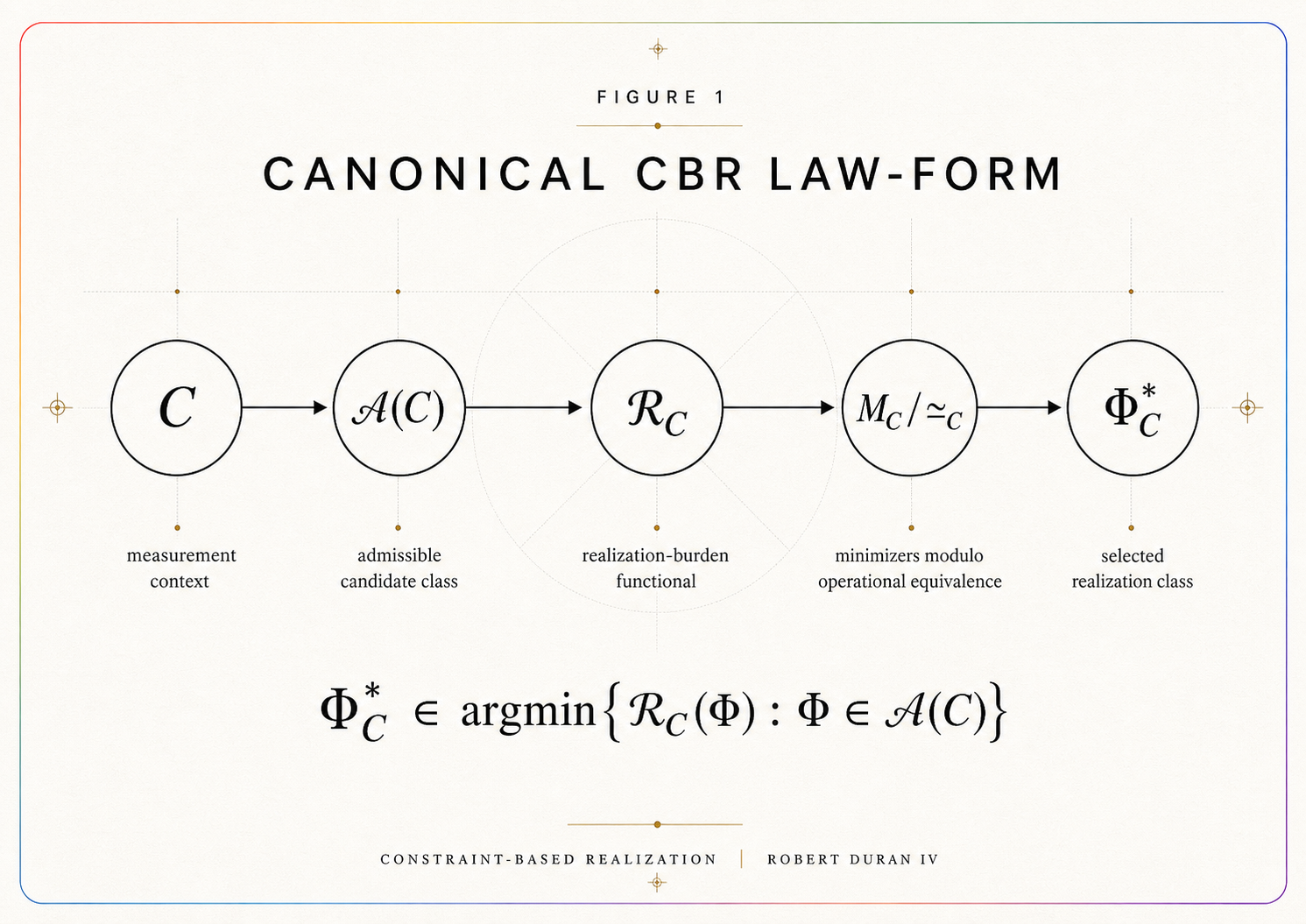
CBR proposes that realization should be represented as constrained selection over a physically admissible class of candidate realization structures. For a measurement context C, the framework specifies an admissible class 𝒜(C), a context-fixed realization-burden functional ℛ_C, an operational equivalence relation ≃_C, and a selected realization channel or equivalence class Φ∗_C satisfying:
Φ∗_C ∈ argmin{ℛ_C(Φ) : Φ ∈ 𝒜(C)}
The claim is not that this equation proves CBR true. The claim is that any disciplined candidate law of realization must specify a domain, identify what is being selected, restrict admissibility, compare candidates by a rule fixed before the outcome, preserve Born-compatible ensemble behavior, avoid collapse into non-selective decoherence, and state the conditions under which it fails. CBR merits evaluation because it converts the outcome-realization problem from a broad interpretive dispute into a reviewable law-candidate structure.
1. The isolated problem
Quantum mechanics supplies state spaces, amplitudes, dynamics, observables, and Born-rule probabilities. Decoherence explains interference suppression, environmental entanglement, pointer stability, record formation, and effective classicality.
CBR does not dispute those achievements.
It isolates a different question: What, if anything, is the law by which one admissible outcome structure becomes the realized event in an individual measurement context?
This question is easy to obscure because three distinct layers are often compressed: Evolution concerns how the quantum state or reduced state changes. Registration concerns how record-bearing correlations form. Realization concerns which admissible outcome structure becomes actual.
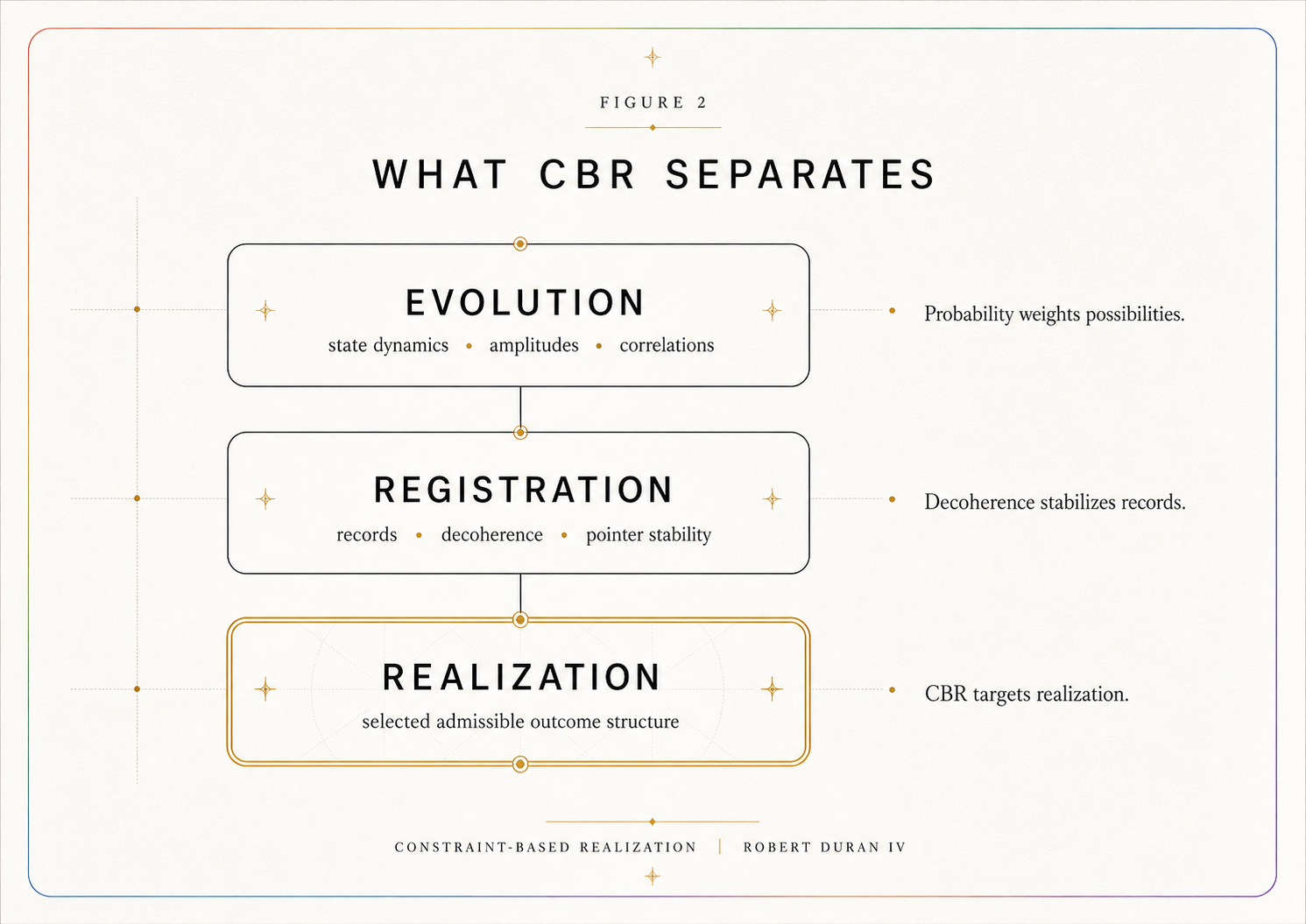
CBR begins from the claim that these are not the same question. Probability weights possible outcomes. Decoherence explains record stabilization and interference suppression. Neither, by itself, transparently states a separate law-form for individual outcome actualization.
CBR is addressed to that residual target.
2. Canonical form
For a physically specified measurement context C, CBR introduces four law-defining objects.
𝒜(C) is the admissible class of realization-compatible candidates.
ℛ_C is a context-fixed realization-burden functional.
≃_C is an operational equivalence relation.
Φ∗_C is the selected realization channel or selected operational equivalence class.
The canonical representation is:
Φ∗_C ∈ argmin{ℛ_C(Φ) : Φ ∈ 𝒜(C)}
This is not intended as decorative notation. It is the compressed form of a burdened law-candidate. The context must be fixed. The candidate class must be physically restricted. The burden functional must be specified before the outcome. Operationally irrelevant multiplicity must be quotiented away. The selected realization class must follow from the fixed structure rather than being assigned retrospectively.
CBR is therefore not primarily an interpretation of quantum mechanics. It is a proposed discipline for formulating a candidate law of outcome realization.
3. The burden standard
CBR should be evaluated by the burdens it imposes on itself.
A candidate realization law must specify its physical domain.
It must identify the admissible structures among which selection occurs.
It must restrict admissibility by physical and operational criteria, not by post hoc preference.
It must compare candidates by a rule fixed before the realized outcome is known.
It must define uniqueness operationally, not merely syntactically.
It must preserve Born-compatible ensemble behavior unless a controlled deviation is declared in advance.
It must add realization content beyond non-selective decoherence, or else concede reduction.
It must prevent post hoc parameter tuning.
It must state the conditions under which it fails.
These are not auxiliary defenses. They are the review criteria.
A CBR model fails if C is undefined, if 𝒜(C) is arbitrary or empty, if ℛ_C is adjusted after the result, if minimizers remain operationally distinct without a tie rule, if Born-compatible behavior is violated without a registered deviation claim, if the selected structure reduces entirely to a non-selective decoherence-compatible channel, or if a pre-registered empirical signature is absent under declared detectability conditions.
The framework therefore does not seek immunity from criticism. It is designed to make criticism exact.
4. Relation to probability
CBR does not replace the Born rule.
The Born rule gives statistical weights for possible outcomes across repeated trials. CBR asks whether there is an additional law-form governing which admissible outcome structure becomes actual in an individual context.
The distinction is between weighting and realization.
A CBR model that violates Born-compatible ensemble statistics without a pre-specified, empirically vulnerable deviation claim fails the probability burden. The framework therefore does not use realization as permission to invent new outcome weights. It treats probability discipline as a condition of admissibility.
5. Relation to decoherence
CBR does not reject decoherence.
Decoherence remains essential for explaining environmental entanglement, interference suppression, record stabilization, and effective classicality. The question is whether non-selective decoherence alone states a law of individual outcome realization.
If CBR adds no realization content beyond a non-selective decoherence-compatible channel, then CBR fails as an independent realization-law candidate in that context.
This is not a rhetorical distinction. It is a defeat condition.
6. Empirical exposure
CBR is intended to be vulnerable to empirical failure.
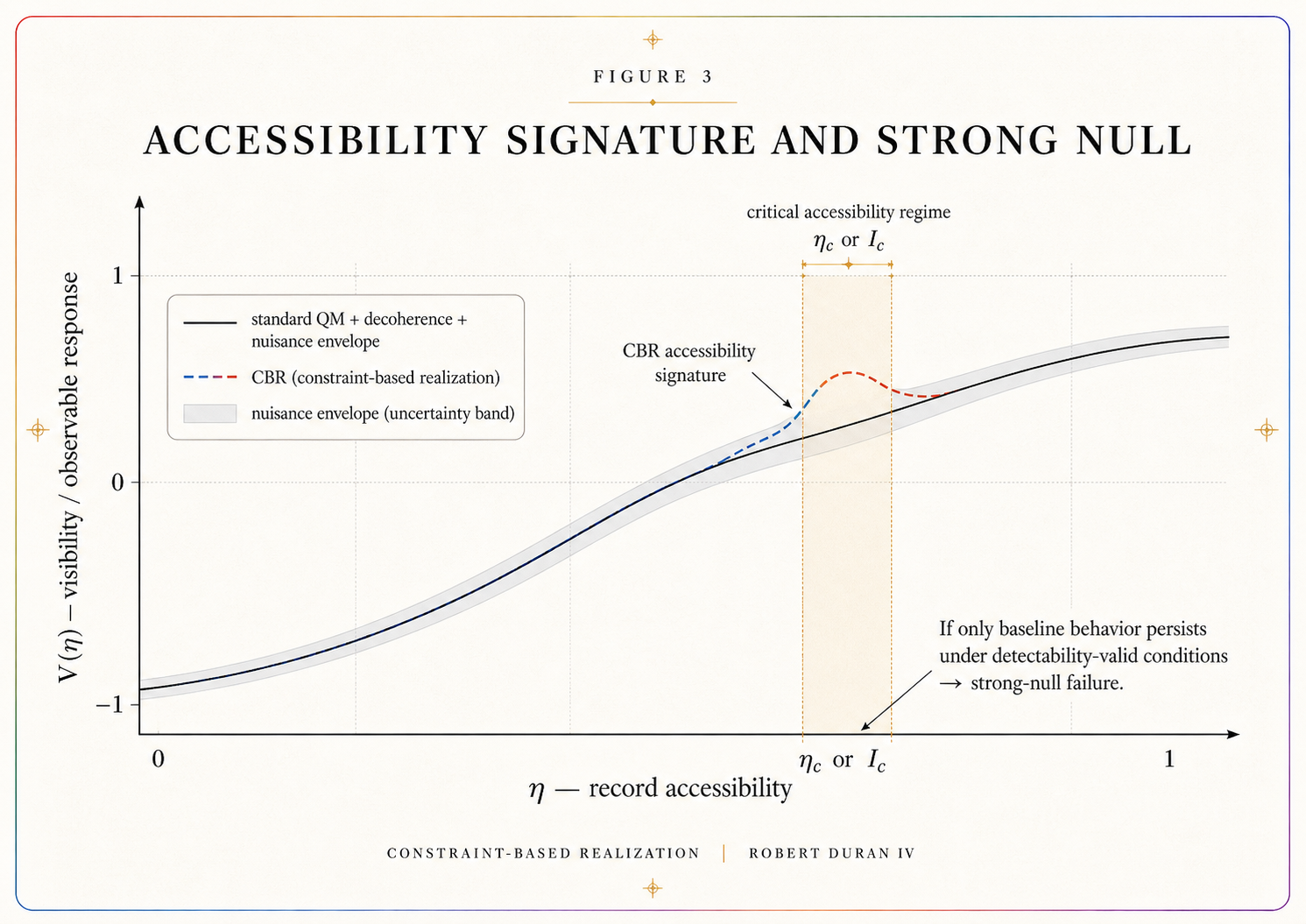
The proposed exposure route is an accessibility-sensitive measurement context, especially delayed-choice record-accessibility protocols. The relevant variable is η, an operational measure of accessible record or which-path information. If accessibility enters the realization law nontrivially, the observable response should not remain globally contained within a validated smooth standard-quantum/decoherence baseline across the accessibility-critical regime.
The strongest expected signature is a kink or derivative break near a critical accessibility value η_c. A weaker admissible signature is a bounded non-baseline deviation near the critical regime.
The strong-null condition is direct: If the context, admissible class, realization functional, accessibility parameter, baseline comparator, nuisance envelope, detectability threshold, and verdict rule are fixed in advance, and validated experiments show only baseline-class behavior across the declared accessibility-critical regime, then that registered CBR instantiation fails.
CBR therefore does not ask to be accepted as an interpretation. It asks to be specified sharply enough that it can be rejected.
7. What is not claimed
CBR does not claim to be established physics.
It does not claim experimental confirmation.
It does not claim to replace standard quantum mechanics.
It does not claim that the Born rule is false.
It does not claim that decoherence is false.
It does not claim to defeat all rival interpretations.
It does not claim universal closure over every possible realization-law framework.
It does not claim broad empirical deviation across ordinary measurement settings.
The claim is narrower: If individual outcome realization is treated as a law-governed physical target, CBR gives a disciplined candidate form for that law: constrained selection from a physically admissible class, fixed by context, burden, and operational equivalence, and exposed to failure.
8. Why it merits review
CBR merits review because it turns a familiar interpretive pressure point into a structured law-candidate problem.
It does not ask the reader to accept a new ontology first. It asks whether the following structure is coherent:
context → admissible candidates → burden ordering → operational equivalence → selected realization class.
The central review questions are precise:
Can 𝒜(C) be specified without smuggling in the outcome?
Can ℛ_C be physically motivated rather than chosen for convenience?
Does ≃_C remove only operationally irrelevant distinctions?
Does the framework preserve Born-rule discipline?
Does CBR add realization content beyond decoherence?
Can η be operationalized in a real delayed-choice record-accessibility protocol?
Can the strong-null condition be made experimentally decisive?
If the answer to these questions is no, CBR fails or must be revised. If the answer is yes, then CBR deserves deeper technical evaluation as a candidate law-form for outcome realization.
Conclusion
Constraint-Based Realization is a candidate law-form for one specific target: individual quantum outcome realization.
Its central claim is not that quantum mechanics is wrong. Its claim is that probability weighting, record formation, and outcome realization are distinct physical questions.
Quantum mechanics weights possible outcomes. Decoherence explains how records stabilize. CBR asks whether the final step — one admissible outcome becoming actual — is itself law-governed.
If CBR is correct, realization is not a primitive leftover, subjective update, or arbitrary collapse. It is constrained selection from a physically admissible class.
If CBR is wrong, its failure would still clarify the burden any rival realization law must carry: domain, candidates, admissibility, non-circular selection, probability discipline, decoherence separation, operational uniqueness, and failure conditions.
That is why CBR merits scientific evaluation.
