

What Constraint-Based Realization Claims — and Does Not Claim | A Scope-Control Note for Evaluating CBR
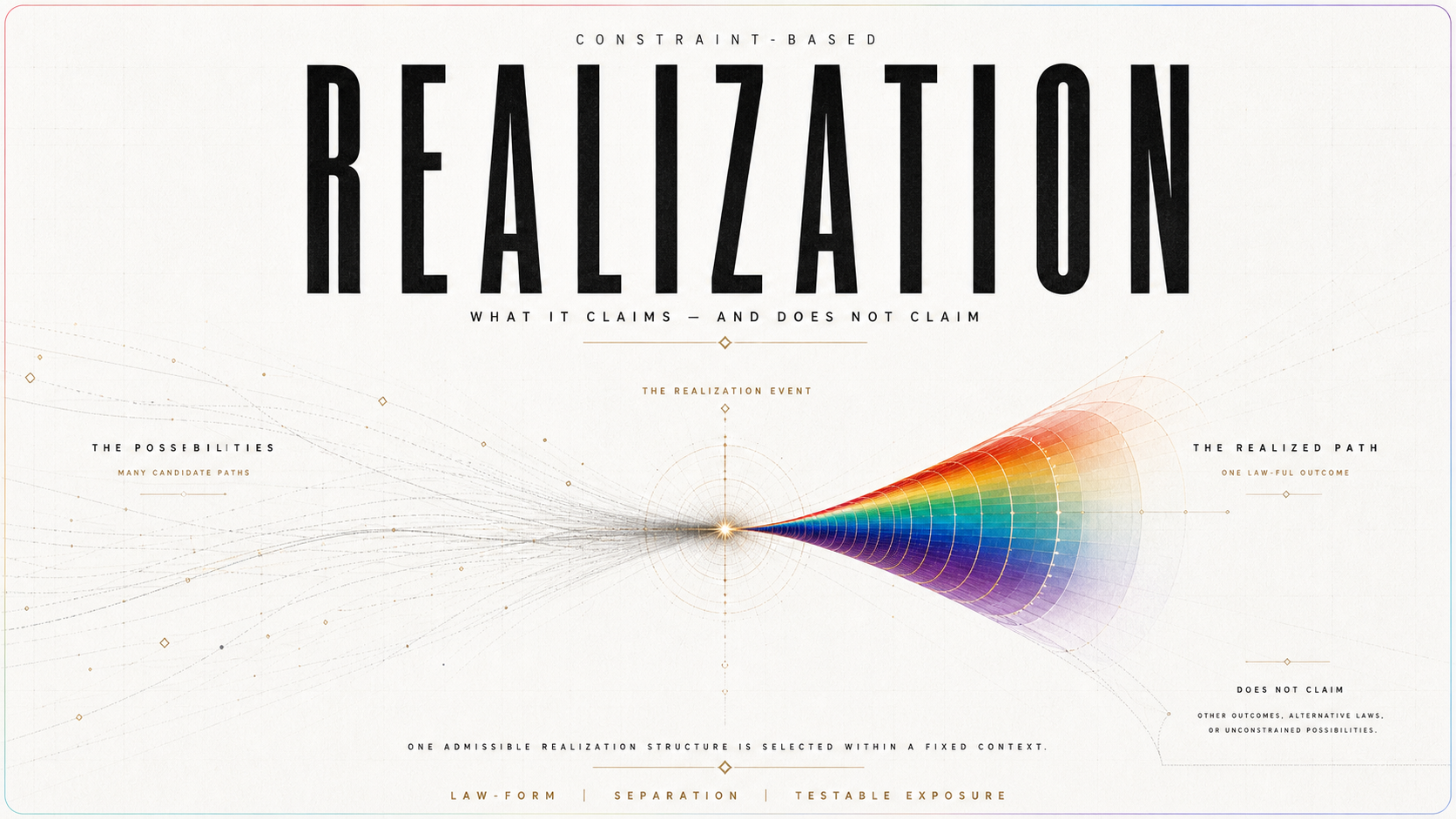
Robert Duran IV
Independent Researcher
www.robertduraniv.com/research
Scope of this note. This note is not the full technical presentation of Constraint-Based Realization. It is a compact scope-control document intended to clarify CBR’s claims, non-claims, and evaluation standards; the full technical program is developed across the related CBR papers and research sequence.
Purpose
This note clarifies the scope of Constraint-Based Realization, or CBR. It is intended to prevent the framework from being overread, underread, or misclassified before its technical claims are evaluated.
CBR is not presented as established physics. It is not a replacement for standard quantum mechanics, a rejection of the Born rule, a denial of decoherence, a consciousness-collapse theory, or a claim of experimental confirmation.
CBR is a candidate law-form for a narrower target: individual quantum outcome realization.
Its guiding question is: If one admissible outcome structure becomes actual in an individual measurement context, can that final step be represented as a non-circular, probability-compatible, decoherence-distinct, operationally meaningful, and failure-capable law?
CBR proposes that, if such a law exists, its disciplined form is constrained selection over physically admissible candidates:
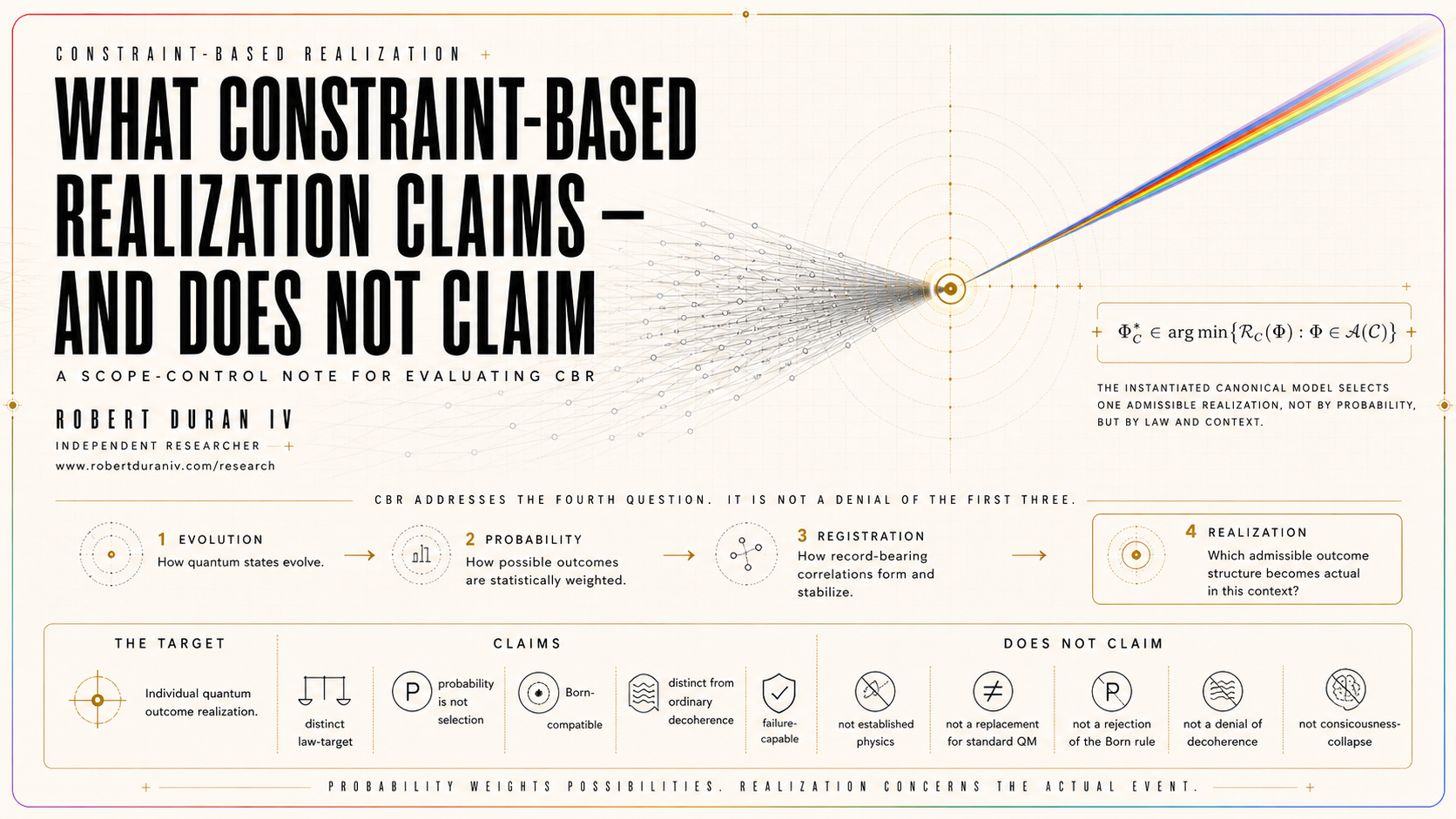
Φ∗_C ∈ argmin{ℛ_C(Φ) : Φ ∈ 𝒜(C)}
This note states what that proposal claims, what it does not claim, and how it should be judged.
1. Core Thesis
The central thesis of CBR is: Quantum theory weights possible outcomes. Decoherence explains the stabilization of records. CBR asks whether the further step — one admissible outcome structure becoming actual — has a law-form.
CBR separates four questions that are often compressed: Evolution concerns how the quantum state or reduced state changes. Probability concerns how possible outcomes are statistically weighted. Registration concerns how record-bearing correlations form and stabilize. Realization concerns which admissible outcome structure becomes actual.
CBR is addressed to the fourth question.
It does not deny the first three.
2. What CBR Claims
Claim 1 — Realization is a distinct law-target.
CBR claims that individual outcome realization can be treated as a distinct physical question from state evolution, probability assignment, and record formation.
This does not mean realization is independent of those structures. It means realization is not automatically identical to them.
CBR’s target is not merely what outcomes are possible, how they are weighted, or how records stabilize. Its target is: which admissible outcome structure becomes actual in an individual measurement context.
Claim 2 — Probability is not selection.
CBR claims that Born-rule probability weighting is not itself a law of individual realization.
The Born rule gives statistical weights across repeated trials. CBR does not reject this. It treats Born-compatible ensemble behavior as a requirement.
The distinction is narrower: Probability weights alternatives; it does not, by itself, identify a separate law selecting one actual outcome structure.
Claim 3 — Decoherence is not automatically realization.
CBR claims that non-selective decoherence-compatible evolution is not automatically equivalent to a law of single-outcome actualization.
Decoherence explains interference suppression, environmental entanglement, pointer stability, and effective classicality. CBR accepts those achievements.
The question is whether decoherence also supplies a law of which admissible record-structure is realized in an individual case.
If CBR adds no realization content beyond non-selective decoherence, then CBR fails as an independent law-candidate in that context.
Claim 4 — A realization law must specify its selection objects.
CBR claims that a serious realization law cannot merely say that “the outcome happens.”
It must specify:
C — the physical measurement context;
𝒜(C) — the admissible candidate class;
ℛ_C — the realization-burden functional;
≃_C — the operational equivalence relation;
Φ∗_C — the selected realization channel or selected realization class.
The canonical representation is:
Φ∗_C ∈ argmin{ℛ_C(Φ) : Φ ∈ 𝒜(C)}
This is not offered as proof that CBR is true. It is the proposed form a disciplined candidate law of realization should take.
Claim 5 — Admissibility is the first anti-arbitrariness condition.
CBR claims that not every mathematically writable candidate should count as physically admissible.
The admissible class 𝒜(C) must be restricted by context-relative physical and operational criteria. Otherwise, the theory could be made to select anything.
Admissibility is therefore not decorative. It is what prevents the candidate space from becoming arbitrary.
Claim 6 — Selection must be non-circular.
CBR claims that the law-defining objects must be fixed before the realized outcome is known.
At minimum, this includes:
C,
𝒜(C),
ℛ_C,
≃_C,
parameters,
thresholds,
tolerances,
and any tie-resolution rule.
In empirical settings, it also includes:
η,
η_c or I_c,
the baseline comparator,
the nuisance envelope,
the detectability threshold,
the statistical plan,
and the verdict rule.
If these are adjusted after the outcome, the model is not explaining realization. It is redescribing the result.
Claim 7 — Uniqueness should be operational, not merely syntactic.
CBR claims that a realization law need not always produce strict formal uniqueness at the level of notation.
Two candidate channels may differ formally while being operationally indistinguishable in context C. CBR therefore uses ≃_C to identify physically irrelevant multiplicity.
The relevant standard is:
unique up to operational equivalence.
This protects the theory from both false uniqueness and meaningless formal multiplicity.
Claim 8 — Born compatibility is mandatory by default.
CBR claims that any acceptable realization law must preserve Born-compatible ensemble behavior unless it declares a controlled, pre-specified, empirically vulnerable deviation.
CBR does not use realization as permission to invent new probabilities.
A model that violates Born-compatible frequencies without a registered deviation claim fails the probability burden.
Claim 9 — Non-reduction to decoherence is a burden, not a slogan.
CBR claims independence from decoherence only if the selected realization structure adds content not exhausted by non-selective decoherence-compatible evolution.
If, in a given context, Φ∗_C is operationally equivalent to a non-selective decoherence-compatible channel and supplies no further realization content, then CBR fails there as an independent realization law.
This is not a rhetorical distinction. It is a defeat condition.
Claim 10 — CBR must be vulnerable to failure.
CBR claims that a serious candidate law must be able to fail.
It can fail structurally if its context is undefined, its candidate class is arbitrary, its burden functional is circular, its equivalence relation hides real differences, its minimizer structure is unresolved, its parameters are tuned after the fact, or its Born/decoherence burdens are not met.
It can fail empirically if a registered instantiation predicts a detectable accessibility-sensitive signature and validated experiments show only baseline-class behavior under the declared conditions.
3. What CBR Does Not Claim
Non-claim 1 — CBR does not claim experimental confirmation.
CBR is a candidate framework. It is not presented as confirmed physics.
Non-claim 2 — CBR does not replace standard quantum mechanics.
CBR does not reject the formal success of standard quantum mechanics. It asks whether an additional law-form is needed for individual realization.
Non-claim 3 — CBR does not reject the Born rule.
CBR does not deny Born-rule probabilities. It treats Born-compatible behavior as a central discipline.
Non-claim 4 — CBR does not deny decoherence.
CBR accepts decoherence as essential to interference suppression, record stabilization, and effective classicality.
Its question is whether decoherence is also a complete law of individual outcome realization.
Non-claim 5 — CBR does not claim to defeat all interpretations.
CBR does not claim that Many-Worlds, Bohmian mechanics, collapse theories, Copenhagen-type approaches, QBism, relational views, or other interpretations have been globally refuted.
It proposes a distinct candidate law-form for a specific target.
Non-claim 6 — CBR does not claim universal closure over every possible realization law.
CBR’s strongest claims are conditional, scoped, and burden-relative.
It does not claim that every conceivable alternative has been ruled out.
Non-claim 7 — CBR does not claim broad empirical deviation in ordinary measurement settings.
CBR does not predict obvious anomalies everywhere.
Its proposed empirical exposure is narrower: accessibility-sensitive record protocols where realization-relevant accessibility may become testable.
Non-claim 8 — CBR does not make consciousness a law-defining object.
CBR is not a consciousness-collapse theory.
The framework does not use awareness, observation, or subjective experience as the mechanism of realization. Its law-defining objects are physical and operational.
Non-claim 9 — CBR does not claim that all possibilities become real.
CBR is not the claim that every possible outcome, branch, world, or timeline is actual.
Its structure is explicitly selective:
many admissible candidates; one selected realization class.
Non-claim 10 — CBR does not claim immunity from failure.
CBR is strongest only if it can be wrong.
A registered CBR instantiation that fails its own declared structural or empirical burdens should be treated as failed.
4. Common Misreadings
Misreading 1 — “CBR says quantum mechanics is wrong.”
CBR does not claim that.
CBR claims that standard quantum mechanics gives probabilities and dynamics, while the law-form of individual realization may be a distinct question.
Misreading 2 — “CBR replaces Born probabilities.”
CBR does not claim that.
CBR treats Born compatibility as a burden. Probability weighting and realization selection are distinguished, not confused.
Misreading 3 — “CBR is just decoherence renamed.”
CBR does not claim identity with decoherence.
If CBR collapses into non-selective decoherence in a context, it fails there as an independent realization-law candidate.
Misreading 4 — “CBR is just another interpretation.”
CBR may have interpretive implications, but its primary form is law-candidate discipline.
It specifies context, admissibility, burden ordering, operational equivalence, and failure conditions.
Misreading 5 — “CBR claims to solve all of quantum foundations.”
CBR does not claim that.
It addresses one target: individual quantum outcome realization.
Misreading 6 — “CBR is unfalsifiable.”
CBR should not be unfalsifiable.
A properly registered instantiation can fail structurally or empirically. In particular, if an accessibility-sensitive test is detectability-valid and only baseline-class behavior persists across the declared critical regime, the registered instantiation fails.
5. Proper Evaluation Standard
CBR should be judged by the following questions:
Can the context C be specified physically and operationally?
Can 𝒜(C) be defined without smuggling in the outcome?
Can ℛ_C be physically motivated rather than chosen for convenience?
Is ≃_C a legitimate operational equivalence relation?
Does the framework preserve Born-compatible ensemble behavior?
Does it add realization content beyond non-selective decoherence?
Can η be operationalized in accessibility-sensitive protocols?
Can the baseline comparator and nuisance envelope be fixed in advance?
Can the registered model fail under a clear strong-null condition?
These are the appropriate pressure points.
CBR should not be accepted because it is conceptually attractive. It should be evaluated because it makes a precise law-candidate claim.
6. One-Sentence Scope Statement
For quick reference, CBR may be summarized as follows: Constraint-Based Realization is a candidate law-form for quantum outcome realization, proposing that one admissible outcome structure becomes actual through constrained selection over physically admissible candidates, while preserving Born compatibility, remaining distinct from decoherence, and exposing registered models to structural and empirical failure.
Conclusion
Constraint-Based Realization claims less than a completed theory of nature and more than an interpretive slogan.
It does not claim that standard quantum mechanics is wrong, that the Born rule is false, or that decoherence fails. It claims that probability weighting, record stabilization, and individual realization are distinct questions.
Its proposed answer is a disciplined law-form:
Φ∗_C ∈ argmin{ℛ_C(Φ) : Φ ∈ 𝒜(C)}
The value of CBR lies in its burden structure. It defines what must be fixed, what must be preserved, what must be distinguished, and what would count as failure.
That is the proper scope of the claim.
References and Related CBR Works
Duran IV, Robert. Constraint-Based Realization: Canonical Closure and Exact Empirical Exposure. Version 1.0, April 2026.
Duran IV, Robert. A Minimal Reconstruction of Constraint-Based Realization from the Burdens of a Quantum Outcome Law. Version 1.0, April 2026.
Duran IV, Robert. The Realization-Burden Functional in Constraint-Based Realization: A Necessity Argument for Quantum Outcome Selection. 2026.
Duran IV, Robert. Constraint-Based Realization and the Quadratic-Weighting Barrier: Born-Rule Discipline in Canonical CBR. 2026.
Duran IV, Robert. Detectability of Constraint-Based Realization in a Delayed-Choice Record-Accessibility Interferometer. 2026.
Duran IV, Robert. The Jurisdiction of Failure in Quantum Outcome Realization. 2026.
