

The Quadratic-Weighting Barrier and Constraint-Based Realization (CBR) : Born Rule Discipline in Canonical CBR
Robert Duran IV
Version 1.0, April 2026
Keywords
Constraint-Based Realization; CBR; Born rule; quantum foundations; outcome realization; probability discipline; admissibility; operational equivalence; quadratic weighting; non-circularity
Abstract
Standard quantum mechanics assigns outcome weights by the Born rule, P(i) = |αᵢ|². Constraint-Based Realization is not introduced as a replacement for that statistical structure. It is a candidate law-form for individual outcome realization, represented canonically as Φ∗_C ∈ argmin{ℛ_C(Φ) : Φ ∈ 𝒜(C)}. Yet a realization law cannot be probability-neutral in an unrestricted sense. If arbitrary weighting can be hidden inside the admissible class 𝒜(C), the burden functional ℛ_C, the minimizer structure M_C, a tie-resolution rule τ_C, the selected verdict Φ∗_C, or an undeclared auxiliary weighting rule, then the law-form risks concealing outcome preference rather than constraining realization.
This paper develops the quadratic-weighting barrier for canonical CBR. Its aim is not to prove a universal Born-rule theorem across every conceivable realization-law framework, admissibility geometry, or interpretation of quantum mechanics. Its aim is narrower and more exact: to identify which weighting rules remain admissible inside canonical CBR. A context-indexed weighting rule w_C : 𝒜(C)/≃_C → [0,1], or outcome-indexed rule w_C(i) = P(i), is canonical only if it satisfies refinement additivity, coarse-graining stability, operational invariance, symmetry, normalization, regularity, nontriviality, empirical Born compatibility, and non-circularity. These conditions are not optional virtues. They are the membership burdens that prevent probability from being engineered after the fact.
The paper proceeds theorem-forward. It first separates probability weighting from realization selection: probability governs ensemble weights, while realization concerns the context-relative selection of one admissible verdict structure. It then defines canonical weighting over operational verdict classes, not arbitrary formal representatives. Refinement additivity and coarse-graining stability prevent weights from changing under mere decomposition or recombination. Operational invariance and symmetry prevent representation-sensitive or hidden preferential weighting. Normalization, regularity, and nontriviality exclude pathological, discontinuous, or empty assignments. Empirical Born compatibility and non-circularity prevent the realization law from embedding undeclare
d probability preference inside its law-defining objects.
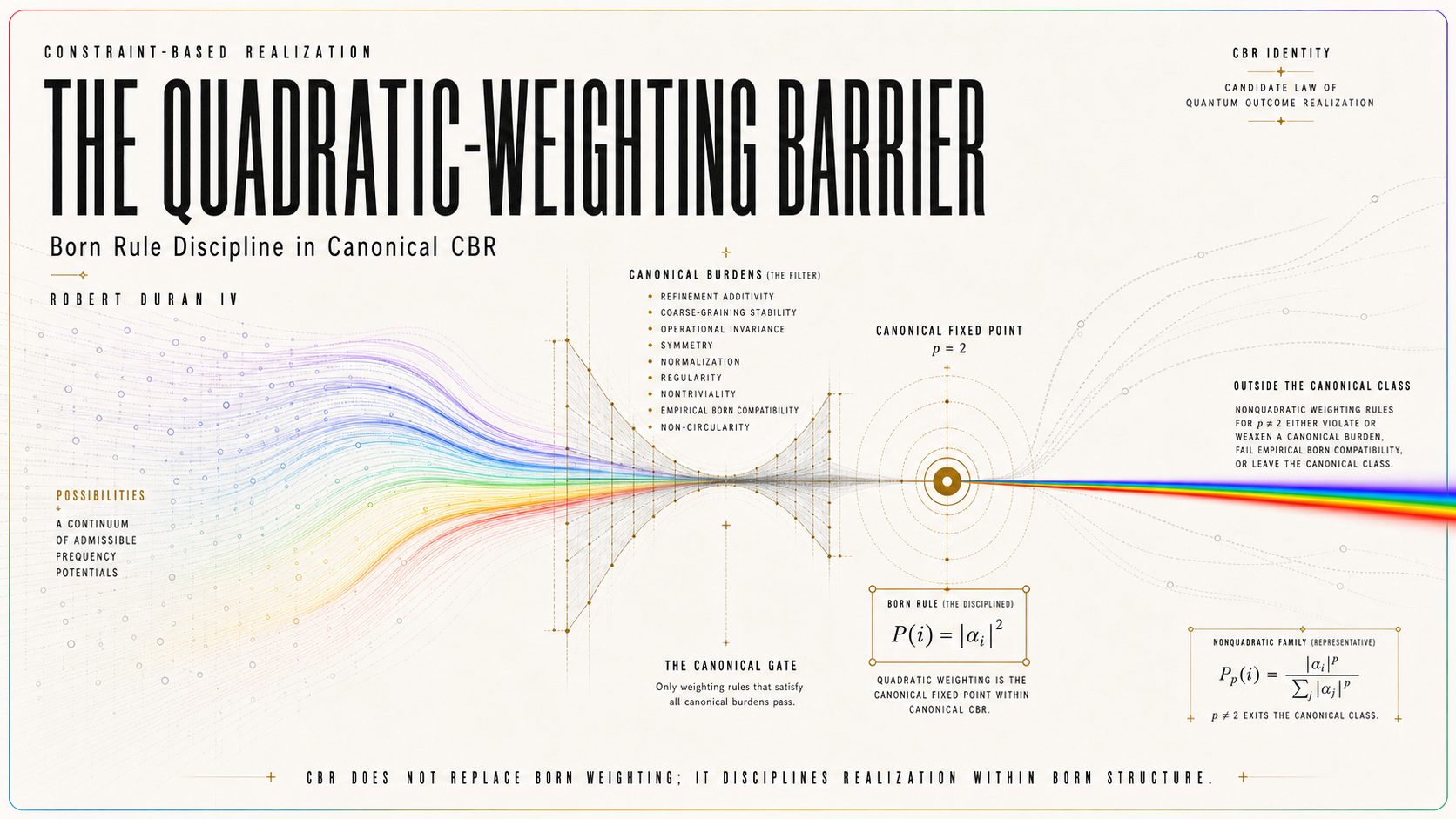
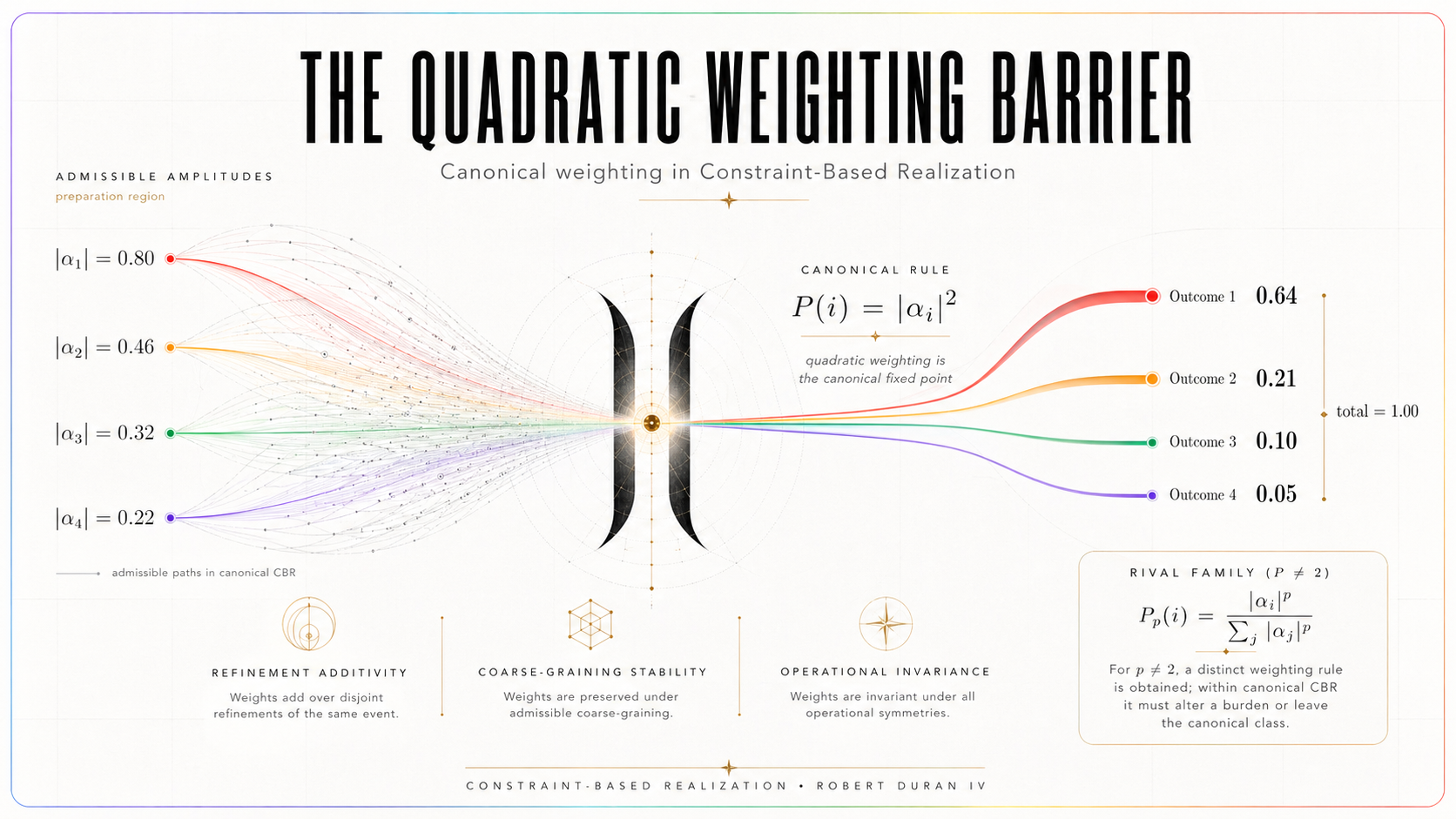
The central result is the Quadratic Rigidity Theorem: within canonical admissibility, quadratic weighting is the stable normalized rule compatible with the declared burdens. A representative nonquadratic family, P_p(i) = |αᵢ|ᵖ / Σⱼ|αⱼ|ᵖ, is used as an adversarial test case. For p = 2, the family recovers quadratic weighting. For p ≠ 2, the rule must either violate or weaken at least one canonical burden, fail empirical Born compatibility, or define a noncanonical admissibility structure. The Nonquadratic Escape-Cost Theorem generalizes this result: a distinct normalized nonquadratic rule must declare which burden it rejects, weakens, or replaces. The Canonical-Membership Reclassification Theorem then states that such a rule may be an external theory, noncanonical extension, or successor framework, but it is not an equivalent internal alternative to canonical CBR. The No Hidden Probability Engineering Theorem further states that ℛ_C cannot claim canonical status if it embeds an outcome-weighting preference that violates the canonical weighting burdens.
The result is not experimental confirmation of CBR and not a universal derivation of the Born rule. It is a canonical-membership result. Canonical CBR is not probability-arbitrary: a weighting rule must satisfy the burdens that stabilize quadratic weighting or leave the canonical class.
1. Introduction
1.1 The probability burden on a realization law
Constraint-Based Realization is proposed as a candidate law-form for individual quantum outcome realization. Its canonical representation is:
Φ∗_C ∈ argmin{ℛ_C(Φ) : Φ ∈ 𝒜(C)}.
Here C is a physically specified measurement context, 𝒜(C) is the admissible class of realization-compatible candidates in that context, ℛ_C is the context-fixed realization-burden functional, and Φ∗_C is the selected realization channel or operational verdict class. The law-form is not introduced as a replacement for standard quantum dynamics, nor as a replacement for Born-rule statistics. It is introduced to state a narrower structure: if individual outcome realization is treated as a law-form problem, then the theory must specify the context, admissible candidates, comparison rule, and selected verdict class.
That structure, however, cannot remain indifferent to probability. If 𝒜(C) admits arbitrary weighting rules, admissibility can conceal hidden preference. If ℛ_C embeds a noncanonical outcome-weighting structure, minimization can appear principled while actually encoding a probability choice by hand. If weighting is selected after the observed outcome, then the law does not explain realization; it rationalizes the result.
The probability burden on CBR is therefore exact. CBR may distinguish probability from realization, but it cannot treat probability as irrelevant to realization. A candidate outcome law must remain disciplined by the empirical and structural role of Born-style weighting. It must not use the language of admissibility or burden minimization to smuggle arbitrary nonquadratic preference into the law-form.
The central problem of this paper is:
CBR must be a law-form for realization, but it must not become probability-arbitrary.
This paper carries that burden.
1.2 The wrong way to state the result
The weakest way to present the present argument would be to claim that CBR universally derives the Born rule across every possible theory, every possible admissibility geometry, and every possible interpretation of quantum probability. That claim is too broad for this paper. It would require a global theorem over all possible realization-law frameworks, all possible representations of admissibility, and all possible candidate probability structures.
That is not the claim made here.
This paper does not attempt to prove that every imaginable theory must use quadratic weighting. It does not attempt to show that every nonquadratic rule is logically incoherent. It does not claim that no external noncanonical theory can be written. It does not claim that all rival interpretations of quantum mechanics are defeated.
Those claims would overstate the result and weaken the paper.
The correct question is narrower:
Which weighting rules remain admissible inside canonical CBR?
That is a membership question, not a universal metaphysical claim. The paper asks what a weighting rule must satisfy in order to remain internal to canonical CBR’s admissibility structure. If a rival rule rejects those requirements, it may be a different theory, an external alternative, a noncanonical extension, or a successor framework. But it is not an equivalent internal replacement inside canonical CBR.
1.3 The correct claim
The correct claim is local, canonical, and structural.
Within canonical CBR, a weighting rule remains admissible only if it satisfies the burdens defining canonical membership: refinement additivity, coarse-graining stability, operational invariance, symmetry, normalization, regularity, nontriviality, empirical Born compatibility, burden independence, and non-circularity. Under those burdens, quadratic weighting is the canonical fixed point.
In outcome notation, the canonical quadratic rule is:
P(i) = |αᵢ|².
Equivalently, if w_C is a context-indexed weighting rule over admissible candidates modulo operational equivalence,
w_C : 𝒜(C)/≃_C → [0,1],
then canonical CBR requires w_C to remain stable under the transformations and constraints that define the canonical class. A rule that changes under admissible refinement, fails under coarse-graining, assigns different weights to operationally equivalent candidates, breaks symmetry without physical cause, fails normalization, behaves pathologically, erases meaningful distinctions, conflicts with empirical Born compatibility, depends on the selected minimizer, or is tuned after the realized outcome is not a canonical weighting rule.
The resulting claim is not that nonquadratic rules cannot be written. Many such rules can be written. For example, the representative family
P_p(i) = |αᵢ|ᵖ / Σⱼ|αⱼ|ᵖ
is mathematically well-defined for many choices of p. But mathematical writability is not canonical membership. The question is whether such a rule remains internal to canonical CBR. For p = 2, the rule recovers quadratic weighting. For p ≠ 2, the rule must either satisfy the canonical burdens, declare a different admissibility structure, fail empirical Born compatibility, or accept reclassification as noncanonical.
The strongest form of the paper’s claim is therefore:
A nonquadratic rival must either satisfy the canonical burdens and collapse into quadratic discipline, or reject a burden and exit the canonical class.
1.4 Main contribution
The paper contributes a canonical-membership criterion for weighting rules.
A weighting rule is not canonical merely because it can be attached to the law-form. It is canonical only if it satisfies the burdens that make admissibility non-arbitrary. The canonical law-form
Φ∗_C ∈ argmin{ℛ_C(Φ) : Φ ∈ 𝒜(C)}
does not license arbitrary weighting inside 𝒜(C) or ℛ_C. On the contrary, the law-form requires a disciplined relation among context specification, admissibility, operational equivalence, amplitude structure, weighting, burden minimization, and selected realization.
The architecture is:
C fixes the physical measurement context.
𝒜(C) fixes the admissible class of realization-compatible candidates.
𝒜(C)/≃_C fixes the operational verdict classes by quotienting away irrelevant formal multiplicity.
Amplitude structure assigns αᵢ, or an operationally equivalent amplitude-bearing representation, to outcome-indexed admissible classes.
w_C assigns weights to admissible verdict classes.
ℛ_C may use only weighting structure compatible with canonical burdens.
Φ∗_C is then selected without hidden probability engineering.
This is the weighting legitimacy chain. It is the bridge between the canonical law-form and the quadratic-weighting barrier.
The paper develops that chain in five steps. First, it separates probability weighting from individual realization selection. Second, it introduces the formal weighting object w_C over 𝒜(C)/≃_C. Third, it states the amplitude-structure condition required for applying quadratic weighting to outcome-indexed admissible classes. Fourth, it defines the canonical weighting burdens. Fifth, it establishes the quadratic-weighting barrier: quadratic weighting is the canonical fixed point of those burdens, and nonquadratic rivals must either satisfy the same burdens or leave the canonical class.
The contribution is therefore not “CBR proves Born weighting everywhere.”
The contribution is:
canonical CBR does not permit arbitrary weighting internally.
1.5 Non-claims
The scope of the paper is deliberately limited.
This paper does not claim that CBR is experimentally confirmed. It does not claim that CBR replaces standard quantum mechanics. It does not claim that CBR universally derives the Born rule across every possible framework. It does not claim that every possible nonquadratic theory is incoherent. It does not claim that all rival interpretations are defeated. It does not eliminate the need for empirical testing.
The paper also does not claim that noncanonical weighting theories are refuted merely by being noncanonical. Reclassification is not refutation. A noncanonical theory may be proposed, but it must be evaluated under its own admissibility rules, empirical burdens, and failure conditions.
The claim is narrower and more durable:
canonical CBR is not probability-arbitrary.
Within canonical admissibility, weighting is burden-constrained. Quadratic weighting is the canonical fixed point. Nonquadratic alternatives cannot remain unpriced internal options. They must either satisfy the burdens that stabilize quadratic weighting or leave the canonical class.
Canonical membership is not truth. It is internal admissibility. A noncanonical rule may still be proposed, but it cannot claim to be an unmodified internal rule of canonical CBR.
2. Probability Is Not Realization
2.1 The Born rule as ensemble discipline
Standard quantum mechanics assigns outcome weights according to the Born rule. For a state written schematically as
|ψ⟩ = Σᵢ αᵢ|i⟩,
the standard weighting rule is
P(i) = |αᵢ|².
This rule governs the statistical distribution of outcomes across repeated trials. It is one of the central empirical structures of quantum theory. Any candidate law of outcome realization must treat that structure with discipline.
CBR is not introduced here as a replacement for that statistical rule. The present paper does not attempt to discard Born weighting and substitute a new probability law. Its task is to ask whether canonical CBR can remain internally disciplined with respect to weighting.
The answer must be yes for CBR to function as a serious realization-law candidate. A theory that proposes a realization law while permitting arbitrary weighting would be unstable at its foundation. It could select among admissible candidates while hiding probability preference inside the admissible class or burden functional.
Born discipline therefore functions as a constraint on realization-law construction.
2.2 Realization as context-relative selection
CBR addresses a different question from ensemble probability assignment.
Given a physically specified measurement context C, what selects the realized outcome channel or operational verdict class Φ∗_C from the admissible class 𝒜(C)?
This is the realization question. It concerns the selection of one admissible outcome structure in an individual context. It is represented by the canonical law-form:
Φ∗_C ∈ argmin{ℛ_C(Φ) : Φ ∈ 𝒜(C)}.
The law-form does not ask merely what probabilities are assigned across repeated trials. It asks what law-like structure, if any, governs the selection of the realized admissible candidate in a specified context.
Probability and realization are therefore distinct. Probability assigns weights. Realization selects. But distinction does not imply independence. The selected realization structure must not be produced by a weighting scheme that violates the probability discipline of the theory. A realization law that ignores weighting can become arbitrary; a probability rule that is mistaken for realization can leave the individual-selection question untouched.
CBR must occupy the disciplined middle position.
2.3 Why the distinction matters
The distinction between probability and realization matters because two opposite errors are possible.
The first error is to identify probability with realization. On this view, once the Born rule assigns P(i) = |αᵢ|², nothing further can be asked at the level of law-form selection. That collapses the realization question into statistical prediction. It may preserve standard probability, but it eliminates CBR’s target.
The second error is to separate realization from probability so completely that realization becomes unconstrained by weighting. On this view, a law-form might select admissible candidates by any weighting rule or by a hidden preference buried inside ℛ_C. That preserves the language of realization, but it loses contact with one of the strongest empirical disciplines of quantum theory.
CBR must avoid both errors.
The proper relation is:
CBR addresses realization while remaining disciplined by Born-compatible weighting.
This is why the present paper is necessary. It does not reduce realization to probability. It does not ignore probability. It asks what weighting discipline canonical CBR must obey in order to remain a serious realization-law candidate.
2.4 Empirical Born compatibility
Empirical Born compatibility means that a canonical weighting rule must reproduce Born-rule ensemble frequencies in the relevant ordinary quantum regime unless it explicitly declares a controlled, testable deviation.
This condition is not a universal derivation of the Born rule. It is a constraint on ordinary-regime ensemble behavior. It states that a model claiming canonical CBR status cannot silently depart from Born-compatible statistical discipline. If it departs, the departure must be declared as a noncanonical or deviation-bearing commitment, and it must carry its own empirical burden.
Thus empirical Born compatibility functions as a membership condition, not as a rhetorical shortcut. A weighting rule that remains inside canonical CBR must be compatible with the ordinary Born-rule regime. A rule that intentionally departs from that regime must say so openly and accept the corresponding test liability.
2.5 Proposition statement
Proposition 1 — Probability/Realization Separation. Probability weighting and individual realization selection are distinct but mutually constraining parts of a candidate outcome law. A realization law must not identify probability assignment with realization, but it also must not violate empirical probability discipline without a declared, testable deviation.
Assumptions. The proposition assumes a distinction between ensemble statistical structure and individual outcome realization. It also assumes that any candidate realization law must remain compatible with the empirical role of Born-style weighting unless it explicitly declares a controlled deviation from that structure.
Argument. Probability weighting assigns statistical weights to possible outcomes across repeated trials. Individual realization selection concerns which admissible outcome structure is selected in a context C. The two functions are not identical. However, a realization law that selects by arbitrary weighting would introduce hidden probability preference. Conversely, a theory that treats probability assignment as identical to realization leaves no distinct law-form for individual selection. Therefore the two questions must be separated but mutually constrained.
Consequence. The paper’s task is not to replace the Born rule. It is to show that canonical CBR cannot arbitrarily choose or conceal a non-Born weighting rule while remaining canonical.
Failure mode. A CBR formulation fails this proposition if it either collapses realization into probability assignment or treats weighting as irrelevant to realization-law structure.
2.6 Consequence for the paper
The rest of the paper proceeds from the separation proposition.
It asks not whether probability and realization are the same, but what weighting rules a realization law may use without becoming arbitrary. It defines a formal weighting object, imposes canonical membership burdens, identifies quadratic weighting as the canonical fixed point, tests a representative nonquadratic family, and states how nonquadratic alternatives must be reclassified when they reject canonical burdens.
The result is a probability-discipline theorem for canonical CBR.
3. The Canonical Weighting Object
3.1 Why the paper needs a formal weighting object
A probability-discipline paper cannot remain purely verbal. It must define the object being constrained.
CBR already contains several formal objects: the context C, the admissible class 𝒜(C), the realization-burden functional ℛ_C, the candidate realization channel Φ, the selected verdict class Φ∗_C, and the operational equivalence relation ≃_C. Weighting discipline must be stated relative to this structure.
If the weighting rule is left implicit, the theory remains vulnerable. A noncanonical preference could enter through the construction of 𝒜(C), through the evaluation of ℛ_C, through the interpretation of minimizers, or through post hoc adjustment of outcome weights. The paper therefore introduces an explicit context-indexed weighting object.
The purpose of the object is not to replace CBR’s law-form. It is to discipline it.
3.2 Definition 1 — Canonical weighting object
Let w_C be a context-indexed weighting rule:
w_C : 𝒜(C)/≃_C → [0,1].
Here 𝒜(C)/≃_C denotes admissible candidate structures modulo operational equivalence in context C. The rule assigns weights to operationally meaningful admissible verdict classes, not to arbitrary formal representatives.
Where admissible candidates are indexed by outcome components, the same rule may be written as:
w_C(i) = P(i).
In the canonical quadratic case, this becomes:
P(i) = |αᵢ|².
The point of defining w_C is to make weighting explicit. A canonical CBR model must be able to say what weighting rule applies, what objects it weights, and why that rule satisfies the canonical burdens.
3.3 Why weighting must live on equivalence classes
The rule w_C must live on 𝒜(C)/≃_C rather than on arbitrary formal representatives.
If weights were assigned to raw representatives, then the weighting rule could change under notational variation, redundant encoding, gauge-like reformulation, or operationally irrelevant description. That would make weighting representation-sensitive rather than physical.
Canonical CBR requires:
if Φ₁ ≃_C Φ₂, then w_C(Φ₁) = w_C(Φ₂).
This condition is not optional. It follows from the meaning of operational equivalence. If two candidates differ only in ways that make no realization-relevant operational difference in C, then a canonical weighting rule cannot assign them different weights.
A rule that violates this requirement is not a physical weighting rule over admissible verdict classes. It is a scoring rule over descriptions.
3.4 Definition 2 — Amplitude-Structure Condition
Because the canonical quadratic rule is expressed using amplitude coefficients, the weighting object must be connected to an amplitude-bearing representation.
Definition 2 — Amplitude-Structure Condition. For each outcome-indexed admissible verdict class [Φ_i]_C ∈ 𝒜(C)/≃_C, the context C supplies an amplitude coefficient αᵢ, or an operationally equivalent amplitude-bearing representation, such that weighting is evaluated over the admissible outcome classes associated with those coefficients.
This condition prevents a category error. The paper does not define w_C abstractly over channels and then suddenly invoke amplitudes without a bridge. The bridge is that, where the canonical weighting theorem is applied to outcome-indexed admissible structures, those structures must carry or inherit amplitude data from the quantum description of C.
If such amplitude structure is absent, then the quadratic theorem is not yet applicable. The model must either supply the missing amplitude-bearing representation or restrict the theorem’s scope. This is not a weakness. It is a proof-readiness requirement.
3.5 Definition 3 — Canonical weighting rule
A weighting rule w_C is canonical only if it satisfies the burdens defining canonical admissibility.
Those burdens are:
refinement additivity,
coarse-graining stability,
operational invariance,
symmetry,
normalization,
regularity,
nontriviality,
empirical Born compatibility,
burden independence,
non-circularity.
Each burden has a distinct function.
Refinement additivity prevents arbitrary changes in weight under admissible decomposition. Coarse-graining stability requires recombined descriptions to recover the same total weight. Operational invariance requires equivalent physical descriptions to receive equivalent weights. Symmetry prevents hidden preference among physically equivalent cases. Normalization requires a coherent probability distribution. Regularity blocks pathological discontinuities. Nontriviality prevents the rule from erasing meaningful distinctions. Empirical Born compatibility anchors the rule to ordinary-regime ensemble behavior unless a deviation is declared. Burden independence requires w_C to be fixed independently of Φ∗_C. Non-circularity prevents the rule from being chosen after the result.
Together, these burdens define canonical weighting.
3.6 Section result
The formal membership principle is:
Canonical weighting is burden-constrained weighting over 𝒜(C)/≃_C, applied where the admissible verdict classes carry the amplitude structure required for the quadratic rule.
This principle is the foundation of the paper. It turns the Born-discipline question into a canonical-membership question. A weighting rule belongs to canonical CBR not because it is asserted to belong, but because it satisfies the burdens that define the canonical class.
4. Canonical Admissibility and Membership
4.1 Why the theorem needs a domain
No weighting theorem is meaningful without a declared domain.
A claim that quadratic weighting is required must specify the class over which it is required. Otherwise the claim becomes either too vague or too strong. If the domain is unspecified, critics can object that other mathematical weighting rules can be written. That is true. But the relevant question is not whether alternatives can be written. The relevant question is whether they remain internal to canonical CBR.
The domain of the present paper is canonical admissibility.
This domain is not all possible theories. It is the class of realization-compatible candidates and weighting structures that satisfy the burdens required for non-arbitrary canonical realization selection.
4.2 Definition 4 — Canonical admissibility
Canonical admissibility is the class of admissible realization-compatible candidates and weighting structures that satisfy the burdens required for canonical CBR.
For the purposes of this paper, canonical admissibility includes:
refinement additivity,
coarse-graining stability,
operational invariance,
symmetry,
normalization,
regularity,
nontriviality,
non-circularity,
burden independence,
empirical Born compatibility.
A rule that satisfies these burdens may be considered a candidate internal weighting rule. A rule that rejects one or more of these burdens may still be a rule, but it is not an equivalent internal rule inside canonical CBR.
The membership standard is therefore structural. It does not ask whether a rule is mathematically writable. It asks whether the rule satisfies the burdens that constitute canonical admissibility.
4.3 Canonical membership is not truth
Canonical membership is not truth. It is internal admissibility.
This distinction protects the paper from overclaiming. If a nonquadratic rule fails canonical membership, the paper has not thereby shown that the rule is meaningless, impossible, or refuted as an external theory. It has shown that the rule is not an unmodified internal rule of canonical CBR.
A noncanonical weighting theory may still be proposed. But it must be evaluated as a different framework, with its own admissibility rules, empirical burdens, and failure conditions. It cannot claim the authority of canonical CBR while rejecting the burdens that define canonical membership.
This distinction is central to the paper’s discipline. The goal is not to defeat every possible nonquadratic theory. The goal is to prevent nonquadratic weighting from remaining an unpriced internal option inside canonical CBR.
4.4 Connection to 𝒜(C)
Canonical admissibility constrains 𝒜(C).
The admissible class cannot be a free container into which arbitrary candidate structures and arbitrary weighting assignments are placed. It must be disciplined by the same burdens that prevent post hoc selection and hidden preference.
If 𝒜(C) permits candidates whose weighting assignments violate refinement additivity, operational invariance, or symmetry, then the class is no longer canonically controlled. If it permits arbitrary nonquadratic weighting without structural cost, then it fails to function as a canonical admissible class. If it is defined around the observed result, it becomes circular.
Thus 𝒜(C) is not merely a set of possible candidates. It is a burden-filtered class. Canonical weighting discipline is one of the filters.
4.5 Connection to ℛ_C
Canonical admissibility also constrains ℛ_C.
The realization-burden functional cannot hide a noncanonical weighting preference while still claiming canonical status. If ℛ_C favors candidates by a weighting rule that violates canonical burdens, then either the functional is noncanonical or the model must explicitly declare which burden it abandons.
This matters because minimization can conceal preference. A model might appear to select Φ∗_C by a principled burden functional while ℛ_C has been constructed to prefer a noncanonical weighting structure. That would not be canonical CBR. It would be hidden probability engineering.
Therefore, ℛ_C must be subject to the same membership discipline as w_C. If ℛ_C contains a weighting component, that component must satisfy the canonical burdens or be declared a noncanonical departure.
4.6 Definition 5 — Burden Independence Requirement
Definition 5 — Burden Independence Requirement. The weighting rule w_C must be fixed independently of Φ∗_C. The selected realization verdict cannot determine the weighting rule that is then used to justify its selection.
This requirement strengthens non-circularity. It is not enough that w_C be written down somewhere in the formalism. It must be fixed prior to, and independently of, the selected minimizer. Otherwise, the law can select Φ∗_C and then construct a weighting rule that makes the selection appear natural.
Burden independence therefore blocks a subtle circularity:
Φ∗_C cannot be used to choose w_C if w_C is then used to legitimate Φ∗_C.
The direction of dependence must run from the registered structure to the selected verdict, not from the selected verdict back into the weighting structure.
4.7 The weighting legitimacy chain
The admissibility structure of canonical CBR can now be stated as a legitimacy chain:
C fixes the physical measurement context.
𝒜(C) fixes the admissible realization-compatible candidates.
𝒜(C)/≃_C fixes the operational verdict classes.
The Amplitude-Structure Condition supplies αᵢ, or an operationally equivalent amplitude-bearing representation, for outcome-indexed admissible classes.
w_C assigns weights to those classes.
The canonical burdens determine whether w_C is admissible.
ℛ_C may use only weighting structure that satisfies those burdens.
Φ∗_C is selected from 𝒜(C) by ℛ_C without hidden probability engineering.
This chain is the formal bridge from CBR’s law-form to its probability discipline. If any link is missing, the canonical claim weakens. If w_C is absent, the model is not probability-disciplined. If amplitude structure is absent, the quadratic theorem lacks its target. If ℛ_C hides noncanonical weighting, the minimization law is under-specified. If Φ∗_C determines w_C, the model is circular.
4.8 Membership principle
The core principle of this section is:
Canonical membership is burden membership.
A weighting rule belongs to canonical CBR only by satisfying the burdens that define the canonical class. A rule that rejects those burdens may be studied, but it cannot claim to be an equivalent internal alternative.
This principle will govern the remainder of the paper. The quadratic-weighting barrier is not a rhetorical preference for the Born rule. It is a membership result: inside canonical admissibility, weighting rules are constrained by the burdens of the class.
5. The Weighting Burden
5.1 Why a weighting discipline is required
A realization law selects among admissible candidates. But those candidates are associated with outcome weights. If the weighting rule is arbitrary, post hoc, or representation-sensitive, then the realization law becomes unstable.
A canonical realization law therefore requires a canonical weighting discipline.
The reason is simple. The law-form
Φ∗_C ∈ argmin{ℛ_C(Φ) : Φ ∈ 𝒜(C)}
depends on the integrity of 𝒜(C) and ℛ_C. If weighting is unconstrained, then either object can hide outcome preference. 𝒜(C) can admit candidates whose probabilities are engineered after the fact. ℛ_C can favor candidates through an unacknowledged weighting structure. The selected Φ∗_C may then appear to arise from constrained minimization while actually reflecting hidden probability choice.
Weighting discipline protects the law-form from that failure.
5.2 Pre-outcome fixity
The weighting rule must be fixed before outcome comparison.
A rule chosen after observing the result does not explain realization. It rationalizes the result. This is the same anti-circularity burden that applies to C, 𝒜(C), ℛ_C, and ≃_C. The weighting rule must be part of the model before the outcome is known.
Pre-outcome fixity prevents two failures.
First, it prevents selection-driven weighting, where a rule is chosen because it favors the realized outcome.
Second, it prevents post hoc probability repair, where a weighting rule is modified after the fact to restore apparent agreement with observed frequencies.
Canonical CBR cannot permit either move.
5.3 No hidden preference
The weighting rule must not smuggle the desired outcome into 𝒜(C) or ℛ_C.
Hidden probability engineering occurs when a weighting rule is presented as neutral while actually favoring a preferred outcome class through noncanonical structure. This may happen directly, by assigning noncanonical weights to admissible outcomes. It may also happen indirectly, by defining 𝒜(C) so that only candidates compatible with a preferred weighting survive, or by constructing ℛ_C so that burden minimization reproduces a hidden weighting preference.
A canonical model must therefore declare its weighting discipline explicitly. If the model uses quadratic weighting, it must state the canonical burdens under which quadratic weighting is being used. If the model uses a nonquadratic rule, it must state which canonical burden is being modified or rejected. It cannot claim canonical status while silently replacing the canonical weighting discipline.
No hidden preference is the probability analogue of no post hoc admissibility.
5.4 Canonical Weighting Burden Theorem
Theorem 1 — Canonical Weighting Burden Theorem. Any candidate realization law inside canonical admissibility must include a pre-outcome weighting rule w_C compatible with refinement additivity, coarse-graining stability, operational invariance, symmetry, normalization, regularity, nontriviality, empirical Born compatibility, burden independence, and non-circularity.
Assumptions. The theorem assumes a physically specified context C, an admissible class 𝒜(C), an operational equivalence relation ≃_C, an amplitude-bearing structure where outcome-indexed quadratic weighting is invoked, and a weighting rule w_C over 𝒜(C)/≃_C. It also assumes that the model claims canonical CBR status.
Proof strategy. The proof proceeds by burden necessity. A weighting rule must survive refinement, or it depends on arbitrary decomposition. It must survive coarse-graining, or recombined outcomes change weight. It must be operationally invariant, or notation changes weights. It must satisfy symmetry, or equivalent cases are treated unequally. It must normalize, or it does not define a coherent distribution. It must be regular, or it permits pathological discontinuity. It must be nontrivial, or it erases meaningful distinctions. It must remain empirically Born-compatible unless it declares a controlled deviation. It must be fixed independently of Φ∗_C, or the selected verdict can determine the rule used to justify it. It must be non-circular, or it is tuned to the result it was supposed to discipline.
Consequence. The weighting burden becomes a membership burden. A rule that fails these conditions is not an equivalent internal weighting rule for canonical CBR.
Failure mode. A CBR model fails the theorem if it claims canonical status while using a weighting rule that is post hoc, representation-sensitive, non-normalized, empirically incompatible without declared deviation, dependent on Φ∗_C, or hidden inside 𝒜(C) or ℛ_C.
5.5 Necessity, not sufficiency
The Canonical Weighting Burden Theorem states a necessary condition for canonical membership. It does not state a sufficient condition for the truth of CBR.
A weighting rule that satisfies the canonical burdens is eligible for canonical treatment. That does not prove that nature obeys the CBR law-form, that a given ℛ_C is correct, that Φ∗_C has been identified experimentally, or that the broader CBR program is established.
The theorem therefore has exact force. It tells us what a canonical weighting rule must satisfy. It does not convert canonical membership into physical confirmation.
This distinction matters. The paper’s result is not “CBR is true because quadratic weighting is canonical.” The result is “CBR cannot claim canonical status while allowing arbitrary weighting.”
5.6 Strong consequence for CBR models
The Canonical Weighting Burden Theorem has an immediate consequence for CBR model construction.
A CBR model that lacks a declared w_C is not yet probability-disciplined.
A CBR model that uses a w_C violating the canonical burdens is not canonical.
A CBR model that hides w_C inside ℛ_C is formally under-specified.
A CBR model that lets Φ∗_C determine w_C is circular.
These consequences are not external criticisms. They follow from canonical membership itself. If CBR is to remain a disciplined realization law, it must declare how weighting enters the admissible class, the burden functional, and the selected verdict.
From this point forward, the question is not whether alternative weights can be written. They can. The question is whether they satisfy the burdens of canonical membership.
5.7 Transition to the technical burdens
The remaining sections sharpen the membership question.
Refinement and coarse-graining test stability under decomposition and recombination. Operational invariance and symmetry test physical meaning. Normalization, regularity, and nontriviality test coherence. The canonical fixed-point section states the proof obligations for quadratic rigidity. The p-rule family supplies a representative nonquadratic rival. The reclassification theorem states the final membership verdict.
The paper now turns from the general burden to the specific tests a canonical weighting rule must pass.
6. Refinement Additivity and Coarse-Graining Stability
6.1 Why refinement is central
Refinement is the first major technical pressure on any candidate weighting rule inside canonical CBR.
A weighting rule cannot be canonical if the weight assigned to a physical outcome changes merely because the outcome has been described at a finer admissible level. If an outcome class is decomposed into sub-outcomes without changing the operational outcome structure relevant to C, then the total weight assigned to the refined description must recover the weight assigned to the original description. Otherwise, weighting depends on descriptive granularity rather than physical structure.
This burden is especially important for CBR because the admissible class 𝒜(C) may contain candidates represented at different levels of description. Some descriptions may be coarse, collecting several operationally related alternatives into one verdict class. Others may be refined, distinguishing subcases that do not change the physical verdict at the level relevant to C. A canonical weighting rule must be stable across such admissible changes.
The refinement burden is not unrestricted. CBR does not assume that every formal decomposition is physically admissible or that every mathematical expansion permits direct additive weighting. Refinement additivity applies only to admissible refinements into operationally exclusive, orthogonal, or otherwise registry-declared subcomponents whose recombination recovers the original outcome class. This restriction prevents the theorem from overclaiming.
The point is exact: if the refinement is admissible in C and preserves the relevant physical outcome class, then it cannot arbitrarily change total weight.
6.2 Refinement and coarse-graining maps
To state the burden precisely, introduce a refinement map R_C and a coarse-graining map G_C.
Let i denote an outcome-indexed admissible verdict class in 𝒜(C)/≃_C. An admissible refinement of i is written:
R_C(i) = {i₁, i₂, …, iₙ}.
The elements i₁, i₂, …, iₙ are admissible sub-outcomes only if the registry declares them operationally exclusive, orthogonal, or otherwise additive subcomponents of i in context C. The refinement must preserve the physical outcome class at the level relevant to C.
The corresponding coarse-graining map satisfies:
G_C(R_C(i)) ≃_C i.
This means that recombining the refined sub-outcomes recovers the original operational verdict class. The equality is not syntactic identity. It is equality up to operational equivalence in C.
This pair of maps makes the refinement burden proof-ready. R_C states how an outcome is decomposed. G_C states how the decomposition recombines. The relation G_C(R_C(i)) ≃_C i states that the refinement did not replace the original physical outcome with a different one.
6.3 Refinement Additivity Lemma
Lemma 1 — Refinement Additivity Lemma. Let i be an outcome-indexed admissible verdict class in 𝒜(C)/≃_C. Suppose R_C(i) = {i₁, i₂, …, iₙ} is an admissible refinement into operationally exclusive, orthogonal, or registry-declared additive subcomponents, and suppose G_C(R_C(i)) ≃_C i. Then canonical weighting requires:
w_C(i) = Σ_k w_C(i_k).
Assumptions. The lemma assumes a fixed context C, a fixed admissible class 𝒜(C), an operational quotient 𝒜(C)/≃_C, a weighting rule w_C, and declared refinement and coarse-graining maps R_C and G_C. It also assumes that the refined subcomponents are admissibly additive in the registry.
Proof sketch. If the total weight of the refined sub-outcomes differs from the weight of the original outcome class, then the weighting rule changes merely because the description has been decomposed. But G_C(R_C(i)) ≃_C i states that the refined and recombined description recovers the same operational verdict class. Therefore a change in total weight would make weighting depend on descriptive granularity rather than physical structure. That violates canonical admissibility. Hence w_C(i) must equal the sum of the weights of the admissible refined subcomponents.
Consequence. A rule that fails refinement additivity cannot be an equivalent internal rule of canonical CBR. It may define a different admissibility structure, but it cannot claim canonical membership without declaring which burden it rejects.
Failure mode. A CBR model fails this lemma if it permits the weight assigned to an outcome class to be changed merely by subdividing that class into admissible subcases that do not alter the relevant operational outcome.
6.4 Coarse-Graining Stability Lemma
Lemma 2 — Coarse-Graining Stability Lemma. Let {i₁, i₂, …, iₙ} be admissible sub-outcomes that coarse-grain to an operational verdict class i under G_C. If G_C({i₁, i₂, …, iₙ}) ≃_C i, then canonical weighting requires:
w_C(i) = Σ_k w_C(i_k).
Assumptions. The lemma assumes that the sub-outcomes being recombined belong to a common operational outcome class under C, or that the registry declares a legitimate coarse-graining map from the refined description back to the coarse description. It also assumes that no relevant physical distinction is lost in a way that would change the admissible outcome structure.
Proof sketch. Coarse-graining is the inverse stability burden of refinement. If admissible sub-outcomes are recombined into a single operational outcome but the resulting weight differs from the sum of their weights, then equivalent descriptions yield different total weights. That violates canonical stability. Therefore recombination must preserve total weight.
Consequence. A canonical weighting rule must be stable under both decomposition and recombination. Refinement and coarse-graining are paired burdens; satisfying only one is not enough.
Failure mode. A rule fails coarse-graining stability if recombining admissible sub-outcomes changes total weight without a registered physical reason.
6.5 Refinement and amplitude structure
Because the quadratic rule is expressed through amplitudes, refinement must also be compatible with the amplitude-bearing representation supplied by C.
Let x_i = |αᵢ|². For an admissible refinement R_C(i) = {i₁, i₂, …, iₙ}, the amplitude structure must specify corresponding quantities x_{i_k} = |α_{i_k}|² such that, for additive refinements,
x_i = Σ_k x_{i_k}.
This is the amplitude-level counterpart of refinement additivity. It is not assumed for arbitrary decompositions. It applies only where the registry identifies the refined components as admissible, exclusive, and additive in C.
Quadratic weighting is stable under such refinement because:
P(i) = |αᵢ|² = x_i,
and
Σ_k P(i_k) = Σ_k |α_{i_k}|² = Σ_k x_{i_k} = x_i.
Thus:
P(i) = Σ_k P(i_k).
This is the first visible reason quadratic weighting becomes the canonical fixed point. It respects the additive structure of admissible amplitude-squared refinement.
6.6 Why nonquadratic rivals become vulnerable here
Refinement and coarse-graining expose the central difficulty for nonquadratic rivals.
A rule may be mathematically writable and even normalized, yet fail canonical refinement. The representative p-rule family is:
P_p(i) = |αᵢ|ᵖ / Σⱼ|αⱼ|ᵖ.
For p ≠ 2, the rule is not automatically additive over the same x_i = |αᵢ|² refinement structure. If x_i = x_a + x_b, the quadratic rule gives:
F(x_i) = F(x_a) + F(x_b)
when F(x) = x.
A nonquadratic rule typically corresponds to a different function of x, such as F_p(x) ∝ x^{p/2}, subject to normalization. For p ≠ 2, additivity generally fails:
F_p(x_a + x_b) ≠ F_p(x_a) + F_p(x_b).
The rival then faces a membership choice. It may reject canonical refinement additivity. It may alter the refinement map. It may redefine admissibility. It may introduce a different amplitude structure. It may accept empirical deviation. But it cannot remain a free internal alternative inside canonical CBR while failing the refinement burden.
This is the first form of the quadratic-weighting barrier: nonquadratic weighting must either preserve canonical refinement and coarse-graining or state the structural price of rejecting them.
6.7 Section result
Refinement additivity and coarse-graining stability are not optional preferences. They are conditions of canonical membership.
They ensure that w_C does not depend on arbitrary descriptive granularity. They prevent 𝒜(C) from becoming a site of hidden probability manipulation. They also establish the functional path used later in the rigidity proof:
x_i = |αᵢ|²,
w_C(i) = F(x_i),
admissible refinement requires F(x + y) = F(x) + F(y).
Once normalization and regularity are added, this path leads to F(x) = x inside canonical admissibility.
7. Operational Invariance and Symmetry
7.1 Operational invariance
A physical weighting rule cannot depend on representational artifacts.
CBR already requires an operational equivalence relation ≃_C. This relation identifies candidates that differ formally but do not differ in a way that matters for realization in context C. If two candidates are equivalent under ≃_C, then a canonical weighting rule must assign them the same weight at the level relevant to C.
This requirement is one reason w_C is defined on 𝒜(C)/≃_C rather than on raw elements of 𝒜(C). The quotient is not cosmetic. It prevents weighting from becoming representation-sensitive.
The rule must therefore satisfy:
if Φ₁ ≃_C Φ₂, then w_C(Φ₁) = w_C(Φ₂).
A weighting rule that violates this condition is not a physical rule over admissible verdict classes. It is a scoring rule over descriptions.
7.2 Operational Invariance Lemma
Lemma 3 — Operational Invariance Lemma. If Φ₁ ≃_C Φ₂, then:
w_C(Φ₁) = w_C(Φ₂).
Equivalently, w_C must be well-defined on the operational quotient 𝒜(C)/≃_C.
Assumptions. The lemma assumes a fixed context C, a fixed operational equivalence relation ≃_C, and a weighting rule w_C that claims canonical status. It also assumes that Φ₁ and Φ₂ differ only in ways that are operationally irrelevant for the realization verdict in C.
Proof sketch. If Φ₁ ≃_C Φ₂ but w_C(Φ₁) ≠ w_C(Φ₂), then the weighting rule distinguishes candidates that the context itself treats as operationally equivalent. The rule therefore responds to representation rather than physical verdict structure. That violates the requirement that canonical weighting be assigned to admissible verdict classes rather than formal representatives.
Consequence. Operational invariance forces weighting to pass through the quotient 𝒜(C)/≃_C. A rule that cannot be consistently defined on the quotient is not canonical.
Failure mode. A model fails operational invariance if it assigns different weights to candidates that are operationally equivalent in C without declaring a physically relevant distinction that breaks the equivalence.
7.3 Symmetry as invariance under context transformations
Symmetry can be stated more sharply as invariance under a declared group or family of context-preserving transformations.
Let Sym(C) denote the transformations that preserve the relevant physical and operational structure of C. For s ∈ Sym(C), let s·Φ denote the transformed candidate. If s preserves admissibility, operational structure, and all weight-relevant features, then a canonical weighting rule must satisfy:
w_C(s·Φ) = w_C(Φ).
This formulation prevents symmetry from remaining merely verbal. A model must state which transformations count as symmetries of C and which quantities are preserved by them. If a transformation preserves all weight-relevant structure, unequal weighting would introduce hidden preference.
7.4 Symmetry Constraint Lemma
Lemma 4 — Symmetry Constraint Lemma. Let s ∈ Sym(C) be a context-preserving transformation. If Φ and s·Φ are both admissible and the transformation preserves all weight-relevant structure declared in C, then canonical weighting requires:
w_C(s·Φ) = w_C(Φ).
Assumptions. The lemma assumes a fixed context C, a declared symmetry family Sym(C), a weighting rule w_C, and a transformation s that preserves admissibility, operational equivalence, and the weight-relevant amplitude or structural data.
Proof sketch. If s preserves all weight-relevant physical structure but w_C(s·Φ) ≠ w_C(Φ), then the weighting rule distinguishes candidates without a registered physical basis. That distinction is not supplied by C, 𝒜(C), ≃_C, or the amplitude structure. It is therefore hidden preference. A canonical weighting rule must be invariant under declared context symmetries.
Consequence. Symmetry blocks hidden selection through unequal weighting of physically symmetric cases. It also forces any departure from equal treatment to be physically accounted for rather than introduced by fiat.
Failure mode. A weighting rule fails the symmetry burden if it treats context-symmetric candidates unequally without a registered physical distinction.
7.5 Relation to quadratic weighting
Quadratic weighting respects the operational and symmetry burdens in the ordinary amplitude-indexed setting because it assigns weights by amplitude modulus squared. If two outcome-indexed classes have the same relevant amplitude modulus and no operational distinction in C, then they receive the same weight:
if |αᵢ| = |αⱼ|, then P(i) = P(j).
More generally, if s ∈ Sym(C) preserves the relevant amplitude modulus, then:
P(s·i) = P(i).
This does not prove the Born rule from symmetry alone. It shows that the quadratic rule satisfies the symmetry burden in the canonical setting. A nonquadratic rule may also preserve some symmetry features. But canonical membership requires survival of the full burden set, not merely one condition.
Symmetry is therefore a filter, not the whole proof.
7.6 Consequence
Operational invariance and symmetry prevent weighting from becoming notation-sensitive or secretly outcome-preferential.
Together, they ensure that w_C attaches to physical verdict classes rather than formal descriptions, and that equivalent or symmetric cases are treated equally unless a physical asymmetry is declared.
A nonquadratic rule may survive these burdens in some cases. But survival of one burden is not enough for canonical membership. The rule must survive refinement additivity, coarse-graining stability, operational invariance, symmetry, normalization, regularity, nontriviality, empirical Born compatibility, burden independence, and non-circularity together.
8. Normalization, Regularity, and Nontriviality
8.1 Normalization
A weighting rule must form a coherent distribution over the admissible outcome class.
For the relevant admissible outcomes, canonical weighting requires:
Σᵢ w_C(i) = 1.
Without normalization, w_C does not assign a probability discipline. It may assign scores, intensities, priorities, or comparative burdens, but it does not assign coherent outcome weights. If CBR is to remain compatible with quantum ensemble structure, the weighting rule must normalize over the relevant admissible outcome classes.
In the quadratic case, normalization is inherited from the normalized state representation:
Σᵢ |αᵢ|² = 1.
Then P(i) = |αᵢ|² supplies a normalized weighting rule over the outcome-indexed classes.
8.2 Regularity
Regularity supplies the final formal step required for the functional proof route.
Refinement additivity leads to an additive functional condition. If x = |α|² and w_C(i) = F(x_i), then admissible refinement requires:
F(x + y) = F(x) + F(y)
for admissible orthogonal or operationally exclusive components.
Additivity alone is not sufficient to force F(x) = x unless pathological additive functions are excluded. Regularity does that exclusion.
For the purposes of canonical CBR, regularity may be stated as continuity, measurability, boundedness on an interval, monotonicity, or another declared stability condition sufficient to rule out pathological additive functions. The exact form may be registry-dependent, but some such condition is required. A rule that changes wildly under arbitrarily small admissible changes cannot function as a stable physical weighting rule.
Regularity therefore prevents formal loopholes. It ensures that additive weighting behaves as a physical rule rather than as a pathological mathematical construction.
8.3 Nontriviality
A weighting rule must not erase the distinction among admissible outcomes.
A rule that assigns the same weight regardless of amplitude structure, record structure, or other admissible physical differences is not a serious weighting discipline unless the context itself declares complete symmetry among those outcomes. If the context contains relevant distinctions, the rule must be capable of responding to them.
Nontriviality prevents an escape route in which a rule avoids refinement, symmetry, and empirical Born compatibility by becoming empty. A rule that assigns uniform weights in every context, for example, may satisfy normalization formally, but it will generally fail to reflect amplitude structure and empirical Born compatibility.
Canonical CBR requires weighting to be coherent and physically meaningful. Nontriviality enforces the second condition.
8.4 Normalization and Regularity Lemma
Lemma 5 — Normalization and Regularity Lemma. A canonical weighting rule must be normalized over the relevant admissible outcome classes, regular under admissible variation of the relevant physical quantities, and nontrivial over physically meaningful distinctions.
Assumptions. The lemma assumes a fixed context C, an admissible class 𝒜(C), an operational quotient 𝒜(C)/≃_C, and a weighting rule w_C. Where outcome-indexed quadratic weighting is invoked, it also assumes the Amplitude-Structure Condition.
Proof sketch. If w_C is not normalized, it does not define a coherent probability distribution over the admissible outcome classes. If w_C is irregular, it may change under admissible variation without physical cause or may exploit pathological additive behavior. If w_C is trivial, it erases relevant physical distinctions and cannot support a serious probability discipline. Therefore normalization, regularity, and nontriviality are required for canonical membership.
Consequence. A nonquadratic rule cannot evade refinement and invariance burdens by becoming pathological, non-normalized, or physically empty.
Failure mode. A rule fails this lemma if it does not normalize, behaves discontinuously or nonmeasurably without registered critical structure, or ignores relevant physical distinctions that the context makes admissible.
8.5 Empirical Born compatibility within this burden set
Normalization, regularity, and nontriviality are formal burdens. Empirical Born compatibility supplies the ordinary-regime statistical burden.
A rule may be normalized, regular, and nontrivial while still conflicting with observed Born-rule ensemble behavior. Such a rule cannot remain silently canonical. It must either show that it reproduces Born-compatible behavior in the relevant ordinary regime or declare a controlled empirical deviation.
This is where many nonquadratic rivals face pressure. A rule such as
P_p(i) = |αᵢ|ᵖ / Σⱼ|αⱼ|ᵖ
is normalized by construction. But normalization alone is not enough. For p ≠ 2, it must still account for empirical Born compatibility, refinement and coarse-graining stability, operational invariance, symmetry, regularity, burden independence, and non-circularity. If it cannot, it must leave the canonical class.
8.6 Section result
Normalization, regularity, and nontriviality prevent degenerate escape routes.
Together with refinement additivity, coarse-graining stability, operational invariance, and symmetry, they define the formal side of canonical weighting discipline. Empirical Born compatibility and non-circularity then connect that discipline to observed ensemble behavior and anti-post-hoc structure.
The functional route is now visible:
x_i = |αᵢ|²,
w_C(i) = F(x_i),
refinement additivity requires F(x + y) = F(x) + F(y),
normalization requires Σᵢ F(x_i) = 1 when Σᵢ x_i = 1,
regularity excludes pathological additive functions,
therefore F(x) = x inside the canonical class.
This is the proof path to quadratic rigidity.
9. Canonical Fixed Point and Proof Obligations
9.1 Definition of canonical fixed point
A weighting rule w_C is a canonical fixed point if it remains invariant under all admissible refinements, coarse-grainings, operationally equivalent reformulations, and context symmetries while preserving normalization, regularity, nontriviality, empirical Born compatibility, burden independence, and non-circularity.
The claim of this paper is that, inside canonical admissibility, quadratic weighting is the canonical fixed point.
This fixed-point language is deliberately scoped. It does not say that no other mathematical rule can be written. It does not say that every possible external theory is incoherent. It says that once the canonical burdens are imposed, the stable internal weighting rule is quadratic.
9.2 Why fixed-point language matters
Fixed-point language clarifies the exact strength of the result.
A weighting rule can be mathematically defined without being canonically stable. A p-rule with p ≠ 2 can be written. A uniform rule can be written. A discontinuous rule can be written. A context-tuned rule can be written. But the question is whether such rules remain invariant under the transformations and burdens that define canonical admissibility.
The fixed-point formulation asks:
What weighting rule remains stable when the canonical burden structure acts on it?
Quadratic weighting is claimed to be the answer within canonical admissibility.
This is stronger than saying that CBR “prefers” Born weighting. It is also narrower than claiming that Born weighting has been universally derived. It is a canonical-membership result.
9.3 Proof obligations for quadratic rigidity
The Quadratic Rigidity Theorem requires several objects and assumptions to be explicit. Without them, the theorem is not proof-ready.
A proof of quadratic rigidity must specify:
a fixed admissible class 𝒜(C),
a defined operational quotient 𝒜(C)/≃_C,
an amplitude structure associated with outcome-indexed admissible classes,
a refinement map R_C,
a coarse-graining map G_C,
a relation G_C(R_C(i)) ≃_C i for admissible refinements,
an operational equivalence relation ≃_C,
a symmetry family Sym(C),
a normalization condition,
a regularity condition sufficient to exclude pathological additive rules,
a nontriviality condition,
an empirical Born-compatibility condition,
burden independence of w_C from Φ∗_C,
and pre-outcome fixity of w_C.
These are not presentation details. They are the objects that carry the theorem.
If the admissible class is not fixed, the domain of weighting can move. If the quotient is undefined, the rule may weight representatives rather than verdict classes. If amplitude structure is absent, the quadratic formula lacks its target. If refinement and coarse-graining maps are absent, stability under decomposition and recombination cannot be tested. If operational equivalence is absent, representation sensitivity cannot be excluded. If symmetry is undefined, hidden preference may enter. If normalization, regularity, or nontriviality are absent, the rule may become incoherent, pathological, or empty. If empirical Born compatibility is absent, ordinary-regime statistics are not disciplined. If burden independence is absent, Φ∗_C may determine the rule that later justifies it. If pre-outcome fixity is absent, the weighting rule may be post hoc.
A theorem that does not state these obligations would be too loose. This paper makes them explicit.
9.4 Rigidity proof route
The proof route can be stated in functional form.
Let:
x_i = |αᵢ|².
For an outcome-indexed admissible verdict class i, suppose canonical weighting depends on the amplitude-bearing structure through a regular function F:
w_C(i) = F(x_i).
This formulation is not an additional physical assumption that replaces the CBR law-form. It is the proof-ready expression of amplitude-based weighting in the outcome-indexed case.
For admissible orthogonal or operationally exclusive refinements, suppose x_i = x_a + x_b. Refinement additivity requires:
F(x_a + x_b) = F(x_a) + F(x_b).
For finite refinements, this generalizes to:
F(Σ_k x_k) = Σ_k F(x_k).
Normalization requires that whenever Σᵢ x_i = 1,
Σᵢ F(x_i) = 1.
Regularity excludes pathological additive solutions. Under the declared regularity condition, additive functions on the relevant nonnegative domain take the linear form:
F(x) = c x.
Normalization fixes c = 1.
Therefore:
F(x) = x.
Since x_i = |αᵢ|², it follows that:
w_C(i) = |αᵢ|².
This is the functional core of the Quadratic Rigidity Theorem. It is conditional on the stated proof obligations. It applies inside canonical admissibility. It does not claim that an external theory cannot reject one of the burdens and construct a different rule.
9.5 How the proof should be read
The proof should be read as a canonical-membership argument.
It does not begin by assuming that every possible theory must obey Born weighting. It begins by asking what remains stable once the canonical burdens are imposed. A rule that does not survive those burdens is not necessarily meaningless; it is noncanonical.
If a rival theory rejects refinement additivity, it may be studied as a theory with a different refinement logic. If it rejects empirical Born compatibility, it may be studied as a deviation-bearing theory. If it rejects burden independence, it may be understood as circular from the standpoint of canonical CBR. But in each case, the rule has left the canonical class.
The Quadratic Rigidity Theorem should therefore be read as a conditional result:
given the canonical burdens, quadratic weighting is the stable internal rule.
It is not a claim that all possible theoretical structures reduce to CBR.
9.6 The canonical fixed point as membership result
The fixed-point claim has a precise jurisdiction.
It applies to canonical CBR. It applies where C, 𝒜(C), 𝒜(C)/≃_C, amplitude structure, refinement, coarse-graining, operational equivalence, symmetry, normalization, regularity, nontriviality, empirical Born compatibility, burden independence, and non-circularity are all in force.
It does not apply to external theories that reject this burden structure. Such theories must be evaluated externally. They do not become false merely because they are noncanonical. But neither can they claim to be internal CBR alternatives.
The fixed-point claim therefore establishes canonical discipline without overclaiming universality.
9.7 Section result
Quadratic rigidity is a local theorem over a declared burden structure. Its strength comes from exact membership conditions, not from universal overreach.
The paper is now ready to state the main theorem in its proof-ready form.
10. Quadratic Rigidity
10.1 The central result
Within canonical admissibility, quadratic weighting is the stable normalized weighting rule compatible with the declared burdens.
The canonical rule is:
P(i) = |αᵢ|².
This is not introduced as a decorative restatement of standard quantum practice. It is the rule that remains stable under the canonical membership conditions: refinement additivity, coarse-graining stability, operational invariance, symmetry, normalization, regularity, nontriviality, empirical Born compatibility, burden independence, and non-circularity.
The result is local. It holds inside canonical admissibility. It does not claim that every possible external theory must adopt the same rule.
10.2 Quadratic weighting as canonical fixed point
The strongest formulation is:
Quadratic weighting is the canonical fixed point of the weighting burdens.
This means that, once the admissible class, operational quotient, amplitude structure, refinement map, coarse-graining map, equivalence relation, symmetry criterion, normalization, regularity, nontriviality, empirical Born compatibility, burden independence, and pre-outcome fixity are imposed, the stable internal weighting rule is quadratic.
The phrase “canonical fixed point” should be read carefully. It does not mean that no other formula can be written. It means that the burden structure of canonical CBR does not leave arbitrary internal freedom over weighting. A rule that departs from quadratic weighting must explain which burden it modifies, rejects, or replaces.
10.3 Functional form of the rigidity result
The rigidity result can be expressed functionally.
Let x_i = |αᵢ|². In the outcome-indexed amplitude-bearing case, suppose:
w_C(i) = F(x_i).
For admissible refinements into operationally exclusive or orthogonal subcomponents, the amplitude-squared structure satisfies:
x_i = Σ_k x_{i_k}.
Refinement additivity requires:
F(x_i) = Σ_k F(x_{i_k}).
Equivalently, for admissible x and y:
F(x + y) = F(x) + F(y).
Normalization requires:
Σᵢ F(x_i) = 1 whenever Σᵢ x_i = 1.
Regularity rules out pathological additive functions. Therefore F is linear on the relevant nonnegative domain:
F(x) = c x.
Normalization fixes c = 1. Hence:
F(x) = x.
Therefore:
w_C(i) = F(|αᵢ|²) = |αᵢ|².
This is the proof route by which the canonical burdens stabilize quadratic weighting.
10.4 Why quadratic weighting is not decorative
Quadratic weighting is not included merely because it is familiar. It survives the canonical burden structure.
It is stable under admissible refinement because it is additive over amplitude-squared components.
It respects coarse-graining because recombined sub-outcomes recover the total amplitude-squared weight.
It is operationally invariant when applied to verdict classes in 𝒜(C)/≃_C rather than arbitrary representatives.
It preserves symmetry when context symmetries preserve amplitude modulus and all weight-relevant structure.
It normalizes under the ordinary normalized quantum state condition.
It is regular under admissible variation of amplitude structure.
It is nontrivial because it responds to physically meaningful amplitude differences.
It is empirically Born-compatible in the ordinary quantum regime.
It is burden-independent when fixed prior to Φ∗_C.
It is non-circular when not chosen after outcome comparison.
This is why quadratic weighting has canonical status. It is not merely assumed as a preference. It is stabilized by the burdens that define the canonical class.
10.5 Quadratic Rigidity Theorem
Theorem 2 — Quadratic Rigidity Theorem. Within canonical admissibility, and where outcome-indexed admissible classes carry the required amplitude structure, quadratic weighting is the stable normalized weighting rule compatible with refinement additivity, coarse-graining stability, operational invariance, symmetry, normalization, regularity, nontriviality, empirical Born compatibility, burden independence, and non-circularity.
For outcome-indexed admissible classes carrying amplitude coefficients αᵢ, the canonical fixed-point form is:
P(i) = |αᵢ|².
Assumptions. The theorem assumes a fixed context C, a fixed admissible class 𝒜(C), a defined operational quotient 𝒜(C)/≃_C, an amplitude-bearing representation for outcome-indexed admissible classes, declared refinement and coarse-graining maps R_C and G_C, an operational equivalence relation ≃_C, a symmetry family Sym(C), normalization, regularity sufficient to exclude pathological additive functions, nontriviality, empirical Born compatibility, burden independence, and pre-outcome fixity of w_C.
Proof sketch. Let x_i = |αᵢ|² and suppose w_C(i) = F(x_i) in the amplitude-bearing outcome-indexed case. Refinement additivity over admissible exclusive components requires F(x + y) = F(x) + F(y). Finite refinement gives F(Σ_k x_k) = Σ_k F(x_k). Normalization requires Σᵢ F(x_i) = 1 whenever Σᵢ x_i = 1. Regularity excludes pathological additive functions, so F(x) = c x on the relevant nonnegative domain. Normalization fixes c = 1. Therefore F(x) = x, and w_C(i) = |αᵢ|².
Operational invariance and symmetry ensure that the rule is assigned to admissible verdict classes rather than descriptions or hidden preferences. Nontriviality prevents collapse into an empty rule. Empirical Born compatibility anchors the result to ordinary-regime ensemble behavior. Burden independence and non-circularity prevent the selected verdict from determining the rule used to justify it.
Consequence. CBR may claim local quadratic discipline inside canonical admissibility. It may not infer from this theorem alone that every possible external theory must use quadratic weighting.
Failure mode. A CBR model fails the theorem if it claims canonical quadratic discipline without specifying the admissible class, operational quotient, amplitude structure, refinement and coarse-graining maps, equivalence relation, symmetry criterion, normalization, regularity, empirical Born compatibility, burden independence, and pre-outcome fixity.
10.6 Necessity of scope discipline
The Quadratic Rigidity Theorem is deliberately scoped.
Its conclusion is not:
Every possible theory must use P(i) = |αᵢ|².
Its conclusion is:
Inside canonical admissibility, quadratic weighting is the stable internal rule.
This difference matters. The theorem is strong because it is exact. It does not attempt to defeat every possible external nonquadratic theory. It shows that such theories are not free internal alternatives to canonical CBR unless they satisfy the same burdens.
If a rival rejects the canonical burden structure, then the rival has not refuted the theorem. It has changed the class.
10.7 Transition to the p-rule family
The next section tests the theorem against a representative nonquadratic rival.
The p-rule family,
P_p(i) = |αᵢ|ᵖ / Σⱼ|αⱼ|ᵖ,
is useful because it is mathematically simple, normalized by construction, and directly comparable to quadratic weighting. For p = 2, it recovers the canonical rule. For p ≠ 2, it offers a clear test case: can a normalized nonquadratic rule remain inside canonical CBR without violating, weakening, or replacing a canonical burden?
The answer will not be asserted by dismissal. It will be framed as a membership test.
11. Representative Nonquadratic Rival: The p-Rule Family
11.1 Why a representative rival is needed
A theorem-forward paper should not treat alternatives only in the abstract. If the quadratic-weighting barrier is to function as a serious canonical-membership result, it should be tested against a representative nonquadratic family.
The natural representative family is:
P_p(i) = |αᵢ|ᵖ / Σⱼ|αⱼ|ᵖ.
For p = 2, this recovers quadratic weighting. For p ≠ 2, it defines a normalized nonquadratic weighting rule.
The p-rule family is useful because it is simple, explicit, and superficially disciplined. It is not an obviously incoherent rule. It is mathematically writable. It can be normalized. It can preserve some symmetries. It can be fixed before outcome comparison. For that reason, it is a fair test case. If the quadratic-weighting barrier can show why P_p with p ≠ 2 is not an unpriced internal option inside canonical CBR, then the barrier has real content.
The question is not whether P_p can be written down. It can. The question is whether it remains canonical.
11.2 What the p-rule family tests
The p-rule family tests whether a normalized nonquadratic alternative can remain inside canonical CBR while preserving the full burden set.
Those burdens are:
refinement additivity,
coarse-graining stability,
operational invariance,
symmetry,
normalization,
regularity,
nontriviality,
empirical Born compatibility,
burden independence,
non-circularity.
The p-rule family already satisfies one burden formally: normalization. By construction,
Σᵢ P_p(i) = 1,
assuming the denominator is nonzero and the relevant outcome set is fixed.
But normalization is not canonical membership. A rule can normalize and still fail refinement additivity, coarse-graining stability, empirical Born compatibility, or burden independence. More sharply, normalization by denominator does not cure refinement failure; it can relocate the failure into dependence on the chosen admissible partition.
The p-rule family is therefore not introduced as a straw man. It is introduced as a representative normalized rival whose canonical status must be tested.
11.3 The p = 2 case
When p = 2, the p-rule is:
P_2(i) = |αᵢ|² / Σⱼ|αⱼ|².
For a normalized quantum state,
Σⱼ|αⱼ|² = 1.
Therefore:
P_2(i) = |αᵢ|².
This is the canonical quadratic form.
In the functional notation used above, let:
x_i = |αᵢ|².
Then p = 2 gives:
P_2(i) = x_i.
The associated local function is:
F(x) = x.
This function satisfies the refinement-additivity condition:
F(x + y) = F(x) + F(y),
for admissible exclusive or orthogonal refinements. It satisfies normalization whenever Σᵢ x_i = 1. It is regular, nontrivial, and empirically Born-compatible in the ordinary quantum regime. It is therefore the canonical fixed-point case.
11.4 The p ≠ 2 cases
For p ≠ 2, the rule remains mathematically writable and normalized, but it no longer automatically belongs to canonical CBR.
Using x_i = |αᵢ|², the p-rule can be written as:
P_p(i) = x_i^{p/2} / Σⱼ x_j^{p/2}.
The corresponding unnormalized local weighting function is:
F_p(x) = x^{p/2}.
For p = 2, F_p(x) = x. For p ≠ 2, F_p is generally not additive:
F_p(x + y) ≠ F_p(x) + F_p(y).
This is not a merely formal concern. It is exactly where refinement additivity becomes a membership test. Suppose an admissible outcome class has amplitude-squared weight x = x_a + x_b, with x_a and x_b corresponding to an admissible exclusive refinement. Refinement additivity requires:
F_p(x_a + x_b) = F_p(x_a) + F_p(x_b).
Take the simple symmetric refinement:
x_a = x_b = 1/4,
so that:
x_a + x_b = 1/2.
The additivity condition becomes:
(1/2)^{p/2} = 2(1/4)^{p/2}.
Since 1/4 = (1/2)², the right-hand side is:
2(1/2)^p.
Thus the condition requires:
(1/2)^{p/2} = 2(1/2)^p.
Equivalently:
2^{-p/2} = 2^{1-p}.
So:
−p/2 = 1 − p,
which gives:
p = 2.
Thus this elementary admissible refinement test selects p = 2. For p ≠ 2, the p-rule fails the same local additivity condition that quadratic weighting satisfies.
The global normalization denominator does not remove this failure. It can make the total probabilities sum to one over a chosen outcome set, but it does not restore local refinement additivity. Indeed, for p ≠ 2, the denominator Σⱼ|αⱼ|ᵖ can itself change when the admissible outcome partition is refined. Normalization then becomes partition-sensitive. The rule may assign different weights depending on how the admissible alternatives are described.
That is precisely what canonical refinement and coarse-graining discipline forbid.
Therefore, for p ≠ 2, the rule faces the canonical-membership question:
Does P_p preserve admissible refinement and coarse-graining under the same R_C and G_C?
Does it remain well-defined on 𝒜(C)/≃_C?
Does it preserve all declared symmetries in Sym(C)?
Does it remain empirically Born-compatible in the ordinary regime without declaring a controlled deviation?
Is p fixed independently of Φ∗_C?
Is p fixed before outcome comparison rather than selected to favor a result?
If any answer fails, the rule exits canonical membership.
11.5 p-Rule Reclassification Theorem
Theorem 3 — p-Rule Reclassification Theorem. For the family
P_p(i) = |αᵢ|ᵖ / Σⱼ|αⱼ|ᵖ,
the case p = 2 recovers canonical quadratic weighting. For p ≠ 2, the rule must either violate or weaken at least one canonical burden, fail empirical Born compatibility, or define a noncanonical admissibility framework.
Assumptions. The theorem assumes a fixed context C, a fixed admissible class 𝒜(C), a defined operational quotient 𝒜(C)/≃_C, an amplitude-bearing representation, declared refinement and coarse-graining maps R_C and G_C, normalization over the relevant outcome set, empirical Born compatibility as an ordinary-regime membership condition, burden independence, non-circularity, and pre-outcome fixity of p.
Proof sketch. Let x_i = |αᵢ|². Then P_p corresponds locally to F_p(x) = x^{p/2}, with global normalization over the outcome set. For canonical refinement additivity, admissible exclusive refinements require F(x + y) = F(x) + F(y), under the declared amplitude-squared decomposition. The simple refinement x_a = x_b = 1/4 already forces p = 2 if F_p is to preserve additivity. For p ≠ 2, the rule fails the canonical additive refinement structure unless it modifies the refinement rule, amplitude structure, admissibility class, or weighting interpretation. In addition, p ≠ 2 generally fails ordinary-regime empirical Born compatibility unless it declares a controlled deviation. Therefore p ≠ 2 cannot remain an unmodified internal canonical weighting rule.
Consequence. The p-rule family illustrates the membership logic of the paper. p ≠ 2 is not declared meaningless. It is reclassified unless it satisfies the canonical burdens. If it changes those burdens, it becomes a noncanonical framework, deviation-bearing model, or successor theory.
Failure mode. A CBR manuscript fails this theorem if it introduces P_p with p ≠ 2 as an internal canonical alternative without declaring which canonical burden is modified, rejected, or replaced.
11.6 Consequence
The p-rule family shows the paper’s central logic in concrete form.
The issue is not whether P_p can be written down. It can. The issue is whether it remains canonical.
For p = 2, P_p recovers the quadratic fixed point. For p ≠ 2, the rule must either justify a different admissibility structure, declare a testable empirical deviation, alter the refinement or coarse-graining discipline, or accept reclassification as noncanonical.
This is the model for how nonquadratic rivals should be treated throughout the paper: not dismissed by rhetoric, but tested by canonical membership.
12. Nonquadratic Escape Costs
12.1 The role of alternatives
The paper should treat nonquadratic alternatives seriously.
A nonquadratic rule is not dismissed merely because it is nonquadratic. It is asked to identify which canonical burdens it satisfies, which it modifies, and which it rejects. That is the burden of membership.
The core distinction is between writability and admissibility. A nonquadratic formula may be mathematically writable. It may be normalizable. It may be interesting as an external theory. But none of that makes it an internal canonical CBR rule.
To remain inside canonical CBR, a nonquadratic rule must survive the same burdens that stabilize quadratic weighting. If it does not, it must declare its escape cost.
12.2 Escape cost: refinement additivity
The first possible escape cost is failure of refinement additivity.
A nonquadratic rule may assign different total weights depending on whether an outcome is represented coarsely or as an admissible refinement into exclusive subcomponents. If R_C(i) = {i₁, i₂, …, iₙ} and G_C(R_C(i)) ≃_C i, canonical weighting requires:
w_C(i) = Σ_k w_C(i_k).
If a nonquadratic rule fails this condition, then weight depends on descriptive granularity. The rule may still be studied, but it cannot claim canonical status without replacing the refinement discipline.
The cost is exact: the rule exits the canonical class unless it supplies a new refinement logic and accepts that it is no longer an unmodified internal CBR alternative.
12.3 Escape cost: coarse-graining stability
The second possible escape cost is failure of coarse-graining stability.
If admissible sub-outcomes recombine into an operational outcome class, the total weight must be preserved. A rule that changes weight upon recombination makes probability depend on whether the outcome space is described finely or coarsely.
This failure is especially serious for a realization law because admissibility classes often contain structures at different levels of description. A weighting rule that changes under recombination can be manipulated by redrawing the descriptive boundary around outcome classes.
If a nonquadratic rule rejects coarse-graining stability, it must declare a noncanonical recombination structure.
12.4 Escape cost: operational invariance
The third possible escape cost is failure of operational invariance.
Canonical weighting must pass through 𝒜(C)/≃_C. If Φ₁ ≃_C Φ₂, then:
w_C(Φ₁) = w_C(Φ₂).
A rule that assigns different weights to operationally equivalent candidates is not weighting physical verdict classes. It is weighting formal representatives.
A nonquadratic rule may avoid this problem if it is defined cleanly on equivalence classes. But if it depends on a feature that changes under operationally irrelevant reformulation, it fails canonical membership.
The escape cost is reclassification as a representation-sensitive or noncanonical rule.
12.5 Escape cost: symmetry failure
The fourth possible escape cost is symmetry failure.
For s ∈ Sym(C), where s preserves all weight-relevant structure, canonical weighting requires:
w_C(s·Φ) = w_C(Φ).
A nonquadratic rule may preserve some symmetries, especially when it depends only on amplitude modulus. But it must preserve all declared context symmetries relevant to the canonical class.
If the rule treats symmetric candidates unequally without registered physical asymmetry, it introduces hidden preference. That hidden preference may be part of a different theory, but it is not canonical CBR.
12.6 Escape cost: normalization, regularity, or nontriviality failure
A nonquadratic rule may fail by becoming non-normalized, irregular, or trivial.
If it does not normalize, it does not define a probability discipline. If it is irregular, discontinuous, nonmeasurable, or otherwise unstable without declared critical structure, it cannot function as a physical weighting rule. If it is trivial, it erases relevant distinctions among admissible outcomes and fails to track the amplitude-bearing structure required for the quadratic theorem.
The p-rule family avoids the first of these by normalizing explicitly. But normalization alone is insufficient. A rule may be normalized while failing refinement, empirical Born compatibility, regularity, or burden independence. Canonical membership requires the full burden set.
12.7 Escape cost: empirical Born incompatibility
A nonquadratic rule may conflict with ordinary-regime Born statistics.
Empirical Born compatibility requires a canonical weighting rule to reproduce Born-rule ensemble frequencies in the relevant ordinary quantum regime unless it declares a controlled, testable deviation. A nonquadratic rule that predicts different frequencies cannot remain silently canonical.
This is not a claim that external deviation theories are impossible. It is a classification rule. If a nonquadratic theory intentionally departs from Born statistics, then it is deviation-bearing. It must specify the regime of deviation, the baseline comparator, and the empirical burden it accepts.
It cannot claim ordinary canonical CBR status while quietly rejecting ordinary Born compatibility.
12.8 Escape cost: burden dependence and circularity
A nonquadratic rule may also fail by depending on Φ∗_C or by being selected after the outcome.
Burden independence requires w_C to be fixed independently of the selected realization verdict. Non-circularity requires w_C to be fixed before outcome comparison. If the weighting rule is chosen because it makes the selected outcome appear favored, then it is not a law-like weighting discipline. It is retrospective fitting.
This is a direct threat in any realization-law proposal. Because CBR selects Φ∗_C by minimizing ℛ_C over 𝒜(C), the weighting structure must not be adjusted after Φ∗_C is identified. Otherwise the selected verdict can determine the rule that later claims to justify it.
Such a rule is not canonical.
12.9 Noncanonical successor obligation
A nonquadratic rule that exits canonical CBR is not erased from consideration. But it inherits a successor burden.
A noncanonical successor must declare:
its new admissibility class,
its refinement and coarse-graining rules,
its operational equivalence relation,
its weighting rule,
its empirical Born-status,
its baseline comparison,
its failure condition,
and the respects in which it departs from canonical CBR.
This is essential. Without such a successor obligation, a nonquadratic rival could reject canonical burdens while still borrowing the authority of the canonical framework. With the obligation, the rival remains scientifically evaluable, but no longer as an internal canonical rule.
A successor framework may be valuable. It may even be correct. But it must carry its own structure and risks.
12.10 Nonquadratic Escape-Cost Theorem
Theorem 4 — Nonquadratic Escape-Cost Theorem. A distinct normalized nonquadratic weighting rule must violate, weaken, or replace at least one canonical burden. If it does not, it is not a distinct internal alternative. If it does, it exits or modifies the canonical class and must accept the successor obligations of a noncanonical framework.
Assumptions. The theorem assumes the canonical burden set: refinement additivity, coarse-graining stability, operational invariance, symmetry, normalization, regularity, nontriviality, empirical Born compatibility, burden independence, and non-circularity. It also assumes the amplitude-bearing outcome-indexed setting where quadratic rigidity is being claimed.
Proof sketch. Suppose a distinct normalized nonquadratic rule remains inside canonical admissibility. It must satisfy the full burden set. In the amplitude-indexed setting, refinement additivity and regularity require the functional route F(x + y) = F(x) + F(y), with F regular. Normalization fixes F(x) = x. Therefore the stable internal rule is quadratic. A genuinely distinct nonquadratic rule must alter at least one burden, such as refinement, regularity, empirical Born compatibility, burden independence, or the amplitude structure. Once it does so, it is no longer an equivalent canonical rule.
Consequence. A nonquadratic rival has a formal choice: satisfy the canonical burdens and collapse into quadratic discipline, or reject a burden and exit the canonical class.
Failure mode. A CBR model fails this theorem if it presents a nonquadratic weighting rule as an internal canonical alternative without identifying the burden it modifies or rejects.
12.11 Section result
The nonquadratic escape-cost structure gives the paper its adversarial force.
A rival is not dismissed because it is different. It is asked to pay the cost of difference. If it preserves the canonical burdens, it loses its distinctness as an internal weighting rule. If it rejects a burden, it loses canonical membership and must declare itself as a successor or external framework.
That is the quadratic-weighting barrier.
13. Canonical-Membership Reclassification
13.1 The strongest move
This is the central membership section of the paper.
The issue is not whether nonquadratic rules can be written. The issue is whether they remain members of the canonical admissibility class.
A nonquadratic rule may be mathematically coherent. It may even motivate an external theory. But canonical CBR is defined by its burdens. A rule that rejects those burdens is not an internal alternative. It is a different object.
This is the strongest move because it avoids two errors at once. It does not overclaim by saying every nonquadratic rule is impossible. It also does not underclaim by allowing nonquadratic rules to remain cost-free inside canonical CBR.
13.2 Internal alternative versus external alternative
An internal alternative must satisfy the same canonical burdens.
It must respect refinement additivity, coarse-graining stability, operational invariance, symmetry, normalization, regularity, nontriviality, empirical Born compatibility, burden independence, and non-circularity. It must be defined on 𝒜(C)/≃_C. It must respect the Amplitude-Structure Condition where quadratic weighting is invoked. It must not hide preference inside ℛ_C or 𝒜(C).
An external alternative may reject one or more of these burdens. It may define a different refinement logic, a different admissibility geometry, a different empirical probability law, or a different realization structure. But then it is not an equivalent internal CBR replacement.
This distinction prevents overclaiming while preserving rigor.
13.3 Reclassification principle
If a nonquadratic rule rejects refinement, coarse-graining, operational invariance, symmetry, normalization, regularity, nontriviality, empirical Born compatibility, burden independence, or non-circularity, then it is reclassified as one of the following:
a different theory,
a noncanonical extension,
a deviation-bearing model,
or a successor framework.
It is not an internal canonical CBR weighting rule.
The reclassification is not punitive. It is classificatory. It states what kind of object the rule is. A theory that rejects canonical burdens is not automatically false. But it cannot claim the authority of canonical CBR while rejecting the conditions of canonical membership.
13.4 Non-refutation of external theories
A noncanonical weighting theory is not refuted merely by being noncanonical. It is reclassified.
This protects the paper from overclaiming. The paper does not need to defeat every possible nonquadratic theory. It only needs to show that nonquadratic weighting is not a free internal option inside canonical CBR.
An external theory must be evaluated externally. It must specify its own admissibility rules, weighting rule, empirical commitments, baseline expectations, and failure conditions. If it rejects empirical Born compatibility, it must state the regime in which it expects deviation. If it rejects refinement additivity, it must define a different refinement logic. If it permits burden dependence, it must explain why that dependence is not circular by its own standards.
The present paper does not undertake that evaluation. It establishes only that such a theory is not canonical CBR.
13.5 Canonical-Membership Reclassification Theorem
Theorem 5 — Canonical-Membership Reclassification Theorem. A weighting rule belongs to canonical CBR only if it satisfies the canonical weighting burdens. A nonquadratic rule that rejects one or more of those burdens is not an equivalent internal alternative to canonical CBR.
Assumptions. The theorem assumes the canonical burden set, a fixed context C, a fixed admissible class 𝒜(C), an operational quotient 𝒜(C)/≃_C, and a model claiming canonical CBR status.
Proof sketch. Canonical CBR is defined by the burdens that make admissibility, weighting, and selection non-arbitrary. A rule that satisfies those burdens is eligible for canonical treatment. A rule that rejects one or more burdens changes the admissibility structure. Therefore it is not an internal alternative within the same canonical class. It may be external, noncanonical, deviation-bearing, or a successor framework, but it is not equivalent canonical CBR.
Consequence. CBR does not need to defeat every imaginable nonquadratic theory in this paper. It only needs to show that such theories are not internal canonical alternatives unless they satisfy the canonical burdens.
Failure mode. A CBR model fails this theorem if it claims canonical status for a weighting rule that rejects a canonical burden while treating the rejection as cost-free.
13.6 Successor-framework burden
Once a rule is reclassified as noncanonical, it must carry its own burden.
A successor framework must not merely say that it rejects canonical refinement, canonical weighting, or empirical Born compatibility. It must replace what it rejects. It must specify its admissibility class, refinement and coarse-graining maps, operational equivalence relation, weighting function, empirical status, baseline expectations, and failure rule.
The purpose of this burden is not to suppress alternatives. It is to make them evaluable. A noncanonical successor may be a legitimate research proposal, but it cannot remain parasitic on canonical CBR. It must become a registered framework in its own right.
13.7 Consequence
The reclassification theorem is the final membership verdict.
Nonquadratic weighting is not forbidden by rhetoric. It is not erased by definition. It is not declared impossible in every framework. It is placed under burden discipline.
If it satisfies the canonical burdens, it collapses into the quadratic fixed point. If it rejects them, it leaves the class.
That is the strongest defensible form of the quadratic-weighting barrier.
14. No Hidden Probability Engineering
14.1 Why this theorem is needed
The quadratic-weighting barrier must protect the CBR law-form itself.
The law-form is:
Φ∗_C ∈ argmin{ℛ_C(Φ) : Φ ∈ 𝒜(C)}.
If ℛ_C embeds a hidden noncanonical weighting preference, then minimization may appear disciplined while actually encoding probability engineering. If 𝒜(C) is constructed so that only candidates compatible with a preferred weighting rule survive, then admissibility may be doing hidden probability work. If Φ∗_C is used to choose the weighting rule after selection, then the model is circular.
The paper therefore requires a separate no-hidden-engineering condition. It is not enough for w_C to be named. The model must also ensure that w_C is not concealed inside another object while avoiding burden scrutiny.
14.2 Hidden probability engineering
Hidden probability engineering occurs when ℛ_C, 𝒜(C), M_C, or the selection procedure favors candidates through a weighting structure that violates canonical burdens while still presenting itself as canonical.
This can occur in several ways.
First, ℛ_C may contain a term that effectively rewards noncanonical weighting while not declaring that preference as part of w_C.
Second, 𝒜(C) may be defined so that candidates incompatible with a preferred noncanonical rule are excluded without a declared admissibility reason.
Third, the minimizer set M_C may be interpreted using a weighting preference not fixed before outcome comparison.
Fourth, the selected verdict Φ∗_C may determine which weighting rule is later claimed to have justified the selection.
Each case undermines canonical status. A realization law cannot claim constrained selection if the selection constraint hides an undeclared probability preference.
14.3 No Hidden Probability Engineering Theorem
Theorem 6 — No Hidden Probability Engineering Theorem. A realization functional ℛ_C cannot claim canonical status if it embeds an outcome-weighting preference that violates the canonical weighting burdens.
More generally, neither 𝒜(C), ℛ_C, M_C, nor the selection procedure may conceal a noncanonical weighting rule while claiming canonical CBR status.
Assumptions. The theorem assumes a model claiming canonical CBR status, a fixed context C, an admissible class 𝒜(C), a realization-burden functional ℛ_C, a minimizer set M_C, and a weighting discipline w_C either explicitly declared or implicitly used.
Proof sketch. If ℛ_C favors candidates according to a weighting rule, that rule must satisfy canonical weighting burdens. If it does not, then ℛ_C imports a noncanonical preference into the selection procedure. The resulting minimizer Φ∗_C is no longer selected under canonical CBR, but under a modified or noncanonical burden structure. The same reasoning applies if 𝒜(C), M_C, or post hoc interpretation of Φ∗_C hides the weighting preference. Therefore a canonical CBR model must declare and discipline any weighting structure used in admissibility, burden evaluation, minimization, or verdict selection.
Consequence. Probability discipline is not an external appendix to CBR. It constrains the admissible class, the burden functional, the minimizer interpretation, and the selected realization verdict.
Failure mode. A CBR model fails this theorem if it claims canonical status while allowing undeclared noncanonical weighting to enter through 𝒜(C), ℛ_C, M_C, or post hoc interpretation of Φ∗_C.
14.4 Corollary — Burden Functional Admissibility
Corollary — Burden Functional Admissibility. If ℛ_C uses weighting information in ranking admissible candidates, then the weighting information must satisfy canonical burdens or ℛ_C is noncanonical.
Proof sketch. ℛ_C determines the ordering of admissible candidates and therefore affects the minimizer set M_C. If weighting information enters that ordering, then weighting is part of the selection structure. A noncanonical weighting component therefore makes the burden functional noncanonical unless the departure is explicitly declared.
Consequence. ℛ_C cannot be treated as canonical merely because it is written as a minimization functional. Its internal terms must also satisfy canonical membership requirements.
This corollary tightens the relation between probability discipline and realization selection. Weighting is not optional once it affects the burden functional.
14.5 Relation to burden independence
The No Hidden Probability Engineering Theorem strengthens the Burden Independence Requirement.
Burden independence says that w_C must be fixed independently of Φ∗_C. The no-hidden-engineering theorem adds that w_C cannot be smuggled into ℛ_C, 𝒜(C), or M_C in a way that escapes canonical burden testing.
Together, the two requirements block a circular path:
Φ∗_C determines w_C,
w_C is hidden inside ℛ_C,
ℛ_C is then used to justify Φ∗_C.
That path is not canonical selection. It is retrospective construction.
A canonical model must instead follow the legitimate direction:
C fixes 𝒜(C),
𝒜(C)/≃_C fixes verdict classes,
amplitude structure supplies αᵢ where applicable,
w_C is declared and burden-constrained,
ℛ_C uses only canonical weighting discipline,
M_C is determined by ℛ_C over 𝒜(C),
Φ∗_C is selected.
This direction is what makes the law-form non-circular.
14.6 Consequence
A realization law whose weighting rule is arbitrary cannot claim canonical selection discipline.
A realization law whose weighting rule is hidden cannot claim proof-readiness.
A realization law whose weighting rule is selected after the verdict cannot claim non-circularity.
The quadratic-weighting barrier therefore does more than defend Born-compatible weighting. It protects the structural integrity of the CBR law-form. It ensures that constrained selection is not merely a surface description for hidden probability preference.
15. Relation to 𝒜(C), ℛ_C, and Φ∗_C
15.1 Weighting constrains admissibility
The quadratic-weighting barrier constrains 𝒜(C).
The admissible class cannot admit arbitrary nonquadratic weighting without structural cost and still claim canonical status. Since 𝒜(C) determines which candidates may be considered by ℛ_C, its construction must already be disciplined by canonical membership.
If 𝒜(C) includes candidates whose weighting behavior violates refinement additivity, operational invariance, or empirical Born compatibility, then the model must declare whether those candidates are noncanonical, deviation-bearing, or excluded from the canonical theorem’s scope.
This does not mean that 𝒜(C) must be artificially narrow. It means that admissibility must be accountable. The class may include many candidates, but their weighting discipline must be declared.
15.2 Weighting constrains the burden functional
The barrier also constrains ℛ_C.
ℛ_C cannot hide a noncanonical probability preference while still claiming canonical status. If ℛ_C favors candidates by a nonquadratic rule, then that rule must satisfy the canonical burdens or be declared noncanonical.
This is essential because ℛ_C performs the selection work. It orders admissible candidates. If the ordering is influenced by weighting, then the weighting structure becomes part of the law. It cannot remain implicit.
A burden functional that uses noncanonical weighting without declaration is not merely incomplete. It is structurally ambiguous. The reader cannot determine whether Φ∗_C was selected by canonical CBR or by an undeclared probability preference.
15.3 Weighting constrains the minimizer set M_C
The minimizer set is:
M_C = argmin{ℛ_C(Φ) : Φ ∈ 𝒜(C)}.
If weighting enters ℛ_C, then the structure of M_C may depend on w_C. A noncanonical weighting rule may change which candidates minimize the burden functional. Therefore, weighting discipline affects not only probabilities but also realization selection.
This is why probability discipline is not external to CBR. If the selected verdict depends on minimization, and minimization depends on a burden functional, and the burden functional depends on weighting, then the weighting rule is part of the selection architecture.
Therefore, any weighting rule influencing M_C must satisfy canonical burdens or be declared noncanonical.
15.4 Weighting and selected realization
Φ∗_C is selected from 𝒜(C) by ℛ_C, either as a unique minimizer or as an operational equivalence class of minimizers. If weighting discipline is arbitrary, selection risks becoming arbitrary. If weighting discipline is hidden, selection risks becoming opaque. If weighting discipline depends on Φ∗_C, selection becomes circular.
Canonical CBR must avoid all three failures.
The selected realization verdict must be downstream of the registered structure. It cannot be used to define the weighting rule that legitimates it. It cannot retroactively fix the admissible class. It cannot determine the burden functional. It must be selected by a structure that is already in place.
This is why the weighting legitimacy chain matters:
C → 𝒜(C) → 𝒜(C)/≃_C → amplitude structure → w_C → ℛ_C → M_C → Φ∗_C.
That chain is not merely organizational. It states the permitted direction of dependence.
15.5 Relation to the canonical law-form
The canonical law-form
Φ∗_C ∈ argmin{ℛ_C(Φ) : Φ ∈ 𝒜(C)}
is strengthened by the quadratic-weighting barrier.
The barrier does not replace the law-form. It disciplines it. It says that 𝒜(C) and ℛ_C cannot be probability-arbitrary. It says that w_C must be declared, burden-constrained, and independent of Φ∗_C. It says that nonquadratic rules must either satisfy canonical burdens or be reclassified. It says that hidden probability engineering is incompatible with canonical CBR.
Thus the weighting result is not a separate appendix to the theory. It is a structural condition on canonical realization selection.
15.6 Paper 2’s role in the broader architecture
Paper 2 does not prove CBR true. It proves that canonical CBR cannot outsource probability discipline.
Weighting is part of the law-form’s identity, not an optional supplement. If weighting is arbitrary, the law-form is underdisciplined. If weighting is hidden, the law-form is under-specified. If weighting is noncanonical, the model must declare itself as noncanonical. If weighting is selected after Φ∗_C, the model is circular.
This is the role of the quadratic-weighting barrier. It protects the admissible class, the burden functional, the minimizer set, and the selected verdict from hidden probability engineering.
15.7 Section result
The quadratic-weighting barrier strengthens the law-form by preventing hidden probability engineering inside 𝒜(C), ℛ_C, M_C, and Φ∗_C.
It ensures that canonical CBR is not merely constrained selection in name. It is constrained selection under declared admissibility, operational equivalence, amplitude structure, canonical weighting discipline, burden minimization, and non-circular verdict selection.
That is the role of Paper 2 in the broader CBR architecture: it establishes probability discipline as a condition of canonical membership.
16. Scope and Limits
16.1 What the paper establishes
This paper establishes a local quadratic-discipline result inside canonical Constraint-Based Realization.
Its central result is not that every possible theory must use Born weighting. Its central result is that canonical CBR cannot be probability-arbitrary. A model claiming canonical CBR status must declare a context-indexed weighting rule w_C, define the admissible verdict classes over which that rule acts, connect outcome-indexed classes to amplitude structure where quadratic weighting is invoked, and show that the rule satisfies the canonical burdens.
Those burdens are:
refinement additivity,
coarse-graining stability,
operational invariance,
symmetry,
normalization,
regularity,
nontriviality,
empirical Born compatibility,
burden independence,
and non-circularity.
Within that burden structure, quadratic weighting is the canonical fixed point:
P(i) = |αᵢ|².
Equivalently, where x_i = |αᵢ|² and w_C(i) = F(x_i), admissible refinement requires:
F(x + y) = F(x) + F(y).
Normalization requires:
Σᵢ F(x_i) = 1 when Σᵢ x_i = 1.
Regularity excludes pathological additive alternatives. Therefore F(x) = x inside the canonical class. Hence:
w_C(i) = |αᵢ|².
This is the formal core of the paper. It shows that quadratic weighting is not an optional decoration attached to CBR after the fact. It is the stable internal weighting rule produced by the canonical burden structure.
The paper also establishes a reclassification principle. A distinct nonquadratic rule is not automatically incoherent. But if it rejects a canonical burden, it is not an equivalent internal alternative to canonical CBR. It must be treated as a noncanonical extension, deviation-bearing model, external theory, or successor framework.
Finally, the paper establishes a no-hidden-engineering constraint. If 𝒜(C), ℛ_C, M_C, or the interpretation of Φ∗_C embeds a noncanonical weighting preference, then the model cannot claim canonical status without declaring the departure.
16.2 What the paper does not establish
The limits of the result are equally important.
This paper does not establish that CBR is confirmed physics.
It does not show that nature obeys the CBR law-form.
It does not prove that a particular ℛ_C is the correct realization-burden functional.
It does not prove that a particular Φ∗_C has been empirically identified.
It does not replace baseline-separated experimental testing.
It does not claim that every possible interpretation of quantum mechanics is defeated.
It does not claim that all nonquadratic theories are incoherent.
It does not claim a universal Born-rule derivation across every possible realization-law framework.
The result is conditional and jurisdictional. It applies inside canonical admissibility. It applies where C, 𝒜(C), 𝒜(C)/≃_C, amplitude structure, refinement maps, coarse-graining maps, operational equivalence, symmetry, normalization, regularity, nontriviality, empirical Born compatibility, burden independence, and non-circularity are in force.
The proof route is stated for finite or registry-controlled outcome settings in which admissible refinements, sums, normalization, and operational verdict classes are well-defined. Infinite-dimensional, continuous-spectrum, or measure-theoretic extensions may be possible, but they require separate technical treatment. They should not be treated as already supplied by the finite or registry-controlled argument.
If an external theory rejects the canonical burden structure, that theory has not been refuted by this paper. It has been classified as external to canonical CBR. It must then supply its own admissibility rules, weighting discipline, empirical commitments, and failure conditions.
That is a limit of the paper. It is also a strength.
16.3 Why the limits strengthen the paper
The paper is strongest when its claims are exact.
An overbroad claim would invite immediate objection: nonquadratic rules can be written; alternative probability theories can be formulated; different admissibility geometries can be imagined; infinite-dimensional settings may require additional analytic care. Those statements are true. They do not defeat the present result because the present result is not universal over all imaginable frameworks.
The paper asks a narrower question:
What weighting rules remain admissible inside canonical CBR?
That question has a sharper answer. Inside canonical CBR, weighting is not free. A rule must survive the canonical burdens. A rule that does not survive them exits the canonical class.
This is why scope discipline matters. The paper does not need to defeat every external theory in order to strengthen CBR. It needs to show that canonical CBR cannot secretly contain arbitrary probability structure. It needs to show that nonquadratic alternatives cannot remain unpriced internal options. It needs to show that ℛ_C cannot claim canonical status while hiding noncanonical weighting.
Those are achievable, meaningful, and referee-facing claims.
16.4 Scope Discipline Theorem
Theorem 7 — Scope Discipline Theorem. CBR may claim local quadratic closure inside canonical admissibility. It may not claim universal Born-rule derivation unless a separate global theorem is supplied.
Assumptions. The theorem assumes the distinction between canonical membership and universal physical truth. It also assumes that the quadratic-rigidity result has been established only over the declared canonical burden structure, in a finite or registry-controlled setting where the relevant sums, refinements, and normalizations are well-defined.
Proof sketch. The Quadratic Rigidity Theorem depends on specific objects and burdens: C, 𝒜(C), 𝒜(C)/≃_C, amplitude structure, refinement additivity, coarse-graining stability, operational invariance, symmetry, normalization, regularity, nontriviality, empirical Born compatibility, burden independence, and non-circularity. Therefore its conclusion is valid over that domain. A universal Born-rule derivation would require showing that every admissible realization-law framework, including those with different admissibility structures or analytic domains, must satisfy equivalent burdens and therefore collapse to the same weighting rule. That broader result has not been established here. Therefore CBR may claim local canonical quadratic closure, but not universal Born derivation on the basis of this paper alone.
Consequence. The result remains strong because it is bounded. It gives canonical CBR internal probability discipline without overstating the reach of the theorem.
Failure mode. A CBR manuscript violates this theorem if it presents the canonical fixed-point result as a universal proof of the Born rule across all possible frameworks.
16.5 Jurisdiction of the result
The result has exact jurisdiction.
It applies to canonical CBR.
It applies to weighting rules that claim internal membership in the canonical admissibility class.
It applies to ℛ_C when ℛ_C uses weighting information to rank admissible candidates.
It applies to 𝒜(C) when admissibility is defined in a way that permits or excludes weighted candidates.
It applies to M_C when the minimizer set depends on weighting structure.
It applies to Φ∗_C when the selected realization verdict is justified by a burden functional that uses weighting.
It applies to finite or registry-controlled outcome settings in which the theorem’s refinement, coarse-graining, and normalization operations are explicitly defined.
It does not apply as a direct refutation of external theories that reject the canonical burden structure. Those theories are not disproved by this paper. They are reclassified as noncanonical and must be evaluated on their own terms.
The jurisdiction is therefore neither too weak nor too broad. It is exact.
16.6 Final scope statement
This paper establishes the strongest defensible probability claim for canonical CBR:
Canonical CBR is not probability-arbitrary.
Within its admissibility class, a weighting rule must satisfy the burdens that stabilize quadratic weighting. A nonquadratic rule must either satisfy those burdens and lose its distinctness as an internal alternative, or reject a burden and leave the canonical class.
The result is not universal Born-rule derivation.
It is canonical quadratic membership.
That is the scope of Paper 2.
17. Conclusion
Canonical CBR is not probability-arbitrary.
A candidate realization law may distinguish probability from realization, but it cannot ignore probability discipline. If its admissible class or burden functional permits arbitrary weighting, then selection can conceal hidden preference. If its weighting rule is selected after the outcome, then the theory does not explain realization. If its burden functional hides a noncanonical probability preference, then the appearance of constrained minimization is misleading.
This paper has defined the formal weighting object:
w_C : 𝒜(C)/≃_C → [0,1].
It has argued that w_C must act on admissible verdict classes modulo operational equivalence, not on arbitrary formal representatives. It has stated the Amplitude-Structure Condition required for applying quadratic weighting to outcome-indexed admissible classes. It has defined the canonical burdens that a weighting rule must satisfy: refinement additivity, coarse-graining stability, operational invariance, symmetry, normalization, regularity, nontriviality, empirical Born compatibility, burden independence, and non-circularity.
Under those burdens, quadratic weighting is the canonical fixed point:
P(i) = |αᵢ|².
The proof route is direct. Let x_i = |αᵢ|². If w_C(i) = F(x_i), then admissible refinement requires:
F(x + y) = F(x) + F(y).
Normalization requires:
Σᵢ F(x_i) = 1 when Σᵢ x_i = 1.
Regularity excludes pathological additive alternatives. Therefore F(x) = x inside the canonical class. Hence:
w_C(i) = |αᵢ|².
That is the quadratic-weighting barrier.
The representative p-rule family makes the point concrete:
P_p(i) = |αᵢ|ᵖ / Σⱼ|αⱼ|ᵖ.
For p = 2, the rule recovers canonical quadratic weighting. For p ≠ 2, the rule must either abandon a canonical burden, alter the admissibility or refinement structure, declare a distinct empirical status, or accept reclassification as noncanonical. It is not dismissed by rhetoric. It is placed under membership discipline.
The same logic applies to broader nonquadratic alternatives. A rival has a formal choice:
satisfy the canonical burdens and collapse into quadratic discipline, or reject a burden and exit the canonical class.
If it exits, it may still be studied. It may be a different theory, a noncanonical extension, a deviation-bearing model, or a successor framework. But it must carry its own burden. It must declare its admissibility class, refinement and coarse-graining rules, operational equivalence relation, weighting rule, empirical Born-status, baseline comparison, and failure condition.
This paper has also shown that probability discipline is not an optional supplement to CBR. It constrains the admissible class 𝒜(C), the burden functional ℛ_C, the minimizer set M_C, and the selected realization verdict Φ∗_C. If ℛ_C uses weighting information in ranking admissible candidates, then that weighting information must satisfy canonical burdens or ℛ_C is noncanonical. If 𝒜(C) admits hidden noncanonical weighting, the admissible class is underdisciplined. If Φ∗_C determines w_C, the model is circular.
The legitimate direction of dependence is:
C → 𝒜(C) → 𝒜(C)/≃_C → amplitude structure → w_C → ℛ_C → M_C → Φ∗_C.
That chain is the probability-discipline architecture of canonical CBR.
The result is not that CBR is confirmed. It is not that the Born rule has been universally derived across every possible framework. It is not that all nonquadratic theories are false. It is not that empirical testing is unnecessary.
The result is narrower and stronger:
canonical CBR cannot outsource probability discipline.
Weighting is part of the law-form’s identity, not an optional supplement. A canonical realization law whose weighting rule is arbitrary is underdisciplined. A canonical realization law whose weighting rule is hidden is under-specified. A canonical realization law whose weighting rule is selected after Φ∗_C is circular. A canonical realization law whose weighting rule rejects the canonical burdens is no longer canonical.
That is the role of Paper 2 in the broader CBR architecture.
Paper 1 states the candidate law-form.
Paper 2 establishes probability discipline as canonical membership.
Paper 3 must expose registered CBR instantiations to baseline-separated empirical decision.
The hardening standard must prevent target-moving, post hoc rescue, and jurisdictional confusion.
Within that architecture, the present paper carries one specific burden: it shows that canonical CBR is not free to engineer probability after the fact.
The result is not that nonquadratic weighting cannot be written. The result is that nonquadratic weighting cannot remain an unpriced internal option inside canonical CBR.
Appendices
Appendix A — Symbol Registry
A.1 Context and admissibility symbols
C denotes a physically specified measurement context. It includes the relevant preparation, measurement architecture, record structure, admissible outcome description, and any context-specific constraints required by the model.
𝒜(C) denotes the admissible class of realization-compatible candidates in context C. It is the domain over which the realization-burden functional is evaluated.
≃_C denotes operational equivalence in context C. If Φ₁ ≃_C Φ₂, then Φ₁ and Φ₂ are equivalent for the realization-relevant operational purposes of C.
𝒜(C)/≃_C denotes the admissible candidate classes modulo operational equivalence. Canonical weighting acts on this quotient rather than on arbitrary formal representatives.
Φ denotes a candidate realization channel or candidate realization-compatible structure.
Φ∗_C denotes the selected realization channel or operational verdict class in context C.
M_C denotes the minimizer set:
M_C = argmin{ℛ_C(Φ) : Φ ∈ 𝒜(C)}.
When minimizers are not unique, Φ∗_C may be understood as the selected operational equivalence class associated with M_C.
A.2 Burden functional symbols
ℛ_C denotes the context-fixed realization-burden functional.
ℛ_C ranks admissible candidates Φ ∈ 𝒜(C). If ℛ_C uses weighting information in that ranking, the weighting information must satisfy the canonical burdens or be declared noncanonical.
The canonical law-form is:
Φ∗_C ∈ argmin{ℛ_C(Φ) : Φ ∈ 𝒜(C)}.
Equivalently:
Φ∗_C ∈ M_C.
A.3 Weighting symbols
w_C denotes the context-indexed weighting rule.
The canonical form of the weighting object is:
w_C : 𝒜(C)/≃_C → [0,1].
Where admissible verdict classes are outcome-indexed, this may be written:
w_C(i) = P(i).
P(i) denotes the probability weight assigned to outcome-indexed admissible class i.
αᵢ denotes the amplitude coefficient associated with outcome-indexed admissible class i, where the context C supplies the relevant amplitude-bearing representation.
x_i denotes the amplitude-squared quantity:
x_i = |αᵢ|².
The canonical quadratic weighting rule is:
P(i) = |αᵢ|².
In functional form:
w_C(i) = F(x_i).
Inside canonical admissibility, the fixed-point result gives:
F(x) = x.
Therefore:
w_C(i) = |αᵢ|².
A.4 p-rule symbols
P_p(i) denotes the representative p-rule family:
P_p(i) = |αᵢ|ᵖ / Σⱼ|αⱼ|ᵖ.
Equivalently, using x_i = |αᵢ|²:
P_p(i) = x_i^{p/2} / Σⱼ x_j^{p/2}.
For p = 2:
P_2(i) = |αᵢ|²,
assuming normalization Σⱼ|αⱼ|² = 1.
For p ≠ 2, the rule is nonquadratic and must either satisfy the canonical burdens, declare noncanonical status, or accept reclassification.
A.5 Refinement, coarse-graining, and symmetry symbols
R_C denotes an admissible refinement map in context C.
For an outcome-indexed admissible class i:
R_C(i) = {i₁, i₂, …, iₙ}.
G_C denotes a coarse-graining map in context C.
For an admissible refinement R_C(i), canonical recombination requires:
G_C(R_C(i)) ≃_C i.
For admissible exclusive or orthogonal refinements, refinement additivity requires:
w_C(i) = Σ_k w_C(i_k).
Sym(C) denotes the declared family of context-preserving symmetry transformations.
For s ∈ Sym(C), if s preserves all weight-relevant structure, canonical weighting requires:
w_C(s·Φ) = w_C(Φ).
A.6 Canonical burden symbols and terms
Refinement additivity means that admissible decomposition preserves total weight.
Coarse-graining stability means that admissible recombination recovers total weight.
Operational invariance means weighting is well-defined on 𝒜(C)/≃_C.
Symmetry means context-preserving transformations do not alter weight.
Normalization means:
Σᵢ w_C(i) = 1.
Regularity means continuity, measurability, boundedness, monotonicity, or another declared stability condition sufficient to exclude pathological additive functions.
Nontriviality means the weighting rule responds to physically meaningful distinctions rather than erasing them.
Empirical Born compatibility means reproducing Born-rule ensemble frequencies in the ordinary quantum regime unless a controlled, testable deviation is declared.
Burden independence means w_C is fixed independently of Φ∗_C.
Non-circularity means w_C is fixed before outcome comparison and is not selected to rationalize the result.
Appendix B — Canonical Weighting Rule
B.1 Definition
A canonical weighting rule is a context-indexed map:
w_C : 𝒜(C)/≃_C → [0,1]
that satisfies the canonical weighting burdens.
Where admissible verdict classes are outcome-indexed, the rule may be written:
w_C(i) = P(i).
Where those outcome-indexed classes carry amplitude structure, the canonical quadratic case is:
P(i) = |αᵢ|².
B.2 Domain of the rule
The domain of w_C is 𝒜(C)/≃_C, not raw 𝒜(C).
This ensures that weighting attaches to operational verdict classes rather than arbitrary formal representatives. If Φ₁ ≃_C Φ₂, then canonical weighting requires:
w_C(Φ₁) = w_C(Φ₂).
A rule that fails this condition is not well-defined on the operational quotient and therefore fails canonical membership.
B.3 Amplitude-Structure Condition
For quadratic weighting to apply to outcome-indexed admissible classes, the context C must supply the relevant amplitude-bearing representation.
For each outcome-indexed admissible verdict class [Φ_i]_C ∈ 𝒜(C)/≃_C, the context C must supply an amplitude coefficient αᵢ, or an operationally equivalent amplitude-bearing representation, such that weighting is evaluated over the admissible outcome classes associated with those coefficients.
If this condition is not met, the quadratic theorem is not yet applicable. The model must either supply the amplitude structure or restrict the theorem’s scope.
B.4 Domain warning
The quadratic rule applies only where the Amplitude-Structure Condition is satisfied.
If no amplitude-bearing representation is supplied, then the quadratic fixed-point theorem is not yet engaged. In that case, the model may still define a weighting rule, but it has not established the canonical quadratic result. It must either provide the missing amplitude structure, limit the claim, or state a different weighting theorem.
This warning prevents a category mistake. The paper does not claim that P(i) = |αᵢ|² applies to structures for which αᵢ has not been defined or operationally supplied.
B.5 Finite or registry-controlled setting
The canonical fixed-point proof assumes a finite or registry-controlled outcome setting in which the relevant sums, refinements, coarse-grainings, and normalizations are well-defined.
If the model operates in an infinite-dimensional, continuous-spectrum, or measure-theoretic setting, the model must supply the corresponding analytic machinery. That extension may be possible, but it is not supplied merely by the finite or registry-controlled proof route.
B.6 Canonical burdens
A weighting rule w_C is canonical only if it satisfies the following burdens.
First, refinement additivity. If R_C(i) = {i₁, i₂, …, iₙ} is an admissible refinement and G_C(R_C(i)) ≃_C i, then:
w_C(i) = Σ_k w_C(i_k).
Second, coarse-graining stability. If admissible sub-outcomes recombine into an operational verdict class i, then the recombined weight must equal the sum of the sub-outcome weights.
Third, operational invariance. If Φ₁ ≃_C Φ₂, then:
w_C(Φ₁) = w_C(Φ₂).
Fourth, symmetry. If s ∈ Sym(C) preserves all weight-relevant structure, then:
w_C(s·Φ) = w_C(Φ).
Fifth, normalization. For the relevant admissible outcome classes:
Σᵢ w_C(i) = 1.
Sixth, regularity. The weighting rule must satisfy a declared stability condition sufficient to rule out pathological additive behavior.
Seventh, nontriviality. The rule must respond to physically meaningful distinctions.
Eighth, empirical Born compatibility. The rule must reproduce Born-rule ensemble behavior in the ordinary quantum regime unless it declares a controlled, testable deviation.
Ninth, burden independence. The rule must be fixed independently of Φ∗_C.
Tenth, non-circularity. The rule must be fixed before outcome comparison and must not be selected to rationalize the result.
B.7 Membership consequence
A weighting rule that satisfies these burdens is eligible for canonical treatment.
A weighting rule that rejects any of these burdens may still define a different theory, noncanonical extension, deviation-bearing model, or successor framework. But it is not an unmodified internal rule of canonical CBR.
Canonical membership is burden membership.
Appendix C — Canonical Fixed Point Definition
C.1 Definition
A weighting rule w_C is a canonical fixed point if it remains invariant under all admissible refinements, coarse-grainings, operationally equivalent reformulations, and context-preserving symmetry transformations while preserving normalization, regularity, nontriviality, empirical Born compatibility, burden independence, and non-circularity.
Inside the amplitude-bearing outcome-indexed setting of canonical CBR, quadratic weighting is the canonical fixed point:
P(i) = |αᵢ|².
C.2 Fixed-point proof route
Let:
x_i = |αᵢ|².
Suppose canonical weighting is expressed as:
w_C(i) = F(x_i).
For admissible exclusive or orthogonal refinements, refinement additivity requires:
F(x + y) = F(x) + F(y).
For finite admissible refinements:
F(Σ_k x_k) = Σ_k F(x_k).
Normalization requires:
Σᵢ F(x_i) = 1 whenever Σᵢ x_i = 1.
Regularity excludes pathological additive functions. Therefore F takes the linear form:
F(x) = c x.
Normalization fixes:
c = 1.
Therefore:
F(x) = x.
Since x_i = |αᵢ|²:
w_C(i) = |αᵢ|².
This is the canonical fixed-point result.
C.3 Pathology exclusion note
The regularity condition is not decorative.
Without regularity, additive functions need not be physically meaningful. A formally additive function can behave pathologically if no continuity, measurability, boundedness, monotonicity, or equivalent stability condition is imposed. Such functions do not supply a usable physical weighting rule inside canonical CBR.
Regularity is therefore the condition that converts formal additivity into a physical weighting discipline. It ensures that refinement additivity supports a stable rule rather than a pathological mathematical construction.
C.4 Scope of the fixed-point claim
The fixed-point claim is local to canonical admissibility.
It does not claim that every possible theory must use quadratic weighting.
It does not claim that every nonquadratic rule is incoherent.
It does not refute external noncanonical theories merely by classifying them as external.
It says that inside canonical CBR, once the canonical burdens are imposed, the stable internal weighting rule is quadratic.
C.5 Nonquadratic alternatives
A nonquadratic rule may be written. For example:
P_p(i) = |αᵢ|ᵖ / Σⱼ|αⱼ|ᵖ.
For p = 2, this recovers the canonical fixed point.
For p ≠ 2, the rule must either satisfy the canonical burdens, declare a distinct admissibility structure, accept empirical deviation, or accept reclassification as noncanonical.
The issue is not whether nonquadratic weighting can be written. The issue is whether it remains canonical.
C.6 Membership consequence
A canonical fixed point is not merely a favored formula. It is the weighting rule that remains stable under the canonical burden structure.
Quadratic weighting has canonical status because it survives that structure.
Nonquadratic weighting cannot remain an unpriced internal option.
Appendix D — Proof Obligations Checklist
D.1 Purpose
The Quadratic Rigidity Theorem is proof-ready only if its objects and assumptions are fixed.
This appendix states the checklist a reviewer should be able to verify before accepting a canonical quadratic-weighting claim. If any item is missing, the theorem may still be conceptually motivated, but it has not yet been fully specified.
D.2 Required objects
A proof of quadratic rigidity must specify the following objects.
First, a fixed physical context C.
Second, a fixed admissible class 𝒜(C).
Third, a defined operational quotient:
𝒜(C)/≃_C.
Fourth, an operational equivalence relation ≃_C.
Fifth, an amplitude-bearing representation for outcome-indexed admissible classes.
Sixth, a context-indexed weighting rule:
w_C : 𝒜(C)/≃_C → [0,1].
Seventh, a refinement map R_C.
Eighth, a coarse-graining map G_C.
Ninth, a declared relation:
G_C(R_C(i)) ≃_C i
for admissible refinements.
Tenth, a declared symmetry family Sym(C).
Eleventh, a realization-burden functional ℛ_C.
Twelfth, a minimizer set:
M_C = argmin{ℛ_C(Φ) : Φ ∈ 𝒜(C)}.
Thirteenth, a selected verdict class Φ∗_C.
D.3 Required burden conditions
A proof of quadratic rigidity must state and apply the following burdens.
Refinement additivity:
w_C(i) = Σ_k w_C(i_k)
for admissible refinements R_C(i) = {i₁, i₂, …, iₙ}.
Coarse-graining stability:
G_C(R_C(i)) ≃_C i
and recombination preserves total weight.
Operational invariance:
if Φ₁ ≃_C Φ₂, then w_C(Φ₁) = w_C(Φ₂).
Symmetry:
if s ∈ Sym(C) preserves all weight-relevant structure, then w_C(s·Φ) = w_C(Φ).
Normalization:
Σᵢ w_C(i) = 1.
Regularity:
F must satisfy continuity, measurability, boundedness, monotonicity, or another declared stability condition sufficient to exclude pathological additive functions.
Nontriviality:
w_C must respond to physically meaningful distinctions.
Empirical Born compatibility:
w_C must reproduce Born-rule ensemble behavior in the ordinary quantum regime unless it declares a controlled, testable deviation.
Burden independence:
w_C must be fixed independently of Φ∗_C.
Non-circularity:
w_C must be fixed before outcome comparison and must not be chosen to rationalize the observed result.
D.4 Required functional proof route
The proof must make the functional route explicit.
Let:
x_i = |αᵢ|².
Assume:
w_C(i) = F(x_i).
Admissible refinement requires:
F(x + y) = F(x) + F(y).
Finite admissible refinement requires:
F(Σ_k x_k) = Σ_k F(x_k).
Normalization requires:
Σᵢ F(x_i) = 1 when Σᵢ x_i = 1.
Regularity excludes pathological additive functions, yielding:
F(x) = c x.
Normalization fixes:
c = 1.
Therefore:
F(x) = x.
Thus:
w_C(i) = |αᵢ|².
D.5 Finite-domain and extension warning
The proof route assumes a finite or registry-controlled outcome setting.
For infinite-dimensional, continuous-spectrum, or measure-theoretic settings, the model must define the relevant measurable outcome space, probability measure, refinement operation, coarse-graining operation, regularity condition, and normalization condition. Those extensions are not automatic.
A manuscript that invokes the finite proof route in a measure-theoretic setting without supplying the additional analytic structure has exceeded the theorem’s stated scope.
D.6 Failure of proof-readiness
A manuscript is not proof-ready if any of the following are missing:
the admissible class is not fixed,
the operational quotient is undefined,
amplitude structure is absent where quadratic weighting is invoked,
refinement and coarse-graining maps are unspecified,
the symmetry family is not declared,
regularity is not stated,
Born compatibility is asserted but not scoped,
w_C is not declared,
w_C depends on Φ∗_C,
ℛ_C hides weighting information without declaring it,
or the proof route assumes finite sums where only a measure-theoretic structure is available.
Such a manuscript may still present a promising idea. But it has not yet established the canonical quadratic fixed-point result.
Appendix E — Nonquadratic Escape-Cost Registry
E.1 Purpose
This appendix states the registry required for any proposed nonquadratic weighting rule.
The goal is not to forbid nonquadratic alternatives. The goal is to classify them correctly. A nonquadratic rule may be a serious external theory, a noncanonical extension, a deviation-bearing model, or a successor framework. But it cannot remain an unpriced internal option inside canonical CBR.
E.2 Required declaration
A proposed nonquadratic rule must state whether it preserves or rejects each canonical burden.
It must answer the following questions.
Does it preserve refinement additivity?
Does it preserve coarse-graining stability?
Does it remain well-defined on 𝒜(C)/≃_C?
Does it preserve operational invariance?
Does it preserve all declared symmetries in Sym(C)?
Does it normalize?
Does it satisfy regularity?
Is it nontrivial?
Does it reproduce empirical Born-compatible behavior in the ordinary regime?
Is it fixed independently of Φ∗_C?
Is it fixed before outcome comparison?
Does it enter ℛ_C, 𝒜(C), M_C, or Φ∗_C?
If it enters those structures, how is hidden probability engineering avoided?
E.3 Classification outcomes
A nonquadratic rule has three possible classification outcomes.
First, it satisfies the canonical burdens. In that case, within the amplitude-bearing outcome-indexed setting, it collapses into quadratic discipline and loses distinctness as an internal canonical alternative.
Second, it rejects or modifies one or more canonical burdens. In that case, it is noncanonical and must be evaluated as an external theory, noncanonical extension, deviation-bearing model, or successor framework.
Third, it is under-specified. In that case, its status cannot be evaluated until it declares its admissibility class, weighting rule, refinement logic, empirical status, and failure conditions.
E.4 Successor-framework obligation
A noncanonical successor framework must declare:
its physical context C,
its admissible class,
its operational equivalence relation,
its refinement map,
its coarse-graining map,
its weighting rule,
its empirical Born-status,
its baseline comparator,
its failure condition,
and the respects in which it departs from canonical CBR.
This obligation does not suppress alternatives. It makes them evaluable.
E.5 Registry consequence
A nonquadratic rule that does not provide this registry is not yet a complete competitor.
A nonquadratic rule that rejects canonical burdens without accepting successor obligations is not a disciplined alternative.
A nonquadratic rule that claims canonical status while rejecting canonical burdens is misclassified.
Appendix F — p-Rule Test Case
F.1 Definition
The representative p-rule family is:
P_p(i) = |αᵢ|ᵖ / Σⱼ|αⱼ|ᵖ.
Using:
x_i = |αᵢ|²,
this becomes:
P_p(i) = x_i^{p/2} / Σⱼ x_j^{p/2}.
For p = 2:
P_2(i) = x_i / Σⱼ x_j.
For normalized amplitude-squared weights with Σⱼ x_j = 1:
P_2(i) = x_i = |αᵢ|².
Thus p = 2 recovers canonical quadratic weighting.
F.2 Local refinement test
The local unnormalized p-rule function is:
F_p(x) = x^{p/2}.
Refinement additivity requires:
F_p(x_a + x_b) = F_p(x_a) + F_p(x_b)
for admissible exclusive or orthogonal subcomponents.
Take:
x_a = x_b = 1/4.
Then:
x_a + x_b = 1/2.
The additivity condition becomes:
(1/2)^{p/2} = 2(1/4)^{p/2}.
Since:
1/4 = (1/2)²,
the right-hand side is:
2(1/2)^p.
So the condition requires:
(1/2)^{p/2} = 2(1/2)^p.
Equivalently:
2^{-p/2} = 2^{1-p}.
Therefore:
−p/2 = 1 − p.
Solving gives:
p = 2.
Thus the simple admissible refinement test selects the quadratic case. For p ≠ 2, the p-rule fails local refinement additivity under the canonical amplitude-squared refinement structure.
F.3 Denominator and partition sensitivity
The global normalization denominator does not cure the refinement failure.
For p ≠ 2, the denominator
Σⱼ|αⱼ|ᵖ
may change under admissible refinement of the outcome partition. That means normalization can become partition-sensitive. The rule may assign different probabilities depending on how the same operational outcome structure is decomposed into admissible sub-outcomes.
Canonical refinement and coarse-graining discipline forbid this unless the model declares a new admissibility structure.
Thus denominator normalization ensures that probabilities sum to one over a chosen partition. It does not ensure that the weighting rule is stable under admissible changes of partition.
F.4 Classification of p ≠ 2
For p ≠ 2, the p-rule has three possible paths.
First, it may attempt to preserve canonical burdens. If it does so, the refinement-additivity argument forces p = 2, and the rule loses its distinctness.
Second, it may reject or modify refinement additivity, coarse-graining stability, empirical Born compatibility, or another canonical burden. In that case, it becomes noncanonical.
Third, it may declare itself a deviation-bearing external theory. In that case, it must state its admissibility rules, empirical baseline, predicted deviations, and failure conditions.
It cannot remain an unmodified internal canonical CBR rule.
F.5 p-Rule conclusion
The p-rule family demonstrates the quadratic-weighting barrier in its simplest form.
The issue is not whether P_p can be written. It can.
The issue is whether P_p remains canonical. For p = 2, it recovers the canonical fixed point. For p ≠ 2, it must pay an escape cost.
That is the membership result.
Appendix G — No Hidden Probability Engineering Declaration
G.1 Purpose
This appendix provides the declaration required for a CBR instantiation that claims canonical status.
The declaration is intended to prevent probability preference from entering through 𝒜(C), ℛ_C, M_C, or post hoc interpretation of Φ∗_C while avoiding scrutiny as a weighting rule.
A model that claims canonical CBR status must not hide noncanonical weighting inside the machinery of constrained selection.
G.2 Required declaration
A canonical CBR instantiation should include the following declaration:
The present model claims canonical status only insofar as its admissible class 𝒜(C), operational quotient 𝒜(C)/≃_C, burden functional ℛ_C, minimizer set M_C, selected verdict class Φ∗_C, and weighting rule w_C satisfy the canonical weighting burdens. Any nonquadratic or noncanonical weighting preference must be explicitly declared as a departure from canonical CBR.
This declaration makes the weighting discipline public. It prevents the model from claiming canonical status while placing noncanonical probability structure elsewhere in the formalism.
G.3 ℛ_C declaration
If ℛ_C uses weighting information in ranking admissible candidates, the model must state:
where weighting enters ℛ_C,
whether the weighting information is w_C,
whether w_C satisfies canonical burdens,
whether any noncanonical weighting preference is present,
and whether the model is claiming canonical or noncanonical status.
If ℛ_C uses noncanonical weighting, then ℛ_C is noncanonical unless the departure is declared and justified as part of a successor framework.
G.4 𝒜(C) declaration
If 𝒜(C) excludes or includes candidates based on weighting structure, the model must state:
which candidates are affected,
which weighting rule is being used,
whether that weighting rule satisfies canonical burdens,
and whether the admissible class remains canonical.
This prevents admissibility from performing hidden probability selection.
G.5 M_C and Φ∗_C declaration
If M_C or Φ∗_C is interpreted using weighting information, the model must state whether that weighting information was fixed before outcome comparison and independently of the selected verdict.
The selected verdict cannot determine the weighting rule that is later used to legitimate it.
The permitted direction of dependence is:
C → 𝒜(C) → 𝒜(C)/≃_C → amplitude structure → w_C → ℛ_C → M_C → Φ∗_C.
Any reversal of this direction must be declared as noncanonical.
G.6 Failure of declaration
A model fails the no-hidden-engineering declaration if:
w_C is absent,
w_C is hidden inside ℛ_C,
𝒜(C) is filtered by undeclared weighting preference,
M_C is interpreted through post hoc weighting,
Φ∗_C determines w_C,
or noncanonical weighting is used while canonical status is claimed.
Such a model is not necessarily false, but it is not canonically specified.
Appendix H — Relation to the CBR Law Form
H.1 Purpose
This appendix states how the probability-discipline result constrains the canonical CBR law-form.
The canonical law-form is:
Φ∗_C ∈ argmin{ℛ_C(Φ) : Φ ∈ 𝒜(C)}.
Paper 2 does not replace this law-form. It disciplines it.
Without the weighting discipline supplied by Paper 2, the canonical law-form remains formally stated but probability-underconstrained.
H.2 Relation to 𝒜(C)
The admissible class 𝒜(C) must not permit arbitrary weighting structure while claiming canonical status.
If 𝒜(C) includes candidates whose weighting assignments violate canonical burdens, then the model must declare whether those candidates are noncanonical, deviation-bearing, or outside the theorem’s scope.
A realization law whose admissible class allows arbitrary probability engineering cannot claim canonical selection discipline.
H.3 Relation to ℛ_C
The burden functional ℛ_C must not hide noncanonical weighting preference.
If ℛ_C uses weighting information in ranking candidates, then that weighting information must satisfy canonical burdens. Otherwise, ℛ_C is noncanonical or under-specified.
A minimization rule is not automatically canonical merely because it is written as an argmin. Its internal burden structure must also satisfy canonical constraints.
H.4 Relation to M_C
The minimizer set is:
M_C = argmin{ℛ_C(Φ) : Φ ∈ 𝒜(C)}.
If M_C depends on weighting information, then the weighting information must be declared and burden-constrained.
Otherwise, the model cannot determine whether the minimizer set reflects canonical realization burden or hidden probability preference.
H.5 Relation to Φ∗_C
Φ∗_C is selected from 𝒜(C) by ℛ_C through M_C.
If Φ∗_C determines w_C, the model is circular.
If w_C is fixed before outcome comparison and satisfies canonical burdens, then the selected verdict is downstream of a disciplined structure.
This direction of dependence is essential:
C → 𝒜(C) → 𝒜(C)/≃_C → amplitude structure → w_C → ℛ_C → M_C → Φ∗_C.
H.6 Final relation statement
Paper 2 establishes that probability discipline is part of canonical CBR’s law-form identity.
It does not prove CBR true.
It does not prove universal Born derivation.
It does not refute every nonquadratic theory.
It establishes that canonical CBR cannot outsource probability discipline.
A realization law whose weighting rule is arbitrary cannot claim canonical selection discipline. A realization law whose weighting rule is hidden cannot claim proof-readiness. A realization law whose weighting rule is selected after Φ∗_C cannot claim non-circularity.
Therefore, the canonical law-form is strengthened by the quadratic-weighting barrier:
Φ∗_C ∈ argmin{ℛ_C(Φ) : Φ ∈ 𝒜(C)}
is a disciplined CBR law-form only when 𝒜(C), ℛ_C, M_C, Φ∗_C, and w_C satisfy the canonical membership burdens.
Appendix I — Theorem Dependency Map
I.1 Purpose
This appendix states the dependency structure of the paper’s main results.
The map is intended to make the theorem chain auditable. Each major claim depends on specific prior definitions, lemmas, or assumptions. If a dependency is absent, the corresponding theorem is not fully supported.
I.2 Dependency map for the weighting object
The definition of w_C depends on:
a fixed context C,
a fixed admissible class 𝒜(C),
an operational equivalence relation ≃_C,
and the quotient 𝒜(C)/≃_C.
Therefore:
Operational equivalence + 𝒜(C) → w_C must live on 𝒜(C)/≃_C.
If the quotient is absent, w_C risks weighting formal representatives rather than operational verdict classes.
I.3 Dependency map for refinement discipline
Refinement Additivity depends on:
a refinement map R_C,
a coarse-graining map G_C,
the relation G_C(R_C(i)) ≃_C i,
and admissibly exclusive or orthogonal subcomponents.
Therefore:
R_C + G_C + operational equivalence → refinement must preserve total weight.
If refinement changes the operational verdict class, then the refinement-additivity lemma is not engaged. If refinement preserves the verdict class but changes total weight, canonical membership fails.
I.4 Dependency map for quadratic rigidity
Quadratic Rigidity depends on:
Amplitude-Structure Condition,
refinement additivity,
normalization,
regularity,
nontriviality,
empirical Born compatibility,
operational invariance,
symmetry,
burden independence,
and non-circularity.
The functional core is:
Amplitude structure → x_i = |αᵢ|².
Refinement additivity → F(x + y) = F(x) + F(y).
Regularity → F(x) = c x.
Normalization → c = 1.
Therefore:
F(x) = x.
Therefore:
w_C(i) = |αᵢ|².
This dependency chain supports the Quadratic Rigidity Theorem.
I.5 Dependency map for nonquadratic reclassification
Nonquadratic Reclassification depends on:
Quadratic Rigidity,
canonical burden membership,
and the distinction between internal and external alternatives.
Therefore:
Quadratic Rigidity + burden membership → nonquadratic rules must either satisfy the burdens or leave the class.
If a nonquadratic rule rejects a burden, it is not refuted merely by reclassification. It is classified as noncanonical and must supply its own framework.
I.6 Dependency map for no hidden probability engineering
No Hidden Probability Engineering depends on:
the definition of w_C,
the canonical burden set,
the role of ℛ_C in ranking admissible candidates,
the minimizer set M_C,
and burden independence from Φ∗_C.
Therefore:
If ℛ_C uses weighting information → that weighting must satisfy canonical burdens.
If M_C depends on weighting → that weighting must be declared.
If Φ∗_C determines w_C → the model is circular.
Thus:
No Hidden Engineering → ℛ_C cannot conceal noncanonical weighting.
I.7 Dependency map for scope discipline
Scope Discipline depends on:
the local nature of the Quadratic Rigidity Theorem,
the stated domain of canonical admissibility,
the finite or registry-controlled proof setting,
and the distinction between canonical membership and universal truth.
Therefore:
Local canonical closure ≠ universal Born-rule derivation.
The result may be extended only by supplying a separate theorem that covers the broader domain.
I.8 Dependency map summary
The core dependency chain of the paper is:
C → 𝒜(C) → 𝒜(C)/≃_C → amplitude structure → w_C → canonical burdens → quadratic rigidity → nonquadratic reclassification → no hidden probability engineering → disciplined CBR law-form.
This is the theorem architecture of Paper 2.
Appendix J — Assumption Ledger
J.1 Purpose
This appendix states what the paper assumes, rather than proves.
The purpose is to make the result precise. A theorem is stronger when its assumptions are visible. The present paper does not hide its scope. It states the assumptions under which canonical quadratic discipline is claimed.
J.2 Structural assumptions
The paper assumes a physically specified measurement context C.
It assumes an admissible class 𝒜(C).
It assumes an operational equivalence relation ≃_C.
It assumes that the quotient 𝒜(C)/≃_C is meaningful for weighting.
It assumes that a context-indexed weighting rule w_C can be defined over that quotient.
These assumptions are required before canonical weighting can be evaluated.
J.3 Amplitude assumptions
The paper assumes that, where quadratic weighting is invoked, outcome-indexed admissible classes carry amplitude structure.
Specifically, for each outcome-indexed class [Φ_i]_C, the context C supplies αᵢ, or an operationally equivalent amplitude-bearing representation.
If this assumption is not satisfied, the quadratic fixed-point theorem is not yet engaged.
J.4 Refinement and coarse-graining assumptions
The paper assumes a finite or registry-controlled outcome setting in which admissible refinements and coarse-grainings are well-defined.
It assumes a refinement map R_C.
It assumes a coarse-graining map G_C.
It assumes that for admissible refinements:
G_C(R_C(i)) ≃_C i.
It assumes that the relevant refined components are operationally exclusive, orthogonal, or otherwise registry-declared additive.
Without these assumptions, refinement additivity cannot be applied.
J.5 Regularity assumption
The paper assumes a regularity condition sufficient to exclude pathological additive functions.
This regularity condition may be continuity, measurability, boundedness, monotonicity, or another declared stability condition appropriate to the setting.
Without regularity, additivity alone does not guarantee a physically meaningful weighting rule.
J.6 Empirical assumption
The paper assumes empirical Born compatibility as a canonical membership condition in the ordinary quantum regime.
This does not mean the paper assumes a universal derivation of the Born rule.
It means that a model claiming canonical CBR status cannot silently violate ordinary-regime Born statistics. If it departs from those statistics, it must declare a controlled, testable deviation and accept noncanonical or deviation-bearing status.
J.7 Independence and timing assumptions
The paper assumes burden independence:
w_C must be fixed independently of Φ∗_C.
It assumes non-circularity:
w_C must be fixed before outcome comparison.
These assumptions are required to prevent the selected verdict from determining the weighting rule that later justifies it.
J.8 Domain limitation
The paper assumes finite or registry-controlled outcome structure for the proof route given here.
Infinite-dimensional, continuous-spectrum, and measure-theoretic generalizations require separate technical treatment.
The paper does not deny such extensions. It does not supply them.
J.9 Assumption ledger conclusion
Under these assumptions, the paper establishes local canonical quadratic discipline.
Outside these assumptions, the result must be extended, restricted, or replaced by a new theorem.
This is not a weakness of the result. It is the condition of its precision.
