

The Realization-Law Burden: A Canonical Law Form for Quantum Outcome Realization
Abstract
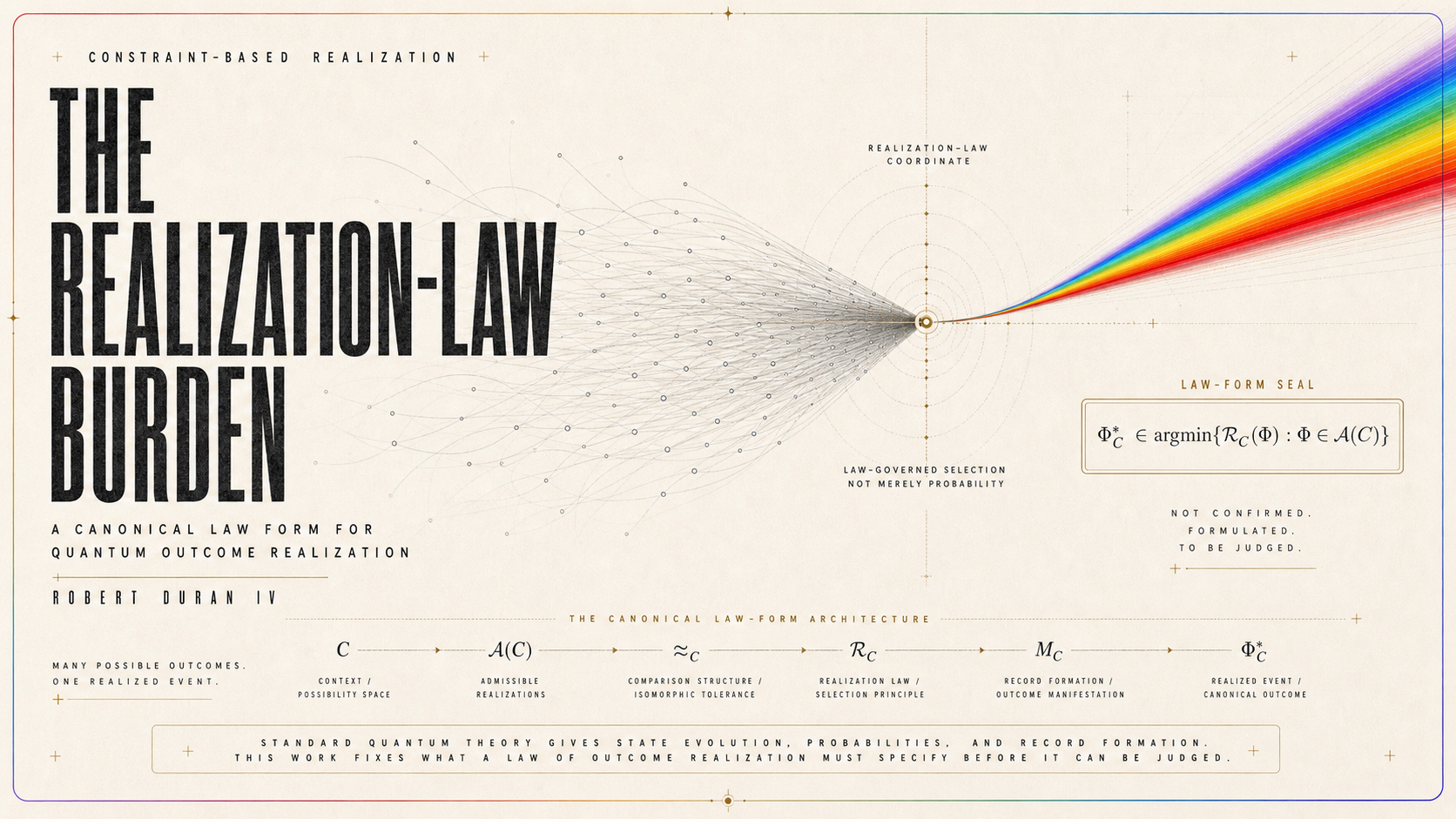
Quantum theory provides an extraordinarily successful account of state evolution and outcome probabilities, while decoherence explains the suppression of interference and the formation of stable records. Yet neither state evolution, probability assignment, nor record formation by itself states a law-form for individual outcome realization: what, if anything, selects one realized verdict in a specified physical context? This paper develops Constraint-Based Realization as a candidate answer to that realization-law burden. Its canonical representation is Φ∗_C ∈ argmin{ℛ_C(Φ) : Φ ∈ 𝒜(C)}, where C is a physically specified measurement context, 𝒜(C) is the admissible class of realization-compatible candidates, ℛ_C is a context-fixed realization-burden functional, and Φ∗_C is the selected realization channel or operational verdict class.
The central claim is not that CBR is experimentally confirmed, that it replaces standard quantum mechanics, or that it universally derives the Born rule. The claim is more exact: the canonical equation is only a schema until its law-defining objects are fixed. A candidate law of outcome realization is not fully specified until it fixes its domain, admissible alternatives, operational equivalence relation, comparison rule, minimizer structure, verdict-extraction rule, probability relation, non-circularity conditions, non-reduction status, baseline relation, and failure exposure. CBR proposes that outcome realization be understood as context-indexed constrained selection over an admissible class.
The paper establishes a theorem-forward architecture for this proposal. It distinguishes evolution, registration, and realization; introduces the schema-to-instantiation discipline; defines C, 𝒜(C), ≃_C, 𝒜(C)/≃_C, ℛ_C, M_C, τ_C where needed, and Φ∗_C; and argues that CBR becomes evaluable only when these objects are registered before verdict selection. It further develops operational verdict uniqueness: CBR need not require formal uniqueness of representatives, but it must determine one operational verdict class or supply a pre-declared tie-resolution rule. The paper also states the non-circularity requirement, the non-reduction condition relative to decoherence, the probability-location burden, the instantiation registry requirement, and the jurisdiction of structural, probability, empirical, and scope failure.
The result is not confirmation but exact liability. Paper 1 does not prove which outcome nature selects; it fixes what a law of such selection must specify before it can be judged, challenged, or defeated.
1. Introduction
1.1 The unresolved realization-law question
Quantum theory supplies a precise and extraordinarily successful account of state evolution and outcome probabilities. In ordinary applications, it tells us how states are represented, how they evolve under the relevant dynamical rules, how measurement interactions are modeled, and what probabilities are assigned to possible outcomes. Decoherence further explains why interference between alternatives becomes practically unavailable in many contexts and why stable record-bearing structures emerge in apparatuses and environments.
Those achievements do not by themselves settle a distinct law-form question:
What, if anything, selects one realized outcome verdict in an individual physical context?
That question is not the same as asking how the quantum state evolves. It is not the same as asking how records form. It is not the same as asking what probabilities should be assigned across repeated trials. It asks whether outcome realization itself can be represented by a disciplined law-form: a structure that fixes the physical context, eligible candidates, operational identity relation, comparison rule, minimizer structure, and selected verdict before the verdict is known.
Constraint-Based Realization is proposed as a candidate answer to that question. In canonical form, CBR represents outcome realization as context-indexed constrained selection:
Φ∗_C ∈ argmin{ℛ_C(Φ) : Φ ∈ 𝒜(C)}.
This expression is not yet a theory merely because it can be written. It is a law-form schema. Its scientific content depends on whether its objects can be fixed before verdict selection.
CBR’s first burden is therefore not to be true. Its first burden is to be fixed enough to be wrong.
1.2 Schema and instantiation
A distinction governs this paper: schema is not instantiation.
The canonical expression
Φ∗_C ∈ argmin{ℛ_C(Φ) : Φ ∈ 𝒜(C)}
is a schema until C, 𝒜(C), ≃_C, ℛ_C, M_C, and the verdict-extraction rule for Φ∗_C are specified. Without those objects, the expression indicates a possible architecture for a realization law, but it does not yet determine a model.
A CBR instantiation begins only when the law-defining objects are fixed. C must specify the physical context. 𝒜(C) must specify eligible realization-compatible candidates. ≃_C must specify operational identity. ℛ_C must specify the burden functional over admissible candidates. M_C must specify the minimizer structure. Φ∗_C must be extractable from M_C, at least up to operational equivalence.
This distinction prevents the canonical equation from doing more work than it has earned. The equation is important because it displays the form of the proposed law. But the law-form becomes evaluable only when the objects in the equation are registered and constrained.
A schema can be suggestive. An instantiation can be judged. Paper 1 is concerned with the transition from the first to the second.
1.3 The realization-law burden
A theory of realization cannot merely say that one outcome happens. That statement identifies the phenomenon to be accounted for. It does not yet supply the law-form that accounts for it.
A candidate law of outcome realization must say what the context is, which candidates are eligible, which candidate distinctions are operationally meaningful, what comparison rule selects among them, what counts as the selected verdict, how probability discipline is respected, what prevents circularity, what distinguishes realization from record formation, and what would count as failure.
This is the realization-law burden.
The burden is neutral with respect to CBR. A rival may reject CBR’s minimization form, but it must still supply an equivalent account of domain, eligibility, operational identity, selection, verdict, probability discipline, non-circularity, and failure. Otherwise it has not yet stated a law of outcome realization. It has only described, interpreted, or renamed the fact that an outcome occurs.
CBR is introduced here as a candidate answer to this general burden.
1.4 CBR as a candidate answer
CBR proposes that outcome realization can be represented as constrained selection over an admissible class. In a physical context C, a class 𝒜(C) of realization-compatible candidates is specified. A context-fixed realization-burden functional ℛ_C ranks those candidates. The selected verdict Φ∗_C is extracted from the minimizer structure:
M_C = argmin{ℛ_C(Φ) : Φ ∈ 𝒜(C)}.
The selected verdict is then represented as:
Φ∗_C ∈ M_C,
with uniqueness understood at the level of operational verdict class unless stronger formal uniqueness is established.
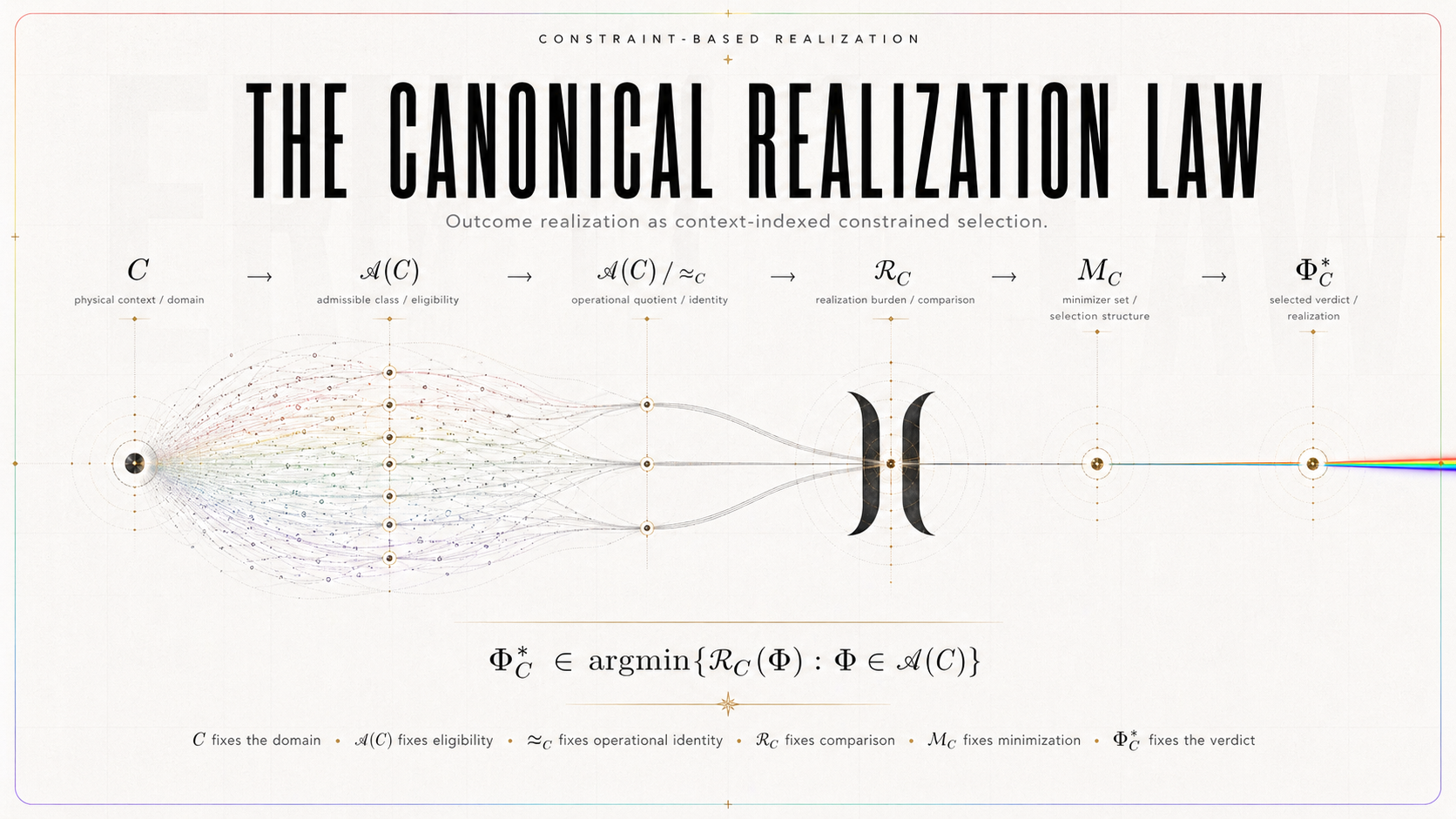
The law-form chain is:
C fixes the domain.
𝒜(C) fixes eligibility.
≃_C fixes operational identity.
ℛ_C fixes comparison.
M_C fixes minimization.
Φ∗_C fixes the verdict.
This chain gives CBR its canonical architecture. It also gives the theory its liabilities. If C is not fixed, the domain moves. If 𝒜(C) is not fixed, eligibility moves. If ≃_C is not fixed, identity moves. If ℛ_C is not fixed, comparison moves. If M_C is not well-defined, minimization fails. If Φ∗_C cannot be extracted, the law-form has no verdict.
The value of the chain is that it makes CBR exact enough to be vulnerable. A theory that can move its domain, candidates, equivalence relation, comparison rule, minimizer structure, or verdict rule after the fact has not yet become a scientific target.
1.5 Schema-to-Instantiation Principle
Principle — Schema-to-Instantiation Principle. The expression Φ∗_C ∈ argmin{ℛ_C(Φ) : Φ ∈ 𝒜(C)} becomes a CBR instantiation only when C, 𝒜(C), ≃_C, ℛ_C, M_C, and the Φ∗_C extraction rule are specified independently of the selected verdict.
Assumptions. The principle assumes that CBR is being treated as a candidate law-form rather than as a purely interpretive description. It also assumes that selection is claimed to occur through the displayed constrained-minimization structure.
Proof strategy. If C is absent, there is no physical domain. If 𝒜(C) is absent, there is no eligible candidate class. If ≃_C is absent, operational identity is undefined. If ℛ_C is absent, there is no comparison rule. If M_C is absent or ill-defined, the minimization structure is not available. If no extraction rule for Φ∗_C is supplied, the theory cannot say what verdict has been selected. Therefore the equation becomes a CBR instantiation only when these objects are specified independently of the selected verdict.
Consequence. The canonical equation is not sufficient by itself. It is a law-form schema whose content depends on successful instantiation.
Failure mode. A CBR manuscript fails this principle if it presents the canonical equation as a completed theory while leaving its context, admissible class, equivalence relation, burden functional, minimizer structure, or verdict-extraction rule unspecified or post hoc.
1.6 Main contribution
This paper establishes the first layer of the CBR program: law-form exactness.
It does not establish that CBR is confirmed physics. It does not derive the Born rule universally. It does not defeat all rival interpretations. It does not supply a completed empirical protocol. It does not claim that decoherence is false or irrelevant.
Its contribution is more limited and more foundational. It states the burden any realization-law candidate must face and gives CBR’s canonical answer to that burden.
Paper 1 establishes the realization-law burden, the canonical CBR law-form, the schema-to-instantiation discipline, the roles of C and 𝒜(C), the need for operational equivalence, the meaning of ℛ_C and M_C, the standard of operational verdict uniqueness, the non-circularity requirement, the non-reduction distinction from decoherence, the opening probability burden, the failure-jurisdiction structure, and the need for later registry hardening.
The result is exact liability. CBR is made precise enough to be criticized, compared, tested, and defeated.
1.7 Non-claims
This paper does not claim that CBR is experimentally confirmed. It does not claim that CBR replaces standard quantum mechanics. It does not claim that CBR universally derives the Born rule. It does not claim that all rival interpretations are defeated. It does not claim that decoherence is false or irrelevant. It does not claim that a specific experiment must show a CBR deviation. It does not claim that the canonical equation is sufficient without fixed objects.
The claim is narrower:
CBR states a realization law-form exact enough to be evaluated.
Paper 1 states the law-form. Paper 2 must discipline probability. Paper 3 must discipline empirical decision. The hardening standard must discipline registry exactness, no-rescue logic, and jurisdiction of failure.
The result of Paper 1 is not confirmation. It is exact liability.
2. The Realization-Law Burden
2.1 Why outcome occurrence is not yet a law
The occurrence of one outcome is not itself a law of outcome realization. It is the fact a law would have to account for.
A law must do more than name the event. It must identify the domain in which the event is selected, the alternatives from which it is selected, the equivalence relation that determines when formal alternatives express the same verdict, the rule that compares eligible candidates, the minimizer or selection structure produced by that rule, and the verdict extracted from that structure.
A theory that says “one outcome occurs” without specifying these objects has not yet supplied a realization law. It has stated the explanandum, not the law-form.
For this reason, the first burden of CBR is not to claim truth. It is to make the proposed selection structure exact enough that truth or failure can be assessed.
2.2 Minimal burden on any realization law
Any candidate law of outcome realization must specify a minimal structure.
It must specify C, the physically described context in which realization is claimed to occur.
It must specify 𝒜(C), the admissible class of realization-compatible candidates in that context.
It must specify ≃_C, the relation identifying candidates that are operationally equivalent in C.
It must specify 𝒜(C)/≃_C, where selection or verdict identity is properly understood modulo operational equivalence.
It must specify ℛ_C or an equivalent comparison rule over admissible candidates.
It must specify M_C or an equivalent selection structure.
It must specify Φ∗_C or an equivalent selected verdict object.
It must specify how the selected verdict is extracted from the selection structure.
It must specify how probability constrains the law-form.
It must specify what prevents the law-form from being tuned after the verdict is known.
It must specify whether the proposal contributes selection structure beyond registration, record formation, or decoherence.
It must specify its relation to the relevant baseline theory.
It must specify what would count as failure.
These conditions are not auxiliary presentation choices. They determine whether a realization-law proposal has a stable object of evaluation.
2.3 The burden is framework-neutral
The realization-law burden does not presuppose that CBR is correct.
A rival framework may reject the CBR argmin form. It may use stochastic dynamics, hidden variables, objective collapse, branch-relative structure, epistemic reconstruction, or another account entirely. But if it claims to supply a law of outcome realization, it must still answer the same structural questions.
What is the physical context? What are the eligible alternatives? What counts as the same verdict? What selects? What is selected? What prevents circularity? How is probability respected? What would count as failure?
This makes the burden framework-neutral. CBR is not protected by the burden; it is exposed by it. The same standard that CBR applies to rivals applies first to CBR itself.
2.4 Realization-Law Burden Theorem
Theorem 1 — Realization-Law Burden Theorem. A candidate law of outcome realization is not fully specified until it fixes the domain, admissible alternatives, operational identity relation, comparison rule, minimizer or selection structure, verdict-extraction rule, probability relation, non-circularity conditions, non-reduction status, baseline relation, and failure conditions.
Assumptions. The theorem assumes that the proposal claims to address individual outcome realization as a law-form problem. It does not assume that CBR’s minimization structure is the only possible form of such a law.
Proof strategy. If the domain is absent, the law has no physical site of application. If admissible alternatives are absent, there is no controlled selection set. If operational identity is absent, formal differences may be mistaken for verdict differences. If the comparison or selection rule is absent, the proposal does not state what selects. If the minimizer or selection structure is absent, the rule cannot be applied. If the verdict-extraction rule is absent, the proposal cannot determine what has been realized. If the probability relation is absent, the proposal may become probability-arbitrary. If non-circularity conditions are absent, the selected verdict may determine the rule that later claims to select it. If non-reduction status is absent, the proposal may collapse into registration. If baseline relation and failure conditions are absent, the proposal cannot be judged against alternatives or against nature.
Consequence. A realization-law proposal becomes serious only when it fixes the objects required for evaluation.
Failure mode. A proposal fails this theorem if it claims to explain realization while leaving its context, admissible alternatives, identity relation, selection rule, verdict, probability relation, or failure conditions unspecified.
2.5 Consequence
The target of Paper 1 is exactness.
Exactness does not prove CBR true. It makes CBR liable. A law-form can be exact and false; indeed, only an exact law-form can fail in a determinate way. A vague proposal can always retreat into reinterpretation. A fixed proposal can be tested, criticized, and defeated.
This is why CBR’s first contribution is exact liability.
3. The Realization Target
3.1 Three distinct tasks
The measurement problem is often discussed in ways that merge three distinct tasks: evolution, registration, and realization.
Evolution concerns the transformation of the quantum state under the relevant dynamical rules.
Registration concerns the formation of records, apparatus correlations, environmental imprints, and stable outcome-bearing structures.
Realization concerns which admissible outcome verdict becomes actual in the context.
CBR targets the third task. It does not deny the first two. It depends on them being properly described. But it does not identify them with realization.
This separation is essential to the paper. If evolution, registration, and realization are collapsed into one another, the CBR law-form either overclaims by pretending to replace standard quantum mechanics or underclaims by becoming a new name for decoherence. Paper 1 avoids both errors by fixing the realization target.
3.2 Evolution
Evolution concerns how the quantum state changes.
In standard quantum theory, the state evolves according to the relevant dynamical rules. In measurement contexts, the description may include interaction with an apparatus, entanglement with degrees of freedom, and effective open-system dynamics. Those structures are part of the physical setting from which candidate verdicts and records emerge.
CBR does not replace this dynamical role in Paper 1. It does not propose a new universal state equation. It does not deny the ordinary formalism used to construct the context C. It asks a different question: given the context and the admissible candidates, what law-form, if any, selects the realized verdict?
Evolution contributes to C. It may help determine 𝒜(C). But evolution is not by itself the full CBR selection law unless the model supplies the additional structure that turns evolution into verdict selection.
3.3 Registration
Registration concerns record formation.
A record may be a detector state, an apparatus pointer, an environmental imprint, a macroscopic trace, or any structure that carries outcome-relevant information. Decoherence is central to explaining why interference between alternatives becomes suppressed and why certain record-bearing structures become stable.
CBR does not deny registration. It does not treat decoherence as irrelevant. Registration may be essential for defining the context C and for identifying the admissible verdict structures in 𝒜(C).
The question is whether registration is sufficient for realization. If registration is claimed to be sufficient, the missing step must be supplied: why does the existence of stable records entail the selection of one realized verdict rather than merely the availability of record-bearing alternatives?
That is the sufficiency challenge. It is not an objection to decoherence. It is a demand that record formation not be mistaken for a selection law unless the selection step is explicitly supplied.
3.4 Realization
Realization concerns which admissible verdict becomes actual in context C.
In the CBR framework, this verdict is represented by Φ∗_C, selected from the minimizer structure M_C over admissible candidates Φ ∈ 𝒜(C). The selected object may be a realization channel, a verdict structure, an outcome map, or another realization-compatible candidate, depending on the context and level of description. Where formal representatives differ but produce the same operational verdict, the selected object should be understood up to ≃_C.
Realization is therefore neither probability assignment nor mere record formation. Probability assigns weights. Registration produces records. Realization selects the actual admissible verdict.
CBR proposes to represent this selection as constrained minimization:
Φ∗_C ∈ argmin{ℛ_C(Φ) : Φ ∈ 𝒜(C)}.
Whether that law-form is true is not established in Paper 1. What is established here is the target of the law-form and the objects required to state it.
3.5 Realization Target Proposition
Proposition 1 — Realization Target Proposition. Evolution, registration, and realization are distinct. A theory may describe state evolution and record formation without supplying a law-form for the selection of one realized verdict.
Assumptions. The proposition assumes that the dynamical evolution of a state, the formation of stable records, and the selection of an actual verdict can be conceptually distinguished. It does not assume that these processes are physically unrelated.
Proof strategy. Evolution specifies state transformation. Registration specifies record formation and stabilization. Neither alone specifies a context-fixed admissible class, an operational equivalence relation, a realization-burden functional, a minimizer set, or a verdict-extraction rule. Therefore, unless a theory shows how evolution or registration entails those objects, the realization-law burden remains distinct.
Consequence. CBR should be judged as a candidate realization-law form, not as a rival dynamics or as decoherence renamed.
Failure mode. A CBR presentation fails this proposition if it collapses realization into dynamics, into probability assignment, or into record formation without specifying the additional selection structure.
3.6 Consequence
The division among evolution, registration, and realization gives Paper 1 its proper jurisdiction.
Standard quantum mechanics remains the baseline for state evolution and statistical prediction. Decoherence remains central to the account of record formation and interference suppression. CBR targets the law-form of verdict selection.
This distinction also determines later failure modes. If CBR fails structurally, it fails as a realization-law form. If it fails probabilistically, it fails in its relation to weighting discipline. If it fails empirically, a registered instantiation fails against a validated baseline. These failures should not be conflated.
4. Physical Context C
4.1 Why context must be fixed
A realization law cannot select in the abstract. It selects, if at all, relative to a physically specified context.
C is the domain anchor of the CBR law-form. It determines which system is under consideration, how it is prepared, what measurement architecture is used, what record-bearing structures are relevant, what interventions are allowed, and what counts as an outcome verdict.
A context is not merely named. It is registered.
If C is vague, then 𝒜(C) is vague. If 𝒜(C) is vague, then ℛ_C has no determinate domain. If ℛ_C has no determinate domain, then M_C is not well-defined. If M_C is not well-defined, then Φ∗_C is not selected by a law-form.
The entire chain depends on context fixity.
4.2 Definition of C
C denotes the physically specified measurement context.
At minimum, C must include the system under consideration, the state preparation, the measurement architecture, the apparatus degrees of freedom, the relevant record-bearing degrees of freedom, the timing structure, environmental couplings, readout conditions, admissible outcome description, and any declared interventions, calibration procedures, or postselection rules.
The level of detail required depends on the use being made of the context. A purely formal law-form discussion may specify C schematically. A concrete experimental instantiation must specify C operationally. A baseline-separated empirical test must specify C with enough precision that nuisance effects, comparator models, and failure conditions can be evaluated.
For example, in a two-path interferometric context, C would not merely say “an interferometer.” It would specify the preparation of the path alternatives, the phase relation, the record-bearing degree of freedom, the accessibility or erasure condition if relevant, the visibility observable, the readout procedure, and the operational distinction between the possible verdicts. Only then can 𝒜(C), ≃_C, and ℛ_C be meaningfully defined.
In every case, C must be fixed before verdict selection or comparison.
4.3 Context dependence without arbitrariness
CBR is context-indexed, but not context-arbitrary.
Context indexing is necessary because admissibility, operational equivalence, burden evaluation, and verdict extraction depend on the physical situation. A delayed-choice interferometric context, a spin measurement, and a detector-array context may have different candidate structures and different operational equivalences.
But context indexing becomes arbitrary if C can be revised after Φ∗_C is known. The context must constrain the selected verdict; the selected verdict must not determine the context.
This is the direction of dependence:
C → 𝒜(C) → 𝒜(C)/≃_C → ℛ_C → M_C → Φ∗_C.
Any reversal of that direction is a threat to the law-form.
4.4 Context Fixity Lemma
Lemma — Context Fixity Lemma. If C can be changed after Φ∗_C is known, the law-form becomes post hoc.
Assumptions. The lemma assumes that 𝒜(C), ≃_C, and ℛ_C depend on C, and that Φ∗_C is claimed to result from the CBR law-form in that context.
Proof strategy. If C is changed after Φ∗_C is known, then the admissible class, operational equivalence relation, and burden functional may also change. The selected verdict can then reshape the domain in which it is later declared selected. This reverses the legitimate direction of dependence. Instead of C fixing the conditions of selection, Φ∗_C effectively fixes C. The result is not law-like selection, but retrospective fitting.
Consequence. C must be fixed before selection. A change of C after verdict selection defines a new instantiation; it does not preserve the original one.
Failure mode. A model fails context fixity if it broadens, narrows, or redefines C after outcome comparison in order to retain the desired verdict, avoid underdetermination, or escape failure.
4.5 Consequence
C fixes the domain.
Without C, there is no defined space in which realization selection occurs. Without a fixed C, the law-form has no stable candidate class, no stable identity relation, no stable comparison rule, and no stable failure condition.
Context failure is therefore structural failure. It is not empirical failure. A model with no fixed context has not reached the stage at which an empirical prediction can be cleanly tested.
5. The Admissible Class 𝒜(C)
5.1 Why admissibility matters
Admissibility is not possibility. It is eligibility under C.
A law of realization does not minimize over every imaginable formal object. It minimizes over candidates that are admissible in the physical context. The admissible class 𝒜(C) is therefore the eligibility boundary of CBR.
If 𝒜(C) is undefined, the law has no candidate domain. If 𝒜(C) is overly broad, it may include representation artifacts or physically irrelevant distinctions. If 𝒜(C) is overly narrow, it may exclude legitimate candidates. If 𝒜(C) is defined after the selected verdict is known, the model becomes circular.
The burden of admissibility is therefore exact: state what is eligible before selection.
5.2 Definition of 𝒜(C)
𝒜(C) denotes the admissible class of realization-compatible candidates in context C.
The candidate type must be declared. Depending on the model, candidates may be realization channels, verdict structures, outcome maps, record-compatible structures, operational realization candidates, or another mathematically specified object appropriate to C.
A candidate belongs to 𝒜(C) only if it is compatible with the physical context, the measurement architecture, the operational outcome description, and the declared realization-relevant constraints. Formal writability is not sufficient. A candidate must be eligible under C.
This is why the notation is 𝒜(C), not merely 𝒜. Admissibility is indexed to context.
5.3 Levels of admissibility
CBR may employ different levels of admissibility, provided the level is declared.
At the channel level, Φ may represent a candidate realization channel. At the verdict level, Φ may represent a candidate operational outcome structure. At the record-compatible level, Φ may represent a structure linked to the record-bearing degrees of freedom in C. At the quotient level, the physically relevant object may be [Φ]_C in 𝒜(C)/≃_C.
These levels should not be conflated. A formal channel, an operational verdict, a record-compatible structure, and an equivalence class of candidates may serve different roles in the model. A CBR instantiation must state which level is being used and how the selected verdict is extracted from it.
This flexibility is legitimate only if the model declares the level of description and keeps it fixed. If the candidate type shifts during the argument, the admissible class shifts with it. That would undermine the law-form.
5.4 What 𝒜(C) must exclude
𝒜(C) must exclude candidates that are not eligible under C.
It must exclude post hoc candidates introduced only after Φ∗_C is known. It must exclude representation artifacts that multiply formal descriptions without multiplying operational verdicts. It must exclude outcome-fitted candidates whose only role is to make the observed verdict minimize ℛ_C. It must exclude physically inaccessible distinctions that make no operational difference in C. It must exclude candidates incompatible with the preparation, measurement architecture, record structure, or declared outcome description.
These exclusions protect the law-form from hidden circularity. If eligibility can be adjusted after the verdict, then minimization becomes performative rather than explanatory. ℛ_C appears to select, but the selection has already been engineered through 𝒜(C).
5.5 Nonempty admissibility condition
A CBR instantiation must state whether 𝒜(C) is nonempty.
If 𝒜(C) is empty, then the argmin is not engaged. There are no admissible candidates over which ℛ_C can minimize. The model must then state what follows. It may declare structural failure in C. It may revise C. It may revise admissibility. It may introduce a successor instantiation. It may replace argmin with a different well-defined limiting rule. But it cannot claim that the original instantiation selected Φ∗_C by minimizing over an empty class.
If 𝒜(C) is empty, undefined, or retrospectively altered, the failure is structural, not empirical. The law-form has not reached the stage of testable prediction.
5.6 Admissibility Lemma
Lemma — Admissibility Lemma. A candidate outside 𝒜(C) is not eligible for realization selection in C.
Assumptions. The lemma assumes that C is fixed and that 𝒜(C) has been declared as the admissible class of realization-compatible candidates in that context.
Proof strategy. The CBR selection law minimizes ℛ_C over 𝒜(C), not over every formally writable object. Therefore a candidate outside 𝒜(C) is outside the domain of selection. If it is later introduced to alter M_C or Φ∗_C, the admissible class has changed and a new instantiation has been defined.
Consequence. 𝒜(C) fixes eligibility. The selected verdict must arise from candidates admissible in C.
Failure mode. A model fails admissibility discipline if it introduces candidates after the verdict is known, includes representation artifacts as eligible verdicts, treats physically inaccessible distinctions as selectable, or changes eligibility to protect a result.
5.7 Consequence
𝒜(C) fixes eligibility.
Without 𝒜(C), the law has no controlled candidate class. Without nonempty 𝒜(C), the law has no domain of application. Without pre-outcome fixity of 𝒜(C), the law becomes vulnerable to post hoc construction.
The first two links of the law-form are therefore fixed:
C fixes the domain.
𝒜(C) fixes eligibility.
Only after domain and eligibility are registered can operational identity, comparison, minimization, and verdict extraction be defined.
6. Operational Equivalence ≃_C
6.1 Why operational equivalence is needed
A realization law must distinguish physical verdict differences from formal redundancy.
In a mathematical representation, two candidates may differ syntactically while making no difference to the realization-relevant verdict in context C. They may use different encodings, representative maps, decompositions, internal parametrizations, or formal descriptions while producing the same operational outcome structure. If a CBR instantiation treats such candidates as distinct verdicts merely because they are formally distinct, it risks manufacturing artificial multiplicity.
Operational equivalence prevents that error.
The role of ≃_C is to identify candidates that differ only in ways irrelevant to the realized verdict in C. It allows CBR to distinguish genuine verdict multiplicity from representational multiplicity. This is essential because a realization law should not be defeated by redundant formal descriptions, but it also should not be allowed to hide genuine underdetermination behind an unexplained claim of equivalence.
The relevant uniqueness standard for CBR is therefore not always formal uniqueness of representatives. The relevant standard is operational uniqueness of the verdict class.
6.2 Definition of ≃_C
Let Φ₁ and Φ₂ be admissible candidates in 𝒜(C). Then:
Φ₁ ≃_C Φ₂
means that Φ₁ and Φ₂ are indistinguishable for the realization-relevant operational purposes of context C.
This equivalence relation is context-indexed. Two candidates may be equivalent in one context and non-equivalent in another, because operational distinctions depend on the measurement architecture, record-bearing degrees of freedom, readout structure, coarse-graining rules, and verdict criteria fixed by C.
A CBR instantiation must therefore state what counts as an operationally meaningful difference in C and what counts as a representational artifact. This cannot be left implicit. If ≃_C is undefined, the model has no disciplined way to determine whether multiple formal candidates represent one verdict or several.
The equivalence relation must also be fixed before verdict selection. If ≃_C is defined after Φ∗_C is known, then the model may collapse distinct candidates into one class, or separate equivalent candidates into many classes, in order to protect a preferred result. That would make operational identity post hoc.
6.3 Quotient structure
Once ≃_C is defined, the physically relevant candidate space may be the quotient:
𝒜(C)/≃_C.
This quotient represents admissible candidates modulo operational equivalence. It preserves verdict-relevant distinctions while removing formal redundancy.
There are two legitimate routes.
First, the model may define ℛ_C on 𝒜(C), then interpret minimizers modulo ≃_C. On this route, formal representatives may be evaluated first, but the selected verdict is extracted at the level of operational equivalence.
Second, the model may define ℛ_C directly on 𝒜(C)/≃_C. On this quotient-first route, the law-form begins from operational verdict classes rather than raw representatives.
Both routes are acceptable if they are declared and mathematically coherent. What is not acceptable is moving between raw candidates and quotient classes opportunistically after the verdict is known.
The quotient structure is especially important when M_C contains more than one formal minimizer. Multiple formal minimizers do not automatically imply multiple realized verdicts. If all minimizers belong to the same equivalence class in 𝒜(C)/≃_C, the model may still yield a unique operational verdict. Conversely, if M_C contains minimizers belonging to distinct equivalence classes and no tie-resolution rule is supplied, the instantiation is underdetermined.
Thus 𝒜(C)/≃_C does not weaken the law-form. It makes the level of verdict identity explicit.
6.4 Quotient-Descent Condition
The burden functional must be compatible with operational equivalence.
If ℛ_C is defined on 𝒜(C), then it must either descend to 𝒜(C)/≃_C or state why representative-level burden differences are irrelevant to verdict selection.
This may be stated as the Quotient-Descent Condition:
If Φ₁ ≃_C Φ₂, then either:
ℛ_C(Φ₁) = ℛ_C(Φ₂),
or any difference between ℛ_C(Φ₁) and ℛ_C(Φ₂) must be shown not to affect the selected operational verdict.
The cleanest formulation is often quotient-first:
ℛ_C : 𝒜(C)/≃_C → ordered burden values.
In that case, ℛ_C ranks operational verdict classes directly. If the model instead defines ℛ_C on raw representatives in 𝒜(C), it must show that representative-level differences do not reintroduce distinctions that ≃_C has already declared verdict-irrelevant.
This condition prevents ℛ_C from breaking operational equivalence by assigning verdict-relevant differences to candidates that the model itself has declared equivalent in C. If two candidates are the same operational verdict, burden differences between them cannot be allowed to determine different realized verdicts unless the model revises ≃_C or explains why the burden difference is not verdict-relevant.
A CBR instantiation that defines operational equivalence but allows ℛ_C to select among equivalent representatives as though they were distinct verdicts is not yet well-specified.
6.5 No Representative Preference Corollary
Corollary — No Representative Preference. CBR cannot select one formal representative over another operationally equivalent representative unless the distinction is operationally meaningful in C.
Assumptions. The corollary assumes fixed C, fixed 𝒜(C), declared ≃_C, and either a quotient-first burden functional or a burden functional on 𝒜(C) satisfying the Quotient-Descent Condition.
Proof strategy. If Φ₁ ≃_C Φ₂, then Φ₁ and Φ₂ represent the same realization-relevant verdict in C. Selecting Φ₁ rather than Φ₂ as though they were different verdicts would treat representational difference as physical difference. That contradicts the definition of ≃_C unless the model identifies an operational distinction and revises the equivalence relation.
Consequence. CBR’s selected verdict should be understood at the level of operational equivalence whenever formal representatives differ without verdict-relevant difference.
Failure mode. A model fails this corollary if it privileges one representative over an equivalent representative without declaring an operationally meaningful difference in C.
6.6 Operational Equivalence Lemma
Lemma — Operational Equivalence Lemma. If Φ₁ ≃_C Φ₂, then selecting Φ₁ or Φ₂ yields the same realization-relevant operational verdict in context C.
Assumptions. The lemma assumes that C is fixed, 𝒜(C) is fixed, and ≃_C has been declared as the operational equivalence relation for candidates in C.
Proof strategy. By definition, Φ₁ ≃_C Φ₂ means that Φ₁ and Φ₂ are indistinguishable for the realization-relevant operational purposes of C. If selecting Φ₁ and selecting Φ₂ produced different verdicts in C, then they would not be operationally equivalent. Therefore, selection among equivalent representatives does not alter the realized verdict class.
Consequence. CBR may treat the selected verdict as an equivalence class rather than as a unique formal representative.
Failure mode. A model fails this lemma if it claims operational equivalence while allowing equivalent candidates to produce different verdicts, or if it treats merely formal differences as separate verdicts without identifying an operational distinction in C.
6.7 Consequence
≃_C fixes operational identity.
Without ≃_C, CBR cannot distinguish genuine verdict multiplicity from formal multiplicity. Without 𝒜(C)/≃_C, the law-form risks overcounting candidates and demanding an unnecessary kind of formal uniqueness. Without quotient descent, ℛ_C may reintroduce distinctions that the equivalence relation was meant to remove.
This is the third link in the law-form chain:
C fixes the domain.
𝒜(C) fixes eligibility.
≃_C fixes operational identity.
Only after operational identity is fixed can ℛ_C rank candidates or verdict classes in a way that supports a meaningful selected verdict.
7. The Realization-Burden Functional ℛ_C
7.1 Why a burden functional is needed
CBR requires a comparison rule over admissible candidates.
The admissible class 𝒜(C) identifies which candidates are eligible in context C, but eligibility alone does not select among them. A further structure must compare the admissible candidates and determine which candidate, or which operational equivalence class of candidates, has least realization burden.
ℛ_C supplies that structure.
The burden functional is the comparison engine of the CBR law-form. It is the object that turns admissibility into selection. Without ℛ_C, CBR has a candidate class but no law-like selection rule.
7.2 Definition of ℛ_C
ℛ_C is the context-fixed realization-burden functional.
In the representative-level formulation, it is defined as:
ℛ_C : 𝒜(C) → ordered burden values.
In the quotient-first formulation, it is defined as:
ℛ_C : 𝒜(C)/≃_C → ordered burden values.
The codomain may be real-valued, partially ordered, vector-valued with a declared ordering rule, lexicographically ordered, or otherwise specified by the model. What matters is that ℛ_C supplies a determinate comparison structure.
The functional must be defined on its declared domain. If ℛ_C is defined on 𝒜(C), then it must apply to the relevant candidates admitted by 𝒜(C). If it is defined on 𝒜(C)/≃_C, then the quotient classes must be well-defined. If ℛ_C is undefined for some candidates or classes, the model must state whether those candidates are excluded, whether the functional is incomplete, or whether the instantiation fails.
The law-form cannot rely on an unnamed or partially defined comparison rule.
7.3 What ℛ_C must satisfy
A realization-burden functional must satisfy several requirements before it can support a law-form.
First, it must be fixed before selection. If ℛ_C is chosen after Φ∗_C is known, it does not explain selection. It rationalizes the selected verdict.
Second, it must be defined on its declared domain: either 𝒜(C) or 𝒜(C)/≃_C.
Third, it must be context-indexed. The burden functional belongs to C. Changing C may change the relevant burden structure, but such changes define a new instantiation unless registered before selection.
Fourth, it must be independent of Φ∗_C. The selected verdict cannot determine the burden functional that later claims to select it.
Fifth, it must be compatible with operational equivalence. If Φ₁ ≃_C Φ₂, then either ℛ_C(Φ₁) = ℛ_C(Φ₂), or any burden difference must be shown to be irrelevant to verdict selection. A burden functional may not secretly convert equivalent representatives into distinct verdicts.
Sixth, it must be transparent about its components. If ℛ_C contains terms associated with definiteness, record compatibility, consistency, stability, accessibility, or other realization-relevant burdens, those terms must be declared. If it contains coefficients, thresholds, ordering priorities, or calibration-dependent quantities, their status must be stated.
Seventh, it must not hide probability engineering, post hoc admissibility, or outcome preference. Any probability-related component must be declared and disciplined by the appropriate probability standard.
7.4 Possible burden components
Paper 1 does not require one universal closed-form burden functional for every possible context. That would overstate what this paper establishes.
Instead, Paper 1 states the role ℛ_C must play and the discipline it must satisfy. Depending on the model, ℛ_C may include declared terms related to definiteness, record compatibility, consistency, stability, accessibility, or other realization-relevant constraints. A concrete instantiation must state which terms are being used and why they belong to the context.
For example, a context involving accessible record structure may require burden terms sensitive to record compatibility or operational accessibility. A context involving competing verdict structures may require terms measuring consistency with the admissible outcome architecture. A context involving degeneracy may require tie-handling rules or quotient-based verdict extraction.
The paper should not pretend that one schematic mention of ℛ_C supplies all such details. The functional becomes meaningful only when its domain, terms, coefficients, ordering rule, relation to ≃_C, and tie-handling implications are fixed.
7.5 Burden Fixity Lemma
Lemma — Burden Fixity Lemma. If ℛ_C is changed after Φ∗_C is known, the original CBR instantiation is not preserved. A new instantiation has been introduced.
Assumptions. The lemma assumes that Φ∗_C is claimed to be selected by minimizing ℛ_C over 𝒜(C), or over 𝒜(C)/≃_C, in context C.
Proof strategy. The selected verdict depends on the minimizer structure generated by ℛ_C. If ℛ_C changes after Φ∗_C is known, then the comparison rule that produced the minimizer structure has changed. The original selection claim no longer applies. The revised functional may define a new model, but it cannot retroactively preserve the original selection law.
Consequence. ℛ_C must be fixed before selection. Post hoc burden tuning is incompatible with non-circular CBR.
Failure mode. A model fails burden fixity if it alters terms, coefficients, thresholds, ordering rules, quotient handling, equivalence compatibility, or admissibility-sensitive burden components after the selected verdict or empirical result is known.
7.6 Quotient-Descent Requirement for ℛ_C
If ℛ_C is defined on raw candidates in 𝒜(C), it must satisfy a quotient-descent requirement:
representative-level burden differences must not change the selected operational verdict unless those differences correspond to operationally meaningful distinctions in C.
This requirement can be satisfied in several ways.
The strongest route is equality on equivalence classes:
If Φ₁ ≃_C Φ₂, then ℛ_C(Φ₁) = ℛ_C(Φ₂).
A weaker but still admissible route is verdict-irrelevance:
If Φ₁ ≃_C Φ₂ and ℛ_C(Φ₁) ≠ ℛ_C(Φ₂), the model must show that this difference cannot affect Φ∗_C at the operational verdict level.
The quotient-first route avoids this issue by defining ℛ_C directly on 𝒜(C)/≃_C.
A model that fails all three routes has not reconciled burden comparison with operational identity.
7.7 Consequence
ℛ_C fixes comparison.
It is the law-form’s selection engine. Without ℛ_C, CBR has no rule for ranking admissible candidates. With an unfixed or post hoc ℛ_C, CBR has no non-circular selection rule. With a declared and fixed ℛ_C, the law-form can generate a minimizer structure that can be examined, criticized, and potentially defeated.
A well-formed ℛ_C does not prove CBR true. It makes CBR evaluable. A well-formed CBR instantiation may still be false. Well-definedness is not confirmation; it is the condition for meaningful evaluation.
The chain now extends:
C fixes the domain.
𝒜(C) fixes eligibility.
≃_C fixes operational identity.
ℛ_C fixes comparison.
The next question is whether this comparison actually yields a well-defined minimizer structure.
8. Existence, Well-Definedness, and the Minimizer Set M_C
8.1 Definition
Given a fixed context C, an admissible class 𝒜(C), an operational equivalence relation ≃_C, and a realization-burden functional ℛ_C, define the minimizer set:
M_C = argmin{ℛ_C(Φ) : Φ ∈ 𝒜(C)}.
In a quotient-first formulation, the corresponding minimizer structure may be defined over:
𝒜(C)/≃_C.
M_C is the set of admissible candidates, or admissible verdict classes, minimizing realization burden in context C.
The selected verdict Φ∗_C is extracted from M_C, subject to operational equivalence and any declared tie-handling rule. If all minimizers in M_C belong to the same equivalence class under ≃_C, then CBR yields a unique operational verdict. If M_C is empty, or if M_C contains operationally distinct minimizers without a tie-resolution rule, the instantiation is not yet well-defined.
8.2 Why argmin notation is not enough
Argmin notation is meaningful only when the model states the conditions under which minimizers exist or how nonexistence is handled.
Writing
M_C = argmin{ℛ_C(Φ) : Φ ∈ 𝒜(C)}
does not guarantee that M_C is nonempty. It does not guarantee that ℛ_C is well-defined on 𝒜(C). It does not guarantee that burden evaluation is compatible with ≃_C. It does not guarantee that ties are operationally harmless. It does not guarantee that Φ∗_C can be extracted.
The notation is a compact expression of the selection form, not a substitute for well-definedness.
A mathematically responsible CBR instantiation must state what makes the minimization problem well-formed. It must declare the relevant existence assumptions or state how failure of existence is treated. Otherwise, the canonical equation remains an empty schema.
8.3 Existence burden
The model must specify when M_C is nonempty.
In some settings, nonemptiness may follow from finite admissibility. In others, it may require compactness of the admissible class, lower semicontinuity of ℛ_C, closure conditions, regularity assumptions, coercivity, or replacement of a strict minimizer by an infimum or approximate-minimizer rule. Paper 1 does not impose one universal mathematical setting on all CBR models. It requires that the setting be declared.
If no existence condition is supplied, then the selection law may fail to select. A proposed realization law that cannot say when its minimizer exists is not yet a complete instantiation.
Existence is therefore not a technical afterthought. It is part of the law-form burden.
8.4 Nonexistence handling
If M_C is empty, the model must state what follows.
Several outcomes are possible. The instantiation may fail in C. The admissible class may have been incorrectly specified. The burden functional may be ill-defined. The model may require an infimum-based, limiting, or approximate-minimizer rule. Or a successor instantiation may be introduced.
What is not permitted is silent repair after the verdict is known. Nonexistence handling must be declared before selection or comparison. If the rule for handling no minimizer is invented after the fact, the law-form becomes post hoc.
A no-minimizer case is structural unless the model has already declared how such cases are treated. It is not an empirical anomaly. It is a failure or incompleteness in the law-form specification.
8.5 Ties and multiple minimizers
Multiple minimizers do not automatically defeat CBR.
The relevant question is whether the minimizers produce distinct operational verdicts in C. If they are formal variants of the same verdict, then formal multiplicity is harmless. If they belong to the same equivalence class under ≃_C, then the verdict is operationally unique.
However, if M_C contains candidates belonging to distinct operational equivalence classes, then the instantiation faces a tie problem. It must either provide a tie-resolution rule fixed before selection or acknowledge underdetermination in that context.
Let τ_C denote a tie-resolution rule, where such a rule is required. τ_C is admissible only if it is fixed before selection and independently of Φ∗_C. If τ_C is invented after the selected verdict is known, it is not a tie-resolution rule. It is post hoc rescue.
This is where 𝒜(C)/≃_C becomes essential. The model should not ask only whether there is one formal representative. It should ask whether there is one operational verdict class.
8.6 Operational minimizer class
If all elements of M_C are equivalent under ≃_C, then the minimizer set determines a single operational class:
[M_C]_≃.
In that case, Φ∗_C may be understood as the selected operational verdict class rather than as an arbitrary formal representative.
This permits a restricted but strong uniqueness claim. CBR does not need to pretend that every formal representation has a unique minimizer. It needs to show that the minimizer structure determines one verdict at the operational level relevant to C.
The correct standard is therefore operational verdict uniqueness, not unrestricted formal uniqueness.
8.7 Existence and Well-Definedness Theorem
Theorem 2 — Existence and Well-Definedness Theorem. A CBR instantiation is mathematically well-formed only if 𝒜(C) is nonempty, ℛ_C is defined on its declared domain, M_C exists or the model states what follows if no minimizer exists, and Φ∗_C can be extracted from M_C either as a representative or as an operational verdict class under ≃_C.
If M_C contains multiple operational equivalence classes, the instantiation is verdict-determinate only if a tie-resolution rule τ_C is declared before selection.
Assumptions. The theorem assumes a fixed context C, a declared admissible class 𝒜(C), a declared operational equivalence relation ≃_C, and a burden functional ℛ_C intended to generate a minimizer structure.
Proof strategy. If 𝒜(C) is empty, there are no candidates to minimize over. If ℛ_C is not defined on its declared domain, the comparison rule cannot be applied. If M_C does not exist and no nonexistence rule is declared, the selection structure fails. If M_C contains multiple operational equivalence classes and no tie-resolution rule is supplied, the model does not determine a unique verdict. If Φ∗_C cannot be extracted from M_C either as a representative or as a verdict class, the model does not determine what has been realized. Therefore a CBR instantiation is well-formed only when these conditions are satisfied or explicitly handled.
Consequence. The canonical law-form cannot rely on argmin notation alone. It must supply the mathematical conditions that make the argmin meaningful.
Failure mode. A model fails well-definedness if it has an empty admissible class, an undefined burden functional, no minimizer without a declared nonexistence rule, operationally distinct minimizers without a declared tie-resolution rule, or no extractable Φ∗_C.
8.8 Failure condition for minimizers
If M_C contains multiple candidates belonging to distinct operational verdict classes and no tie-resolution rule τ_C is supplied, the instantiation is underdetermined.
Operational underdetermination is not a failed experiment. It is a structural failure of verdict extraction.
This distinction matters. A model that cannot extract a verdict has not yet made a definite empirical prediction. It has not reached the stage at which it can fail by comparison with a baseline. It has failed earlier, at the level of law-form specification.
A successor instantiation may add τ_C, define ℛ_C on the quotient, refine 𝒜(C), modify ℛ_C, or restrict C. But those modifications must be declared as new structure. They do not retroactively make the original underdetermined instantiation determinate.
8.9 Consequence
M_C fixes minimization.
The minimizer set is where the comparison rule becomes a selection structure. But it does so only if existence, nonexistence handling, equivalence, quotient structure, and tie-handling are specified.
A well-defined minimizer structure does not confirm CBR. It makes the selection claim determinate enough to be evaluated.
The chain now extends:
C fixes the domain.
𝒜(C) fixes eligibility.
≃_C fixes operational identity.
ℛ_C fixes comparison.
M_C fixes minimization.
Only then can Φ∗_C be claimed as the selected verdict.
9. The Canonical Selection Law
9.1 Statement of the law form
CBR represents realization selection as:
Φ∗_C ∈ argmin{ℛ_C(Φ) : Φ ∈ 𝒜(C)}.
Equivalently, with
M_C = argmin{ℛ_C(Φ) : Φ ∈ 𝒜(C)},
the selected verdict satisfies:
Φ∗_C ∈ M_C,
with the understanding that Φ∗_C may denote an operational verdict class when formal representatives are equivalent under ≃_C.
In a quotient-first formulation, the same law-form may be understood as selection over 𝒜(C)/≃_C, so that ℛ_C ranks operational verdict classes directly.
This is the canonical CBR selection law. It states the proposed structure of realization: a context-fixed burden functional ranks admissible candidates or verdict classes, and the realized verdict is extracted from the minimizer structure.
9.2 Law-form interpretation
The canonical selection law is not a claim of experimental confirmation.
It is a claim about the form a CBR realization law takes once instantiated. It states that realization is represented as constrained selection over a context-indexed admissible class, with operational equivalence and well-definedness conditions included.
The law-form is exact only when C, 𝒜(C), ≃_C, ℛ_C, M_C, τ_C where needed, and the verdict-extraction rule are fixed.
This distinction matters. The canonical selection law is not a slogan. It is also not sufficient by itself. It is the central schema whose scientific content depends on successful instantiation.
A fully specified model must still answer the probability burden, the empirical burden, and the failure burden.
9.3 The selection chain
The selection chain is:
C → 𝒜(C) → 𝒜(C)/≃_C → ℛ_C → M_C → Φ∗_C.
Expanded:
C fixes the domain.
𝒜(C) fixes eligibility.
≃_C fixes operational identity.
ℛ_C fixes comparison.
M_C fixes minimization.
Φ∗_C fixes the verdict.
If operationally distinct minimizers exist, the chain must include a pre-declared tie-resolution rule:
C → 𝒜(C) → 𝒜(C)/≃_C → ℛ_C → M_C → τ_C → Φ∗_C.
The direction of dependence is essential. The verdict must be downstream of the registered structure. If Φ∗_C determines C, 𝒜(C), ≃_C, ℛ_C, quotient handling, nonexistence handling, or τ_C, the model is circular. If the objects upstream are changed after the verdict is known, the original instantiation is not rescued; a new instantiation has been defined.
The selection chain is therefore both constructive and disciplinary. It constructs the law-form and constrains how the law-form can be defended.
9.4 Canonical Selection Theorem
Theorem 3 — Canonical Selection Theorem. Given fixed C, 𝒜(C), ≃_C, ℛ_C, and a well-defined minimizer structure M_C, CBR selects Φ∗_C from M_C, with uniqueness understood at the level of operational verdict class unless stronger formal uniqueness is proven. If M_C contains multiple operational verdict classes, verdict determinacy requires a pre-declared tie-resolution rule τ_C.
Assumptions. The theorem assumes that C is fixed, 𝒜(C) is nonempty or nonexistence is handled, ℛ_C is defined on its declared domain, M_C exists or is replaced by a declared rule, and ≃_C has been specified. It also assumes that a verdict-extraction rule is declared and that operationally distinct ties are either resolved by τ_C or acknowledged as underdetermination.
Proof strategy. Since ℛ_C ranks admissible candidates or operational verdict classes, the minimizer structure M_C contains the candidates or classes of least realization burden under the model. If M_C is well-defined and the extraction rule is specified, Φ∗_C is selected from M_C. If all relevant minimizers are equivalent under ≃_C, the selected verdict is unique at the operational level. If formal uniqueness is additionally established, then the stronger uniqueness claim may be made. If minimizers fall into multiple operational classes, τ_C is required for verdict determinacy. Without τ_C, the model is underdetermined.
Consequence. CBR becomes a precise law-form rather than a verbal interpretation. Its selection claim is stated in terms of fixed objects, a declared minimizer structure, and a determinate verdict-extraction rule.
Failure mode. A CBR instantiation fails this theorem if it invokes the canonical selection law without fixing C, 𝒜(C), ≃_C, ℛ_C, M_C, quotient handling, tie-handling where needed, or the verdict-extraction rule.
9.5 Consequence
The canonical selection law is the center of Paper 1, but it is not the whole of Paper 1.
The equation gives the form. The surrounding architecture gives the content. The law-form becomes evaluable only when its objects are registered, its minimizer structure is well-defined, its quotient structure is coherent, and its verdict is extractable without circularity.
At this point, CBR can state what it selects. The next question is how strong the uniqueness claim should be.
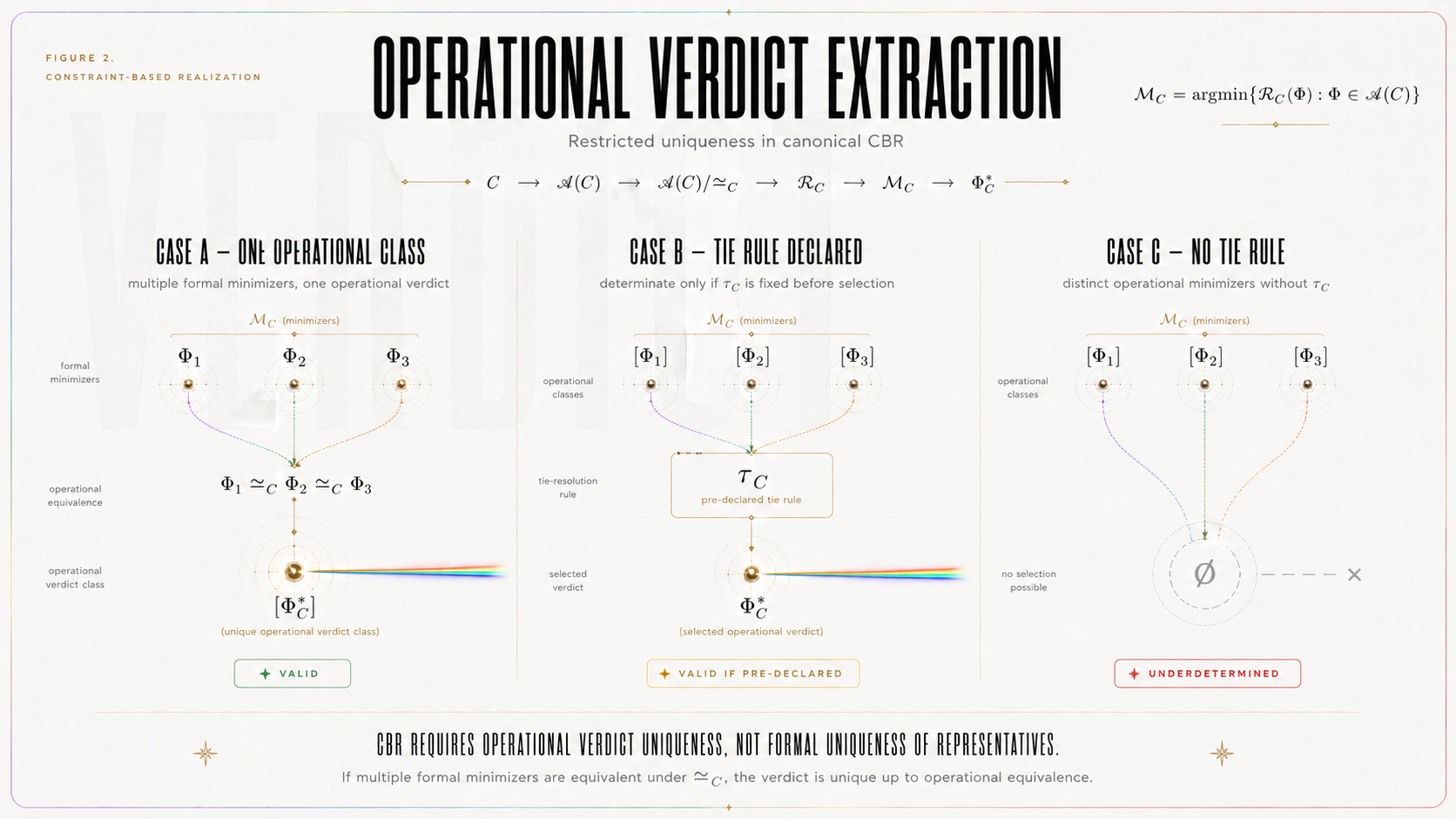
10. Operational Verdicts and Restricted Uniqueness
10.1 Why formal uniqueness is too strong
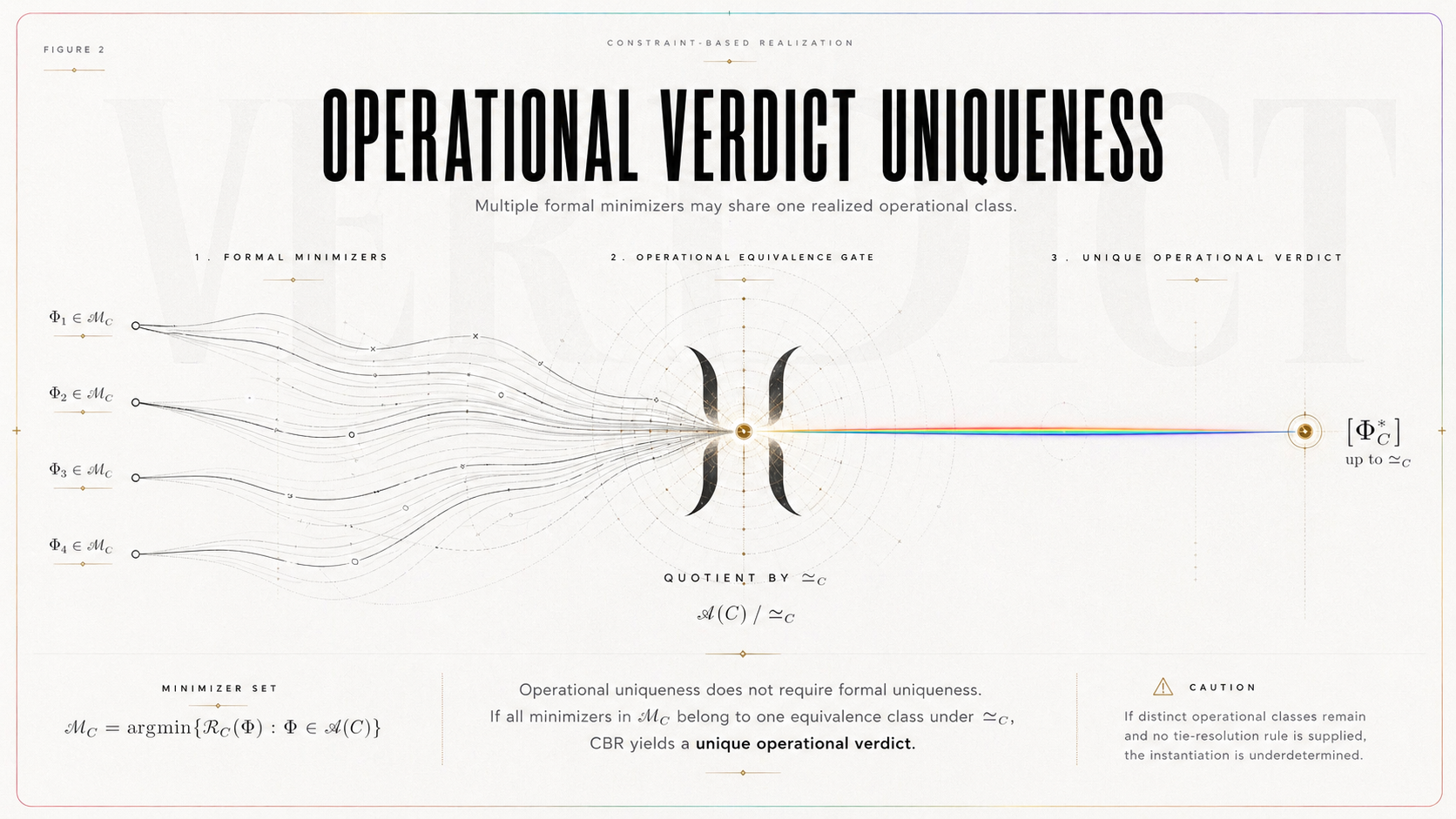
A theory may have multiple formal minimizers that yield the same operational verdict.
Demanding literal formal uniqueness in every representation would be stronger than necessary. Formal multiplicity may arise from redundant descriptions, equivalent channels, equivalent maps, gauge-like representation choices, coarse-graining differences, or alternative encodings that make no difference to the realization-relevant verdict in C.
If such candidates are equivalent under ≃_C, then their multiplicity does not imply multiple realized verdicts. It implies multiple representatives of the same operational verdict class.
CBR should therefore not overclaim formal uniqueness when operational uniqueness is the correct standard.
10.2 Operational verdict class
The selected object should be understood as an operational verdict class when minimizers are equivalent under ≃_C.
If M_C contains candidates Φ₁, Φ₂, …, Φ_n, and all satisfy:
Φ₁ ≃_C Φ₂ ≃_C … ≃_C Φ_n,
then the selected verdict is not an arbitrary choice among them. It is the equivalence class they jointly determine.
The verdict may be written schematically as:
Φ∗C = [M_C]≃,
where [M_C]_≃ denotes the operational equivalence class determined by the minimizer set, provided all minimizers fall within one verdict class.
This makes restricted uniqueness precise. The model does not need to identify one privileged formal representative if all representatives have the same operational content.
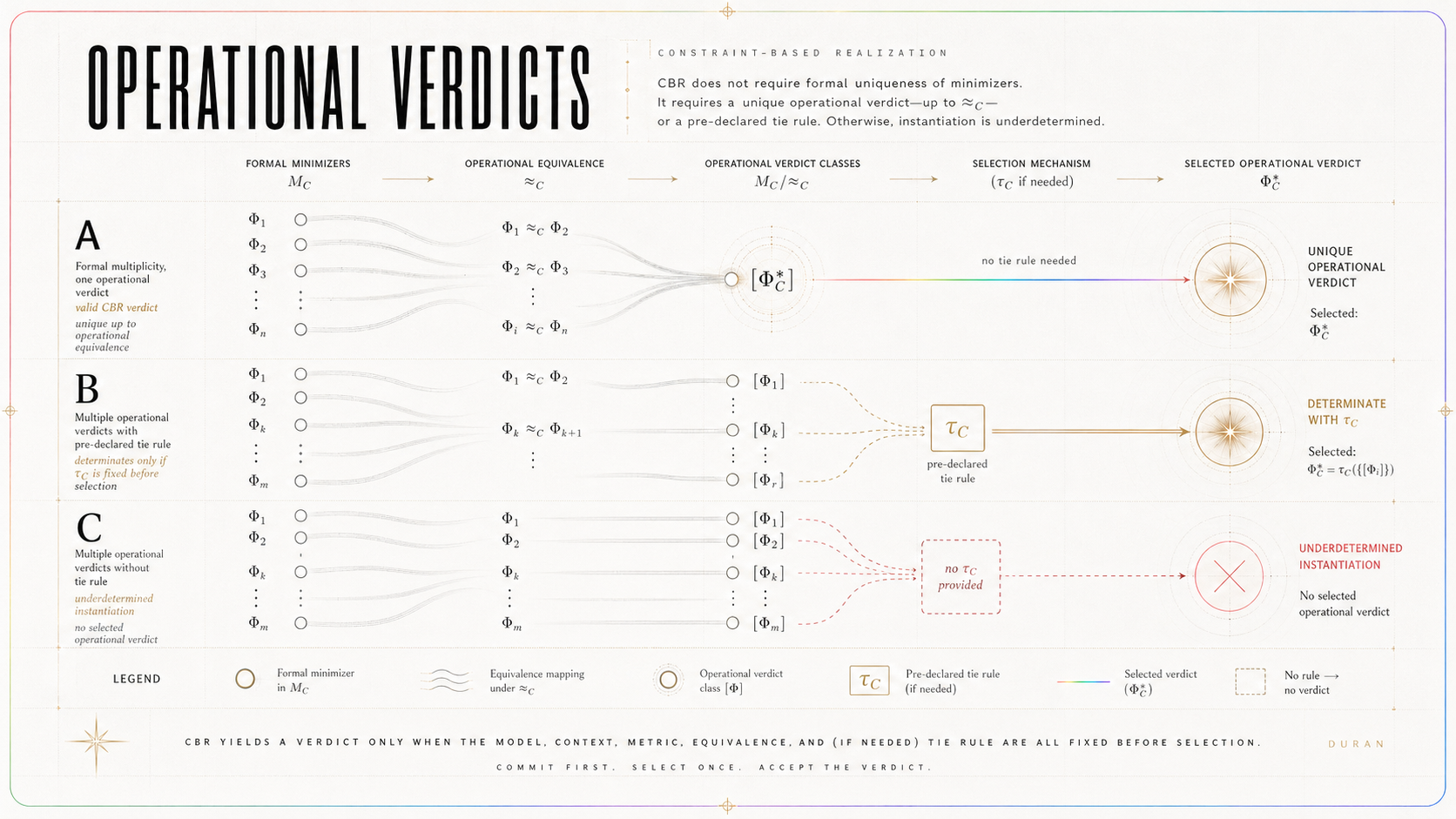
10.3 Verdict Determinacy Standard
A CBR instantiation is verdict-determinate only under one of two conditions.
First, M_C determines exactly one operational minimizer class under ≃_C.
Second, M_C determines multiple operational minimizer classes, but a tie-resolution rule τ_C has been declared before selection and independently of Φ∗_C.
This may be stated compactly:
Verdict determinacy requires either one operational minimizer class or a pre-declared τ_C over distinct minimizer classes.
This standard is stronger than mere formal minimization. It prevents the model from treating an unresolved set of distinct verdicts as though it had selected one. It also prevents post hoc tie-breaking from being mistaken for law-like selection.
10.4 Operational Verdict Theorem
Theorem 4 — Operational Verdict Theorem. CBR does not require formal uniqueness of representatives. It requires operational uniqueness of the verdict class, unless a pre-declared tie-resolution rule τ_C resolves distinct operational minimizer classes. If M_C contains multiple formal minimizers but all are equivalent under ≃_C, the instantiation yields a unique operational verdict.
Assumptions. The theorem assumes a fixed C, a fixed 𝒜(C), a declared ≃_C, a defined ℛ_C, and a nonempty minimizer set M_C. It also assumes either that all candidates in M_C belong to the same operational equivalence class or that a tie-resolution rule τ_C has been declared before selection.
Proof strategy. If all minimizers belong to the same equivalence class under ≃_C, then they are indistinguishable for the realization-relevant operational purposes of C. Selecting any formal representative yields the same operational verdict. Therefore the model yields a unique verdict at the operational level even if formal representatives are multiple. If multiple operational verdict classes are present, then a unique verdict follows only if τ_C selects among those classes according to a pre-declared rule. Without τ_C, no unique operational verdict is determined.
Consequence. CBR’s uniqueness claim is restricted but defensible. It does not demand unnecessary formal uniqueness, and it does not tolerate operational underdetermination.
Failure mode. A model fails operational verdict discipline if it either demands formal uniqueness where operational equivalence suffices, or claims verdict uniqueness despite minimizers belonging to distinct operational equivalence classes without a pre-declared τ_C.
10.5 Underdetermination condition
If M_C contains minimizers producing distinct operational verdicts and no tie-resolution rule is supplied, the CBR instantiation is underdetermined in that context.
Operational underdetermination is not a failed experiment. It is a structural failure of verdict extraction.
This is a central distinction. Empirical failure occurs when a registered, determinate instantiation confronts a validated baseline and loses. Operational underdetermination occurs earlier: the instantiation has not produced a single verdict class to test. It has failed to complete the law-form.
A successor instantiation may add τ_C, define ℛ_C on the quotient, refine 𝒜(C), modify ℛ_C, or restrict C. But those changes must be declared as new structure. They do not retroactively make the original instantiation determinate.
10.6 Well-formedness and truth
A CBR instantiation may be well-formed and false.
This point is essential. Well-formedness means that the model fixes its context, admissible class, equivalence relation, burden functional, minimizer structure, tie-handling where needed, and verdict-extraction rule. It means the model has become determinate enough to evaluate. It does not mean the model is correct.
A poorly specified model is not protected by its vagueness. A well-specified model is not confirmed by its precision. Precision is the condition under which confirmation or failure becomes meaningful.
Thus operational verdict uniqueness is not a proof of CBR. It is part of the discipline that makes CBR a possible object of proof, criticism, or defeat.
10.7 Consequence
CBR’s uniqueness claim is restricted, precise, and defensible.
It is not:
There is always exactly one formal minimizer.
It is:
A CBR instantiation is verdict-determinate when its minimizer structure yields one operational verdict class under ≃_C, or when any operationally distinct tie is resolved by a pre-declared τ_C.
This standard is stronger than ambiguity and weaker than unnecessary formal absolutism. It gives CBR a clear uniqueness burden while avoiding overclaim.
The first ten sections have now fixed the law-form chain through selected verdict structure:
C fixes the domain.
𝒜(C) fixes eligibility.
≃_C fixes operational identity.
ℛ_C fixes comparison.
M_C fixes minimization.
Φ∗_C fixes the verdict.
The next burden is non-circularity: the selected verdict must not determine the structure that claims to select it.
11. Non-Circularity and Burden Independence
11.1 The circularity risk
A realization law fails if the selected verdict determines the structure that later claims to select it.
This is the central circularity risk for CBR. If C is fixed only after Φ∗_C is known, then the domain has been shaped around the verdict. If 𝒜(C) is adjusted after the verdict is known, then eligibility has been made outcome-sensitive. If ≃_C is revised after the verdict is known, then operational identity has been used to hide or manufacture uniqueness. If ℛ_C is tuned after the verdict is known, then the burden functional has become a rationalization of the selected result. If τ_C is introduced after the verdict is known, then tie-resolution has become post hoc selection.
A CBR instantiation is non-circular only if the law-form objects stand upstream of Φ∗_C.
The permitted direction of dependence is:
C → 𝒜(C) → 𝒜(C)/≃_C → ℛ_C → M_C → τ_C where needed → Φ∗_C.
The reverse direction is not allowed. Φ∗_C cannot determine the context, candidate class, equivalence relation, burden functional, minimizer handling, tie-resolution rule, or verdict-extraction rule that later claims to select it.
11.2 Independence requirement
The independence requirement is direct:
C, 𝒜(C), ≃_C, ℛ_C, M_C handling, τ_C where needed, and the Φ∗_C extraction rule must be fixed before selection and independently of Φ∗_C.
This does not mean those objects are independent of the physical facts in C. They are, by design, context-dependent. It means they must be independent of the selected verdict as a post hoc object.
For example, 𝒜(C) may depend on the measurement architecture, preparation, record-bearing degrees of freedom, and operational readout criteria. It may not depend on knowing which verdict was obtained. ℛ_C may depend on declared realization burdens in the context. It may not be tuned after the selected outcome is known. τ_C may resolve a genuine operational tie. It may not be invented after the result to preserve a preferred verdict.
This is burden independence: the law-form objects that determine selection must not be determined by the selected verdict.
11.3 No post hoc admissibility
Post hoc admissibility occurs when 𝒜(C) is revised after Φ∗_C is known in order to include, exclude, or favor candidates based on the observed verdict.
This is not a minor technical error. It changes the law-form.
If a candidate is excluded only because it would have prevented the desired verdict from minimizing ℛ_C, then admissibility is doing hidden selection work. If a candidate is introduced only because it makes the observed verdict admissible, then the admissible class has been fitted to the outcome. In both cases, 𝒜(C) is no longer an eligibility boundary fixed by C. It is a retrospective filter.
A CBR instantiation must therefore distinguish admissibility application from admissibility revision. Application occurs when a fixed 𝒜(C) is used to evaluate candidates in C. Revision occurs when the eligible class itself is changed. Revision may be legitimate in a successor model, but it cannot rescue the original instantiation without cost.
The original 𝒜(C) either supported the selection claim or it did not.
11.4 No post hoc burden tuning
Post hoc burden tuning occurs when ℛ_C is adjusted after Φ∗_C is known.
This includes changing burden terms, coefficients, thresholds, priority ordering, quotient handling, regularity assumptions, admissibility-sensitive penalties, or probability-sensitive components after the selected verdict or empirical result is known.
Such tuning destroys the explanatory direction of the law-form. A burden functional is supposed to generate M_C. M_C is supposed to support extraction of Φ∗_C. If Φ∗_C instead determines ℛ_C, then selection has been reversed.
The CBR law-form is non-circular only if ℛ_C is fixed before it is applied. If a new ℛ_C is introduced after failure or underdetermination, then a new instantiation has been proposed. That may be scientifically legitimate as a successor model, but it is not preservation of the original model.
11.5 No post hoc tie handling
Tie-handling is also part of the law-form.
If M_C contains multiple operational verdict classes, the model must either declare underdetermination or apply a pre-declared tie-resolution rule τ_C. A tie-resolution rule introduced after the selected verdict is known is not a lawful tie-resolution rule. It is post hoc rescue.
This matters because tie-handling can silently perform the selection that ℛ_C failed to perform. If τ_C is not fixed in advance, the model may appear to preserve deterministic verdict selection while actually choosing among operationally distinct minimizers after the fact.
Therefore, if τ_C is needed, it must be registered before selection. It must be part of the instantiation, not an emergency repair.
11.6 No-Retroactive-Rescue Principle
Principle — No-Retroactive-Rescue Principle. A failed, underdetermined, or incomplete CBR instantiation cannot be rescued by changing its law-defining objects after the verdict or result is known. Such changes define a successor instantiation.
Assumptions. The principle assumes that an instantiation is defined by its registered law-form objects: C, 𝒜(C), ≃_C, 𝒜(C)/≃_C, ℛ_C, M_C handling, τ_C where needed, and the Φ∗_C extraction rule.
Proof strategy. If any law-defining object is altered after the verdict or result is known, then the original selection structure has changed. The revised model may be worth studying, but it is not identical to the tested or underdetermined instantiation. Therefore post hoc alteration cannot convert an unsuccessful original instantiation into a successful one.
Consequence. CBR is strengthened by making its liabilities explicit. A model may evolve, but it may not retroactively erase the failure or incompleteness of a previous registered form.
Failure mode. A presentation violates this principle if it treats a revised context, admissible class, equivalence relation, burden functional, tie-resolution rule, or extraction rule as though it had been part of the original instantiation.
11.7 Non-Circularity Theorem
Theorem 5 — Non-Circularity Theorem. A CBR instantiation is non-circular only if its context, admissible class, operational equivalence relation, realization-burden functional, minimizer-handling rule, tie-resolution rule where needed, and verdict-extraction rule are fixed before selection and independently of Φ∗_C.
Assumptions. The theorem assumes that Φ∗_C is claimed to be selected by the CBR law-form. It also assumes that C, 𝒜(C), ≃_C, ℛ_C, M_C handling, τ_C where needed, and the extraction rule are selection-relevant objects.
Proof strategy. If any selection-relevant object is determined by Φ∗_C, then Φ∗_C is no longer the output of the law-form. It becomes part of the input used to define the law-form. This reverses the direction of dependence. In that case, the instantiation does not explain or determine the verdict; it reconstructs the law-form around the verdict. Therefore non-circularity requires that all selection-relevant objects be fixed before and independently of Φ∗_C.
Consequence. CBR’s law-form is credible only when its objects are fixed before application.
Failure mode. A model fails non-circularity if it defines or revises C, 𝒜(C), ≃_C, ℛ_C, M_C handling, τ_C, or the verdict-extraction rule after the selected verdict is known.
11.8 Consequence
Non-circularity is the condition that turns CBR from retrospective description into candidate law-form.
A circular CBR model may still be suggestive. It may still motivate a successor theory. But it is not yet a law-form that selects a verdict. It is a reconstruction of a verdict already known.
The next question is how this law-form relates to standard quantum mechanics. CBR must be stated without pretending to replace the dynamical and probabilistic machinery that already works.
12. Relation to Standard Quantum Mechanics
12.1 Not a replacement for dynamics
CBR does not replace standard quantum evolution in this paper.
The physical context C is described using the ordinary resources of quantum theory and the relevant experimental model. State preparation, unitary evolution, open-system dynamics, measurement interactions, apparatus coupling, and environmental interactions remain part of the baseline physical description.
CBR enters at a different point. It asks whether, given a physically specified context and an admissible class of realization-compatible candidates, there is a law-form selecting one realized verdict.
This distinction protects the paper from overclaiming. Paper 1 does not propose a new universal dynamics. It proposes a canonical realization-law form.
12.2 Not a replacement for probability
CBR also does not replace Born-rule ensemble weighting in this paper.
Standard quantum mechanics supplies probability weights for outcomes. Paper 1 does not claim to derive those weights universally. It does not claim to replace them with a new probability rule. It does not claim that ordinary quantum statistics are wrong.
Instead, Paper 1 states a compatibility burden: a canonical realization law cannot be probability-arbitrary. It must either remain compatible with ordinary quantum probability discipline or declare a controlled, testable deviation.
The probability burden is opened here, not completed here. Paper 2 must carry the probability-discipline argument.
12.3 Standard quantum mechanics as baseline
Standard quantum mechanics remains the baseline for ordinary state evolution and statistical prediction.
This has two consequences.
First, CBR must not claim novelty merely because it reproduces ordinary quantum statistics. Reproducing the baseline is compatibility, not confirmation.
Second, if CBR claims an empirical distinction, that distinction must be made against the correct baseline: standard quantum mechanics plus the relevant decoherence, detector, calibration, noise, and platform-specific effects. A weak or idealized comparator is not enough for a serious empirical claim.
Agreement with standard quantum predictions is not confirmation of CBR. It is a minimum compatibility condition unless CBR declares a separated empirical signature.
Paper 1 does not construct the full baseline comparator. It states that any empirical CBR instantiation must eventually supply one.
12.4 What CBR adds
CBR adds a candidate law-form for realization selection.
The added structure is not a replacement for state evolution. It is not a replacement for ensemble probability. It is not a denial of record formation. It is a proposed answer to the realization-law burden:
What selects the realized admissible verdict in context C?
CBR’s answer is constrained minimization over an admissible class:
Φ∗_C ∈ argmin{ℛ_C(Φ) : Φ ∈ 𝒜(C)}.
This is the point at which CBR is distinct. It treats realization as a law-form target rather than as a merely verbal add-on to probability or decoherence.
12.5 Compatibility requirement
A CBR law-form must be compatible with ordinary quantum predictions unless it declares a controlled, testable deviation.
This compatibility requirement has two sides.
On the conservative side, CBR should not disturb ordinary quantum statistics without explicit reason. If it claims to operate as a realization law while leaving standard probabilities intact, then that compatibility must be maintained.
On the exposure side, if CBR predicts a deviation from the standard baseline, the deviation must be declared in advance, separated from nuisance effects, and tied to a failure condition.
In either case, CBR must not occupy an ambiguous middle position in which it claims compatibility when convenient and deviation when convenient. Compatibility or deviation must be part of the instantiation.
12.6 Standard-Quantum Relation Theorem
Theorem — Standard-Quantum Relation Theorem. Paper 1’s CBR law-form does not replace standard quantum dynamics or ordinary probability assignment. It supplements the formal architecture with a candidate realization-selection law, subject to compatibility with standard quantum predictions unless a controlled, testable deviation is declared.
Assumptions. The theorem assumes the scope of Paper 1: law-form exactness, not universal theory replacement or experimental confirmation.
Proof strategy. The CBR law-form takes C as its physical context, 𝒜(C) as its admissible class, and ℛ_C as its realization-burden functional. None of these objects, as stated in Paper 1, replaces the standard dynamical rules used to construct the context or the ordinary probability rule used to constrain outcomes. Therefore Paper 1’s contribution is a realization-selection form, not a replacement of the quantum formalism.
Consequence. CBR should be framed as a proposed completion of the realization law-form, not as a wholesale replacement of quantum theory.
Failure mode. A CBR presentation fails this theorem if it claims to replace standard dynamics or probability without supplying a distinct, fully specified replacement theory and its empirical liabilities.
12.7 Consequence
CBR’s relation to standard quantum mechanics is disciplined by scope.
It does not deny the baseline. It does not claim confirmation from mere compatibility with the baseline. It adds a candidate law-form aimed at a specific remaining target: verdict realization.
The next question is how this law-form relates to decoherence and record formation.
13. Relation to Decoherence and Record Formation
13.1 What decoherence explains
Decoherence explains how interference between alternatives becomes suppressed through interaction with uncontrolled or environmental degrees of freedom. It explains why certain record-bearing structures become stable and why classical-looking alternatives become practically available in measurement contexts.
For CBR, this is not a rival achievement to be dismissed. Decoherence may be essential for defining the context C, the record-bearing structure, the admissible verdict candidates, and the operational distinctions relevant to ≃_C.
A serious CBR paper should therefore treat decoherence as part of the physical background, not as an error.
13.2 What decoherence does not by itself supply
Decoherence, by itself, is non-selective.
It explains how interference becomes suppressed and how record-bearing structures stabilize. But suppression of interference is not identical to the selection of one realized verdict. A set of stable or effectively classical alternatives is not yet a law-form selecting which admissible verdict is actual.
Decoherence may help define 𝒜(C), but it does not by itself define Φ∗_C unless a selection rule is supplied.
This is the exact distinction.
If one claims that decoherence is sufficient for realization, then the selection step must be supplied. The theory must explain why the existence of stable record-bearing alternatives entails one realized verdict rather than merely a structure of alternatives with suppressed interference.
CBR is not claiming that decoherence is false. It is claiming that record formation and verdict selection are distinct law-form tasks unless a theory explicitly shows otherwise.
13.3 CBR’s distinct target
CBR targets selection of a realized admissible verdict.
The burden functional ℛ_C is where CBR introduces selection structure. If ℛ_C contributes a comparison rule that ranks admissible candidates and supports extraction of Φ∗_C, then CBR is not merely decoherence renamed. It is a candidate realization-selection law-form.
However, if ℛ_C contributes no selection structure beyond ordinary record formation, environmental stabilization, or interference suppression, then CBR has not distinguished itself from decoherence. In that case, CBR either reduces to decoherence or remains under-specified.
The distinction is exact: CBR is distinct only to the extent that ℛ_C does realization-selection work not already supplied by non-selective record formation.
13.4 Non-Reduction to Decoherence Theorem
Theorem 6 — Non-Reduction to Decoherence Theorem. CBR reduces to decoherence only if ℛ_C contributes no selection structure beyond non-selective record formation, environmental stabilization, or interference suppression.
Assumptions. The theorem assumes the separation among evolution, registration, and realization. It also assumes that decoherence is understood as explaining interference suppression and record stabilization without, by itself, specifying a distinct verdict-selection law.
Proof strategy. If ℛ_C contributes a context-fixed comparison rule over admissible candidates and supports extraction of Φ∗_C, then CBR contains selection structure beyond non-selective record formation. It is therefore not identical to decoherence. If ℛ_C contributes no such structure and merely restates the presence of stable records or suppressed interference, then CBR adds no realization-selection content beyond decoherence and reduces to it.
Consequence. CBR is not decoherence renamed unless its burden functional collapses into decoherence alone.
Failure mode. A CBR instantiation fails the non-reduction standard if it claims a distinct realization law but supplies no selection structure beyond record formation, environmental stabilization, or interference suppression.
13.5 The sufficiency challenge
The sufficiency challenge can be stated directly.
If registration is claimed to be sufficient for realization, then the model must show how stable record-bearing alternatives become one realized verdict. It must identify the selection rule, the verdict object, and the non-circular conditions under which the verdict is determined.
Without that step, registration remains registration. It does not become realization by being redescribed.
CBR’s value, if it has one, is that it makes the missing step explicit:
C → 𝒜(C) → 𝒜(C)/≃_C → ℛ_C → M_C → Φ∗_C.
The chain is not a denial of decoherence. It is a demand that realization-selection be stated as such.
13.6 Consequence
CBR’s relation to decoherence is neither rejection nor reduction by default.
Decoherence helps define the physical context and record-bearing structure. CBR asks whether a further realization-selection law-form is required. If ℛ_C provides no such selection structure, CBR reduces to decoherence. If ℛ_C does provide such structure, CBR is distinct and must be evaluated on its own terms.
The next burden is probability. A realization law cannot be probability-arbitrary, but Paper 1 must not overclaim the probability result.
14. Relation to Probability Discipline
14.1 Why probability discipline belongs here
A realization law cannot be probability-arbitrary.
CBR distinguishes probability assignment from realization selection, but it cannot treat the two as unrelated. A law-form that selects realized verdicts must remain disciplined by ordinary quantum statistics unless it declares a controlled, testable deviation.
If CBR allowed arbitrary probability weighting inside 𝒜(C), ℛ_C, M_C, τ_C, or Φ∗_C, then selection could conceal hidden preference. A model could appear to select by realization burden while actually selecting by an undeclared probability structure. That would make the law-form underdisciplined.
Probability discipline is therefore part of CBR’s law-form burden, even though Paper 1 does not complete the probability theorem.
14.2 The probability-location problem
A central question is not only whether CBR is probability-compatible, but where probability enters the law-form.
Probability may enter through the admissible class 𝒜(C), if eligibility depends on weighting structure. It may enter through ℛ_C, if burden comparison uses probability-sensitive terms. It may enter through M_C, if minimizer interpretation depends on weights. It may enter through τ_C, if ties are resolved by probabilistic weighting. It may enter through Φ∗_C, if the selected verdict is interpreted through a weighting rule. Or it may enter through a separate context-indexed weighting rule w_C.
If probability enters anywhere in the selection chain, its location must be declared. Hidden probability placement is hidden theory content.
This is the probability-location problem. It is one reason Paper 2 is necessary. A realization law cannot claim to be canonical while leaving probability structure implicit, mobile, or outcome-sensitive.
14.3 What Paper 1 claims
Paper 1 claims compatibility with probability discipline.
It does not derive the Born rule. It does not prove universal quadratic weighting. It does not show that every possible nonquadratic rule is incoherent. It does not settle probability across all admissibility geometries.
The Paper 1 claim is narrower:
A canonical realization law must not hide arbitrary weighting inside its admissible class, burden functional, minimizer structure, tie-resolution rule, or verdict-extraction rule.
If the model claims standard quantum compatibility, that compatibility must be maintained. If it claims a deviation, that deviation must be declared and made testable. It may not alternate between compatibility and deviation after the result is known.
14.4 What Paper 2 must establish
Paper 2 must carry the probability-discipline burden.
That burden includes defining a weighting object w_C, stating its domain, clarifying its relation to 𝒜(C)/≃_C, and determining what weighting rules remain admissible inside canonical CBR. In particular, Paper 2 must address the quadratic-weighting barrier and the structural cost of nonquadratic alternatives.
Paper 1 should not import the conclusion of Paper 2 as though it had already been proven. It should only state why the probability burden is necessary and where that burden belongs in the CBR architecture.
This preserves the scope of Paper 1 and strengthens the overall program by preventing overclaim.
14.5 Probability-Compatibility Theorem
Theorem 7 — Probability-Compatibility Theorem. A canonical realization law must remain compatible with ordinary quantum probability discipline unless it declares a controlled, testable deviation.
Assumptions. The theorem assumes that CBR is intended to function as a candidate law-form for outcome realization while ordinary quantum statistics remain the baseline unless explicitly challenged.
Proof strategy. If a realization law violates ordinary probability discipline without declaring a deviation, it becomes empirically and conceptually unstable. It may produce outcome-selection claims incompatible with known ensemble behavior while avoiding responsibility for that incompatibility. If it hides weighting inside 𝒜(C), ℛ_C, M_C, τ_C, or Φ∗_C, then the law-form may become probability-engineered rather than burden-selected. Therefore a canonical realization law must either preserve ordinary probability discipline or declare a controlled deviation with corresponding empirical liability.
Consequence. Paper 1 opens the probability burden. Paper 2 must carry it.
Failure mode. A model fails probability compatibility if it hides arbitrary weighting, violates ordinary probability discipline without declaration, or claims both standard compatibility and nonstandard deviation without specifying the conditions under which each applies.
14.6 No hidden weighting
A CBR instantiation must not hide weighting preference inside structural objects.
If 𝒜(C) is defined so that only outcome-favored candidates are eligible, probability structure may be hidden in admissibility. If ℛ_C includes probability-sensitive terms without declaration, probability structure may be hidden in burden comparison. If M_C is interpreted through an undeclared weighting rule, probability structure may be hidden in minimizer handling. If τ_C resolves ties through an undeclared weighting preference, probability structure may be hidden in tie-resolution. If Φ∗_C determines the weighting rule, the model becomes circular.
The permitted structure is the opposite: any weighting rule must be declared, fixed before verdict selection, and disciplined by the appropriate probability theorem.
Paper 2 is where that discipline must be developed. Paper 1 establishes that it cannot be avoided.
14.7 Consequence
Probability discipline is not optional for CBR.
But Paper 1 does not claim to complete it. The correct relation is:
Paper 1 states the realization-law form.
Paper 2 disciplines probability.
Paper 3 disciplines empirical exposure.
This division of labor keeps the paper strong by keeping it exact.
15. Failure Jurisdiction
15.1 Why failure must be divided
A failed claim may fail in different ways.
For CBR, failure must be scoped carefully. If failure is defined too narrowly, no result can threaten the theory. If failure is defined too broadly, any local defect is misrepresented as total defeat. Both errors are damaging.
CBR must therefore distinguish structural failure, probability failure, empirical failure, and scope failure.
These categories are not defensive maneuvers. They are part of scientific accountability. A theory should state not only what it claims, but also what kind of failure would count against which part of the claim.
CBR is not strengthened by being made immune to failure. It is strengthened by making clear which object fails, at what level, and with what consequence.
15.2 Failure hierarchy
The failure hierarchy is ordered.
Structural failure comes first. If C, 𝒜(C), ≃_C, ℛ_C, M_C, τ_C where needed, or Φ∗_C extraction is ill-defined, the instantiation has not produced a determinate law-form.
Probability failure comes next. A structurally determinate model may still fail because its weighting discipline is hidden, arbitrary, circular, or incompatible with ordinary quantum statistics.
Empirical failure applies only to registered, determinate, probability-disciplined instantiations. Such an instantiation must have a declared baseline relation, nuisance treatment, detectability condition, and failure rule.
Scope failure applies to the manuscript’s claims. A paper fails by scope when it claims more than its theorem establishes.
This hierarchy prevents confusion. Not every failure is empirical. Not every empirical failure defeats every realization-law possibility. Not every structural defect refutes the broader question. Each failure has jurisdiction.
15.3 Structural failure
Structural failure occurs when the law-form objects cannot be specified or do not support verdict extraction.
Examples include:
C is undefined or retrospectively changed.
𝒜(C) is undefined, empty, or post hoc.
≃_C is absent or inconsistent.
𝒜(C)/≃_C is not meaningful.
ℛ_C is undefined on its declared domain.
ℛ_C fails quotient descent where needed.
M_C does not exist and no nonexistence rule is supplied.
M_C contains distinct operational verdict classes and no τ_C is declared.
Φ∗_C cannot be extracted from the minimizer structure.
Structural failure occurs before empirical testing. A structurally failed instantiation has not produced a determinate verdict claim to compare with a baseline.
15.4 Probability failure
Probability failure occurs when the law-form cannot be reconciled with the required probability discipline.
This may happen if the model hides arbitrary weighting inside 𝒜(C), ℛ_C, M_C, τ_C, or Φ∗_C. It may happen if the model violates ordinary quantum probability without declaring a controlled deviation. It may happen if a proposed weighting rule cannot satisfy the canonical burdens developed in Paper 2. It may happen if the model claims Born compatibility while embedding non-Born structure without disclosure.
Probability failure is not the same as structural failure. A model may be structurally well-formed but probability-undisciplined. It may have C, 𝒜(C), ≃_C, ℛ_C, M_C, τ_C where needed, and Φ∗_C while still failing because its probability relation is arbitrary, hidden, or incompatible with the declared baseline.
15.5 Empirical failure
Empirical failure occurs when a registered, determinate, probability-disciplined CBR instantiation makes a baseline-separated empirical claim and the observed result remains within the validated baseline.
This kind of failure requires more than a vague mismatch. It requires a fixed instantiation, a declared comparator, nuisance controls, detectability conditions, and a failure rule. It belongs primarily to the experimental and hardening parts of the CBR program.
Paper 1 does not supply the full empirical protocol. It states the need for empirical liability. Paper 3 must develop baseline-separated empirical decision. The hardening standard must specify no-rescue logic and jurisdiction of failure.
Empirical failure is downstream of structural exactness and probability discipline.
15.6 Scope failure
Scope failure occurs when a paper claims more than its theorem establishes.
Paper 1 would commit scope failure if it claimed experimental confirmation, universal Born-rule derivation, final theory status, or defeat of all rivals. It would also commit scope failure if it presented the canonical equation as sufficient without fixed objects.
Scope failure is serious because it makes the theory appear stronger than its established results. The proper remedy is not to inflate the theorem, but to restrict the claim.
A strong CBR paper should be explicit about what it has and has not established.
15.7 Jurisdiction Rule
Rule — Failure Jurisdiction Rule. A failure defeats only the level at which the failed object is essential.
If 𝒜(C) is undefined, empty, or post hoc, the failure is structural and defeats that instantiation’s admissibility basis. It does not by itself decide every possible realization-law thesis.
If w_C fails the required probability discipline, the failure defeats canonical probability membership. It does not by itself show that the law-form schema could never be made structurally exact.
If a registered empirical instantiation fails against a validated baseline, the failure defeats that registered empirical instantiation. Broader consequences depend on whether the failed instantiation was claimed as local, canonical, or exhaustive.
If a manuscript claims more than its theorem proves, the failure is scope failure. It defeats the overclaim, not necessarily every weaker claim contained within the paper.
This rule prevents both evasion and overextension.
15.8 Failure-Jurisdiction Theorem
Theorem 8 — Failure-Jurisdiction Theorem. Structural failure, probability failure, empirical failure, and scope failure are distinct. A serious CBR program must state which kind of failure is at issue and what follows from it.
Assumptions. The theorem assumes that CBR is a multi-layer program: law-form exactness, probability discipline, empirical exposure, and failure hardening are related but distinct tasks.
Proof strategy. Structural failure concerns missing or ill-defined law-form objects. Probability failure concerns hidden, arbitrary, or incompatible weighting discipline. Empirical failure concerns a registered, determinate, probability-disciplined instantiation failing against a validated baseline. Scope failure concerns claiming more than the theorem proves. Since these failures concern different objects and different levels of the program, they cannot be treated as identical. Proper evaluation requires identifying the level at which failure occurs.
Consequence. CBR must not be protected by vagueness, but it also must not be defeated by imprecise failure attribution.
Failure mode. A CBR presentation fails this theorem if it treats structural underdetermination as empirical failure, treats empirical null results as automatically refuting every realization-law possibility, treats a local failure as irrelevant without explaining its jurisdiction, or treats a scope correction as a refutation of the entire law-form question.
15.9 Consequence
Failure jurisdiction makes CBR more accountable, not less.
A model that fails structurally cannot proceed to empirical vindication. A model that fails probability discipline cannot claim canonical status. A model that fails empirically under a registered baseline-separated test loses that instantiation. A paper that exceeds its theorem commits scope failure.
The next step is rival adequacy. Once the burden has been stated for CBR, the same burden can be applied neutrally to any framework that claims to solve the realization problem.
16. Rival Adequacy Burden
16.1 Why rival adequacy matters
The realization-law burden is not unique to CBR.
If a framework claims to explain individual outcome realization, it must make its own explanatory structure explicit. It must identify the physical situation in which realization is being discussed, the relevant alternatives or successor structures, the relation by which verdicts are distinguished or identified, the rule or mechanism by which the realized verdict is determined, its relation to probability, its protection against circularity, and the conditions under which the account could fail.
This does not mean every framework must adopt CBR’s notation or minimization form. A rival may reject constrained minimization, admissible classes, burden functionals, or operational verdict language. It may be dynamical, stochastic, collapse-based, hidden-variable, branch-relative, epistemic, operational, or something else. But if it claims to answer the realization question, it must supply an equivalent adequacy structure in its own terms.
The point is not to force all rivals into CBR’s architecture. The point is to prevent the realization problem from being answered by labels rather than law-like structure.
16.2 Burden on rival realization-law candidates
A rival realization-law candidate should be asked a neutral set of adequacy questions.
What is the physical context or domain of application?
What are the relevant alternatives, branches, states, verdicts, records, variables, or candidate structures?
What distinguishes a genuine outcome difference from a merely representational difference?
What determines the realized verdict, or what replaces the need for a single realized verdict?
What is the verdict object, or what is the framework’s substitute for such an object?
How does the framework relate to probability?
What prevents the observed result from determining the rule that later explains it?
Does the framework supply selection structure beyond registration, record formation, or decoherence?
What would count as failure, revision, or loss of adequacy?
These questions are not attacks. They are conditions of intelligibility. A framework may answer them differently from CBR, but it cannot simply avoid them while claiming to resolve outcome realization.
The realization-law burden is therefore an adequacy standard, not a sectarian defense of one proposal.
16.3 No direct attack required
Paper 1 does not need to argue against Everett, GRW, Bohmian mechanics, QBism, Copenhagen, or any other framework one by one.
A one-by-one interpretive comparison would risk distracting from the paper’s central task. The purpose of Paper 1 is not to rank interpretations. It is to state the realization-law burden and present CBR as a candidate canonical answer.
This restraint strengthens the paper. The argument does not require caricaturing rivals. It only states that any framework claiming to answer the realization question must specify its own version of the burden.
If a rival says there is no single realized verdict, then it must state what replaces the verdict object and how empirical definiteness is recovered. If a rival says collapse selects the verdict, it must specify the collapse law, domain, probability relation, and failure conditions. If a rival says hidden variables determine the verdict, it must specify the hidden-state structure, dynamics, probability relation, and empirical exposure. If a rival says realization is observer-relative, information-relative, or branch-relative, it must specify the context, verdict relation, and limits of that relativity.
The burden is flexible enough to allow different answers. It is strict enough to reject answers that remain merely verbal.
16.4 Rival Adequacy Theorem
Theorem 9 — Rival Adequacy Burden. Any theory claiming to supply a law or law-like account of outcome realization must specify, in its own terms, its domain of application, relevant alternatives, identity or equivalence relation, selection rule or equivalent explanatory structure, verdict object or substitute, probability relation, non-circularity discipline, non-reduction status, and failure exposure.
Assumptions. The theorem assumes only that the rival framework claims to address outcome realization rather than merely state outcome probabilities or describe record formation.
Proof strategy. A theory that lacks a domain has no specified site of application. A theory that lacks relevant alternatives has no candidate space or replacement structure. A theory that lacks an identity relation cannot distinguish genuine verdict differences from representational differences. A theory that lacks a selection rule or equivalent structure has not stated what determines the verdict, or why no such verdict is required. A theory that lacks a verdict object or substitute has not stated what is realized. A theory that lacks a probability relation may conflict with ordinary quantum statistics without accountability. A theory that lacks non-circularity discipline may reconstruct the rule around the result. A theory that lacks non-reduction status may collapse into registration or decoherence. A theory that lacks failure exposure cannot be publicly evaluated. Therefore any realization-law candidate must answer these burdens in some form.
Consequence. CBR is not exempt from the adequacy burden, and neither are its rivals.
Failure mode. A rival framework fails the adequacy burden if it claims to solve the realization problem while leaving its domain, alternatives or replacement structure, verdict object or substitute, selection structure, probability relation, or failure conditions unspecified.
16.5 Consequence
CBR is framed as a realization-law adequacy standard, not merely as a competing interpretation.
This framing shifts the discussion from preference among interpretations to the adequacy of law-form structure. The first question is not whether one likes CBR’s metaphysical picture. The first question is whether outcome realization can be stated as a disciplined target, whether the required objects can be fixed, and whether CBR’s proposed objects satisfy that burden.
CBR may ultimately fail. But if it fails, it should fail against a clear burden. That same burden remains available for evaluating successor theories and rivals.
The next section states the exactness condition that makes such evaluation possible.
17. Law-Form Exactness
17.1 Why exactness is necessary
A law-form must specify its objects before use.
Without exactness, the proposal cannot be judged. It cannot be tested. It cannot be compared with rivals. It cannot be meaningfully defended or defeated. It remains too adjustable to count as a determinate target.
For CBR, exactness means that the canonical schema has become an instantiation. The model has fixed C, 𝒜(C), ≃_C, 𝒜(C)/≃_C, ℛ_C, M_C, τ_C where needed, and the Φ∗_C extraction rule. It has stated its probability status. It has stated its relation to decoherence and standard quantum mechanics. It has stated its baseline relation and failure condition.
Only then does the proposal move from suggestive architecture to evaluable law-form.
17.2 Exactness conditions
A CBR instantiation must specify at least the following objects.
It must specify C, the physical context.
It must specify 𝒜(C), the admissible class.
It must specify ≃_C, the operational equivalence relation.
It must specify 𝒜(C)/≃_C, where verdict identity is understood modulo operational equivalence.
It must specify ℛ_C, the realization-burden functional, including its domain, terms, ordering rule, and relation to ≃_C.
It must specify M_C, the minimizer structure, including existence assumptions and nonexistence handling.
It must specify τ_C where operationally distinct minimizers require tie-resolution.
It must specify the Φ∗_C extraction rule.
It must specify probability-discipline status, including whether probability enters through w_C, 𝒜(C), ℛ_C, M_C, τ_C, Φ∗_C, or another declared object.
It must specify its relation to standard quantum mechanics.
It must specify its relation to decoherence and record formation.
It must specify its baseline relation for any empirical claim.
It must specify its failure condition.
These conditions do not prove CBR true. They make the claim determinate enough to assess.
17.3 Exactness is not truth
A law-form can be exact without being true.
This point must remain explicit. Exactness is not confirmation. A precise model may be wrong. A well-defined burden functional may select the wrong verdict. A probability-disciplined instantiation may fail empirically. A registered experimental signature may remain inside the validated baseline. Exactness makes these failures possible.
That is why exactness is valuable. A vague theory can survive by shifting its terms. An exact theory can be challenged at its registered objects.
CBR’s first contribution is therefore not to show which outcome nature selects. It is to state what a law of such selection must fix before it can be judged.
17.4 No empty law-form
The canonical equation is not sufficient by itself.
The expression
Φ∗_C ∈ argmin{ℛ_C(Φ) : Φ ∈ 𝒜(C)}
does not become a complete CBR instantiation merely by being written. Without fixed objects and a well-defined verdict-extraction rule, the equation remains a schema. A schema may guide theory construction, but it is not yet a law-form application.
This matters because empty formalism can imitate rigor. A symbolically precise expression may still be under-specified if its domain, admissible class, equivalence relation, functional, minimizer structure, and verdict rule are not fixed.
CBR must therefore resist its own strongest temptation: treating the canonical equation as though it already carried all the content of the theory.
It does not. The content is carried by the registered instantiation.
17.5 Law-Form Exactness Theorem
Theorem 10 — Law-Form Exactness Theorem. A CBR instantiation is exact only when its domain, admissible class, equivalence relation, quotient structure, burden functional, minimizer structure, tie-resolution rule where needed, selected verdict rule, probability relation, non-reduction status, baseline relation, and failure exposure are specified before verdict selection or comparison.
Assumptions. The theorem assumes that CBR is being advanced as a candidate realization-law form and that Φ∗_C is claimed to be selected by the registered law-form objects.
Proof strategy. If C is absent, there is no domain. If 𝒜(C) is absent, there is no eligible candidate class. If ≃_C and 𝒜(C)/≃_C are absent, operational identity is undefined. If ℛ_C is absent, there is no comparison rule. If M_C is absent or ill-defined, there is no minimizer structure. If τ_C is needed but undeclared, distinct operational minimizers remain unresolved. If the verdict-extraction rule is absent, Φ∗_C is not determined. If probability relation, non-reduction status, baseline relation, and failure exposure are absent, the instantiation cannot be evaluated in relation to quantum statistics, decoherence, empirical comparators, or failure. Therefore exactness requires all such objects to be specified.
Consequence. The goal of Paper 1 is exactness, not confirmation.
Failure mode. A CBR model fails law-form exactness if it relies on the canonical equation while leaving one or more law-defining objects unspecified, mobile, or post hoc.
17.6 Scope discipline as strength
Scope discipline is not modesty for its own sake. It is what prevents the law-form claim from being weakened by overclaim.
If Paper 1 claims experimental confirmation, it exceeds its result. If it claims universal Born-rule derivation, it exceeds its result. If it claims all rivals are defeated, it exceeds its result. Such overclaims would not make CBR stronger. They would make the law-form easier to dismiss.
The stronger move is to state the exact result:
CBR supplies a canonical law-form for outcome realization and identifies the objects that must be fixed before such a law-form can be judged.
That claim is narrower than final theory status, but it is also more durable.
17.7 Consequence
Law-form exactness is the threshold of evaluability.
Below that threshold, CBR is a promising schema, not a complete instantiation. Above that threshold, it becomes a determinate target: it can be analyzed, compared, criticized, tested, and defeated.
The next section converts exactness into a registry requirement.
18. Instantiation Registry
18.1 Why a registry is necessary
A realization law becomes evaluable only when its law-defining objects are registered.
A registry is the pre-selection specification of the objects that define a CBR instantiation. It prevents target-moving, post hoc admissibility, burden tuning, hidden probability placement, ambiguous tie-handling, and unclear failure.
A registry is not a defense of the model. It is the condition under which the model becomes vulnerable.
Without a registry, the model can shift after pressure. With a registry, the model has a fixed identity. It can survive, fail, or be replaced by a successor instantiation.
18.2 Required registry objects
A complete CBR instantiation must declare the following objects.
C: the physical context.
𝒜(C): the admissible class of realization-compatible candidates.
≃_C: the operational equivalence relation.
𝒜(C)/≃_C: the quotient structure where operational verdict identity is defined.
ℛ_C: the realization-burden functional, including its domain, terms, ordering rule, coefficients, thresholds, and quotient-descent status.
M_C: the minimizer structure.
Nonexistence handling: what follows if M_C is empty or unavailable.
τ_C: the tie-resolution rule where operationally distinct minimizers are possible.
Φ∗_C extraction rule: how the selected verdict is extracted from M_C or from τ_C.
Probability status: whether the model claims ordinary quantum compatibility, declares a deviation, or introduces a separate weighting rule w_C.
Probability location: where probability enters the selection chain, if it enters.
Decoherence relation: whether ℛ_C contributes selection structure beyond record formation.
Standard quantum relation: whether the model is compatible with standard dynamics and ordinary probability.
Baseline relation: the comparator relevant to any empirical claim.
Failure condition: the result or structural circumstance that counts against the instantiation.
This registry is not optional. It is the identity condition for a CBR instantiation.
18.3 Registry timing
The registry must be fixed before selection or comparison.
A registry completed after Φ∗_C is known is not a law-form specification. It is a retrospective fit. A registry completed after an empirical result is known is not a pre-declared test target. It is a reconstruction.
This does not forbid theory development. Models may be revised. Successor instantiations may be proposed. New contexts may be explored. But revisions must be identified as revisions. They do not retroactively alter the identity of the original instantiation.
The timing rule is therefore simple:
Registry first. Verdict second. Evaluation third.
Any reversal of that order threatens non-circularity.
18.4 Instantiation Registry Theorem
Theorem 11 — Instantiation Registry Theorem. A CBR instantiation is not complete until it registers its context, admissible class, operational equivalence relation, quotient structure, burden functional, minimizer structure, nonexistence handling, tie-resolution rule where needed, verdict-extraction rule, probability status, probability location, non-reduction status, baseline relation, and failure condition before selection or comparison.
Assumptions. The theorem assumes that a CBR instantiation is defined by the law-form objects that determine Φ∗_C and by the declared conditions under which the instantiation can be evaluated.
Proof strategy. If any law-defining object is missing, the instantiation is incomplete. If any law-defining object is introduced only after the verdict or empirical result is known, the instantiation is post hoc. If probability location, baseline relation, or failure condition is absent, the model cannot be evaluated against probability discipline or empirical exposure. Therefore a complete CBR instantiation requires a pre-selection registry.
Consequence. No registered objects, no complete instantiation.
Failure mode. A CBR model fails the registry theorem if it claims determinate selection while leaving its law-defining objects unspecified, or if it revises those objects after the verdict or comparison while treating the revised model as the same instantiation.
18.5 Relation to no-rescue discipline
The registry grounds no-rescue discipline.
A failed or underdetermined instantiation can be revised. But revision creates a successor instantiation when it changes registered objects. A successor instantiation may be better. It may correct structural defects. It may introduce a more precise ℛ_C, a more defensible 𝒜(C), or a valid τ_C. But it cannot erase the status of the original registered model.
The registry protects both sides of evaluation. It prevents unfair dismissal by clarifying exactly what failed. It prevents illegitimate rescue by clarifying what was originally claimed.
A registered model can lose. That is the point. A model that cannot lose because it can redefine itself after every challenge is not yet a serious law-form target.
18.6 Registry and public evaluation
A registry also makes CBR publicly evaluable.
Without a registry, disagreement remains diffuse. Critics may object to one version of the model while defenders retreat to another. Supporters may claim a success without showing which objects were fixed before the result. A registry prevents this ambiguity.
It tells the reader what the instantiation is.
It tells the critic what may be challenged.
It tells the defender what may not be moved after the fact.
It tells the experimenter what must be tested.
This is why the registry belongs in Paper 1. It is not merely an administrative device. It is a condition of scientific exposure.
18.7 Consequence
Paper 1 links directly to the hardening standard.
Law-form exactness requires registry. Registry enables failure discipline. Failure discipline prevents CBR from becoming immune to criticism.
CBR’s seriousness depends on this chain:
schema → instantiation → registry → evaluation → possible failure.
The next section states the limits of what Paper 1 establishes.
19. Scope and Limits
19.1 What the paper establishes
This paper establishes CBR’s canonical realization-law form.
It establishes the realization-law burden. It states that outcome realization cannot be treated as law-like unless the theory specifies its domain, admissible alternatives, operational identity relation, comparison rule, minimizer structure, verdict rule, probability relation, non-circularity discipline, non-reduction status, baseline relation, and failure conditions.
It establishes schema-to-instantiation discipline. The CBR equation is not a complete theory until its objects are fixed.
It establishes the law-form chain:
C fixes the domain.
𝒜(C) fixes eligibility.
≃_C fixes operational identity.
ℛ_C fixes comparison.
M_C fixes minimization.
Φ∗_C fixes the verdict.
It establishes operational verdict uniqueness as the appropriate default standard: CBR need not demand formal uniqueness of representatives, but it must deliver one operational verdict class or supply a pre-declared τ_C.
It establishes that CBR is not decoherence renamed unless ℛ_C contributes no selection structure beyond non-selective record formation.
It establishes that CBR must be probability-disciplined, but it does not complete that discipline here.
It establishes that CBR must be registrable and exposable to failure.
19.2 What the paper does not establish
This paper does not establish that CBR is true.
It does not establish experimental confirmation.
It does not derive the Born rule universally.
It does not prove final theory status.
It does not defeat all rival interpretations.
It does not supply a complete empirical protocol.
It does not prove that every context admits a nonempty 𝒜(C).
It does not prove that every ℛ_C has a minimizer.
It does not prove that every CBR instantiation yields a unique operational verdict.
It does not prove that CBR’s empirical signatures exist in nature.
It does not prove that decoherence is insufficient in every possible formulation.
It does not prove that no rival can answer the realization-law burden differently.
The paper’s claim is narrower and stronger because it is narrower:
CBR supplies a canonical law-form for outcome realization and states the burden under which that law-form becomes evaluable.
19.3 Scope Discipline Theorem
Theorem 12 — Scope Discipline Theorem. Paper 1 may claim canonical law-form exactness. It may not claim experimental truth, universal probability closure, final theory status, or defeat of all rival frameworks.
Assumptions. The theorem assumes the actual results established in Paper 1: realization-law burden, schema-to-instantiation discipline, law-form exactness, operational verdict structure, non-circularity, non-reduction conditions, probability burden, registry requirement, and failure jurisdiction.
Proof strategy. None of the preceding results establishes experimental confirmation. None supplies a universal Born-rule theorem. None proves that all rivals fail. None proves that nature realizes CBR’s selection law. Therefore Paper 1 cannot legitimately claim those conclusions. It can claim only what it has established: a canonical law-form and the exactness requirements under which that law-form becomes evaluable.
Consequence. The result is foundational architecture, not final verification.
Failure mode. A manuscript violates scope discipline if it presents Paper 1’s law-form exactness as though it were empirical confirmation, universal probability derivation, or final foundational closure.
19.4 Why the limits strengthen the paper
The limits are not weaknesses. They are part of the paper’s rigor.
Scope discipline is not modesty for its own sake. It is what prevents the law-form claim from being weakened by overclaim.
A paper that claims too much becomes easy to dismiss. A paper that states exactly what it establishes becomes harder to evade. Paper 1 does not need to prove all of CBR. It needs to make the first layer precise.
That first layer is substantial. It turns the realization problem into a law-form burden. It gives CBR a canonical answer to that burden. It specifies what must be registered. It identifies how the law-form can fail. It draws the boundary between exactness and truth.
This is the proper scope of Paper 1.
19.5 Consequence
The result is foundational architecture, not final verification.
Paper 1 gives CBR a stable target. Paper 2 must discipline probability. Paper 3 must discipline empirical exposure. The hardening standard must discipline no-rescue logic and jurisdiction of failure.
This division of labor keeps the program accountable.
20. Conclusion
CBR proposes that outcome realization can be represented as context-indexed constrained selection:
Φ∗_C ∈ argmin{ℛ_C(Φ) : Φ ∈ 𝒜(C)}.
This paper has argued that the equation is not enough. It is a schema until its objects are fixed. The scientific content of CBR begins when the schema becomes an instantiation.
That instantiation must specify C, the physical context. It must specify 𝒜(C), the admissible class. It must specify ≃_C, the operational equivalence relation, and 𝒜(C)/≃_C, the quotient structure over which verdict identity is defined. It must specify ℛ_C, the realization-burden functional. It must specify M_C, the minimizer structure. It must specify τ_C where operationally distinct minimizers require tie-resolution. It must specify how Φ∗_C is extracted. It must specify its probability relation, non-reduction status, baseline relation, and failure condition.
That is the realization-law burden.
The central chain is:
C fixes the domain.
𝒜(C) fixes eligibility.
≃_C fixes operational identity.
ℛ_C fixes comparison.
M_C fixes minimization.
Φ∗_C fixes the verdict.
The paper has also distinguished evolution, registration, and realization. Evolution concerns state dynamics. Registration concerns record formation. Realization concerns which admissible verdict is actual in context C. CBR targets realization. It does not replace standard quantum mechanics. It does not deny decoherence. It does not complete probability discipline in Paper 1. It does not claim experimental confirmation.
The paper has stated the non-circularity requirement: the selected verdict cannot determine the structure that claims to select it. It has stated the operational verdict standard: CBR need not prove formal uniqueness of every representative, but it must determine one operational verdict class or supply a pre-declared τ_C. It has stated the registry requirement: no registered objects, no complete instantiation. It has stated the failure hierarchy: structural failure, probability failure, empirical failure, and scope failure are distinct.
The result is not that CBR is confirmed.
It is not that the Born rule has been universally derived.
It is not that every rival has been defeated.
It is not that decoherence is false.
It is not that every CBR instantiation succeeds.
The result is exact liability.
CBR’s first contribution is to state what a law of outcome realization must fix before it can be judged. If the objects cannot be fixed, the instantiation fails structurally. If probability is hidden or arbitrary, it fails probability discipline. If a registered empirical prediction remains inside the validated baseline, the registered instantiation fails empirically. If a manuscript claims more than its theorem proves, it fails by scope.
This is how CBR becomes scientifically serious: not by being protected from defeat, but by becoming exact enough to be defeated.
Paper 1 states the law-form.
Paper 2 must discipline probability.
Paper 3 must discipline empirical decision.
The hardening standard must discipline failure and no-rescue logic.
The result is not that CBR proves which outcome nature selects. The result is that CBR fixes what a law of such selection must specify before it can be judged, challenged, or defeated.
Appendices
Constraint-Based Realization and the Realization-Law Burden
Appendix A — Symbol Registry
A.1 Purpose
This appendix fixes the notation used throughout the manuscript. The purpose is not merely typographic consistency. In CBR, notation identifies the law-form objects whose specification determines whether an instantiation is exact, circular, underdetermined, or evaluable.
A symbol is not treated as meaningful merely because it is introduced. Each symbol must correspond to a declared object in a specified context.
A.2 Physical context
C denotes the physically specified measurement context.
C includes, as relevant:
the system,
state preparation,
measurement architecture,
apparatus degrees of freedom,
record-bearing degrees of freedom,
timing structure,
environmental couplings,
readout conditions,
admissible outcome description,
calibration procedures,
declared interventions,
postselection rules,
and any platform-specific assumptions needed to define the candidate space.
C fixes the domain of realization.
If C is undefined, the law-form has no domain. If C is changed after Φ∗_C is known, the original instantiation is not preserved; a successor instantiation has been introduced.
A.3 Admissible class
𝒜(C) denotes the admissible class of realization-compatible candidates in context C.
Candidates may be:
realization channels,
verdict structures,
outcome maps,
record-compatible structures,
operational realization candidates,
or another declared object type appropriate to C.
𝒜(C) fixes eligibility.
A candidate Φ is eligible for selection only if Φ ∈ 𝒜(C). A formally writable object outside 𝒜(C) is not part of the selection domain.
If 𝒜(C) is empty, undefined, or retrospectively altered, the instantiation fails structurally unless a pre-declared nonexistence or revision rule is supplied.
A.4 Candidate and verdict symbols
Φ denotes an admissible candidate realization structure.
Depending on the declared model, Φ may denote a channel, verdict structure, outcome map, record-compatible candidate, or other realization-compatible object.
Φ∗_C denotes the selected realization channel or operational verdict class in context C.
Φ∗_C is not an input to the law-form. It is the output of the registered structure:
C → 𝒜(C) → 𝒜(C)/≃_C → ℛ_C → M_C → τ_C where needed → Φ∗_C.
If Φ∗_C determines C, 𝒜(C), ≃_C, ℛ_C, M_C handling, τ_C, or the extraction rule, the instantiation is circular.
A.5 Operational equivalence
≃_C denotes operational equivalence in context C.
For Φ₁, Φ₂ ∈ 𝒜(C):
Φ₁ ≃_C Φ₂
means that Φ₁ and Φ₂ are indistinguishable for the realization-relevant operational purposes of C.
𝒜(C)/≃_C denotes admissible candidates modulo operational equivalence.
This quotient fixes the level at which verdict identity is assessed. CBR does not require formal uniqueness of representatives unless formal uniqueness is claimed. It requires operational verdict uniqueness.
A.6 Burden functional and minimizer structure
ℛ_C denotes the context-fixed realization-burden functional.
In a representative-level formulation:
ℛ_C : 𝒜(C) → ordered burden values.
In a quotient-first formulation:
ℛ_C : 𝒜(C)/≃_C → ordered burden values.
ℛ_C fixes comparison.
M_C denotes the minimizer structure:
M_C = argmin{ℛ_C(Φ) : Φ ∈ 𝒜(C)}.
If ℛ_C is defined quotient-first, M_C may instead be understood as the minimizing class or set of classes in 𝒜(C)/≃_C.
M_C fixes minimization.
If M_C is empty, unavailable, or contains operationally distinct minimizers without a declared τ_C, the instantiation is structurally incomplete or underdetermined.
A.7 Tie-resolution
τ_C denotes a tie-resolution rule for context C.
τ_C is required only when M_C contains multiple operational verdict classes and the model claims a determinate verdict.
τ_C must be fixed before selection and independently of Φ∗_C.
If τ_C is introduced after the selected verdict is known, it is not a lawful tie-resolution rule. It is post hoc rescue.
A.8 Probability-related symbols
w_C denotes a context-indexed weighting rule, where probability discipline is relevant.
P(i) denotes the probability weight assigned to an indexed outcome component i.
αᵢ denotes an amplitude coefficient associated with outcome component i, where amplitude structure is relevant.
Paper 1 does not derive the Born rule. It states that any canonical realization law must be probability-disciplined. Paper 2 must specify w_C and the conditions under which quadratic weighting is canonical.
A.9 Empirical-exposure symbols
η denotes an accessibility parameter where empirical exposure is relevant.
η_c denotes a critical accessibility point, where such a point is claimed.
I_c denotes a critical accessibility interval, where the critical region is represented as an interval rather than a point.
These symbols are not required for every Paper 1 instantiation. They become necessary only when a CBR model makes an accessibility-based empirical claim.
A.10 Baseline and failure symbols
The baseline comparator denotes the standard quantum plus platform-specific comparator relevant to an empirical claim.
For a serious empirical claim, the baseline cannot be merely idealized standard quantum mechanics. It must include relevant decoherence, detector effects, calibration limitations, noise, postselection, reconstruction assumptions, and other nuisance effects.
A failure condition denotes the declared structural, probability, empirical, or scope condition under which the instantiation or claim fails.
Failure must be assigned to the correct jurisdiction.
Appendix B — Law-Form Registry
B.1 Purpose
This appendix gives the minimum registry required for a complete Paper 1 CBR instantiation.
A registry is the pre-selection specification of the law-defining objects. It is not a defense of the model. It is the condition under which the model becomes vulnerable.
No registered objects, no complete instantiation.
B.2 Required registry objects
A complete CBR instantiation must declare, before verdict selection or empirical comparison:
C,
𝒜(C),
≃_C,
𝒜(C)/≃_C,
ℛ_C,
M_C,
nonexistence handling,
τ_C where needed,
Φ∗_C extraction rule,
probability status,
probability location,
standard-quantum relation,
decoherence relation,
baseline relation for any empirical claim,
and failure condition.
These objects define the identity of the instantiation.
B.3 Physical-context registry
The registry must state C with enough precision to support the claim being made.
For a formal law-form claim, C may be specified abstractly, provided the relevant admissibility, equivalence, and burden objects are well-defined.
For an empirical claim, C must be operationally specified. It must include preparation, measurement architecture, record-bearing degrees of freedom, calibration procedures, readout conditions, interventions, nuisance sources, and postselection rules where relevant.
If C is not fixed, all downstream objects are unstable.
B.4 Admissibility registry
The registry must state 𝒜(C).
It must specify:
the type of candidate Φ,
the inclusion criteria,
the exclusion criteria,
whether 𝒜(C) is nonempty,
and how empty admissibility is handled.
It must exclude candidates introduced only to fit the selected verdict.
A candidate outside 𝒜(C) is not eligible for realization selection in C.
B.5 Operational-equivalence registry
The registry must state ≃_C.
It must specify:
which distinctions are operationally meaningful,
which distinctions are representational artifacts,
whether selection is performed on 𝒜(C) and then quotiented,
or whether selection is performed directly on 𝒜(C)/≃_C.
It must state how formal multiplicity is handled.
If ≃_C is absent, the model cannot distinguish verdict multiplicity from representation multiplicity.
B.6 Burden-functional registry
The registry must state ℛ_C.
It must specify:
the domain of ℛ_C,
the codomain or ordering structure,
the functional terms,
coefficients,
thresholds,
priority ordering,
calibration-dependent quantities,
quotient-descent status,
and whether probability-sensitive information enters ℛ_C.
ℛ_C must be fixed before verdict selection.
B.7 Minimizer and verdict registry
The registry must state M_C.
It must state:
existence assumptions,
what happens if M_C is empty,
what happens if M_C contains multiple formal minimizers,
what happens if M_C contains multiple operational verdict classes,
whether τ_C is required,
and how Φ∗_C is extracted.
If Φ∗_C cannot be extracted, the instantiation is not verdict-determinate.
B.8 Probability registry
The registry must state the probability status of the instantiation.
The model must specify whether it:
claims ordinary quantum compatibility,
declares a controlled deviation,
or introduces a separate weighting rule w_C.
The model must also state where probability enters:
𝒜(C),
ℛ_C,
M_C,
τ_C,
Φ∗_C,
w_C,
or another declared object.
Hidden probability placement is hidden theory content.
B.9 Non-reduction registry
The registry must state whether ℛ_C contributes selection structure beyond decoherence, record formation, environmental stabilization, or interference suppression.
If ℛ_C contributes no selection structure beyond those processes, the model reduces to decoherence or remains under-specified as a distinct realization law.
If ℛ_C does contribute selection structure, that structure must be stated.
B.10 Baseline and failure registry
If the instantiation makes an empirical claim, the registry must state the baseline comparator and failure condition.
For Paper 1, this may be schematic.
For an empirical paper, it must be:
operational,
baseline-separated,
nuisance-controlled,
detectability-valid,
and fixed before comparison.
B.11 Registry conclusion
A registry does not confirm CBR.
It identifies the instantiation.
It fixes what may be evaluated.
It fixes what may fail.
It prevents post hoc rescue.
Appendix C — Operational Equivalence Checklist
C.1 Purpose
This appendix states the checklist required for responsible use of operational equivalence.
Operational equivalence is not decorative. It determines the level at which verdict identity is assessed.
C.2 Equivalence declaration
A model must state when two candidates count as operationally equivalent.
For Φ₁, Φ₂ ∈ 𝒜(C), the model must state the conditions under which:
Φ₁ ≃_C Φ₂.
It must specify which observables, records, readout structures, verdict criteria, or operational consequences are relevant to equivalence.
C.3 Meaningful distinctions
The model must state which candidate differences are physically meaningful in C.
A distinction is meaningful only if it changes the realization-relevant operational verdict in C.
If two formal descriptions differ but no realization-relevant operational difference follows, they should not be treated as distinct verdicts.
C.4 Representation artifacts
The model must state which distinctions are representation artifacts.
Representation artifacts may include:
redundant encodings,
equivalent maps,
gauge-like descriptions,
relabelings,
internal decompositions,
or formal variants that do not alter the verdict.
Such artifacts must not generate artificial verdict multiplicity.
C.5 Quotient structure
The model must state whether selection is performed over raw 𝒜(C) or over 𝒜(C)/≃_C.
If ℛ_C is defined on 𝒜(C), the model must state whether ℛ_C descends to 𝒜(C)/≃_C.
If ℛ_C is defined directly on 𝒜(C)/≃_C, the model must state how the quotient classes are constructed.
C.6 Quotient-Descent Condition
If Φ₁ ≃_C Φ₂, then either:
ℛ_C(Φ₁) = ℛ_C(Φ₂),
or any difference between ℛ_C(Φ₁) and ℛ_C(Φ₂) must be shown not to affect the selected operational verdict.
If this condition is not met, ℛ_C may reintroduce distinctions that ≃_C was meant to remove.
C.7 No Representative Preference
CBR cannot select one formal representative over another operationally equivalent representative unless the distinction is operationally meaningful in C.
If a model privileges one representative while declaring it equivalent to another, the model is inconsistent unless it revises ≃_C.
C.8 Operational uniqueness
The model must state whether minimizers are unique formally or only up to ≃_C.
If all minimizers are equivalent under ≃_C, the model may claim operational verdict uniqueness.
If minimizers belong to distinct equivalence classes and no τ_C is supplied, the model is underdetermined.
C.9 Equivalence failure
A model fails operational-equivalence discipline if:
≃_C is absent,
≃_C is defined after Φ∗_C is known,
formal artifacts are treated as distinct verdicts,
genuine operational differences are collapsed without justification,
ℛ_C violates quotient descent,
or verdict uniqueness is claimed across distinct equivalence classes without τ_C.
Appendix D — Non-Circularity Checklist
D.1 Purpose
This appendix states the non-circularity conditions required for a CBR instantiation.
Non-circularity requires that the selected verdict be downstream of the law-form objects, not upstream of them.
D.2 Direction of dependence
The permitted direction of dependence is:
C → 𝒜(C) → 𝒜(C)/≃_C → ℛ_C → M_C → τ_C where needed → Φ∗_C.
The selected verdict cannot determine the structures that claim to select it.
D.3 Context independence from verdict
C must be fixed before selection.
C may depend on physical setup, preparation, apparatus, records, timing, environment, readout, and declared interventions.
C may not depend on knowing Φ∗_C.
D.4 Admissibility independence from verdict
𝒜(C) must be fixed before selection.
It may depend on C.
It may not be narrowed, widened, or redefined after Φ∗_C is known in order to preserve a desired verdict.
D.5 Operational-equivalence independence from verdict
≃_C must be fixed before selection.
It may not be used after the fact to collapse operationally distinct minimizers or separate equivalent candidates in order to manipulate verdict determinacy.
D.6 Burden-functional independence from verdict
ℛ_C must be fixed before selection.
Its terms, coefficients, thresholds, ordering rule, quotient handling, and probability-sensitive components must not be tuned after Φ∗_C is known.
D.7 Minimizer-handling independence from verdict
Rules for M_C must be fixed before selection.
The model must state:
what happens if M_C is empty,
what happens if M_C contains multiple formal minimizers,
and what happens if M_C contains multiple operational verdict classes.
D.8 Tie-resolution independence from verdict
τ_C must be fixed before selection where needed.
If τ_C is introduced after the selected verdict is known, it is post hoc rescue.
D.9 Verdict-extraction independence
The rule for extracting Φ∗_C from M_C or τ_C must be fixed before selection.
The selected verdict may not determine the extraction rule.
D.10 No-Retroactive-Rescue Declaration
A failed, incomplete, or underdetermined CBR instantiation cannot be rescued by changing its law-defining objects after the verdict or result is known.
Such changes define a successor instantiation.
They do not preserve the original instantiation.
D.11 Non-circularity failure
A model fails non-circularity if:
C is post hoc,
𝒜(C) is post hoc,
≃_C is post hoc,
ℛ_C is post hoc,
M_C handling is post hoc,
τ_C is post hoc,
the extraction rule is post hoc,
or Φ∗_C determines any law-defining object.
Appendix E — Operational Verdict and Tie-Handling
E.1 Purpose
This appendix states how CBR should handle formal multiplicity, operational verdicts, and ties.
The goal is to avoid two errors:
demanding unnecessary formal uniqueness,
and allowing genuine operational underdetermination to masquerade as selection.
E.2 Formal minimizers
M_C may contain multiple formal minimizers.
This does not automatically defeat the model.
The relevant question is whether those minimizers represent one operational verdict class or multiple operational verdict classes.
E.3 Operational verdict class
If all minimizers in M_C are equivalent under ≃_C, the selected verdict may be represented as:
Φ∗C = [M_C]≃.
In that case, CBR yields a unique operational verdict even if formal representatives are multiple.
E.4 Distinct operational minimizers
If M_C contains minimizers belonging to distinct equivalence classes under ≃_C, the instantiation is not verdict-determinate unless τ_C is supplied.
Distinct operational minimizers are not merely formal multiplicity. They represent multiple possible verdict classes.
E.5 Tie-resolution rule τ_C
τ_C denotes a tie-resolution rule for context C.
τ_C is admissible only if it is fixed before selection and independently of Φ∗_C.
τ_C must operate over distinct operational minimizer classes, not over post hoc preferences.
E.6 Verdict determinacy standard
A CBR instantiation is verdict-determinate if and only if one of the following holds:
M_C determines one operational minimizer class under ≃_C.
M_C determines multiple operational minimizer classes, but τ_C is declared before selection and selects among them.
If neither condition holds, the instantiation is underdetermined.
E.7 Underdetermination
Operational underdetermination is a structural failure of verdict extraction.
It is not an empirical failure.
A model that cannot extract a determinate verdict has not yet produced a definite empirical claim.
E.8 Successor instantiations
A successor instantiation may add τ_C, refine 𝒜(C), revise ℛ_C, modify ≃_C, or restrict C.
Such changes may be legitimate.
They do not retroactively make the original underdetermined instantiation determinate.
Appendix F — Decoherence Non-Reduction Test
F.1 Purpose
This appendix states the test for whether CBR is distinct from decoherence or merely a restatement of it.
CBR does not reject decoherence. It relies on decoherence and record formation where they are physically relevant. The question is whether CBR adds realization-selection structure beyond them.
F.2 Decoherence role
Decoherence may help define:
C,
record-bearing structure,
candidate verdicts,
operational distinctions,
environmental stabilization,
and the admissible class 𝒜(C).
This role is legitimate and important.
F.3 Decoherence limitation
Decoherence explains suppression of interference and stabilization of records.
It does not define Φ∗_C unless a selection rule is supplied.
A set of stable record-bearing alternatives is not yet a law-form selecting which admissible verdict is realized.
F.4 Non-reduction question
A CBR instantiation must answer:
Does ℛ_C contribute realization-selection structure beyond ordinary record formation, environmental stabilization, or interference suppression?
If yes, the model must state that structure.
If no, the model reduces to decoherence or remains under-specified as a distinct realization law.
F.5 Non-reduction criterion
CBR is non-reductive with respect to decoherence only if:
ℛ_C ranks admissible candidates or verdict classes,
M_C follows from that ranking,
Φ∗_C is extracted from M_C or τ_C,
and this selection structure is not already supplied by non-selective record formation.
F.6 Reduction condition
CBR reduces to decoherence if ℛ_C contributes no selection structure beyond:
interference suppression,
record stabilization,
environmental encoding,
apparatus correlation,
or ordinary registration.
In that case, CBR has not stated a distinct realization-selection law.
F.7 Sufficiency challenge
If registration is claimed to be sufficient for realization, the model must state how stable record-bearing alternatives become one realized verdict.
It must identify:
the selection rule,
the verdict object,
and the non-circular conditions under which the verdict is determined.
Without that step, registration remains registration.
F.8 Test result
A CBR model passes the non-reduction test only if it specifies the additional realization-selection work performed by ℛ_C.
A CBR model fails the test if it merely redescribes decoherence as realization.
Appendix G — Probability-Location Registry
G.1 Purpose
This appendix states the probability-location requirement opened in Paper 1 and carried by Paper 2.
A realization law cannot be probability-arbitrary. It must declare whether and where probability enters the selection chain.
G.2 Probability-location question
For any CBR instantiation, the model must answer:
Where does probability enter the law-form?
The answer cannot be left implicit.
Hidden probability placement is hidden theory content.
G.3 Possible probability locations
Probability may enter through:
𝒜(C), if admissibility depends on weighting structure.
ℛ_C, if burden comparison uses probability-sensitive terms.
M_C, if minimizer interpretation depends on weights.
τ_C, if tie-resolution depends on probabilistic weighting.
Φ∗_C, if the selected verdict is interpreted through a weighting rule.
w_C, if a separate context-indexed weighting rule is introduced.
Another declared object, if the model specifies it.
G.4 Probability-status options
A CBR instantiation must declare whether it:
claims ordinary quantum probability compatibility,
declares a controlled deviation,
introduces a separate weighting rule w_C,
or leaves probability to a companion theorem.
If probability discipline is left to a companion theorem, the instantiation must state that limitation.
G.5 Hidden weighting failure
A model fails probability-location discipline if:
probability enters 𝒜(C) without declaration,
probability enters ℛ_C without declaration,
probability enters M_C without declaration,
probability enters τ_C without declaration,
probability enters Φ∗_C without declaration,
or w_C is used without definition.
G.6 Relation to Paper 2
Paper 1 requires probability discipline.
Paper 2 must supply the weighting theorem.
The two papers should not be conflated. Paper 1 opens the probability burden; Paper 2 carries it.
Appendix H — Failure-Jurisdiction Registry
H.1 Purpose
This appendix states the failure categories relevant to CBR.
Failure jurisdiction prevents both evasion and overextension. It tells the reader what failed, at which level, and with what consequence.
H.2 Structural failure
Structural failure occurs when the law-form objects cannot be specified or do not support verdict extraction.
Structural failure includes:
undefined C,
post hoc C,
undefined 𝒜(C),
empty 𝒜(C) without handling,
post hoc 𝒜(C),
absent ≃_C,
incoherent 𝒜(C)/≃_C,
undefined ℛ_C,
ℛ_C not defined on its declared domain,
failure of quotient descent,
empty M_C without handling,
distinct operational minimizers without τ_C,
or no extractable Φ∗_C.
Structural failure occurs before empirical testing.
H.3 Probability failure
Probability failure occurs when the instantiation is structurally determinate but probability-undisciplined.
Probability failure includes:
hidden weighting in 𝒜(C),
hidden weighting in ℛ_C,
hidden weighting in M_C,
hidden weighting in τ_C,
hidden weighting in Φ∗_C,
violation of ordinary quantum probability without declared deviation,
or failure of the probability discipline required by Paper 2.
H.4 Empirical failure
Empirical failure occurs when a registered, determinate, probability-disciplined instantiation makes a baseline-separated empirical claim and the observed result remains inside the validated baseline under declared failure conditions.
Empirical failure requires:
registered instantiation,
declared baseline,
nuisance controls,
detectability threshold,
critical regime where relevant,
and failure rule.
Paper 1 does not supply the full empirical protocol. It requires that later empirical work do so.
H.5 Scope failure
Scope failure occurs when a manuscript claims more than its theorem establishes.
Paper 1 commits scope failure if it claims:
experimental confirmation,
universal Born-rule derivation,
final theory status,
defeat of all rivals,
or completed empirical exposure.
H.6 Failure hierarchy
The failure hierarchy is:
structural failure,
probability failure,
empirical failure,
scope failure.
Structural failure prevents determinate empirical testing.
Probability failure prevents canonical probability membership.
Empirical failure defeats the registered empirical instantiation.
Scope failure defeats the overclaim.
H.7 Jurisdiction rule
A failure defeats only the level at which the failed object is essential.
Failure of 𝒜(C) defeats that instantiation’s admissibility basis.
Failure of w_C defeats canonical probability discipline.
Failure against a validated baseline defeats the registered empirical instantiation.
Failure by overclaim defeats the manuscript’s scope.
Failure jurisdiction is not a shield against falsification. It is the rule that makes falsification intelligible.
Appendix I — Rival Adequacy Checklist
I.1 Purpose
This appendix states the adequacy questions any realization-law rival should answer.
The questions are framework-neutral. They do not require a rival to adopt CBR notation or constrained minimization.
I.2 Domain
What is the physical context or domain of application?
Where does the account apply?
What conditions define the measurement or outcome situation?
I.3 Alternatives or replacement structure
What are the relevant alternatives, branches, histories, states, records, variables, verdicts, or candidate structures?
If the framework rejects alternatives, what replaces them?
I.4 Identity relation
What distinguishes a genuine outcome difference from a merely representational difference?
When do two descriptions count as the same verdict, branch, record, observer-relative state, or physical situation?
I.5 Selection or substitute
What determines the realized verdict?
If the framework rejects a single realized verdict, what replaces the verdict object?
How is empirical definiteness recovered?
I.6 Verdict object
What is realized?
Is the verdict an event, branch, record, collapse result, hidden-variable configuration, observer-relative state, operational update, or something else?
I.7 Probability relation
How does the framework relate to ordinary quantum probabilities?
Does it preserve them, derive them, reinterpret them, or modify them?
I.8 Non-circularity
What prevents the observed result from determining the rule that later explains it?
Are the law-defining objects fixed before the result?
I.9 Non-reduction status
Does the framework supply selection structure beyond registration, record formation, or decoherence?
If not, does it deny that such selection structure is needed?
I.10 Failure exposure
What would count as failure, revision, or loss of adequacy?
Can the framework be wrong in a determinate way?
I.11 Checklist conclusion
A rival need not answer these questions in CBR’s vocabulary.
But it must answer them in some vocabulary if it claims to resolve outcome realization.
Appendix J — Paper 1 / Paper 2 / Paper 3 Dependency Map
J.1 Purpose
This appendix states how Paper 1 depends on later parts of the CBR program and what each paper contributes.
The purpose is to prevent Paper 1 from claiming what belongs to Paper 2, Paper 3, or the hardening standard.
J.2 Paper 1
Paper 1 establishes law-form architecture.
It defines the realization-law burden.
It states the canonical CBR schema.
It distinguishes schema from instantiation.
It defines:
C,
𝒜(C),
≃_C,
𝒜(C)/≃_C,
ℛ_C,
M_C,
τ_C where needed,
and Φ∗_C.
It states operational verdict uniqueness.
It states non-circularity.
It states non-reduction to decoherence.
It opens probability discipline.
It opens empirical exposure.
It requires registry.
Paper 1 does not confirm CBR.
J.3 Paper 2
Paper 2 establishes probability discipline.
It must define w_C.
It must state where probability enters the selection chain.
It must determine which weighting rules remain canonical.
It must address the quadratic-weighting barrier.
It must classify nonquadratic alternatives by structural cost.
Paper 1 depends on Paper 2 for probability closure.
J.4 Paper 3
Paper 3 establishes empirical exposure.
It must specify:
empirical contexts,
accessibility variables where relevant,
baseline comparators,
nuisance envelopes,
detectability thresholds,
critical regimes,
and failure rules.
It must distinguish ordinary standard-quantum behavior from any claimed CBR signature.
Paper 1 depends on Paper 3 for empirical decision.
J.5 Hardening standard
The hardening standard establishes registry exactness, no-rescue logic, and jurisdiction of failure.
It must prevent moving the target after failure.
It must state what can and cannot be revised after a failed instantiation.
It must specify how local failure relates to broader theory status.
Paper 1 prepares this standard by requiring registry.
J.6 Dependency chain
The dependency chain is:
law-form exactness → probability discipline → empirical exposure → failure discipline.
Without law-form exactness, there is no stable object for probability discipline.
Without probability discipline, there is no canonical weighting status.
Without empirical exposure, there is no public test.
Without failure discipline, there is no protection against post hoc rescue.
Appendix K — Assumption Ledger
K.1 Purpose
This appendix states what Paper 1 assumes rather than proves.
A serious law-form paper should make its assumptions visible. Hidden assumptions weaken the result. Declared assumptions make the result auditable.
K.2 Context assumption
Paper 1 assumes that a physically specified context C can be defined in at least relevant measurement situations.
It does not prove that every possible physical situation admits a clean C.
K.3 Admissibility assumption
Paper 1 assumes that an admissible class 𝒜(C) can be specified for the relevant context.
It does not prove that every C admits a nonempty 𝒜(C).
K.4 Operational-equivalence assumption
Paper 1 assumes that an operational equivalence relation ≃_C can be stated.
It does not prove that every candidate space admits a simple or unique equivalence relation.
K.5 Burden-functional assumption
Paper 1 assumes that a realization-burden functional ℛ_C can be fixed.
It does not prove that a particular ℛ_C is the correct functional for nature.
K.6 Minimizer assumption
Paper 1 assumes that minimizers can be identified, or that nonexistence can be handled by a declared rule.
It does not prove that every ℛ_C over every 𝒜(C) has a minimizer.
K.7 Verdict-extraction assumption
Paper 1 assumes that Φ∗_C can be extracted from M_C, either as a representative or as an operational verdict class, when the instantiation is well-formed.
It does not prove that every CBR instantiation will be verdict-determinate.
K.8 Tie-resolution assumption
Paper 1 assumes that if operationally distinct minimizers exist, either underdetermination is acknowledged or τ_C is supplied.
It does not prove that a valid τ_C exists in every context.
K.9 Probability-discipline assumption
Paper 1 assumes that probability discipline is required.
It does not complete that discipline. Paper 2 carries that burden.
K.10 Empirical-exposure assumption
Paper 1 assumes that a serious CBR instantiation must be exposable to failure.
It does not supply the full empirical protocol. Paper 3 and the hardening standard carry that burden.
K.11 Assumption conclusion
These are assumptions of law-form construction.
They are not proofs of physical truth.
Their purpose is to make clear what Paper 1 establishes and what remains to be established.
Appendix L — Failure and Scope Declaration
L.1 Purpose
This appendix provides a declaration suitable for inclusion in Paper 1.
The declaration prevents the manuscript from being read as claiming more than law-form exactness.
L.2 Declaration
The present paper states the canonical CBR law-form for quantum outcome realization.
It does not claim experimental confirmation.
It does not claim universal Born-rule derivation.
It does not claim final theory status.
It does not claim that every rival framework is defeated.
It does not claim that decoherence is false.
It does not claim that every CBR instantiation succeeds.
It claims that a candidate law of outcome realization must specify its physical context, admissible candidates, operational equivalence relation, burden functional, minimizer structure, verdict-extraction rule, probability relation, non-circularity discipline, non-reduction status, baseline relation, and failure exposure.
Any instantiated CBR model must state its probability discipline, empirical comparator, nuisance controls, detectability conditions, and failure rule before it can be considered fully test-ready.
L.3 Scope consequence
If a future CBR paper claims more than these conditions support, that claim requires additional proof.
If a CBR instantiation fails structurally, probabilistically, or empirically, the failure must be assigned to the correct level.
This declaration is not a shield against criticism. It is the condition under which criticism becomes exact.
Appendix M — Proof Obligations Checklist
M.1 Purpose
This appendix states what a reviewer should be able to verify before treating a CBR instantiation as proof-ready.
If any item is missing, the instantiation may still be conceptually motivated, but it is not yet fully specified.
M.2 Context obligations
A reviewer should be able to verify that C is specified.
The reviewer should know:
the system,
preparation,
measurement architecture,
record-bearing structure,
timing,
readout,
declared interventions,
calibration procedures,
and postselection rules where relevant.
M.3 Admissibility obligations
A reviewer should be able to verify that 𝒜(C) is specified.
The reviewer should know:
what candidate type Φ denotes,
the inclusion criteria,
the exclusion criteria,
whether 𝒜(C) is nonempty,
and how nonexistence is handled.
M.4 Operational-equivalence obligations
A reviewer should be able to verify that ≃_C is defined.
The reviewer should know:
what counts as an operationally meaningful difference,
what counts as a representation artifact,
and whether 𝒜(C)/≃_C is meaningful.
M.5 Burden-functional obligations
A reviewer should be able to verify that ℛ_C is defined on its declared domain.
The reviewer should know:
whether ℛ_C acts on 𝒜(C) or 𝒜(C)/≃_C,
the codomain or ordering rule,
the terms,
coefficients,
thresholds,
priority structure,
quotient-descent status,
and whether ℛ_C contains probability-sensitive terms.
M.6 Minimizer obligations
A reviewer should be able to verify that M_C exists or that nonexistence is handled.
The reviewer should know:
existence assumptions,
what happens if M_C is empty,
whether minimizers are formally unique,
whether minimizers are operationally unique,
and whether distinct operational minimizers exist.
M.7 Tie-handling obligations
A reviewer should be able to verify whether τ_C is needed.
If τ_C is needed, the reviewer should know:
the rule,
its domain,
whether it is fixed before selection,
and whether it uses probability-sensitive information.
M.8 Verdict-extraction obligations
A reviewer should be able to verify how Φ∗_C is extracted.
The reviewer should know whether Φ∗_C is:
a formal representative,
an operational verdict class,
or the output of τ_C.
The reviewer should know whether operationally distinct minimizers have been resolved or declared underdetermined.
M.9 Probability obligations
A reviewer should be able to verify the probability status of the instantiation.
The reviewer should know whether the model:
claims ordinary quantum compatibility,
declares a deviation,
introduces w_C,
or leaves probability discipline to Paper 2.
The reviewer should know where probability enters the selection chain.
The reviewer should know that hidden weighting is not being used.
M.10 Standard-quantum and decoherence obligations
A reviewer should be able to verify the model’s relation to standard quantum mechanics.
The reviewer should know whether the model claims to supplement or replace standard dynamics.
A reviewer should be able to verify the model’s relation to decoherence.
The reviewer should know whether ℛ_C contributes selection structure beyond record formation.
M.11 Baseline and failure obligations
A reviewer should be able to verify the baseline relation for any empirical claim.
The reviewer should know:
the comparator,
nuisance treatment,
detectability condition,
critical regime where relevant,
and failure rule.
A reviewer should know what kind of failure is being claimed:
structural,
probability,
empirical,
or scope.
M.12 Scope obligations
A reviewer should be able to verify that the manuscript does not claim more than law-form exactness.
The manuscript should not claim:
experimental confirmation,
universal Born-rule derivation,
final theory status,
or defeat of all rivals
unless separate arguments are supplied.
M.13 Checklist conclusion
A CBR instantiation is proof-ready only when its law-defining objects are fixed, its verdict-extraction rule is clear, its probability status is declared, its non-reduction status is stated, its baseline relation is identified where relevant, and its failure condition is specified.
If any item is missing, the model may still be promising.
It is not yet complete.
