

Exactness, Separation, and Failure Discipline In Constraint-Based Realization (CBR)
Abstract
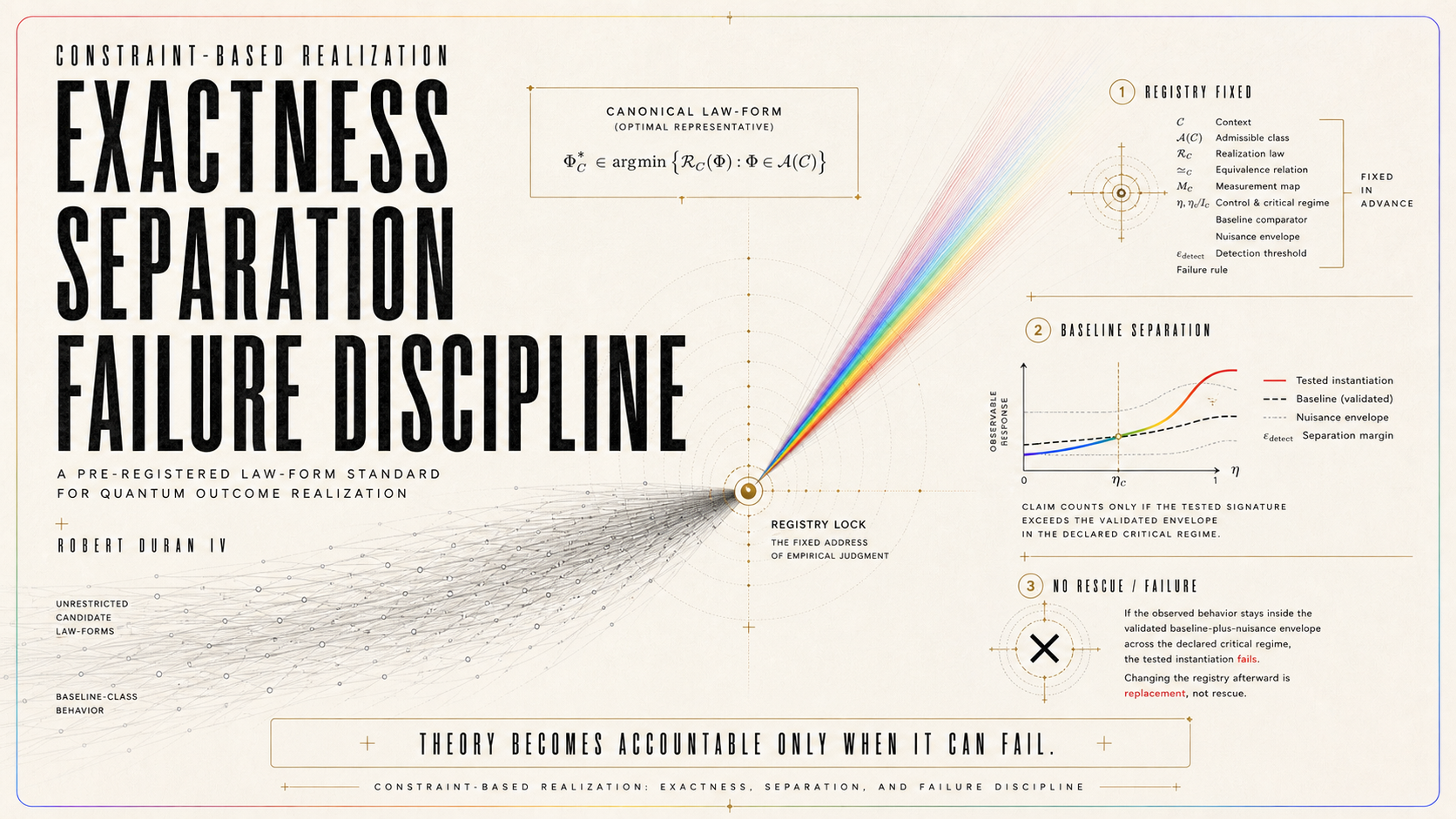
Constraint-Based Realization is a candidate law-form for individual quantum outcome realization. Its canonical representation is:
Φ∗_C ∈ argmin{ℛ_C(Φ) : Φ ∈ 𝒜(C)}.
This expression states that, for a physically specified measurement context C, a selected realization channel or operational verdict class Φ∗_C is obtained by minimizing a context-fixed realization-burden functional ℛ_C over an admissible class 𝒜(C) of realization-compatible candidates. But a canonical form is not yet a testable instantiation. A law-form becomes scientifically evaluable only when its domain, admissible class, comparison rule, equivalence relation, empirical comparator, nuisance allowances, detectability threshold, and failure condition are fixed before confrontation.
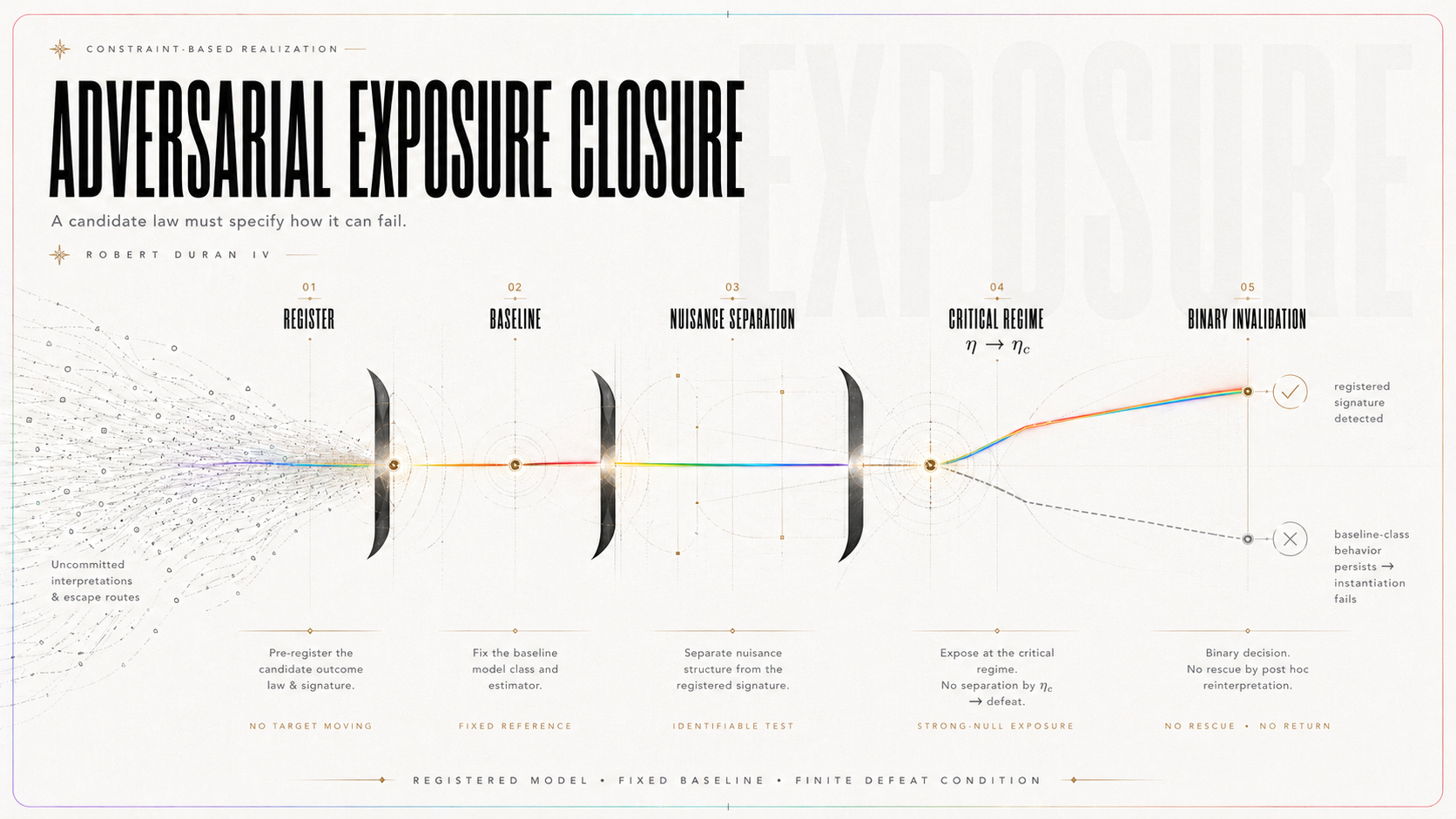
This paper introduces the Exactness and Separation Standard for CBR. The standard requires every serious CBR instantiation to be identified with a finite pre-comparison registry: C, 𝒜(C), ℛ_C, ≃_C, M_C, Φ∗_C, η where relevant, η_c or I_c where a critical regime is claimed, the baseline comparator, nuisance class 𝓝, nuisance envelope B_𝓝, detectability threshold ε_detect, and failure rule. These are not optional annotations added to an otherwise complete theory. They are identity conditions for the tested instantiation. If they are changed after failure, the original model has not been rescued; a successor model has been introduced.
The paper establishes five results. First, the Law-Form Exactness Requirement: the canonical CBR equation is not a fully specified model until its law-defining objects are fixed. Second, the Registry Identity Theorem: a CBR instantiation is identical, for purposes of structural and empirical evaluation, to its pre-comparison registry. Third, the Quadratic-Discipline Theorem: within canonical admissibility, CBR may claim local quadratic-weighting closure, while universal Born-rule derivation requires a separate global theorem. Fourth, the Baseline-Separation Theorem: an accessibility signature is discriminating only if it exceeds the validated standard-quantum-plus-nuisance envelope in the declared critical regime. Fifth, the No-Rescue Theorem: post hoc alteration of registry objects after failure defines replacement, not rescue.
The result is not experimental confirmation of CBR. It is a formal discipline for making CBR exact, non-circular, baseline-separated, Born-disciplined, and publicly vulnerable to failure.
Theorem Spine
Proposition 1 — Law-Form Exactness Requirement
A CBR instantiation is not fully specified by the canonical equation alone. The expression
Φ∗_C ∈ argmin{ℛ_C(Φ) : Φ ∈ 𝒜(C)}
states the form of the law, but not yet the complete identity of a testable model. A testable CBR instantiation is fully specified only when its context C, admissible class 𝒜(C), realization-burden functional ℛ_C, operational equivalence relation ≃_C, parameter values, admissibility rules, minimizer structure M_C, selected verdict criterion Φ∗_C, baseline comparator where relevant, nuisance bounds where relevant, detectability threshold where relevant, and failure condition are fixed before outcome comparison.
The purpose of this proposition is to close the underdetermination objection. A law-form whose objects can be redefined after confrontation is not yet a law under test. It is a flexible schema. Exactness requires pre-comparison fixity.
Theorem 1 — Registry Identity Theorem
A CBR instantiation is identical, for purposes of empirical and structural evaluation, to its pre-comparison registry. The registry fixes the model’s domain of application, admissible candidate class, comparison rule, operational equivalence relation, minimizer structure, accessibility structure where relevant, baseline comparator, nuisance allowance, detectability threshold, and failure rule.
Accordingly, post hoc alteration of any registry object defines a distinct instantiation. It does not preserve the identity of the tested model.
This theorem is the backbone of the Exactness and Separation Standard. The registry is not a checklist external to CBR. It is the condition under which a CBR instantiation becomes a determinate object of evaluation.
Theorem 2 — Quadratic-Discipline Theorem
CBR may claim local quadratic-weighting closure only within the stated admissibility class and regularity assumptions. A stronger universal Born-rule claim requires a separate global theorem.
Equivalently, within canonical admissibility, nonquadratic alternatives must break or weaken at least one declared structural burden: refinement consistency, operational invariance, symmetry, normalization, nontriviality, regularity, or non-circularity. The theorem therefore does not overstate CBR’s probability result. It sharpens it. The point is not to claim that every possible realization-law framework has been defeated, but to make precise the structural cost of departing from quadratic weighting inside the canonical class.
Theorem 3 — Baseline-Separation Theorem
A CBR accessibility signature is empirically meaningful only if the predicted CBR deviation exceeds the validated standard-quantum-plus-nuisance envelope in the declared critical accessibility regime.
Let V_obs(η) denote observed visibility, V_SQM(η) the validated standard-quantum baseline, V_CBR(η) the CBR-predicted response, Δ_CBR(η) the predicted separation from baseline, B_𝓝 the nuisance envelope, ε_detect the detectability threshold, and I_c the declared critical regime. If Δ_CBR(η) ≤ B_𝓝 + ε_detect throughout I_c, then the proposed signature is not empirically separated from baseline. If Δ_CBR(η) > B_𝓝 + ε_detect in a declared nonempty subregion of I_c, then the signature is, in principle, experimentally discriminating.
The purpose of this theorem is to prevent CBR from claiming ordinary visibility change as unique evidence. Standard quantum mechanics already expects record accessibility and which-path information to affect interference. CBR must claim a separated response, not merely a familiar dependence.
Theorem 4 — Strong-Null Failure Theorem
If the registry is fixed, the test is detectability-valid, the baseline comparator is validated, nuisance bounds are respected, and observed behavior remains inside the validated baseline-plus-nuisance envelope throughout the declared critical regime, then the tested CBR instantiation fails.
This theorem is jurisdictionally exact. It does not state that every possible CBR-like framework fails. It does not state that the realization-law question itself fails. It states that the registered instantiation fails under its own declared empirical burden.
Theorem 5 — No-Rescue Theorem
Changing C, 𝒜(C), ℛ_C, ≃_C, η, η_c, I_c, 𝓝, B_𝓝, ε_detect, or the failure rule after a failed test defines a new model. It does not rescue the failed one.
No-rescue is not a methodological add-on. It follows from registry identity. If the registry individuates the tested instantiation, then changing the registry after failure cannot preserve that instantiation. It can only define a successor model.
1. Introduction
1.1 The remaining burden on CBR
Constraint-Based Realization has already been formulated as a candidate law-form for individual quantum outcome realization. In its compressed canonical form, the theory is organized around the sequence:
C → 𝒜(C) → ℛ_C → Φ∗_C.
A physically specified measurement context C determines an admissible class 𝒜(C) of realization-compatible candidates. A context-fixed realization-burden functional ℛ_C orders those candidates. The selected realization channel or operational verdict class Φ∗_C is then obtained by constrained minimization over the admissible class.
That structure is necessary. It is not yet sufficient for public scientific evaluation.
A critic can accept the formal elegance of the canonical expression while still asking whether the theory has been made exact enough to test. Are the objects in the law-form independently fixed? Is the admissible class specified before the result is known? Is the burden functional fixed by theory or by pre-declared calibration, rather than adjusted after the fact? Is the accessibility variable operationally measurable? Is the critical regime declared before data inspection? Is the baseline comparator the real standard-quantum-plus-noise model, or only a weakened ideal baseline? Are nuisance effects bounded? Is there a detectability threshold? Is there a result that would make the tested model fail? Can the theory avoid moving the target after a failed confrontation?
These questions are not peripheral. They determine whether CBR functions as a serious theory candidate or remains an adjustable interpretive schema. A law-form for realization must do more than introduce formal objects. It must bind those objects before outcome comparison. It must declare its comparison class. It must state what counts as baseline behavior. It must specify which deviations are large enough to matter. It must identify which failures count against the tested instantiation. It must also state what cannot be changed afterward.
The present paper therefore treats exactness not as a stylistic preference but as a condition of model identity. A CBR instantiation is not merely a general equation plus later details. It is the complete registered object by which the theory agrees to be judged. Once that registry is fixed, the instantiation has a determinate target, comparator, admissibility structure, and defeat condition. Once that registry fails, altering it does not preserve the same object. It changes the object.
This is the central discipline of the paper.
1.2 Why exactness matters
A realization-law proposal fails as a law candidate if its central objects remain adjustable after the result. If C can be redescribed after the observed outcome, then the domain can be moved. If 𝒜(C) can be narrowed or widened after the result, then eligibility can be moved. If ℛ_C can be reweighted after the result, then selection can be moved. If η_c or I_c can be chosen after inspecting the data, then the target region can be moved. If the baseline comparator can be weakened after the fact, then the comparison can be moved. If the failure rule can be revised after null behavior appears, then the theory cannot lose.
A law candidate becomes scientific only when its freedom is bounded before confrontation.
This is especially important for a theory such as CBR, whose central ambition is to supply a law-form for individual outcome realization. The target is narrow, but the burden is severe. It is not enough to say that constraints select realization. It is not enough to state a minimization law. It is not enough to identify a possible accessibility-sensitive experimental regime. A serious instantiation must state exactly which context is being tested, which candidates are admissible, which burden functional compares them, which operational equivalences are being quotiented out, which baseline behavior is expected without CBR, which nuisance effects are allowed, how large a deviation must be to count, and what outcome defeats the model.
Exactness therefore means pre-comparison fixity. It does not mean that CBR can never be revised. Scientific theories can be revised. But revision after failure is not rescue. It is the introduction of a successor model. The tested instantiation stands or falls under the registry by which it was evaluated.
The movement from canonical form to registered instantiation is therefore not cosmetic. It is the transition from a promising law-form to an accountable model.
1.3 Main contribution
This paper introduces the Exactness and Separation Standard for Constraint-Based Realization.
The standard is simple in principle. A CBR instantiation is acceptable for serious evaluation only if it pre-fixes the law object, the admissible class, the comparison rule, the operational equivalence relation, the accessibility variable where relevant, the critical regime where claimed, the baseline comparator, the nuisance class, the nuisance envelope, the detectability threshold, and the failure rule.
In this standard, the canonical law-form remains central:
Φ∗_C ∈ argmin{ℛ_C(Φ) : Φ ∈ 𝒜(C)}.
But the equation is no longer allowed to float free of its instantiation. The context C must be specified. The admissible class 𝒜(C) must be nonempty, physically constrained, and fixed before outcome comparison. The realization-burden functional ℛ_C must be defined before selection. The operational equivalence relation ≃_C must state when formal differences do not amount to distinct physical verdicts. The minimizer structure M_C must be identified. If accessibility is invoked, η must be operational, not verbal. If a critical regime is claimed, η_c or I_c must be declared before data inspection. If an empirical signature is claimed, the baseline comparator must include standard quantum mechanics plus platform-specific decoherence, detector limitations, loss, phase noise, calibration uncertainty, postselection effects, and other declared nuisance behavior. If a deviation is claimed, it must exceed B_𝓝 + ε_detect in the declared regime. If a failure condition is declared and obtained, the tested instantiation fails.
The contribution is therefore not a new empirical confirmation claim. It is a discipline of specification. The paper states how CBR must be fixed before testing, how its Born-related claims must be scoped, how its accessibility signatures must be separated from ordinary baseline behavior, how its strong-null failures must count, and why post hoc alteration defines replacement rather than rescue.
In compressed form, the contribution is this: the Exactness and Separation Standard converts CBR from a canonical law-form into a registered theory instantiation — a finite, fixed, baseline-separated, Born-disciplined, failure-capable object whose post hoc alteration is not rescue but replacement.
1.4 Non-claims
The force of the Exactness and Separation Standard depends on its restraint. The present paper does not claim that CBR is experimentally confirmed. It does not claim that CBR universally derives the Born rule. It does not claim that CBR defeats all rival interpretations. It does not claim that CBR predicts deviations in ordinary measurement contexts generally. It does not claim that CBR survives every possible failed instantiation. It does not claim that CBR may be adjusted after failure without cost.
The paper also does not claim that one failed registered instantiation destroys every possible realization-law framework. Failure has jurisdiction. A failed test may defeat one registered instantiation. If that instantiation faithfully represents a canonical accessibility model, it may defeat that canonical accessibility model in the tested domain. It does not automatically prove that all possible realization-law questions are meaningless. Nor does it automatically defeat every future model that is independently specified before its own confrontation.
The claim is narrower and stronger: a serious CBR model must be exact before testing and vulnerable after testing. Its objects must be fixed. Its baseline must be real. Its nuisance class must be bounded. Its detectability threshold must be declared. Its failure rule must have consequences. Its failed instantiations cannot be saved by moving the target afterward.
That is the standard adopted in this paper.
2. Background: The CBR Law Form
2.1 The realization target
CBR is addressed to a specific target: individual quantum outcome realization. It is not introduced here as a replacement for ordinary quantum evolution, nor as a denial of record formation, nor as a rejection of decoherence. Its purpose is to isolate the question of what, if anything, functions as the law-form by which one admissible outcome structure is realized in an individual measurement context.
Three levels must be kept distinct.
Evolution concerns state change. In standard quantum theory, this includes unitary evolution in closed systems and effective open-system dynamics in reduced or instrument-level descriptions. Evolution describes how amplitudes, phases, correlations, and state assignments change under the accepted dynamical rules.
Registration concerns record formation. It includes system-apparatus correlation, environmental encoding, pointer stability, interference suppression, and the emergence of effectively classical record-bearing structures. Registration is indispensable to any serious account of measurement because realized outcomes must be physically recordable in some appropriate sense.
Realization concerns the selection of one admissible outcome structure as actual in an individual context. It is not identical to the evolution of the state. It is not identical to the existence of correlations. It is not identical to the suppression of interference in a reduced description. It is the further law-candidate question of which realization-compatible channel or verdict class is selected once the relevant context and admissible candidates are fixed.
CBR targets the third level. It presupposes the importance of the first two. It does not deny that ordinary quantum dynamics governs state evolution, and it does not deny that decoherence and record formation are physically central. Its claim is that if individual outcome realization is treated as a law-form problem, then one must specify the context, candidates, burden structure, operational equivalence, selection rule, and failure conditions for that law.
2.2 Canonical representation
The canonical representation of CBR is:
Φ∗_C ∈ argmin{ℛ_C(Φ) : Φ ∈ 𝒜(C)}.
Here C denotes the physically specified measurement context. It is not merely the name of an observable or basis. It includes the system, apparatus, measurement architecture, record-bearing degrees of freedom, timing, environmental couplings, readout structure, and any accessibility conditions relevant to the realization question.
𝒜(C) denotes the admissible class of realization-compatible candidates in context C. These candidates may be represented as channels, maps, or outcome-structures depending on the level of formalization. The crucial point is that they are not arbitrary mathematical objects. They are the candidates that survive the physical and operational admissibility constraints of the context.
ℛ_C denotes the context-fixed realization-burden functional. It orders the admissible candidates by how well they satisfy the declared realization constraints. ℛ_C is not an ordinary energy functional unless a particular instantiation explicitly makes it one. It is a burden functional: a rule for comparing realization-compatible candidates within a fixed context.
Φ∗_C denotes the selected realization channel or operational verdict class. It is the minimizer, or equivalence class of minimizers, of ℛ_C over 𝒜(C). If multiple formal minimizers exist but are equivalent under the operational equivalence relation ≃_C, they do not represent distinct physical verdicts. They represent different representatives of the same selected realization class.
The canonical equation therefore compresses the law-form:
context → admissible candidates → burden comparison → selected verdict.
It is important that Φ∗_C is not defined as “whatever outcome occurred.” It is defined by minimization over a pre-fixed admissible class under a pre-fixed burden structure. Without that pre-fixity, the equation would collapse into retrospective labeling. With that pre-fixity, it becomes a candidate law-form.
2.3 Why the equation is not enough
The canonical equation is necessary, but it is not sufficient.
A formally elegant expression can still be scientifically underdetermined if the objects appearing in it remain adjustable. The equation becomes a serious theory only when its objects are fixed tightly enough to constrain comparison and failure.
Without a fixed C, the domain can move. A result that appears unfavorable in one context can be reclassified as belonging to another. Without a fixed 𝒜(C), eligibility can move. Candidates can be added, removed, or reinterpreted after the result. Without a fixed ℛ_C, selection can move. The burden functional can be tuned so that the observed result appears favored. Without a fixed ≃_C, formal multiplicity can be hidden or manufactured. Without a fixed η and η_c or I_c, the accessibility target can move. Without a fixed baseline comparator, the comparison can be weakened. Without a fixed nuisance class and nuisance envelope, ordinary imperfections can be selectively invoked. Without a fixed ε_detect, insignificant deviations can be overread. Without a fixed failure rule, the model cannot lose.
The Exactness and Separation Standard is introduced to prevent these failures. It does not replace the canonical CBR equation. It makes the equation accountable. It states that a CBR instantiation is not fully specified until the law-defining objects and test-defining objects are registered before outcome comparison.
This distinction matters. A framework may be promising before it is fully exact. A theory candidate, however, must eventually become exact enough to be wrong. The present paper defines that standard for CBR.
2.4 From law-form to registered instantiation
The transition from law-form to registered instantiation is the central conceptual movement of this paper.
A law-form gives the structure of explanation. It says what kinds of objects must exist for the theory to operate. In CBR, those objects are C, 𝒜(C), ℛ_C, ≃_C, M_C, and Φ∗_C. But a registered instantiation gives the identity of the model actually being evaluated. It states which C, which 𝒜(C), which ℛ_C, which ≃_C, which accessibility variable, which baseline, which nuisance envelope, which detectability threshold, and which failure rule are in force.
The distinction is analogous to the difference between a general equation schema and a specific physical model. The schema may identify the form of the law, but the model is individuated by the objects that make the schema determinate. In CBR, those objects are not auxiliary. They are constitutive. A change to the registry is not a harmless change of notation. It changes the instantiation.
This is why registry identity is necessary. Without it, CBR could always retreat from failure by saying that a different admissible class, different functional, different accessibility variable, different critical regime, or different nuisance envelope should have been used. With registry identity, that retreat is blocked. A revised model may be proposed, but it must be acknowledged as revised. It cannot retroactively become the model that was tested.
3. The Instantiation Registry
3.1 Definition: Instantiation Registry
An Instantiation Registry is the complete pre-comparison specification of a CBR model in a given context of evaluation. It records the law-defining objects, admissibility criteria, comparison rule, operational equivalence relation, accessibility structure where relevant, baseline comparator, nuisance allowance, detectability threshold, and failure rule by which the instantiation will be judged.
The registry must be fixed before outcome comparison. This requirement is not merely procedural. It is constitutive of non-circularity. A model that identifies its context, admissible class, burden functional, baseline, or failure condition only after the result is known has not explained or predicted anything at the level of realization. It has reorganized the description after the fact.
More strongly, the registry is an identity condition. A registered CBR instantiation is not the canonical equation plus unspecified future choices. It is the canonical equation bound to a finite specification. The registry individuates the model under evaluation. If the registry changes, the instantiation changes.
The registry therefore functions as the anti-target-moving device for CBR. It establishes which model is under evaluation. It states what the model is allowed to use. It states what baseline it must beat. It states what nuisance effects are permitted. It states when the model fails. Without such a registry, the canonical law-form remains vulnerable to the objection that it is elegant but adjustable.
A registered instantiation need not be universal. It may apply only to a particular experimental family, platform, or measurement context. That restriction is not a weakness. It is how exactness is achieved. What matters is that, within its declared scope, the instantiation is fixed before confrontation.
3.2 Registry Object 1: Physical context C
The first registry object is the physical context C.
C must include the relevant physical and operational details of the measurement setting. At minimum, this includes the system, apparatus, state preparation, measurement architecture, record-bearing degrees of freedom, timing relations, environmental couplings, readout structure, postselection rules, and calibration procedures. If accessibility is relevant, C must also state how outcome-defining information is stored, degraded, erased, recovered, or made available to further interaction.
C cannot be a bare label. It is not enough to say “a two-path experiment,” “a delayed-choice setup,” or “a measurement in a given basis.” Those phrases may identify a family of contexts, but they do not yet define the specific context over which 𝒜(C), ℛ_C, η, I_c, and the baseline comparator are fixed.
The reason C must be registered is straightforward. If C can be redescribed after outcome comparison, then the theory can escape failure by changing the domain. A null result in one declared context could be reinterpreted as not having tested the “real” context after all. A deviation could be redescribed as belonging to a different regime. A nuisance effect could be absorbed into a revised context definition. These moves may be legitimate in constructing a future model, but they cannot rescue the tested one.
Registry fixity of C ensures that the model under evaluation has a definite target.
3.3 Registry Object 2: Admissible class 𝒜(C)
The second registry object is the admissible class 𝒜(C).
𝒜(C) defines which candidate realization channels or outcome-structures are eligible for selection in context C. It is not the set of all mathematically writable maps. It is the set of candidates that satisfy the physical, operational, and admissibility conditions declared for the context.
𝒜(C) must exclude post hoc candidates, representation artifacts, arbitrary relabelings, inaccessible branch distinctions, and candidates whose only function is to fit the observed result. It must also exclude candidates that violate the declared dynamical compatibility, record-structural requirements, probability discipline, or operational equivalence criteria of the instantiation.
The admissible class is where CBR either becomes disciplined or collapses into arbitrariness. If 𝒜(C) is too broad, almost any outcome can be made selectable. If it is too narrow, the selected result may be smuggled into the class by construction. If it is adjusted after the result, the model becomes retrospective.
For that reason, the registry must state not only which candidates are included, but also why they are included. It must state the admissibility rule, not merely list favored candidates. A serious CBR instantiation selects from 𝒜(C); it does not define 𝒜(C) around the selected result.
3.4 Registry Object 3: Realization functional ℛ_C
The third registry object is the realization-burden functional ℛ_C.
ℛ_C is the rule by which admissible candidates are compared. It assigns or induces an ordering over 𝒜(C), allowing the minimizer set M_C to be defined. The selected verdict Φ∗_C is then obtained from the minimizer structure, either as a unique minimizer or as an operational equivalence class of minimizers.
ℛ_C must be fixed before selection. If ℛ_C contains component burdens such as Ξ_C, Ω_C, and Λ_C, each term must be defined in the registry. If ℛ_C contains coefficients such as α, β, and γ, those coefficients must be fixed by theory or by pre-declared calibration. If calibration is used, the calibration procedure must be separated from the outcome comparison it is later used to evaluate.
The danger is post hoc burden adjustment. If coefficients can be changed after observing the data, then ℛ_C can be made to favor almost any result. If terms can be added after failure, then the functional becomes a rescue device. If the meaning of a burden term changes after the test, then the selection rule has moved.
The registry prevents this. It states what ℛ_C is before the model is judged. Later modification is possible only as a successor instantiation, not as preservation of the tested one.
3.5 Registry Object 4: Operational equivalence ≃_C
The fourth registry object is the operational equivalence relation ≃_C.
Two candidates Φ₁ and Φ₂ satisfy Φ₁ ≃_C Φ₂ when they differ only in ways that make no realization-relevant operational difference in context C. Operational equivalence prevents the theory from treating merely formal differences as physically distinct verdicts. It also prevents false multiplicity in the minimizer set.
The registry must state the equivalence relation before minimizers are interpreted. Otherwise, equivalence can be used opportunistically. If two unfavorable minimizers are declared “equivalent” after the fact, degeneracy can be hidden. If two favorable representatives are declared distinct after the fact, artificial richness can be manufactured. Neither move is acceptable in a registered instantiation.
The purpose of ≃_C is disciplined quotienting. It allows CBR to select a physical verdict class rather than a syntactic representative. This is essential because mathematical descriptions can differ in ways that do not correspond to distinct physical outcomes. But the equivalence relation must itself be fixed. Operational equivalence cannot become a post hoc tool for avoiding non-selection.
3.6 Registry Object 5: Accessibility parameter η
The fifth registry object, where relevant, is the accessibility parameter η.
If accessibility is part of the model, η must be operationally defined. It cannot mean merely that a record is “available,” “visible,” “known,” or “accessible” in an informal sense. It must be tied to a measurable feature of the context.
Possible operational definitions include record distinguishability, recoverable which-path information, mutual information with record-bearing degrees of freedom, trace-distance distinguishability, or another declared accessibility measure. The choice of definition depends on the platform and protocol. What matters is not that every CBR instantiation use the same operational implementation, but that each instantiation state exactly what η means before comparison.
The reason is direct. If η is vague, the critical regime can be moved. If η is redefined after seeing the data, a null result can be dismissed as not having probed the “right” accessibility variable. If η is measured differently across baseline and CBR comparisons, the separation claim becomes unstable.
A registered η makes accessibility a physical control parameter rather than a conceptual placeholder.
3.7 Registry Object 6: Critical regime η_c or I_c
The sixth registry object is the critical accessibility point η_c or interval I_c, where such a regime is claimed.
A CBR instantiation that predicts an accessibility-sensitive signature must state where the signature is expected to occur. This may be a point η_c, a bounded interval I_c, or a theoretically derived region of accessibility values. The declared regime may include tolerance allowances, but those allowances must themselves be specified before data inspection.
The critical regime cannot be chosen after seeing the data. If it could, any fluctuation could be elevated into a signature and any null region could be excluded from relevance. The theory would then become immune to ordinary empirical discipline.
The registry therefore requires a declared region of vulnerability. Within I_c, the CBR signature must either appear outside the baseline-plus-nuisance envelope or fail under the stated strong-null condition. Outside I_c, the model may not claim equal exposure unless it has declared a broader burden.
This restriction strengthens CBR. It prevents the theory from claiming every anomaly while avoiding every null.
3.8 Registry Object 7: Baseline comparator
The seventh registry object is the baseline comparator.
The baseline cannot be idealized standard quantum mechanics alone. A serious comparator must include standard quantum mechanics plus platform-specific decoherence, detector limitations, loss, phase noise, calibration uncertainty, postselection effects, reconstruction procedures, and ordinary nuisance behavior relevant to the experiment.
This point is crucial. CBR cannot claim empirical distinction by defeating a weak baseline that no expert would accept. It must distinguish itself from the strongest ordinary model available for the platform. If the experiment involves interferometric visibility, the baseline must include ordinary visibility degradation mechanisms. If it involves record erasure or recovery, the baseline must include imperfect erasure, residual distinguishability, loss channels, finite detector efficiency, dark counts, timing jitter, and statistical uncertainty where applicable.
The baseline comparator defines what counts as non-CBR behavior. Without it, a deviation cannot be interpreted. A change in visibility as η varies is not automatically evidence for CBR, because standard quantum theory already expects which-path information and record accessibility to affect interference. The question is whether the observed behavior lies outside the validated standard-quantum-plus-nuisance envelope in the declared critical regime.
A registered baseline makes the comparison fair.
3.9 Registry Object 8: Nuisance class 𝓝
The eighth registry object is the nuisance class 𝓝.
𝓝 is the class of ordinary non-CBR imperfections allowed to distort the baseline. It should include all relevant platform effects that could mimic, obscure, or deform the predicted signal. These may include finite detector efficiency, dark counts, phase drift, imperfect erasure, residual decoherence, alignment errors, timing jitter, calibration uncertainty, readout noise, postselection bias, finite sample effects, and other platform-specific imperfections.
The nuisance class must be declared before outcome comparison. If nuisance effects are added selectively after a result, then ordinary explanations can be used opportunistically. A favorable anomaly can be protected from mundane explanation by narrowing 𝓝. An unfavorable null can be dismissed by expanding 𝓝. Both moves undermine testability.
𝓝 should therefore be broad enough to represent the real experiment and narrow enough to remain constraining. The purpose is not to make CBR easy to confirm. The purpose is to make confirmation and failure meaningful.
3.10 Registry Object 9: Nuisance envelope B_𝓝
The ninth registry object is the nuisance envelope B_𝓝.
B_𝓝 is the maximum baseline distortion allowed by nuisance effects in the declared critical regime. In simple terms, B_𝓝 is how far ordinary noise is allowed to move the baseline.
If V_SQM(η) is the validated standard-quantum baseline, then nuisance effects generate a class of allowed baseline-distorted responses. B_𝓝 bounds the size of those ordinary distortions in I_c. A CBR signature is not separated from baseline merely because V_obs(η) differs from an ideal curve. It is separated only if it differs from the allowed standard-quantum-plus-nuisance class by more than the declared detectability threshold.
The registry must define how B_𝓝 is obtained. It may be derived from calibration, bounded by independent measurement, estimated from platform characterization, or specified through a validated noise model. But it cannot be selected after the data in order to include or exclude the observed result.
B_𝓝 is the object that prevents CBR from confusing ordinary experimental imperfection with realization-sensitive deviation.
3.11 Registry Object 10: Detectability threshold ε_detect
The tenth registry object is the detectability threshold ε_detect.
ε_detect is the minimum observable separation required for a valid test. It accounts for the fact that no experiment has infinite resolution. A predicted deviation smaller than the experiment can distinguish does not constitute an empirical burden. A claimed anomaly smaller than the declared threshold does not constitute separation.
The threshold must be fixed before outcome comparison. Otherwise, insignificant fluctuations can be elevated into signatures, or failures can be avoided by revising the claimed threshold after the fact.
In the baseline-separation condition, ε_detect appears with B_𝓝 because empirical discrimination requires more than theoretical difference. It requires resolvable difference. CBR is separated from baseline only where its predicted deviation exceeds the ordinary nuisance envelope plus the threshold of detection.
Thus the relevant condition is:
Δ_CBR(η) > B_𝓝 + ε_detect
in a declared nonempty region of I_c.
3.12 Registry Object 11: Failure rule
The eleventh registry object is the failure rule.
The failure rule states exactly what result counts against the registered instantiation. For an accessibility-sensitive CBR test, a natural failure condition is:
If observed behavior remains inside the baseline-plus-nuisance envelope throughout I_c under detectability-valid conditions, the tested CBR instantiation fails.
This rule must be declared before the test. It cannot be softened after the result. A model that declares an empirical burden must accept the corresponding empirical liability.
The failure rule is not an embarrassment. It is the condition that makes the model scientifically legible. A CBR instantiation that cannot fail is not stronger than one that can. It is less evaluable.
3.13 Registry identity
The preceding registry objects are not merely documentary requirements. They are identity conditions.
A CBR instantiation is the canonical law-form together with its registered specification. The registry fixes what the model is, where it applies, what it compares, what it counts as admissible, what it predicts or burdens, what baseline it faces, what nuisance effects it permits, and how it fails.
Therefore, two CBR instantiations that differ in C, 𝒜(C), ℛ_C, ≃_C, η, I_c, baseline comparator, 𝓝, B_𝓝, ε_detect, or failure rule are not the same tested model. They may belong to the same broader research program. They may share a canonical law-form. They may be related as predecessor and successor. But they are not identical for purposes of evaluation.
This is the decisive move. No-rescue follows from identity. If the registry individuates the model, then altering the registry after failure cannot preserve the model. It can only replace it.
4. Law-Form Exactness and Registry Identity
4.1 Theorem statement
Law-Form Exactness and Registry Identity Theorem. A CBR model is exact in context C only if all law-defining and test-defining objects in its Instantiation Registry are fixed before outcome comparison. For purposes of structural and empirical evaluation, the registered CBR instantiation is identical to that pre-comparison registry.
More explicitly, a CBR instantiation is exact only if it specifies, prior to comparison, its physical context C, admissible class 𝒜(C), realization-burden functional ℛ_C, operational equivalence relation ≃_C, minimizer structure M_C, selected verdict criterion Φ∗_C, accessibility parameter η where relevant, critical accessibility point η_c or interval I_c where claimed, baseline comparator, nuisance class 𝓝, nuisance envelope B_𝓝, detectability threshold ε_detect, and failure rule.
The theorem is conditional. It does not say that every such instantiation is true. It says that without such pre-comparison fixity, the instantiation is not exact enough to function as a serious testable CBR model. It also says that once such fixity is established, post hoc alteration of registry objects defines a different instantiation rather than preserving the original one.
4.2 Proof sketch
The proof is by anti-circularity and model individuation.
First, anti-circularity requires that the objects used to select, compare, interpret, and evaluate the outcome not depend on the outcome itself. If C is adjustable after outcome comparison, then the domain of the model can move. A failed result can be redescribed as having tested the wrong context. The model has not faced a fixed target.
If 𝒜(C) is adjustable after outcome comparison, then the candidate space can move. Candidates can be added or removed to make the selected verdict appear natural. Selection becomes retrospective.
If ℛ_C is adjustable after outcome comparison, then the comparison rule can move. Coefficients can be retuned, terms can be reinterpreted, and burdens can be rearranged to favor the observed result. Minimization no longer functions as a law-like selection rule.
If ≃_C is adjustable after outcome comparison, then physical equivalence can move. Operationally distinct candidates can be collapsed when degeneracy is inconvenient, or equivalent candidates can be separated when multiplicity is useful.
If η is adjustable after outcome comparison, then the accessibility variable can move. The theory can claim that the relevant kind of accessibility was not the one actually measured.
If η_c or I_c is adjustable after outcome comparison, then the target regime can move. A null can be excluded from the critical region, or a fluctuation can be declared critical.
If the baseline comparator is adjustable after outcome comparison, then the comparison can move. The model can be tested against a weak baseline when seeking support and against a flexible baseline when avoiding failure.
If 𝓝 and B_𝓝 are adjustable after outcome comparison, then ordinary noise can be invoked selectively. Nuisance effects can be widened or narrowed depending on whether the observed result is favorable.
If ε_detect is adjustable after outcome comparison, then the evidential threshold can move. Small fluctuations can be counted as signatures, or unresolved differences can be treated as meaningful.
If the failure rule is adjustable after outcome comparison, then defeat disappears. The model can always reinterpret the result as non-decisive.
Therefore, exactness requires registry fixity.
Second, model individuation requires that the tested instantiation be identified by the objects under which it agrees to be evaluated. A CBR instantiation is not merely the generic canonical expression. It is the canonical expression with a specific C, a specific 𝒜(C), a specific ℛ_C, a specific ≃_C, a specific accessibility definition where relevant, a specific baseline, a specific nuisance envelope, a specific detectability threshold, and a specific failure rule. These objects determine what the model is for purposes of testing.
It follows that changing those objects after failure does not preserve the tested instantiation. It defines another instantiation. The successor may be legitimate. It may be better. It may deserve separate evaluation. But it cannot retroactively become the model that faced the failed test.
4.3 Consequence
The main consequence is that CBR should not be defended merely by saying that the framework could be modified.
Of course it could be modified. Any developing framework can be modified. But a registered instantiation is not saved by the mere possibility of future revision. If the model under test declares C, 𝒜(C), ℛ_C, η, I_c, baseline, nuisance bounds, detectability threshold, and failure rule, then it must stand or fall under those declarations.
A later alteration may be legitimate. It may improve the theory. It may define a better successor model. It may even motivate a new experimental program. But it does not retroactively rescue the tested instantiation.
This consequence is central to the credibility of CBR. The theory becomes stronger by refusing post hoc immunity. It becomes exact enough to be judged.
4.4 Failure mode avoided
The theorem blocks the central failure mode of adjustable theory construction: indefinite reinterpretability.
Without registry identity, every negative result can be absorbed by saying that the wrong context was tested, the wrong admissible class was used, the wrong accessibility parameter was measured, the wrong critical regime was inspected, the baseline was not the intended one, the nuisance envelope was too strict, or the failure rule was too narrow. Some of these claims may be legitimate before a test, if they are built into the registry. After a failed test, however, they cannot preserve the identity of the tested instantiation.
Registry identity does not forbid future theory development. It forbids retroactive preservation. This is the distinction that lets CBR remain both flexible as a research program and strict as a tested model.
4.5 Exactness as a scientific virtue
Exactness increases risk. It prevents a model from claiming every favorable result while evading every unfavorable one. But that risk is precisely what gives a theory candidate scientific meaning.
Under the Exactness and Separation Standard, CBR does not seek protection from failure. It seeks a disciplined form of failure. If a registered instantiation succeeds, its success is interpretable because the baseline, nuisance envelope, and threshold were fixed. If it fails, its failure is interpretable because the defeat condition was declared. In either case, the result has content.
The standard therefore strengthens CBR not by making it easier to defend, but by making it harder to rescue illegitimately. That is the appropriate burden for a candidate law of outcome realization.
5. Quadratic-Weighting Discipline
5.1 Why probability discipline belongs in the hardening standard
The Exactness and Separation Standard is not limited to empirical protocol design. It also governs the status of CBR’s probability claims. A candidate realization law cannot be exact about its selection structure while remaining loose about its relation to Born-rule statistics. If CBR is to be evaluated as a serious law-form, it must state what it claims about weighting, what it does not claim, and what burden a rival weighting rule must carry.
The relevant distinction is between probability replacement and probability discipline. CBR should not be presented as casually replacing the Born rule, nor should it claim, without qualification, that every possible realization-law framework has been forced into quadratic weighting. Such a claim would require a global theorem over all admissibility geometries, all possible realization-law representations, and all candidate probability structures. That is not the burden of the present paper.
The appropriate claim is narrower and stronger. Within canonical admissibility, if a realization-law candidate accepts refinement consistency, coarse-graining consistency, operational invariance, symmetry, normalization, nontriviality, regularity, and non-circular admissibility, then normalized nonquadratic alternatives are not freely available. They must either satisfy those burdens or leave the canonical class.
This point is important. A nonquadratic rival is not declared logically impossible. It is reclassified. If it breaks the canonical burdens, then it is not an equivalent member of the same canonical admissibility class. It may define a different theory, a different admissibility geometry, or a successor weighting framework, but it cannot be presented as a cost-free alternative internal to canonical CBR.
The result is best understood as a quadratic-weighting discipline or quadratic-weighting barrier. CBR’s probability claim becomes strongest when it is scoped exactly: within the declared canonical class, departures from quadratic weighting require explicit structural cost.
5.2 Correct claim: local quadratic discipline within canonical admissibility
The correct probability claim for the present standard is the following:
Within canonical admissibility, quadratic weighting is forced or uniquely stabilized by the combined requirements of admissible refinement, coarse-graining consistency, operational invariance, symmetry, normalization, nontriviality, regularity, and non-circularity.
This claim must be read precisely. It is not a universal derivation of the Born rule from no assumptions. It is a conditional rigidity result inside a declared admissibility structure. Once the canonical class is fixed, and once the relevant invariance and refinement constraints are imposed, the weighting structure cannot be altered freely while remaining in that same class.
Admissible refinement requires that subdividing an outcome structure not arbitrarily change the total weight assigned to the physical outcome being refined. Coarse-graining consistency requires that recombining operationally related refinements recover the same total weight. Operational invariance requires physically equivalent descriptions to yield the same weighting verdict. Symmetry requires equivalent cases to be treated equally. Normalization requires the total assigned weight over the relevant outcome class to be unity. Nontriviality excludes degenerate assignments that erase the distinction among admissible outcomes. Regularity excludes unstable or pathological assignments not justified by the physical context. Non-circularity requires that the weighting rule not be chosen after the observed outcome in order to rationalize that outcome.
Under those constraints, a nonquadratic rule is not merely an alternative notation. It changes the admissibility discipline. It must either change how refinements behave, change how operationally equivalent cases are treated, alter symmetry, disturb normalization, introduce irregularity, or reintroduce hidden outcome-dependence.
The result is not that CBR has completed every possible probability theorem. The result is that canonical CBR is not probability-arbitrary. It imposes a membership condition: a weighting rule that rejects the canonical burdens is no longer an equivalent inhabitant of the same canonical admissibility class.
5.3 Incorrect overclaim: universal Born-rule derivation without a global theorem
The present paper should not claim that CBR has universally derived the Born rule across every possible realization-law framework. That claim would exceed the scope of the Exactness and Separation Standard.
A universal derivation would require more than showing that quadratic weighting is rigid within the canonical class. It would require showing that all admissible realization-law geometries, or all serious alternatives satisfying some independently justified global standard, collapse into the same weighting structure. Such a result may be a possible future ambition, but it is not established by the hardening standard alone.
The danger of overclaim is not merely rhetorical. If CBR claims more than it proves, then its strongest local result becomes vulnerable to unnecessary criticism. A careful local theorem can survive scrutiny. An unearned universal theorem invites rejection.
The disciplined formulation is therefore:
CBR has a local quadratic-weighting closure claim within canonical admissibility. A stronger universal Born-rule derivation requires a separate global theorem.
This formulation preserves the merit of the result without confusing scope. It also aligns the probability claim with registry discipline. Just as an empirical instantiation must state its domain before testing, a probability theorem must state its admissibility domain before claiming closure.
5.4 The quadratic barrier and canonical-class reclassification
The quadratic barrier is the structural cost imposed on nonquadratic alternatives within canonical admissibility.
Let a proposed alternative weighting rule assign normalized weights to admissible outcome structures by some function distinct from the quadratic modulus form. Such a rule may be mathematically writable. The question is not whether it can be written. The question is whether it can remain inside the same canonical class while satisfying the same burdens.
Within the canonical discipline, a nonquadratic rival must sacrifice at least one of the following: admissible refinement, coarse-graining consistency, operational invariance, symmetry, normalization, regularity, non-circular admissibility, or empirical Born compatibility.
If it sacrifices none of them, then it has not supplied a distinct normalized nonquadratic alternative within the canonical class. If it sacrifices one or more of them, then it has left or modified that class. It may be an alternative theory. It may be a noncanonical realization-law proposal. It may be a useful foil. But it is not an equivalent canonical CBR weighting rule.
This is the sharper form of the barrier. Nonquadratic alternatives are not merely “costly” in a vague sense. They are subject to classification. Either they satisfy the canonical burdens and collapse into the same quadratic discipline, or they reject some burden and are reclassified as outside the canonical admissibility class.
The force of the barrier is therefore not that nonquadratic alternatives are logically impossible in every imaginable formal system. The force is that they cannot enter canonical CBR without paying an explicit structural price.
5.5 Quadratic-Discipline Theorem
Theorem 2 — Quadratic-Discipline Theorem. Within canonical admissibility, no distinct normalized nonquadratic weighting rule survives as an equivalent replacement for quadratic weighting unless it violates, weakens, or replaces at least one declared structural burden: admissible refinement, coarse-graining consistency, operational invariance, symmetry, normalization, nontriviality, regularity, non-circular admissibility, or empirical Born compatibility. If it does so, it is not an equivalent member of the same canonical admissibility class.
Assumptions. The theorem assumes a fixed canonical admissibility class, fixed operational equivalence criteria, normalized outcome weighting, refinement discipline, coarse-graining consistency, symmetry across physically equivalent cases, regularity of the weighting assignment, and independence of the weighting rule from the realized outcome. It does not assume that every conceivable realization-law framework has the same admissibility geometry.
Proof sketch. A weighting rule inside the canonical class must remain stable under admissible refinement and coarse-graining. It must assign the same weights to operationally equivalent descriptions. It must respect symmetry among physically equivalent outcome structures. It must normalize over the admissible outcome class. It must not depend on the outcome selected. Under these constraints, quadratic weighting is not merely one arbitrary option among indefinitely many. It is the stable weighting form compatible with the declared canonical burdens. A distinct normalized nonquadratic rule changes the weighting response under at least one admissible transformation, equivalence condition, or regularity requirement. Therefore it either violates a declared burden or replaces the burden structure with a different one. In the first case, it fails as a canonical alternative. In the second case, it defines a noncanonical framework.
Consequence. CBR may legitimately claim local quadratic-weighting discipline within its canonical admissibility class. It should not claim universal Born-rule derivation unless a separate theorem establishes that no alternative admissibility geometry can satisfy the relevant global burdens.
Failure mode. A CBR manuscript fails the present standard if it inflates local quadratic closure into universal Born-rule derivation without proving the global claim. It also fails if it treats nonquadratic alternatives as impossible without specifying the burdens they must violate or abandon.
5.6 Strategic result
The Born-rule issue becomes stronger when framed as a quadratic-weighting barrier rather than as an overbroad universal derivation.
A universal derivation claim invites the question: universal over what class? If the class is not precisely specified, the claim becomes vulnerable. A quadratic-barrier claim answers that question directly. It says: within this class, under these burdens, nonquadratic alternatives incur these costs or leave the class.
This is the more mature form of the probability result. It does not retreat from CBR’s strength. It disciplines it. The theory does not need to pretend that every possible probability question has been settled in order to make a serious contribution. It needs to show that its canonical realization-law class is not probability-arbitrary. The quadratic-barrier formulation does that.
For the purposes of the present paper, probability discipline therefore has two functions. First, it prevents CBR from becoming an unconstrained modification of quantum statistics. Second, it prevents CBR from overstating its own closure. Both functions strengthen the framework.
6. Baseline-Separation Standard
6.1 Why ordinary visibility change is not enough
The empirical vulnerability of CBR depends on baseline separation. It is not enough for a CBR instantiation to predict that interference visibility changes as record accessibility changes. Standard quantum mechanics already expects which-path information, record distinguishability, decoherence, imperfect erasure, and environmental coupling to affect interference. A visibility curve that varies with accessibility is not, by itself, evidence for CBR.
This point must be stated without ambiguity. CBR cannot claim ordinary accessibility-dependent interference behavior as its unique empirical signature. The relevant question is not whether V_obs(η) changes. The relevant question is whether V_obs(η) departs from the validated standard-quantum-plus-nuisance class in the declared critical regime by more than the detectability threshold.
A weak baseline would make the theory appear more successful than it is. If CBR is compared only against an idealized smooth curve while the actual platform contains loss, phase drift, residual distinguishability, finite detector efficiency, imperfect erasure, or postselection effects, then apparent deviation may reflect ordinary nuisance structure rather than realization-sensitive physics. Such a comparison would not establish CBR. It would establish only that the comparator was incomplete.
The Exactness and Separation Standard therefore requires a strong comparator. CBR must be tested against standard quantum mechanics plus the relevant ordinary physics of the platform. Only then can a deviation become meaningful.
6.2 Baseline class rather than baseline curve
For a serious test, the comparator should not be treated as a single ideal curve whenever the platform admits nuisance variation. The relevant comparator is a baseline class.
Let 𝔅_SQM,𝓝 denote the registered class of all standard-quantum-plus-nuisance responses allowed by the baseline model and nuisance class 𝓝. This class includes the ordinary standard-quantum response together with all platform-specific variations permitted by detector limits, loss, phase noise, calibration uncertainty, postselection effects, residual decoherence, imperfect erasure, finite sampling, and other declared nuisance mechanisms.
The purpose of 𝔅_SQM,𝓝 is to prevent false separation. A predicted CBR response does not separate from baseline merely by differing from one chosen V_SQM(η). It separates only by falling outside the allowed baseline class.
Thus the sharper question is:
Does V_CBR(η), or the observed response V_obs(η), lie outside 𝔅_SQM,𝓝 in the declared critical regime by more than ε_detect?
This class-based formulation is stronger than comparison with a single curve plus informal error tolerance. It makes the comparator explicit. It requires CBR to defeat the full registered ordinary model, not a weakened representative of it.
6.3 What CBR must predict
A CBR accessibility signature must be a non-baseline feature. It must not reduce to the familiar fact that which-path information suppresses interference or that record erasure can restore visibility. It must specify a response structure that the validated baseline class does not absorb.
The admissible forms of such a signature may include a kink, a derivative break, a bounded non-baseline deviation, a lower-bound separation, or a forbidden response shape. These possibilities need not all be present in the same instantiation. What matters is that the registered model declare which form is being claimed.
A kink or derivative break would represent a non-smooth change in the response near a declared critical accessibility regime. A bounded non-baseline deviation would represent a response outside 𝔅_SQM,𝓝 in a specified region. A lower-bound separation would specify a minimum deviation size required by the CBR model. A forbidden response shape would identify a functional dependence inconsistent with the validated baseline class.
The signature must be declared before data inspection. If the model claims a kink only after observing a kink-like fluctuation, the claim is post hoc. If it claims a broad deviation only after failing to find a sharp transition, the target has moved. If it changes from derivative-break language to envelope-deviation language after the data arrive, a new instantiation has been introduced.
The point is not to privilege one signature form in advance for all possible platforms. The point is to require each registered instantiation to declare its signature form before confrontation.
6.4 Observables and notation
For an accessibility-sensitive test, let η denote the registered operational accessibility parameter. Let I_c denote the declared critical accessibility regime. Let V_obs(η) denote the observed visibility or corresponding primary observable as a function of η. Let V_SQM(η) denote a representative validated standard-quantum baseline response for the same platform and context. Let 𝔅_SQM,𝓝 denote the full registered class of standard-quantum-plus-nuisance responses.
Let V_CBR(η) denote the CBR-predicted response for the registered instantiation. Define the pointwise predicted CBR separation from a representative baseline as:
Δ_CBR(η) = |V_CBR(η) − V_SQM(η)|.
For the strongest version of the standard, however, the decisive comparison is not only pointwise distance from V_SQM(η). It is distance from the baseline class 𝔅_SQM,𝓝. Let:
dist(V_CBR, 𝔅_SQM,𝓝; I_c)
denote the registered distance between the CBR-predicted response and the allowed baseline-response class over the declared critical regime. The metric or norm used for this distance must itself be part of the registry. It may be pointwise, uniform over I_c, integrated over I_c, or defined by a pre-specified statistical test. What matters is that the distance criterion be fixed before outcome comparison.
The registry must also state which observable is primary. If the primary observable is visibility, then V_obs(η), V_CBR(η), and 𝔅_SQM,𝓝 must be defined accordingly. If the primary observable is another quantity, the same structure applies under the appropriate notation.
6.5 The declared critical regime
Let I_c be the declared accessibility-critical regime. I_c may be an interval surrounding a critical value η_c, a bounded region derived from the realization functional, or a platform-specific regime in which the registered model claims accessibility becomes realization-effective.
All baseline separation claims must be evaluated inside I_c unless the registry declares a broader burden. This prevents selective use of the data. A CBR instantiation cannot search the entire η-domain after the fact and designate whichever region appears most favorable as critical. Nor can it exclude an unfavorable region from I_c after observing null behavior.
The declared critical regime is a site of vulnerability. If the CBR signature is expected there, then the absence of that signature there matters. If the model does not claim exposure outside that regime, then ordinary baseline behavior outside the regime does not by itself defeat the model. This is why I_c must be stated exactly. It defines the empirical jurisdiction of the signature claim.
The critical regime may include uncertainty if that uncertainty is itself registered. A model may say, for example, that the signature is expected within a specified interval rather than at an exact point. But the interval must be fixed before outcome comparison. A vague critical regime is not a vulnerability condition. It is an escape route.
6.6 The nuisance envelope
B_𝓝 is the nuisance envelope associated with the declared nuisance class 𝓝. It specifies the maximum ordinary baseline distortion allowed within I_c.
In the class-based formulation, B_𝓝 may be understood as the boundary or tolerance structure defining 𝔅_SQM,𝓝. It determines which responses count as ordinary standard-quantum-plus-nuisance behavior and which responses fall outside that class.
The nuisance envelope must be derived or bounded independently of the CBR signature claim. It may come from calibration runs, platform characterization, detector models, phase-stability measurements, statistical uncertainty analysis, or other ordinary physical modeling. Its role is to determine how far standard quantum mechanics plus ordinary imperfections can move the observable before CBR-specific explanation is required.
The envelope should be neither artificially narrow nor indefinitely broad. If B_𝓝 is too narrow because ordinary imperfections are ignored, CBR may appear discriminating when it is not. If B_𝓝 is too broad, the test may become incapable of detecting any meaningful deviation. A valid registry must therefore justify the envelope relative to the platform.
The nuisance envelope is not a place to hide the theory. It is a boundary of fair comparison. It protects standard explanations from being prematurely dismissed, and it protects CBR from being credited for effects that ordinary physics already explains.
6.7 Separation condition
CBR is empirically separated from baseline only if its registered predicted response lies outside the standard-quantum-plus-nuisance baseline class by more than the detectability threshold in a declared nonempty part of I_c.
In the simplified envelope notation, the condition is:
Δ_CBR(η) > B_𝓝 + ε_detect
for η in a registered nonempty subregion of I_c.
In the stronger class-based notation, the condition is:
dist(V_CBR, 𝔅_SQM,𝓝; I_c) > ε_detect
under the registered distance criterion.
This condition should not be treated as decorative. It is the condition under which the CBR response becomes experimentally discriminating. If the predicted deviation remains inside 𝔅_SQM,𝓝, or if its distance from that class is smaller than ε_detect, then the proposed signature is not meaningfully distinguishable from the validated baseline. In that case, the signature may be conceptually interesting, but it is not an empirical discriminator in the registered test.
The condition also prevents overinterpretation of small deviations. If V_obs(η) differs slightly from a representative V_SQM(η), but the difference lies within 𝔅_SQM,𝓝, the result does not support CBR. It remains baseline-compatible. Conversely, if the observed response lies outside the validated baseline class in the declared region by more than ε_detect, then the result may become separated support for the registered signature, provided the registry was fixed and the test conditions were valid.
Separation is therefore not anomaly hunting. It is registered discrimination against a serious comparator.
6.8 Decision triad for empirical outcomes
A registered CBR test should not be forced into a false binary when the experiment is underpowered, the nuisance model is incomplete, or the baseline is not validated. The strongest standard recognizes three possible outcomes.
First, separated support obtains when the registry is fixed, the experiment is detectability-valid, the baseline class 𝔅_SQM,𝓝 is validated, nuisance bounds are respected, and V_obs(η) displays the registered CBR signature outside 𝔅_SQM,𝓝 by more than ε_detect in the declared critical regime.
Second, strong-null failure obtains when the registry is fixed, the experiment is detectability-valid, the baseline class is validated, nuisance bounds are respected, and V_obs(η) remains inside 𝔅_SQM,𝓝 throughout I_c despite the model’s registered prediction of separation. In that case, the registered instantiation is false in that domain.
Third, inconclusive outcome obtains when the test lacks the conditions needed to decide. This may occur if detectability is insufficient, the baseline class is not validated, nuisance effects exceed the registered envelope, the accessibility control is not achieved, the primary observable is corrupted, or the critical regime is not adequately sampled. Inconclusive does not mean support. It also does not mean falsification. It means the registered decision conditions were not met.
This decision triad is essential. It prevents CBR from claiming support too easily, and it prevents critics from treating an invalid or underpowered test as decisive failure. A serious standard must allow success, failure, and inconclusiveness under defined conditions.
6.9 Baseline-Separation Theorem
Theorem 3 — Baseline-Separation Theorem. A CBR accessibility signature is empirically meaningful only if the registered CBR-predicted response lies outside the validated standard-quantum-plus-nuisance baseline class 𝔅_SQM,𝓝 by more than the detectability threshold in the declared critical regime.
Equivalently, in simplified envelope form, if Δ_CBR(η) ≤ B_𝓝 + ε_detect throughout I_c, then the proposed signature is not empirically separated from baseline. In class-distance form, if dist(V_CBR, 𝔅_SQM,𝓝; I_c) ≤ ε_detect under the registered distance criterion, then the proposed signature is not discriminating. If dist(V_CBR, 𝔅_SQM,𝓝; I_c) > ε_detect in the declared manner, then the signature is, in principle, experimentally discriminating.
Assumptions. The theorem assumes a fixed accessibility parameter η, a declared critical regime I_c, a validated standard-quantum-plus-nuisance baseline class 𝔅_SQM,𝓝, a declared nuisance structure, a nuisance envelope B_𝓝 where envelope notation is used, a detectability threshold ε_detect, and a fixed primary observable.
Proof sketch. A predicted CBR response can discriminate the theory from baseline only if it falls outside the class of responses allowed by standard quantum mechanics plus declared nuisance effects. The baseline class 𝔅_SQM,𝓝 defines the allowed ordinary responses. ε_detect specifies the minimum experimentally resolvable separation. If the predicted CBR response does not exceed this class by more than ε_detect in the declared critical regime, then no detectable separation from baseline has been registered. If it does, then the registered prediction identifies a possible empirical distinction.
Consequence. CBR cannot claim empirical support from ordinary accessibility-dependent visibility change. It must claim, and then face, a response outside the validated baseline class.
Failure mode. A CBR instantiation fails the separation standard if its claimed signature is not defined against the real platform baseline class, if its nuisance envelope is absent or post hoc, if its distance criterion is undefined, or if its predicted deviation is smaller than the declared detectability threshold.
7. Strong-Null Failure
7.1 The point of strong-null testing
The point of strong-null testing is not to ask whether something unusual happened. It is to ask whether the pre-declared CBR signature appeared outside the validated baseline class in the declared critical regime.
This distinction is essential. A vague anomaly does not by itself support CBR. A small discrepancy does not by itself support CBR. A change in visibility does not by itself support CBR. The relevant question is whether the observed behavior contradicts the registered baseline class in exactly the way the CBR instantiation declared.
Strong-null testing therefore gives the model a precise liability. It defines what happens if the baseline wins. If the experiment is valid, the registry is fixed, the baseline class is validated, nuisance effects remain within the declared envelope, and V_obs(η) remains baseline-compatible throughout I_c, then the registered CBR instantiation has failed its own test.
The strong-null condition is not merely absence of support. It is domain-specific falsity of the registered instantiation, provided the registry, baseline, nuisance, and detectability conditions are satisfied.
7.2 Strong-null condition
The strong-null condition obtains when the following conditions are satisfied.
First, the registry is fixed before outcome comparison. The tested C, 𝒜(C), ℛ_C, ≃_C, η, I_c, baseline class 𝔅_SQM,𝓝, 𝓝, B_𝓝, ε_detect, distance criterion, and failure rule are all declared in advance.
Second, the experiment is detectability-valid. The platform has sufficient resolution to detect the registered CBR separation if it is present. If the predicted deviation is below the actual detection capability, the test is not a valid strong-null test.
Third, the baseline class is validated. The standard-quantum-plus-nuisance model must adequately represent ordinary platform behavior. A null result against an invalid baseline has no decisive force.
Fourth, nuisance bounds are respected. The observed behavior must remain within the declared ordinary error and nuisance structure. If uncontrolled nuisance effects exceed the registry, the test may be inconclusive rather than null.
Fifth, V_obs(η) remains within 𝔅_SQM,𝓝 throughout I_c. In other words, the registered CBR signature does not appear in the regime where the model declared it should become visible.
When these conditions jointly obtain, the result is not merely absence of confirmation. It is a strong null against the registered instantiation.
7.3 Decision triad under the strong-null standard
The strong-null standard produces three possible evaluative outcomes.
Separated support obtains if V_obs(η) exhibits the registered CBR signature outside 𝔅_SQM,𝓝 by more than ε_detect in the declared critical regime, while the registry is fixed, the baseline class is validated, nuisance bounds are respected, and detectability is sufficient. This does not by itself establish CBR as final physics. It supports the registered instantiation against the declared baseline in the tested domain.
Strong-null failure obtains if V_obs(η) remains inside 𝔅_SQM,𝓝 throughout I_c under detectability-valid conditions, with the registry fixed and the baseline class validated. This is not merely non-confirmation. It means the registered instantiation is false in the tested domain.
Inconclusive outcome obtains if the deciding conditions fail. The registry may be incomplete, the baseline class may be invalid, nuisance effects may exceed the declared envelope, detectability may be insufficient, η may not be properly controlled, or I_c may not be adequately sampled. In that case, the test does not support the registered CBR signature, but neither does it deliver a strong-null failure.
This triad is necessary for scientific discipline. It prevents CBR from converting every anomaly into support. It also prevents premature falsification when the test does not actually satisfy the registered conditions.
7.4 Strong-Null Failure Theorem
Theorem 4 — Strong-Null Failure Theorem. If the registry is fixed, the experiment is detectability-valid, the baseline class 𝔅_SQM,𝓝 is validated, nuisance bounds are respected, and V_obs(η) remains inside 𝔅_SQM,𝓝 throughout the declared critical regime I_c, then the tested CBR instantiation is false in that domain.
Assumptions. The theorem assumes registry identity, a declared empirical burden, a valid detectability threshold, a validated baseline class, a bounded nuisance structure, and a declared critical regime. It also assumes that the instantiation claims an accessibility-sensitive signature in I_c.
Proof sketch. By registry identity, the tested model is the model specified by the registry. By the empirical burden, the model declares that its signature should separate from the baseline class in I_c under detectability-valid conditions. By the strong-null condition, the baseline class remains valid, nuisance effects remain bounded, and observed behavior stays inside 𝔅_SQM,𝓝 throughout I_c. Therefore the registered signature does not appear where the registered model required it. The tested instantiation is false in that domain.
Consequence. The result is jurisdictionally exact. The failed object is the registered CBR instantiation in the tested domain. If that instantiation faithfully represents a canonical accessibility model, then the failure may also count against that canonical accessibility model in that domain. It does not automatically refute every possible future CBR-like model, every possible realization-law framework, or the abstract question of realization law.
Failure mode. The theorem is weakened if the registry is incomplete, if the baseline class is not validated, if nuisance effects are unbounded, if detectability is insufficient, or if the critical regime was not fixed. In those cases, the result may be inconclusive rather than a strong null.
7.5 Why this strengthens CBR
A theory that states how it can lose is more serious than one that avoids defeat.
The strong-null theorem strengthens CBR because it prevents the theory from treating empirical exposure as optional. If the registered signature appears outside the baseline class, the result has content. If the registered signature fails to appear under valid conditions, that result also has content. Either way, the theory has submitted itself to a meaningful comparison.
This is the difference between interpretive flexibility and scientific risk. An interpretation can often survive by redescribing the meaning of the result. A registered instantiation cannot. It has already declared the target, comparator, nuisance allowance, detectability threshold, and failure condition.
The strength of CBR under this standard is therefore not that it cannot be defeated. The strength is that defeat is made precise. A failed registered instantiation does not show that every realization-law program is false. It shows something narrower and more exact: the model that accepted that registry as its identity is false in the tested domain under its own declared conditions. That is not a weakness of the standard. It is what makes the standard scientifically meaningful.
8. No-Rescue Doctrine
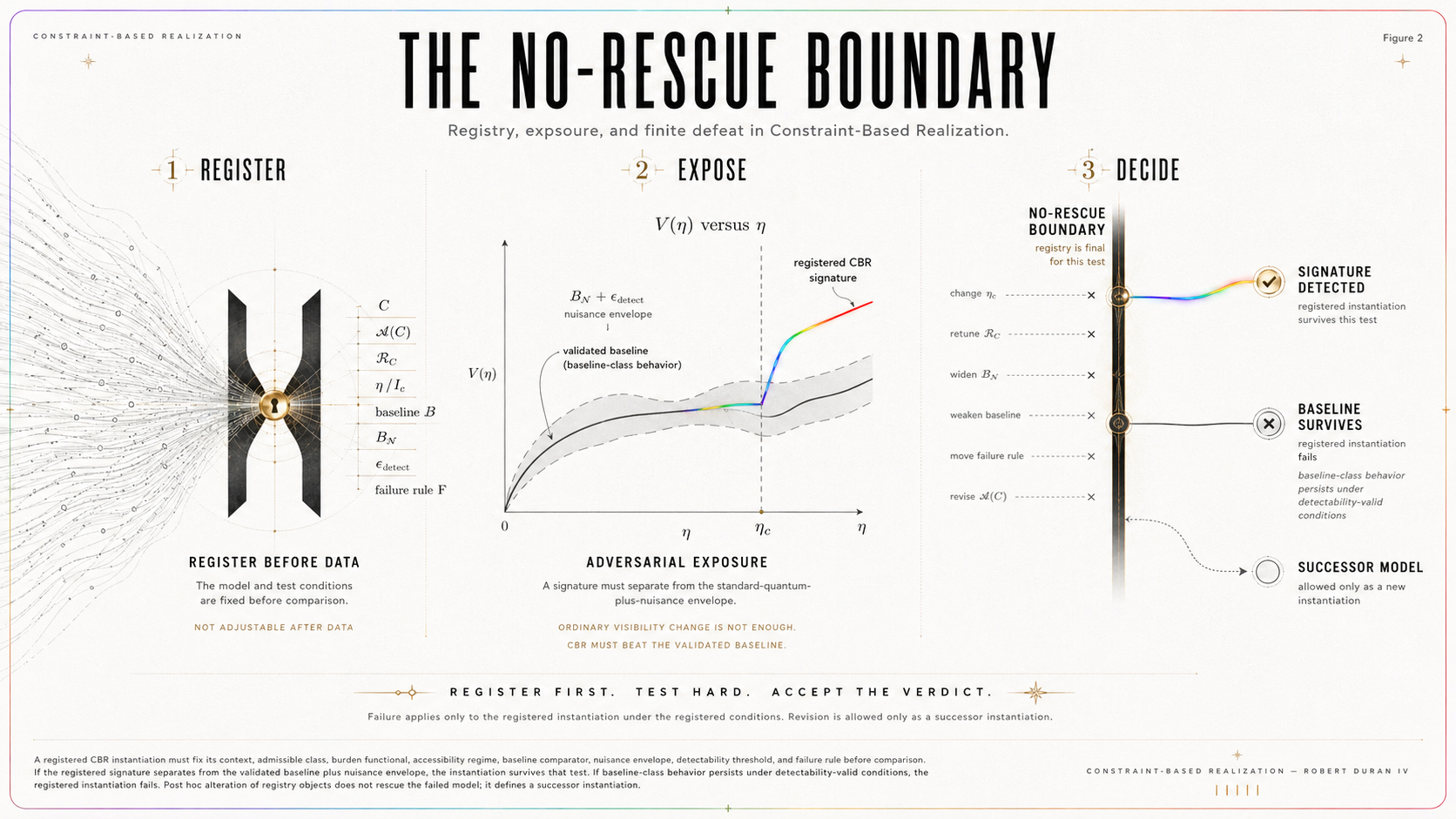
8.1 The problem of post hoc survival
A theory can become unfalsifiable if it changes after every failed test while claiming to remain the same theory under evaluation. This danger is especially acute for frameworks that contain multiple formal objects: contexts, admissible classes, functionals, equivalence relations, accessibility variables, critical regimes, baselines, nuisance models, detectability thresholds, distance criteria, and failure rules. If each of these can be altered after the result, then every failure can be converted into an invitation to reinterpret the model.
CBR must explicitly forbid that move for registered instantiations.
The no-rescue doctrine does not prevent theoretical development. It does not say that future CBR models cannot be improved. It does not say that a failed experiment can never reveal that an earlier registry was poorly chosen. It says something narrower and more important: once an instantiation has been registered and tested, changing the registry after failure cannot retroactively save that instantiation.
That is the cost of exactness. It is also the source of credibility.
8.2 No-rescue rule
The no-rescue rule is:
Changing C, 𝒜(C), ℛ_C, ≃_C, η, η_c, I_c, 𝓝, B_𝓝, 𝔅_SQM,𝓝, ε_detect, the distance criterion, or the failure rule after a failed test defines a new CBR instantiation. It does not rescue the tested instantiation.
This rule follows directly from registry identity. If the registry individuates the model, then changing the registry changes the model. The successor may be related to the failed instantiation. It may preserve some of its structure. It may be motivated by the failure. But it is not identical to the model that failed.
The rule applies symmetrically. A theorist may not narrow I_c after a null result to exclude the unfavorable region. A theorist may not redefine η after the measured accessibility variable fails to produce the expected response. A theorist may not expand B_𝓝 after the data remain baseline-compatible. A theorist may not change ε_detect after discovering that the predicted effect was below resolution. A theorist may not revise ℛ_C after minimization yields the wrong verdict. A theorist may not redefine 𝒜(C) around the observed outcome. A theorist may not replace 𝔅_SQM,𝓝 with a weaker baseline class after the result.
All such moves may define future work. None rescues the tested instantiation.
8.3 Successor-model burden
Revision is permitted, but it carries a burden. A successor CBR model proposed after failure must state, explicitly and publicly, what changed.
At minimum, a successor model must identify which registry object was altered, why the alteration is being made, whether the alteration is independently motivated or merely failure-responsive, what new empirical or structural burden the successor accepts, and why the change should not be interpreted as retroactive rescue.
This burden is essential. Without it, every failure can be absorbed by small untracked adjustments. With it, revision remains possible but accountable. A successor model may say: the earlier η was operationally inadequate; the earlier nuisance class omitted a platform effect; the earlier I_c was too narrow; the earlier ℛ_C was under-specified. But the successor must then register the new object before its own confrontation and accept a new failure condition.
A successor model cannot inherit the evidential status of the failed model. It must earn its own status under its own registry.
8.4 What can survive failure
Failure of one registered instantiation does not automatically destroy everything surrounding it.
The broader realization-law question may survive. A failed CBR instantiation does not by itself prove that individual outcome realization is not a legitimate law-form problem. It proves only that the registered model did not satisfy its own declared burden.
The abstract CBR-form representation may also survive. The equation Φ∗_C ∈ argmin{ℛ_C(Φ) : Φ ∈ 𝒜(C)} may remain a coherent law-form even if a particular instantiation of C, 𝒜(C), ℛ_C, η, and I_c fails.
Other independently registered CBR instantiations may survive if they were fixed before their own tests and do not rely on the failed registry’s defeated commitments.
A revised future theory may also be proposed, provided it is clearly marked as a successor model. It may learn from the failed instantiation. It may alter the admissible class, redefine the accessibility variable, change the baseline comparator, or modify the critical regime. But it must accept that it is not the same tested model.
This jurisdictional discipline is important. Without it, failure becomes either too weak or too strong. Too weak, and no result can hurt CBR. Too strong, and one failed platform would be treated as refuting every possible realization-law framework. The no-rescue doctrine takes the middle position: exact failure of exact objects.
8.5 What cannot survive as-is
The tested instantiation cannot survive as successful if its own declared failure condition obtains.
It cannot be declared successful by redefining the target. It cannot be preserved by changing C after the result. It cannot be saved by altering 𝒜(C) so that the relevant candidates are different from those originally tested. It cannot survive by retuning ℛ_C after the observed behavior is known. It cannot avoid failure by changing η, η_c, or I_c after the critical regime produces only baseline-compatible behavior. It cannot claim empirical discrimination by weakening the baseline class. It cannot reinterpret nuisance bounds after the data. It cannot move ε_detect. It cannot revise the distance criterion. It cannot revise the failure rule.
These restrictions are not punitive. They are the meaning of model identity. A model that agrees to be tested under one registry cannot later claim victory under another while pretending continuity.
A failed instantiation may remain historically important. It may clarify which assumptions were too strong. It may motivate a better registry. It may narrow the viable class of CBR models. But it cannot be counted as a successful test of the original registered model.
8.6 No-Rescue Theorem
Theorem 5 — No-Rescue Theorem. If a registered CBR instantiation fails under its own declared strong-null condition, then post hoc alteration of registry objects cannot convert that failed instantiation into a successful one. Such alteration defines a successor instantiation and carries a successor-model burden.
Assumptions. The theorem assumes registry identity. It assumes that the tested model was individuated by its registered C, 𝒜(C), ℛ_C, ≃_C, η where relevant, η_c or I_c where claimed, baseline class 𝔅_SQM,𝓝, nuisance class 𝓝, nuisance envelope B_𝓝, detectability threshold ε_detect, distance criterion, and failure rule. It also assumes that the declared failure condition obtained under valid testing conditions.
Proof sketch. By registry identity, the tested instantiation is identical, for evaluative purposes, to its registry. If the declared failure condition obtains, that registered object fails. Altering a registry object changes the identity conditions of the model. Therefore the altered object is not the failed instantiation preserved, but a successor instantiation newly defined. It may be evaluated in the future, but it cannot retroactively change the failure status of the original model.
Consequence. CBR becomes resistant to post hoc rescue. It can be revised, but revision is not preservation. It can generate successor models, but successors must state what changed, why it changed, whether the change is independently motivated, what new burden they accept, and why the change is not retroactive rescue.
Failure mode. A CBR program violates the no-rescue doctrine if it treats a failed registered instantiation as successful by changing the context, admissible class, functional, accessibility variable, critical regime, baseline class, nuisance envelope, detectability threshold, distance criterion, or failure rule after the result.
8.7 No-rescue as a strength
No-rescue discipline makes CBR harder to defend illegitimately. That is exactly why it makes CBR stronger.
A theory candidate earns seriousness not by maximizing its escape routes, but by limiting them. A registered CBR instantiation says: this is the model, this is the target, this is the comparator, this is the allowed nuisance structure, this is the threshold, this is the decision rule, and this is the failure condition. That declaration gives both support and failure meaning.
The doctrine also clarifies the status of future work. CBR can develop without pretending that development erases past failures. A successor model may be better. It may be more exact. It may correct earlier assumptions. But it must bear its own burden.
The no-rescue doctrine therefore protects both sides of the evaluation. It prevents critics from overextending a local failure into a universal refutation. It prevents proponents from diluting a real failure into a harmless adjustment. It keeps the jurisdiction of failure exact.
That is the discipline required of a candidate law of outcome realization.
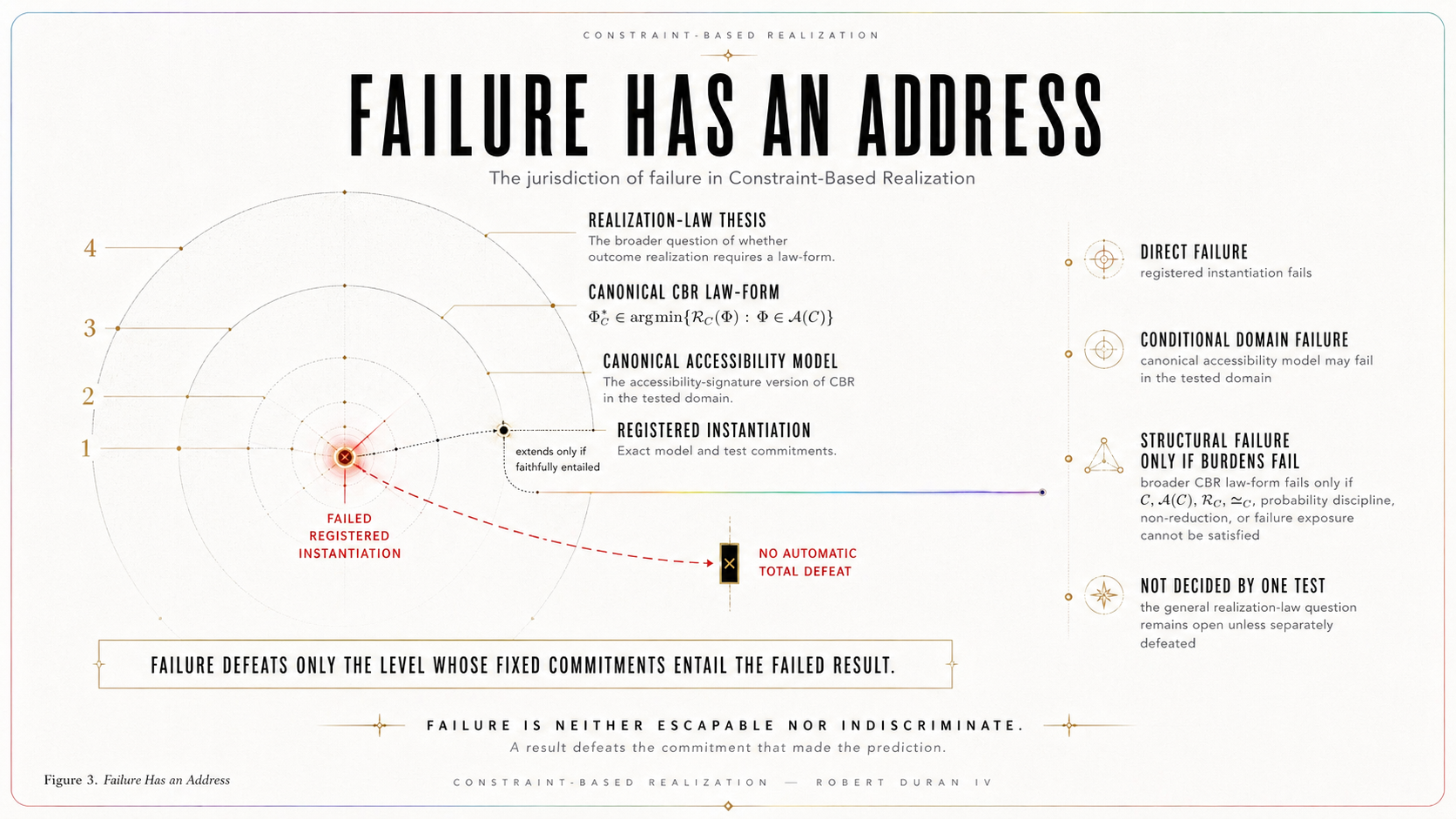
9. Jurisdiction of Failure
9.1 Why failure must be scoped
Failure must have jurisdiction. A theory standard that cannot state what a failed test defeats is too weak. A theory standard that lets one failed test defeat everything associated with a research program is too crude. The appropriate standard is neither immunity nor overextension. It is exact scope.
This is especially important for CBR because the framework contains several levels of claim. There is the general realization-law question: whether individual quantum outcome realization is a legitimate target for law-form treatment. There is the abstract CBR law-form:
Φ∗_C ∈ argmin{ℛ_C(Φ) : Φ ∈ 𝒜(C)}.
There are canonical admissibility assumptions. There are accessibility-sensitive models. There are platform-level registries. There are particular choices of η, I_c, 𝔅_SQM,𝓝, B_𝓝, ε_detect, distance criterion, and failure rule.
A failed result does not strike all these levels equally. Nor should it be allowed to strike none of them. The task is to identify exactly what was registered, exactly what burden it accepted, exactly what was tested, and exactly what failed.
The jurisdiction principle is therefore:
Failure applies to the strongest object whose registered burden was faithfully instantiated and validly defeated.
This principle prevents two distortions. It prevents proponents from making failure harmless by narrowing it after the fact. It also prevents critics from making failure indiscriminate by extending it beyond the object that actually accepted the defeated burden.
9.2 Failure propagation
Failure propagates only through constitutive dependence. A higher-level CBR claim fails only when the defeated registered burden is not merely an implementation detail, but a necessary condition of that higher-level claim.
The propagation structure is:
registered instantiation → canonical accessibility model → broader CBR law-form → realization-law question.
A registered instantiation fails when its own declared failure condition obtains under valid testing conditions. A canonical accessibility model fails in a domain when the registered instantiation faithfully implemented that model’s constitutive accessibility burden and the burden was defeated. The broader CBR law-form fails only if the failed condition is constitutive of the law-form itself: for example, if no stable C can be specified, no non-post-hoc 𝒜(C) can be defined, no fixed ℛ_C can be maintained, no operational verdict class can be selected, no Born-disciplined weighting can be preserved, or the proposal reduces entirely to non-selective decoherence. The realization-law question fails only if the target of individual outcome realization is shown to be incoherent, redundant, or non-evaluable as a law-form problem.
This propagation rule is essential. A failed platform test should not be insulated from consequence merely because CBR is a broad program. But neither should a local failure be inflated into a universal refutation unless the failed burden is constitutive of the higher-level claim.
Failure moves upward only when the higher-level claim depends on the defeated burden.
9.3 Failure of a registered instantiation
The most direct failure is failure of a registered instantiation.
A registered instantiation is the complete model specified by its registry: C, 𝒜(C), ℛ_C, ≃_C, M_C, Φ∗_C, η where relevant, η_c or I_c where claimed, 𝔅_SQM,𝓝, 𝓝, B_𝓝, ε_detect, distance criterion, decision rule, and failure rule. If the registry declares that the CBR response must separate from the baseline class in I_c, and the strong-null condition obtains, then that registered instantiation is false in the tested domain.
This is not merely absence of support. It is not merely a reason for caution. Under valid conditions, it is defeat of the model that accepted the registry as its identity.
The language must be exact. The failed object is not “CBR in all possible forms.” The failed object is not “the measurement problem.” The failed object is the registered instantiation. It is the particular model that stated: this is the context, this is the admissible class, this is the burden functional, this is the accessibility parameter, this is the critical regime, this is the baseline class, this is the nuisance envelope, this is the detectability threshold, this is the distance criterion, and this is the failure condition.
If that failure condition obtains, the instantiation loses.
The conclusion is strong because it is narrow. It cannot be dismissed as rhetorical overreach, and it cannot be evaded as merely inconclusive if the registered conditions were satisfied.
9.4 Failure of a canonical accessibility model
A stronger jurisdictional consequence arises when the failed registered instantiation is not merely a platform-specific exploratory model but a faithful instantiation of a canonical accessibility model.
A canonical accessibility model is a CBR model that treats operational accessibility η as realization-relevant in a declared way and predicts a separated accessibility-sensitive response in a critical regime η_c or I_c. If a platform-level registry faithfully implements that canonical model, then failure of the registered test may count against more than the platform implementation. It may defeat the canonical accessibility model in that domain.
The extension is conditional. It depends on fidelity between the registry and the canonical model. If the registry altered the canonical model, weakened its signature, changed η, modified I_c, changed the distance criterion, or introduced platform-specific assumptions not essential to the canonical accessibility claim, then failure may remain local to the instantiation. But if the registry accurately represents the canonical accessibility burden, and if the strong-null condition obtains, then the canonical accessibility version of CBR is defeated in the tested domain.
A canonical claim cannot inherit the authority of a registered test without also inheriting its failure liability. If a successful registered result would be cited as support for the canonical accessibility model, then a valid strong-null failure of the same faithful registry must count against that model as well. Evidential inheritance is symmetrical. A broader claim may not accept the prestige of support while refusing the reach of failure.
The conclusion should still remain scoped. The failure of a canonical accessibility model in one domain does not automatically defeat all possible CBR law-forms. It defeats the accessibility model that accepted that empirical burden in that domain. Whether broader CBR survives depends on whether the broader law-form can be independently specified without relying on the defeated accessibility commitment.
9.5 Failure of the broader CBR law-form
The broader CBR law-form fails only under a deeper kind of defeat.
The abstract law-form is:
Φ∗_C ∈ argmin{ℛ_C(Φ) : Φ ∈ 𝒜(C)}.
This form is not defeated merely because one platform-level accessibility instantiation fails. It is defeated if its core burdens cannot be satisfied. Those burdens include stable context specification, nonempty admissible class, non-circular admissibility, fixed burden functional, operational equivalence, minimizer structure, probability discipline, non-reduction to ordinary decoherence, and vulnerability to failure.
The broader law-form is threatened if no stable C can be specified for outcome realization, if no physically meaningful 𝒜(C) can be defined without post hoc selection, if no ℛ_C can be fixed independently of the outcome, if operational equivalence cannot be stated, if minimization fails to produce a verdict class, if Born-compatible discipline cannot be maintained, if the selected structure reduces entirely to non-selective decoherence, or if no possible failure condition can be attached to the framework.
These are structural defeats, not merely empirical nulls. They would show that CBR cannot function as a disciplined law-form for outcome realization. Such a result would be more damaging than failure of a single registered instantiation.
However, that conclusion requires the broader structural burden to fail. It should not be inferred casually from one accessibility test unless the test was explicitly registered as decisive for the broader law-form. The Exactness and Separation Standard therefore protects both rigor and fairness. It allows a genuine failure to count, but it requires that the jurisdiction of that failure match the burden the model actually accepted.
9.6 Failure of the realization-law question
The deepest question is whether individual quantum outcome realization is a legitimate law-form target at all.
A failed CBR instantiation does not decide that question by itself. Even failure of a canonical accessibility model does not automatically show that no realization law is possible. It may show that the accessibility route was wrong. It may show that the chosen admissibility structure was too narrow. It may show that the specific realization-burden functional did not capture the relevant physics. It may show that CBR, as registered, failed.
It does not automatically prove that the question of realization is meaningless.
The realization-law question would be undermined only by a broader argument showing that the target itself is incoherent, redundant, empirically empty, or fully absorbed by existing non-selective dynamics and registration structure. That is a different burden. It is not discharged merely by one failed registered CBR model.
This distinction matters because it prevents overextension. A strong-null failure should be allowed to defeat what it tests. It should not be used to settle questions it did not test.
The jurisdiction of failure is therefore hierarchical. A registered instantiation fails when its registered failure condition obtains. A canonical accessibility model fails in a domain when a faithful registered instantiation of that model fails under valid conditions. The broader CBR law-form fails if its core law-form burdens cannot be satisfied. The realization-law question fails only if the very target of individual outcome realization is shown to be incoherent, redundant, or non-evaluable.
This hierarchy keeps CBR scientifically vulnerable without making its failure logic careless.
9.7 Jurisdiction of support
Support has jurisdiction as much as failure does.
A separated result does not establish CBR as final physics. It supports the registered instantiation against its declared baseline class in the tested domain. If the registry faithfully instantiates a canonical accessibility model, the support may extend to that model in that domain. If the supported burden is constitutive of a broader CBR claim, then the result may strengthen the broader law-form. But support does not automatically prove universal truth.
This symmetry matters. The same discipline that prevents overextension of failure also prevents overextension of success. A registered CBR result should not be sold as more than it is. If the evidence is domain-specific, the support is domain-specific. If the baseline class is platform-specific, the support is against that baseline class. If the signature is accessibility-specific, the support is for that registered accessibility burden.
The standard therefore keeps both sides honest. It prevents critics from turning local failure into universal refutation, and it prevents proponents from turning local support into final confirmation.
9.8 Jurisdiction of Failure Theorem
Theorem 6 — Jurisdiction of Failure Theorem. The failure of a CBR test applies to the strongest object whose registered burden was faithfully instantiated and validly defeated. It applies directly to the registered instantiation. It extends to a canonical accessibility model only if the registry faithfully instantiates that model’s constitutive burden. It extends to the broader CBR law-form only if the failed burden is constitutive of the law-form itself. It does not, by itself, refute the general realization-law question.
Assumptions. The theorem assumes registry identity, a valid test condition, a declared failure rule, and a determinate relation between the registered instantiation and any broader model it is claimed to represent.
Proof sketch. By registry identity, the tested object is the registered instantiation. If its failure rule obtains under valid conditions, that object fails. If the registered object faithfully implements a broader canonical model, and if the failed burden is constitutive of that model, then the failure is inherited by the broader model in the tested domain. If the failed condition is merely platform-specific, the failure remains local. If the failed condition is constitutive of the broader law-form, then the law-form is threatened. Since the general realization-law question is not identical to any one registered CBR instantiation, it is not defeated merely by that instantiation’s failure.
Consequence. Failure becomes neither harmless nor indiscriminate. It has exact reach.
Failure mode. A CBR program violates jurisdictional discipline if it treats every failure as merely local when the registry faithfully instantiated a broader canonical claim. A critic violates the same discipline if one failed local instantiation is treated as refuting all possible realization-law frameworks.
10. Minimal Registered Example
10.1 Purpose
This section provides a minimal registered example to illustrate how the Exactness and Separation Standard operates. The example is schematic. It is not a complete experimental proposal, not a derivation of CBR, and not a claim of empirical confirmation. Its purpose is to show how a CBR instantiation becomes testable without moving the target.
The example uses a two-path accessibility-sensitive interferometric context because that setting naturally displays the distinction between ordinary visibility change and non-baseline separation. Standard quantum mechanics already predicts that which-path information, record distinguishability, and decoherence can affect interference. Therefore the example is useful precisely because it forces CBR to face the real comparator. CBR cannot merely predict visibility dependence on η. It must register a response outside the standard-quantum-plus-nuisance baseline class.
The example therefore illustrates the minimum discipline required of a registered instantiation. C must be fixed. 𝒜(C) must be fixed. ℛ_C must be fixed. ≃_C must be fixed. η and I_c must be operationally declared. 𝔅_SQM,𝓝 must be specified. B_𝓝 and ε_detect must be fixed. The distance criterion must be declared. The decision rule must allow separated support, strong-null failure, and inconclusive outcome. The no-rescue rule must apply.
The example is intentionally modest. Its value lies in exactness, not in breadth.
10.2 Two-path accessibility context
Let C be a two-path interferometric measurement context with record-bearing alternatives. The system has two path alternatives, labeled only for description as path 0 and path 1. The apparatus contains record-bearing degrees of freedom capable, in principle, of carrying which-path information. An accessibility-control mechanism varies the operational availability of the record. The primary observable is interference visibility as a function of accessibility.
The context C includes the system preparation, interferometric geometry, record-coupling mechanism, erasure or accessibility-control procedure, timing relations, readout apparatus, detector efficiencies, postselection rules, calibration procedures, and environmental couplings. C is not merely “a two-path setup.” It is the full physical context relevant to defining admissible realization-compatible candidates and evaluating the visibility response.
Let η ∈ [0,1] be the registered operational accessibility parameter. In this example, η may be defined by a declared measure of recoverable which-path information, record distinguishability, mutual information between the path degree of freedom and the record-bearing system, trace-distance accessibility, or another operationally specified accessibility measure. The choice must be made before testing. η is not a metaphor for observer knowledge. It is a physical control variable.
Let I_c be the declared critical accessibility regime. I_c may be a bounded interval around a theoretically motivated η_c. It is the region in which the registered CBR instantiation claims that accessibility becomes realization-relevant in a way that produces a response not absorbed by the baseline class.
Let V_obs(η) be the observed visibility. Let 𝔅_SQM,𝓝 be the registered class of standard-quantum-plus-nuisance visibility responses. This class includes ordinary quantum predictions for visibility under record accessibility and erasure, together with platform-specific effects such as decoherence, residual distinguishability, phase drift, detector inefficiency, loss, alignment error, timing jitter, dark counts, calibration uncertainty, finite sampling, and postselection effects.
Let V_CBR(η) be the CBR-predicted visibility response for the registered instantiation. The CBR claim is not that V_CBR(η) changes with η. The claim must be that V_CBR(η) separates from 𝔅_SQM,𝓝 inside I_c by more than ε_detect according to the registered distance criterion.
10.3 Example registry
A minimal registry for this schematic example would include the following objects.
C: the full two-path record-accessibility context, including system preparation, interferometer geometry, record coupling, accessibility-control procedure, readout structure, detector model, postselection rules, calibration procedure, and environmental characterization.
𝒜(C): the admissible class of realization-compatible candidate channels in C. The class must be specified by rule, not by observed result. It must exclude post hoc channels, representation artifacts, arbitrary relabelings, candidates incompatible with the physical context, and candidates whose only purpose is to fit the measured visibility curve.
ℛ_C: the registered realization-burden functional. Its component terms and coefficients must be specified before outcome comparison. If ℛ_C includes burdens corresponding to definiteness, record-structural coherence, accessibility consistency, or probabilistic discipline, those burdens must be defined operationally or mathematically before testing.
≃_C: the operational equivalence relation. The registry must state when two candidate realization channels count as the same physical verdict class in this context.
M_C: the minimizer set of ℛ_C over 𝒜(C). The registry must state how minimizers are identified and how operational equivalence is applied.
Φ∗_C: the selected realization channel or operational verdict class, defined by the minimizer structure rather than by the observed result.
η: the operational accessibility parameter, defined by a pre-specified measurable quantity such as recoverable which-path information, record distinguishability, mutual information, or trace-distance accessibility.
I_c: the declared critical accessibility interval. It must be fixed before data inspection.
𝔅_SQM,𝓝: the baseline class of standard-quantum-plus-nuisance visibility responses. This class must include all ordinary platform effects declared relevant by the registry.
B_𝓝: the nuisance envelope or tolerance structure defining the allowed baseline distortion inside I_c.
ε_detect: the detectability threshold required for the experiment to resolve a separated CBR response.
Distance criterion: the registered rule for deciding whether V_obs(η) or V_CBR(η) lies outside 𝔅_SQM,𝓝 by more than ε_detect. The criterion may be pointwise, uniform over I_c, integrated over I_c, or statistical, but it must be fixed before testing.
Decision rule: the pre-declared classification of outcomes into separated support, strong-null failure, or inconclusive result.
Failure rule: if V_obs(η) remains inside 𝔅_SQM,𝓝 throughout I_c under detectability-valid conditions, the tested CBR instantiation fails in that domain.
No-rescue declaration: post hoc alteration of C, 𝒜(C), ℛ_C, ≃_C, η, I_c, 𝔅_SQM,𝓝, B_𝓝, ε_detect, distance criterion, decision rule, or failure rule defines a successor instantiation and does not rescue the tested one.
10.4 Decision outcomes for the example
The registered example admits three possible outcomes.
Separated support occurs if V_obs(η) displays the registered CBR signature outside 𝔅_SQM,𝓝 by more than ε_detect inside I_c, while the registry is fixed, the baseline class is validated, nuisance effects remain within the declared envelope, the accessibility control is achieved, and the test is detectability-valid. Such a result would not establish CBR as final physics. It would support the registered instantiation against the declared baseline class in the tested domain.
Strong-null failure occurs if V_obs(η) remains inside 𝔅_SQM,𝓝 throughout I_c under detectability-valid conditions, with the registry fixed and the baseline class validated. In that case, the registered instantiation is false in the tested domain. If the registry faithfully instantiates a canonical accessibility model, the failure may extend to that canonical model in that domain.
An inconclusive outcome occurs if the deciding conditions are not met. For example, the accessibility parameter η may not be adequately controlled; I_c may not be sufficiently sampled; the nuisance envelope may be exceeded by uncontrolled platform effects; the baseline class may not be validated; ε_detect may be too large to resolve the registered CBR response; or the distance criterion may be inapplicable to the actual data quality. In that case, the test provides neither separated support nor strong-null failure.
This decision structure prevents two errors. It prevents proponents from counting any unusual fluctuation as support. It also prevents critics from treating an invalid or underpowered test as decisive failure.
10.5 Forbidden post-failure moves
The example also makes clear what would count as cheating.
If the strong-null condition obtains, the tested CBR instantiation cannot say afterward that the “real” accessibility parameter was different from the registered η. It cannot say that the critical regime was actually outside the declared I_c. It cannot widen B_𝓝 after the fact to absorb the result. It cannot replace 𝔅_SQM,𝓝 with a weaker or stronger comparator depending on convenience. It cannot change the distance criterion after seeing which metric makes the result look favorable. It cannot reinterpret ordinary baseline-compatible visibility change as the intended CBR signature if the registry declared a different signature. It cannot say that the failure condition was merely provisional if the registry made it decisive.
Each such move may motivate a successor model. None preserves the tested one.
This subsection is not rhetorical. It states the operational meaning of registry identity. A model is what it registered itself to be. If it fails under that registry, it cannot survive by becoming something else while keeping the evidential status of the original.
10.6 What the example shows
The example shows how CBR becomes testable without moving the target.
It shows that a registered CBR instantiation is not merely the canonical law-form. It is the law-form bound to a definite context, admissible class, functional, equivalence relation, accessibility parameter, critical regime, baseline class, nuisance envelope, detectability threshold, distance criterion, decision rule, and failure rule.
It also shows why ordinary visibility change is insufficient. In a two-path accessibility context, standard quantum mechanics already predicts accessibility-dependent visibility behavior. The registered CBR burden is not to predict change. It is to predict separated change: a response outside 𝔅_SQM,𝓝 in I_c by more than ε_detect.
Finally, the example shows how no-rescue discipline operates. If the registered model fails, one may propose a successor model with a different η, I_c, ℛ_C, or baseline class. But the successor must state what changed and accept its own burden. It cannot retroactively convert the failed registry into a successful one.
10.7 What the example does not show
The example does not prove that CBR is true. It does not establish that nature obeys the registered law-form. It does not derive the Born rule. It does not provide a complete laboratory protocol. It does not show that every accessibility-sensitive platform would produce a CBR deviation. It does not show that failure in this example would defeat every possible CBR model.
The example has a narrower purpose. It demonstrates the exactness discipline required for a testable CBR instantiation. It shows how the objects must be fixed, how the baseline must be defined, how nuisance effects must be bounded, how detectability must be declared, how decision outcomes must be classified, how forbidden post-failure moves are excluded, and how no-rescue follows from registry identity.
That is enough for the example’s role in this paper. Its function is not confirmation. Its function is specification.
11. Relation to the Three-Paper Architecture
11.1 The division of burdens
The streamlined CBR architecture should be organized as a division of burdens.
The law-form burden asks whether CBR has a precise candidate structure for individual outcome realization.
The probability-discipline burden asks whether the law-form can remain Born-compatible and whether nonquadratic alternatives incur explicit structural cost.
The empirical-separation burden asks whether a registered instantiation can distinguish itself from the full standard-quantum-plus-nuisance baseline class.
The exactness-and-failure burden asks whether the model’s objects are fixed before testing and whether failure has consequences afterward.
These burdens should not be collapsed into one oversized manuscript. Each is serious enough to require its own clean treatment. The present paper supplies the hardening standard that binds them together.
11.2 Paper 1: law-form burden
The first paper in the streamlined CBR architecture should carry the law-form burden.
Its task is to isolate CBR as a candidate law-form for individual quantum outcome realization. It should define the realization target, distinguish realization from evolution and registration, introduce the context C, define the admissible class 𝒜(C), state the realization-burden functional ℛ_C, define operational equivalence ≃_C, and identify Φ∗_C as the selected realization channel or operational verdict class.
The central claim of the law-form paper is not that CBR is experimentally confirmed. It is that a disciplined candidate law of individual outcome realization requires a context, admissible candidates, a fixed comparison rule, operational equivalence, a selected verdict class, and failure conditions. CBR compresses that burden structure into:
Φ∗_C ∈ argmin{ℛ_C(Φ) : Φ ∈ 𝒜(C)}.
That paper should also state the non-reduction burden. If Φ∗_C supplies no realization content beyond a non-selective decoherence-compatible channel, then CBR fails as an independent realization law in that context.
Paper 1 therefore answers the question:
What is the law form?
11.3 Paper 2: probability-discipline burden
The second paper should carry the probability-discipline burden.
Its task is not to overclaim universal Born-rule derivation without qualification. Its task is to establish the strongest defensible probability result: within canonical admissibility, quadratic weighting is not optional without structural cost. A nonquadratic alternative must either satisfy refinement consistency, coarse-graining consistency, operational invariance, symmetry, normalization, nontriviality, regularity, non-circular admissibility, and empirical Born compatibility, or leave the canonical class.
The key result should be the quadratic-weighting barrier. The barrier does not say that every imaginable nonquadratic framework is logically impossible. It says that nonquadratic alternatives cannot enter canonical CBR as equivalent replacements unless they satisfy the same burdens. If they break those burdens, they are reclassified as noncanonical alternatives.
Paper 2 therefore answers the question:
Why is the canonical law-form probability-disciplined?
This separation is important. It prevents the law-form paper from carrying too much, and it prevents the probability argument from being buried inside a broader interpretive manuscript.
11.4 Paper 3: empirical-separation burden
The third paper should carry the empirical-separation burden.
Its task is to specify η, η_c or I_c, 𝔅_SQM,𝓝, 𝓝, B_𝓝, ε_detect, the primary observable, the distance criterion, and the strong-null failure rule for an accessibility-sensitive CBR test. It should make clear that ordinary visibility change is not enough. CBR must predict a response outside the validated standard-quantum-plus-nuisance baseline class.
The central empirical condition should be expressed in class-based form:
dist(V_CBR, 𝔅_SQM,𝓝; I_c) > ε_detect.
The corresponding decision structure should distinguish separated support, strong-null failure, and inconclusive outcome.
Paper 3 therefore answers the question:
How can a registered CBR instantiation be tested against a serious baseline?
This paper must be especially strict about nuisance modeling. The comparator cannot be idealized standard quantum mechanics alone. It must include platform-specific decoherence, detector effects, loss, phase noise, calibration uncertainty, postselection effects, finite sampling, and any other ordinary mechanism declared relevant by the registry.
11.5 This paper: exactness-and-failure burden
The present paper carries the exactness-and-failure burden.
It does not replace the law-form paper, the quadratic-weighting paper, or the empirical baseline-separation paper. It supplies the rule under which those papers become collectively evaluable.
The standard is:
No law-form without registry.
No registry without identity conditions.
No Born claim without scope discipline.
No empirical claim without baseline-class separation.
No signature without detectability.
No null without jurisdiction.
No revision without successor-model burden.
No failed instantiation without consequences.
No post hoc alteration as rescue.
This paper therefore answers a different question from the three companion papers. It asks:
What makes CBR exact enough to be judged?
The answer is registry identity plus baseline separation plus scoped probability discipline plus no-rescue failure logic.
11.6 Why the architecture matters
The architecture matters because CBR is vulnerable to being misunderstood in two opposite ways.
One misunderstanding treats CBR as merely an interpretive slogan. The law-form paper prevents that by specifying C, 𝒜(C), ℛ_C, ≃_C, and Φ∗_C.
The opposite misunderstanding treats CBR as claiming too much at once: universal Born derivation, empirical confirmation, total defeat of rivals, and broad deviation from standard quantum mechanics. The quadratic-weighting paper, baseline-separation paper, and present hardening standard prevent that by scoping each claim.
The resulting architecture is more credible because it is modular. Each paper carries a distinct burden. The law-form paper states the candidate law. The weighting paper states the probability discipline. The empirical paper states the test. The present paper states the exactness and failure standard.
This modularity is not fragmentation. It is scientific hygiene. It lets each claim be evaluated at the proper level.
11.7 Integration with the broader CBR program
The broader CBR program may include additional reconstruction, canonical closure, adversarial exposure, execution standards, and jurisdictional analyses. The present paper does not replace those works. It compresses one key lesson from them: CBR becomes strongest when it is least adjustable.
The mature program should therefore be read as a sequence of increasing discipline. First, identify the realization target. Second, state the law-form. Third, restrict admissibility. Fourth, discipline probability. Fifth, expose the model to baseline-separated empirical test. Sixth, define the jurisdiction of support and failure. Seventh, forbid post hoc rescue.
This sequence does not prove CBR true. It makes CBR evaluable.
That is the appropriate status of a candidate law of outcome realization.
12. Conclusion
Constraint-Based Realization becomes scientifically serious only when its freedom is fixed before confrontation. The canonical law form
Φ∗_C ∈ argmin{ℛ_C(Φ) : Φ ∈ 𝒜(C)}
supplies the structure of a candidate realization law. But the equation alone does not define a fully testable model. A testable model requires registry identity. It must state its context, admissible class, burden functional, operational equivalence relation, minimizer structure, selected verdict criterion, accessibility variable where relevant, critical regime where claimed, baseline class, nuisance structure, detectability threshold, distance criterion, decision rule, and failure condition before outcome comparison.
This paper has introduced the Exactness and Separation Standard as that discipline.
The standard is built around a simple principle: a CBR instantiation is identical, for purposes of structural and empirical evaluation, to its registered specification. The registry is not an appendix to the model. It is the model’s evaluative identity. If the registry changes after failure, the tested model has not been rescued. A successor model has been introduced.
This identity principle gives the rest of the paper its force. It explains why C, 𝒜(C), ℛ_C, and ≃_C must be fixed before selection. Without them, the law-form remains adjustable. It explains why η and I_c must be operationally declared before testing. Without them, the critical regime can move. It explains why CBR must be compared against 𝔅_SQM,𝓝, the full standard-quantum-plus-nuisance baseline class, rather than against a weakened ideal curve. Without that comparator, ordinary visibility change can be mistaken for a CBR signature.
It also explains why the relevant empirical standard is not mere deviation but separated deviation:
dist(V_CBR, 𝔅_SQM,𝓝; I_c) > ε_detect.
It explains why empirical outcomes must be classified into separated support, strong-null failure, and inconclusive result. Without that triad, the standard would either overclaim support or overclaim failure. It explains why a strong-null result, under valid registered conditions, means that the tested CBR instantiation is false in that domain. Not merely unsupported. Not merely unconfirmed. False in that domain.
It also explains why support must have jurisdiction. A separated result supports the registered instantiation against its declared baseline class in its tested domain. It does not by itself establish CBR as final physics. The same restraint that prevents overextended failure also prevents overextended success.
The standard further explains why failure must propagate only through constitutive dependence. Failure of one registry defeats the registered instantiation. Failure of a faithful canonical accessibility instantiation may defeat that canonical model in the tested domain. Failure of the broader CBR law-form requires failure of its constitutive burdens. Failure of the realization-law question itself requires a still broader argument.
Finally, the standard explains why successor models are permitted but burdened. Revision is allowed. Retroactive rescue is not. A successor must state what changed, why it changed, whether the change is independently motivated, what new burden it accepts, and why the change is not an attempt to preserve the failed model under another name.
The result is not experimental confirmation of CBR. It is not universal Born-rule derivation. It is not a claim that decoherence is false. It is not a claim that ordinary quantum mechanics is broadly wrong. It is not a claim that every failed instantiation destroys the realization-law question.
The result is narrower and stronger.
CBR can be made exact enough to be judged.
Under the Exactness and Separation Standard, CBR is not protected by vagueness. Its law-form must be registered. Its probability claims must be scoped. Its empirical signatures must separate from the real baseline. Its null results must count when the test is valid. Its support must remain jurisdictional. Its failures must propagate only through constitutive dependence. Its revisions must be declared as successors. Its tested instantiations cannot be saved by moving the target afterward.
That is the appropriate standard for a candidate law of quantum outcome realization.
If CBR survives under this discipline, its survival has meaning. If it fails under this discipline, its failure has meaning. In either case, the theory has entered the domain of public evaluation.
CBR’s seriousness is not measured by whether it can avoid failure. It is measured by whether it can define the exact object that would fail.
Appendices
Appendix A — Locked Instantiation Registry Template
A.1 Purpose
A CBR instantiation is not fully specified by the canonical law-form alone:
Φ∗_C ∈ argmin{ℛ_C(Φ) : Φ ∈ 𝒜(C)}.
The law-form states the structure of constrained realization, but it does not by itself identify the tested model. A testable instantiation must specify the physical context, admissible class, burden functional, equivalence relation, accessibility parameter, critical regime, baseline comparator, nuisance envelope, detectability threshold, failure rule, and no-rescue rule before outcome comparison.
The Instantiation Registry is the pre-comparison specification of the tested CBR model.
A registered instantiation is identified by its locked registry. Any later change to a registry-defining object changes the identity of the tested model.
A.2 Registry lock
A registry must be locked before data comparison.
The locked registry should include:
version identifier,
date of registry lock,
author or responsible party,
test platform,
declared scope of the instantiation,
and the full registry objects listed below.
The registry lock is not a formality. It is the identity condition for the tested model.
If the registry is changed after the result is known, the original instantiation has not been rescued. A successor instantiation has been defined.
A.3 Registry identity principle
A CBR instantiation is identical to its locked registry.
Changing C, 𝒜(C), ℛ_C, ≃_C, M_C, Φ∗_C, η, η_c, I_c, V_SQM(η), V_CBR(η), 𝓝, B_𝓝, ε_detect, the failure rule, or the no-rescue declaration changes the model.
The registry therefore fixes what is being tested.
A.4 Required registry fields
A.4.1 Physical context C
C is the physically specified measurement context.
The registry must specify:
system,
state preparation,
measurement architecture,
apparatus,
record-bearing degrees of freedom,
timing structure,
environmental couplings,
readout procedure,
postselection rules,
calibration procedures,
and operational conditions of the test.
C cannot remain a generic “measurement.” It must be physically instantiated.
A.4.2 Admissible class 𝒜(C)
𝒜(C) is the class of realization-compatible candidates eligible for selection in C.
The registry must state:
which candidates are admissible,
which candidates are excluded,
why those inclusions and exclusions are justified,
and whether 𝒜(C) is fixed independently of the observed result.
𝒜(C) must not be defined after outcome comparison. It must not include candidates merely because they fit the observed data. It must not exclude candidates merely because they would make the registered prediction fail.
A.4.3 Realization-burden functional ℛ_C
ℛ_C is the context-fixed burden functional used to rank candidates in 𝒜(C).
The registry must define:
the terms in ℛ_C,
their physical meaning,
their units or normalization where applicable,
their coefficients,
their calibration source,
and whether any term depends on accessibility, weighting, record structure, decoherence, or other context variables.
If ℛ_C has adjustable coefficients, the registry must state how they are fixed before comparison. They may be fixed by theory, independent calibration, or pre-declared fitting rules. They cannot be tuned after failure to rescue the model.
A.4.4 Operational equivalence ≃_C
≃_C defines when two candidates count as the same operational verdict in C.
The registry must state the equivalence relation used to identify candidates that differ formally but not operationally.
This prevents artificial multiplicity. A model cannot multiply candidate structures through relabeling, representation changes, or operationally irrelevant distinctions.
A.4.5 Minimizer set M_C
M_C is the set of burden-minimizing candidates:
M_C = argmin{ℛ_C(Φ) : Φ ∈ 𝒜(C)}.
The registry must state:
how minimizers are identified,
how ties are handled,
whether minimizers are unique,
and whether the selected verdict is a unique minimizer or an operational equivalence class of minimizers.
If multiple minimizers are operationally equivalent under ≃_C, the selected result may be treated as an equivalence-class verdict. If minimizers are not operationally equivalent, the registry must state how non-uniqueness is handled.
A.4.6 Selected realization verdict Φ∗_C
Φ∗_C is the selected realization channel or operational verdict class.
The registry must state how Φ∗_C is obtained from M_C.
Φ∗_C must be downstream of C, 𝒜(C), ≃_C, and ℛ_C. It cannot be used after the fact to redefine the context, admissible class, burden functional, equivalence relation, critical regime, or failure rule.
A.4.7 Accessibility parameter η
If the instantiation uses accessibility, η must be operationally defined.
η cannot mean “how accessible the record feels.” It must be measurable.
Permissible forms may include:
record distinguishability,
recoverable which-path information,
mutual information with record-bearing degrees of freedom,
trace-distance distinguishability,
controlled erasure/recovery strength,
or another declared operational accessibility measure.
The registry must state how η is prepared, varied, measured, calibrated, and bounded.
A.4.8 Critical accessibility point η_c or interval I_c
If the instantiation predicts a critical accessibility feature, the registry must define the critical region before data inspection.
The critical structure may be:
a point η_c,
an interval I_c,
or a theoretically derived bounded region.
If the model predicts a regime rather than a point, I_c must be declared in advance, including its boundaries, tolerance, and theoretical justification.
η_c or I_c cannot be chosen after observing where the data appear favorable.
A.4.9 Standard quantum baseline V_SQM(η)
V_SQM(η) is the standard quantum baseline response as a function of η.
The baseline must be declared before outcome comparison.
V_SQM(η) cannot mean an artificially idealized standard quantum prediction unless the platform justifies that simplification. In a serious test, the baseline must be tied to standard quantum theory plus the relevant platform details.
A.4.10 Baseline+nuisance class ℬ_𝓝
The strongest comparator is not a single weak curve. It is a baseline+nuisance class.
ℬ_𝓝 denotes the validated class of standard-quantum-plus-nuisance responses allowed by the platform model and nuisance bounds.
A response V_base,𝓝(η) belongs to ℬ_𝓝 if it is generated by standard quantum theory together with nuisance effects in the declared class 𝓝 and within the declared bounds B_𝓝.
CBR is not separated from baseline unless its registered response lies outside the validated class ℬ_𝓝 by more than ε_detect inside I_c.
A.4.11 CBR-predicted response V_CBR(η)
V_CBR(η) is the response predicted by the registered CBR instantiation.
The registry must state the predicted form of the CBR signature before comparison.
The signature may be:
a kink,
a derivative break,
a bounded non-baseline deviation,
a lower-bound separation,
a forbidden response shape,
or another declared non-baseline feature.
The signature must be fixed before comparison. A post hoc feature is not a registered CBR signature.
A.4.12 Nuisance class 𝓝
𝓝 is the declared class of ordinary non-CBR imperfections allowed by the test.
𝓝 may include:
finite detector efficiency,
dark counts,
phase drift,
imperfect erasure,
residual distinguishability,
decoherence,
loss,
alignment errors,
timing jitter,
calibration uncertainty,
readout noise,
postselection bias,
finite-sample effects.
𝓝 must be declared before comparison. It cannot be expanded after failure to absorb the result.
A.4.13 Nuisance envelope B_𝓝
B_𝓝 is the allowed baseline distortion due to nuisance effects inside the declared critical regime.
The registry must define how B_𝓝 is obtained:
independent calibration,
platform modeling,
control experiments,
uncertainty propagation,
or another declared procedure.
B_𝓝 is not a free tolerance. It is the pre-declared bound on how far ordinary non-CBR effects may move the baseline.
A.4.14 Detectability threshold ε_detect
ε_detect is the minimum separation required for the test to distinguish CBR from baseline+nuisance behavior.
The registry must state ε_detect before comparison.
A CBR signature smaller than ε_detect is not empirically discriminating in that test. A claimed deviation below detectability cannot count as support.
A.4.15 Failure rule
The registry must state exactly what result counts as failure.
A standard form is:
If the registry is locked, the baseline+nuisance class ℬ_𝓝 is validated, nuisance bounds are respected, detectability conditions are satisfied, and V_obs(η) remains inside ℬ_𝓝 throughout I_c, then the registered CBR instantiation fails in that domain.
A model without a failure rule is not fully testable.
A.4.16 No-rescue declaration
The registry must include a no-rescue declaration.
A standard form is:
The present instantiation is fixed by the locked registry above. If its declared strong-null failure condition obtains, the instantiation is false. Later alteration of registry objects may define a successor model, but cannot retroactively preserve the tested one.
A.5 Minimal fillable registry
C:
𝒜(C):
ℛ_C:
≃_C:
M_C:
Φ∗_C:
η:
η_c or I_c:
V_obs(η):
V_SQM(η):
ℬ_𝓝:
V_CBR(η):
𝓝:
B_𝓝:
ε_detect:
failure rule:
no-rescue declaration:
registry version:
registry lock date:
A.6 Registry consequence
A CBR model that lacks a registry is not yet test-ready.
A CBR model with a locked registry can be evaluated.
A CBR model whose registry changes after failure is a successor model, not a rescued original.
Appendix B — Failure Checklist and Decision Distinctions
B.1 Purpose
This checklist identifies structural failures, empirical failures, and inconclusive test conditions.
These categories must not be conflated.
A structural failure means the model is under-specified or noncanonical.
An empirical failure means the registered strong-null condition obtains under valid test conditions.
An inconclusive result means the test conditions were insufficient for decision.
This distinction prevents the hardening standard from calling every weakness a failure, while also preventing failed models from being mislabeled as merely inconclusive.
B.2 Structural failure
A CBR instantiation structurally fails when it lacks the objects required for canonical specification or test-readiness.
Structural failure is not the same as empirical disconfirmation. It means the model has not yet earned the right to a decisive empirical comparison.
A structurally failed instantiation may be repaired before testing. But if repair occurs after a failed comparison, the repaired version is a successor model.
B.3 Empirical failure
A CBR instantiation empirically fails when:
the registry is locked,
η is operational,
I_c is pre-declared,
ℬ_𝓝 is validated,
nuisance bounds are respected,
ε_detect is satisfied,
and V_obs(η) remains inside the baseline+nuisance class ℬ_𝓝 throughout I_c.
This is the strong-null failure condition.
Empirical failure defeats the registered instantiation in the tested domain.
B.4 Inconclusive result
A result is inconclusive when the empirical decision conditions are not satisfied.
Examples include:
η was not controlled,
I_c was not fixed,
the baseline class was not validated,
nuisance bounds failed,
ε_detect was not achieved,
the data did not cover the declared critical regime,
or the registry was incomplete.
An inconclusive result is not support for CBR.
It is also not necessarily failure.
It means the registered test did not reach decision quality.
B.5 Context failures
A CBR instantiation fails structurally if C is undefined.
A generic measurement description is insufficient. C must specify the physical system, preparation, apparatus, record structure, timing, readout, environmental couplings, and calibration conditions.
A CBR instantiation also fails structurally if C is changed after outcome comparison to fit the result.
That defines a successor model.
B.6 Admissibility failures
A CBR instantiation fails structurally if 𝒜(C) is undefined, empty, or post hoc.
Without 𝒜(C), there is no controlled candidate set over which ℛ_C can operate. If 𝒜(C) is empty, the minimization problem has no domain. If 𝒜(C) is defined after the result, it is retrospective fitting.
A CBR instantiation also fails structurally if 𝒜(C) admits candidates only because they match the observed outcome or excludes candidates merely because they would defeat the preferred prediction.
B.7 Burden-functional failures
A CBR instantiation fails structurally if ℛ_C is undefined.
Without ℛ_C, there is no burden comparison and no selection law.
A CBR instantiation fails structurally if ℛ_C is tuned after the outcome.
A CBR instantiation also fails structurally if ℛ_C contains undeclared parameters, uncalibrated coefficients, or hidden weighting preferences that affect selection.
A minimization rule is not automatically canonical merely because it is written as an argmin. Its burden functional must be fixed and interpretable.
B.8 Operational-equivalence failures
A CBR instantiation fails structurally if ≃_C is absent.
Without operational equivalence, the model cannot distinguish genuine physical multiplicity from formal multiplicity.
A CBR instantiation also fails structurally if operationally equivalent candidates are treated as different merely to alter weighting, minimization, or verdict structure.
This is artificial multiplicity.
B.9 Minimizer and verdict failures
A CBR instantiation fails structurally if M_C is undefined.
A CBR instantiation fails structurally if Φ∗_C is not derived from M_C.
The selected verdict must be downstream of the registered minimization structure.
A CBR instantiation fails structurally if Φ∗_C is used to redefine C, 𝒜(C), ℛ_C, ≃_C, η, I_c, the baseline class, or the failure rule.
That reverses the permitted direction of dependence.
B.10 Accessibility failures
A CBR accessibility instantiation fails structurally if η is not operational.
η must be measurable through record distinguishability, recoverable which-path information, mutual information, trace distance, erasure/recovery strength, or another declared operational measure.
A CBR accessibility instantiation fails structurally if η is calibrated after inspecting the result in a way that changes the target.
A CBR accessibility instantiation fails structurally if η_c or I_c is chosen after data inspection.
The critical point or interval must be fixed before comparison.
B.11 Baseline failures
A CBR instantiation fails structurally if the baseline comparator is weak or undefined.
The comparator should be a validated standard-quantum-plus-nuisance class ℬ_𝓝, not merely an ideal curve selected for convenience.
A CBR instantiation fails structurally if the baseline is changed after comparison to make CBR appear separated.
A CBR instantiation fails structurally if ordinary visibility changes are treated as CBR evidence without showing separation from ℬ_𝓝.
B.12 Nuisance failures
A CBR instantiation fails structurally if 𝓝 and B_𝓝 are not fixed.
A CBR instantiation fails structurally if 𝓝 is expanded after failure to absorb baseline-consistent behavior.
A CBR instantiation fails structurally if nuisance effects are ignored despite being platform-relevant.
A CBR instantiation fails structurally if nuisance bounds are so loose that no result can meaningfully threaten the model.
B.13 Detectability failures
A CBR instantiation fails structurally if ε_detect is absent.
A model cannot claim empirical discrimination unless it states the minimum detectable separation.
A test is inconclusive if the experiment lacks the resolution, calibration, or statistical power required to detect the registered signature.
A claimed deviation below ε_detect cannot count as support.
B.14 Probability-discipline failures
A CBR instantiation fails structurally if Born compatibility is violated without declaration.
If a model departs from ordinary Born-rule ensemble behavior, it must declare the departure, its regime, its empirical consequences, and its failure conditions.
A CBR instantiation also fails structurally if nonquadratic weighting is introduced without specifying which canonical burden is rejected.
A CBR instantiation fails structurally if weighting is hidden inside 𝒜(C), ℛ_C, M_C, or Φ∗_C.
B.15 Decoherence-reduction failures
A CBR instantiation fails structurally if it reduces to non-selective decoherence.
CBR’s target is realization, not merely interference suppression or record formation.
If the model only reproduces decoherence behavior without a distinct realization-selection structure, then it has not supplied a CBR instantiation.
A CBR instantiation empirically fails if its registered accessibility signature is fully absorbed by the validated baseline+nuisance class ℬ_𝓝 throughout I_c under valid detectability conditions.
B.16 Failure-rule failures
A CBR instantiation fails structurally if failure conditions are absent.
A model that cannot state what result would count against it is not test-ready.
A CBR instantiation fails structurally if the failure rule is changed after the result.
A CBR instantiation violates the hardening standard if a strong-null result is reinterpreted as support without changing the registry and declaring a successor model.
B.17 Checklist summary
A CBR instantiation is structurally defective if:
C is undefined.
𝒜(C) is undefined, empty, or post hoc.
ℛ_C is undefined, hidden, or tuned after the outcome.
≃_C is absent.
M_C is undefined.
Φ∗_C is not derived from the registered minimization structure.
η is not operational.
η_c or I_c is chosen after data inspection.
ℬ_𝓝 is weak or undefined.
V_CBR(η) is not pre-declared.
𝓝 is absent or post hoc.
B_𝓝 is absent or post hoc.
ε_detect is absent.
Born compatibility is violated without declaration.
CBR reduces to non-selective decoherence.
failure conditions are absent.
the no-rescue declaration is absent.
Appendix C — Probability-Discipline Cross-Check
C.1 Purpose
This appendix supplies the probability-discipline cross-check for registered CBR instantiations.
A hardening paper should not re-derive the full quadratic-weighting argument. That burden belongs to the probability-discipline paper. The present appendix has a narrower purpose: it ensures that a registered CBR instantiation does not use nonquadratic weighting, hidden weighting, or Born-violating structure without declaring the consequences for canonical status.
C.2 Cross-check principle
A CBR instantiation cannot use nonquadratic weighting unless it declares:
which canonical burden it rejects,
whether the resulting model remains canonical,
whether it is noncanonical,
whether it is deviation-bearing,
and what empirical burden follows from the departure.
Nonquadratic weighting is not forbidden merely because it is nonquadratic. But it is not free inside canonical CBR.
C.3 Canonical burdens to check
A registered instantiation must state whether its weighting discipline preserves:
refinement consistency,
coarse-graining consistency,
operational invariance,
symmetry,
normalization,
regularity,
non-circular admissibility,
empirical Born compatibility.
If any burden is rejected, the model must declare the rejection and its consequence for canonical status.
C.4 Canonical outcome
If the model preserves the canonical burdens, then it remains within canonical probability discipline.
In that case, ordinary quadratic weighting is the expected canonical form:
P(i) = |αᵢ|²,
where the relevant amplitude-bearing representation is supplied.
The model may then claim local Born-compatible discipline within canonical admissibility, but it may not claim universal Born-rule derivation unless a separate global theorem is supplied.
C.5 Noncanonical outcome
If the model rejects refinement consistency, coarse-graining consistency, operational invariance, symmetry, normalization, regularity, non-circular admissibility, or empirical Born compatibility, then it is not an unmodified canonical CBR instantiation.
It may be a noncanonical extension, deviation-bearing model, external theory, or successor framework.
But it must be labeled as such.
C.6 Deviation-bearing outcome
If the model intentionally departs from ordinary Born-compatible ensemble behavior, then it must declare:
the predicted deviation,
the regime in which deviation is expected,
the baseline comparator,
the nuisance class,
the detectability threshold,
and the failure rule.
A Born-violating model without a declared empirical burden is not test-ready.
C.7 Hidden-weighting check
The registry must state whether weighting enters:
𝒜(C),
ℛ_C,
M_C,
Φ∗_C,
η,
V_CBR(η),
or the failure rule.
If weighting enters any of these objects, the model must declare the weighting rule and its canonical status.
A model that hides weighting inside another registry object is under-specified.
C.8 Cross-check conclusion
The hardening standard does not forbid nonquadratic alternatives. It prevents them from being smuggled into canonical CBR without cost.
A nonquadratic alternative must either satisfy the canonical burdens or declare itself noncanonical, deviation-bearing, or successor-level.
That is the probability-discipline cross-check.
Appendix D — Baseline-Separation Formulae
D.1 Purpose
This appendix defines the formulae used to determine whether a registered CBR accessibility signature is separated from the standard quantum plus nuisance baseline.
The purpose is to prevent ordinary visibility changes from being mistaken for CBR evidence. Standard quantum mechanics already predicts that accessibility, which-path information, decoherence, detector behavior, and noise can affect interference visibility. CBR is empirically meaningful only if it predicts a registered feature outside the validated baseline+nuisance class.
D.2 Observed response V_obs(η)
V_obs(η) denotes the observed visibility or registered experimental response as a function of accessibility η.
The registry must specify how V_obs(η) is measured, estimated, calibrated, and uncertainty-bounded.
If the primary observable is not visibility, the model must define the corresponding observable and replace V_obs(η) with the appropriate registered response function.
D.3 Standard quantum baseline V_SQM(η)
V_SQM(η) denotes the standard quantum baseline response as a function of η.
In a serious platform-level test, V_SQM(η) should not mean idealized standard quantum mechanics alone. It should mean the expected standard quantum response before platform nuisance distortions are applied, with the underlying quantum model specified.
D.4 Baseline+nuisance class ℬ_𝓝
ℬ_𝓝 denotes the validated class of standard-quantum-plus-nuisance responses.
A response V_base,𝓝(η) belongs to ℬ_𝓝 if it is generated by standard quantum theory together with nuisance effects in the declared class 𝓝 and within the declared bounds B_𝓝.
The baseline comparator is therefore not merely one curve. It is a class of allowed ordinary responses.
CBR is not separated from baseline unless its registered response lies outside this class by more than ε_detect inside I_c.
D.5 Nuisance-distorted baseline V_0,𝓝(η)
V_0,𝓝(η) denotes a representative nuisance-distorted baseline response within ℬ_𝓝.
These nuisance effects may include:
decoherence,
loss,
phase drift,
finite detector efficiency,
dark counts,
timing jitter,
alignment error,
imperfect erasure,
residual distinguishability,
readout noise,
postselection effects,
calibration uncertainty,
finite sampling.
The nuisance-distorted baseline must be derived from the declared nuisance class 𝓝.
D.6 CBR-predicted response V_CBR(η)
V_CBR(η) denotes the response predicted by the registered CBR instantiation.
The registry must state the predicted CBR signature before outcome comparison.
The signature may be:
a kink,
a derivative break,
a bounded non-baseline deviation,
a lower-bound separation,
a forbidden response shape,
or another declared non-baseline feature.
A post hoc feature is not a registered CBR signature.
D.7 CBR deviation Δ_CBR(η)
A minimal curve-based deviation may be written as:
Δ_CBR(η) = |V_CBR(η) − V_SQM(η)|.
A stronger class-based deviation is:
d_CBR(η, ℬ_𝓝) = distance from V_CBR(η) to the baseline+nuisance class ℬ_𝓝 at η.
The class-based form is preferred because CBR must separate from the entire validated standard-quantum-plus-nuisance class, not merely from one baseline curve.
D.8 Nuisance envelope B_𝓝
B_𝓝 denotes the maximum allowed baseline distortion due to nuisance effects inside the declared critical regime I_c.
It should be obtained through independent calibration, platform modeling, control experiments, uncertainty propagation, or another declared method.
B_𝓝 is not a free parameter. It is the pre-declared bound on ordinary non-CBR effects.
D.9 Detectability threshold ε_detect
ε_detect denotes the minimum observable separation required for a valid discriminating test.
It includes instrumental resolution, statistical uncertainty, calibration limits, and any other declared detection limitations.
CBR cannot claim empirical support from a deviation smaller than ε_detect.
D.10 Critical regime I_c
I_c denotes the declared accessibility-critical regime.
It may be centered on a critical point η_c or specified as an interval of η values.
I_c must be declared before data inspection. If I_c is relocated after seeing the data, a new instantiation has been defined.
D.11 Baseline-separation condition
The envelope form of baseline separation is:
Δ_CBR(η) > B_𝓝 + ε_detect
for a declared nonempty region of I_c.
The stronger class-based form is:
d_CBR(η, ℬ_𝓝) > ε_detect
for a declared nonempty region of I_c.
The class-based condition says that the registered CBR prediction must lie outside the validated standard-quantum-plus-nuisance class by more than the detectability threshold.
If this condition is not met anywhere in I_c, then the proposed signature is not empirically discriminating in that test.
D.12 Observed separation condition
Observed support requires more than a predicted separation.
The observed response must exit the baseline+nuisance class in the registered CBR direction:
distance from V_obs(η) to ℬ_𝓝 > ε_detect
in the declared CBR-signature region of I_c,
with the sign, shape, or feature matching the pre-registered CBR prediction.
A generic anomaly is not automatically CBR support.
D.13 Strong-null condition
The strong-null condition obtains when:
the registry is locked,
η is operational,
I_c is pre-declared,
ℬ_𝓝 is validated,
𝓝 is fixed,
B_𝓝 is respected,
ε_detect is satisfied,
and V_obs(η) remains inside ℬ_𝓝 throughout I_c.
In that case, the registered CBR instantiation fails in the tested domain.
D.14 Inconclusive condition
A test is inconclusive if:
the registry is incomplete,
η is not controlled,
the baseline class is not validated,
nuisance bounds fail,
ε_detect is not achieved,
the declared critical regime is not covered,
or the data do not resolve the registered signature.
An inconclusive result is not support for CBR.
It is also not necessarily failure.
It means the empirical decision conditions were not met.
D.15 Baseline-separation conclusion
CBR is not tested by asking whether visibility changes with accessibility. Standard quantum theory already expects such dependence.
CBR is tested by asking whether the registered CBR response separates from the validated standard-quantum-plus-nuisance class by more than ε_detect inside the declared critical regime.
That is the empirical burden.
Appendix E — No-Rescue Declaration and Jurisdiction of Failure
E.1 Purpose
The no-rescue declaration prevents target-moving after a failed test.
A registered CBR instantiation must state in advance what objects define the tested model and what result would count as failure. If those objects are changed after the failure condition obtains, the original instantiation is not rescued. A successor model has been introduced.
This rule protects CBR from unfalsifiability. It also protects the broader research program from confusion by distinguishing failure of a registered model from revision of a future model.
E.2 Formal declaration
A registered CBR instantiation should include the following declaration:
The present instantiation is fixed by the locked registry above. If its declared strong-null failure condition obtains, the instantiation is false. Later alteration of registry objects may define a successor model, but cannot retroactively preserve the tested one.
E.3 Registry objects covered by the declaration
The no-rescue rule applies to changes in:
C,
𝒜(C),
ℛ_C,
≃_C,
M_C,
Φ∗_C,
η,
η_c or I_c,
V_obs(η),
V_SQM(η),
ℬ_𝓝,
V_CBR(η),
𝓝,
B_𝓝,
ε_detect,
the failure rule,
and the no-rescue declaration itself.
Changing any of these after failure changes the identity of the instantiation.
E.4 Jurisdiction of failure
Failure must be scoped exactly.
A failed registered instantiation does not automatically defeat every realization-law thesis. It defeats the locked model whose registry generated the failed prediction.
Broader failure requires showing that the failed registry faithfully instantiated the broader canonical claim.
The jurisdiction of failure may therefore fall at different levels:
failure of a registered instantiation,
failure of a specific accessibility-signature model,
failure of a canonical CBR implementation in a domain,
failure of a broader CBR law-form claim,
or failure of a wider realization-law thesis.
One failed test does not automatically establish all of these. The failure jurisdiction must be argued.
E.5 What may survive failure
Failure of a registered instantiation does not automatically prove that every possible realization-law thesis is false.
The following may remain open after failure:
the broader realization-law question,
the abstract canonical law-form,
other independently registered CBR instantiations,
a noncanonical successor framework,
or a revised future model explicitly labeled as new.
This is why failure jurisdiction matters. A failed test must neither be minimized into irrelevance nor inflated into more than it establishes.
E.6 What cannot survive as-is
The tested instantiation cannot survive as-is if its declared strong-null failure condition obtains.
It cannot be preserved by redefining C.
It cannot be preserved by changing 𝒜(C).
It cannot be preserved by retuning ℛ_C.
It cannot be preserved by relocating η_c or I_c.
It cannot be preserved by weakening the baseline comparator.
It cannot be preserved by expanding 𝓝 after the fact.
It cannot be preserved by loosening B_𝓝.
It cannot be preserved by changing ε_detect.
It cannot be preserved by rewriting the failure rule.
It cannot be preserved by calling an inconclusive or failed result a success.
E.7 Successor-model requirements
A successor model may be introduced after failure, but it must be labeled as a successor.
It must state:
what changed,
why it changed,
whether the change is independently motivated,
whether the change was available before the failed result,
what new empirical burden the successor accepts,
what baseline class it now uses,
what nuisance envelope it accepts,
what detectability threshold it requires,
and what result would now count as failure.
A successor model without a new failure burden is not a scientific rescue. It is target-moving.
E.8 No-Rescue Theorem
No-Rescue Theorem. If a registered CBR instantiation fails under its own declared strong-null condition, post hoc alteration of registry objects cannot convert that failed instantiation into a successful one.
Proof sketch. The registry defines the identity of the tested instantiation. A strong-null result defeats that registered identity. Changing a registry-defining object changes the identity of the model. Therefore, the changed model may be a successor, but it is not the original instantiation. The original remains failed.
Consequence. CBR remains falsifiable at the level of registered instantiations.
Failure mode. A CBR program violates the no-rescue rule if it treats post hoc alteration of registry objects as preservation of the tested model rather than introduction of a successor.
E.9 Final declaration
A registered CBR instantiation must be able to say:
This is the model.
This is the baseline class.
This is the critical regime.
This is the nuisance envelope.
This is the detection threshold.
This is the failure condition.
If the strong-null condition obtains, this instantiation fails.
Without that declaration, the model is not fully exposed to public failure.
Appendix F — Decision Status Classification
F.1 Purpose
This appendix classifies possible outcomes of a registered CBR test.
Its purpose is to prevent ambiguity after comparison. A result should not be called support, failure, inconclusive, or rescue unless it satisfies the corresponding conditions.
The decision system is:
registry,
baseline separation,
test status,
failure jurisdiction,
no-rescue rule.
F.2 Status 1 — Not test-ready
A CBR instantiation is not test-ready if the registry is incomplete.
Examples include:
C is undefined,
𝒜(C) is absent,
ℛ_C is undefined,
η is not operational,
I_c is not fixed,
ℬ_𝓝 is absent,
B_𝓝 is absent,
ε_detect is absent,
or the failure rule is missing.
A not-test-ready model may be developed further. But it cannot claim empirical support or empirical failure from the proposed test.
F.3 Status 2 — Structurally defective
A CBR instantiation is structurally defective if its registry contains circular, post hoc, or noncanonical objects.
Examples include:
𝒜(C) is defined after the result,
ℛ_C is tuned after comparison,
η_c is chosen after data inspection,
𝓝 is expanded after failure,
nonquadratic weighting is hidden,
Φ∗_C determines w_C,
or the failure rule is rewritten after comparison.
A structurally defective model is not merely incomplete. It violates the hardening standard.
F.4 Status 3 — Inconclusive test
A test is inconclusive if the registry exists but the empirical decision conditions fail.
Examples include:
η was not controlled,
I_c was not adequately sampled,
ℬ_𝓝 was not validated,
nuisance bounds failed,
ε_detect was not achieved,
or data quality was insufficient.
An inconclusive test is not support.
It is also not necessarily disconfirmation.
It means the test did not reach decision quality.
F.5 Status 4 — Baseline-contained result
A baseline-contained result occurs when V_obs(η) remains inside ℬ_𝓝 in the declared region, but one or more strong-null conditions are not fully satisfied.
This result weakens the registered signature but may not yet count as empirical failure if detectability, coverage, or nuisance validation is incomplete.
It should be classified as baseline-contained but not decisive.
F.6 Status 5 — Strong-null failure
A strong-null failure occurs when:
the registry is locked,
η is operational,
I_c is pre-declared,
ℬ_𝓝 is validated,
𝓝 is fixed,
B_𝓝 is respected,
ε_detect is satisfied,
and V_obs(η) remains inside ℬ_𝓝 throughout I_c.
Under these conditions, the registered CBR instantiation fails in the tested domain.
This is the cleanest empirical defeat condition.
F.7 Status 6 — Discriminating CBR-direction support
A result may count as discriminating CBR-direction support only if:
the registry is locked,
the CBR signature is pre-declared,
the baseline+nuisance class ℬ_𝓝 is validated,
ε_detect is satisfied,
V_obs(η) exits ℬ_𝓝 by more than ε_detect in the declared region of I_c,
and the observed feature matches the registered CBR direction, sign, shape, or structural signature.
A generic anomaly is not enough.
A deviation in the wrong direction is not CBR support.
A deviation outside the baseline class but not matching the registered CBR signature may motivate further study, but it does not confirm the registered instantiation.
F.8 Status 7 — Successor model
A successor model exists when one or more registry-defining objects are changed after comparison.
A successor model may be legitimate. But it is not a rescue of the tested instantiation.
It must be labeled as new and must include a new locked registry, new baseline comparison where needed, new nuisance envelope where needed, and a new failure rule.
F.9 Confirmation caution
No single decision status in this appendix establishes CBR as confirmed physics.
Discriminating support for a registered instantiation would be significant, but it would not by itself prove the entire CBR program. It would support the tested model in the tested domain under the declared registry.
The hardening paper is a discipline for evaluation, not a shortcut to confirmation.
F.10 Decision classification conclusion
A registered CBR test should end with one of the following statuses:
not test-ready,
structurally defective,
inconclusive,
baseline-contained but not decisive,
strong-null failure,
discriminating CBR-direction support,
or successor model.
This classification makes the empirical logic explicit.
It prevents support from being claimed too easily.
It prevents failure from being evaded too easily.
It prevents successor revision from being confused with rescue.
