

Constraint-Based Realization Reading Roadmap | A Guide to the CBR Research Sequence and Companion Notes
Purpose
This roadmap explains how to read the Constraint-Based Realization, or CBR, research sequence.
CBR is a candidate law-form for quantum outcome realization. Its central question is: If one admissible quantum outcome becomes actual in an individual measurement context, what law-form, if any, governs that realization?
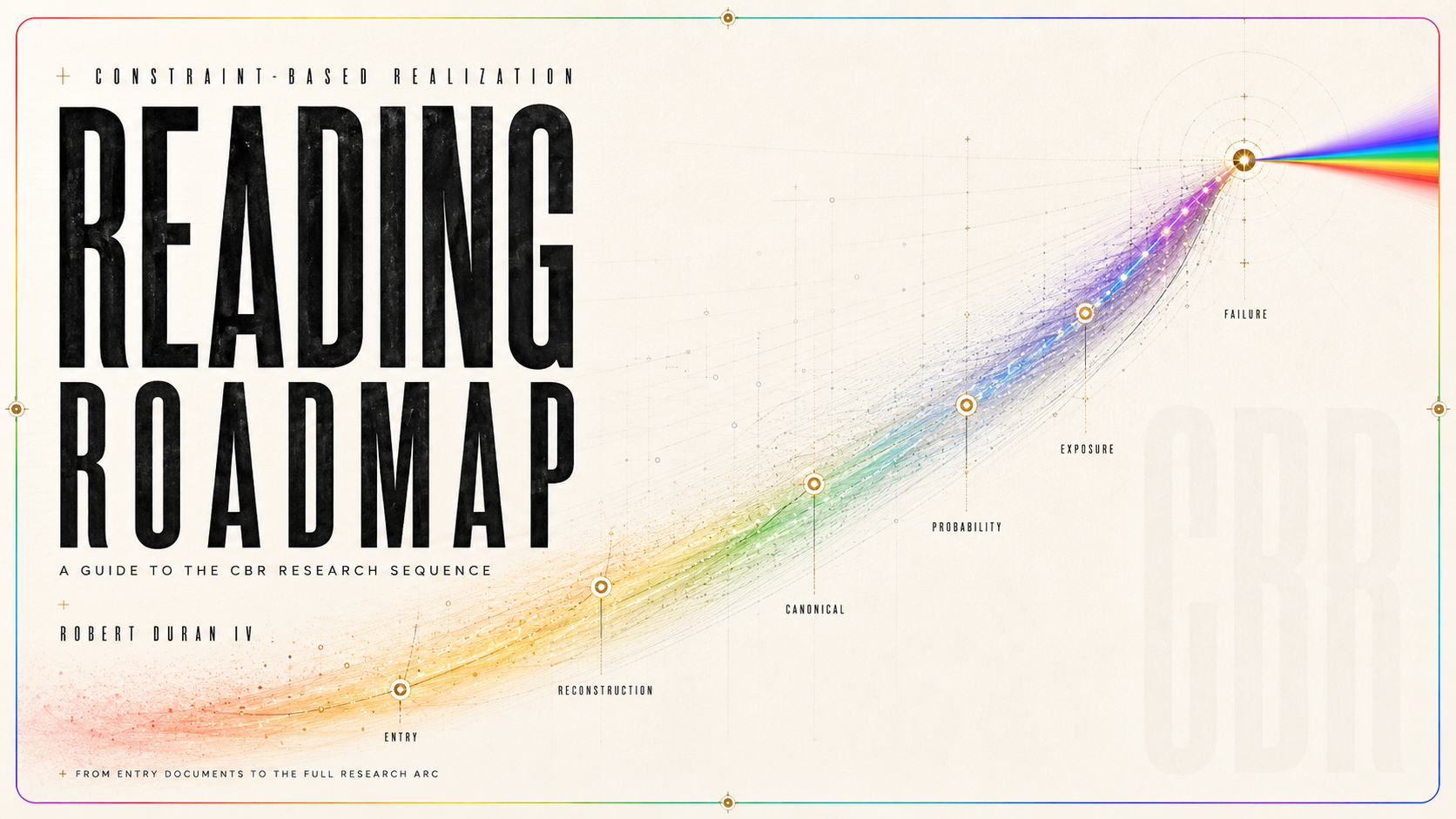
The full program is developed across the CBR research sequence and supported by a smaller set of companion notes. This roadmap gives readers a structured path through both: first the short entry documents, then the full technical arc from problem statement to empirical exposure, execution discipline, and failure jurisdiction.
Scope of this roadmap
This roadmap is not itself the technical argument for CBR. It is an orientation document. Its purpose is to help readers identify which CBR paper or companion note to read first, depending on whether they want a fast overview, a referee-facing summary, a claims/non-claims clarification, a review checklist, or the full research sequence.

I. Short-Form Entry Documents
Before entering the full 15-paper sequence, most readers should begin with the short-form documents. These are designed to make CBR easier to evaluate without requiring immediate immersion in the entire technical program.
00 — The Abstract
Probability Is Not Selection
Constraint-Based Realization as a Candidate Law-Form for Quantum Outcome Actualization
This is the best first entry point.
It introduces the core distinction before the technical machinery appears:
probability is not selection; decoherence is not selection; realization is a distinct law-target.
Readers should begin here because it states the problem in its simplest form. Quantum mechanics gives probabilities. Decoherence stabilizes records. CBR asks what law-form, if any, governs one admissible outcome becoming actual.
This abstract prepares the reader for the full program.
Companion Note 1 — Referee Note
Constraint-Based Realization: A Referee Note on a Candidate Law-Form for Quantum Outcome Realization
This is the best academic engagement document.
It presents CBR in compressed referee-facing form: the target problem, canonical representation, burden standard, relation to Born-rule probability, relation to decoherence, empirical exposure, non-claims, and review questions.
Its purpose is not to prove the full theory. Its purpose is to make the CBR law-candidate structure legible enough for serious review.
Readers who want to decide quickly whether CBR is worth deeper engagement should read this after the abstract.
Companion Note 2 — Claims and Non-Claims Sheet
What Constraint-Based Realization Claims — and Does Not Claim
This is the scope-control document.
It clarifies what CBR does and does not assert. It prevents common misreadings: that CBR rejects standard quantum mechanics, denies the Born rule, dismisses decoherence, depends on consciousness, claims experimental confirmation, defeats all interpretations, or asserts that all possible outcomes become real.
Its role is to control the frame of evaluation.
CBR should not be judged as a replacement for standard quantum mechanics or as a consciousness-collapse theory. It should be judged as a candidate law-form for individual outcome realization.
Companion Note 3 — Reviewer Checklist
Seven Pressure Points for Evaluating Constraint-Based Realization
This is the review instrument.
It identifies the seven burdens by which CBR should be evaluated:
Context specification
Candidate-class admissibility
Physical motivation for ℛ_C
Operational equivalence
Born-rule discipline
Decoherence separation
Empirical exposure
Its role is to make criticism precise. A reviewer should be able to mark each burden as satisfied, incomplete, or failed.
This note is especially useful for physicists, philosophers of physics, and technically serious readers who want to know exactly where CBR should be challenged.
Companion Note 4 — Empirical-Liability Brief
How CBR Could Fail: Accessibility Signature, Locked-Dossier Registration, and Strong-Null Exposure
This is the testability document.
It explains how a registered CBR instantiation could fail through an accessibility-sensitive protocol. It introduces η as the accessibility parameter, η_c or I_c as the critical accessibility regime, V(η) as the relevant observable response, ℬ as the baseline comparator, B_𝓝 as the nuisance envelope, ε_detect as the detectability threshold, and the strong-null condition as the failure rule.
Its role is to show that CBR is not meant to be protected as interpretation. It must be made exact enough that nature can say no.
II. Recommended Full Research Arc
The full CBR research sequence is best read in this order:
The Problem → The Reconstruction → The Canonical Theory → Probability Discipline → Empirical Exposure → Execution and Failure
This order is conceptual, not merely chronological.
The reader should first understand why CBR exists, then why its law-form is reconstructed, then how the canonical structure is stated, then how probability is disciplined, then how the framework becomes empirically vulnerable, and finally how failure is adjudicated.
III. The Full CBR Research Sequence
The Problem
01 — The Realization-Law Burden
A Canonical Law Form for Quantum Outcome Realization
Read this after the short-form entry documents.
This paper introduces the burden that motivates the program: a realization law cannot merely say “one outcome occurs.” It must specify its domain, candidate class, selection rule, operational equivalence, probability discipline, decoherence separation, and failure conditions.
Its role is foundational. It states why outcome realization must be treated as a law-candidate problem rather than a vague interpretive preference.
02 — The Law-Candidate Test
For Quantum Outcome Realization
This paper explains what a proposal must satisfy to count as a serious candidate law of outcome realization.
It functions as an evaluation standard. It asks whether a framework specifies a context, selects among admissible candidates, avoids circularity, preserves Born compatibility, remains distinct from decoherence, and exposes itself to failure.
Together, the first two problem papers establish the standard CBR must meet.
The Reconstruction
03 — A Minimal Reconstruction of Constraint-Based Realization
From the Burdens of a Quantum Outcome Law
This is one of the most important papers in the program.
It shows why the CBR form is not merely asserted. Starting from the burdens of any disciplined outcome-realization law, it reconstructs the structure:
C → 𝒜(C) → ℛ_C → Φ∗_C.
The paper argues that if a realization law must be non-circular, probability-compatible, distinct from decoherence, operationally meaningful, and vulnerable to failure, then a CBR-form representation naturally follows.
Its role is to answer:
Why this structure?
04 — A No-Internal-Alternative Theorem
For Outcome Realization
This paper is best understood as a conditional structural-closure argument.
It should not be read as claiming that all rival interpretations are defeated. Its claim is narrower: within a declared burden-bearing class, a theory satisfying the same realization-law burdens will tend to be representable in CBR-like form, up to operational equivalence.
Its role is to explore whether CBR is not only a possible structure, but a structurally natural one within its own burden class.
Readers should approach this paper carefully because its force depends on scope.
The Canonical Theory
05 — Constraint-Based Realization
Canonical Closure and Exact Empirical Exposure
This is the flagship canonical paper.
It compresses the CBR program into one mature law-candidate object. It states the canonical law form, restricted admissible class, operational uniqueness structure, local probability-closure result, accessibility parameter, empirical signature class, nuisance-separation burden, and strong-null failure condition.
This paper is where CBR becomes more than a family of arguments. It becomes a canonically specified candidate theory.
Its central structure is:
Φ∗_C ∈ argmin{ℛ_C(Φ) : Φ ∈ 𝒜(C)}.
06 — Synthesis Paper
Canonical Law Form and a Testable Accessibility Signature Theorem
This paper functions as a bridge between formal law structure and empirical exposure.
It is useful for readers who want a compact connection between canonical CBR, accessibility η, critical regime η_c, and the proposed empirical signature.
Some later papers sharpen and supersede parts of it, but it remains valuable as a synthesis document.
07 — The Realization-Burden Functional in Constraint-Based Realization
A Necessity Argument for Quantum Outcome Selection
This paper explains why ℛ_C is not merely decorative.
It argues that if realization is distinct from evolution, registration, and probability assignment, then a law of realization must provide a non-circular ordering over admissible candidates. When representable as a functional, that ordering is ℛ_C.
Its role is to strengthen the heart of the theory: the burden functional.
Readers should place this paper after the canonical form because it clarifies why the minimization structure is needed.
Probability Discipline
08 — The Quadratic-Weighting Barrier
Born-Rule Discipline in Canonical CBR
This paper protects CBR from a major objection: hidden probability engineering.
It argues that CBR cannot freely alter probabilities through its admissible class, burden functional, minimizer selection, tie resolution, or auxiliary structure.
Its role is internal policing. It keeps CBR from smuggling a custom probability rule into the realization mechanism.
09 — The Necessity of Quadratic Weighting
And Constraint-Based Realization
This is the stronger probability-discipline paper.
It argues that, within an operationally acceptable theorem class, quadratic modulus weighting is forced by constraints such as refinement consistency, symmetry, operational invariance, normalization, regularity, nontriviality, and non-circularity.
Its role is to show that CBR is not casually Born-compatible. It is structurally disciplined around Born-rule weighting within the declared theorem class.
Read these probability papers together.
Empirical Exposure
10 — The Accessibility Signature Test
Detectability of Constraint-Based Realization in a Delayed-Choice Record-Accessibility Interferometer
This is the main empirical-exposure paper.
It introduces the delayed-choice record-accessibility setting and the visibility response V(η). The key idea is that if accessibility enters realization nontrivially, then a controlled accessibility parameter η may expose a non-baseline response near a critical regime.
Its role is to move CBR from law-form to experimental vulnerability.
11 — Locked-Dossier Standard
For Testing Canonical CBR in a Delayed-Choice Record-Accessibility Interferometer
This is the strongest protocol-discipline paper.
It requires that the test be registered in advance: context, admissible class, burden functional, operational equivalence, η, critical regime, baseline comparator, nuisance envelope, detectability threshold, statistical plan, and verdict rule.
Its most important message is:
A new model requires a new registry.
This prevents post hoc rescue.
12 — From Canonical CBR to Adversarial Exposure Closure
This paper hardens the empirical program.
It asks whether CBR can survive adversarial exposure rather than friendly interpretation. It emphasizes hostile rival comparison, invariant verdict assignment, no-rescue discipline, and the need to avoid explaining anomalies after the fact.
Its role is to make the empirical side scientifically tougher.
Execution, Failure, and Scope
13 — The Canonical Execution Standard
For Constraint-Based Realization
This is the operating manual.
It explains what must be fixed before a CBR model is executable: context, admissible class, burden terms, coefficients, operational equivalence, η calibration, baseline, nuisance envelope, statistical threshold, verdict taxonomy, and no-rescue rules.
Its role is practical discipline.
14 — Exactness, Separation, and Failure Discipline
This paper explains why CBR must separate model claims from nature claims.
It states that a canonical equation is not enough. A testable model must fix its registry, baseline, nuisance structure, detectability threshold, and failure condition.
Its role is to prevent ambiguity, rescue, and overclaiming.
15 — The Jurisdiction of Failure
In Quantum Outcome Realization
This is the scope-control paper.
It explains what a failed test defeats and what it does not defeat. A failed registered instantiation defeats the object whose fixed commitments entailed the failed prediction. Broader failure requires bridge theorems.
Its role is essential because it prevents two mistakes:
overclaiming failure,
and evading failure.
It gives failure an address.
IV. Fast Reading Paths
Fastest serious path
For a reader with limited time:
00 — Probability Is Not Selection
Companion Note 1 — Referee Note
03 — Minimal Reconstruction
05 — Canonical Closure and Exact Empirical Exposure
09 — Necessity of Quadratic Weighting
10 — Accessibility Signature Test
15 — Jurisdiction of Failure
This gives the core arc: problem, review orientation, reconstruction, canonical law, probability discipline, empirical exposure, and failure scope.
Best academic review path
For a physicist or philosopher of physics:
00 — Probability Is Not Selection
Companion Note 1 — Referee Note
Companion Note 3 — Seven Pressure Points
03 — Minimal Reconstruction
05 — Canonical Closure and Exact Empirical Exposure
07 — Realization-Burden Functional
09 — Necessity of Quadratic Weighting
10 — Accessibility Signature Test
11 — Locked-Dossier Standard
15 — Jurisdiction of Failure
This path gives the strongest review-relevant materials first.
Best empirical path
For an experimental or technically minded reader:
00 — Probability Is Not Selection
Companion Note 4 — How CBR Could Fail
05 — Canonical Closure and Exact Empirical Exposure
10 — Accessibility Signature Test
11 — Locked-Dossier Standard
13 — Canonical Execution Standard
14 — Exactness, Separation, and Failure Discipline
15 — Jurisdiction of Failure
This path emphasizes testability, baseline separation, nuisance control, detectability, locked-dossier discipline, and failure.
Best conceptual path
For readers interested in foundations and interpretation:
00 — Probability Is Not Selection
Companion Note 2 — Claims and Non-Claims
01 — Realization-Law Burden
02 — Law-Candidate Test
03 — Minimal Reconstruction
04 — No-Internal-Alternative Theorem
05 — Canonical Closure
15 — Jurisdiction of Failure
This path emphasizes why CBR exists and how it reframes the measurement problem.
Best first-contact path
For someone deciding whether to engage:
00 — Probability Is Not Selection
Companion Note 1 — Referee Note
Companion Note 2 — Claims and Non-Claims
Companion Note 3 — Seven Pressure Points
Companion Note 4 — How CBR Could Fail
This path gives a reader the whole evaluation frame before they enter the full paper sequence.
V. How to Understand the Program as a Whole
CBR should not be read as one isolated claim.
It is a layered program:
The abstract identifies the problem.
The referee note makes the law-candidate structure reviewable.
The claims/non-claims note controls the scope.
The pressure-point checklist defines the evaluation standard.
The empirical-liability brief explains how CBR could fail.
The burden papers define what a realization law must carry.
The reconstruction paper explains why the CBR form arises.
The canonical paper fixes the mature law-candidate.
The probability papers protect Born-rule discipline.
The empirical papers expose the model to possible failure.
The execution papers prevent post hoc rescue.
The jurisdiction paper defines what failure means.
That sequence is the program.
VI. The Shortest Summary
CBR begins with a distinction: Probability is not selection. Decoherence is not selection. Registration is not realization.
It proposes a law-form:
Φ∗_C ∈ argmin{ℛ_C(Φ) : Φ ∈ 𝒜(C)}
It imposes burdens: domain, admissibility, non-circularity, operational uniqueness, Born compatibility, decoherence separation, parameter fixity, and failure vulnerability.
It seeks empirical exposure: accessibility-sensitive record protocols and strong-null failure.
It defines scope: a failed test defeats the registered object whose commitments entailed the failed prediction.
And it now has a short-form review layer: the abstract, the referee note, the claims/non-claims sheet, the pressure-point checklist, and the empirical-liability brief.
Conclusion
The best way to read CBR is not as a collection of independent papers, but as a staged argument.
It moves from problem identification to law-form reconstruction, from canonical specification to probability discipline, from empirical exposure to failure jurisdiction.
The companion notes now make that sequence easier to enter, easier to evaluate, and harder to misread.
The goal is not to declare CBR established physics.
The goal is to make outcome realization precise enough to evaluate.
That is the purpose of the CBR research sequence.
