

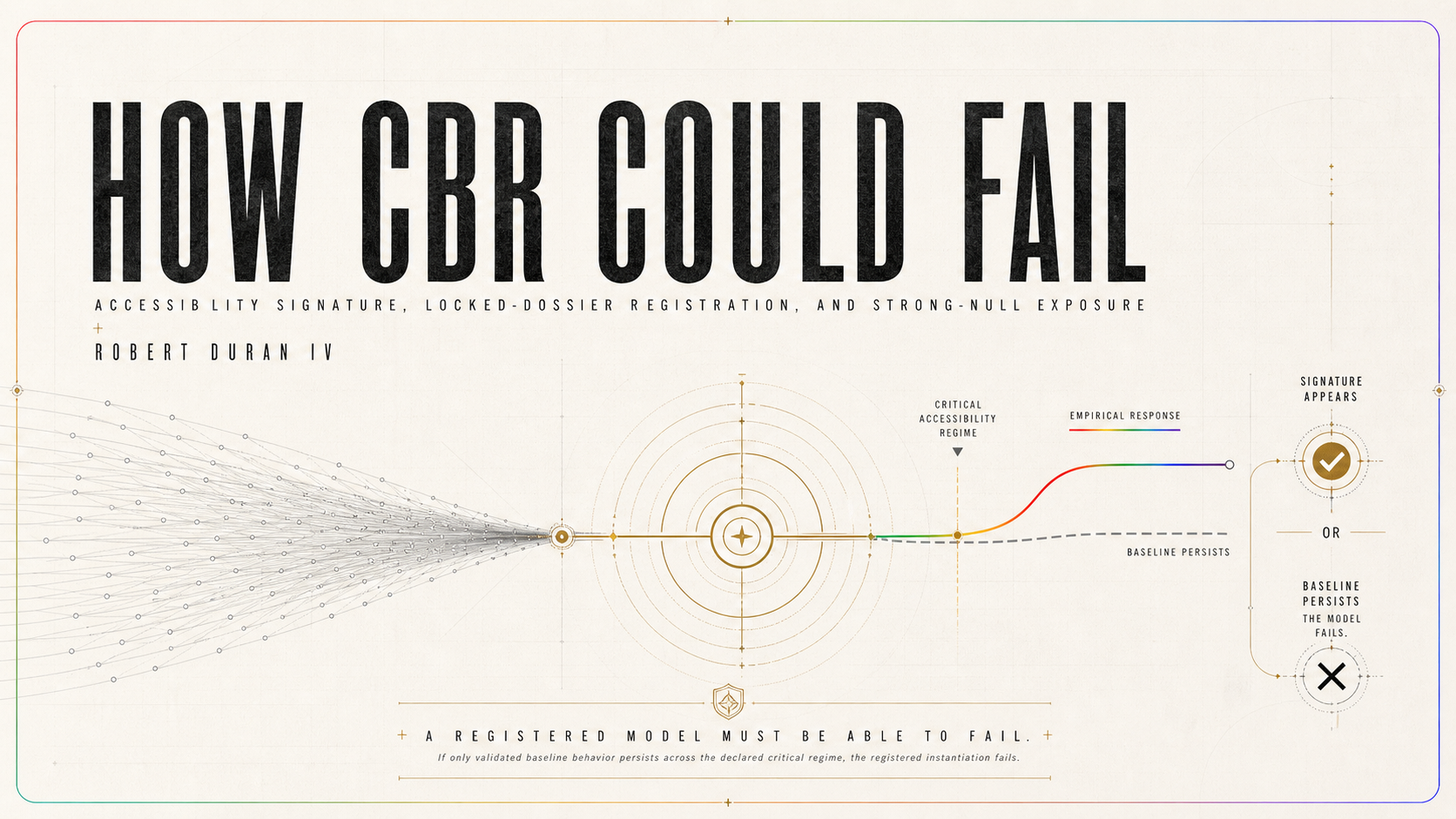
How CBR Could Fail | Accessibility Signature, Locked-Dossier Registration, and Strong-Null Exposure
Robert Duran IV
Independent Researcher
www.robertduraniv.com/research
Abstract
Constraint-Based Realization, or CBR, is a candidate law-form for quantum outcome realization. Its empirical seriousness depends on whether a CBR instantiation can be specified tightly enough to fail. This brief states the proposed empirical exposure route: accessibility-sensitive measurement contexts, especially delayed-choice record-accessibility protocols. The central control variable is η, an operational measure of accessible outcome-defining record information. If accessibility enters the realization law nontrivially, a registered CBR instantiation should entail a detectable non-baseline response near a declared critical accessibility regime η_c or I_c. If, under detectability-valid conditions, the observed response remains within a validated standard-quantum/decoherence/nuisance baseline across the declared critical regime, then the registered instantiation fails. The purpose of this brief is not to claim confirmation, but to state the empirical burden under which CBR can be made scientifically vulnerable.
Scope of this brief
This brief is not the full technical presentation of CBR and does not specify a completed platform-level experiment. It is a compact empirical-liability note. Its purpose is to clarify how a CBR model becomes testable, what must be fixed before testing, what would count as a strong-null failure, and what a failed test would and would not defeat.
1. Why empirical exposure matters
A candidate law of quantum outcome realization must be more than a reinterpretation.
CBR proposes that, for a physically specified measurement context C, individual outcome realization can be represented as constrained selection from an admissible candidate class:
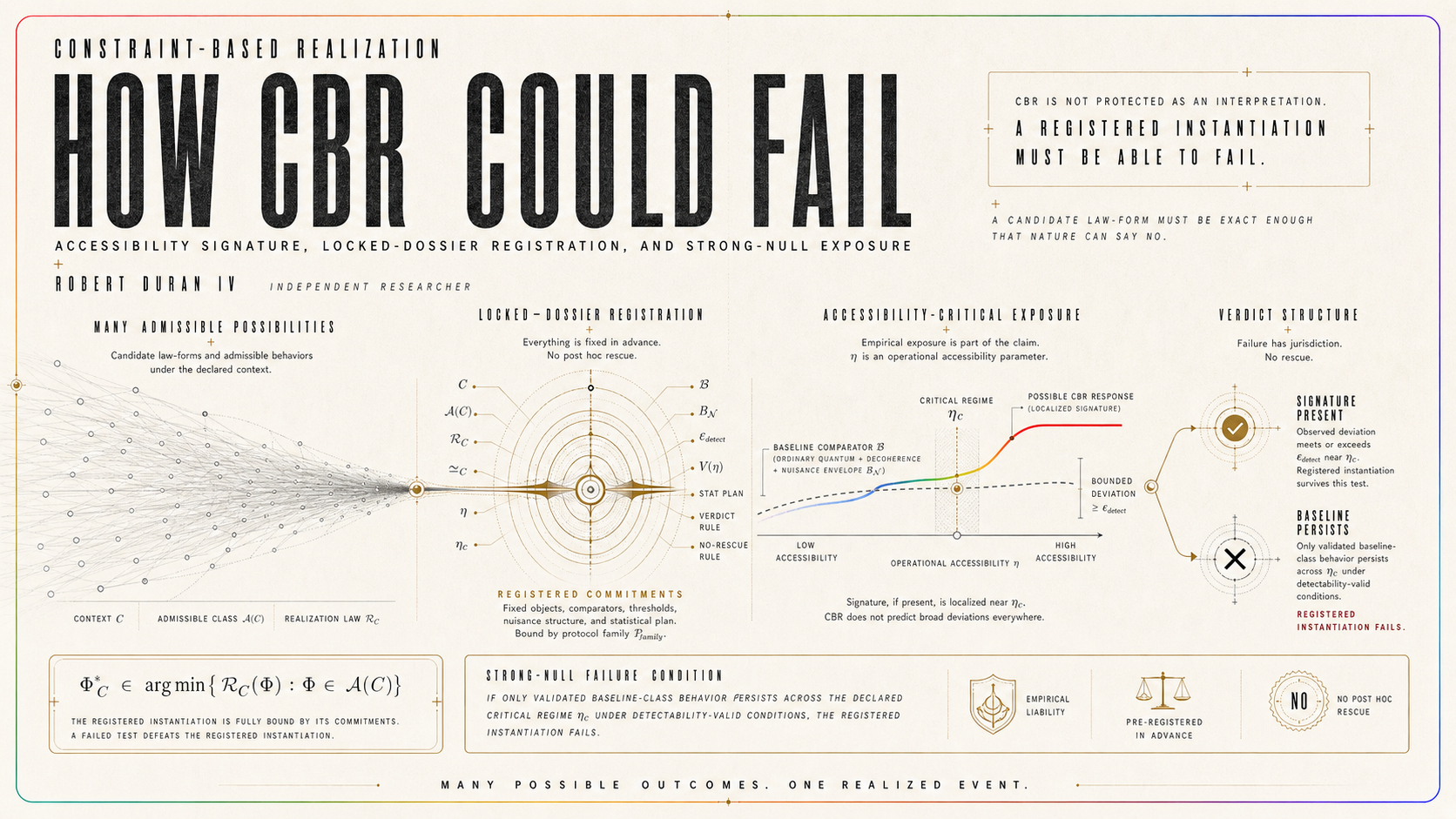
Φ∗_C ∈ argmin{ℛ_C(Φ) : Φ ∈ 𝒜(C)}
This structure becomes scientifically serious only if its law-defining objects can be specified before comparison with experiment.
A theory that cannot fail is not strengthened by that immunity. It is weakened as a scientific proposal.
CBR therefore requires structural or empirical vulnerability. Empirical exposure is not an optional supplement to the program. It is part of what makes the framework reviewable.
The guiding standard is simple: A CBR instantiation must be exact enough that nature can say no.
2. The empirical target
CBR does not predict broad deviations from standard quantum mechanics across ordinary measurement settings.
Its proposed first empirical target is narrower: accessibility-sensitive record contexts.
The guiding idea is that if realization depends not merely on formal record existence, but on physically accessible record structure, then controlled variation of accessibility may expose a realization-sensitive response.
This motivates delayed-choice record-accessibility protocols, where which-path or outcome-defining record information can be controlled, erased, delayed, retrieved, or made differentially accessible.
The empirical question is: Does the observed response remain fully contained within a validated standard-quantum/decoherence/nuisance baseline, or does a registered CBR model entail a detectable non-baseline accessibility signature?
This is the decisive shift. CBR is not asking for an anomaly after the fact. It is asking whether a pre-registered accessibility-sensitive burden can survive comparison with a strong baseline.
3. The accessibility parameter η
CBR introduces η as an operational accessibility parameter.
η represents the degree to which outcome-defining record information is physically accessible in the protocol context.
In a simplified normalization:
η = 0 represents inaccessible or effectively unavailable record information.
η = 1 represents fully accessible record information.
Intermediate values represent partial accessibility.
The exact construction of η must be platform-specific. Depending on the implementation, η may be defined through accessible which-path mutual information, retrieval probability, record distinguishability, erasure control, detector architecture, storage stability, or another operational measure.
The requirement is not that η be universal across every possible experiment.
The requirement is that, in the registered context, η be: physically meaningful, operationally measurable, calibrated in advance, independent of the observed verdict, and relevant to the declared realization burden.
η cannot be assigned retrospectively.
4. The critical accessibility regime
CBR’s empirical exposure does not require anomaly everywhere.
The proposed signature is localized near a critical accessibility regime, denoted either by a critical value η_c or by a critical interval I_c.
η_c may be appropriate if the registered model entails a sharp transition.
I_c may be appropriate if the platform, nuisance structure, or theoretical response class supports only a bounded critical region rather than a point-like threshold.
This distinction matters. A physically realistic experiment may not support an idealized mathematical discontinuity. The more mature formulation allows a critical regime rather than requiring an exact critical point.
Near η_c or I_c, accessibility is hypothesized to become realization-relevant. If the accessibility-sensitive term in the CBR law is nontrivial, the observable response should not remain globally equivalent to the declared smooth baseline class across the relevant domain.
The burden is not: CBR must generate a dramatic anomaly everywhere.
The burden is: A registered CBR model must specify where accessibility becomes realization-relevant and what non-baseline response class follows.
5. The expected signature class
For interferometric protocols, the natural observable is often written as:
V(η),
where V denotes interference visibility or another primary observable response as a function of accessibility.
The standard baseline may predict smooth behavior across η once ordinary quantum dynamics, decoherence, detector effects, and nuisance behavior are included.
A CBR accessibility-sensitive response, if nontrivial, should depart from that baseline near the declared critical regime.
The strongest admissible signature is: a kink, a derivative break, a slope discontinuity, or a sharp local change in V(η) near η_c.
A weaker admissible signature is: a bounded non-baseline deviation in a nonempty neighborhood of η_c or I_c.
The important point is not that every CBR model predicts the same curve. The important point is that the registered model must declare its expected response class before testing.
A post hoc anomaly is not enough.
A CBR signature must be pre-specified, localized, detectable, and separated from the nuisance envelope.
6. The baseline comparator ℬ
A serious test cannot compare CBR against an idealized or artificially smooth version of standard quantum mechanics.
The baseline comparator ℬ must be strong.
It should include: standard quantum dynamics, ordinary decoherence, detector inefficiencies, phase noise, alignment drift, calibration uncertainty, finite-sample effects, source instability, background counts, timing jitter, platform-specific imperfections, and other relevant nuisance behavior.
CBR fails only against a validated baseline, not against a straw-man comparator.
This is crucial. A deviation from an oversimplified baseline would not establish a CBR signature. It could merely reveal an incomplete model of the experiment.
The baseline must be strong enough that a detected departure cannot be dismissed as ordinary experimental imperfection, and a null result cannot be dismissed as an unfair comparison.
7. The nuisance envelope B_𝓝
The nuisance envelope B_𝓝 defines the range of behavior explainable by known non-CBR effects.
It may include: environmental decoherence variation, phase instability, detector response asymmetry, timing jitter, alignment drift, source fluctuations, background counts, calibration error, model uncertainty, and statistical noise.
The nuisance envelope must be fixed before testing.
A claimed CBR signature is meaningful only if the observed response exits the validated nuisance envelope under detectability-valid conditions.
Likewise, a strong-null failure is meaningful only if the experiment was sensitive enough to detect the registered CBR signature had it been present.
This prevents both false victory and false defeat.
8. Detectability
CBR cannot be fairly tested unless the declared signature is detectable.
Let ε_detect denote the declared detectability threshold.
A test is detectability-valid only if the platform has sufficient precision, stability, sample size, calibration quality, and nuisance control to resolve the predicted response class.
If the predicted CBR effect is smaller than experimental uncertainty, the result is not a decisive null. It is inconclusive.
CBR should fail only when three conditions are jointly satisfied: the registered model predicts a detectable signature; the experiment is capable of resolving that signature; and the observed behavior remains baseline-class across the declared critical regime.
This is the right standard. It prevents CBR from being defeated by an experiment that could not have seen the predicted effect.
9. The locked-dossier requirement
Before empirical comparison, a CBR instantiation must be registered as a fixed dossier.
The dossier should include:
C — the physical measurement context.
𝒜(C) — the admissible candidate class.
ℛ_C — the realization-burden functional.
≃_C — the operational equivalence relation.
η — the accessibility parameter and calibration method.
η_c or I_c — the declared critical accessibility value or interval.
ℬ — the baseline comparator.
B_𝓝 — the nuisance envelope.
ε_detect — the detectability threshold.
V(η) or another primary observable.
Statistical plan — how data will be analyzed.
Verdict rule — what counts as support, failure, or inconclusive result.
No-rescue rule — what changes would create a successor model rather than save the registered model.
This locked dossier is central.
Without it, CBR risks becoming post hoc. With it, CBR becomes reviewable.
The rule is: A new model requires a new registry.
10. The strong-null failure condition
The strong-null condition is the central empirical liability.
A registered CBR instantiation fails if all of the following hold: the context and law-defining objects are fixed in advance; the accessibility-sensitive signature class is declared; the baseline comparator is validated; the nuisance envelope is bounded; the experiment is detectability-valid; and the observed behavior remains entirely within the baseline-class envelope across the declared accessibility-critical regime.
In condensed form: If only validated baseline-class behavior persists across the declared critical accessibility regime under detectability-valid conditions, the registered CBR instantiation fails.
This is not merely lack of confirmation.
It is failure of the registered instantiation.
11. What failure would defeat
A failed accessibility test defeats the exact registered CBR model whose fixed commitments entailed the failed prediction.
It does not automatically defeat every possible realization-law thesis.
It does not automatically defeat every possible CBR-like representation.
It does not automatically defeat every future model with a different registered functional, context, admissible class, or accessibility construction.
But it does defeat the registered instantiation if that instantiation fixed the tested commitments and those commitments failed.
Failure has jurisdiction.
The broader consequences depend on bridge theorems. If the failed instantiation is shown to faithfully represent canonical CBR in the tested domain, then failure may reach canonical CBR in that domain. If further bridge arguments show that the domain is representative of the broader CBR representation class, the failure may scale further.
Without such bridges, failure remains local but real.
This distinction matters because local failure should neither be inflated into universal refutation nor softened into non-failure.
12. What would count as support
CBR should not be treated as supported merely because an anomaly appears.
A meaningful positive result would require: a registered CBR prediction, a validated baseline comparator, a bounded nuisance envelope, detectability-valid conditions, a response outside the baseline envelope, localization near the declared accessibility-critical regime, robustness under calibration checks, and independent replication or platform-level confirmation.
Even then, the result would support only the registered instantiation provisionally. Alternative explanations would need to be excluded.
CBR should not claim victory from an unexplained anomaly.
The standard is not anomaly.
The standard is registered, nuisance-separated, detectability-valid non-baseline response.
13. What remains incomplete
The next scientific burden is to complete a platform-specific locked dossier.
That means specifying an actual delayed-choice record-accessibility protocol in full technical detail, including hardware assumptions, calibration procedure, η construction, predicted response class, nuisance envelope, detectability threshold, and statistical verdict rule.
Until that is done, CBR’s empirical exposure is programmatically defined but not yet experimentally complete.
This is not a fatal weakness. It is the next required step.
A theory candidate does not become weaker by stating its next burden clearly. It becomes more evaluable.
One-Sentence Failure Standard
A registered CBR instantiation fails if it predicts a detectable accessibility-sensitive non-baseline response and a validated experiment instead shows only baseline-class behavior across the declared critical accessibility regime.
Conclusion
CBR’s empirical seriousness depends on its willingness to fail.
The accessibility-signature program gives CBR a finite exposure route. If accessibility is realization-relevant, a registered model should predict a detectable non-baseline response near a declared critical accessibility regime. If a detectability-valid experiment instead shows only validated baseline-class behavior, the registered instantiation fails.
This is the correct standard for a candidate law-form.
CBR does not ask to be protected as an interpretation.
It asks to be made exact enough that nature can say no.
