

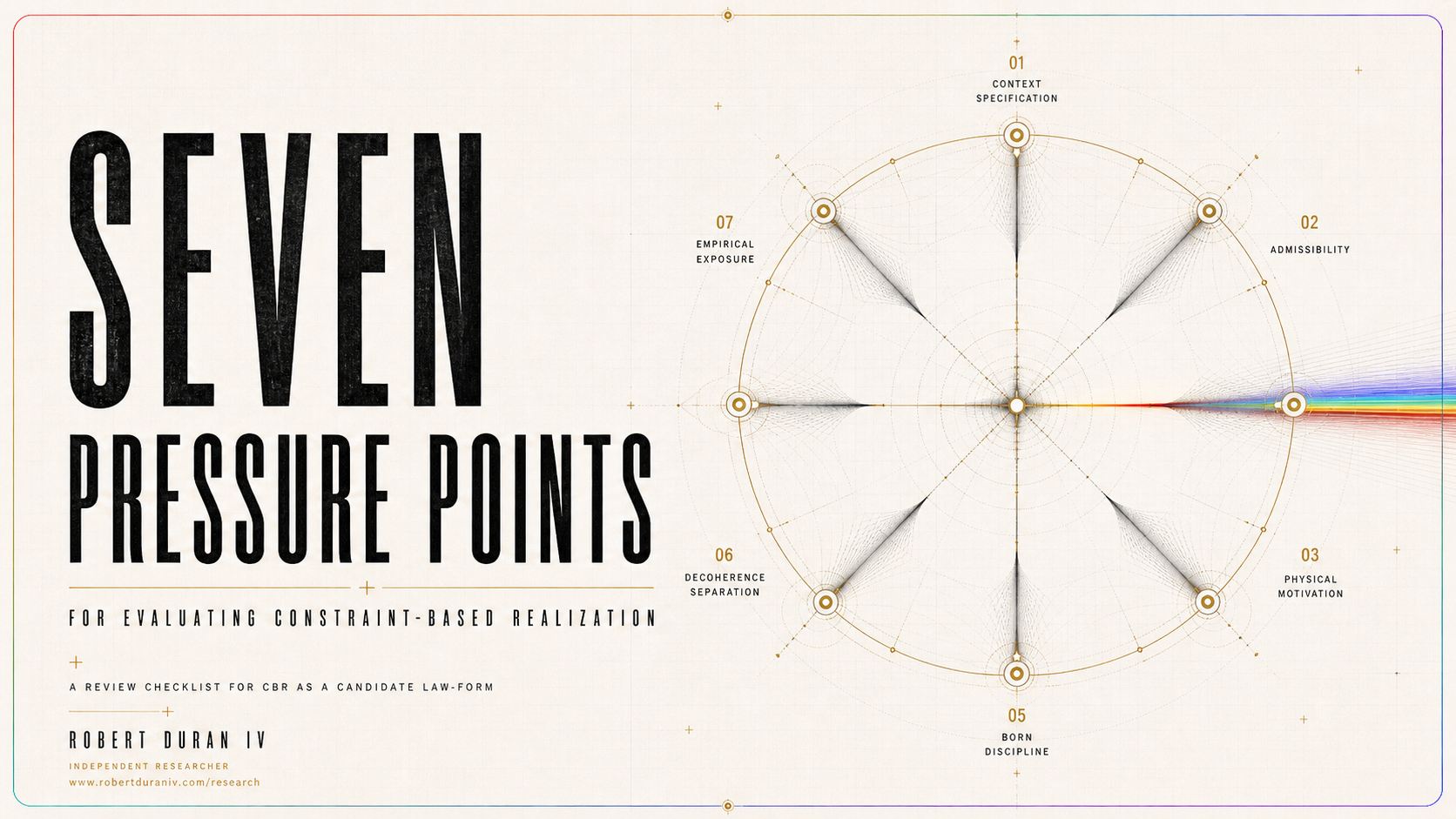
Seven Pressure Points for Evaluating Constraint-Based Realization | A Review Checklist for CBR as a Candidate Law-Form
Robert Duran IV
Independent Researcher
www.robertduraniv.com/research
Purpose
This checklist states the primary review burdens for evaluating Constraint-Based Realization, or CBR, as a candidate law-form for quantum outcome realization.
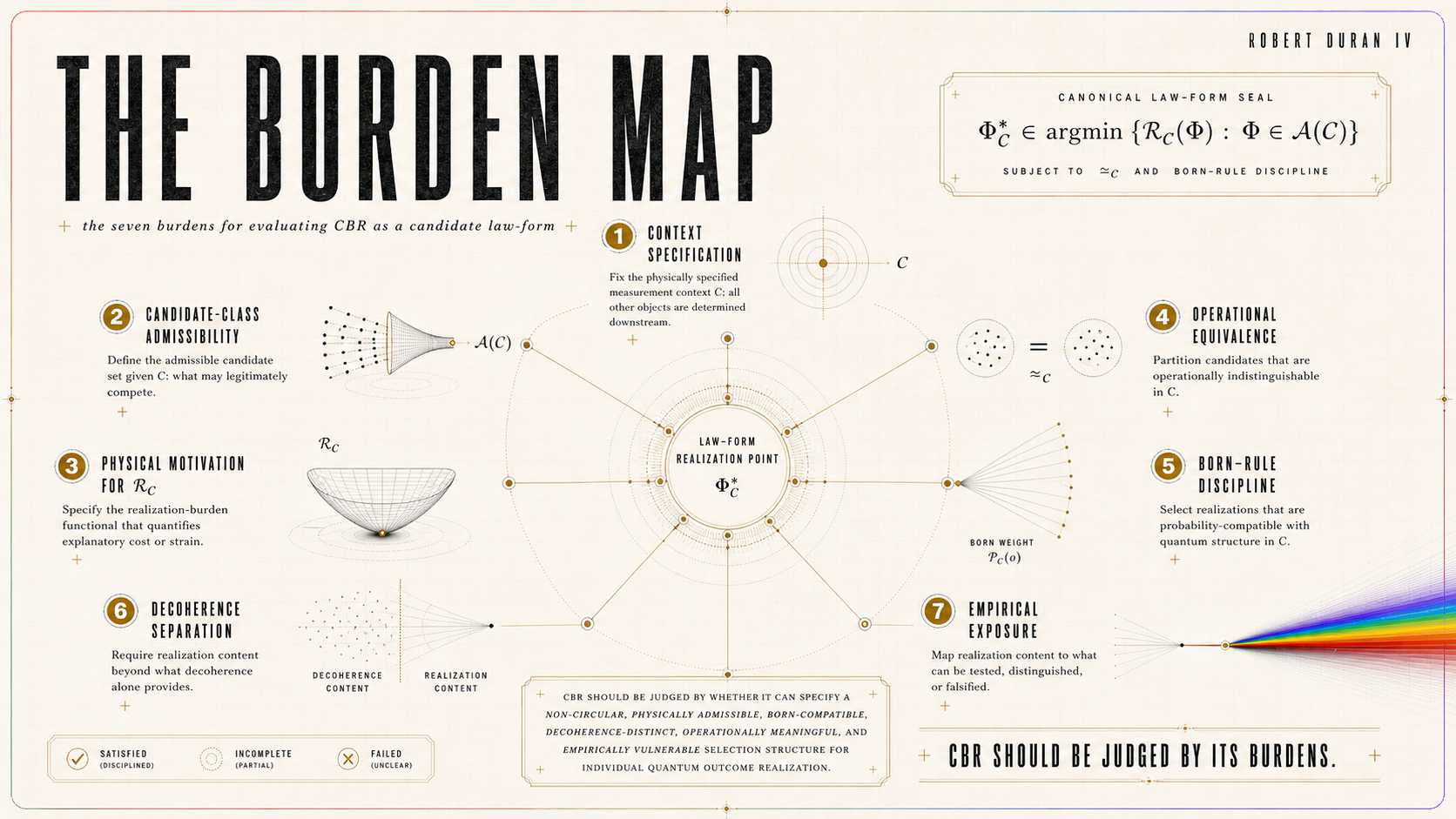
CBR proposes that, for a physically specified measurement context C, individual outcome realization may be represented as constrained selection over an admissible candidate class 𝒜(C), using a context-fixed realization-burden functional ℛ_C and an operational equivalence relation ≃_C:
Φ∗_C ∈ argmin{ℛ_C(Φ) : Φ ∈ 𝒜(C)}
This checklist is not a defense of CBR. It is a protocol for disciplined criticism.
A serious review should not ask only whether CBR is interesting, intuitive, or metaphysically attractive. It should ask whether the law-defining objects can be fixed without circularity, whether the admissible class is physically constrained, whether the burden functional is motivated rather than chosen, whether Born-rule discipline is preserved, whether the framework adds realization content beyond decoherence, and whether the empirical exposure can be made decisive.
Scope of this checklist
This checklist is not the full technical presentation of CBR. It is a compact review instrument intended to identify where a CBR model is satisfied, incomplete, or failed with respect to its own stated burdens. The full technical program is developed across the related CBR papers and research sequence.
Review status categories
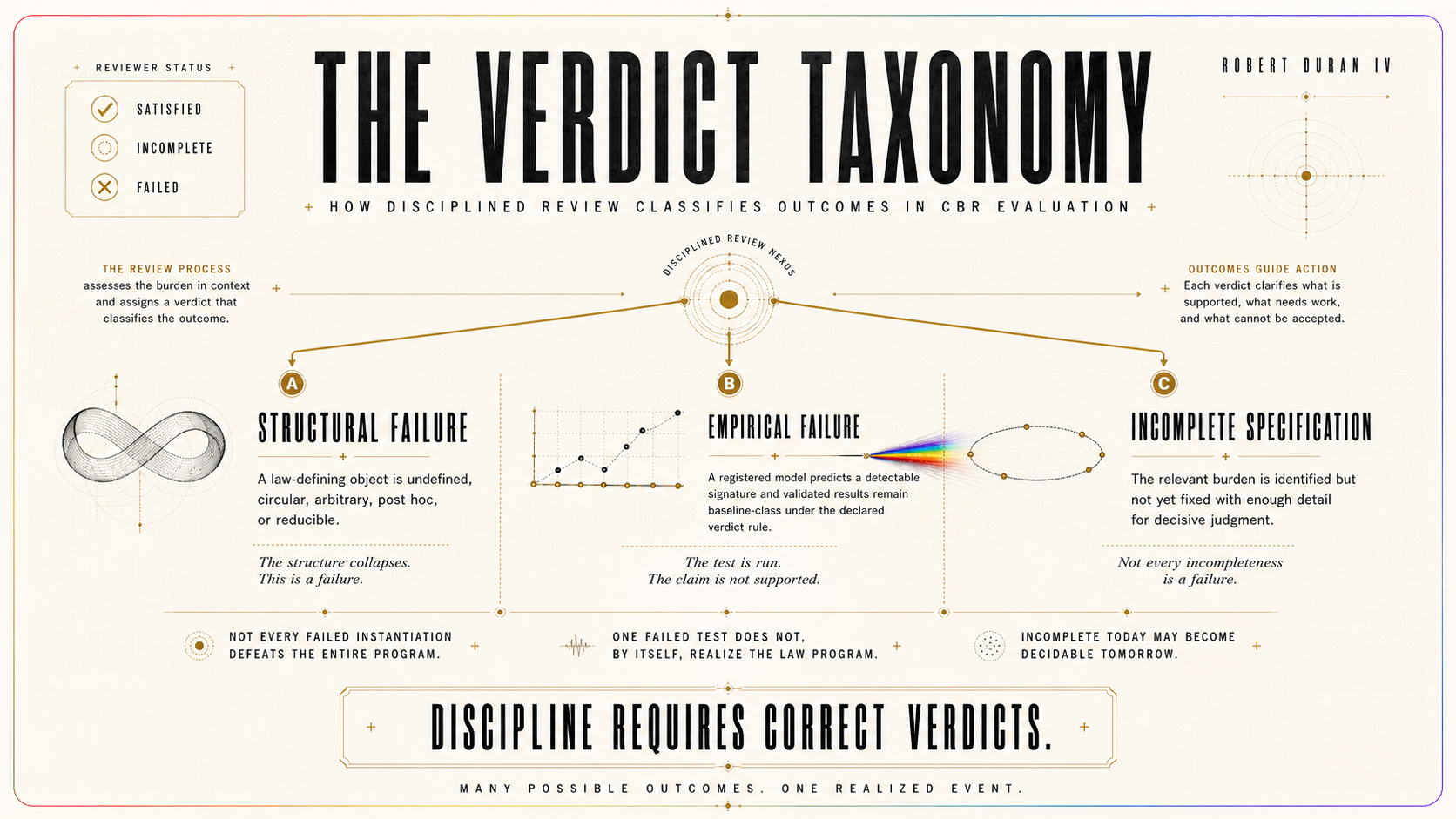
For each pressure point, a reviewer may assign one of three statuses.
Satisfied means the burden is specified clearly enough to support the CBR claim in the relevant context.
Incomplete means the burden is identified but not yet specified with enough physical, mathematical, or operational detail for decisive judgment.
Failed means the burden cannot be met as stated, is circular, is post hoc, is physically underdefined, or collapses into a structure CBR claims to distinguish itself from.
These categories are intended to prevent vague evaluation. A criticism of CBR should identify which burden fails, why it fails, and whether the failure is structural, empirical, or only an incomplete specification.
1. Context Specification
Review question
Can the measurement context C be specified with enough physical and operational detail to support a realization-law claim?
Why it matters
CBR is context-indexed. It does not operate over “measurement” in the abstract. It operates over physically specified measurement contexts.
A context C may include system degrees of freedom, apparatus structure, Hilbert-space description, record-bearing degrees of freedom, environmental coupling, timing relations, accessibility conditions, coarse-graining scale, and readout limitations.
If C is vague, every downstream object becomes unstable: 𝒜(C), ℛ_C, ≃_C, η, the baseline comparator, the nuisance envelope, and the failure condition.
Satisfaction condition
This pressure point is satisfied only if C is fixed before outcome comparison and is detailed enough to determine:
C’s physical domain,
the admissible candidate class,
the operational equivalence relation,
the relevant record structure,
the accessibility parameter where applicable,
the baseline comparator where applicable,
and the structural or empirical failure conditions.
Failure mode
CBR fails this pressure point if C is described only verbally, adjusted after the outcome, or specified so loosely that incompatible admissible classes could be justified from the same physical situation.
Reviewer test
Does the stated context determine the realization problem, or does the model still depend on interpretive discretion?
2. Candidate-Class Admissibility
Review question
Can 𝒜(C) be defined without smuggling in the realized outcome?
Why it matters
Selection is meaningful only if there is a candidate class from which selection occurs. But the candidate class cannot be defined retrospectively.
If 𝒜(C) is too broad, the model can be made arbitrary. If it is too narrow, the outcome may be hidden inside the admissibility filter.
The admissible class must therefore be a physical filter, not a disguised verdict.
Satisfaction condition
This pressure point is satisfied only if 𝒜(C) is nonempty, physically restricted, operationally meaningful, and fixed before the selected realization is known.
Candidate structures should be admissible because they satisfy context-relative physical constraints, not because they match the observed outcome.
Failure mode
CBR fails this pressure point if 𝒜(C) is empty, undefined, arbitrarily broad, post hoc, or constructed so that only the realized outcome could have qualified.
Reviewer test
Would the same admissible class have been declared if a different outcome had occurred?
If the answer is no, the admissibility structure is circular.
3. Physical Motivation for ℛ_C
Review question
Can the realization-burden functional ℛ_C be physically motivated rather than chosen for convenience?
Why it matters
ℛ_C is the central ordering object in CBR. It ranks admissible candidates and determines the minimizer structure.
If ℛ_C is arbitrary, CBR becomes arbitrary. If it is adjusted after the outcome, CBR becomes retrospective.
The burden functional must therefore be more than a scoring device. It must represent a physically interpretable ordering over admissible candidates.
Satisfaction condition
This pressure point is satisfied only if ℛ_C is: context-fixed, pre-outcome, physically interpretable, operationally meaningful, stable under irrelevant representation changes, and independent of the selected result.
Its terms, weights, thresholds, tolerances, and tie-rules must be fixed by theory, context, or pre-specified calibration.
Where possible, ℛ_C should decompose into physically meaningful burdens, such as dynamical compatibility, representational invariance, record-structural coherence, accessibility consistency, admissibility separation, or other context-defined constraints.
Failure mode
CBR fails this pressure point if ℛ_C is tuned after the outcome, lacks physical interpretation, changes under irrelevant redescription, or can be adjusted to select any desired result.
Reviewer test
What physical burden does ℛ_C measure, and why this functional rather than another?
This is one of the central technical questions for CBR.
4. Operational Equivalence
Review question
Does ≃_C remove only operationally irrelevant distinctions?
Why it matters
CBR does not require strict syntactic uniqueness in every representation. It requires uniqueness up to operational equivalence.
That move is legitimate only if ≃_C is carefully defined. Otherwise, operational equivalence could become a way to hide unresolved multiplicity.
A law-candidate cannot simply declare distinct minimizers equivalent because their distinction is inconvenient.
Satisfaction condition
This pressure point is satisfied only if ≃_C identifies candidates that differ merely by representation, relabeling, inaccessible description, or operationally null reformulation within context C.
The equivalence relation must be fixed before minimization and tied to accessible observables, record structure, readout capacities, and protocol-level distinctions.
Failure mode
CBR fails this pressure point if operationally distinct minimizers are treated as equivalent without justification, or if ≃_C is defined after the fact to merge inconvenient alternatives.
Reviewer test
What operational test, available in context C, would distinguish these candidates?
If such a test exists and the candidates are still treated as equivalent, the equivalence relation is too coarse.
5. Born-Rule Discipline
Review question
Does CBR preserve Born-compatible ensemble behavior?
Why it matters
Any serious outcome-realization law must respect the empirical success of the Born rule unless it declares a controlled, pre-specified, testable deviation.
CBR distinguishes probability weighting from realization selection. That distinction does not permit arbitrary probability modification.
CBR cannot hide new probability weights inside 𝒜(C), ℛ_C, minimizer selection, tie-breaking, or accessibility terms.
Satisfaction condition
This pressure point is satisfied only if the realization-selection structure preserves Born-compatible ensemble behavior across repeated contexts, unless a non-Born deviation has been explicitly registered in advance with its own empirical burden.
The model must state where probability enters and must keep probability weighting distinct from realization selection.
Failure mode
CBR fails this pressure point if it produces non-Born frequencies without a declared, constrained, empirically vulnerable deviation.
It also fails if Born weights are silently imported into the selection rule in a way that makes realization circular or outcome-biased.
Reviewer test
Does CBR preserve the Born rule, or has it moved probability selection into hidden machinery?
6. Decoherence Separation
Review question
Does CBR add realization content beyond non-selective decoherence?
Why it matters
CBR does not reject decoherence. Decoherence explains interference suppression, environmental entanglement, record formation, pointer stability, and effective classicality.
The question is whether CBR supplies a distinct law-form for individual outcome realization.
If the selected CBR structure adds nothing beyond a non-selective decoherence-compatible channel, then CBR has not established independence in that context.
Satisfaction condition
This pressure point is satisfied only if Φ∗_C supplies realization content not exhausted by a non-selective decoherence-compatible channel Φ_mix.
The model must specify what selection structure is added and why that structure is not already provided by ordinary decoherence.
Failure mode
CBR fails this pressure point if, in the relevant context, Φ∗_C ≃_C Φ_mix and no further realization content is supplied.
This is not a failure of decoherence. It is a failure of CBR to establish a distinct realization-law role.
Reviewer test
What does CBR select that decoherence does not already select?
7. Empirical Exposure
Review question
Can the accessibility-based failure condition be made experimentally decisive?
Why it matters
CBR is scientifically serious only if it can fail.
The proposed empirical route is an accessibility-sensitive protocol, especially delayed-choice record-accessibility interferometry. The relevant parameter is η, an operational measure of accessible record or which-path information.
If accessibility enters realization nontrivially, CBR expects a non-baseline response near a critical accessibility regime η_c or I_c. If only validated baseline behavior persists under detectability-valid conditions, the registered CBR instantiation fails.
Satisfaction condition
This pressure point is satisfied only if the following are fixed before comparison with data:
C,
𝒜(C),
ℛ_C,
≃_C,
η,
η_c or I_c,
baseline comparator ℬ,
nuisance envelope B_𝓝,
detectability threshold ε_detect,
primary observable such as V(η),
statistical plan,
and verdict rule.
The baseline must include standard quantum behavior, decoherence, detector inefficiencies, noise, drift, calibration uncertainty, and platform-specific nuisance effects.
Failure mode
CBR fails this pressure point if η cannot be operationalized, if the baseline comparator is incomplete, if nuisance effects are not bounded, if the predicted signature is not distinguishable from standard noise, or if the strong-null condition is not experimentally decisive.
Reviewer test
What exact result would make this registered CBR model false?
If that question cannot be answered, the empirical exposure is not yet complete.
Summary of the Seven Pressure Points
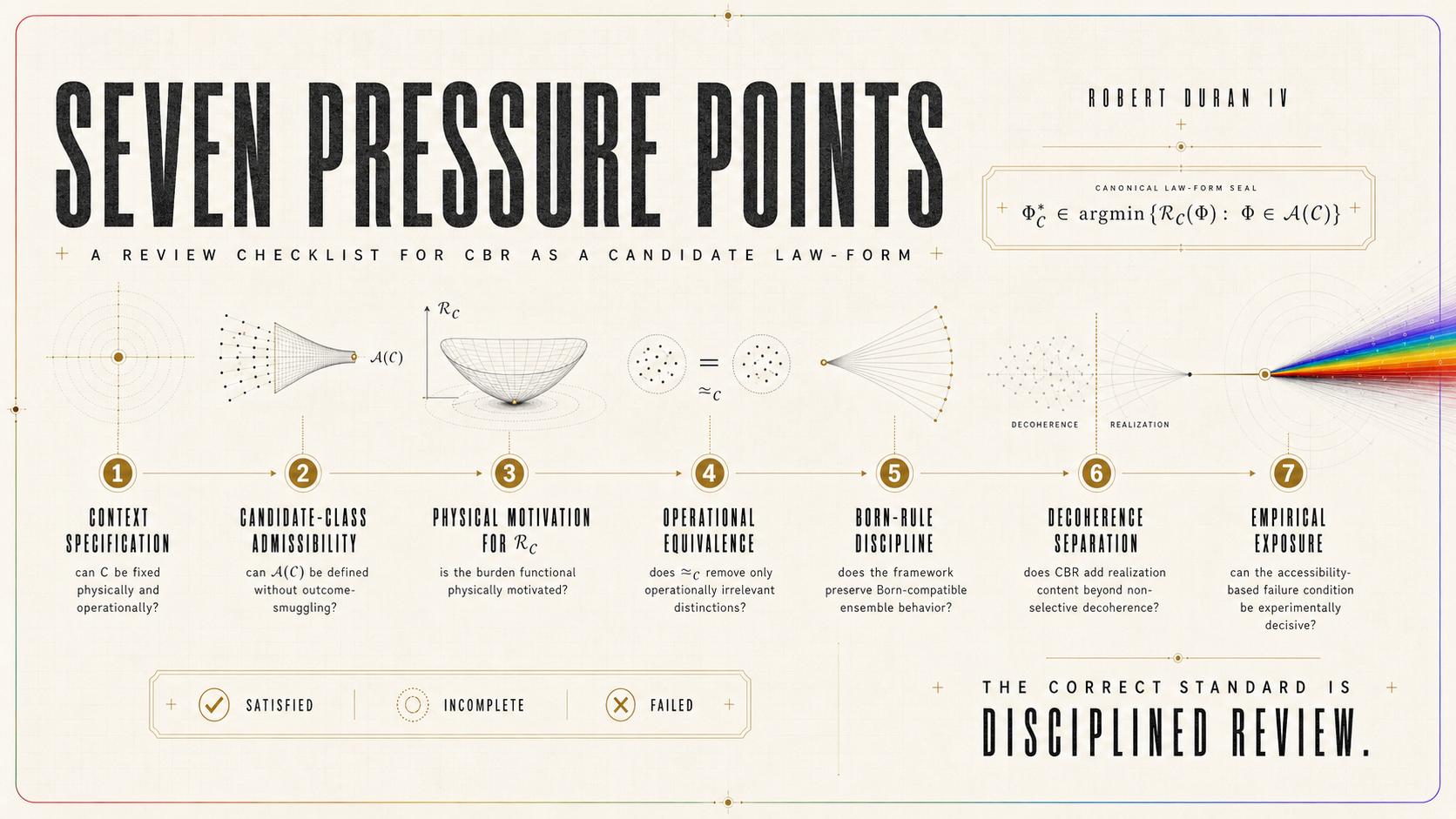
CBR should be evaluated through seven questions:
Can C be specified physically and operationally?
Can 𝒜(C) be defined without outcome-smuggling?
Can ℛ_C be physically motivated?
Does ≃_C remove only operationally irrelevant differences?
Does CBR preserve Born-compatible behavior?
Does CBR add realization content beyond decoherence?
Can the empirical exposure be made decisive?
These are not external objections imposed on the framework. They are the internal burdens CBR must satisfy to mature as a candidate law-form.
One-Sentence Review Standard
CBR should be judged by whether it can specify a non-circular, physically admissible, Born-compatible, decoherence-distinct, operationally meaningful, and empirically vulnerable selection structure for individual quantum outcome realization.
Use of This Checklist
This checklist may be used in three ways.
First, it may be used by a reviewer to identify where a CBR paper is strongest or weakest.
Second, it may be used by the author to determine whether a proposed CBR instantiation is complete enough to evaluate.
Third, it may be used to distinguish three different outcomes of review: structural failure, where a law-defining object is undefined, circular, arbitrary, or reducible to what it claims to distinguish itself from; empirical failure, where a registered model makes a detectable prediction and the validated result remains baseline-class; incomplete specification, where the framework identifies the right burden but has not yet specified it sufficiently for decisive judgment.
This distinction matters because not every incompleteness is a failure, and not every failed instantiation defeats the entire realization-law program.
Conclusion
CBR’s value depends on its willingness to be judged.
The framework should not be accepted because it is conceptually attractive. It should be evaluated because it states a precise burden structure for outcome realization.
If CBR fails one or more of the pressure points above, the failure should be identified directly. If it survives them, it deserves deeper technical and experimental engagement.
The correct standard is not agreement.
The correct standard is disciplined review.
