

The Necessity of Quadratic Weighting and Constraint-Based Realization
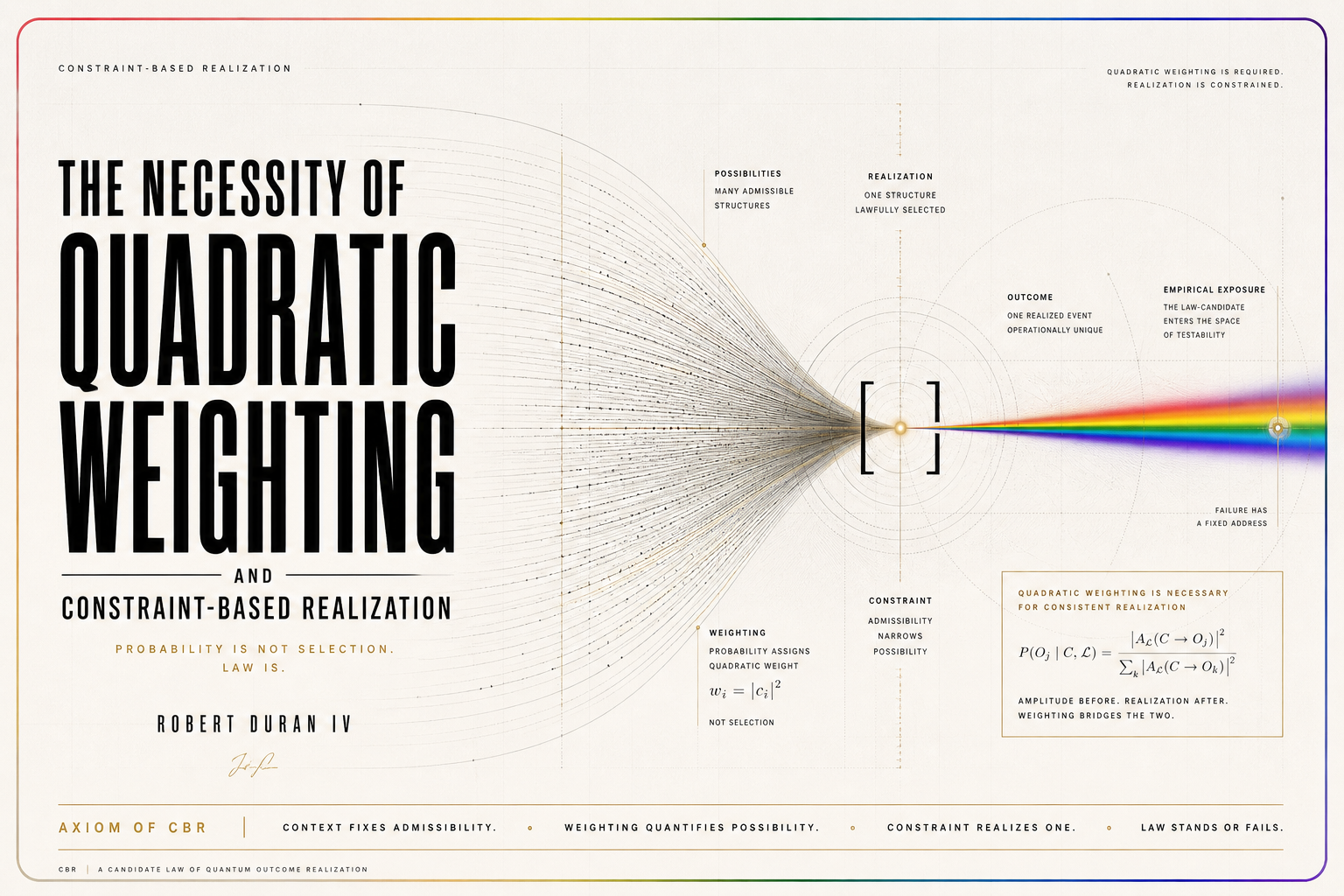
Abstract
This paper addresses the remaining probability burden in Constraint-Based Realization by asking whether quadratic modulus weighting is merely sufficient within canonical CBR or instead necessary for any realization-weighting framework that aims to preserve stable physical probability. The paper’s central claim is that, within an operationally acceptable theorem class, quadratic weighting is not optional: it is forced.
To make that claim precise, the paper defines a class of realization-weighting frameworks over admissible decompositions ψ = ∑ᵢ αᵢeᵢ, with probabilities of the form Pᵢ = W(αᵢ)/∑ⱼ W(αⱼ). It then identifies the structural conditions required for physically meaningful realization probability, including phase insensitivity, admissible refinement consistency, coarse-graining consistency, symmetry, operational invariance, normalization, nontriviality, regularity, and non-circular admissibility. These are treated not as optional design choices, but as the minimal constraints any viable realization-weighting rule must satisfy.
Within that admissible class, the paper proves a Quadratic Necessity Theorem: the weighting rule must reduce to dependence on amplitude modulus, must be additive on squared modulus under admissible refinement, and—given regularity and normalization—collapses to the unique normalized form W(α) = │α│². On this account, quadratic weighting is not merely recovered inside canonical CBR; it is the unique weighting form available to any realization-weighting framework that preserves the stated operational constraints.
The claim is deliberately narrow. The paper does not assert unrestricted universality across all conceivable mathematical or interpretive frameworks, nor does it claim empirical confirmation of CBR. Its stronger point is conditional: any nonquadratic alternative survives only by rejecting one or more of the structural conditions required for stable physical probability, and therefore assumes the burden of explaining how probability retains physical meaning after that loss.
If successful, the result materially strengthens the CBR program. It shifts quadratic weighting from a local internal feature of canonical CBR to a necessity result for the full operationally acceptable realization-weighting class.
1. Introduction
1.1 The remaining probability burden
The Core Theorem Paper established local probability closure inside canonical Constraint-Based Realization. Within the canonical admissibility structure developed there, normalized nonquadratic weighting does not survive once admissible refinement, operational invariance, symmetry, normalization, nontriviality, and regularity are imposed. That result was already significant because it removed the probability rule from the category of optional internal design choices. Inside canonical CBR, the weighting structure is not left free.
That result, however, does not by itself settle the stronger question. A local closure theorem establishes that quadratic weighting follows within a given canonical admissibility class. It does not yet show that the structural assumptions generating that result are necessary for any realization-weighting framework that claims stable physical probability meaning. A critic may therefore grant the internal CBR derivation while still asking whether the assumptions used there are merely sufficient, rather than required by the very idea of operationally meaningful realization probability.
The present paper addresses exactly that remaining burden. It asks whether the conditions that force quadratic modulus weighting are simply a disciplined package internal to canonical CBR, or whether they are in fact necessary for any realization-weighting framework that purports to assign stable probabilities to admissible realization alternatives. The question is therefore not whether a nonquadratic formula can be written down. Many such formulas can. The question is whether any such formula can survive as a physically acceptable probability rule once the elementary structural demands of realization weighting are made explicit.
The target can be stated sharply:
Are the conditions that force quadratic weighting merely sufficient, or are they necessary for any realization-weighting framework that claims physical probability meaning?
The answer developed here is conditional but strong. It is conditional because the paper does not claim unrestricted universality across every conceivable mathematical or interpretive scheme. It is strong because, within the admissible theorem class defined below, the probability rule is no longer merely recovered locally; it is forced by the requirements of operational probability acceptability.
1.2 Central thesis
The central thesis of the paper is:
Any operationally acceptable realization-weighting framework must either reduce to quadratic modulus weighting or abandon one of the structural conditions required for stable physical probability.
This thesis should be read with care. It is not the claim that quadratic weighting is aesthetically preferable, historically conventional, or merely compatible with canonical CBR. It is the claim that once a framework attempts to assign realization probabilities to admissible branch decompositions in a physically stable way, its room to deviate from quadratic weighting collapses sharply.
The argument does not proceed by direct appeal to the Born rule as an unexplained target. It proceeds by isolating the conditions without which realization weighting ceases to function as probability at all. If a rule depends on physically irrelevant phase, if it changes total probability under admissible refinement, if it changes under coarse-graining, if it depends on branch labels, if it varies across operationally equivalent decompositions, if it fails normalization, if it ignores amplitude structure, if it permits pathological additive behavior, or if it derives its conclusion only by building that conclusion into admissibility, then it fails to satisfy the minimum structural requirements of operational probability acceptability.
The paper therefore treats quadratic weighting not as a preferred internal rule of canonical CBR, but as the unique normalized weighting form available within the operationally acceptable realization-weighting class.
1.3 The two theorem centers
The paper has two major theorem centers, and the distinction between them is essential.
The first is the Probability Acceptability Theorem. Its role is to establish that the structural assumptions often treated as premises in weighting derivations are not merely optional conveniences. They are forced by the requirement that a realization-weighting framework assign stable operational probability. More specifically, the theorem shows that any such framework must satisfy, or possess structural equivalents of, phase insensitivity, admissible refinement consistency, coarse-graining consistency, symmetry, operational invariance, normalization, nontriviality, regularity, and non-circular admissibility.
The second is the Quadratic Necessity Theorem. Once the acceptable theorem class has been fixed, the weighting rule reduces to dependence on amplitude modulus, induces additivity on squared modulus, and—under regularity and normalization—collapses to the unique form
W(α) = │α│².
These two theorem centers correspond to two different burdens. The first burden is structural: what conditions must hold before a weighting rule can count as stable physical probability? The second burden is mathematical: once those conditions hold, what form can the weighting rule take? A large part of the paper’s force comes from refusing to conflate these two burdens.
In the Core Theorem Paper, local probability closure established the second burden inside canonical CBR. The present paper strengthens the program by addressing the first burden directly. It asks whether the assumptions underwriting the local closure result are not merely sufficient inside canonical CBR, but necessary for the broader class of operationally acceptable realization-weighting frameworks.
1.4 Formal definition of the admissible theorem class
The main results of this paper apply to a definite theorem class, which should be stated at the outset.
Definition 1.1 — Admissible decomposition.
An admissible decomposition is a representation of the form
ψ = ∑ᵢ αᵢeᵢ
in which the components eᵢ correspond to physically meaningful outcome-defining alternatives for the realization-weighting problem under consideration, and in which admissible refinement, admissible coarse-graining, and operational equivalence can be defined.
Definition 1.2 — Realization-weighting rule.
A realization-weighting rule is a map
W : α ↦ ℝ≥0
that assigns a nonnegative branch weight to each admissible amplitude contribution, with normalized probabilities given by
Pᵢ = W(αᵢ)∕∑ⱼW(αⱼ)
whenever the admissible decomposition is under evaluation as a probability-bearing realization structure.
Definition 1.3 — Operational equivalence.
Two admissible decompositions are operationally equivalent if no admissible realization-relevant physical test distinguishes them at the level of probability assignment or realization consequence.
Definition 1.4 — Operationally acceptable realization-weighting framework.
A realization-weighting framework is operationally acceptable if its probability assignments are invariant under physically irrelevant phase changes, stable under admissible refinement, stable under admissible coarse-graining, symmetric under labels lacking operational content, invariant under operationally equivalent decompositions, normalized, nontrivially sensitive to amplitude structure, regular enough to exclude pathological additive constructions, and non-circular in its admissibility definitions.
Definition 1.5 — Admissible theorem class of the paper.
The admissible theorem class consists of realization-weighting frameworks that assign probabilities to admissible decompositions and satisfy, or claim to satisfy, operational probability acceptability in the sense of Definition 1.4.
This definition block is not ornamental. It prevents a common misunderstanding. The paper is not trying to prove that every imaginable mathematical rule on amplitudes is impossible unless it is quadratic. It is proving something narrower and stronger: within the theorem class of operationally acceptable realization-weighting frameworks, quadratic weighting is structurally forced.
The definition block also makes clear that the argument is not automatically directed at every interpretation of quantum mechanics. A framework that denies the relevance of single-outcome realization weighting may fall outside the theorem class. Such a framework is not refuted by this paper. It is simply not the target of the theorem.
1.5 What this paper does not claim
The strength of the present paper depends in part on what it refuses to claim.
First, it does not claim that every imaginable mathematical weighting scheme is impossible. Nonquadratic functions can easily be written down. The paper’s claim is not that such functions cannot exist, but that they cannot function as operationally acceptable realization-probability rules without sacrificing at least one structural condition required for stable physical probability.
Second, the paper does not claim that every interpretation of quantum mechanics is refuted. In particular, it does not force Everettian frameworks to accept single-outcome realization. A framework may reject the target problem itself and thereby leave the theorem class rather than contradict the theorem.
Third, the paper does not claim empirical validation of CBR. It is a probability-structure paper, not an experiment paper. Empirical vulnerability belongs to the protocol-level work developed separately.
Fourth, the paper does not claim that its result is identical to Gleason-style, envariance-style, or Everettian decision-theoretic derivations of the Born rule. Those derivations operate over different domains, under different assumptions, and for different conceptual targets. The present theorem concerns realization-weighting frameworks over admissible outcome-branch decompositions.
Fifth, the paper does not claim unrestricted universality. It is best understood as a near-global structural theorem for the operationally acceptable realization-weighting class, not as an unrestricted theorem over every conceivable interpretive or mathematical framework.
These non-claims do not weaken the paper. They keep it within the bounds of what the proof can actually support.
1.6 Proof strategy
The proof strategy is direct and staged.
First, the paper defines realization-weighting frameworks and the admissible theorem class in a form explicit enough to support theorem-level claims rather than rhetorical plausibility.
Second, it develops the notion of operational probability acceptability and treats it as the primary structural burden. This is the level at which the paper argues that phase insensitivity, refinement consistency, coarse-graining consistency, symmetry, operational invariance, normalization, nontriviality, regularity, and non-circularity are not merely convenient assumptions, but requirements of physically stable realization probability.
Third, it proves these requirements one by one as necessity lemmas. Each lemma identifies the pathology created by rejecting the relevant condition.
Fourth, it shows that the acceptable theorem class induces additive measure structure on squared modulus. This is the point at which the weighting rule ceases to be an arbitrary branch assignment and becomes a constrained measure-like object.
Fifth, it proves the Probability Acceptability Theorem and then the Quadratic Necessity Theorem. The first theorem fixes the structural class. The second theorem fixes the weighting form.
Sixth, it classifies nonquadratic escape routes. This is not an appendix-like afterthought. It is a central consequence of the theorem. A nonquadratic rule can survive only by rejecting one of the structural conditions required for operational probability acceptability, and it must then explain why doing so does not destroy stable physical probability.
This proof order matters. It makes clear that the paper is not simply another Born-rule derivation in which a desired answer is reached from a convenient list of assumptions. It is a theorem about what realization weighting must look like if it is to function as operational probability in the first place.
1.7 Why this matters
If successful, the present paper changes the status of the probability side of CBR.
Without this paper, the Core Theorem Paper shows that quadratic weighting is locally forced inside canonical CBR. That is already important. But a critic can still ask whether the assumptions behind that local closure are only internal to the CBR architecture.
With this paper, the burden shifts. The conclusion becomes:
Quadratic weighting is not merely recovered inside canonical CBR. It is forced for any realization-weighting framework in the operationally acceptable theorem class.
That shift matters because probability is one of the central vulnerabilities of any proposed completion or realization-law framework. A theory that specifies a law of realization but leaves its weighting rule arbitrary has not completed its own burden. A theory that shows why the weighting rule is structurally forced has done much more.
The result also matters for alternatives. A nonquadratic proposal can still be made, but after this paper it must become explicit about its cost. It must say which condition of operational probability acceptability it rejects and why rejecting that condition does not destroy the physical meaning of probability.
That is the paper’s core contribution. It does not settle all of quantum foundations. It does not claim final unrestricted universality. It does, however, make the probability side of CBR substantially more difficult to dismiss as internal stipulation.
2. From Local Closure to Necessity
2.1 Local probability closure in canonical CBR
The Core Theorem Paper established a local probability-closure result within canonical CBR. The result was local because it was proved inside the canonical admissibility structure of the theory. It assumed a law-selection framework in which realization is defined over an admissible class and constrained by operational equivalence, refinement stability, coarse-graining consistency, and admissibility discipline.
Within that structure, the weighting rule is not freely chosen. The relevant assumptions are as follows. First, admissible refinement must preserve the total weight of a physical alternative under finer description. Second, operationally equivalent decompositions must induce the same normalized weighting. Third, symmetric branches with no relevant physical distinction must receive equal treatment. Fourth, the total probability assignment must normalize. Fifth, the rule must be nontrivial, meaning that amplitude structure cannot be erased into branch-count uniformity. Sixth, the weighting function must satisfy enough regularity to exclude pathological additive constructions.
Under those conditions, no normalized nonquadratic weighting survives. The local result therefore closes a major internal gap in canonical CBR: probability is not an arbitrary addition to the law form, but a consequence of the admissibility structure.
Nevertheless, the result remains local in an important sense. It establishes closure inside the canonical CBR theorem class. It does not yet show that the assumptions behind the closure are necessary for every operationally meaningful realization-weighting framework. That is the task of the present paper.
2.2 Generalized weighting uniqueness
The Core Theorem Paper’s appendix-level generalization pushed the result beyond the strict canonical CBR setting. It considered a generalized admissible weighting framework in which branch amplitudes are assigned nonnegative weights, refinement and coarse-graining are available, operational equivalence can be assessed, and normalized total weight is defined.
Under the generalized assumptions B1–B9, the only normalized admissible weighting rule is:
W(α) = │α│².
Those assumptions include phase insensitivity, refinement consistency, coarse-graining consistency, permutation symmetry, operational invariance, normalization, nontriviality, regularity, and non-circular admissibility. The generalized result is already stronger than a canon-specific derivation, because it shows that quadratic weighting follows across a broader structural class.
However, even this generalized uniqueness theorem remains formally conditional. It states that if a framework satisfies the listed assumptions, then quadratic weighting follows. It does not yet prove that a physically acceptable realization-weighting framework must satisfy them.
The difference between “if accepted, then quadratic” and “must be accepted for physical probability” is the difference between sufficiency and necessity. The present paper is written to close that gap as far as the realization-weighting framework permits.
2.3 The remaining gap
A sufficiency theorem has the following form:
If the assumptions hold, quadratic weighting follows.
Such a theorem is valuable, but it leaves open a natural objection. A nonquadratic theorist may reject one or more assumptions and claim that the quadratic conclusion has been avoided. The question then becomes whether the rejected assumption was optional, or whether rejecting it destroys the rule’s claim to physical probability meaning.
The present paper therefore seeks a necessity result of the following form:
If a weighting rule claims stable physical probability meaning, then the assumptions that force quadratic weighting, or their structural equivalents, must hold.
The phrase “or their structural equivalents” is important. The theorem does not require every framework to use the same vocabulary as CBR. A framework may express refinement, invariance, or regularity in different formal language. What matters is whether it preserves the same physical function: probability must not change under operationally irrelevant phase, relabeling, refinement, aggregation, or equivalent redescription.
Thus the remaining gap is not merely technical. It is conceptual and structural. The paper must show that the assumptions leading to quadratic weighting are not arbitrary restrictions chosen to force a desired answer, but conditions required for any realization-weighting rule to count as operational probability.
2.4 Proof strategy
The proof strategy proceeds in six stages.
First, the paper defines realization-weighting frameworks. These are frameworks that assign normalized probabilities to admissible outcome-branch decompositions intended to represent realization likelihood.
Second, the paper defines operational probability acceptability. A weighting rule is acceptable only if its assignments are invariant under physically irrelevant representation changes, stable under admissible refinement and coarse-graining, symmetric under labels with no operational content, normalized, nontrivially sensitive to amplitude structure, regular, and non-circular.
Third, the paper proves each acceptability condition as a necessity lemma. Each lemma has the same form: state the requirement, prove that rejecting it generates a specific pathology, identify the failure mode, and state the dependency of the result.
Fourth, the paper derives additive measure representation. Phase insensitivity reduces W(α) to a function of │α│. Refinement and coarse-graining consistency then produce additivity on squared modulus.
Fifth, the paper proves quadratic necessity. Regularity forces the additive function to be linear on squared modulus, and normalization fixes the constant. The result is W(α) = │α│².
Sixth, the paper classifies nonquadratic escape routes. A nonquadratic alternative may reject one of the structural requirements, but it must then accept the corresponding physical cost: phase-label dependence, branch-splitting arbitrariness, aggregation instability, label sensitivity, representation dependence, non-normalization, pathology, or circularity.
The structure is intentionally proof-disciplined. The paper does not rely on the rhetorical claim that the assumptions are “reasonable.” It argues that without them, the weighting rule ceases to function as stable operational probability.
3. Realization-Weighting Frameworks
3.1 Admissible branch decompositions
Let an admissible branch decomposition be written:
ψ = ∑ᵢ αᵢeᵢ.
Here eᵢ denotes an outcome-defining component of the decomposition, and αᵢ denotes the complex amplitude associated with that component. The notation is intentionally minimal. The paper does not require that every formal decomposition of ψ be admissible. It requires only that the decomposition under consideration belong to the class of physically meaningful outcome-branch decompositions relevant to realization-weighting.
The branch components eᵢ should therefore be understood as physically interpretable alternatives within the stated context, not merely arbitrary basis labels. A decomposition is admissible only when the alternatives support the probability-assignment task at issue. In the CBR setting, the alternatives are not merely mathematical branches; they are candidate realization alternatives or outcome-defining components relevant to a realization law.
The weighting rule assigns to each amplitude αᵢ a branch weight W(αᵢ). The present paper asks what form W can take if the resulting weights are to function as stable physical probabilities.
3.2 Weighting rule
A realization-weighting rule is a map:
W : α ↦ ℝ≥0.
The nonnegativity condition is required because W is intended to contribute to probability assignment. Negative probability weights would require a different interpretive structure and are not part of the theorem class considered here.
For an admissible decomposition ψ = ∑ᵢ αᵢeᵢ, normalized probabilities are written:
Pᵢ = W(αᵢ)∕∑ⱼW(αⱼ).
When the decomposition is already normalized and W is itself normalized over the admissible branch set, this reduces to the usual condition:
∑ᵢPᵢ = 1.
The purpose of this definition is not to assume the Born rule. At this stage W is arbitrary except for nonnegativity and the claim that it is to be used for probability assignment. The paper will ask which additional constraints are forced by operational probability acceptability.
3.3 Admissible decompositions
A decomposition is admissible only if it satisfies five conditions.
First, its branches must correspond to physically meaningful outcome alternatives. A merely formal expansion in an arbitrary basis is not automatically realization-relevant.
Second, refinements must be well-defined. If a branch is subdivided into admissible subbranches representing a finer description of the same physical alternative, the framework must be able to state how weights behave under that subdivision.
Third, coarse-grainings must be well-defined. If subbranches are aggregated into a parent branch representing a lower-resolution alternative, the framework must be able to state how total weight behaves under that aggregation.
Fourth, operational equivalence must be assessable. If two decompositions differ only by representation and cannot be distinguished by any admissible test relevant to realization probability, the framework must identify them as equivalent at the probability-assignment level.
Fifth, probability assignment must not be merely representational. A weighting rule that changes its probabilities under changes in notation, labeling, or arbitrary branch resolution is not assigning physical probabilities. It is assigning description-dependent scores.
These admissibility requirements are intentionally modest. They do not determine the Born rule by themselves. They define the class of decompositions over which the weighting problem is physically meaningful.
3.4 Operational equivalence
Two decompositions are operationally equivalent if no admissible physical test distinguishes them at the level of probability assignment or realization-relevant consequence.
This definition should be read carefully. Operational equivalence does not require syntactic identity. Two decompositions may be written differently, use different labels, or represent alternatives at different descriptive resolutions while remaining equivalent for the probability question at hand. Conversely, two decompositions that look formally similar may be operationally inequivalent if they differ in a way that changes realization-relevant predictions.
Operational equivalence is therefore the relation that prevents the weighting rule from responding to mere notation. It is also the relation that allows the paper to state necessity results without requiring exact identity of formal representations.
The theorem class assumes that physical probability must be invariant under operational equivalence. If a framework rejects that assumption, it leaves the class of operationally acceptable realization-weighting rules and must explain how representation-dependent probabilities retain physical meaning.
3.5 Realization-weighting framework
A realization-weighting framework is a rule assigning normalized probabilities to admissible branch decompositions intended to represent realization likelihood.
This definition places the present paper in a specific domain. It is not addressing every possible interpretation of quantum mechanics. It is addressing frameworks that assign probability weights to outcome-defining alternatives in connection with physical realization. In particular, the paper is not directed at frameworks that deny the need for single-outcome realization weighting altogether. Such frameworks may be important, but they do not fall inside the theorem class.
Within the theorem class, a weighting framework must answer a specific question:
Given an admissible outcome-branch decomposition ψ = ∑ᵢ αᵢeᵢ, what probability weight should be assigned to each branch?
The paper argues that any answer preserving operational probability acceptability must reduce to W(α) = │α│².
3.6 Proof discipline requirement
Every necessity claim in this paper follows the same structure.
First, the requirement is stated. Second, a necessity lemma is formulated. Third, a proof is given or, where appropriate, the strongest proof sketch consistent with the stated assumptions is supplied. Fourth, the failure mode produced by rejecting the requirement is identified. Fifth, a dependency note records what the result depends on.
This structure is deliberate. The paper does not treat “physical reasonableness” as an unexplained black box. It identifies the specific operational pathology that appears when a requirement is removed.
For example, refinement consistency is not defended merely because it is elegant. It is defended because rejecting it allows probability to be changed by branch subdivision. Operational invariance is not defended merely because it is standard. It is defended because rejecting it allows equivalent descriptions to produce different probabilities.
This proof discipline is the central methodological standard of the paper. Each assumption must earn its place by blocking a specific failure mode.
4. Operational Probability Acceptability
4.1 Definition
A realization-weighting framework is operationally probability-acceptable if its probability assignments satisfy the following requirements.
First, they must be invariant under physically irrelevant phase changes. If a phase transformation does not alter realization-relevant physical content, it must not alter probability.
Second, they must be stable under admissible refinement. If a physical alternative is described at finer resolution, the total probability assigned to that alternative must be preserved.
Third, they must be stable under admissible coarse-graining. If subbranches are aggregated into a parent alternative, the total probability assigned to the parent must equal the total probability assigned to the admissible subbranches.
Fourth, they must be symmetric under labels with no operational content. Equal-modulus, operationally indistinguishable alternatives cannot receive unequal probabilities merely because they carry different labels.
Fifth, they must be invariant under operationally equivalent decompositions. If two decompositions cannot be distinguished by admissible realization-relevant tests, their normalized probabilities must agree.
Sixth, they must be normalized. A probability rule must support total probability one over mutually exclusive admissible alternatives.
Seventh, they must be nontrivially sensitive to amplitude structure. A rule that ignores all unequal-amplitude structure does not solve the amplitude-weighting problem.
Eighth, they must be regular enough to exclude pathological additive solutions. Minimal continuity or measurability is required for physical interpretability.
Ninth, they must be non-circular. The admissibility rules used to derive weighting cannot secretly encode the target conclusion.
These conditions define the theorem class. A framework outside them may still be a mathematical construction, but it does not count here as an operationally acceptable realization-probability theory.
4.2 Acceptability principle
Principle 4.1 — Operational Probability Acceptability.
A weighting rule that claims physical probability meaning may not assign different probabilities to descriptions that differ only by operationally irrelevant representation, refinement, aggregation, labeling, or pathological construction.
This principle is not an additional Born-rule assumption. It does not mention │α│². It says only that physical probability must not be hostage to description choices that do not alter the physical alternative being weighted.
The principle is also weaker than unrestricted universality. It does not require every possible mathematical object to behave this way. It applies only to weighting rules that claim to assign stable physical probabilities in realization-law frameworks.
The remainder of the paper shows that this principle is strong enough to force the structural conditions that yield quadratic weighting.
4.3 The acceptability filter
The acceptability filter excludes rules that fail to function as stable operational probability.
A representation-sensitive rule is excluded because it assigns different probabilities to physically equivalent descriptions.
A branch-splitting-sensitive rule is excluded because it allows probability to change under admissible refinement.
An aggregation-sensitive rule is excluded because it allows probability to change under coarse-graining.
A label-sensitive rule is excluded because it permits names or symbolic positions to alter probability without physical distinction.
A non-normalized rule is excluded from the class of probability rules, although it may define some other kind of score or tendency.
A pathological rule is excluded because it has no stable empirical or physical dependence on amplitude.
A circular rule is excluded because it hides the desired weighting conclusion inside the admissibility structure.
The filter is not designed to make alternatives impossible by definition. It is designed to force alternatives to identify the cost of their escape. If a nonquadratic theory rejects refinement consistency, for example, it must explain why branch subdivision may alter probability without rendering probability representation-dependent.
4.4 Acceptability versus universality
Operational probability acceptability should not be confused with unrestricted mathematical universality.
The theorem does not claim that every possible mathematical function must pass the acceptability filter. It does not claim that every interpretation of quantum mechanics must adopt the same realization target. It does not claim that a framework which rejects single-outcome realization is internally incoherent simply because it falls outside the theorem class.
The claim is narrower and stronger within its domain. A rule failing the acceptability filter does not function as stable operational probability in a realization-law framework. If it changes probabilities under physically irrelevant phase, refinement, aggregation, labeling, or equivalent redescription, then it is not assigning probability to physical alternatives alone.
This distinction protects the theorem from overclaiming. It also protects it from trivialization. The result is not merely that quadratic weighting follows under assumptions. It is that the assumptions express what operational probability requires in the theorem class.
5. Necessity of Phase Insensitivity
5.1 Requirement
The first requirement is phase insensitivity.
For every phase θ whose transformation is operationally irrelevant at the realization-probability level, the weighting rule must satisfy:
W(α) = W(eⁱᶿα).
This requirement does not say that phase is never physically relevant in quantum theory. Relative phase can be physically significant in interference contexts. The requirement is narrower. It concerns phase transformations that do not alter the realization-relevant probability content of the branch under the admissible equivalence relation.
Thus the requirement should be read as operational phase insensitivity: weighting cannot depend on a phase label when that phase label has no physical probability significance in the stated context.
5.2 Lemma 5.1 — Phase Insensitivity Necessity
Lemma 5.1 — Phase Insensitivity Necessity.
Any operationally probability-acceptable realization-weighting framework must be phase-insensitive under physically irrelevant phase transformations.
5.3 Proof
Assume that there exists an amplitude α and a phase θ such that α and eⁱᶿα are operationally equivalent at the realization-probability level, but:
W(α) ≠ W(eⁱᶿα).
By hypothesis, the transformation from α to eⁱᶿα introduces no admissible physical distinction relevant to realization probability. The two descriptions therefore represent the same probability-relevant content under the operational equivalence relation.
If the weighting rule assigns different weights to them, then the rule is responding to a phase label rather than to a physical difference in the realization alternative. That violates operational probability acceptability, which requires probability assignments to remain invariant under physically irrelevant redescription.
Therefore, whenever α and eⁱᶿα are operationally equivalent at the realization-probability level, the weighting rule must satisfy:
W(α) = W(eⁱᶿα).
This proves phase insensitivity under the stated operational condition.
5.4 Failure mode if rejected
Rejecting phase insensitivity permits probability to depend on phase labels without physical distinction. Such a rule can assign different probabilities to two descriptions that are operationally equivalent for the weighting question.
A simple example would be a rule of the form:
W(α) = │α│²(1 + ε cos arg α),
where ε ≠ 0. If arg α can be changed by an operationally irrelevant phase transformation, then the assigned weight changes without a physical probability difference. The result is representation-sensitive probability.
That failure mode is not merely aesthetic. It means probability can be altered by changing a descriptive phase convention. Such a rule cannot function as stable operational probability in the theorem class.
5.5 Dependency note
Lemma 5.1 depends on the operational equivalence relation and on the requirement that probability assignments be invariant under physically irrelevant redescription. It does not require the Born rule. It does not assume W(α) = │α│². It establishes only that W must factor through amplitude modulus whenever phase carries no realization-probability content.
The result is therefore a necessity condition, not a probability derivation by itself. Its role is to support the later reduction:
W(α) = f(│α│),
which will become one input to the additive measure argument.
6. Necessity of Refinement Consistency
6.1 Requirement
The second requirement is refinement consistency.
Suppose an admissible branch α is refined into admissible subbranches α₁, …, αₘ such that the refined family represents a finer-grained description of the same physical alternative and satisfies
∑ⱼ │αⱼ│² = │α│².
The requirement is that total weight be preserved under that admissible refinement:
W(α) = ∑ⱼ W(αⱼ).
This requirement should be read carefully. It does not say that every arbitrary formal subdivision of an amplitude must count as physically meaningful refinement. It applies only to admissible refinements: refinements that preserve the relevant physical alternative while altering only its descriptive resolution. The point is not to impose a mathematical convenience. It is to prevent probability from depending on branch subdivision that introduces no new realization-relevant physical content.
Refinement consistency is therefore a conservation principle for physical probability under finer admissible description.
6.2 Lemma 6.1 — Refinement Consistency Necessity
Lemma 6.1 — Refinement Consistency Necessity.
Any operationally probability-acceptable weighting rule must preserve total weight under admissible refinement of the same physical alternative.
6.3 Proof
Let α be an admissible branch corresponding to a physical alternative A. Let α₁, …, αₘ be an admissible refinement of α such that the refined family represents the same physical alternative A at finer descriptive resolution.
By the meaning of admissible refinement, the refinement does not create new mutually exclusive physical alternatives that were absent before. It replaces one admissible description of A by a finer admissible description of A. Therefore the total probability assigned to A must remain invariant under that change of descriptive resolution if the weighting rule is to function as stable physical probability.
Assume, to the contrary, that
W(α) ≠ ∑ⱼ W(αⱼ).
Then the total probability assigned to A depends on whether A is represented in coarse or refined form. That means the weighting rule permits the same physical alternative to change probability under a purely admissible subdivision of description. The probability assignment is then no longer tracking physical content alone. It is tracking branch bookkeeping.
This violates operational probability acceptability, because operational probability must remain invariant under admissible redescription that does not alter realization-relevant physical content. Therefore any operationally acceptable realization-weighting framework must satisfy
W(α) = ∑ⱼ W(αⱼ)
for admissible refinements.
This establishes refinement consistency as a necessary condition.
6.4 Failure mode if rejected
Rejecting refinement consistency creates branch-splitting arbitrariness.
A simple pathology illustrates the problem. Suppose a rule assigns one probability to a parent branch α and a different total probability to a refined version α₁, …, αₘ of that same branch. Then an agent could alter the assigned probability of a physical alternative merely by choosing to describe it with more or fewer admissible subbranches. Such a theory would make probability depend on representational granularity rather than physical structure.
This failure is not minor. It means that realization probability can be manipulated by descriptive refinement. A probability rule with that property cannot be regarded as stable physical probability in the theorem class.
6.5 Dependency note
Lemma 6.1 depends on three elements.
First, it depends on the notion of admissible refinement: refinement must preserve the relevant physical alternative while changing only its descriptive resolution.
Second, it depends on operational probability acceptability: the principle that physically irrelevant changes of description cannot alter the assigned probability.
Third, it depends on the identification of the refined family with the same realization-relevant alternative as the parent branch. Without that identification, the refinement would not be admissible in the sense required here.
The lemma does not assume the Born rule. It establishes only that whatever the weighting rule is, it must preserve total weight under admissible branch refinement.
6.6 Scope control
The result is not an unrestricted statement about every formal decomposition of a state vector. It applies only to admissible refinements inside realization-weighting frameworks that claim operational probability meaning. A framework may reject admissible refinement as a legitimate operation, but then it leaves the theorem class and must explain how probability remains stable under changes in descriptive resolution. The present paper does not forbid that move. It identifies its cost.
7. Necessity of Coarse-Graining Consistency
7.1 Requirement
The third requirement is coarse-graining consistency.
Suppose admissible subbranches α₁, …, αₘ are aggregated into a parent branch α such that the parent represents the same physical alternative at lower descriptive resolution and satisfies
│α│² = ∑ⱼ │αⱼ│².
The requirement is that total weight be preserved under admissible aggregation:
W(α) = ∑ⱼ W(αⱼ).
Coarse-graining consistency is the converse stability requirement to refinement consistency. If refinement moves from a coarse description to a finer one, coarse-graining moves from a finer description to a coarser one. If the weighting rule is to remain physically meaningful across admissible changes of resolution, both directions must preserve total probability.
7.2 Lemma 7.1 — Coarse-Graining Consistency Necessity
Lemma 7.1 — Coarse-Graining Consistency Necessity.
Any operationally probability-acceptable weighting rule must preserve total weight under admissible aggregation.
7.3 Proof
Let α₁, …, αₘ be admissible subbranches representing finer-grained descriptions of a single physical alternative A, and let α be the admissible parent branch representing that same alternative A at lower resolution.
Since the parent and refined families refer to the same realization-relevant alternative, operational probability acceptability requires that the probability assigned to A not depend on whether A is described in aggregated or resolved form.
Assume, to the contrary, that
W(α) ≠ ∑ⱼ W(αⱼ).
Then total probability changes when the description is coarse-grained. This means the weighting rule is sensitive to observational granularity rather than only to physical content. The same physical alternative receives one probability under refined description and a different probability under aggregated description.
That violates the requirement that operationally equivalent descriptions induce the same realization probability. Therefore any operationally acceptable weighting rule must satisfy
W(α) = ∑ⱼ W(αⱼ)
for admissible coarse-grainings.
This proves coarse-graining consistency as a necessary condition.
7.4 Failure mode if rejected
Rejecting coarse-graining consistency creates aggregation instability.
A weighting rule with this defect allows probability to change simply because one chooses to aggregate subbranches into a parent description. That means the probability assignment is not invariant under a basic change in descriptive resolution. Such a rule fails to represent stable physical probability. It instead represents a bookkeeping-sensitive quantity whose value depends on whether branches are counted separately or jointly.
This is the inverse pathology of branch-splitting arbitrariness. Together, the two pathologies show that stable probability requires both refinement and coarse-graining consistency.
7.5 Dependency note
Lemma 7.1 depends on the same core principle as Lemma 6.1: admissible changes of descriptive resolution may not alter the total probability assigned to a fixed physical alternative.
It depends on the existence of admissible coarse-graining maps, on the identification of the subbranch family with the same parent alternative, and on operational probability acceptability. It does not assume any specific functional form for W.
7.6 Scope control
As before, the claim is restricted. It concerns admissible coarse-grainings in realization-weighting frameworks that claim to assign stable physical probabilities. A formalism that denies the legitimacy of admissible aggregation may escape the theorem class, but only by accepting that probability depends on description at different observational scales. The present theorem does not forbid that position; it classifies it as a departure from operational probability acceptability.
8. Necessity of Symmetry and Operational Invariance
8.1 Symmetry requirement
The fourth requirement is symmetry under labels without operational content.
If two admissible branches have equal modulus and are operationally indistinguishable at the realization-probability level, then they must receive equal weight. Formally, if α₁ and α₂ satisfy
│α₁│ = │α₂│
and the corresponding branches are operationally equivalent apart from labeling, then
W(α₁) = W(α₂).
This requirement does not say that equal modulus always suffices for equal weight in every imaginable context. It says that when equal-modulus branches are also operationally indistinguishable for the probability question at hand, unequal weighting would amount to assigning physical significance to labels or symbolic placement alone.
8.2 Lemma 8.1 — Symmetry Necessity
Lemma 8.1 — Symmetry Necessity.
Any label-invariant weighting framework must assign equal weights to equal-modulus operationally equivalent branches.
8.3 Proof
Let α₁ and α₂ be branch amplitudes associated with admissible branches that are operationally equivalent for realization probability and satisfy
│α₁│ = │α₂│.
Assume, for contradiction, that
W(α₁) ≠ W(α₂).
Because the branches are operationally equivalent, the difference in assigned weight cannot be attributed to any admissible physical distinction relevant to realization. Because the moduli are equal, it also cannot be attributed to unequal amplitude magnitude. The only remaining basis for unequal weighting is label, symbolic position, or other representational residue.
But a label-invariant weighting framework may not assign different probabilities on that basis. Therefore unequal weighting violates the framework’s own claim to label invariance.
Hence any operationally acceptable label-invariant framework must satisfy
W(α₁) = W(α₂)
for equal-modulus operationally equivalent branches.
8.4 Operational invariance requirement
The fifth requirement is operational invariance.
If two admissible decompositions are operationally equivalent at the level relevant to realization probability, then they must induce identical normalized probabilities. Formally, if two decompositions D and D′ are operationally equivalent, then their induced probability assignments must agree branchwise under the relevant equivalence map.
Operational invariance is the broader principle of which symmetry is a special case. Symmetry handles equal-modulus branches under label change. Operational invariance handles equivalent decompositions more generally, including different but probability-equivalent resolutions of the same physical content.
8.5 Lemma 8.2 — Operational Invariance Necessity
Lemma 8.2 — Operational Invariance Necessity.
Any physically meaningful realization-weighting rule must assign identical normalized probabilities to operationally equivalent decompositions.
8.6 Proof
Let D and D′ be admissible decompositions that are operationally equivalent for realization probability. By definition, no admissible realization-relevant test distinguishes them at the level of probability assignment.
Assume, for contradiction, that the normalized probabilities induced by D and D′ differ. Then there exists at least one branch-equivalence class whose assigned probability changes under passage from D to D′.
Since D and D′ are operationally equivalent, this difference cannot reflect a physical difference relevant to realization probability. The weighting rule is therefore responding to representation rather than to physical content. That is incompatible with the claim that the rule assigns physical probabilities.
Therefore operationally equivalent decompositions must induce identical normalized probabilities.
8.7 Failure mode if rejected
Rejecting symmetry yields label-sensitive probability. Equal alternatives may receive unequal weights solely because they are named or positioned differently.
Rejecting operational invariance yields representation-sensitive probability more broadly. Equivalent decompositions can then produce different probabilities without a physical difference in the realization alternatives.
In both cases, the weighting rule ceases to represent stable physical probability. It instead becomes sensitive to symbolic structure, descriptive placement, or decomposition choice.
8.8 Dependency note
Lemma 8.1 depends on label invariance, equal modulus, and operational indistinguishability of the relevant branches. Lemma 8.2 depends on the operational equivalence relation and on the requirement that probability track physical alternatives rather than representational form.
Neither lemma assumes the Born rule. They establish only that physically meaningful probability must remain invariant under label-preserving and decomposition-preserving equivalence.
8.9 Scope control
These lemmas do not claim that every equal-modulus branch in every possible interpretive framework must receive equal weight. They apply inside realization-weighting frameworks that accept operational probability as their target and that recognize operational equivalence as a meaningful constraint.
A framework that rejects operational invariance may still define some weighting rule, but it must then explain why probability may vary across operationally equivalent descriptions without ceasing to be physical probability. That burden is the cost of escape.
9. Necessity of Normalization and Nontriviality
9.1 Normalization requirement
The sixth requirement is normalization.
For a normalized admissible decomposition, the assigned probabilities must satisfy
∑ᵢ Pᵢ = 1,
with
Pᵢ = W(αᵢ)∕∑ⱼ W(αⱼ).
Normalization is not optional if W is to function as a probability-bearing rule. Without it, W may define a ranking, burden, salience score, or some other scalar assignment, but not probability in the ordinary operational sense.
9.2 Lemma 9.1 — Normalization Necessity
Lemma 9.1 — Normalization Necessity.
Any probability-bearing realization-weighting rule must support normalized total probability.
9.3 Proof
A probability assignment over a set of mutually exclusive admissible alternatives must exhaust the total probability space represented by that set. If the assigned total is not normalizable to one, then the rule fails to produce a complete probability distribution over the admissible alternatives.
Formally, suppose W assigns nonnegative branch weights but no normalization is available. Then the resulting assignment does not determine probabilities Pᵢ satisfying
∑ᵢ Pᵢ = 1.
In that case, W may still rank branches or measure relative tendency, but it does not by itself constitute a probability rule.
Since the theorem class concerns realization-weighting frameworks that claim physical probability meaning, normalization is required.
9.4 Nontriviality requirement
The seventh requirement is nontriviality.
The weighting rule must distinguish at least some unequal-amplitude decompositions. A rule that assigns equal probabilities to all branches regardless of amplitude does not solve the amplitude-weighting problem. It erases it.
More precisely, if the framework claims that amplitude structure is realization-relevant, then there must exist admissible unequal-amplitude decompositions for which the assigned probabilities are not branch-count uniform.
9.5 Lemma 9.2 — Nontriviality Necessity
Lemma 9.2 — Nontriviality Necessity.
Any realization-weighting rule intended to track amplitude structure must not collapse all admissible alternatives into branch-count uniformity.
9.6 Proof
Assume a weighting rule claims to represent realization probability in a framework where branch amplitudes are physically meaningful inputs. Suppose, however, that for every admissible decomposition the rule assigns weights independently of amplitude structure and depends only on branch count.
Then unequal amplitudes never affect the probability assignment. The rule therefore fails to track the very structure it is supposed to weight. In such a case, the weighting rule does not resolve the amplitude problem. It bypasses it by refusing to let amplitude matter.
A realization-weighting framework that claims amplitude-sensitive probability must therefore satisfy nontriviality: there must exist at least one admissible unequal-amplitude decomposition for which amplitude structure affects the assigned probabilities.
9.7 Failure modes
Without normalization, W is not a probability rule. It may be a score or ordering function, but it cannot represent a complete probability assignment over mutually exclusive admissible alternatives.
Without nontriviality, amplitude structure becomes irrelevant. The rule degenerates into branch-count uniformity or some other amplitude-insensitive assignment. Such a rule cannot claim to have derived or explained physical probability from amplitude structure.
9.8 Dependency note
Lemma 9.1 depends only on the fact that the theorem class concerns probability-bearing frameworks. Lemma 9.2 depends on the additional claim that amplitude structure is realization-relevant. If a framework denies that amplitudes are relevant to probability, it exits the theorem class rather than defeating the result.
9.9 Scope control
These lemmas do not prove quadratic weighting by themselves. They establish two necessary preconditions for any probability-bearing realization-weighting rule: the assignment must normalize, and it must be nontrivially sensitive to amplitude structure if it claims to solve the amplitude-weighting problem.
They therefore constrain the theorem class without yet determining W(α) uniquely.
10. Necessity of Regularity and Non-Circularity
10.1 Regularity requirement
The eighth requirement is regularity.
The weighting rule W must be measurable or continuous as a function of │α│. Equivalently, once phase insensitivity reduces W to a function of amplitude modulus, that function must satisfy enough regularity to exclude pathological additive constructions.
Regularity is required because the later additive-measure argument will produce a functional equation on squared modulus. Without continuity or measurability, that equation admits pathological solutions that are mathematically definable in a highly nonconstructive sense but physically uninterpretable.
10.2 Lemma 10.1 — Regularity Necessity
Lemma 10.1 — Regularity Necessity.
Any physically interpretable realization-weighting rule must satisfy minimal regularity sufficient to exclude pathological additive solutions.
10.3 Proof
Suppose W is intended to assign physically meaningful probabilities as a function of branch amplitude. Physical interpretability requires that small, controlled changes in admissible amplitude structure do not produce uncontrolled, nonmeasurable, or radically discontinuous changes in assigned probability unless some independently justified physical threshold is present.
If W lacks minimal regularity, then once the functional equation for additivity is obtained, there exist pathological additive solutions whose values cannot be tracked by ordinary physical continuity, calibration, or empirical approximation. Such functions may satisfy formal algebraic constraints while failing to provide stable dependence on experimentally meaningful input.
A rule with that property cannot function as a physically interpretable realization-probability law. Therefore at least minimal regularity—measurability or continuity—is required.
10.4 Non-circularity requirement
The ninth requirement is non-circularity.
The admissibility conditions used to derive the weighting rule must not already encode the target conclusion. If admissibility is defined in such a way that only quadratic weighting can satisfy it by construction, then the derivation does not derive the Born rule. It presupposes it in disguised form.
Non-circularity therefore requires that admissibility, refinement, and coarse-graining be defined independently of the target conclusion W(α) = │α│².
10.5 Lemma 10.2 — Non-Circularity Necessity
Lemma 10.2 — Non-Circularity Necessity.
Any genuine derivation of a weighting rule must define admissibility independently of the target weighting conclusion.
10.6 Proof
Assume, to the contrary, that admissibility is defined so that quadratic weighting is already privileged at the level of branch grammar, refinement rule, metric structure, or normalization convention.
Then the subsequent theorem showing that quadratic weighting follows from admissibility does not derive the rule from independent premises. It merely reformulates the conclusion already built into the definitions.
A result of that kind cannot count as a genuine derivation. It is structurally circular. Therefore any proof claiming to derive a weighting rule from admissibility must define the admissibility structure independently of the target rule.
This establishes non-circularity as a necessary condition of derivational legitimacy.
10.7 Failure modes
Rejecting regularity permits pathological additive solutions. These may satisfy the algebraic letter of the later derivation while lacking physical continuity, measurability, or empirical interpretability.
Rejecting non-circularity makes the derivation vacuous. The conclusion is no longer earned from independent constraints. It is built into the admissibility definitions from the outset.
These failure modes are distinct. Regularity protects physical interpretability. Non-circularity protects logical legitimacy.
10.8 Dependency note
Lemma 10.1 depends on the requirement that the weighting rule be physically interpretable rather than merely formally definable. Lemma 10.2 depends on the requirement that the theorem be a genuine derivation rather than a definitional restatement.
Neither lemma presupposes quadratic weighting. Each constrains the form and legitimacy of any candidate derivation.
10.9 Scope control
The regularity requirement does not insist on full smoothness, analyticity, or any unnecessarily strong functional regularity. Measurability or continuity is enough for the theorem class.
The non-circularity requirement does not forbid every use of structural constraints. It forbids only those formulations in which the target weighting rule is already encoded in the admissibility definitions. A framework may use strong admissibility conditions so long as those conditions are independently motivated and do not presuppose the conclusion.
Together, Lemmas 10.1 and 10.2 complete the necessity side of the theorem class. The next step is to show that these conditions yield additive measure representation and, from there, quadratic necessity.
11. Additive Measure Representation
11.1 Modulus reduction
The preceding necessity lemmas establish the structural conditions required for operational probability acceptability. The first mathematical consequence of those conditions is modulus reduction.
By Lemma 5.1, the weighting rule is phase-insensitive under physically irrelevant phase transformations. Therefore, on the operational equivalence class relevant to realization weighting, the value of W(α) may depend only on the modulus of α. There thus exists a function f defined on [0, 1] such that
W(α) = f(│α│).
This reduction is not yet the Born rule. It states only that once operationally irrelevant phase dependence has been excluded, the weighting problem becomes a problem in real-valued dependence on amplitude modulus.
It is convenient to transfer the problem to squared modulus. Define
g(x) = f(√x)
for x ∈ [0, 1].
The weighting rule may then be written equivalently as
W(α) = g(│α│²).
This reformulation is mathematically natural because refinement and coarse-graining conditions are expressed in terms of preservation of squared-modulus structure. The rest of the derivation will show that operational probability acceptability forces g to be additive and, under regularity, linear.
11.2 Lemma 11.1 — Additivity on squared modulus
Lemma 11.1 — Additivity on Squared Modulus.
Under admissible refinement consistency and admissible coarse-graining consistency, the induced function g satisfies
g(x + y) = g(x) + g(y)
for admissible x, y ≥ 0 with x + y ≤ 1.
This lemma is the bridge from qualitative structural constraints to a precise functional equation. It states that once weight is conserved under refinement and coarse-graining of the same physical alternative, the induced weighting function must behave additively on squared modulus.
11.3 Proof
Let α be an admissible parent branch whose squared modulus satisfies
│α│² = x + y,
with x, y ≥ 0 and x + y ≤ 1.
Suppose α admits an admissible refinement into two subbranches α₁ and α₂ such that
│α₁│² = x
and
│α₂│² = y.
By refinement consistency, because α₁ and α₂ constitute an admissible refinement of the same physical alternative represented by α, one must have
W(α) = W(α₁) + W(α₂).
By modulus reduction,
W(α) = g(│α│²) = g(x + y),
W(α₁) = g(│α₁│²) = g(x),
W(α₂) = g(│α₂│²) = g(y).
Substituting into the refinement-consistency equation yields
g(x + y) = g(x) + g(y).
The same identity is reinforced by coarse-graining consistency. If α₁ and α₂ are first given as admissible subbranches and α is their admissible aggregation, then coarse-graining requires exactly the same preservation of total weight. Thus the additive identity is not an artifact of one direction of description change; it is stable under both refinement and aggregation.
This proves the lemma.
11.4 Theorem 11.1 — Additive Measure Representation
Theorem 11.1 — Additive Measure Representation.
The weighting rule induces a finitely additive nonnegative measure over admissible branch-refinement classes.
This theorem gives the weighting rule its first genuinely measure-theoretic form. Once the structural conditions of operational probability acceptability are imposed, weighting is no longer a free assignment to symbols or branches. It becomes an additive measure over admissible refinement structure.
11.5 Proof
By Lemma 5.1, W depends only on modulus and therefore may be written as g(│α│²). By Lemmas 6.1 and 7.1, total weight is preserved under admissible refinement and admissible coarse-graining. By Lemmas 8.1 and 8.2, the weight assignment is invariant under label changes and operationally equivalent decompositions. It therefore descends from a rule on syntactic branch representatives to a rule on admissible branch-refinement classes modulo operational equivalence.
Define μ on admissible branch-refinement classes by
μ([α]) = W(α),
where [α] denotes the operational equivalence class of admissible representatives corresponding to the same realization-weighting alternative. This is well-defined because operational invariance ensures that equivalent representatives receive the same weight.
Now consider a finite family of admissibly disjoint refinement classes [α₁], …, [αₘ] which together refine a parent admissible class [α]. By refinement consistency,
W(α) = ∑ⱼ W(αⱼ).
Equivalently,
μ([α]) = ∑ⱼ μ([αⱼ]).
Thus μ is finitely additive over admissible refinement classes. Nonnegativity follows from the codomain of W. Therefore μ is a finitely additive nonnegative measure over the admissible branch-refinement structure.
This proves the theorem.
11.6 Consequence
The consequence of Theorem 11.1 is substantial. The weighting rule is no longer an arbitrary assignment attached to branches one by one. It is constrained to act as an additive measure over admissible refinement structure. That fact sharply narrows the remaining space of acceptable weighting rules.
The theorem does not yet prove that μ must be the standard squared-modulus measure. Additional regularity is still needed. But it establishes the decisive intermediate result: operationally acceptable weighting rules are measure-like in exactly the sense required for the later linearity argument.
11.7 Failure mode if rejected
If additive measure representation is rejected, then weighting ceases to be stable under admissible composition and decomposition of physical alternatives. Probability can then change under refinement or aggregation, and the weighting rule no longer represents a measure over admissible alternatives. Instead it becomes a description-sensitive branch assignment.
That failure would undo the entire rationale of the preceding necessity lemmas. The present theorem therefore marks the point at which the structural side of the argument becomes a genuine measure-theoretic constraint.
11.8 Dependency note
Theorem 11.1 depends on:
phase insensitivity, to reduce W to dependence on │α│ or │α│²;
refinement consistency, to preserve total weight under admissible subdivision;
coarse-graining consistency, to preserve total weight under admissible aggregation;
symmetry and operational invariance, to ensure the resulting assignment descends to branch-refinement classes rather than remaining notation-sensitive.
It does not yet depend on normalization to derive additivity itself, nor on regularity to derive linearity. Those enter later.
11.9 Scope control
The theorem does not claim countable additivity, nor does it establish a full measure on all subspaces of a Hilbert space. Its domain is narrower: admissible branch-refinement classes in realization-weighting frameworks. That restriction is intentional. The present paper is not rederiving general measure theory on Hilbert spaces. It is deriving the probability structure forced by admissible realization decompositions.
12. Probability Acceptability Theorem
12.1 Purpose
This is the first principal theorem of the paper.
Its function is to convert the preceding necessity lemmas into a single structural result. The goal is to show that the assumptions commonly treated as premises in Born-style derivations are, in the present theorem class, consequences of a more primitive requirement: stable operational probability acceptability.
The theorem therefore answers a foundational question: what must a realization-weighting rule look like before it can count as physically meaningful probability at all?
12.2 Theorem 12.1 — Probability Acceptability Theorem
Theorem 12.1 — Probability Acceptability Theorem.
Any realization-weighting framework that claims stable operational probability meaning must satisfy, or possess structural equivalents of, the following conditions:
phase insensitivity, refinement consistency, coarse-graining consistency, symmetry, operational invariance, normalization, nontriviality, regularity, and non-circular admissibility.
This is a theorem about necessity, not convenience. It does not say that these conditions are elegant or standard. It says that without them, the framework cannot maintain stable physical probability in the realization-weighting setting.
12.3 Proof
Assume a realization-weighting framework claims to assign stable operational probabilities to admissible outcome-branch decompositions.
By the requirement that physically irrelevant phase changes not alter realization probability, and by Lemma 5.1, the framework must satisfy phase insensitivity under operationally irrelevant phase transformations.
By the requirement that admissible finer descriptions of the same physical alternative not alter total probability, and by Lemma 6.1, the framework must satisfy refinement consistency.
By the requirement that admissible aggregations of subbranches into a coarser description preserve the same physical alternative’s total probability, and by Lemma 7.1, the framework must satisfy coarse-graining consistency.
By the requirement that labels without operational content not change probability, and by Lemma 8.1, the framework must satisfy symmetry for equal-modulus operationally equivalent branches.
By the requirement that operationally equivalent decompositions induce the same probabilities, and by Lemma 8.2, the framework must satisfy operational invariance.
By the requirement that the weighting rule actually define probability, and by Lemma 9.1, the framework must satisfy normalization.
By the requirement that amplitude structure matter to a realization-weighting theory, and by Lemma 9.2, the framework must satisfy nontriviality.
By the requirement that the weighting rule be physically interpretable rather than pathological, and by Lemma 10.1, the framework must satisfy regularity.
By the requirement that the derivation be genuine rather than definitional, and by Lemma 10.2, the framework must satisfy non-circular admissibility.
Each condition therefore follows from the claim that the framework assigns stable operational probability meaning. Accordingly, any realization-weighting framework that makes that claim must satisfy the listed conditions or possess structural equivalents that perform the same physical function.
This proves the theorem.
12.4 Consequence
The consequence of Theorem 12.1 is decisive for the logic of the paper. The structural assumptions used in the weighting derivation are no longer merely a chosen package of sufficient premises. They are imposed by the very demand that the weighting rule function as stable operational probability.
This shifts the burden on alternative frameworks. A nonquadratic proposal cannot simply reject one of the assumptions and move on. It must explain why the rejected condition was not actually required for stable physical probability, despite the corresponding pathology identified in the necessity lemmas.
12.5 Failure mode if rejected
If the theorem is rejected, the rejection must take one of two forms.
Either one rejects the claim that the framework is assigning stable operational probability at all, in which case the framework exits the theorem class.
Or one rejects one of the necessity lemmas, in which case one must accept the associated pathology: phase-label dependence, branch-splitting arbitrariness, aggregation instability, label sensitivity, representation dependence, non-normalization, pathological irregularity, or circular derivation.
In either case, the framework no longer occupies the theorem class defined by operational probability acceptability.
12.6 Dependency note
Theorem 12.1 depends on the full chain of necessity lemmas from Sections 5–10. It does not yet depend on additive measure representation or on the later linearity argument. Its role is structural: it states what conditions are forced before the mathematical uniqueness argument begins.
12.7 Scope control
The theorem is not a universal statement over all conceivable interpretations of quantum mechanics. It applies only to realization-weighting frameworks that claim stable operational probability meaning. Frameworks that deny the target problem, deny admissible refinement, or reject operational probability as such do not fall within its scope. The theorem does not refute those frameworks. It states that they are outside the present necessity program.
13. Quadratic Necessity Theorem
13.1 Purpose
This is the second principal theorem of the paper.
Where Theorem 12.1 established the necessary structural conditions of operational probability acceptability, Theorem 13.1 derives the unique weighting rule forced by those conditions. It is the culmination of the paper’s probability argument.
The mathematical route is now short and controlled: modulus reduction, additive measure representation on squared modulus, regularity, and normalization.
13.2 Lemma 13.1 — Regular Additive Solution
Lemma 13.1 — Regular Additive Solution.
If g : [0, 1] → ℝ≥0 satisfies
g(x + y) = g(x) + g(y)
for admissible x, y ≥ 0 with x + y ≤ 1, and if g is measurable or continuous, then
g(x) = cx
for some c ≥ 0.
This is the standard linearity result for regular additive functions on a bounded interval. In the present paper it serves a precise role: it excludes the pathological nonlinear additive possibilities that would otherwise remain after Theorem 11.1.
13.3 Proof of Lemma 13.1
The proof proceeds inside the admissible domain already fixed by the paper. The function g is not an arbitrary function on an unrestricted mathematical space. It is the squared-modulus representation of an operationally acceptable realization-weighting rule. Its domain is the bounded interval [0, 1], corresponding to admissible squared-modulus weights in normalized branch decompositions. Its values lie in ℝ≥0, because the weighting rule is probability-bearing.
By Lemma 11.1, admissible refinement and coarse-graining imply the additivity relation
g(x + y) = g(x) + g(y)
for admissible x, y ≥ 0 with x + y ≤ 1.
First, set y = 0. Additivity gives
g(x) = g(x) + g(0),
so
g(0) = 0.
Next, for any positive integer n with nx ≤ 1, repeated additivity gives
g(nx) = ng(x).
In particular, for rational subdivisions of the unit interval, let q = m∕n, with 0 ≤ m ≤ n. Since
1 = n(1∕n),
additivity gives
g(1) = ng(1∕n),
so
g(1∕n) = g(1)∕n.
Then
g(m∕n) = mg(1∕n) = (m∕n)g(1).
Thus, on rational points in [0, 1],
g(q) = cq,
where
c = g(1).
The remaining question is whether this rational linearity extends to all real x ∈ [0, 1]. This is precisely where the regularity requirement enters. If g is continuous, the extension follows because every real x ∈ [0, 1] is the limit of rational sequences qₙ → x, and continuity gives
g(x) = lim g(qₙ) = lim cqₙ = cx.
If g is measurable rather than continuous, the standard Cauchy-additivity pathology is excluded by measurability on the bounded interval. A measurable additive function on an interval is linear on that interval. Hence again
g(x) = cx
for all x ∈ [0, 1].
Because g(x) ∈ ℝ≥0, one has c ≥ 0. Nontriviality excludes the degenerate case c = 0 for a probability-bearing amplitude-sensitive weighting rule. Normalization later fixes the scale to c = 1.
Therefore the only regular, nonnegative, additive squared-modulus representation compatible with the admissible realization-weighting domain is
g(x) = cx.
This proves Lemma 13.1.
13.4 Theorem 13.1 — Quadratic Necessity Theorem
Theorem 13.1 — Quadratic Necessity Theorem.
Any operationally probability-acceptable realization-weighting framework assigns normalized branch weights according to
W(α) = │α│².
This is the main probability theorem of the paper.
13.5 Proof
By Theorem 12.1, any operationally probability-acceptable realization-weighting framework satisfies phase insensitivity, refinement consistency, coarse-graining consistency, symmetry, operational invariance, normalization, nontriviality, regularity, and non-circular admissibility.
By phase insensitivity, there exists a function f such that
W(α) = f(│α│).
Define
g(x) = f(√x)
for x ∈ [0, 1]. Then
W(α) = g(│α│²).
By Lemma 11.1, refinement and coarse-graining consistency imply
g(x + y) = g(x) + g(y)
for admissible x, y ≥ 0 with x + y ≤ 1.
By Lemma 13.1, regularity forces g to be linear:
g(x) = cx
for some c ≥ 0.
Substituting back yields
W(α) = c│α│².
By normalization, the constant c must be fixed so that the total probability over a normalized admissible decomposition is one. Therefore c = 1. Hence
W(α) = │α│².
This proves the theorem.
13.6 Corollary 13.1 — Structural Cost of Nonquadratic Weighting
Corollary 13.1 — Structural Cost of Nonquadratic Weighting.
Any nonquadratic weighting rule must reject at least one condition required for operational probability acceptability.
13.7 Proof
By Theorem 13.1, any framework satisfying operational probability acceptability yields W(α) = │α│². Therefore a nonquadratic weighting rule cannot satisfy the full acceptability class. It must reject at least one of the conditions identified in Theorem 12.1.
This proves the corollary.
13.8 Consequence
The result is not merely that CBR happens to recover quadratic weighting. It is that within the theorem class of operationally acceptable realization-weighting frameworks, quadratic weighting is necessary. Alternatives survive only by leaving the theorem class or by accepting one of the structural pathologies previously identified.
13.9 Failure mode if rejected
To reject Theorem 13.1 while remaining inside the theorem class, one would need either to deny additive measure representation despite refinement and coarse-graining consistency, or to deny linearity despite regularity, or to deny normalization while still claiming probability meaning. Each route requires contradicting one of the established necessity results.
A framework may still define a nonquadratic rule, but only by leaving the theorem class or by explicitly sacrificing one of the structural requirements of operational probability acceptability.
13.10 Dependency note
Theorem 13.1 depends on:
modulus reduction from phase insensitivity;
additive measure representation from refinement and coarse-graining consistency;
symmetry and operational invariance to descend to admissible refinement classes;
regularity to exclude pathological additive solutions;
normalization to fix the multiplicative constant.
It is therefore explicitly conditional on operational probability acceptability.
13.11 Scope control
The theorem does not say that every possible interpretive framework in quantum theory must accept single-outcome realization weighting. It says that if such a framework claims stable operational probability meaning, then quadratic weighting is forced.
The theorem is therefore structural rather than unrestrictedly universal. That is the strongest claim supported by the proof.
14. Counterexample Catalogue
14.1 Purpose
The formal theorems establish the logic of the result. The present section makes that logic concrete by cataloguing representative nonquadratic alternatives and identifying the exact condition each one violates.
This catalogue is not decorative. Its function is diagnostic. It shows that nonquadratic rules do not survive because of abstract prejudice. They fail because each one abandons a specific structural requirement needed for stable physical probability.
14.2 Phase-sensitive counterexample
Consider the rule
W(α) = │α│²(1 + ε cos arg α),
with ε ≠ 0.
This rule violates phase insensitivity. If arg α is altered by an operationally irrelevant phase transformation, the assigned weight changes despite the absence of a realization-relevant physical difference. The pathology is therefore phase-label dependence.
The rule can survive only by denying that physically irrelevant phase transformations must leave probability unchanged. That is precisely the structural price identified in Section 5.
14.3 Branch-count counterexample
Consider the rule that assigns equal weight to each admissible branch regardless of amplitude.
This rule violates nontriviality because amplitude structure becomes irrelevant. It also violates refinement consistency whenever admissible subdivision changes the number of branches representing the same physical alternative. A parent branch and its admissible refinement can receive different total probability solely because branch count changed.
The pathology is branch-splitting arbitrariness. The rule survives only by allowing descriptive subdivision to change probability.
14.4 Linear-modulus counterexample
Consider the rule
W(α) ∝ │α│.
This rule is phase-insensitive, but it fails the additive structure on squared modulus. If one attempts to apply refinement consistency to a parent branch whose squared modulus decomposes into x and y, the induced function g(x) corresponding to linear modulus is proportional to √x rather than x. Then
g(x + y) ≠ g(x) + g(y)
in general.
The pathology is failure of additive measure representation under admissible refinement. The rule survives only by rejecting refinement or coarse-graining consistency.
14.5 Nonquadratic power counterexample
Consider the family
W(α) ∝ │α│ᵖ
with p ≠ 2.
For p ≠ 2, the induced function on squared modulus is
g(x) ∝ xᵖ∕².
This is additive only if p∕2 = 1, that is, p = 2. Therefore all nonquadratic power rules violate additive consistency under admissible refinement and coarse-graining.
The pathology is failure of structural additivity. The rule survives only by abandoning refinement/coarse-graining consistency or by denying the measure representation theorem.
14.6 Pathological additive counterexample
Consider a rule derived from a nonmeasurable additive function g on [0, 1] satisfying
g(x + y) = g(x) + g(y)
but not g(x) = cx.
Such functions may exist in a purely formal sense if regularity is dropped. They evade the linearity conclusion while preserving abstract additivity.
However, they violate regularity. The resulting weighting rule lacks continuity or measurability and therefore lacks physical interpretability, stable calibration meaning, and controlled dependence on amplitude.
The pathology is irregularity. The rule survives only by abandoning the requirement that probability be physically interpretable rather than merely formally assignable.
14.7 Circular admissibility counterexample
Consider a framework that defines admissible refinement only through a metric or rule that already privileges quadratic weighting.
Such a framework may then “derive” W(α) = │α│², but only because the conclusion was encoded in the admissibility grammar from the outset.
The pathology is circularity. The result is not a derivation but a definitional restatement. The rule survives only by abandoning derivational legitimacy.
14.8 Catalogue result
The catalogue shows that every representative nonquadratic alternative survives only by abandoning one of the structural requirements identified in the Probability Acceptability Theorem.
The alternatives are therefore not excluded by fiat. They are excluded by the structural costs they incur: phase-label dependence, branch-splitting arbitrariness, aggregation instability, loss of amplitude sensitivity, pathological irregularity, or circularity.
This is the practical content of the necessity program.
14.9 Scope control
The catalogue is illustrative, not exhaustive. It does not prove that every conceivable nonquadratic expression falls into one and only one category. It shows that the most natural and recurrent families of alternatives fail by violating the structural conditions already proved necessary.
The theorem therefore retains its generality while the catalogue supplies concrete diagnostic cases.
15. Structural Exclusion Corollaries
15.1 Corollary 15.1 — No Branch-Splitting Probability
Corollary 15.1 — No Branch-Splitting Probability.
No operationally acceptable realization-weighting rule permits total probability to change under admissible branch refinement.
This corollary is an immediate consequence of Lemma 6.1 and Theorem 12.1. If a rule permits branch splitting to alter total probability, then the same physical alternative can be assigned different probabilities solely because its description has been refined. That removes the rule from the theorem class.
The consequence is important because branch-splitting sensitivity is one of the most common hidden defects of nonquadratic proposals. The present corollary makes explicit that such sensitivity is incompatible with operational probability acceptability.
15.2 Corollary 15.2 — No Label-Dependent Probability
Corollary 15.2 — No Label-Dependent Probability.
No operationally acceptable realization-weighting rule permits equal operational alternatives to receive unequal probabilities solely by label.
This follows from Lemma 8.1 and the broader operational invariance condition. If label alone changes the assigned probability, then the weighting rule is not tracking physical alternatives. It is tracking notation.
The corollary excludes any theory in which branch names, ordering, or symbolic placement influence probabilities absent a corresponding physical distinction.
15.3 Corollary 15.3 — No Nonquadratic Normalized Weighting
Corollary 15.3 — No Nonquadratic Normalized Weighting.
No operationally acceptable normalized nonquadratic weighting rule survives inside the theorem class.
This follows directly from Theorem 13.1. Any normalized weighting rule in the theorem class must satisfy
W(α) = │α│².
Therefore any normalized nonquadratic rule either exits the theorem class or violates at least one condition required for operational probability acceptability.
This is the strongest exclusion corollary of the paper. It does not exclude all nonquadratic formulas in an unrestricted mathematical sense. It excludes them as physically acceptable realization-probability rules.
15.4 Corollary 15.4 — Burden Shift for Alternatives
Corollary 15.4 — Burden Shift for Alternatives.
Any nonquadratic alternative must identify which acceptability condition it rejects and justify that rejection physically.
The force of this corollary is methodological. After the theorems of this paper, a nonquadratic proposal can no longer simply present itself as another possible weighting rule. It must answer a more demanding question:
Which condition of operational probability acceptability is being abandoned, and why does abandoning it not destroy stable physical probability?
If the answer is “phase insensitivity,” the framework must explain phase-label dependence. If the answer is “refinement consistency,” it must explain branch-splitting probability. If the answer is “regularity,” it must justify pathological solutions. If the answer is “non-circularity,” it must explain why a circular derivation remains acceptable.
The burden has therefore shifted. The default structural position inside the theorem class is quadratic weighting. Alternatives must now justify their departures by defending the pathology they require or by denying that the theorem class is their target at all.
15.5 Consequence
Taken together, the corollaries show that the theorem is not a merely positive derivation of one preferred rule. It is also a structural exclusion result. It identifies the specific conditions under which nonquadratic alternatives fail and forces those alternatives to become explicit about the cost of their escape.
That is the principal payoff of the paper’s necessity program.
15.6 Scope control
These corollaries do not claim that every interpretation of quantum theory must adopt the theorem class. They claim that any realization-weighting framework within the theorem class is structurally driven to quadratic weighting, and that departures from quadratic weighting must be purchased by leaving or weakening that class.
That is the strongest conclusion supported by the proofs.
16. Relation to Gleason, Envariance, and Decision Theory
16.1 Why this section matters
A probability theorem in quantum foundations must be explicit about its relation to existing Born-rule programs. Without that clarification, the present result could be misread in two opposite ways. It could be overstated as a replacement for all prior probability theorems, or it could be dismissed as merely a restatement of one of them in new vocabulary. Neither reading is correct.
The present theorem is not a Gleason theorem, not an envariance theorem, and not an Everettian decision-theoretic theorem. It is a theorem about realization-weighting frameworks. Its domain is the assignment of probabilities to admissible outcome-branch decompositions under operational probability acceptability. Its central question is not merely what measure may be placed on Hilbert-space subspaces, what symmetries entanglement permits, or what rational agents should believe in a branching universe. Its question is:
What weighting rule can function as stable physical realization probability?
The answer developed in this paper is that any operationally acceptable realization-weighting framework must assign weights by W(α) = │α│². The result overlaps with existing Born-rule traditions because all such traditions address the amplitude-squared rule. But the route, domain, and burden are different.
16.2 Gleason-style comparison
Gleason-style results derive probability measures over Hilbert-space subspaces under noncontextuality-type assumptions. Their importance is that they show, under appropriate dimensional and measure-theoretic conditions, that a probability measure on quantum propositions must take the trace-rule form. These results are among the strongest formal achievements in the foundations of quantum probability.
The present theorem differs in domain. It does not begin with measures over all closed subspaces of a Hilbert space. It begins with admissible realization decompositions of the form
ψ = ∑ᵢ αᵢeᵢ,
together with a weighting rule W(α) intended to assign realization probabilities to outcome-defining branches.
The structural assumptions are also different. Gleason-style arguments typically rely on noncontextuality over projection structure. The present argument relies on operational probability acceptability for realization-weighting frameworks: phase insensitivity, admissible refinement consistency, coarse-graining consistency, label symmetry, operational invariance, normalization, nontriviality, regularity, and non-circularity.
There is a conceptual affinity between noncontextuality and operational invariance. Both prevent probability from depending on irrelevant representational structure. But they are not identical. Operational invariance here is tied to admissible decompositions and realization-relevant equivalence, not to arbitrary assignment over all projection-valued decompositions.
Thus the present theorem should not be described as Gleason in different language. It is narrower in one respect and more targeted in another. It is narrower because it concerns realization-weighting frameworks rather than all Hilbert-space probability measures. It is more targeted because it asks which weighting rule can function as stable probability for outcome realization.
16.3 Envariance-style comparison
Envariance-style derivations seek to recover Born weighting from symmetry properties of entangled states, especially environment-assisted invariance. Their central insight is that certain transformations on a system can be undone by corresponding transformations on an environment, implying symmetry constraints on probability assignments. These arguments are powerful because they attempt to ground probability in physical invariance rather than in postulated measure.
The present theorem shares the conviction that probability should be constrained by invariance. But the invariance structure is different. CBR does not begin with environment-assisted symmetry as the primary route to probability. It begins with admissible realization decompositions and asks what weighting rule remains stable under physically conservative refinement, coarse-graining, operational equivalence, and non-circular admissibility.
In envariance, the emphasis is on symmetry of entangled states under transformations. In the present paper, the emphasis is on the stability of realization probability under admissible changes of branch description. The relevant question is not only whether two branches are symmetric in an entangled state, but whether a weighting rule can survive refinement, aggregation, labeling, and operational equivalence without becoming representation-sensitive.
The two approaches are therefore not enemies. They address related pressure points from different directions. Envariance emphasizes entanglement symmetry. The present theorem emphasizes realization-weighting acceptability. Both can support the conclusion that quadratic modulus weighting is privileged, but they do not establish that conclusion by the same route.
16.4 Decision-theoretic Everettian comparison
Decision-theoretic Everettian derivations approach probability through rational credence in a branching universe. Their central task is to explain why a rational agent in an Everettian framework should assign subjective weights according to the Born rule, despite all branches being physically real in the Everettian ontology.
The present theorem is not of that kind. It is not a rational-agent theorem. It does not derive probability from preferences, betting behavior, diachronic consistency, or decision-theoretic constraints. It also does not presuppose Everettian branching ontology.
The theorem belongs instead to single-outcome realization-law frameworks. It asks what weighting rule can assign stable realization probabilities to admissible outcome alternatives. The target is physical realization likelihood, not rational credence in a branching multiverse.
This difference matters because the theorem does not force Everettian frameworks to accept single-outcome realization. An Everettian may reject the target of this paper and thereby exit the theorem class. The paper’s claim is narrower: if a framework does assign realization weights to outcome-defining alternatives, and if those weights claim operational probability meaning, then the weighting rule is forced to be quadratic under the stated acceptability conditions.
16.5 Collapse-model comparison
Collapse models address the measurement problem by modifying or supplementing quantum dynamics so that definite outcomes occur. In such models, probability is typically introduced through a stochastic law designed to reproduce Born-rule statistics. The probability structure may be postulated, dynamically encoded, or justified by the details of the collapse mechanism.
CBR differs in the role assigned to weighting. It does not begin by postulating a stochastic collapse process with Born probabilities built in. It asks whether the weighting rule can be derived from the structural requirements of operationally acceptable realization probability.
This difference should not be exaggerated. Both collapse models and CBR are concerned with outcome definiteness in a way that Everettian frameworks are not. Both must address probability. Both must eventually face empirical burden. But the route is distinct. Collapse models typically alter dynamics. CBR, in the form considered here, develops a realization-law and admissibility framework in which weighting is constrained by refinement, invariance, normalization, regularity, and non-circularity.
Thus the present theorem does not refute collapse models. It supplies a standard that any realization-weighting component of a collapse-like or single-outcome theory must meet if it claims operational probability acceptability.
16.6 Not-Gleason-in-disguise statement
The theorem proved in this paper should not be read as Gleason’s theorem in different vocabulary. The resemblance is limited to a shared destination: quadratic probability structure. The route, domain, equivalence relation, admissible structure, target problem, and proof burden are different.
First, the domain is different. Gleason-style results concern probability measures over the closed subspaces, or projection structure, of Hilbert space under noncontextuality assumptions. The present theorem does not begin with all closed subspaces or all projection-valued decompositions. It begins with admissible realization decompositions of the form
ψ = ∑ᵢ αᵢeᵢ
where eᵢ are outcome-defining components relevant to a realization-weighting framework. The domain is therefore not the full lattice of quantum propositions. It is the operationally admissible branch-refinement structure relevant to realization probability.
Second, the equivalence relation is different. Gleason-type arguments rely on noncontextual assignment across subspace decompositions. This paper relies on operational equivalence among admissible realization decompositions: two decompositions are equivalent when no admissible realization-relevant physical test distinguishes them at the level of probability assignment or realization consequence. That equivalence relation is tied to realization context, refinement, coarse-graining, and operational indistinguishability, not simply to Hilbert-space subspace identity.
Third, the admissible structure is different. The present theorem is built around admissible refinement, admissible coarse-graining, label symmetry, phase insensitivity, normalization, nontriviality, regularity, and non-circularity. These are not introduced as generic measure-theoretic assumptions over all quantum events. They are introduced as conditions required for a realization-weighting rule to function as stable physical probability. The additivity in this paper is not assumed over all subspaces; it is derived from the demand that probability remain stable when the same physical alternative is refined or aggregated within the admissible realization structure.
Fourth, the target problem is different. Gleason-style theorems ask what form a probability measure over quantum propositions must take. This paper asks what weighting rule can assign stable realization probabilities to admissible outcome alternatives. The question is not merely “what measure is compatible with Hilbert-space structure?” but “what weighting rule can serve as physical realization probability without becoming phase-sensitive, branch-splitting-sensitive, aggregation-sensitive, representation-sensitive, pathological, or circular?”
Fifth, the proof burden is different. A Gleason-style theorem derives a measure constraint from noncontextuality and Hilbert-space structure. The present theorem first proves a Probability Acceptability Theorem: that the structural assumptions required for the weighting derivation are themselves necessary for operational probability acceptability. Only after that does it prove the Quadratic Necessity Theorem. The paper’s distinctive burden is therefore not only to derive W(α) = │α│², but to show that any nonquadratic alternative must reject a specific condition required for stable realization probability.
For these reasons, the present theorem is not a disguised restatement of Gleason. It is a realization-weighting necessity theorem. It belongs to the theory of operationally acceptable realization-law frameworks, not merely to Hilbert-space measure theory.
16.7 Scope control
The comparisons in this section are not priority claims over the entire Born-rule literature. They are domain clarifications. Existing derivations remain important, and the present theorem should be read as complementary to them rather than as replacing them.
The paper’s distinctiveness lies in its target: operationally acceptable realization weighting. Within that target, the theorem supplies a proof-disciplined route from probability acceptability to quadratic necessity.
17. What the Theorem Proves and Leaves Open
17.1 What it proves
The paper proves that operationally probability-acceptable realization-weighting frameworks must use quadratic modulus weighting.
More precisely, it proves the following conditional necessity result. If a framework assigns realization probabilities to admissible outcome-branch decompositions, and if those assignments satisfy operational probability acceptability, then the weighting rule is forced to take the form
W(α) = │α│².
The proof proceeds through named dependencies. Phase insensitivity reduces W to a function of │α│. Refinement and coarse-graining consistency produce additivity on squared modulus. Symmetry and operational invariance ensure that the assignment descends to admissible branch-refinement classes rather than remaining representation-sensitive. Regularity forces the additive function to be linear. Normalization fixes the multiplicative constant. The result is quadratic weighting.
The theorem also proves a burden-shift result. Any nonquadratic alternative inside the realization-weighting domain must reject at least one acceptability condition and explain why rejecting that condition does not destroy stable physical probability.
17.2 What it excludes
The theorem excludes normalized nonquadratic alternatives inside the theorem class.
It excludes phase-sensitive rules when phase is operationally irrelevant. It excludes branch-count weighting when branch splitting changes total probability. It excludes linear-modulus weighting and nonquadratic power rules because they fail additivity on squared modulus. It excludes pathological additive rules because they fail regularity. It excludes circular derivations because they build the conclusion into admissibility.
The exclusion is structural rather than rhetorical. A rule is excluded not because it is unfamiliar or undesirable, but because it violates a condition required for operational probability acceptability.
Thus the theorem excludes nonquadratic weighting rules as physically acceptable realization-probability rules, provided they fall within the domain of admissible realization decompositions and claim stable operational probability meaning.
17.3 What it does not prove
The theorem does not prove that every interpretation of quantum mechanics must accept single-outcome realization. A framework that rejects the target problem, such as an Everettian framework, may exit the theorem class rather than contradict it.
The theorem does not prove that every imaginable mathematical weighting scheme is impossible. Nonquadratic functions can be written down. The claim is that they cannot function as operationally acceptable realization-probability rules without sacrificing one of the structural conditions identified in the paper.
The theorem does not empirically validate CBR. It addresses probability structure, not experimental confirmation. Empirical validation would require a platform-specific test, calibrated observables, nuisance bounds, sensitivity thresholds, and data.
The theorem does not establish a full measure-theoretic result over all Hilbert-space subspaces. Its domain is admissible realization decompositions and their refinement/coarse-graining structure.
Finally, the theorem does not claim final universal Born-rule closure across every metaphysical or ontological framework. It establishes near-global closure within the physically serious realization-weighting class defined by operational probability acceptability.
17.4 What remains open
Several extension targets remain.
First, the theorem could be extended to broader infinite-dimensional settings. The present proof is stated for the admissible branch-refinement structures needed for the realization-weighting argument. A fully general infinite-dimensional treatment would require additional domain, regularity, and limiting assumptions.
Second, the relationship between realization-weighting acceptability and broader ontological frameworks remains open. Some frameworks may reject the single-outcome realization target. Others may accept it but express admissibility in different language. The theorem permits structural equivalents, but additional comparative work is needed.
Third, the empirical side remains separate. The present theorem strengthens the probability pillar of CBR, but it does not test the realization law. Platform-specific empirical work is required to determine whether the canonical CBR model receives support or fails under strong-null conditions.
Fourth, the necessity of the acceptability conditions can always be challenged by frameworks willing to pay the associated costs. The paper’s claim is not that such frameworks cannot exist. It is that they must become explicit about the cost: representation sensitivity, branch-splitting sensitivity, aggregation instability, non-normalization, pathology, or circularity.
17.5 Scope discipline
The theorem’s strength comes from its boundedness. It does not attempt to settle all of quantum foundations. It closes a specific burden: within operationally acceptable realization-weighting frameworks, the probability rule is not free.
That is a strong result precisely because it is not inflated beyond its proof.
The result is therefore best understood as near-global for the operationally acceptable realization-weighting class, though not unrestrictedly universal across every conceivable interpretive or mathematical framework.
18. Implications for CBR
18.1 Strengthens the Core Theorem Paper
The result strengthens the Core Theorem Paper by upgrading its local probability closure into a broader structural necessity theorem.
In the Core Theorem Paper, local probability closure showed that within canonical admissibility, normalized nonquadratic weighting does not survive. That result was already important because it prevented the canonical realization law from carrying an arbitrary probability rule.
The present paper pushes further. It argues that the conditions responsible for that local result are not merely internal preferences of CBR. They are requirements of operational probability acceptability for realization-weighting frameworks. Thus the probability rule is no longer only locally closed inside canonical CBR; it is structurally forced across the broader theorem class.
This gives the Core Theorem Paper a stronger foundation. Its probability result can now be read not as a local convenience, but as an instance of a general necessity structure.
18.2 Reduces arbitrariness
One of the main objections to any proposed completion of quantum theory is that the probability rule may be smuggled in rather than derived. The present paper directly addresses that objection.
Quadratic weighting is not introduced as an additional preference. It is reached through a chain of necessity lemmas. Each condition is justified by identifying the pathology produced by its rejection. The resulting theorem does not ask the reader to accept W(α) = │α│² as a postulate. It shows why any operationally acceptable realization-weighting rule is driven to that form.
This reduces arbitrariness in the CBR program. The weighting structure becomes a consequence of stable probability acceptability rather than an independent design choice.
18.3 Clarifies the next burden
Once the probability rule is structurally constrained, the remaining burden shifts.
The central theoretical probability question is no longer whether CBR can recover quadratic weighting under its own assumptions. The present paper answers that in stronger form. The next burden is empirical and platform-specific: whether the canonical realization law, with its probability structure constrained, produces a detectable accessibility-sensitive signature in a real or simulated protocol.
This is why the third paper in the CBR sequence is necessary. The present paper supplies the probability pillar. It does not replace the experimental pillar.
18.4 Role in the CBR trilogy
The CBR trilogy has a natural division of labor.
The Core Theorem Paper supplies the canonical law form and empirical exposure structure. It defines the central realization-law object, admissibility discipline, restricted uniqueness, local probability closure, operational accessibility, and strong-null failure logic.
The present paper supplies the probability necessity argument. It shows that quadratic weighting is not merely recovered inside canonical CBR, but is required by operational probability acceptability in realization-weighting frameworks.
The third paper supplies platform-specific detectability. It translates empirical exposure into a concrete delayed-choice record-accessibility protocol with calibrated quantities, nuisance budgets, sensitivity thresholds, simulation values, and strong-null interpretation.
Together, the three papers answer the three essential questions for the program:
What is the law candidate?
Why is its probability rule not arbitrary?
How can the instantiated model fail?
The present paper answers the second question.
18.5 Scope control
The implications for CBR should not be overstated. The paper does not prove CBR true. It does not demonstrate empirical deviation. It does not force every interpretation into the CBR framework.
Its contribution is narrower but central: it makes the probability side of CBR substantially less arbitrary and more difficult to dismiss as internal stipulation.
That is the proper status of the result.
19. Conclusion
This paper has argued that quadratic modulus weighting is not merely sufficient inside canonical Constraint-Based Realization. It is necessary for any realization-weighting framework that claims stable operational probability meaning within the theorem class defined here.
The argument proceeded in two stages. First, the Probability Acceptability Theorem established that stable realization probability requires phase insensitivity, refinement consistency, coarse-graining consistency, symmetry, operational invariance, normalization, nontriviality, regularity, and non-circular admissibility. These requirements were not treated as optional assumptions. Each was justified by the failure mode that appears when it is rejected.
Second, the Quadratic Necessity Theorem showed that those requirements force W(α) = │α│². Phase insensitivity reduces the weighting rule to dependence on │α│. Refinement and coarse-graining consistency yield additivity on squared modulus. Regularity forces linearity. Normalization fixes the constant. The resulting weighting rule is quadratic modulus weighting.
The conclusion is not unrestricted mathematical universality. It is a structural necessity theorem for operationally acceptable realization-weighting frameworks. A nonquadratic alternative may still be proposed, but it must reject at least one condition required for stable physical probability and defend the cost of that rejection.
That is the paper’s main burden shift. CBR no longer merely recovers quadratic weighting locally. It shows why any acceptable realization-weighting framework is driven toward it.
