

The Law-Candidate Test for Quantum Outcome Realization
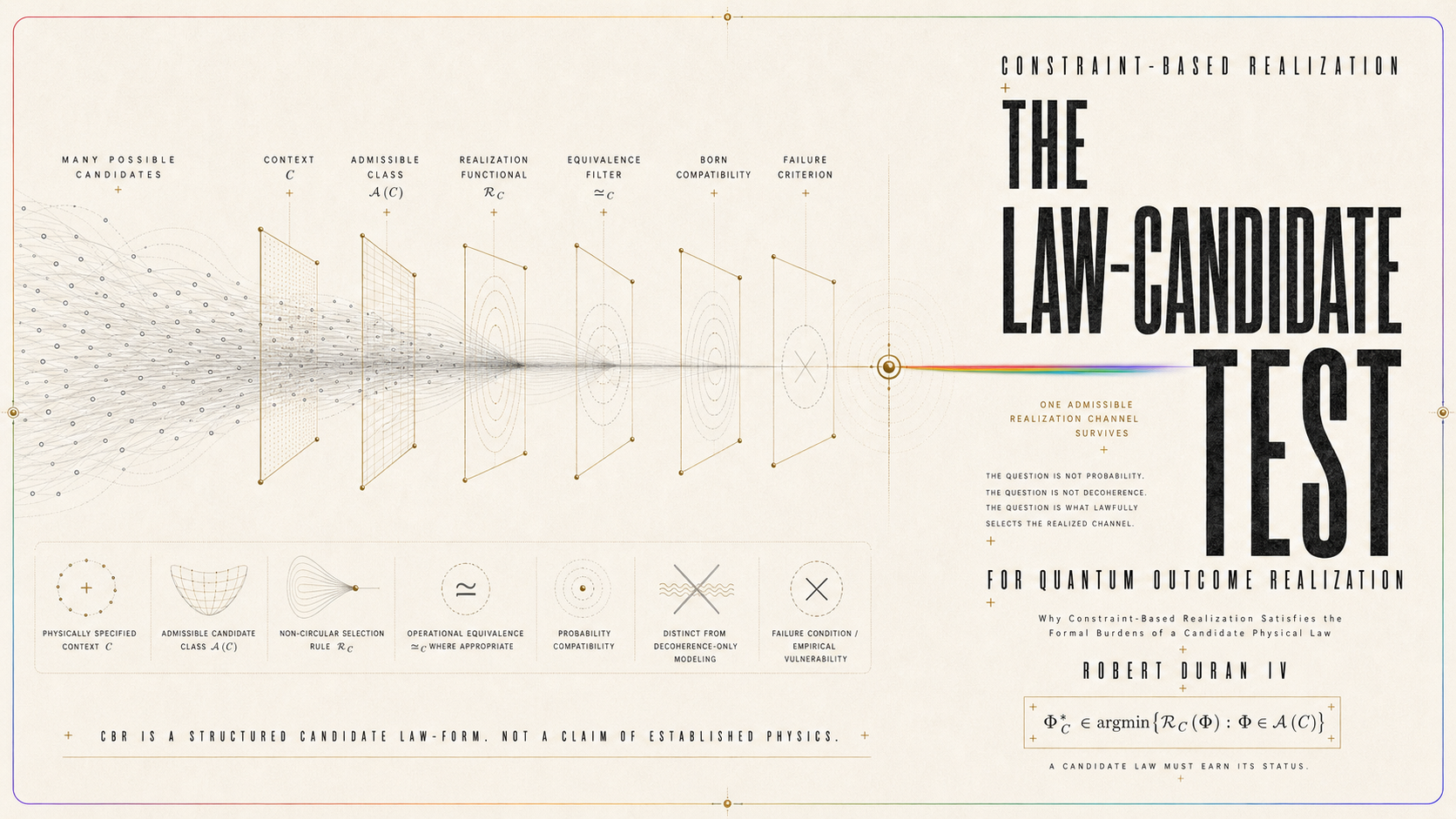
0. Position of the Paper
This paper develops Constraint-Based Realization, or CBR, as a candidate physical law of quantum outcome realization. Its aim is not to claim that CBR is experimentally established, nor to claim that it has already become accepted physics. The aim is narrower and more precise: to determine whether CBR satisfies the formal burdens that any serious candidate law of outcome realization must face.
The central problem is not whether quantum mechanics predicts measurement statistics. It does. The relevant question is whether a physical theory of measurement must also specify how one admissible outcome becomes the realized outcome in an individual measurement context. CBR is proposed as a candidate answer to that question.
The position of this paper is therefore conditional and structural. If quantum outcome realization requires a physical law, and if such a law must specify its domain, candidate realizations, admissibility conditions, non-circular selection rule, determinate selection condition, probability compatibility, distinction from decoherence-only modeling, and empirical vulnerability, then CBR qualifies as a serious law-candidate.
This paper does not attempt to prove that nature obeys CBR. It attempts to show that CBR clears the threshold for a disciplined candidate physical law of outcome realization.
0.1 What is being claimed
The claim defended here is:
CBR is a structured candidate physical law of quantum outcome realization.
This means that CBR is not presented merely as an interpretive attitude toward measurement, a metaphor about constraints, or a restatement of decoherence. It is presented as a proposed law-form with identifiable formal components:
a physically specified measurement context C,
an admissible class of candidate realization channels 𝒜(C),
a context-indexed realization functional ℛ_C,
a selected realization channel Φ∗_C,
an operational equivalence relation ≃_C,
a probability-compatibility requirement,
and a failure condition.
The proposed selection form is:
Φ∗C = argmin{Φ ∈ 𝒜(C)} ℛ_C(Φ),
where selection is understood up to operational equivalence when appropriate.
The central thesis is not that this law-form is already confirmed. The central thesis is that this is the kind of structure a candidate law of outcome realization must possess if it is to be physically assessable rather than merely interpretive.
0.2 What is not being claimed
Several claims are explicitly not made.
First, this paper does not claim that CBR is experimentally established. The framework remains a candidate law until its formal structure survives scrutiny and its empirical consequences are tested.
Second, this paper does not claim that the final form of ℛ_C is closed for every possible measurement context. A candidate law may have a canonical form without every applied functional being fully specified in all domains.
Third, this paper does not claim that all rival interpretations are false. Copenhagen-type approaches, decoherence-based accounts, Everettian approaches, epistemic interpretations, and collapse theories address the measurement problem in different ways and under different commitments. The present paper does not attempt to refute them wholesale. Its narrower claim is that any framework seeking to supply a physical law of single-outcome realization inherits specific burdens.
Fourth, this paper does not claim that probability assignment by itself is outcome selection. The Born rule supplies the operational weighting of outcomes. The question addressed here is whether there is also a physical law governing which admissible outcome-channel becomes realized in an individual context.
Fifth, this paper does not claim metaphysical uniqueness stronger than required. The relevant target is operational uniqueness: determinacy of the realized channel up to distinctions physically available in the measurement context.
0.3 The burden-based strategy
The paper proceeds by defining a Law-Candidate Test for quantum outcome realization. This test is not introduced as a rhetorical device, but as a burden structure. A proposed physical law of realization must do more than describe the existence of measurement outcomes. It must specify what is being selected, from which admissible candidates, by what non-circular rule, under what determinacy condition, with what probability compatibility, with what distinction from already available dynamics, and with what failure condition.
CBR is then evaluated against this burden structure.
The strongest defensible result of the paper is:
If a physical law of quantum outcome realization is required, and if such a law must satisfy the Law-Candidate Test defined below, then CBR qualifies as a serious candidate physical law of outcome realization.
This does not establish that CBR is true. It establishes that CBR has the structure required to be seriously tested, criticized, developed, or rejected as a candidate law.
0.4 Why this framing matters
A framework that cannot fail is not yet a physical law-candidate. A framework that cannot specify its candidate set has no well-defined selection problem. A framework that selects by assuming the selected outcome is circular. A framework that cannot recover or accommodate the Born-rule structure is incompatible with quantum statistics. A framework that merely redescribes decoherence without additional selection content or empirical vulnerability does not supply an independent law of realization.
The purpose of this paper is to make these burdens explicit and then show how CBR addresses them.
This framing is deliberately conservative. It does not ask the reader to accept CBR as established physics. It asks the reader to judge whether CBR is formulated with enough precision, restraint, and vulnerability to count as a candidate physical law.
1. The Missing Problem: Outcome Selection
Quantum mechanics provides a successful formalism for the evolution of quantum states and for the statistical weighting of measurement outcomes. For a system prepared in a state ψ, expanded in an appropriate basis as ψ = ∑ᵢ αᵢeᵢ, the Born rule assigns outcome probabilities proportional to │αᵢ│². This probability calculus is empirically indispensable.
Yet probability assignment is not the same question as outcome selection.
The measurement problem, in the sense relevant here, concerns the transition from a structured set of possible outcomes to one realized outcome in an individual measurement context. A probability distribution tells us how outcomes are weighted across trials. It does not, by itself, specify the physical law by which one admissible outcome-channel becomes actual in a particular trial.
CBR targets that missing selection question.
1.1 Three distinct questions
The problem is clarified by separating three questions that are often conflated.
First:
What outcomes are possible?
This question concerns the structure of the quantum state, the measurement basis, and the physical context in which measurement is performed.
Second:
How are possible outcomes statistically weighted?
This question concerns the probability rule, operationally captured by the Born rule.
Third:
What physically selects the outcome that becomes actual in an individual measurement context?
This is the outcome-selection question.
CBR is not proposed as a replacement for the first question. It does not deny the formal structure of quantum states. CBR is also not proposed as a replacement for the second question. It must remain compatible with standard quantum probabilities. Rather, CBR is directed at the third question: the physical realization of one outcome-channel from an admissible set.
The distinction is essential:
Probability is not selection.
Decoherence is not selection.
Observer update is not selection.
Branching avoids unique selection.
Collapse asserts selection.
CBR attempts to formulate selection as a constraint-governed physical law.
1.2 Probability is not realization
A probability rule assigns weights to possible outcomes. It may be exact, empirically confirmed, and mathematically indispensable while still leaving open the question of realization.
For example, the expression W(α)=│α│² identifies the weighting of an outcome amplitude. It does not by itself specify the physical rule by which one outcome-channel becomes realized rather than another in a single measurement context. If probabilities are interpreted purely operationally, this may be sufficient for prediction. If the target is a physical account of outcome realization, it is not sufficient.
The claim is not that quantum mechanics fails predictively. The claim is that a physical law of realization, if required, must address a different object: not the distribution over outcomes alone, but the selection of the realized outcome-channel.
1.3 Decoherence is not sufficient selection for the present target
Decoherence explains why interference between certain alternatives becomes suppressed and why stable records can emerge through environmental interaction. It is central to any serious account of measurement. CBR does not reject this role.
However, decoherence by itself describes dynamical suppression and record stabilization. It does not, without additional interpretive or physical commitments, specify which admissible channel is realized as the single actual outcome. A decohered reduced state may encode the practical inaccessibility of interference between branches or records, but CBR’s target is the additional question of realization: which channel becomes physically actual in the context C?
CBR therefore treats decoherence as part of the physical background that any adequate theory must respect, not as identical to the selection law itself.
A CBR proposal fails as an independent law-candidate if its realization structure reduces entirely to decoherence-only modeling with no independent selection content, no admissibility-restricted candidate class, no operational uniqueness condition, and no empirical vulnerability. This failure possibility is not incidental. It is part of the burden the framework accepts.
1.4 Observer update is not physical selection
In epistemic or agent-centered interpretations, measurement may be treated as an update in information, belief, or expectation. Such accounts may be coherent for their purposes. But an observer update is not the same as a physical law of outcome realization.
CBR’s target is not the rule by which an observer changes expectations after receiving data. It is the rule by which a physical outcome-channel becomes realized in the measurement context. Therefore, any account that treats outcome occurrence primarily as an update in description does not address the target in the same way unless it also supplies a physical selection structure.
1.5 Branching avoids unique selection
Everettian or many-branch approaches preserve unitary evolution by treating multiple outcomes as realized in a branching structure. This strategy may avoid collapse and preserve the quantum dynamics, but it does not supply a law selecting one unique realized outcome at the fundamental level. It changes the target: instead of explaining why one outcome becomes actual, it denies that only one outcome is fundamentally actual.
CBR is not competing with branching on the same terms. CBR is a single-realization law-candidate. Its burden is to explain how determinate outcome realization can be law-governed without merely assuming collapse or relying on observer update.
1.6 Collapse asserts selection
Collapse theories directly address the single-outcome problem by introducing physical collapse mechanisms or stochastic modifications to quantum dynamics. These are genuine physical approaches to outcome selection.
CBR shares with collapse approaches the view that the single-outcome question is physically substantive. Its difference is that it attempts to formulate selection through admissible realization channels and constraint structure, rather than by postulating an unconstrained collapse event. CBR therefore inherits a difficult burden: it must specify how constraints select without smuggling in the selected result and without reducing to ordinary decoherence.
1.7 The CBR target
CBR begins from the following claim:
A physical theory of outcome realization must explain how one admissible outcome-channel becomes actual in an individual measurement context.
This target can be stated more formally.
Let C be a physically specified measurement context. Let 𝒜(C) be the admissible class of realization-compatible channels in that context. Let ℛ_C be a realization functional over 𝒜(C). The CBR selection question is:
Which Φ ∈ 𝒜(C) becomes the realized channel Φ∗_C, and by what non-circular physical rule?
CBR proposes that the answer is given by constraint-governed minimization of realization burden:
Φ∗C = argmin{Φ ∈ 𝒜(C)} ℛ_C(Φ),
with uniqueness understood up to operational equivalence ≃_C when exact channel identity is stronger than the physical context requires.
1.8 Proposition: Selection is a distinct burden
Proposition.
A framework that assigns probabilities to possible measurement outcomes has not, solely by doing so, supplied a physical law of outcome realization. A candidate law of realization must additionally specify the admissible alternatives and the physical rule by which one alternative becomes realized in an individual context.
Proof sketch.
A probability assignment maps possible outcomes to weights. A selection law maps a physically specified context and admissible candidate set to a realized outcome-channel or operational equivalence class of channels. These are formally different functions. The first may determine statistical expectation across trials. The second determines actualization in a single context. Therefore, probability assignment alone does not define a selection rule unless additional structure is supplied that identifies how one candidate is realized.
What this establishes.
This establishes the conceptual independence of the outcome-selection burden. It justifies treating CBR as addressing a problem not exhausted by probability assignment.
What this does not establish.
This does not prove that CBR is the correct selection law. It also does not prove that every interpretation must accept the single-realization target. It establishes only that, for any framework that does seek a physical law of single-outcome realization, probability assignment alone is insufficient.
2. The Law-Candidate Test
A proposed law of quantum outcome realization must be evaluated by burdens appropriate to a physical law-candidate. It is not enough for such a proposal to offer a suggestive interpretation, a useful analogy, or an after-the-fact description of observed outcomes. A candidate law must specify what it applies to, what it selects among, how selection occurs, why the selection is determinate, how the proposal remains compatible with quantum probabilities, how it differs from existing dynamics, and how it can fail.
This section defines the Law-Candidate Test used throughout the paper.
The test is not designed to prove CBR true. It is designed to determine whether CBR has the formal structure required to qualify as a serious candidate physical law of outcome realization.
2.1 L1. Domain
A candidate law must specify the physical domain in which it applies.
For CBR, the domain is the class of physically specified measurement contexts C. A context C is not merely a label for an observable. It is the physical architecture in which measurement occurs: system, apparatus, environment, timing relations, record-bearing degrees of freedom, accessibility structure, and constraint set.
A law with no domain cannot be evaluated. It is unclear where it applies, what it governs, or what would count as a counterexample. Therefore, domain specification is the first burden.
For CBR, the relevant domain is not “all possible events” and not “all quantum evolution.” It is outcome realization in measurement contexts where candidate realization-compatible channels can be defined.
What this establishes.
L1 establishes that a candidate realization law must be indexed to physical contexts rather than abstractly applied to outcomes without specifying the measurement architecture.
What this does not establish.
L1 does not establish that all physical contexts admit a CBR selection rule. It only states that any serious law-candidate must define the domain in which its rule is intended to operate.
2.2 L2. Candidate Set
A candidate law must specify what possible realizations are being selected among.
For CBR, the candidate set is 𝒜(C), the admissible class of realization-compatible channels in context C. The elements of 𝒜(C) are not arbitrary mathematical maps. They are candidate channels that satisfy physical admissibility constraints.
Without a candidate set, selection is undefined. A law cannot select unless it specifies the alternatives over which selection occurs. If the candidate set is unconstrained, the theory becomes too permissive. If the candidate set is defined after the outcome is known, the theory becomes circular.
Therefore, L2 requires that the candidate set be physically specified prior to selection.
What this establishes.
L2 establishes that outcome realization must be formulated as selection over a defined space of alternatives.
What this does not establish.
L2 does not establish that 𝒜(C) has been fully characterized in every measurement context. It establishes the burden that any realization law must meet: it must say what is being selected among.
2.3 L3. Admissibility Conditions
A candidate law must specify which candidates are physically allowed.
For CBR, admissibility conditions determine membership in 𝒜(C). These conditions include physical implementability, context compatibility, record consistency, accessibility compatibility, operational invariance, refinement stability, non-circularity, and nontriviality.
This burden is distinct from selection. Admissibility determines what may enter the selection problem. The realization functional ℛ_C then ranks admissible candidates. Confusing admissibility with selection risks circularity.
A theory without admissibility conditions either selects from too broad a class or hides its restrictions informally. A theory whose admissibility conditions encode the selected outcome has not solved the selection problem; it has presupposed it.
What this establishes.
L3 establishes that the selection problem must be physically constrained before any minimization or selection rule is applied.
What this does not establish.
L3 does not establish that CBR’s proposed admissibility conditions are final. It establishes that such conditions are necessary for any law-candidate and that CBR explicitly accepts this burden.
2.4 L4. Non-Circular Selection Rule
A candidate law must specify how the realized outcome is selected without assuming the answer.
For CBR, the selection rule is expressed by the minimization of ℛ_C over 𝒜(C):
Φ∗C = argmin{Φ ∈ 𝒜(C)} ℛ_C(Φ).
This rule is non-circular only if 𝒜(C) and ℛ_C can be specified before Φ∗_C is known. The selected channel cannot be built into the admissible class, hidden inside the functional, or smuggled into the notation through observer report.
Non-circularity is one of the central burdens of any candidate law of realization. A post-hoc description may correctly describe the observed outcome, but it does not provide a physical selection law.
What this establishes.
L4 establishes the anti-circularity standard that CBR must meet: the rule must select the outcome rather than encode the outcome.
What this does not establish.
L4 does not prove that every proposed ℛ_C is non-circular. It establishes the criterion by which any proposed ℛ_C must be judged.
2.5 L5. Operational Uniqueness
A candidate law must explain why selection is determinate, at least up to operational equivalence.
For CBR, the target is not unrestricted metaphysical uniqueness. The target is operational uniqueness: uniqueness of the realized channel at the level of distinctions physically available in context C.
Define Φ₁ ≃_C Φ₂ when no admissible record, accessible statistic, or context-preserving observation distinguishes Φ₁ from Φ₂ in C. The relevant selected object is therefore not necessarily a bare channel Φ∗_C, but an equivalence class [Φ∗_C] under ≃_C.
CBR’s uniqueness burden is to show that, under sufficient context specification and appropriate assumptions on 𝒜(C) and ℛ_C, the minimizer is unique up to ≃_C.
This avoids overclaiming. A physical law of measurement need not distinguish between mathematically distinct representations that make no operational difference in the context. But it must provide determinate actualization at the level where outcome records and accessible statistics are physically meaningful.
What this establishes.
L5 establishes that the relevant determinacy requirement is operational, not metaphysical beyond the context.
What this does not establish.
L5 does not prove uniqueness in every possible context. It identifies the uniqueness condition a CBR theorem must satisfy and the level at which that condition should be interpreted.
2.6 L6. Probability Compatibility
A candidate law of outcome realization must recover or require the standard probability structure of quantum mechanics.
For CBR, probability compatibility is not optional. A realization law that selects outcomes but conflicts with the Born rule is not viable as a candidate completion of quantum measurement. Therefore, CBR must show that its realization structure is compatible with W(α)=│α│² or that quadratic weighting is required under the admissible probability conditions.
The relevant burden is conditional and scoped. The claim need not be that every conceivable interpretive framework is forced into CBR. The relevant claim is that within an operationally acceptable realization-weighting class, physically meaningful probability requires phase insensitivity, refinement consistency, coarse-graining consistency, symmetry, operational invariance, normalization, nontriviality, regularity, and non-circular admissibility. Under those conditions, the weighting rule is forced to the quadratic form.
What this establishes.
L6 establishes that CBR must not ignore the Born-rule burden. Probability compatibility is part of the law-candidate threshold.
What this does not establish.
L6 does not establish experimental confirmation of CBR. It also does not establish unrestricted universality across every possible mathematical framework. It establishes the requirement that any realization law must explain how stable physical probability is retained.
2.7 L7. Non-Reduction
A candidate law must explain why it is not merely a restatement of an already available account.
For CBR, the central non-reduction burden concerns decoherence. Decoherence explains interference suppression and record stability. CBR must show that it adds something distinct: a selection structure over admissible realization-compatible channels, a realization functional, an operational uniqueness condition, and an accessibility-sensitive failure criterion.
If CBR reduces entirely to decoherence-only modeling, then it fails as an independent candidate law. This possibility must be acknowledged rather than avoided.
The relevant standard is:
CBR has independent law-candidate content only if it supplies nontrivial selection structure not reducible to smooth decoherence dynamics alone, or if its accessibility structure yields an empirically distinguishable signature.
What this establishes.
L7 establishes that CBR must earn its distinction from decoherence. It cannot rely on new terminology for familiar dynamics.
What this does not establish.
L7 does not prove that CBR is distinct in every model. It defines the burden CBR must meet to remain an independent law-candidate.
2.8 L8. Empirical Vulnerability
A candidate physical law must specify what would count against it.
For CBR, empirical vulnerability is expressed through accessibility-sensitive failure conditions. A typical form is:
η = I_acc(W;R) / H(W),
V_CBR(η) = V_SQM(η) + L(η).
Here η represents normalized accessible which-path or record information, V_SQM(η) represents the smooth standard quantum/decoherence baseline, and L(η) represents a CBR-specific accessibility contribution. If observed visibility V_obs(η) remains within V_SQM(η) ± Δ_nuisance(η) across the critical region N(η_c), with sensitivity sufficient to detect L(η), then the tested CBR accessibility model is disconfirmed.
The purpose of this condition is not to claim that the experiment has already confirmed CBR. Its purpose is to show that CBR is not insulated from evidence.
What this establishes.
L8 establishes that a law-candidate must be vulnerable to possible defeat. CBR accepts this burden by identifying conditions under which its tested accessibility model would fail.
What this does not establish.
L8 does not establish that the accessibility signature exists. It establishes that CBR can be formulated with an empirical failure condition.
2.9 The Law-Candidate Test
The Law-Candidate Test can now be stated.
Definition.
A framework qualifies as a serious candidate physical law of quantum outcome realization only if it specifies:
L1. Domain.
L2. Candidate Set.
L3. Admissibility Conditions.
L4. Non-Circular Selection Rule.
L5. Operational Uniqueness.
L6. Probability Compatibility.
L7. Non-Reduction.
L8. Empirical Vulnerability.
The test is not a proof of truth. It is a threshold of seriousness. A framework may satisfy the test and still be false. A framework that does not satisfy the test has not yet supplied a serious candidate physical law of outcome realization.
2.10 Proposition: Law-candidate qualification burden
Proposition.
Any framework claiming to be a physical law of quantum outcome realization must satisfy L1–L8 or explain why one of the listed burdens is unnecessary for physical outcome selection.
Proof sketch.
A physical law of realization must apply somewhere, so it requires a domain. It must select something, so it requires a candidate set. It must exclude physically irrelevant or inconsistent candidates, so it requires admissibility. It must select without assuming the selected result, so it requires non-circularity. It must explain determinate actualization, so it requires operational uniqueness or an equivalent determinacy condition. It must remain compatible with observed quantum statistics, so it requires probability compatibility. It must not be a redundant restatement of an existing mechanism, so it requires non-reduction. It must be assessable as physics, so it requires empirical vulnerability. Therefore, the listed burdens are not optional decorations but structural requirements of any candidate law of outcome realization.
What this establishes.
This establishes the evaluative standard of the paper. CBR will be defended by showing how it satisfies these burdens in a unified structure.
What this does not establish.
This does not establish that CBR is true. It does not establish that no other framework can satisfy the same test. It establishes the burden any such framework must meet and prepares the comparison on formal grounds rather than rhetorical preference.
2.11 Transition to the CBR law-form
The remainder of the paper evaluates CBR by this test.
The central question is not whether CBR is already established physics. It is whether CBR possesses the formal structure required of a serious candidate law of outcome realization.
The next step is therefore to state CBR in one formal expression:
Φ∗C = argmin{Φ ∈ 𝒜(C)} ℛ_C(Φ),
with C, 𝒜(C), ℛ_C, Φ∗_C, and ≃_C defined in relation to the Law-Candidate Test.
3. CBR in One Formal Statement
The purpose of this section is to state Constraint-Based Realization in its most compact formal form. The statement is not offered as experimental confirmation. It is offered as the canonical structure of the law-candidate to be evaluated by the Law-Candidate Test.
CBR begins with a physically specified measurement context C. Within C, not every mathematically imaginable map qualifies as a possible realization. The candidate space must be physically constrained. CBR therefore defines an admissible class of realization-compatible channels, denoted 𝒜(C). Each Φ ∈ 𝒜(C) represents a candidate channel through which the measurement context could realize an outcome-compatible record structure.
CBR then introduces a context-indexed realization functional ℛ_C. The value ℛ_C(Φ) represents the realization burden associated with candidate channel Φ in context C. Lower realization burden means stronger compatibility with the full constraint structure of the measurement context.
The CBR law-candidate is then stated as:
Φ∗C = argmin{Φ ∈ 𝒜(C)} ℛ_C(Φ)
when the minimizer exists and is unique up to operational equivalence ≃_C.
Equivalently, when the analysis is performed over operational equivalence classes:
[Φ∗C] = argmin{[Φ] ∈ 𝒜(C)/≃_C} ℛ_C([Φ])
This is the central formal statement of CBR.
In plain language: the actual outcome is the admissible outcome-channel with the least realization burden under the full physical constraint structure of the measurement context.
3.1 Definition: Measurement context
Definition.
A measurement context C is the physically specified structure within which outcome realization is assessed. It includes the system degrees of freedom, apparatus structure, environmental coupling, timing relations, record-bearing degrees of freedom, accessibility conditions, and physical constraints relevant to the candidate realization.
A compact representation is:
C = (S, A, E, T, R, η, 𝒞)
where S denotes the measured system, A denotes the apparatus, E denotes the relevant environment, T denotes timing relations, R denotes record-bearing degrees of freedom, η denotes accessibility structure, and 𝒞 denotes the physical constraint set.
The point of this definition is that C is not merely an observable label. C is the physical architecture in which candidate outcome-channels become admissible, inadmissible, or differently burdened.
What this establishes.
This establishes L1, the domain requirement. CBR applies to physically specified measurement contexts, not to abstract outcome labels detached from physical implementation.
What this does not establish.
This does not establish that every possible context C has already been analyzed. It defines the required object. Applied CBR still requires specifying C in each case with enough physical detail to make admissibility and selection meaningful.
3.2 Definition: Admissible realization class
Definition.
For a measurement context C, 𝒜(C) is the class of realization-compatible channels that satisfy the admissibility requirements of C. Each Φ ∈ 𝒜(C) is a candidate physical channel through which an outcome-compatible record structure could be realized.
In a minimal quantum-channel setting:
Φ: 𝒟(𝓗_C) → 𝒟(𝓗_C)
where 𝓗_C is the Hilbert space relevant to context C and 𝒟(𝓗_C) is the set of density operators on 𝓗_C.
When apparatus and record degrees of freedom are explicit, a channel may instead be represented as:
Φ: 𝒟(𝓗_S) → 𝒟(𝓗_S ⊗ 𝓗_A ⊗ 𝓗_R)
where 𝓗_S is the system Hilbert space, 𝓗_A is the apparatus Hilbert space, and 𝓗_R is the record Hilbert space.
The exact representation depends on the level of modeling, but the burden is invariant: CBR must define a physically admissible candidate class before selection occurs.
What this establishes.
This establishes L2, the candidate-set requirement. CBR does not select from all imaginable outcomes or all formally writable maps. It selects from the physically admissible candidate channels in 𝒜(C).
What this does not establish.
This does not establish that a particular candidate class 𝒜(C) is correct in every application. It establishes that a candidate physical law of realization must provide such a class and that CBR makes this class explicit.
3.3 Definition: Realization functional
Definition.
For a context C, the realization functional ℛ_C is a context-indexed functional over the admissible realization class:
ℛ_C: 𝒜(C) → ℝ ∪ {∞}
The value ℛ_C(Φ) is the realization burden of Φ in C.
The use of ∞ permits the formal representation of channels that may be syntactically describable but physically disqualified by the context. In many applications, such channels will already be excluded from 𝒜(C). The notation allows both exclusion and infinite burden to be treated consistently.
The realization functional is not a probability rule. It does not assign trial frequencies. It ranks admissible candidate channels by their compatibility with the physical constraints of realization in C.
What this establishes.
This establishes L4 in its formal setting. CBR proposes a selection rule through minimization of realization burden. The selected outcome-channel is not chosen by observer report, post-hoc labeling, or direct insertion of the result.
What this does not establish.
This does not establish that every candidate expression for ℛ_C is non-circular or physically adequate. It establishes the structural role ℛ_C must play. Later sections specify constraints required for ℛ_C to be acceptable.
3.4 Definition: Operational equivalence
Definition.
Two admissible realization channels Φ₁, Φ₂ ∈ 𝒜(C) are operationally equivalent in context C, written Φ₁ ≃_C Φ₂, if no admissible record, accessible statistic, or context-preserving observation within C distinguishes Φ₁ from Φ₂.
Operational equivalence is necessary because exact mathematical identity may be too strong for a physical law of realization. A measurement context may contain representational redundancies or channel descriptions that differ formally while producing the same physically accessible record structure.
The object of selection is therefore best understood as an operational equivalence class [Φ∗_C], not always as a bare channel distinguished beyond the physical resolution of C.
What this establishes.
This establishes the appropriate interpretation of L5, operational uniqueness. CBR’s determinacy burden is not metaphysical uniqueness beyond all possible descriptions. It is uniqueness of realized structure up to physically meaningful distinctions in C.
What this does not establish.
This does not prove operational uniqueness in every context. It defines the equivalence relation needed for a non-overclaimed uniqueness theorem.
3.5 Definition: CBR law-candidate
Definition.
Given a physically specified measurement context C, an admissible class 𝒜(C), a realization functional ℛ_C, and an operational equivalence relation ≃_C, CBR proposes that the realized outcome-channel is selected by:
[Φ∗C] = argmin{[Φ] ∈ 𝒜(C)/≃_C} ℛ_C([Φ])
when the minimizing equivalence class exists and is unique.
If the minimizer is represented by a particular channel Φ∗_C, then:
Φ∗C = argmin{Φ ∈ 𝒜(C)} ℛ_C(Φ)
with the understanding that any operationally equivalent representative belongs to the same selected physical realization.
This is the central law-candidate form.
3.6 Proposition: Formal law-form sufficiency
Proposition.
A framework satisfies the minimal formal law-form burden for outcome realization if it specifies a domain C, a candidate class 𝒜(C), a selection functional ℛ_C, and a selected object Φ∗_C or [Φ∗_C] determined by a non-circular rule over admissible candidates. CBR satisfies this formal burden at the level of candidate structure.
Proof sketch.
A physical selection law must apply to some domain, select from some candidate space, and provide a rule that determines the selected object. CBR specifies the domain as measurement contexts C, the candidate space as 𝒜(C), the selection rule as minimization of ℛ_C, and the selected object as Φ∗_C or [Φ∗_C]. Therefore, CBR has the minimal formal structure required of a candidate selection law.
What this establishes.
This establishes that CBR is not merely a verbal interpretation. It has the formal skeleton of a law-candidate: domain, candidate set, selection rule, and selected result.
What this does not establish.
This does not establish that the law is true. It does not establish that ℛ_C is uniquely fixed in all contexts. It does not establish empirical confirmation. It establishes only that CBR clears the minimal formal-structure threshold required for further evaluation.
3.7 Corollary: CBR is not probability assignment alone
Corollary.
Because CBR selects Φ∗_C by minimizing ℛ_C over 𝒜(C), it is not identical to assigning probabilities W(α)=│α│² over outcomes.
Proof sketch.
Probability weighting assigns a measure over possible outcomes or components. CBR’s selection rule acts over admissible realization-compatible channels in a physically specified context. These are distinct formal operations. Probability compatibility is required, but it does not replace selection.
What this establishes.
This clarifies that CBR is aimed at outcome realization, not merely at rewriting probability.
What this does not establish.
This does not show that CBR’s selection rule is empirically correct. It only distinguishes the type of rule CBR proposes from ordinary probability assignment.
4. Domain and Candidate Set
The first two burdens of the Law-Candidate Test require a proposed realization law to specify its domain and candidate set. These requirements are basic but decisive. A law without a domain cannot be tested or applied. A selection rule without a candidate set cannot select.
CBR addresses these burdens through the pair C and 𝒜(C). The domain is the physically specified measurement context C. The candidate set is the admissible class of realization-compatible channels 𝒜(C).
4.1 Domain: physically specified measurement contexts
CBR does not propose a free-floating rule over abstract outcome labels. It proposes a rule over physical measurement contexts.
A context C includes the elements relevant to outcome realization:
S: the measured system.
A: the apparatus.
E: the relevant environment.
T: the timing relations.
R: the record-bearing structure.
η: the accessibility structure.
𝒞: the physical constraint set.
This representation is not intended to impose a single universal modeling format. It is intended to make explicit what a law of realization must not ignore. A measurement context is not exhausted by a basis choice or an observable name. It is the physical arrangement in which certain channels become possible, others impossible, and still others differentially burdened.
CBR therefore treats measurement as physically situated. The same formal state written in isolation may correspond to different realization problems under different apparatus structures, record conditions, accessibility relations, and timing constraints.
4.2 Why C is not merely an observable label
An observable label may identify what is being measured in a conventional formal description. But a law of outcome realization requires more.
For example, two experiments may be associated with the same nominal observable but differ in detector architecture, environmental coupling, record preservation, timing, or accessibility of which-path information. These differences may not be irrelevant to realization. If outcome realization depends on the full physical constraint structure, then the measurement context C must include the features that determine admissibility and burden.
This is why CBR distinguishes the observable from the context.
The observable may specify a measurement target. The context specifies the physical conditions under which realization occurs.
4.3 Candidate set: admissible realization-compatible channels
Given C, CBR defines 𝒜(C), the admissible class of realization-compatible channels.
The expression 𝒜(C) is central. It means that candidate outcomes are not treated as unstructured labels. They are represented by candidate channels capable of producing outcome-compatible record structures in the measurement context.
This moves the problem from:
Which outcome label appears?
to:
Which physically admissible realization-channel becomes actual in C?
This reframing is important because it prevents CBR from treating outcome selection as an arbitrary selection among abstract possibilities. Selection occurs over a constrained physical class.
4.4 Candidate channels and physical implementability
A candidate channel Φ ∈ 𝒜(C) must be physically meaningful. In standard quantum information language, this ordinarily requires complete positivity and trace preservation, or an explicitly controlled trace-accounting structure for conditioned processes.
In the simplest case:
Φ: 𝒟(𝓗_C) → 𝒟(𝓗_C)
For a record-explicit measurement model:
Φ: 𝒟(𝓗_S) → 𝒟(𝓗_S ⊗ 𝓗_A ⊗ 𝓗_R)
The exact map depends on the modeling level, but the candidate must be compatible with the physical measurement context. A formally writable map that violates context compatibility, record structure, or physical implementability does not qualify as a realization candidate.
4.5 Candidate set before selection
The candidate class 𝒜(C) must be specified before the selected channel Φ∗_C is identified.
This requirement is not merely procedural. It is necessary for non-circularity. If 𝒜(C) is defined by first observing the outcome and then admitting only channels compatible with that outcome, the theory has not selected the outcome. It has renamed it.
Therefore:
𝒜(C) must be defined from C, not from Φ∗_C.
The physical context may include apparatus structure, record relations, accessibility, and constraints. It may not include the selected outcome as an input to the candidate set.
4.6 Proposition: Domain and candidate-set requirement
Proposition.
Any physical law of quantum outcome realization must specify a domain of application and a candidate set prior to selection. For CBR, these are C and 𝒜(C), respectively.
Proof sketch.
A physical law cannot be evaluated without knowing the situations to which it applies. This requires a domain. A selection law cannot select without specifying the alternatives under consideration. This requires a candidate set. CBR identifies the domain as physically specified measurement contexts C and the candidate set as admissible realization-compatible channels 𝒜(C). Therefore, CBR satisfies the domain and candidate-set requirements of the Law-Candidate Test at the structural level.
What this establishes.
This establishes that CBR is not an unconstrained claim that “one outcome happens.” It is a selection framework indexed to physical contexts and defined over a candidate channel class.
What this does not establish.
This does not establish that 𝒜(C) is easy to compute in all cases. It does not establish that every context has a unique selected channel. It establishes only that CBR supplies the objects required for a meaningful selection problem.
4.7 Corollary: No selection without candidate restriction
Corollary.
A proposed law of outcome realization that lacks a physically defined candidate set cannot distinguish law-governed selection from arbitrary assignment.
Proof sketch.
If no candidate set is defined, any selected outcome can be described as having been selected from an unspecified class. Such a description has no physical content because no alternatives were fixed prior to selection. By contrast, once 𝒜(C) is specified, selection becomes a constrained problem over a defined space.
What this establishes.
This supports the need for admissibility. The next section specifies what restricts 𝒜(C).
What this does not establish.
This does not show that CBR’s particular admissibility conditions are exhaustive. It shows that some physically meaningful admissibility conditions are required.
5. Admissibility Conditions
Admissibility is the mechanism by which CBR avoids arbitrary selection. It determines which candidate channels may enter the realization problem. Without admissibility, the candidate set 𝒜(C) is unconstrained. With admissibility, CBR selects only among channels that satisfy the physical requirements of the measurement context.
Admissibility is not the same as selection. Admissibility determines which channels may be considered. The realization functional ℛ_C ranks admissible channels. The selected channel Φ∗_C is then obtained by minimizing ℛ_C over 𝒜(C), subject to operational uniqueness.
This distinction is essential. If admissibility itself selects the outcome, the theory risks circularity. If admissibility is too weak, the selection problem becomes physically underdetermined.
5.1 Definition: Admissibility
Definition.
A realization-compatible channel Φ is admissible in context C if Φ satisfies the physical, structural, operational, and non-circularity conditions required for membership in 𝒜(C).
Formally:
𝒜(C) = {Φ : Φ satisfies A1–A8 in C}
The admissibility conditions A1–A8 are not arbitrary embellishments. They specify the minimum burdens a physical candidate must meet before it can be ranked by ℛ_C.
What this establishes.
This defines 𝒜(C) as a physically constrained class rather than an unrestricted set of maps.
What this does not establish.
This does not prove that A1–A8 are final or complete for every possible application. It establishes a disciplined admissibility baseline for the law-candidate.
5.2 A1. Physical implementability
A1. Physical implementability.
A candidate channel Φ must be a legitimate quantum operation in the modeling regime used for C. In ordinary channel language, this means complete positivity and trace preservation, unless the model explicitly uses a conditioned or trace-accounted subspace.
This condition excludes formally writable transformations that cannot represent physical processes. CBR is not selection over arbitrary functions. It is selection over physically meaningful candidate channels.
Physical implementability is a minimal requirement. A law of outcome realization cannot be built from candidates that are not physically realizable even in principle.
5.3 A2. Context compatibility
A2. Context compatibility.
A candidate channel Φ must respect the apparatus, environment, timing, record architecture, accessibility conditions, and constraint structure specified by C.
This condition prevents a candidate channel from solving the realization problem by ignoring the physical setup. A channel admissible in one context may be inadmissible in another. Context compatibility is therefore not optional; it is the way CBR makes measurement physically situated.
5.4 A3. Record consistency
A3. Record consistency.
A candidate channel Φ must generate or preserve record structures compatible with the outcome it purports to realize.
Measurement is not merely a transition in an abstract state. It involves record-bearing degrees of freedom. If Φ realizes an outcome but produces records incompatible with that outcome, then Φ is not a valid realization candidate in C.
Record consistency also prevents arbitrary outcome labeling. A channel cannot count as realizing an outcome unless its record structure supports that realization.
5.5 A4. Accessibility compatibility
A4. Accessibility compatibility.
A candidate channel Φ must respect the accessibility structure η of the measurement context.
Accessibility concerns which outcome-relevant or which-path records are physically available, unavailable, erased, delayed, or conditionally reconstructible. A candidate channel that treats inaccessible information as accessible, or accessible information as physically irrelevant, may misrepresent the context.
This condition is especially important because accessibility is one bridge between the formal law-candidate and empirical vulnerability. If CBR predicts accessibility-dependent behavior, then admissible channels must encode accessibility correctly.
5.6 A5. Operational invariance
A5. Operational invariance.
Admissibility must not depend on arbitrary labels, descriptions, or representational choices that make no operational difference in C.
If two candidate descriptions are related by a context-preserving re-description, their admissibility status should not change merely because the notation changes. A law of realization must be physically invariant, not notation-dependent.
Operational invariance also supports the use of ≃_C. The theory should not distinguish candidates beyond the distinctions physically available in the measurement context.
5.7 A6. Refinement and coarse-graining stability
A6. Refinement and coarse-graining stability.
Admissibility must remain stable under legitimate refinements or coarse-grainings of the description.
If a candidate is admissible only because the system is described at one arbitrary scale, but becomes inadmissible under an equivalent refinement with no physical change, then admissibility is representation-dependent. Conversely, if coarse-graining changes admissibility without physical justification, the selection problem becomes unstable.
This condition is also central to probability compatibility. A realization law must not generate different probability or selection behavior merely because the same physical context is decomposed differently.
5.8 A7. Non-circularity
A7. Non-circularity.
Admissibility cannot assume the selected outcome.
This is one of the most important requirements. The admissible class 𝒜(C) must be definable from the physical context C and the general admissibility rules, not from knowledge of Φ∗_C.
The following are not permitted as admissibility criteria:
the already-realized outcome,
observer report as primitive actualization,
Born probability used as a direct selection postulate,
or a hidden label that encodes the answer.
Non-circularity does not mean admissibility ignores records. It means admissibility cannot use the selected outcome as an input. Record structure may constrain candidate channels, but the identity of the selected channel cannot be presupposed.
5.9 A8. Nontriviality
A8. Nontriviality.
The admissible class 𝒜(C) must be nonempty and must exclude at least some physically inconsistent candidates.
If 𝒜(C) is empty, the theory cannot apply. If 𝒜(C) includes every conceivable map, admissibility has done no physical work. Nontriviality requires that the admissible class be neither vacuous nor unrestricted.
This condition gives CBR a failure mode. If ordinary measurement contexts cannot generate a nonempty, physically meaningful 𝒜(C), then CBR fails in those contexts. If 𝒜(C) is too broad to support determinate selection, the theory remains incomplete.
5.10 Proposition: Admissibility necessity
Proposition.
Any candidate physical law of quantum outcome realization must define admissibility conditions for candidate realizations. Without admissibility, the selection problem is either undefined, arbitrary, or circular.
Proof sketch.
A selection law requires alternatives. If the alternatives are unrestricted, selection has no physical constraint. If the alternatives are chosen after the outcome is known, selection is circular. If the alternatives are physically impossible, selection lacks physical meaning. Therefore, a realization law must specify conditions under which candidate realizations are physically admissible prior to selection. CBR does this through 𝒜(C) and A1–A8.
What this establishes.
This establishes that admissibility is not a dispensable detail. It is a necessary component of any law-candidate for outcome realization.
What this does not establish.
This does not establish that A1–A8 are the only possible admissibility conditions. It does not establish that they are sufficient in every context. It establishes that CBR has a structured admissibility framework and that such a framework is required for non-arbitrary selection.
5.11 Corollary: Admissibility is not realization
Corollary.
Admissibility alone does not select the realized outcome-channel. It only defines the candidate class over which selection may occur.
Proof sketch.
A channel Φ may satisfy A1–A8 and therefore belong to 𝒜(C), while still not be the selected channel Φ∗_C. Selection requires applying ℛ_C to the admissible class. Therefore, admissibility and realization are distinct stages.
What this establishes.
This protects CBR from collapsing admissibility into post-hoc outcome selection. The admissible class is fixed prior to selection; ℛ_C performs the ranking.
What this does not establish.
This does not prove that the ranking functional ℛ_C is adequate. It prepares the ground for evaluating ℛ_C as the next burden.
5.12 Failure modes at the admissibility stage
CBR can fail at the admissibility stage in several ways.
First, 𝒜(C) may be under-specified. If the candidate class cannot be defined with sufficient clarity, selection cannot proceed.
Second, 𝒜(C) may be circular. If the selected outcome is built into admissibility, the law has not selected anything.
Third, 𝒜(C) may be too broad. If inadmissible or physically irrelevant maps remain in the candidate class, ℛ_C may be forced to rank candidates that should never have entered the problem.
Fourth, 𝒜(C) may be empty in contexts where measurement plainly occurs. If CBR cannot define viable candidates in ordinary measurement settings, the framework fails or requires revision.
Fifth, admissibility may be unstable under refinement. If equivalent re-description changes the candidate class without physical justification, the selection rule becomes representation-dependent.
These failure modes are not weaknesses to be hidden. They are part of what makes CBR evaluable as a candidate law. A framework that specifies how it can fail is more scientifically disciplined than one that cannot be tested at the level of its own definitions.
5.13 Transition to non-circular selection and ℛ_C
Admissibility defines what may be selected. It does not determine what is selected.
The next burden is therefore the selection rule itself. CBR proposes that selection is governed by the realization functional ℛ_C. For this to be physically meaningful, ℛ_C must be non-circular, context-indexed, operationally invariant, and capable of supporting determinate selection up to ≃_C.
The next sections examine these requirements.
6. Non-Circular Selection
A candidate law of outcome realization must select the realized outcome without presupposing the outcome it claims to select. This is the central non-circularity burden. If the admissible class 𝒜(C) is defined by reference to the already-realized outcome, or if the realization functional ℛ_C ranks candidates by using the selected result as an input, then the framework has not supplied a law of realization. It has only redescribed the result after the fact.
CBR therefore requires a strict separation between the physical specification of the selection problem and the identity of the selected channel. The measurement context C, the admissible class 𝒜(C), the operational equivalence relation ≃_C, and the realization functional ℛ_C must be definable before the selected channel Φ∗_C is identified.
This requirement is not merely methodological. It is constitutive of the law-candidate claim. CBR is defensible as a candidate physical law only if the selection rule is prior to the selected result.
6.1 The circularity danger
The strongest objection to any realization law is that it may secretly encode the outcome.
A circular realization theory has the following structure:
The outcome is observed.
The candidate set is defined so that only that outcome can qualify.
The selection rule then “selects” the already-encoded result.
Such a framework has no genuine selection content. It may be descriptively accurate after the fact, but it does not explain realization.
CBR avoids this only if the objects entering the law-form are specified independently of the selected channel:
C is specified by the physical measurement architecture.
𝒜(C) is specified by admissibility conditions.
ℛ_C is specified by physical realization burden.
≃_C is specified by operational indistinguishability within C.
Only after these are fixed may Φ∗_C be identified.
6.2 Definition: Non-circular realization law
Definition.
A proposed realization law is non-circular in context C only if the admissible class 𝒜(C), the realization functional ℛ_C, and the operational equivalence relation ≃_C can be specified without reference to the identity of the selected channel Φ∗_C.
Equivalently, a realization law is non-circular only if:
𝒜(C), ℛ_C, and ≃_C are fixed prior to evaluating Φ∗C = argmin{Φ ∈ 𝒜(C)} ℛ_C(Φ).
What this establishes.
This definition specifies the anti-circularity standard CBR must satisfy. It prevents the theory from defining the outcome into the admissible class or into the ranking functional.
What this does not establish.
This definition does not prove that every proposed application of CBR is non-circular. It gives the criterion by which each application must be evaluated.
6.3 Permitted inputs to selection
A non-circular CBR selection rule may depend on the physical structure of the measurement context.
Permitted inputs include:
the system degrees of freedom S,
the apparatus structure A,
environmental coupling E,
timing relations T,
record-bearing degrees of freedom R,
accessibility structure η,
the physical constraint set 𝒞,
admissibility conditions A1–A8,
and realization-functional requirements R1–R7.
These are permitted because they specify the physical context in which selection is to occur. They define the realization problem. They do not, by themselves, identify the selected outcome.
The selected channel must emerge from the evaluation of admissible candidates under ℛ_C. It cannot be inserted into the construction of 𝒜(C) or ℛ_C.
6.4 Prohibited inputs to selection
A non-circular realization law may not use the selected result as an input.
The following are prohibited as primitive inputs to 𝒜(C) or ℛ_C:
the already-realized outcome,
a final observer report treated as primitive actualization,
a hidden label that encodes which outcome is selected,
a Born-weighted draw treated as the selection law itself,
or a candidate class defined by retaining only the channel corresponding to the observed result.
This does not mean that records are irrelevant. Records are part of the physical context. A channel must be record-consistent to be admissible. But record consistency is not the same as using the already-selected outcome as an input. The admissibility condition may require that candidate channels produce coherent records. It may not use the final record to decide retroactively which candidate was admissible.
6.5 Proposition: Non-circular selection condition
Proposition.
CBR satisfies the non-circular selection condition in a context C only if 𝒜(C), ℛ_C, and ≃_C are definable from C and the admissibility/functional constraints prior to identifying Φ∗_C.
Proof sketch.
CBR selects according to:
Φ∗C = argmin{Φ ∈ 𝒜(C)} ℛ_C(Φ).
If 𝒜(C) or ℛ_C depends on Φ∗_C as an input, then the minimization does not determine Φ∗_C; Φ∗_C has already been encoded. In that case, the selection rule is circular. If, instead, 𝒜(C), ℛ_C, and ≃_C are fixed by the physical context and admissibility constraints before the minimization is performed, then Φ∗_C is obtained by applying the rule to a pre-specified candidate structure. Therefore, pre-selection definability of 𝒜(C), ℛ_C, and ≃_C is necessary for non-circular CBR selection.
What this establishes.
This establishes the formal anti-circularity burden for CBR. It states exactly what must be true for CBR to count as a selection law rather than a post-hoc description.
What this does not establish.
This does not prove that all possible CBR models satisfy the condition. It establishes the requirement. A specific model may still fail if its candidate set or functional is defined in a way that smuggles in the selected result.
6.6 Corollary: Born weighting cannot serve as primitive selection
Corollary.
Within CBR, W(α)=│α│² may serve as a probability-compatibility condition or a derived realization-weighting result, but it cannot serve as the primitive selection rule for Φ∗_C.
Proof sketch.
The Born rule assigns probability weights to possible outcomes. If CBR uses Born weighting directly as the primitive rule selecting the actual outcome in a single measurement context, then selection is replaced by probabilistic sampling. That may reproduce statistical behavior, but it does not define the physical realization rule over 𝒜(C). CBR may require compatibility with W(α)=│α│², and it may attempt to show that quadratic weighting is forced within an admissible realization-weighting class. But the selection law itself remains the context-indexed minimization of ℛ_C over 𝒜(C), not a bare probability draw.
What this establishes.
This preserves the distinction between probability compatibility and outcome selection. It prevents CBR from collapsing into a restatement of the Born rule.
What this does not establish.
This does not derive the Born rule. It only states that Born weighting cannot be used as a primitive substitute for the realization law.
6.7 Corollary: Observer report cannot serve as primitive realization
Corollary.
Within CBR, observer report may be part of the record structure R, but it cannot be treated as the primitive fact that determines Φ∗_C.
Proof sketch.
If observer report is treated as primitive actualization, then the theory identifies the outcome by appeal to the reported result rather than by a physical selection law. CBR may include observer-accessible records as part of the measurement context, but those records must be modeled as physical record-bearing structures. They cannot replace the selection rule.
What this establishes.
This distinguishes CBR from observer-update accounts and from theories that treat measurement primarily as a change in knowledge.
What this does not establish.
This does not deny the importance of observers or records in measurement practice. It only states that observer report cannot be the primitive selection mechanism in a physical law of realization.
6.8 Failure modes for non-circularity
CBR fails or weakens at the non-circularity stage if any of the following occurs.
First, 𝒜(C) is defined by retaining only channels compatible with the known outcome.
Second, ℛ_C includes a term that directly penalizes all channels except the observed one because it is observed.
Third, the accessibility parameter η is calibrated after the outcome analysis in a way that favors the CBR prediction.
Fourth, the equivalence relation ≃_C is adjusted after selection to remove inconvenient distinctions.
Fifth, Born weighting is inserted as a selection postulate rather than derived or imposed only as a probability-compatibility constraint.
Sixth, record consistency is confused with outcome identity, so that only the actual record is treated as physically possible.
These failure modes are not peripheral. They define the edge of the framework. CBR is a serious law-candidate only to the extent that it avoids them.
6.9 Transition to ℛ_C
Non-circularity requires that the selection rule be fixed before selection. But a non-circular rule may still be arbitrary. The next burden is therefore stronger: ℛ_C must not only avoid encoding Φ∗_C, it must also be constrained by physically meaningful requirements.
The realization functional must be context-indexed, operationally invariant, record-sensitive, accessibility-sensitive, refinement-stable, and capable of supporting determinate selection. The next section defines these requirements.
7. The Realization Functional ℛ_C
The realization functional ℛ_C is the central object that gives CBR its selection-law form. It ranks admissible candidate channels according to their realization burden in a physically specified context C. Without ℛ_C, CBR would have an admissible candidate set but no rule for selecting among candidates. With ℛ_C, the theory proposes a definite law-form:
Φ∗C = argmin{Φ ∈ 𝒜(C)} ℛ_C(Φ).
The functional must be treated carefully. If ℛ_C is arbitrary, the law-candidate is weak. If ℛ_C is circular, the law-candidate fails. If ℛ_C is not operationally invariant, selection may depend on notation rather than physics. If ℛ_C does not respond to record and accessibility structure, it cannot address the measurement context that CBR claims to govern.
The burden of this section is therefore to specify what ℛ_C must be in order to function as a serious realization functional.
7.1 Definition: Realization functional
Definition.
For a physically specified measurement context C and admissible class 𝒜(C), the realization functional is a context-indexed map:
ℛ_C: 𝒜(C) → ℝ ∪ {∞}.
For Φ ∈ 𝒜(C), ℛ_C(Φ) is the realization burden of Φ in C.
A lower value of ℛ_C(Φ) indicates lower burden relative to the physical constraints of C. The selected channel is the admissible channel, or operational equivalence class of channels, minimizing that burden.
What this establishes.
This defines the object that supplies CBR’s selection rule. ℛ_C is not an observer report, not a probability assignment, and not a decoherence parameter alone. It is the proposed ordering functional over admissible realization candidates.
What this does not establish.
This does not establish the final detailed form of ℛ_C in all contexts. It defines the role ℛ_C must play and prepares the requirements it must satisfy.
7.2 R1. Context dependence
R1. Context dependence.
ℛ_C must be indexed to the physical measurement context C.
The burden of realization cannot be evaluated without specifying the context in which realization occurs. Candidate channels are not burdened in isolation. Their admissibility and ranking depend on apparatus structure, environmental coupling, timing, record-bearing degrees of freedom, accessibility, and constraints.
Therefore, CBR does not define a single context-free burden ℛ. It defines ℛ_C.
This requirement prevents a candidate channel from being treated as universally favored or disfavored independent of the measurement architecture. It also ensures that selection is physically situated.
7.3 R2. Operational invariance
R2. Operational invariance.
If two admissible channels Φ₁ and Φ₂ are operationally equivalent in C, then they must have equal realization burden:
If Φ₁ ≃_C Φ₂, then ℛ_C(Φ₁) = ℛ_C(Φ₂).
This requirement ensures that ℛ_C does not distinguish channels where the context provides no physically meaningful distinction. A realization law should not rank representationally different but operationally identical candidates differently.
Operational invariance also protects the law-candidate from notation dependence. If relabeling, basis representation, or redundant channel description changes the burden without changing the physical context, ℛ_C is not physically well-defined.
7.4 R3. Constraint monotonicity
R3. Constraint monotonicity.
Additional physical constraints cannot lower the realization burden of a channel that is incompatible with those constraints.
If a refinement of C adds a genuine physical constraint that conflicts with Φ, then Φ must either become inadmissible or receive a higher realization burden. A channel should not become easier to realize because a constraint is added against it.
This condition is central to the constraint-based character of CBR. The theory’s core claim is that outcome realization is governed by the narrowing force of physical constraints. Constraint monotonicity makes that narrowing formally meaningful.
7.5 R4. Record-consistency sensitivity
R4. Record-consistency sensitivity.
ℛ_C must be sensitive to the consistency between candidate channels and record-bearing structures in C.
If a candidate channel produces records inconsistent with the outcome-channel it purports to realize, it should either be excluded from 𝒜(C) or assigned prohibitive burden. Conversely, channels that preserve coherent record structure may receive lower burden relative to otherwise comparable candidates.
This does not mean that the final observed record is used to select the outcome. Record-consistency sensitivity concerns structural compatibility between candidate channels and possible record architectures. It must be defined before selection.
7.6 R5. Accessibility sensitivity
R5. Accessibility sensitivity.
ℛ_C must be sensitive to the accessibility structure η of the measurement context.
Accessibility concerns the physical availability of outcome-relevant information. In interference-based contexts, this may include which-path accessibility, record recoverability, delayed erasure, or mutual information between path variables and record systems.
If accessibility changes the physical structure of the realization problem, then ℛ_C must be capable of reflecting that change. A functional insensitive to accessibility cannot support CBR’s claimed empirical vulnerability through accessibility-dependent signatures.
This requirement also distinguishes CBR from a merely static selection rule. The burden ordering may change as the record-accessibility structure changes.
7.7 R6. Refinement stability
R6. Refinement stability.
The ordering induced by ℛ_C must be stable under legitimate refinement and coarse-graining of the physical description.
If C and C′ represent the same physical measurement context at different descriptive resolutions, then the burden ordering should not change arbitrarily. Refinement may reveal additional constraints, but it should not produce incompatible selection solely because of representational choice.
This requirement is closely related to probability compatibility. A law of realization cannot be physically meaningful if equivalent descriptions generate incompatible rankings or incompatible weighting behavior.
7.8 R7. Non-circularity
R7. Non-circularity.
ℛ_C cannot contain the selected outcome Φ∗_C as an input.
The functional may depend on physical context, admissibility, record structure, accessibility, invariance, and constraint burden. It may not depend on knowing which channel is selected.
This requirement repeats the core anti-circularity condition at the level of the functional. A non-circular admissible class is not enough if the functional itself encodes the result.
7.9 Definition: Acceptable realization functional
Definition.
A realization functional ℛ_C is acceptable for CBR in context C only if it satisfies R1–R7:
R1. Context dependence.
R2. Operational invariance.
R3. Constraint monotonicity.
R4. Record-consistency sensitivity.
R5. Accessibility sensitivity.
R6. Refinement stability.
R7. Non-circularity.
What this establishes.
This definition specifies the minimum requirements for ℛ_C to serve as a serious realization functional. It prevents ℛ_C from being arbitrary, notation-dependent, record-blind, accessibility-blind, refinement-unstable, or circular.
What this does not establish.
This definition does not supply a final closed-form expression for ℛ_C in every possible context. It establishes the acceptability constraints any such expression must satisfy.
7.10 Proposition: Functional necessity
Proposition.
Any candidate physical law of outcome realization must contain, explicitly or implicitly, a structure functionally equivalent to ℛ_C: an ordering, rule, or constraint relation that ranks or selects admissible candidate realizations in a context.
Proof sketch.
A realization law must select one realized candidate from an admissible set. Selection requires more than the set itself. Either the theory provides an ordering over candidates, a rule eliminating all but one, or a relation that determines the selected candidate. Such a structure is functionally equivalent to ℛ_C, even if it is not written as a real-valued functional. Therefore, any candidate realization law requires some selection-generating structure. CBR makes this structure explicit as ℛ_C.
What this establishes.
This establishes that ℛ_C is not an optional decorative feature. It represents the type of structure any law of outcome realization must provide.
What this does not establish.
This does not prove that CBR’s particular ℛ_C is the only possible selection structure. It establishes that rivals must provide an equivalent selection-generating object or explain why selection can occur without one.
7.11 Proposition: Non-arbitrariness condition
Proposition.
ℛ_C is non-arbitrary only to the extent that its ordering over 𝒜(C) is constrained by physical features of C and by R1–R7.
Proof sketch.
If ℛ_C may assign arbitrary burdens to admissible channels, then minimization of ℛ_C can select any outcome by stipulation. Such a rule has no physical content. If, however, the ordering must respect context dependence, operational invariance, constraint monotonicity, record consistency, accessibility sensitivity, refinement stability, and non-circularity, then the ordering is constrained by the physical structure of C. Therefore, non-arbitrariness requires that ℛ_C be governed by R1–R7.
What this establishes.
This establishes the standard by which ℛ_C must be judged. A proposed realization functional is not acceptable merely because it can be minimized. It must be physically constrained.
What this does not establish.
This does not prove that any particular proposed ℛ_C satisfies R1–R7. It establishes the criteria for evaluating one.
7.12 Candidate decomposition of realization burden
In concrete applications, ℛ_C may be decomposed into terms corresponding to distinct physical burdens. A schematic expression may take the form:
ℛ_C(Φ) = λ_I𝓘_C(Φ) + λ_R𝓡ec_C(Φ) + λ_A𝓐_C(Φ) + λ_D𝓓_C(Φ)
where 𝓘_C(Φ) represents inconsistency burden, 𝓡ec_C(Φ) represents record-structure burden, 𝓐_C(Φ) represents accessibility burden, 𝓓_C(Φ) represents dynamical compatibility burden, and λ_I, λ_R, λ_A, λ_D are nonnegative context-appropriate weights or scaling factors.
This expression is schematic. It should not be treated as the final universal form of ℛ_C. Its purpose is to indicate the kinds of physical terms that an applied realization functional may need to encode.
A fully specified application must define each term, justify its role, calibrate its parameters if used empirically, and show that the resulting ordering satisfies R1–R7.
7.13 What ℛ_C is not
ℛ_C is not the Born rule. Probability compatibility is addressed separately.
ℛ_C is not decoherence alone. Decoherence may contribute to record and dynamical structure, but ℛ_C must also support selection over admissible channels.
ℛ_C is not observer report. It cannot take the already-reported outcome as primitive input.
ℛ_C is not a hidden variable unless supplemented by additional ontological commitments. As formulated here, it is a context-indexed burden functional over admissible realization-compatible channels.
ℛ_C is not established physics. It is the formal selection object in the candidate law.
7.14 Failure modes for ℛ_C
CBR fails or weakens at the level of ℛ_C if any of the following occur.
First, ℛ_C is arbitrary, allowing any desired outcome to be selected by stipulation.
Second, ℛ_C is circular, using Φ∗_C or the observed outcome as an input.
Third, ℛ_C violates operational invariance, ranking physically indistinguishable candidates differently.
Fourth, ℛ_C is insensitive to record structure in contexts where record formation is essential.
Fifth, ℛ_C is insensitive to accessibility while the theory claims accessibility-dependent effects.
Sixth, ℛ_C is unstable under legitimate refinement or coarse-graining.
Seventh, ℛ_C reduces entirely to a decoherence parameter while claiming independent selection content.
These failure modes make the proposal evaluable. They also show why the functional requirements are not cosmetic.
7.15 Transition to operational uniqueness
A non-circular and physically constrained ℛ_C provides an ordering over admissible candidates. But an ordering alone is not sufficient. A candidate law of realization must also explain determinate selection.
The next burden is operational uniqueness: under what conditions does minimization of ℛ_C over 𝒜(C) yield a unique realized channel, at least up to operational equivalence?
8. Operational Uniqueness
The defining burden of any single-outcome realization law is determinacy. It is not enough to define candidate channels or to assign them realization burdens. The theory must explain why one realization becomes actual in the relevant physical sense.
CBR addresses this through operational uniqueness. The target is not unrestricted metaphysical uniqueness across all possible descriptions. The target is uniqueness of the selected realization-channel up to operational equivalence within the measurement context C.
This is the correct level of claim for a law-candidate. It avoids two errors. It avoids underclaiming, where selection remains indefinite. It also avoids overclaiming, where the theory asserts distinctions beyond what the physical context can support.
8.1 Definition: Operational equivalence
Definition.
For Φ₁, Φ₂ ∈ 𝒜(C), Φ₁ and Φ₂ are operationally equivalent in context C, written Φ₁ ≃_C Φ₂, if no admissible record, accessible statistic, accessibility relation, or context-preserving observation in C distinguishes Φ₁ from Φ₂.
The equivalence class of Φ under ≃_C is denoted [Φ].
What this establishes.
This defines the level at which uniqueness is required. CBR need not distinguish representationally different channels if they are physically indistinguishable in C.
What this does not establish.
This does not prove that a unique equivalence class exists. It defines the equivalence relation needed to state a uniqueness theorem without overclaiming.
8.2 Definition: Operational uniqueness
Definition.
CBR achieves operational uniqueness in context C if the minimization of ℛ_C over 𝒜(C) yields a unique operational equivalence class [Φ∗_C]:
[Φ∗C] = argmin{[Φ] ∈ 𝒜(C)/≃_C} ℛ_C([Φ]).
Operational uniqueness is therefore uniqueness over physically distinguishable candidate realization classes, not necessarily uniqueness of a particular mathematical representative.
What this establishes.
This states the determinacy condition CBR must meet. The realized outcome-channel is determinate at the level of operationally meaningful structure.
What this does not establish.
This does not prove that all measurement contexts satisfy the assumptions needed for operational uniqueness. It identifies the target condition.
8.3 Conditions supporting operational uniqueness
Operational uniqueness requires more than minimization. The minimization problem must be well-defined and sufficiently separating.
The following conditions are sufficient for a standard theorem-level formulation.
First, the quotient candidate space 𝒜(C)/≃_C must be sufficiently well-behaved for minimization. A common sufficient condition is compactness or an appropriate finite/discrete structure.
Second, ℛ_C must be lower semicontinuous or otherwise minimizer-admitting on 𝒜(C)/≃_C.
Third, ℛ_C must separate operationally inequivalent minimizers. If two inequivalent classes have the same minimal burden, selection is not unique unless additional physical refinement resolves the degeneracy.
Fourth, the context C must be sufficiently specified. Under-specified contexts may generate artificial degeneracies that disappear when apparatus, record, timing, or accessibility conditions are included.
These conditions are not claims that every context automatically satisfies uniqueness. They are the assumptions under which CBR’s operational uniqueness theorem can be stated.
8.4 Theorem: Operational uniqueness
Theorem.
Let C be a sufficiently specified measurement context. Let 𝒜(C) be the admissible class of realization-compatible channels satisfying A1–A8. Let ≃_C be operational equivalence in C. Let ℛ_C be an acceptable realization functional satisfying R1–R7. Suppose 𝒜(C)/≃_C is compact or otherwise minimizer-admitting, ℛ_C is lower semicontinuous or otherwise minimizer-admitting, and ℛ_C strictly separates operationally inequivalent minimizers. Then CBR selects a unique realized channel up to operational equivalence:
[Φ∗C] = argmin{[Φ] ∈ 𝒜(C)/≃_C} ℛ_C([Φ]).
Proof sketch.
Because 𝒜(C)/≃_C is minimizer-admitting and ℛ_C is lower semicontinuous or otherwise minimizer-admitting, at least one minimizing equivalence class exists. Suppose there are two distinct minimizing classes [Φ₁] and [Φ₂]. If [Φ₁] ≠ [Φ₂], then Φ₁ and Φ₂ are operationally inequivalent. By strict separation of operationally inequivalent minimizers, ℛ_C cannot assign the same minimal value to both. This contradicts the assumption that both are minimizing classes. Therefore, the minimizer is unique up to ≃_C.
What this establishes.
This establishes that CBR can support determinate selection under explicit assumptions. It shows that operational uniqueness is not merely asserted; it follows when the admissible class, equivalence relation, realization functional, and separation conditions are fixed.
What this does not establish.
This does not establish that every physical measurement context satisfies the theorem’s assumptions. It does not prove CBR experimentally true. It does not establish metaphysical uniqueness beyond operational equivalence. It establishes a conditional uniqueness result appropriate to the law-candidate threshold.
8.5 Corollary: No arbitrary actualization under theorem conditions
Corollary.
Under the assumptions of the operational uniqueness theorem, CBR does not select an outcome arbitrarily. The selected realization class is determined by the minimization of ℛ_C over the admissible quotient class 𝒜(C)/≃_C.
Proof sketch.
If the theorem’s assumptions hold, there exists a unique minimizing equivalence class. Since the class is determined by 𝒜(C), ℛ_C, and ≃_C, selection is constrained by the physical context and realization burden rather than by arbitrary choice.
What this establishes.
This strengthens the claim that CBR is a law-candidate rather than a metaphor. It provides a formal route from context and admissibility to determinate selection.
What this does not establish.
This does not establish that the selected class matches observed outcomes in nature. Empirical comparison remains required.
8.6 Degenerate cases
Degenerate cases must be treated explicitly. A theory that hides degeneracy overclaims.
Suppose two or more channels minimize ℛ_C.
There are four possibilities.
First, the minimizers are operationally equivalent. Then there is no physical ambiguity at the level of C. The selected object is the equivalence class [Φ∗_C].
Second, the minimizers are operationally inequivalent, but C is under-specified. In this case, the degeneracy may reflect missing physical information. Refining C by specifying apparatus details, timing, accessibility, or record structure may restore uniqueness.
Third, the minimizers are operationally inequivalent and no physically justified refinement resolves the tie. In this case, CBR does not yet provide determinate selection for that context. The theory must either introduce an additional non-circular physical constraint or abstain.
Fourth, ordinary measurement contexts systematically produce unresolved inequivalent minimizers. In that case, CBR fails as a general law of outcome realization unless revised.
This degeneracy protocol is essential. It prevents the framework from pretending uniqueness where uniqueness has not been earned.
8.7 Proposition: Degeneracy discipline
Proposition.
CBR remains non-arbitrary in degenerate cases only if it treats unresolved inequivalent minimizers as under-specification, abstention, or failure rather than selecting among them by stipulation.
Proof sketch.
If two operationally inequivalent candidates have equal minimal burden and no physical refinement distinguishes them, choosing one by stipulation would reintroduce arbitrary selection. A law-candidate must either show that the candidates are equivalent, refine the context non-circularly, identify an additional physical constraint, or acknowledge failure in that domain. Therefore, disciplined handling of degeneracy is required for CBR to remain non-arbitrary.
What this establishes.
This establishes that CBR has a principled response to degeneracy. It does not treat every tie as automatically solved.
What this does not establish.
This does not prove that degeneracies will be rare or resolvable in all important contexts. It states the rule for handling them without overclaiming.
8.8 Operational uniqueness and the measurement problem
Operational uniqueness is where CBR most directly engages the single-outcome burden.
A probability rule can weight outcomes without selecting one. Decoherence can suppress interference without identifying a unique realized channel. Observer update can describe information change without supplying a physical selection law. Branching can avoid single-outcome selection by treating multiple outcomes as real. Collapse can assert selection by adding a collapse event.
CBR’s proposal is different. It attempts to derive determinate realization from a constrained minimization structure over admissible channels.
This is why operational uniqueness is central to the law-candidate test. Without it, CBR would remain an organized description of constraints. With it, CBR becomes a candidate law-form for outcome selection.
8.9 Failure modes for operational uniqueness
CBR fails or weakens at the uniqueness stage if any of the following occurs.
First, 𝒜(C)/≃_C does not admit a minimizer in ordinary measurement contexts.
Second, ℛ_C admits multiple inequivalent minimizers with no non-circular refinement or additional physical constraint.
Third, uniqueness depends on observer labeling rather than physical structure.
Fourth, uniqueness is obtained by inserting the selected outcome into ℛ_C or 𝒜(C).
Fifth, operational equivalence is defined so broadly that genuine physical distinctions are erased.
Sixth, operational equivalence is defined so narrowly that representational redundancies become false physical differences.
These risks are serious. They define the theorem’s boundaries.
8.10 Transition to probability compatibility
Operational uniqueness addresses determinate selection. It does not by itself address statistical weighting across repeated trials or ensembles. A candidate law of realization must also remain compatible with the Born-rule structure.
The next burden is therefore probability compatibility: how CBR can preserve or recover W(α)=│α│² without using it as a primitive selection postulate and without circularly encoding the desired probability rule.
9. Probability Compatibility and Quadratic Weighting
A candidate physical law of quantum outcome realization must remain compatible with the statistical structure of quantum mechanics. It cannot merely select outcomes while leaving probability unexplained, arbitrary, or inconsistent with observed quantum statistics. For CBR, this means that the law-form must be compatible with the Born-rule structure and must not use the Born rule as a disguised selection postulate.
This section distinguishes two burdens.
The first burden is selection: which admissible outcome-channel becomes realized in a particular context C?
The second burden is probability compatibility: how are repeated realizations or admissible outcome weights related to the amplitudes of the quantum state?
CBR addresses selection through the minimization of ℛ_C over 𝒜(C). It addresses probability compatibility through a separate admissibility burden on realization-weighting rules. The two burdens are connected, but they are not identical.
Probability is not selection. A probability law may describe outcome frequencies without identifying the physical rule selecting one realization in a single context. Conversely, a selection rule cannot be viable if it conflicts with the probability structure that quantum mechanics empirically requires.
9.1 The probability burden
Let a state be written in an admissible outcome decomposition as:
ψ = ∑ᵢ αᵢeᵢ
A general realization-weighting framework may assign probabilities of the form:
Pᵢ = W(αᵢ) / ∑ⱼ W(αⱼ)
where W is a weighting function over amplitudes or amplitude-dependent quantities.
The probability burden is to determine what W may be if the resulting probabilities are to retain stable physical meaning under admissible transformations of the description. CBR cannot simply choose W arbitrarily. Nor can it treat W(α)=│α│² as a hidden primitive unless that status is openly stated. For a law-candidate, the stronger route is to show that quadratic weighting is forced by the structural requirements of physically meaningful realization probability.
9.2 Definition: Realization-weighting rule
Definition.
A realization-weighting rule is a function W assigning nonnegative weights to amplitude contributions in an admissible decomposition ψ = ∑ᵢ αᵢeᵢ, producing normalized probabilities:
Pᵢ = W(αᵢ) / ∑ⱼ W(αⱼ)
The rule is operationally acceptable only if its resulting probabilities are invariant or stable under the admissible transformations that preserve the physical content of the measurement context.
What this establishes.
This defines the probability object relevant to CBR without confusing it with the realization functional ℛ_C. W assigns probability weights. ℛ_C ranks admissible realization channels.
What this does not establish.
This does not derive W(α)=│α│². It defines the class of rules for which a necessity result can be formulated.
9.3 Operational acceptability conditions
A physically meaningful realization-weighting rule must satisfy constraints strong enough to prevent arbitrary probability assignment. The following conditions define the admissible theorem class for the quadratic-weighting result.
First, phase insensitivity.
Probability weights must not depend on global or locally irrelevant phase information when that phase does not change the physically relevant outcome contribution.
Second, admissible refinement consistency.
If an outcome contribution is decomposed into admissible refinements, the probability assigned to the coarse outcome must equal the sum of the probabilities assigned to the refined sub-outcomes.
Third, coarse-graining consistency.
If refined alternatives are recombined into a physically meaningful coarse outcome, the total assigned probability must be preserved.
Fourth, symmetry.
Physically symmetric amplitude contributions must receive equal weights.
Fifth, operational invariance.
Probability assignments must not change under physically irrelevant re-description of the same measurement context.
Sixth, normalization.
The probabilities over the admissible outcome set must sum to one.
Seventh, nontriviality.
The weighting rule must not collapse all nonzero amplitudes into identical or physically meaningless assignments unless the context demands it.
Eighth, regularity.
The weighting rule must be sufficiently well-behaved to avoid pathological discontinuities or representation-dependent jumps not grounded in physical structure.
Ninth, non-circular admissibility.
The admissible decomposition and weighting rule cannot be defined by first assuming the desired probability result.
These conditions are not presented as conveniences. They are the conditions under which probability can retain stable physical meaning in a realization framework.
9.4 Proposition: Probability acceptability
Proposition.
A realization-weighting rule W is operationally acceptable only if it preserves stable probability assignments under phase-insensitive representation, admissible refinement, coarse-graining, symmetry, operational re-description, normalization, nontriviality, regularity, and non-circular admissibility.
Proof sketch.
A probability rule that depends on physically irrelevant phase information is not operationally stable. A rule that changes under admissible refinement or coarse-graining assigns different probabilities to the same physical event under different descriptions. A rule that violates symmetry treats physically equivalent alternatives differently. A rule that violates normalization fails to produce probabilities. A rule that violates non-circularity builds the target probability into its own admissibility assumptions. Therefore, any rule intended to assign physically meaningful realization probabilities must satisfy these acceptability conditions or explain why probability remains meaningful without them.
What this establishes.
This establishes the burden for any probability component of a realization law. It prevents the weighting rule from being arbitrary or description-dependent.
What this does not establish.
This does not yet prove quadratic weighting. It defines the theorem class within which the quadratic necessity result is stated.
9.5 Theorem: Quadratic necessity
Theorem.
Within the operationally acceptable realization-weighting class, W must depend on amplitude modulus and must be additive over squared modulus under admissible refinement. Given regularity and normalization, the unique normalized weighting form is:
W(α) = │α│²
Proof sketch.
Phase insensitivity removes dependence on physically irrelevant phase and restricts W to modulus-dependent structure. Symmetry requires equal weights for physically equivalent contributions. Refinement and coarse-graining consistency require that a coarse outcome’s weight equal the sum of the weights assigned to its admissible refinements. This imposes additivity over the quantity preserved under Hilbert-space norm decomposition, namely squared modulus. Regularity excludes pathological alternatives that satisfy additivity only on restricted or discontinuous domains. Normalization fixes the remaining scale. Therefore, within the operationally acceptable class, W reduces to the normalized quadratic form W(α)=│α│².
What this establishes.
This establishes that quadratic weighting is not an arbitrary addition to CBR within the specified theorem class. If a realization-weighting framework satisfies the stated acceptability conditions, then W(α)=│α│² is forced.
What this does not establish.
This does not prove that CBR is experimentally confirmed. It does not prove unrestricted universality across every conceivable mathematical or interpretive framework. It also does not replace the selection rule Φ∗C = argmin{Φ ∈ 𝒜(C)} ℛ_C(Φ). It establishes a conditional probability-compatibility result within an operationally acceptable theorem class.
9.6 Corollary: Nonquadratic rivals inherit a burden
Corollary.
Any nonquadratic realization-weighting rule must reject at least one operational acceptability condition or restrict the theorem class, and must then explain how probability remains physically meaningful under that rejection or restriction.
Proof sketch.
If W is nonquadratic while the acceptability conditions hold, it contradicts the Quadratic Necessity Theorem. Therefore, a nonquadratic rule must deny or modify at least one condition: phase insensitivity, refinement consistency, coarse-graining consistency, symmetry, operational invariance, normalization, nontriviality, regularity, or non-circular admissibility. Once such a condition is rejected, the rule must explain why probability remains stable and physically meaningful despite that rejection.
What this establishes.
This shifts the burden from preference to structure. The question is not whether one prefers quadratic weighting, but what must be abandoned to avoid it.
What this does not establish.
This does not show that no nonquadratic framework can be constructed. It shows that such a framework must pay an explicit structural cost.
9.7 Relation between W and ℛ_C
The weighting rule W and the realization functional ℛ_C play different roles.
W governs probability compatibility across admissible decompositions or repeated trials.
ℛ_C governs selection among admissible realization-compatible channels in a particular context.
CBR must not collapse these into one another. If W is treated as the primitive selection rule, then CBR becomes probability sampling rather than a physical realization law. If ℛ_C ignores W entirely, then CBR risks incompatibility with quantum statistics. The correct relationship is that ℛ_C supplies the selection-law structure while W supplies the probability-compatibility burden that any viable law must satisfy.
In this sense, quadratic weighting strengthens CBR without replacing its law-form. It shows that the probability side of the proposal is not arbitrary within the admissible theorem class.
9.8 Failure modes for probability compatibility
CBR fails or weakens at the probability stage if any of the following occurs.
First, W(α)=│α│² is inserted as a primitive selection postulate rather than justified as a probability-compatibility result.
Second, the admissible theorem class is defined in a way that secretly assumes quadratic weighting.
Third, refinement or coarse-graining changes probabilities without physical justification.
Fourth, nonquadratic alternatives are dismissed without identifying the acceptability condition they violate.
Fifth, ℛ_C generates selection behavior incompatible with Born-rule statistics across repeated trials.
Sixth, the framework confuses probability compatibility with empirical confirmation of CBR.
These failure modes matter because probability is one of the hardest burdens for any law of outcome realization. CBR becomes stronger only if it treats this burden explicitly and conditionally.
9.9 Transition to non-reduction
Probability compatibility addresses one necessary condition of a realization law. It does not by itself distinguish CBR from existing accounts of measurement. A framework may be probability-compatible and still reduce to a restatement of decoherence or another already available structure.
The next burden is therefore non-reduction: CBR must explain what it adds beyond decoherence-only modeling and under what conditions it would fail to remain distinct.
10. Non-Reduction to Decoherence
A serious CBR law-candidate must distinguish itself from decoherence-only modeling. This requirement is not rhetorical. Decoherence is an indispensable part of modern quantum measurement theory. It explains the dynamical suppression of interference between certain alternatives and the emergence of stable record structures through system-environment interaction. Any candidate law of outcome realization that ignores decoherence is incomplete.
CBR does not reject decoherence. It treats decoherence as part of the physical structure that any adequate measurement account must respect. The question is whether decoherence alone supplies the law of single-outcome realization targeted by CBR.
CBR’s answer is no, but this answer must be defended carefully. It is not enough to say that CBR uses different language. The framework must show that it contains distinct law-candidate structure: an admissible class of realization-compatible channels, a realization functional, an operational uniqueness condition, and an empirical failure criterion.
10.1 What decoherence explains
Decoherence explains why interference terms become suppressed relative to environmental degrees of freedom and why certain record structures become effectively stable. It is central to understanding why macroscopic measurement records appear classical and why interference between alternatives becomes practically inaccessible in many contexts.
CBR does not dispute this. Indeed, any plausible realization framework must be compatible with decoherence. Record formation, accessibility, and environmental coupling are all relevant to the context C.
The issue is not whether decoherence is real or important. The issue is whether decoherence alone is the same as a physical selection law for one realized outcome-channel.
10.2 The CBR target beyond decoherence
CBR targets the following question:
Given a physically specified context C and an admissible class 𝒜(C), which realization-compatible channel becomes the realized channel Φ∗_C?
Decoherence may help define the record structure, suppress interference, and constrain admissibility. But decoherence-only modeling does not by itself provide the full CBR law-form:
𝒜(C): a restricted class of admissible realization-compatible channels.
ℛ_C: a realization functional ranking those candidates.
≃_C: an operational equivalence relation.
[Φ∗_C]: a selected realization class.
A failure condition tied to accessibility-dependent behavior.
Therefore, CBR must be evaluated as a proposed selection structure that may incorporate decoherence but is not identical to decoherence unless its additional structures collapse into redundancy.
10.3 Definition: Decoherence-only reduction
Definition.
CBR reduces to decoherence-only modeling in a context C if its candidate class 𝒜(C), realization functional ℛ_C, operational equivalence relation ≃_C, selected channel [Φ∗_C], and failure condition add no selection content beyond the smooth decoherence dynamics and record-stability structure already captured by the standard model of C.
What this establishes.
This defines the reduction risk. It makes clear what would count as CBR failing to be an independent law-candidate in a given context.
What this does not establish.
This does not claim that CBR does reduce to decoherence. It defines the condition under which it would.
10.4 Definition: Non-reduction condition
Definition.
CBR satisfies the non-reduction condition in context C only if at least one of the following holds.
First, CBR supplies a nontrivial selection structure over 𝒜(C) that is not contained in decoherence-only modeling.
Second, CBR’s realization functional ℛ_C imposes a physically meaningful ordering over admissible channels not reducible to the smooth decoherence baseline alone.
Third, CBR yields an accessibility-sensitive empirical burden whose failure or success can be evaluated against a standard quantum/decoherence baseline.
What this establishes.
This defines L7, the non-reduction burden. It specifies how CBR can remain distinct from a rewording of decoherence.
What this does not establish.
This does not prove that CBR satisfies non-reduction in every context. It states the burden and the routes by which the burden may be satisfied.
10.5 Proposition: Non-reduction requirement
Proposition.
CBR fails as an independent candidate law of outcome realization in any context C where its admissible class, realization functional, operational uniqueness condition, and empirical failure criterion reduce entirely to decoherence-only modeling with no additional selection content or testable distinction.
Proof sketch.
A candidate law of outcome realization must supply more than already available dynamical description. If 𝒜(C) is merely the set of decoherence-stabilized outcomes, ℛ_C is merely a restatement of decoherence suppression, operational uniqueness adds no determinacy beyond record stability, and the failure criterion produces no possible distinction from the decoherence baseline, then CBR has not supplied an independent realization law. It has redescribed decoherence. Therefore, non-reduction is required for CBR to remain a distinct law-candidate.
What this establishes.
This establishes that CBR accepts the decoherence-rewording objection as a serious formal burden. The framework must earn distinctness.
What this does not establish.
This does not establish that decoherence-only modeling is false. It does not establish that CBR is correct. It establishes that CBR must either add genuine selection structure or be considered redundant in the context at issue.
10.6 Corollary: Decoherence compatibility is not enough
Corollary.
A CBR model that is merely compatible with decoherence has not yet satisfied the non-reduction burden.
Proof sketch.
Compatibility means that CBR does not contradict decoherence. Non-reduction requires more: CBR must contribute selection structure, functional ordering, operational uniqueness, or empirical vulnerability not already contained in the decoherence-only model. Therefore, decoherence compatibility is necessary but not sufficient.
What this establishes.
This prevents a weak defense of CBR. The framework cannot claim success merely because it agrees with decoherence where decoherence is already successful.
What this does not establish.
This does not imply that CBR should conflict with decoherence. The strongest version of CBR should be compatible with decoherence while adding distinct realization-law content.
10.7 Accessibility as the non-reduction bridge
Accessibility is one way CBR can distinguish itself from decoherence-only modeling. The relevant idea is not that accessibility replaces decoherence. Rather, accessibility may define the regime in which CBR’s realization structure becomes empirically vulnerable.
Let η represent normalized accessible record information:
η = I_acc(W;R) / H(W)
A standard quantum/decoherence baseline may predict smooth visibility behavior:
V_SQM(η) ± Δ_nuisance(η)
A tested CBR accessibility model may introduce a localized realization term:
V_CBR(η) = V_SQM(η) + L(η)
If L(η) is nonzero in a critical region N(η_c), then CBR is not merely restating the baseline. It is making a distinguishable claim. If no such deviation appears under adequate sensitivity, then the tested CBR accessibility model is disconfirmed.
Thus accessibility functions as a bridge between law-form and empirical vulnerability.
10.8 Fair comparison with decoherence
A fair comparison must preserve the strengths of decoherence. Decoherence is not a weak theory. It is a mathematically and experimentally grounded account of interference suppression and record stabilization.
CBR’s claim is narrower. It does not claim that decoherence is wrong. It claims that decoherence alone does not supply the specific law-form CBR targets: a non-circular rule selecting a realized outcome-channel from an admissible class.
If a decoherence-only account is supplemented by an additional rule that supplies admissible alternatives, selection, operational uniqueness, probability compatibility, and failure conditions, then that supplemented account begins to occupy the same burden space as CBR. The comparison should then be made at the level of law-candidate structure, not terminology.
10.9 Failure modes for non-reduction
CBR fails or weakens at the non-reduction stage if any of the following occurs.
First, 𝒜(C) is indistinguishable from a decoherence-defined record set with no independent admissibility structure.
Second, ℛ_C is reducible to a decoherence parameter without additional selection content.
Third, operational uniqueness merely rephrases the existence of stable records.
Fourth, accessibility dependence yields no distinction from smooth decoherence behavior.
Fifth, the proposed failure condition cannot differ from the standard baseline under any physically meaningful test.
Sixth, the framework uses decoherence’s success as evidence for CBR without identifying what CBR adds.
These are serious failure modes. A disciplined CBR presentation must include them.
10.10 Transition to empirical vulnerability
Non-reduction requires CBR to have content beyond decoherence-only modeling. Empirical vulnerability specifies how that content could be tested or disconfirmed.
The next section states the accessibility-based failure condition in a form suitable for a law-candidate paper. The goal is not to claim that CBR has been experimentally verified. The goal is to show that CBR can be exposed to possible defeat.
11. Empirical Vulnerability and Failure Conditions
A candidate physical law must be vulnerable to evidence. If a framework cannot say what would count against it, then it is not yet a serious physical law-candidate. It may be interpretively useful, but it is not empirically disciplined.
CBR therefore requires a failure condition. The law-candidate does not become stronger by avoiding risk. It becomes stronger by specifying how it could fail.
The failure condition considered here is accessibility-based. It compares a standard quantum/decoherence baseline against a tested CBR accessibility model. If the CBR model predicts a deviation from the baseline and the observed data remain within the baseline envelope with adequate sensitivity, then the tested CBR model is disconfirmed in that regime.
This does not disprove every possible CBR variant. It does disconfirm the specified model under the specified conditions. That is the correct level of empirical vulnerability for a candidate law.
11.1 Accessibility parameter
Definition.
The accessibility parameter η represents normalized accessible record information. In a which-path or record-accessibility setting, η may be written as:
η = I_acc(W;R) / H(W)
where W denotes the outcome-relevant or which-path variable, R denotes the record system, I_acc(W;R) denotes accessible mutual information between W and R, and H(W) denotes the entropy of W.
The value η measures how physically available outcome-relevant information is in the context.
What this establishes.
This defines the empirical bridge variable used in the accessibility-based CBR test. It connects record accessibility to measurable information structure.
What this does not establish.
This does not establish that η is easy to calibrate in every experiment. It also does not establish that η alone captures every relevant realization constraint. It defines the parameter for the tested model.
11.2 Standard baseline
Definition.
Let V_SQM(η) denote the standard quantum/decoherence visibility baseline as a function of accessibility η. Let Δ_nuisance(η) denote the total nuisance envelope, including statistical uncertainty, systematic uncertainty, model uncertainty, drift, calibration error, and other controlled non-CBR effects.
The baseline envelope is:
V_SQM(η) ± Δ_nuisance(η)
What this establishes.
This defines the null comparator. CBR must be evaluated against a pre-specified standard baseline, not against an undefined expectation.
What this does not establish.
This does not establish that the baseline is correct in every detail. It establishes the need for a pre-registered comparator against which CBR is tested.
11.3 CBR accessibility model
Definition.
A tested CBR accessibility model introduces a localized realization term L(η) relative to the standard baseline:
V_CBR(η) = V_SQM(η) + L(η)
where L(η) is predicted to be nonzero or structurally distinguishable in a critical accessibility region N(η_c).
A typical critical region may be written:
N(η_c) = [η_c − δ, η_c + δ]
where δ specifies the neighborhood width around the critical accessibility value η_c.
What this establishes.
This gives the tested CBR model empirical content. CBR is not merely saying that accessibility matters in general; it is specifying a deviation structure relative to a baseline.
What this does not establish.
This does not establish that L(η) exists in nature. It defines the form of the tested hypothesis.
11.4 Minimum detectable deviation
For the test to be meaningful, the CBR term must exceed the relevant uncertainty threshold in the critical region. A target condition may be stated as:
│L(η)│ ≥ ε
for at least one η ∈ N(η_c), where ε is the minimum detectable deviation after accounting for Δ_nuisance(η).
This condition prevents unfalsifiable shrinking. If L(η) can be made arbitrarily small after the fact, the model loses empirical discipline. A meaningful test requires that the predicted deviation be fixed before outcome analysis and large enough to be detected under the proposed sensitivity.
11.5 Failure criterion
The empirical failure criterion can be stated as follows.
If V_obs(η) remains within V_SQM(η) ± Δ_nuisance(η) across N(η_c), with sensitivity sufficient to detect the pre-specified L(η), then the tested CBR accessibility model is disconfirmed in that regime.
Equivalently:
If │V_obs(η) − V_SQM(η)│ ≤ Δ_nuisance(η) throughout the relevant critical region, and the experiment had sufficient power to detect │L(η)│ ≥ ε, then the tested CBR model fails.
What this establishes.
This establishes L8, empirical vulnerability. CBR has a possible defeat condition when instantiated as an accessibility-sensitive model.
What this does not establish.
This does not establish that all possible CBR formulations are refuted by one null result unless the tested formulation exhausts the relevant class. It establishes that a specific pre-registered CBR accessibility model can be disconfirmed.
11.6 Proposition: Empirical vulnerability
Proposition.
A CBR accessibility model is empirically vulnerable if it specifies η, V_SQM(η), Δ_nuisance(η), L(η), N(η_c), ε, and a decision rule before outcome analysis, such that a sufficiently sensitive smooth-null result disconfirms the tested model.
Proof sketch.
Empirical vulnerability requires that the model make a prediction distinguishable from the null comparator and that the conditions for failure be fixed before the data are interpreted. If η is calibrated, the baseline and nuisance envelope are specified, the CBR term L(η) is defined, the critical region N(η_c) is fixed, the minimum detectable deviation ε is stated, and a decision rule is pre-specified, then the model can fail. If the data remain within the baseline envelope despite adequate sensitivity, the tested model is disconfirmed. Therefore, such a CBR model is empirically vulnerable.
What this establishes.
This establishes that CBR can be formulated in a way that accepts possible empirical defeat.
What this does not establish.
This does not establish that the accessibility prediction is correct. It does not establish experimental confirmation. It establishes only that the tested model can be meaningfully evaluated.
11.7 Corollary: Interpretive insulation is avoided
Corollary.
A CBR model with a pre-specified accessibility failure condition is not insulated as a purely interpretive framework.
Proof sketch.
A purely interpretive framework may remain compatible with all possible empirical outcomes by construction. A tested CBR accessibility model does not have that structure. It predicts a distinguishable relation between accessibility and visibility relative to a standard baseline. A sufficiently sensitive null result disconfirms the tested model. Therefore, the model is empirically vulnerable rather than interpretively insulated.
What this establishes.
This strengthens the law-candidate status of CBR. A physical law-candidate must be able to lose.
What this does not establish.
This does not imply that every part of the broader CBR program is falsified by any single accessibility test. It establishes vulnerability for the tested model.
11.8 Validity requirements
For the failure condition to be meaningful, several validity requirements must be satisfied.
First, η must be calibrated independently of the outcome analysis.
Second, V_SQM(η) must be specified before testing.
Third, Δ_nuisance(η) must include relevant statistical, systematic, model, drift, and calibration uncertainties.
Fourth, L(η) must be specified before outcome analysis.
Fifth, N(η_c) must be fixed in advance.
Sixth, the experiment must have sufficient sensitivity to detect the predicted effect.
Seventh, rival explanations such as detector artifacts, postselection bias, source instability, drift, or calibration error must be bounded.
Eighth, the decision rule must be fixed before interpreting the result.
Without these validity requirements, a claimed success or failure would not be decisive.
11.9 Failure modes for empirical vulnerability
CBR fails or weakens at the empirical-vulnerability stage if any of the following occurs.
First, η is not operationally calibratable.
Second, the baseline V_SQM(η) is not fixed before analysis.
Third, Δ_nuisance(η) is too loose to permit a meaningful test.
Fourth, L(η) is adjusted after the data are known.
Fifth, N(η_c) is selected post hoc.
Sixth, the predicted deviation is always smaller than experimental sensitivity.
Seventh, the model treats any outcome as compatible with CBR.
Eighth, the accessibility test cannot distinguish CBR from smooth decoherence behavior.
These failure modes are central. They prevent the empirical component from becoming rhetorical rather than testable.
11.10 The role of empirical vulnerability in the law-candidate test
The presence of a failure condition does not make CBR true. It makes CBR assessable.
This distinction matters. A candidate physical law should not be rewarded for avoiding risk. It should be judged by how precisely it states the conditions under which it would fail.
CBR’s accessibility-based failure condition therefore supports the law-candidate threshold. It shows that the framework can be formulated in a way that is not merely interpretive, not merely metaphorical, and not automatically compatible with every possible observation.
11.11 Transition to constructive illustration
The preceding sections have stated the law-form, admissibility conditions, non-circular selection burden, realization functional, operational uniqueness theorem, probability-compatibility requirement, non-reduction condition, and empirical failure criterion.
The next step is to show these components working together in a compact model. A two-outcome toy context can illustrate how CBR organizes the sequence:
C → 𝒜(C) → ℛ_C → [Φ∗_C] → W(α)=│α│² → failure condition.
Such a model does not prove CBR true. It demonstrates the internal architecture of the law-candidate in a form that can be inspected, criticized, and refined.
12. Two-Outcome Toy Model
The preceding sections define CBR as a candidate law-form. A compact toy model can make the structure explicit without claiming empirical confirmation. The purpose of this model is not to prove CBR true. Its purpose is to show how the burdens of the Law-Candidate Test fit together in a simple two-outcome context.
The model uses a state with two possible outcome components:
ψ = α│0⟩ + β│1⟩
where │0⟩ and │1⟩ are outcome-relevant basis states in the measurement context C, and α, β ∈ ℂ with │α│² + │β│² = 1.
A standard probability treatment assigns outcome weights │α│² and │β│². CBR accepts that probability compatibility burden. But the toy model is not merely about probability. It illustrates the separate realization question:
Which admissible outcome-channel becomes the realized channel in this measurement context?
12.1 Measurement context
Let the measurement context be:
C = (S, A, E, T, R, η, 𝒞)
where S is the two-state system, A is the measurement apparatus, E is the relevant environment, T specifies timing relations, R is the record-bearing structure, η is the accessibility structure, and 𝒞 is the physical constraint set.
The context C is not equivalent to the abstract state ψ. The same state ψ may be embedded in different measurement contexts with different apparatus structures, environmental couplings, record conditions, or accessibility relations. CBR treats these contextual features as physically relevant to outcome realization.
12.2 Candidate channels
The simplest candidate realization channels are:
Φ₀: realization-compatible channel associated with outcome │0⟩.
Φ₁: realization-compatible channel associated with outcome │1⟩.
In a record-explicit description, these may be represented schematically as:
Φ₀(ρ_S) → ρ_{S,A,R}^{(0)}
Φ₁(ρ_S) → ρ_{S,A,R}^{(1)}
where ρ_{S,A,R}^{(0)} contains an outcome-compatible record R₀ and ρ_{S,A,R}^{(1)} contains an outcome-compatible record R₁.
This notation is schematic. The model does not assume that Φ₀ and Φ₁ are the only formally writable maps. It assumes only that, after physical admissibility is imposed, these are representative candidates in the simplified two-outcome case.
12.3 Admissible class
The admissible class is:
𝒜(C) = {Φ ∈ candidate channels : Φ satisfies A1–A8 in C}
In the simplified model, suppose that after applying admissibility conditions, the relevant admissible candidates are:
𝒜(C) = {Φ₀, Φ₁}
This means that Φ₀ and Φ₁ are physically implementable, context-compatible, record-consistent, accessibility-compatible, operationally invariant under irrelevant re-description, stable under legitimate refinement and coarse-graining, non-circularly specified, and nontrivial.
The admissible class is fixed before selection. It is not defined by observing whether R₀ or R₁ occurred. If 𝒜(C) were defined after the observed record, the model would be circular.
12.4 Realization functional
Let ℛ_C be an acceptable realization functional:
ℛ_C: 𝒜(C) → ℝ ∪ {∞}
In the two-outcome case:
ℛ_C(Φ₀) = realization burden of Φ₀ in C
ℛ_C(Φ₁) = realization burden of Φ₁ in C
The selected realization channel is:
Φ∗C = argmin{Φ ∈ 𝒜(C)} ℛ_C(Φ)
Thus, if:
ℛ_C(Φ₀) < ℛ_C(Φ₁)
then:
Φ∗_C = Φ₀
If:
ℛ_C(Φ₁) < ℛ_C(Φ₀)
then:
Φ∗_C = Φ₁
If:
ℛ_C(Φ₀) = ℛ_C(Φ₁)
then the degeneracy must be handled by operational equivalence or by further context specification.
12.5 Operational equivalence in the toy model
Operational equivalence is defined by ≃_C.
If Φ₀ ≃_C Φ₁, then no admissible record, accessible statistic, or context-preserving observation in C distinguishes Φ₀ from Φ₁. In that case, equality of burden is not a physical ambiguity. The selected object is an equivalence class:
[Φ∗_C] = [Φ₀] = [Φ₁]
If Φ₀ ≄_C Φ₁ and ℛ_C(Φ₀) = ℛ_C(Φ₁), then the model has an unresolved degeneracy. CBR must not select by stipulation. It must treat the case as one of the following:
the context C is under-specified,
a non-circular physical refinement is required,
an additional admissibility or burden condition is missing,
or the framework fails to determine realization in that context.
This is not a defect of the toy model. It is a necessary discipline. A candidate law is stronger when it states how degeneracy is handled rather than hiding it.
12.6 Probability compatibility in the toy model
Across repeated preparations of the same state and measurement context, probability compatibility requires:
P₀ = W(α) / (W(α) + W(β))
P₁ = W(β) / (W(α) + W(β))
Within the operationally acceptable realization-weighting class, the quadratic necessity result gives:
W(α)=│α│²
W(β)=│β│²
Therefore:
P₀ = │α│²
P₁ = │β│²
This probability structure does not replace the realization rule. It constrains the statistical behavior that any viable realization law must recover or require. The selected channel in a particular context is governed by ℛ_C over 𝒜(C); the ensemble weights are governed by the admissible probability structure.
12.7 Accessibility in the toy model
If the measurement context includes which-path or outcome-record accessibility, define:
η = I_acc(W;R) / H(W)
where W is the outcome-relevant variable and R is the record system.
The standard baseline may be written:
V_SQM(η) ± Δ_nuisance(η)
A tested CBR accessibility model may be written:
V_CBR(η) = V_SQM(η) + L(η)
If CBR predicts a localized realization contribution L(η) near η_c, then the toy model connects the formal selection law to an empirical burden. The model is no longer merely interpretive. It identifies a condition under which the tested accessibility version of CBR could fail.
12.8 The full toy-model sequence
The compact sequence is:
C → 𝒜(C) → ℛ_C → [Φ∗_C] → W(α)=│α│² → failure condition
This sequence is the law-candidate structure in miniature.
First, the physical context C is specified.
Second, the admissible candidate class 𝒜(C) is defined.
Third, the realization functional ℛ_C ranks admissible candidates.
Fourth, the selected realization class [Φ∗_C] is obtained, when operational uniqueness holds.
Fifth, probability compatibility requires quadratic weighting within the admissible theorem class.
Sixth, empirical vulnerability is supplied by a failure condition comparing V_CBR(η) with V_SQM(η) ± Δ_nuisance(η).
12.9 Proposition: Toy-model coherence
Proposition.
In the two-outcome context ψ = α│0⟩ + β│1⟩, CBR coherently satisfies the law-candidate sequence if C, 𝒜(C), ℛ_C, ≃_C, W, and the failure condition are specified prior to outcome analysis and if minimization of ℛ_C yields a unique selected class [Φ∗_C] up to operational equivalence.
Proof sketch.
The context C supplies the domain. The admissible class 𝒜(C) supplies the candidate set. The functional ℛ_C supplies the selection rule. The relation ≃_C defines operational equivalence. The minimization of ℛ_C over 𝒜(C)/≃_C supplies the selected class if uniqueness holds. The weighting rule W(α)=│α│² supplies probability compatibility within the acceptable theorem class. The accessibility failure criterion supplies empirical vulnerability. Therefore, the two-outcome model contains all major components of the Law-Candidate Test.
What this establishes.
This establishes that CBR’s law-candidate structure can be displayed in a compact two-outcome setting. It shows how domain, admissibility, selection, uniqueness, probability compatibility, and failure condition fit together.
What this does not establish.
This does not prove that CBR is true. It does not prove that the toy model captures all features of real measurement. It does not prove that ℛ_C has been fully specified in all contexts. It establishes only that the CBR law-form is internally organizable in a simple case.
12.10 Failure modes in the toy model
The toy model fails to support CBR if any of the following occurs.
First, C is not sufficiently specified to define admissibility.
Second, 𝒜(C) is defined after the outcome is known.
Third, ℛ_C is chosen to force Φ₀ or Φ₁ by stipulation.
Fourth, Φ₀ and Φ₁ remain operationally inequivalent but tied under ℛ_C with no non-circular refinement.
Fifth, probability compatibility is achieved by inserting W(α)=│α│² as a primitive selection rule rather than deriving or requiring it under operational acceptability.
Sixth, the accessibility failure condition cannot distinguish the tested model from smooth decoherence behavior.
These failure modes show why the toy model is not merely illustrative. It is a compact stress test of the framework’s discipline.
13. Rival Burden Framework
The Law-Candidate Test is not designed only for CBR. It is a general burden framework for any proposed physical law of quantum outcome realization. Its value lies in shifting the comparison away from rhetorical preference and toward structural responsibility.
A rival framework may reject CBR. It may reject the need for a single-outcome law. It may interpret measurement differently. But if it claims to provide a physical law of outcome realization, then it inherits the same burdens: domain, candidate set, admissibility, non-circular selection, operational uniqueness, probability compatibility, non-reduction, and empirical vulnerability.
This section states those burdens without attacking rival approaches. The goal is not to declare CBR victorious by assertion. The goal is to clarify what any law-candidate must provide.
13.1 Burden 1: Domain
A rival law-candidate must specify where it applies.
It must answer:
What is the physical context in which the realization law operates?
If the answer is all quantum evolution, the framework must explain why ordinary unitary dynamics is not disrupted in contexts where no measurement-like realization occurs. If the answer is measurement contexts only, the framework must specify what counts as such a context.
CBR’s answer is C: the physically specified measurement context.
13.2 Burden 2: Candidate set
A rival law-candidate must specify what is being selected among.
It must answer:
Are the candidates outcome labels, branches, records, channels, histories, collapse targets, observer states, or something else?
Without a candidate set, selection is undefined. Without a physically constrained candidate set, selection is arbitrary.
CBR’s answer is 𝒜(C): the admissible class of realization-compatible channels.
13.3 Burden 3: Admissibility
A rival law-candidate must specify which candidates are physically allowed.
It must answer:
What excludes physically impossible, context-incompatible, record-inconsistent, or description-dependent candidates?
If the admissible set is unrestricted, the law has no physical discipline. If the admissible set is defined after the selected outcome, the law is circular.
CBR’s answer is A1–A8: physical implementability, context compatibility, record consistency, accessibility compatibility, operational invariance, refinement/coarse-graining stability, non-circularity, and nontriviality.
13.4 Burden 4: Non-circular selection
A rival law-candidate must specify how selection occurs without assuming the selected result.
It must answer:
Can the selection rule be stated before the outcome is known?
If not, the framework is not selecting. It is describing.
CBR’s answer is minimization of ℛ_C over 𝒜(C), with the requirement that 𝒜(C), ℛ_C, and ≃_C be fixed prior to identifying Φ∗_C.
13.5 Burden 5: Operational uniqueness
A rival law-candidate must explain determinate realization.
It must answer:
Why does one outcome become actual, at least at the level of operationally meaningful distinction?
The answer need not be metaphysical uniqueness beyond all representation. But it must be sufficient to distinguish determinate realization from unresolved multiplicity.
CBR’s answer is uniqueness of [Φ∗_C] over 𝒜(C)/≃_C under explicit conditions such as sufficient context specification, minimizer existence, lower semicontinuity or equivalent minimizer-admitting structure, and strict separation of operationally inequivalent minimizers.
13.6 Burden 6: Probability compatibility
A rival law-candidate must recover or require the quantum probability structure.
It must answer:
Why do outcome probabilities follow the Born-rule form?
A framework may derive the rule, assume it as a primitive, or explain why it emerges from a deeper structure. But it cannot ignore it.
CBR’s answer is conditional: within an operationally acceptable realization-weighting class, phase insensitivity, admissible refinement consistency, coarse-graining consistency, symmetry, operational invariance, normalization, nontriviality, regularity, and non-circular admissibility force W(α)=│α│².
13.7 Burden 7: Non-reduction
A rival law-candidate must explain why it is not merely a restatement of an already available account.
For CBR, the relevant risk is reduction to decoherence-only modeling. For another framework, the relevant risk may be reduction to probability assignment, observer update, branch bookkeeping, or collapse by stipulation.
A law-candidate must identify its distinct physical content.
CBR’s answer is that it supplies a selection structure over 𝒜(C), a realization functional ℛ_C, an operational uniqueness condition, and an accessibility-based failure condition not exhausted by smooth decoherence modeling.
13.8 Burden 8: Empirical vulnerability
A rival law-candidate must specify what would count against it.
If no possible observation or formal failure condition can weaken the proposal, then it is not yet a disciplined physical law-candidate.
CBR’s answer is the accessibility-based failure condition:
If V_obs(η) remains within V_SQM(η) ± Δ_nuisance(η) across N(η_c), with sensitivity sufficient to detect L(η), then the tested CBR accessibility model is disconfirmed.
13.9 Proposition: Rival burden inheritance
Proposition.
Any framework claiming to supply a physical law of quantum outcome realization inherits the burdens L1–L8 unless it explicitly rejects the target of single-outcome realization or explains why one or more burdens are unnecessary.
Proof sketch.
A physical law of realization must have a domain, because otherwise it has no application conditions. It must have a candidate set, because otherwise selection is undefined. It must have admissibility, because otherwise physically impossible or irrelevant candidates remain. It must be non-circular, because otherwise it presupposes the result. It must explain determinacy, because realization requires an actual outcome or equivalent structure. It must be probability-compatible, because quantum statistics are empirically constrained. It must avoid reduction to already available descriptions, because otherwise it lacks independent content. It must be vulnerable to failure, because otherwise it is not assessable as a physical law. Therefore, any rival law-candidate inherits L1–L8 or must justify rejecting one of them.
What this establishes.
This establishes that the Law-Candidate Test is not an internal standard invented only for CBR. It is a general burden framework for any physical law of outcome realization.
What this does not establish.
This does not prove that CBR is the only possible framework satisfying L1–L8. It does not refute rival interpretations that reject the single-realization target. It establishes the burdens that apply when a framework claims to provide a physical law of outcome realization.
13.10 CBR’s comparative strength under the burden framework
CBR’s strength is that it places the burdens in one unified structure.
Its domain is C.
Its candidate set is 𝒜(C).
Its admissibility conditions are A1–A8.
Its selection rule is minimization of ℛ_C.
Its determinacy condition is operational uniqueness under ≃_C.
Its probability-compatibility result is W(α)=│α│² within the operationally acceptable theorem class.
Its non-reduction burden is explicitly stated against decoherence-only modeling.
Its empirical vulnerability is expressed through the accessibility failure condition.
This does not make CBR true. It makes CBR structurally serious.
13.11 Corollary: Burden clarity strengthens criticism
Corollary.
A burden framework strengthens criticism of CBR rather than insulating it.
Proof sketch.
If CBR failed to define 𝒜(C), a critic could identify failure at L2 or L3. If ℛ_C were circular, the failure would occur at L4. If operational uniqueness failed, the failure would occur at L5. If quadratic weighting were smuggled in, the failure would occur at L6. If the framework reduced to decoherence-only modeling, the failure would occur at L7. If no failure condition could be stated, the failure would occur at L8. Therefore, the Law-Candidate Test makes the framework more vulnerable to precise criticism.
What this establishes.
This establishes that the burden framework is not protective rhetoric. It is a way of making CBR easier to assess and potentially reject.
What this does not establish.
This does not prove that CBR passes every burden in every context. It clarifies where the framework must continue to be tested and strengthened.
13.12 Avoiding unfair comparison
The burden framework should not be used to misdescribe rival frameworks.
A framework that does not aim to supply a single-outcome realization law should not be criticized for failing to provide one. For example, a branching framework may reject unique selection as the wrong target. An epistemic framework may treat probability and measurement differently. Such frameworks should be evaluated relative to their own aims.
The Law-Candidate Test applies specifically to frameworks claiming to provide a physical law of outcome realization. CBR accepts that burden. Rival frameworks that accept the same target inherit the same test. Rival frameworks that reject the target should be compared at the level of target choice, not accused of failing a burden they deny.
This distinction is important for fairness and precision.
13.13 Transition to the master result
The prior sections have established the components of CBR’s law-candidate structure and the general burden framework. The next step is to state the master result: CBR qualifies as a serious candidate physical law of quantum outcome realization because it satisfies the Law-Candidate Test at the level of formal structure.
The result is not a proof that CBR is true. It is a theorem-level qualification claim. It identifies what CBR has achieved and what remains open.
14. Master Result
The preceding sections establish the central components of the CBR law-candidate structure. The purpose of the master result is to gather those components into one precise claim.
The claim is not that CBR is experimentally established. The claim is not that CBR is the only conceivable candidate law. The claim is that CBR satisfies the formal burdens required to qualify as a serious candidate physical law of quantum outcome realization.
This is the strongest claim the paper can defend without overstatement.
14.1 Definition: Law-candidate qualification
Definition.
A framework qualifies as a serious candidate physical law of quantum outcome realization if it satisfies the following burdens.
L1. It specifies a physical domain of application.
L2. It specifies the candidate set of possible realizations.
L3. It specifies admissibility conditions for candidate realizations.
L4. It provides a non-circular selection rule.
L5. It provides a determinate selection condition, at least up to operational equivalence.
L6. It is compatible with the quantum probability structure or explains why that structure is required.
L7. It avoids reduction to an already available account without added selection content.
L8. It specifies conditions under which the proposal can fail.
What this establishes.
This definition states the qualification threshold. It defines what the master result means by a serious candidate physical law.
What this does not establish.
This definition does not imply truth, confirmation, or uniqueness. A framework can qualify as a serious law-candidate and still be false.
14.2 Theorem: Law-Candidate Qualification of CBR
Theorem.
CBR qualifies as a serious candidate physical law of quantum outcome realization under the Law-Candidate Test, provided its stated objects and conditions are specified non-circularly in the context under consideration.
Proof sketch.
CBR satisfies L1 by defining its domain as physically specified measurement contexts C.
CBR satisfies L2 by defining the candidate set 𝒜(C), the admissible class of realization-compatible channels.
CBR satisfies L3 by imposing admissibility conditions A1–A8, including physical implementability, context compatibility, record consistency, accessibility compatibility, operational invariance, refinement stability, non-circularity, and nontriviality.
CBR satisfies L4 by proposing selection through minimization of ℛ_C over 𝒜(C), with the requirement that 𝒜(C), ℛ_C, and ≃_C be fixed before Φ∗_C is identified.
CBR satisfies L5 conditionally through operational uniqueness: when 𝒜(C)/≃_C is minimizer-admitting, ℛ_C is lower semicontinuous or otherwise minimizer-admitting, and ℛ_C strictly separates operationally inequivalent minimizers, the selected realization class [Φ∗_C] is unique.
CBR satisfies L6 by incorporating the quadratic-weighting necessity result within the operationally acceptable realization-weighting class, yielding W(α)=│α│² under phase insensitivity, refinement consistency, coarse-graining consistency, symmetry, operational invariance, normalization, nontriviality, regularity, and non-circular admissibility.
CBR satisfies L7 by specifying a non-reduction burden: the framework fails as an independent law-candidate if its admissible class, realization functional, operational uniqueness condition, and accessibility-sensitive failure condition reduce entirely to decoherence-only modeling with no additional selection content or testable distinction.
CBR satisfies L8 by specifying an accessibility-based failure condition: if V_obs(η) remains within V_SQM(η) ± Δ_nuisance(η) across N(η_c), with sensitivity sufficient to detect the pre-specified L(η), then the tested CBR accessibility model is disconfirmed.
Therefore, CBR satisfies the formal burdens of the Law-Candidate Test and qualifies as a serious candidate physical law of quantum outcome realization.
What this establishes.
This establishes CBR’s law-candidate status. It shows that CBR is not merely a metaphor, interpretive preference, or rewording of decoherence. It possesses the structural components required of a candidate physical law of realization.
What this does not establish.
This does not establish that CBR is true. It does not establish experimental confirmation. It does not establish that ℛ_C has been finalized in every context. It does not establish that all rival frameworks fail. It establishes that CBR clears the formal threshold for serious law-candidate evaluation.
14.3 Corollary: CBR is criticizable in a structured way
Corollary.
Because CBR satisfies the Law-Candidate Test only through explicit objects and conditions, it can be criticized at precise points rather than rejected or defended globally.
Proof sketch.
If C is under-specified, the failure occurs at L1. If 𝒜(C) is arbitrary or circular, the failure occurs at L2 or L3. If ℛ_C encodes the selected outcome, the failure occurs at L4. If operational uniqueness fails, the failure occurs at L5. If quadratic weighting is smuggled in or not recovered, the failure occurs at L6. If CBR reduces to decoherence-only modeling, the failure occurs at L7. If no empirical failure condition is available, the failure occurs at L8. Therefore, the framework is open to targeted criticism.
What this establishes.
This establishes that CBR’s strength is not immunity from objection. Its strength is that objections can be located precisely.
What this does not establish.
This does not show that all objections have been answered. It shows that the framework is structured enough for serious evaluation.
14.4 Corollary: CBR is not established by qualification
Corollary.
Passing the Law-Candidate Test does not establish CBR as a true law of nature.
Proof sketch.
The Law-Candidate Test assesses whether a framework has the formal burdens required of a serious physical law-candidate. Truth requires additional success: mathematical hardening, model execution, consistency across contexts, empirical comparison, and eventual experimental support. Therefore, qualification is weaker than confirmation.
What this establishes.
This preserves the paper’s scope. It prevents the master result from being overstated.
What this does not establish.
This does not weaken the law-candidate claim. It clarifies that candidate status and established physical law status are different stages.
14.5 Strongest conditional claim
The strongest defensible conclusion is:
If quantum measurement requires a physical law of outcome realization, and if such a law must specify a domain, admissible candidates, non-circular selection, operational uniqueness, probability compatibility, non-reduction, and empirical vulnerability, then CBR is a serious and unusually constrained candidate law-form.
This is a conditional claim. It does not force acceptance of CBR. It states that CBR satisfies the burden structure that such a law-candidate must meet.
14.6 What remains open after the master result
Several issues remain open.
First, applied forms of ℛ_C must be further specified and tested in concrete measurement contexts.
Second, operational uniqueness must be demonstrated in more than schematic examples.
Third, the quadratic-weighting theorem must be checked for hidden assumptions and scope limitations.
Fourth, the non-reduction condition must be sharpened in models where decoherence is already well understood.
Fifth, the accessibility failure condition must be operationalized with sufficient experimental precision.
Sixth, the two-outcome toy model must be extended to richer measurement architectures.
These open issues do not erase the master result. They define the next stage of development.
14.7 Final statement of the master result
CBR clears the law-candidate threshold because it turns the measurement problem into a precise burden structure.
It does not merely say that outcomes occur.
It defines the domain C.
It defines the candidate class 𝒜(C).
It defines admissibility conditions.
It defines a non-circular selection rule through ℛ_C.
It defines operational uniqueness through ≃_C.
It incorporates probability compatibility through W(α)=│α│² within the admissible weighting class.
It states a non-reduction burden relative to decoherence-only modeling.
It specifies an empirical failure condition.
On that basis, CBR should be evaluated as a candidate physical law of quantum outcome realization. It should not be treated as established physics. But it also should not be reduced to metaphor, interpretation, or verbal redescription. Its proper status is that of a structured, constrained, probability-compatible, non-circular, empirically vulnerable law-candidate.
15. Limitations and Failure Modes
The preceding sections defend CBR as a serious candidate physical law of quantum outcome realization. That defense must be paired with an equally explicit account of the framework’s limits. A law-candidate becomes stronger, not weaker, when it states where it remains incomplete and under what conditions it would fail.
CBR is not presented here as established physics. It is presented as a structured proposal satisfying the formal burdens of a candidate law. Those burdens include domain specification, admissible alternatives, non-circular selection, operational uniqueness, probability compatibility, non-reduction to decoherence-only modeling, and empirical vulnerability. Passing that threshold does not eliminate the need for further mathematical development, model-specific implementation, or experimental confrontation.
This section identifies the principal limitations and failure modes of the framework.
15.1 Candidate status, not established law
The first limitation is status.
CBR is a candidate law-form. It is not an experimentally confirmed law of nature. It has not been established by laboratory evidence, community consensus, or incorporation into standard quantum theory.
The paper’s master result is therefore limited:
CBR qualifies as a serious candidate physical law of quantum outcome realization under the Law-Candidate Test.
It does not follow that CBR is true.
This distinction is essential. A candidate law may be formally disciplined and still fail. It may be internally coherent and still not describe nature. It may satisfy a burden structure and still require revision.
What this establishes.
This establishes the epistemic status of the framework. CBR is defended as a serious candidate, not as settled physics.
What this does not establish.
This does not diminish the formal claim of the paper. It clarifies that law-candidate qualification and physical confirmation are distinct standards.
15.2 Incomplete final form of ℛ_C
A central limitation concerns the realization functional ℛ_C.
The paper has specified the role and acceptability requirements of ℛ_C:
ℛ_C: 𝒜(C) → ℝ ∪ {∞}
ℛ_C must be context-dependent, operationally invariant, constraint-monotonic, record-sensitive, accessibility-sensitive, refinement-stable, and non-circular.
However, these requirements do not by themselves provide a final closed-form ℛ_C for every possible measurement context. Different contexts may require different applied decompositions of realization burden. A schematic form such as:
ℛ_C(Φ) = λ_I𝓘_C(Φ) + λ_R𝓡ec_C(Φ) + λ_A𝓐_C(Φ) + λ_D𝓓_C(Φ)
is useful only if each term is physically defined, non-circular, calibrated where necessary, and shown to satisfy the functional requirements.
Failure mode.
CBR weakens or fails if ℛ_C remains too underdetermined to rank admissible candidates in ordinary measurement contexts.
CBR fails more seriously if ℛ_C can be adjusted after the outcome is known or if it is flexible enough to select any desired result.
What this establishes.
This identifies the most important mathematical burden remaining for CBR: the realization functional must become sufficiently exact in concrete contexts.
What this does not establish.
This does not show that ℛ_C cannot be specified. It identifies the condition under which the framework must continue to develop.
15.3 Non-circularity risk
CBR depends on non-circular selection. The admissible class 𝒜(C), the realization functional ℛ_C, and the operational equivalence relation ≃_C must be definable prior to identifying Φ∗_C.
Failure mode.
CBR fails if the selected outcome is smuggled into 𝒜(C), ℛ_C, ≃_C, η, or the failure criterion.
This includes cases where:
𝒜(C) is defined by retaining only channels compatible with the already-observed outcome.
ℛ_C includes a term that directly favors the observed outcome because it is observed.
η is calibrated after the result in a way that favors the desired CBR interpretation.
≃_C is widened or narrowed post hoc to erase inconvenient distinctions.
W(α)=│α│² is used as a primitive selection rule rather than as a probability-compatibility result.
This is not a secondary issue. A circular CBR model is not an incomplete selection law; it is not a selection law at all.
What this establishes.
This identifies the central formal danger for the framework. CBR must select without assuming the selected result.
What this does not establish.
This does not imply that all CBR formulations are circular. It defines the condition under which a formulation would fail.
15.4 Operational uniqueness limitations
CBR’s determinacy claim is operational, not unrestrictedly metaphysical. The relevant object is [Φ∗_C], the selected equivalence class under ≃_C.
The operational uniqueness theorem is conditional. It requires a sufficiently specified context C, a meaningful admissible quotient class 𝒜(C)/≃_C, minimizer-admitting structure, and strict separation of operationally inequivalent minimizers.
Failure mode.
CBR weakens if ordinary measurement contexts produce unresolved inequivalent minimizers.
CBR fails in a domain if:
𝒜(C)/≃_C admits no minimizer.
ℛ_C admits multiple inequivalent minimizers.
No non-circular refinement of C resolves the degeneracy.
The degeneracy occurs in ordinary contexts where the framework is expected to apply.
CBR must not respond to unresolved degeneracy by stipulation. If multiple inequivalent minimizers remain tied, the framework must either identify missing physical structure, abstain, or acknowledge failure in that context.
What this establishes.
This identifies the boundary of the operational uniqueness claim. CBR’s uniqueness result is conditional and context-sensitive.
What this does not establish.
This does not show that operational uniqueness fails in ordinary measurement contexts. It states the condition under which it would.
15.5 Probability compatibility limitations
CBR must remain compatible with the Born-rule structure. The quadratic necessity result strengthens the framework by showing that within an operationally acceptable realization-weighting class, W(α)=│α│² is forced by structural conditions such as phase insensitivity, refinement consistency, coarse-graining consistency, symmetry, operational invariance, normalization, nontriviality, regularity, and non-circular admissibility.
However, the result is conditional.
Failure mode.
CBR weakens if the admissible theorem class is too narrow, if the quadratic result depends on hidden Born-rule assumptions, or if the bridge between realization weighting and empirical statistics is not sufficiently specified.
CBR fails at the probability stage if:
quadratic weighting is assumed rather than derived or structurally required,
nonquadratic alternatives are dismissed without identifying which acceptability condition they violate,
refinement or coarse-graining changes probabilities without physical justification,
or ℛ_C generates realized outcomes incompatible with Born-rule statistics across repeated trials.
What this establishes.
This identifies the scope of the probability claim. CBR must treat the Born-rule burden as a live formal requirement, not as an afterthought.
What this does not establish.
This does not refute the quadratic necessity result. It clarifies that the result must remain non-circular and properly scoped.
15.6 Non-reduction limitations
CBR must not reduce to decoherence-only modeling. Decoherence is essential to record stability and interference suppression. CBR may incorporate decoherence, but it cannot merely rename it.
Failure mode.
CBR fails as an independent law-candidate in any context where:
𝒜(C) is merely a decoherence-stabilized record set with no independent admissibility structure,
ℛ_C is merely a decoherence parameter with no additional selection role,
operational uniqueness merely restates the existence of stable records,
accessibility dependence yields no distinction from smooth decoherence behavior,
and no empirical failure condition differs from the standard baseline.
This limitation is especially important because CBR is strongest when it is clear about what decoherence already explains. CBR should not claim credit for decoherence’s successes. It must identify its distinct target: the selection of one realized outcome-channel from an admissible class.
What this establishes.
This identifies the non-reduction burden. CBR must add selection content or empirical vulnerability beyond decoherence-only modeling.
What this does not establish.
This does not imply that CBR should conflict with decoherence. CBR should be compatible with decoherence while not being reducible to it.
15.7 Empirical vulnerability limitations
CBR’s accessibility-based failure condition strengthens the law-candidate case, but it remains an empirical burden.
The relevant tested model is:
V_CBR(η) = V_SQM(η) + L(η)
with:
η = I_acc(W;R) / H(W)
A failure condition can be stated:
If V_obs(η) remains within V_SQM(η) ± Δ_nuisance(η) across N(η_c), with sensitivity sufficient to detect the pre-specified L(η), then the tested CBR accessibility model is disconfirmed.
Failure mode.
CBR weakens if η cannot be calibrated, if V_SQM(η) is not pre-specified, if Δ_nuisance(η) is too broad, if L(η) is adjusted after the data, or if N(η_c) is selected post hoc.
CBR fails as an empirical law-candidate if every possible outcome is treated as compatible with the framework.
What this establishes.
This identifies the experimental burden. CBR must remain vulnerable to possible defeat.
What this does not establish.
This does not claim that the experiment has already been performed or that CBR has been confirmed. It only states the conditions under which empirical vulnerability becomes meaningful.
15.8 Limitation: Toy-model scope
The two-outcome toy model demonstrates the architecture of the law-candidate, but it is not a general proof.
The model shows:
C → 𝒜(C) → ℛ_C → [Φ∗_C] → W(α)=│α│² → failure condition
It does not establish that every real measurement context can be reduced to this form without loss. More complex contexts may involve multiple outcomes, continuous spectra, degenerate records, nested apparatus structures, adaptive measurement, delayed-choice features, or multipartite entanglement.
Failure mode.
CBR weakens if the law-candidate structure works only in simplified examples and cannot be extended to realistic measurement architectures.
What this establishes.
This identifies the need for further model-building beyond the two-outcome case.
What this does not establish.
This does not undermine the toy model’s role. A toy model is meant to clarify architecture, not settle the theory.
15.9 Limitation: Rival frameworks
The Law-Candidate Test applies to frameworks claiming to provide a physical law of outcome realization. It should not be used unfairly against frameworks that reject that target.
A branching framework may deny unique outcome selection.
An epistemic framework may treat measurement as an update in rational expectation.
A collapse framework may assert a different physical selection mechanism.
A decoherence-based account may focus on record formation and interference suppression rather than single-outcome actualization.
CBR can argue that these do not answer the same law-of-realization question. It should not claim that they fail on their own terms unless that argument is separately made.
Failure mode.
CBR weakens if it mischaracterizes rival frameworks. A strong law-candidate paper should compare burdens fairly.
What this establishes.
This preserves fairness and scope.
What this does not establish.
This does not prevent CBR from arguing that a physical law of outcome realization remains necessary. It only requires that the comparison be precise.
15.10 Summary of failure modes
CBR fails or weakens if:
C cannot be specified physically.
𝒜(C) cannot be defined non-circularly.
Admissibility rules are too weak, too broad, or outcome-dependent.
ℛ_C remains arbitrary or post hoc.
Operational uniqueness fails in ordinary contexts.
W(α)=│α│² is assumed circularly.
The framework reduces to decoherence-only modeling.
η cannot be calibrated.
The predicted accessibility term L(η) cannot be distinguished from nuisance effects.
No possible observation can count against the model.
These failure modes define the boundary of the present law-candidate claim.
The framework is serious precisely because these failures can be named.
16. Conclusion
This paper has defended Constraint-Based Realization as a candidate physical law of quantum outcome realization. It has not claimed that CBR is experimentally established. It has not claimed that CBR is accepted physics. It has not claimed that all rival interpretations are false. Its claim is narrower and more precise: CBR satisfies the formal burdens required of a serious law-candidate for outcome realization.
The central distinction is that probability is not selection. Quantum mechanics supplies an extraordinarily successful probability calculus. Decoherence explains interference suppression and record stabilization. Observer update describes changes in information or expectation. Branching avoids unique selection by treating multiple outcomes as real. Collapse theories assert physical selection through collapse mechanisms. CBR targets the specific missing object left open by those distinctions: a physical law-form for how one admissible outcome-channel becomes realized in an individual measurement context.
The Law-Candidate Test introduced in this paper formalizes that burden. A candidate law of outcome realization must specify its domain, candidate set, admissibility conditions, non-circular selection rule, operational uniqueness condition, probability compatibility, non-reduction to existing dynamics alone, and empirical vulnerability.
CBR satisfies those burdens at the level of formal law-candidate structure.
Its domain is the physically specified measurement context C.
Its candidate set is the admissible realization class 𝒜(C).
Its admissibility conditions constrain what may enter the selection problem.
Its selection rule is the minimization of ℛ_C over 𝒜(C).
Its determinacy condition is operational uniqueness up to ≃_C.
Its probability-compatibility burden is addressed through the quadratic weighting result W(α)=│α│² within the operationally acceptable theorem class.
Its non-reduction burden is stated against decoherence-only modeling.
Its empirical vulnerability is expressed through accessibility-sensitive failure conditions involving η, V_SQM, V_CBR, L(η), Δ_nuisance, and N(η_c).
The master result is therefore limited but significant:
CBR qualifies as a structured candidate physical law of quantum outcome realization.
This result does not prove CBR true. It does not eliminate the need for mathematical hardening, model-specific development, expert criticism, or experiment. It does, however, establish that CBR should not be treated merely as a metaphor, interpretive preference, or rewording of decoherence. It has the architecture of a law-candidate.
The next stage is clear. CBR must further specify ℛ_C in concrete contexts. It must demonstrate operational uniqueness in richer models. It must preserve non-circularity under pressure. It must maintain probability compatibility without smuggling in the Born rule. It must sharpen its distinction from decoherence-only accounts. It must submit its accessibility predictions to empirical tests capable of disconfirmation.
Those are demanding burdens. They are also the correct burdens.
A proposed law of outcome realization should not be easy to defend. It should be precise enough to challenge, narrow enough to test, and honest enough to fail.
CBR’s significance lies in converting the measurement problem into a burden structure:
define the physical context,
identify the admissible realization channels,
state the non-circular selection rule,
establish determinate selection up to operational equivalence,
recover stable probability,
avoid reduction to decoherence-only modeling,
and specify failure.
On that standard, CBR is not established physics, but it is a serious candidate for the missing physical law of quantum outcome realization.
Appendix A — Definitions
This appendix collects the principal definitions used throughout the paper. The definitions are intended to standardize notation and clarify the formal role of each object in the CBR law-candidate structure.
A.1 Measurement context C
Definition.
A measurement context C is the physically specified structure within which outcome realization is assessed.
A compact representation is:
C = (S, A, E, T, R, η, 𝒞)
where:
S denotes the measured system.
A denotes the apparatus.
E denotes the relevant environment.
T denotes timing relations.
R denotes record-bearing degrees of freedom.
η denotes accessibility structure.
𝒞 denotes the physical constraint set.
Role in the paper.
C supplies L1, the domain of application. CBR applies to physically specified measurement contexts, not to abstract outcome labels detached from physical implementation.
A.2 Hilbert space 𝓗_C
Definition.
𝓗_C denotes the Hilbert space relevant to the measurement context C.
Depending on the modeling level, 𝓗_C may include system, apparatus, environmental, and record degrees of freedom.
Role in the paper.
𝓗_C supplies the state space on which candidate realization channels act.
A.3 Density operators 𝒟(𝓗_C)
Definition.
𝒟(𝓗_C) denotes the set of density operators on 𝓗_C.
If ρ ∈ 𝒟(𝓗_C), then ρ represents a physical state in the context-relevant Hilbert space.
Role in the paper.
𝒟(𝓗_C) is the domain and codomain for candidate realization-compatible channels in minimal channel descriptions.
A.4 Candidate realization channel Φ
Definition.
A candidate realization channel Φ is a physically meaningful quantum operation representing a possible realization-compatible transition in context C.
In a minimal context-level description:
Φ: 𝒟(𝓗_C) → 𝒟(𝓗_C)
In a record-explicit model:
Φ: 𝒟(𝓗_S) → 𝒟(𝓗_S ⊗ 𝓗_A ⊗ 𝓗_R)
Role in the paper.
Φ represents a candidate realization pathway. CBR selects among admissible channels, not among unconstrained outcome labels.
A.5 Admissible realization class 𝒜(C)
Definition.
𝒜(C) is the class of realization-compatible channels admissible in context C.
Formally:
𝒜(C) = {Φ : Φ satisfies A1–A8 in C}
Role in the paper.
𝒜(C) supplies L2 and L3: the candidate set and admissibility structure. CBR selects over 𝒜(C), not over all formally imaginable maps.
A.6 Admissibility conditions A1–A8
Definition.
The admissibility conditions are the physical and structural requirements for membership in 𝒜(C).
A1. Physical implementability.
A2. Context compatibility.
A3. Record consistency.
A4. Accessibility compatibility.
A5. Operational invariance.
A6. Refinement/coarse-graining stability.
A7. Non-circularity.
A8. Nontriviality.
Role in the paper.
A1–A8 prevent the candidate set from being arbitrary, physically impossible, representation-dependent, or circular.
A.7 Realization functional ℛ_C
Definition.
The realization functional ℛ_C is a context-indexed map:
ℛ_C: 𝒜(C) → ℝ ∪ {∞}
For Φ ∈ 𝒜(C), ℛ_C(Φ) is the realization burden of Φ in C.
Role in the paper.
ℛ_C supplies the selection-ranking structure. The selected channel minimizes ℛ_C over 𝒜(C), subject to operational equivalence.
A.8 Functional requirements R1–R7
Definition.
The realization functional must satisfy acceptability requirements.
R1. Context dependence.
R2. Operational invariance.
R3. Constraint monotonicity.
R4. Record-consistency sensitivity.
R5. Accessibility sensitivity.
R6. Refinement stability.
R7. Non-circularity.
Role in the paper.
R1–R7 prevent ℛ_C from being arbitrary, notation-dependent, record-blind, accessibility-blind, refinement-unstable, or circular.
A.9 Selected realization channel Φ∗_C
Definition.
Φ∗_C denotes the selected realization channel in context C.
The basic selection expression is:
Φ∗C = argmin{Φ ∈ 𝒜(C)} ℛ_C(Φ)
When operational equivalence is explicit:
[Φ∗C] = argmin{[Φ] ∈ 𝒜(C)/≃_C} ℛ_C([Φ])
Role in the paper.
Φ∗_C or [Φ∗_C] is the proposed realized outcome-channel or realized equivalence class selected by the CBR law-candidate.
A.10 Operational equivalence ≃_C
Definition.
For Φ₁, Φ₂ ∈ 𝒜(C), Φ₁ ≃_C Φ₂ if no admissible record, accessible statistic, accessibility relation, or context-preserving observation in C distinguishes Φ₁ from Φ₂.
Role in the paper.
≃_C defines the level at which uniqueness is required. CBR seeks uniqueness up to operational equivalence, not unnecessary distinction among representational redundancies.
A.11 Operational equivalence class [Φ]
Definition.
[Φ] denotes the equivalence class of Φ under ≃_C.
Role in the paper.
The selected object is often best represented as [Φ∗_C], the operationally unique realized class.
A.12 Weighting function W
Definition.
W is a realization-weighting function assigning nonnegative weights to amplitude contributions.
For ψ = ∑ᵢ αᵢeᵢ:
Pᵢ = W(αᵢ) / ∑ⱼ W(αⱼ)
Role in the paper.
W supplies probability compatibility. Within the operationally acceptable realization-weighting class, W(α)=│α│².
A.13 Quadratic weighting
Definition.
Quadratic weighting is the amplitude-weighting rule:
W(α)=│α│²
Role in the paper.
Quadratic weighting supplies compatibility with the Born-rule structure within the admissible theorem class. It does not replace the CBR selection rule.
A.14 Accessibility parameter η
Definition.
η denotes normalized accessible record information.
In a which-path or record-accessibility context:
η = I_acc(W;R) / H(W)
where W is the outcome-relevant or which-path variable, R is the record system, I_acc(W;R) is accessible mutual information, and H(W) is the entropy of W.
Role in the paper.
η supplies the accessibility coordinate used in the empirical vulnerability condition.
A.15 Standard visibility baseline V_SQM(η)
Definition.
V_SQM(η) denotes the standard quantum/decoherence visibility baseline as a function of accessibility η.
Role in the paper.
V_SQM(η) is the null comparator for empirical tests of accessibility-sensitive CBR models.
A.16 Nuisance envelope Δ_nuisance(η)
Definition.
Δ_nuisance(η) denotes the total nuisance envelope around the standard baseline. It includes statistical uncertainty, systematic uncertainty, model uncertainty, calibration uncertainty, drift, and other non-CBR effects.
Role in the paper.
Δ_nuisance(η) determines whether an observed deviation from V_SQM(η) is meaningful.
A.17 CBR visibility model V_CBR(η)
Definition.
A tested CBR accessibility model may be represented as:
V_CBR(η) = V_SQM(η) + L(η)
where L(η) is a CBR-specific accessibility term.
Role in the paper.
V_CBR(η) expresses the empirical difference between the tested CBR model and the standard baseline.
A.18 Accessibility term L(η)
Definition.
L(η) is a localized CBR realization term, typically specified relative to a critical accessibility region.
Role in the paper.
L(η) is the predicted deviation whose presence or absence determines whether the tested accessibility model survives.
A.19 Critical accessibility value η_c
Definition.
η_c denotes a critical accessibility value near which the tested CBR model predicts localized realization-sensitive behavior.
Role in the paper.
η_c anchors the critical region in which the CBR accessibility model is tested.
A.20 Critical region N(η_c)
Definition.
N(η_c) is the critical neighborhood around η_c.
A typical form is:
N(η_c) = [η_c − δ, η_c + δ]
Role in the paper.
N(η_c) specifies where the predicted accessibility-sensitive deviation is expected.
A.21 Minimum detectable deviation ε
Definition.
ε denotes the minimum detectable deviation required for the test to be meaningful.
A target condition may be:
│L(η)│ ≥ ε
for at least one η ∈ N(η_c).
Role in the paper.
ε prevents unfalsifiable shrinking of the predicted effect.
A.22 Observed visibility V_obs(η)
Definition.
V_obs(η) denotes the measured visibility as a function of accessibility η.
Role in the paper.
V_obs(η) is compared against V_SQM(η) ± Δ_nuisance(η) to assess the tested CBR model.
A.23 Empirical failure condition
Definition.
The tested CBR accessibility model is disconfirmed in the tested regime if:
V_obs(η) remains within V_SQM(η) ± Δ_nuisance(η) across N(η_c),
and the experiment has sufficient sensitivity to detect the pre-specified L(η).
Role in the paper.
This supplies L8, empirical vulnerability. It gives CBR a way to lose.
A.24 Law-Candidate Test L1–L8
Definition.
The Law-Candidate Test consists of eight burdens.
L1. Domain.
L2. Candidate Set.
L3. Admissibility Conditions.
L4. Non-Circular Selection Rule.
L5. Operational Uniqueness.
L6. Probability Compatibility.
L7. Non-Reduction.
L8. Empirical Vulnerability.
Role in the paper.
L1–L8 define the threshold for qualifying as a serious candidate physical law of quantum outcome realization. CBR is defended as satisfying this threshold, not as already established physics.
Appendix B — Law-Candidate Test
This appendix states the Law-Candidate Test in compact form. The test is the organizing standard used throughout the paper. It is not a proof that CBR is true. It is a threshold test for whether a proposed framework qualifies as a serious candidate physical law of quantum outcome realization.
A framework may pass this test and still fail mathematically or empirically. Passing the test means only that the framework has enough formal structure, scope discipline, probability compatibility, non-circularity, non-reduction, and empirical vulnerability to be evaluated as a candidate law rather than as a metaphor, interpretive posture, or post-hoc description.
B.1 Definition: Law-Candidate Test
Definition.
A framework qualifies as a serious candidate physical law of quantum outcome realization only if it satisfies the following burdens.
L1. Domain.
The framework must specify the physical domain in which the proposed law applies.
L2. Candidate Set.
The framework must specify what possible realizations are being selected among.
L3. Admissibility Conditions.
The framework must specify which candidate realizations are physically allowed.
L4. Non-Circular Selection Rule.
The framework must specify how the realized outcome is selected without assuming the selected outcome.
L5. Operational Uniqueness.
The framework must explain why selection is determinate, at least up to operational equivalence.
L6. Probability Compatibility.
The framework must recover, require, or remain structurally compatible with the Born-rule probability form.
L7. Non-Reduction.
The framework must identify what it adds beyond existing accounts, especially decoherence-only modeling, probability assignment, observer update, or branch description.
L8. Empirical Vulnerability.
The framework must specify what would count against the proposal.
What this establishes.
This defines the burden structure used to evaluate CBR. It clarifies that a candidate law of outcome realization must be more than an interpretation or description of measurement after the fact.
What this does not establish.
This does not establish that CBR is true. It does not establish that no other framework can satisfy the same test. It establishes the standard by which candidate laws of outcome realization may be evaluated.
B.2 L1. Domain
A physical law must specify where it applies.
For CBR, the relevant domain is the class of physically specified measurement contexts C. A context C includes system, apparatus, environment, timing, record-bearing structure, accessibility, and constraint set.
A candidate law without a domain cannot be applied, tested, or falsified. If the proposed law applies to all quantum evolution, it must explain why ordinary unitary dynamics remains undisturbed where no measurement-like realization is at stake. If it applies only to measurement contexts, it must specify what makes a context measurement-relevant.
CBR answers this by treating outcome realization as context-indexed:
C = (S, A, E, T, R, η, 𝒞)
This establishes the domain burden without claiming that every possible context has already been fully analyzed.
B.3 L2. Candidate Set
A selection law must specify what is being selected among.
For CBR, the candidate set is 𝒜(C), the admissible class of realization-compatible channels in context C. The candidates are not bare outcome labels. They are physically admissible channels through which an outcome-compatible record structure may be realized.
This prevents the theory from selecting from an undefined set. It also prevents outcome realization from becoming a verbal description of whatever happens.
The candidate-set burden is satisfied at the formal level when 𝒜(C) is specified before selection and is tied to the physical structure of C.
B.4 L3. Admissibility Conditions
A candidate set must be physically restricted.
For CBR, admissibility is expressed through A1–A8: physical implementability, context compatibility, record consistency, accessibility compatibility, operational invariance, refinement/coarse-graining stability, non-circularity, and nontriviality.
Admissibility is not selection. It determines which candidates may enter the selection problem. Selection occurs only after admissible candidates are ranked by ℛ_C.
The admissibility burden is satisfied only if 𝒜(C) is neither unrestricted nor outcome-dependent. If 𝒜(C) is too broad, the theory lacks physical discipline. If 𝒜(C) is defined by the already-realized outcome, the theory is circular.
B.5 L4. Non-Circular Selection Rule
A realization law must select without assuming the result.
For CBR, selection is expressed as:
Φ∗C = argmin{Φ ∈ 𝒜(C)} ℛ_C(Φ)
or, when operational equivalence is explicit:
[Φ∗C] = argmin{[Φ] ∈ 𝒜(C)/≃_C} ℛ_C([Φ])
This is non-circular only if C, 𝒜(C), ℛ_C, and ≃_C are specified before Φ∗_C is identified.
A framework fails L4 if it uses the already-realized outcome, observer report, a hidden outcome label, or a post-hoc calibration of ℛ_C as an input to the selection rule.
L4 is one of the central burdens of the entire paper.
B.6 L5. Operational Uniqueness
A candidate law must explain determinate realization.
CBR does not require metaphysical uniqueness stronger than the context can support. It requires operational uniqueness: uniqueness of the selected realization-channel up to distinctions physically available in C.
Operational equivalence is written:
Φ₁ ≃_C Φ₂
when no admissible record, statistic, accessibility relation, or context-preserving observation distinguishes Φ₁ from Φ₂.
CBR satisfies L5 conditionally when:
𝒜(C)/≃_C is minimizer-admitting,
ℛ_C is lower semicontinuous or otherwise minimizer-admitting,
ℛ_C separates operationally inequivalent minimizers,
and C is sufficiently specified.
Under those assumptions, [Φ∗_C] is unique.
L5 is not the claim that every imaginable context has already been proven unique. It is the claim that CBR states the determinacy burden in a theorem-facing way.
B.7 L6. Probability Compatibility
A law of realization must remain compatible with quantum statistics.
For CBR, this burden is addressed through the realization-weighting form:
Pᵢ = W(αᵢ) / ∑ⱼ W(αⱼ)
Within the operationally acceptable realization-weighting class, the relevant structural conditions include phase insensitivity, admissible refinement consistency, coarse-graining consistency, symmetry, operational invariance, normalization, nontriviality, regularity, and non-circular admissibility.
Under those conditions, the quadratic weighting result is:
W(α)=│α│²
This result is conditional. It does not prove CBR experimentally true. It does not claim unrestricted universality across every imaginable framework. It states that within the admissible theorem class, quadratic weighting is forced by the requirements of stable physical probability.
B.8 L7. Non-Reduction
A candidate law must show that it is not merely a redescription of an already available account.
For CBR, the principal reduction risk is decoherence. Decoherence explains interference suppression and record stability. CBR must show what it adds beyond that: admissible realization-compatible channels, a realization functional, operational uniqueness, and an accessibility-sensitive failure condition.
CBR fails L7 in a context if its entire structure reduces to smooth decoherence-only modeling with no additional selection content or testable distinction.
Non-reduction does not require opposition to decoherence. CBR should be compatible with decoherence. It must simply avoid being identical to decoherence under new terminology.
B.9 L8. Empirical Vulnerability
A candidate physical law must be able to lose.
CBR’s empirical vulnerability is expressed through accessibility-sensitive tests. A representative structure is:
η = I_acc(W;R) / H(W)
V_CBR(η) = V_SQM(η) + L(η)
If V_obs(η) remains within V_SQM(η) ± Δ_nuisance(η) across N(η_c), with sensitivity sufficient to detect the pre-specified L(η), then the tested CBR accessibility model is disconfirmed in that regime.
L8 does not claim that the relevant experiment has confirmed CBR. It states that a CBR model must be formulated so that a sufficiently sensitive result can count against it.
B.10 Proposition: Completeness of the Law-Candidate Test
Proposition.
A framework that satisfies L1–L8 has the minimal structural form required of a serious candidate physical law of quantum outcome realization.
Proof sketch.
A law requires a domain, so L1 is necessary. A selection law requires alternatives, so L2 is necessary. Physical selection requires restriction to physically admissible candidates, so L3 is necessary. Selection cannot be post-hoc or assumed, so L4 is necessary. Realization requires determinate actualization, so L5 is necessary. Quantum measurement is statistically constrained, so L6 is necessary. A new law-candidate must add content beyond already available descriptions, so L7 is necessary. A physical proposal must be vulnerable to possible failure, so L8 is necessary. Taken together, these burdens specify the minimal threshold for serious law-candidate status.
What this establishes.
This establishes the Law-Candidate Test as a necessary burden structure for frameworks claiming to supply a physical law of outcome realization.
What this does not establish.
This does not establish that satisfying L1–L8 proves the framework true. It establishes candidate status, not confirmation.
B.11 Proposition: CBR satisfies the test at the structural level
Proposition.
CBR satisfies the Law-Candidate Test at the structural level through C, 𝒜(C), A1–A8, ℛ_C, ≃_C, W(α)=│α│² within the admissible weighting class, the non-reduction condition, and the accessibility-based failure criterion.
Proof sketch.
C satisfies L1. 𝒜(C) satisfies L2. A1–A8 satisfy L3. The minimization of ℛ_C over 𝒜(C), with pre-selection specification of all objects, satisfies L4. Operational uniqueness up to ≃_C under stated minimizer and separation assumptions satisfies L5. Quadratic weighting within the operationally acceptable theorem class satisfies L6. The non-reduction condition relative to decoherence-only modeling satisfies L7. Accessibility-based disconfirmation satisfies L8. Therefore, CBR satisfies the Law-Candidate Test at the level of formal structure.
What this establishes.
This establishes the central qualification claim of the paper: CBR clears the threshold for serious candidate-law evaluation.
What this does not establish.
This does not establish that every applied CBR model succeeds. It does not establish that ℛ_C is final in all contexts. It does not establish experimental truth. It establishes the law-candidate structure.
Appendix C — Admissibility and Realization Axioms
This appendix collects the axioms governing the admissible class 𝒜(C) and the realization functional ℛ_C. The purpose is to make explicit which assumptions are being used in the paper’s formal claims.
The admissibility axioms A1–A8 define what may enter the candidate set. The realization-functional axioms R1–R7 define what an acceptable ℛ_C must satisfy. These two groups of axioms are distinct. Admissibility determines the candidate set. ℛ_C ranks the admissible candidates.
C.1 Axioms for admissibility
Definition.
For a context C, the admissible class 𝒜(C) is:
𝒜(C) = {Φ : Φ satisfies A1–A8 in C}
The axioms A1–A8 are as follows.
C.2 A1. Physical Implementability
A1. Physical Implementability.
A candidate realization channel Φ must be a legitimate quantum operation in the modeling regime used for C. Ordinarily, this means Φ is completely positive and trace-preserving, unless the model explicitly uses a conditioned or trace-accounted operation.
Purpose.
This axiom excludes formally writable transformations that cannot represent physical processes.
Failure mode.
CBR fails at A1 if its candidate channels are not physically meaningful quantum operations.
C.3 A2. Context Compatibility
A2. Context Compatibility.
A candidate channel Φ must be compatible with the physical context C, including apparatus structure, environmental coupling, timing relations, record-bearing degrees of freedom, accessibility structure, and constraint set.
Purpose.
This axiom prevents a candidate channel from ignoring the physical architecture of the measurement.
Failure mode.
CBR fails at A2 if a candidate is treated as admissible despite being incompatible with the apparatus, records, timing, or constraints of C.
C.4 A3. Record Consistency
A3. Record Consistency.
A candidate channel Φ must generate or preserve record structures compatible with the outcome-channel it purports to realize.
Purpose.
This axiom connects realization to physical records rather than abstract labels.
Failure mode.
CBR fails at A3 if a candidate channel is admitted while producing record structures inconsistent with its claimed outcome.
C.5 A4. Accessibility Compatibility
A4. Accessibility Compatibility.
A candidate channel Φ must respect the accessibility structure η of the context C.
Purpose.
This axiom ensures that physically available and unavailable record information are treated correctly.
Failure mode.
CBR fails at A4 if a candidate treats inaccessible information as accessible, accessible information as irrelevant, or accessibility as adjustable after outcome analysis.
C.6 A5. Operational Invariance
A5. Operational Invariance.
Admissibility must not depend on arbitrary labels, notational choices, or representational changes that do not alter the physical content of C.
Purpose.
This axiom prevents admissibility from becoming description-dependent.
Failure mode.
CBR fails at A5 if the admissible class changes under purely notational re-description.
C.7 A6. Refinement and Coarse-Graining Stability
A6. Refinement and Coarse-Graining Stability.
Admissibility must remain stable under legitimate refinement and coarse-graining of the physical description.
Purpose.
This axiom prevents the candidate set from depending on arbitrary descriptive scale.
Failure mode.
CBR fails at A6 if physically equivalent refinements or coarse-grainings produce incompatible admissible classes.
C.8 A7. Non-Circularity
A7. Non-Circularity.
Admissibility cannot assume the selected outcome.
Purpose.
This axiom ensures that 𝒜(C) is defined before Φ∗_C is identified.
Failure mode.
CBR fails at A7 if 𝒜(C) is built from the already-realized outcome, observer report as primitive actualization, or a hidden label encoding the selected channel.
C.9 A8. Nontriviality
A8. Nontriviality.
The admissible class 𝒜(C) must be nonempty in contexts where the theory applies and must exclude at least some physically inconsistent candidates.
Purpose.
This axiom prevents 𝒜(C) from being either vacuous or unrestricted.
Failure mode.
CBR fails at A8 if 𝒜(C) is empty in ordinary measurement contexts or includes every formally imaginable map.
C.10 Proposition: Admissibility discipline
Proposition.
The axioms A1–A8 are jointly sufficient to define a disciplined admissible candidate class for purposes of law-candidate evaluation.
Proof sketch.
A1 ensures physical implementability. A2 ensures context compatibility. A3 ensures record consistency. A4 ensures accessibility compatibility. A5 ensures invariance under irrelevant re-description. A6 ensures stability under legitimate refinement and coarse-graining. A7 prevents circularity. A8 prevents vacuity and unrestricted permissiveness. Together, these conditions define a candidate set that is physically constrained, non-circular, and suitable for selection by ℛ_C.
What this establishes.
This establishes that 𝒜(C) is not an arbitrary candidate set. It is disciplined by explicit physical and structural requirements.
What this does not establish.
This does not establish that A1–A8 are complete for all future applications. Specific contexts may require additional admissibility constraints.
C.11 Axioms for the realization functional
Definition.
An acceptable realization functional is:
ℛ_C: 𝒜(C) → ℝ ∪ {∞}
It must satisfy R1–R7.
C.12 R1. Context Dependence
R1. Context Dependence.
ℛ_C must be indexed to the physical context C.
Purpose.
This axiom ensures that realization burden is evaluated relative to the physical measurement architecture.
Failure mode.
CBR fails at R1 if ℛ_C ranks candidates without reference to the context in which realization occurs.
C.13 R2. Operational Invariance
R2. Operational Invariance.
If Φ₁ ≃_C Φ₂, then:
ℛ_C(Φ₁) = ℛ_C(Φ₂)
Purpose.
This axiom prevents the functional from ranking operationally indistinguishable candidates differently.
Failure mode.
CBR fails at R2 if ℛ_C depends on representation rather than physical distinction.
C.14 R3. Constraint Monotonicity
R3. Constraint Monotonicity.
Additional physical constraints cannot lower the realization burden of channels incompatible with those constraints.
Purpose.
This axiom captures the constraint-based character of CBR.
Failure mode.
CBR fails at R3 if adding a genuine constraint makes an incompatible channel easier to realize.
C.15 R4. Record-Consistency Sensitivity
R4. Record-Consistency Sensitivity.
ℛ_C must be sensitive to the compatibility between candidate channels and record-bearing structures in C.
Purpose.
This axiom links realization burden to physical record structure.
Failure mode.
CBR fails at R4 if record-inconsistent candidates receive the same or lower burden without physical justification.
C.16 R5. Accessibility Sensitivity
R5. Accessibility Sensitivity.
ℛ_C must be capable of responding to the accessibility structure η of the context.
Purpose.
This axiom connects the formal law-candidate to accessibility-based empirical vulnerability.
Failure mode.
CBR fails at R5 if the theory claims accessibility-dependent predictions while ℛ_C is insensitive to accessibility.
C.17 R6. Refinement Stability
R6. Refinement Stability.
The ordering induced by ℛ_C must remain stable under legitimate refinement and coarse-graining of the description.
Purpose.
This axiom prevents selection from depending on arbitrary descriptive scale.
Failure mode.
CBR fails at R6 if physically equivalent descriptions yield incompatible rankings.
C.18 R7. Non-Circularity
R7. Non-Circularity.
ℛ_C cannot contain the selected outcome Φ∗_C as an input.
Purpose.
This axiom prevents the realization functional from encoding the result it is supposed to determine.
Failure mode.
CBR fails at R7 if ℛ_C is adjusted after the outcome is known or contains a hidden selected-outcome label.
C.19 Proposition: Functional discipline
Proposition.
The axioms R1–R7 are jointly sufficient to define the minimum discipline required for ℛ_C to function as a candidate realization functional.
Proof sketch.
R1 makes the functional context-indexed. R2 makes it operationally invariant. R3 makes it constraint-responsive. R4 makes it record-sensitive. R5 makes it accessibility-sensitive. R6 makes it refinement-stable. R7 makes it non-circular. Without these requirements, ℛ_C risks arbitrariness, representational dependence, record blindness, accessibility blindness, refinement instability, or circularity. Therefore, R1–R7 define the minimum functional discipline required for CBR law-candidate evaluation.
What this establishes.
This establishes that ℛ_C is not an unconstrained ranking device. It must satisfy explicit physical and formal requirements.
What this does not establish.
This does not supply a universal closed-form ℛ_C. It specifies the conditions any proposed ℛ_C must satisfy.
C.20 Relation between A-axioms and R-axioms
The A-axioms and R-axioms play different roles.
A1–A8 determine which channels enter 𝒜(C).
R1–R7 determine how admissible channels may be ranked by ℛ_C.
This distinction is necessary for non-circularity. If admissibility itself determines the selected channel, then ℛ_C becomes redundant. If ℛ_C admits physically impossible channels by ignoring admissibility, then selection loses physical meaning.
The correct sequence is:
C → 𝒜(C) → ℛ_C → [Φ∗_C]
The context defines the candidate problem. Admissibility restricts candidates. The realization functional ranks them. Operational uniqueness identifies the selected equivalence class.
Appendix D — Proof Sketches
This appendix collects proof sketches for the principal formal claims used in the paper. The sketches are not substitutes for fully formal derivations in every applied context. Their function is to show the logical dependencies of the law-candidate argument and to identify the assumptions under which each result holds.
D.1 Proof sketch: Selection is distinct from probability
Claim.
A framework that assigns probabilities to possible outcomes has not, solely by doing so, supplied a physical law of outcome realization.
Proof sketch.
A probability rule maps possible outcomes or amplitudes to weights. In a simple decomposition ψ = ∑ᵢ αᵢeᵢ, a probability rule may assign Pᵢ = W(αᵢ) / ∑ⱼ W(αⱼ). This gives statistical structure across trials or possible outcomes. A realization law, by contrast, must map a context C and admissible candidate set 𝒜(C) to a selected realization channel Φ∗_C or equivalence class [Φ∗_C]. These are different formal roles. Therefore, probability assignment alone does not define physical outcome selection.
What this establishes.
This establishes the central distinction motivating CBR’s law-candidate status.
What this does not establish.
This does not show that CBR is the correct selection law. It establishes only that probability and selection are different burdens.
D.2 Proof sketch: Admissibility necessity
Claim.
Any physical law of outcome realization must define an admissible candidate class.
Proof sketch.
A selection rule requires alternatives. If no candidate set is defined, selection is undefined. If all formally imaginable maps are included, selection is physically unconstrained. If candidates are chosen after the outcome is known, selection is circular. Therefore, a physical realization law must specify a candidate class before selection and restrict it by physical admissibility conditions. CBR supplies this class as 𝒜(C).
What this establishes.
This establishes that 𝒜(C) is necessary for law-candidate structure.
What this does not establish.
This does not establish that every proposed 𝒜(C) is correct. It establishes that some physically disciplined candidate class is required.
D.3 Proof sketch: Non-circular selection
Claim.
CBR is non-circular in a context C only if 𝒜(C), ℛ_C, and ≃_C are definable before Φ∗_C is identified.
Proof sketch.
CBR selects by:
Φ∗C = argmin{Φ ∈ 𝒜(C)} ℛ_C(Φ)
If 𝒜(C) depends on Φ∗_C, then the candidate set already encodes the selected result. If ℛ_C depends on Φ∗_C, then the functional ranks candidates by using the answer. If ≃_C is defined after the outcome to erase inconvenient distinctions, operational equivalence becomes post-hoc. In each case, selection is circular. Therefore, all three objects must be fixed before Φ∗_C is selected.
What this establishes.
This establishes the anti-circularity condition required for CBR to function as a genuine selection law.
What this does not establish.
This does not prove that every CBR application is non-circular. It defines the condition each application must satisfy.
D.4 Proof sketch: Functional necessity
Claim.
Any candidate physical law of outcome realization must contain a structure functionally equivalent to ℛ_C.
Proof sketch.
A law of realization must determine which admissible candidate becomes realized. A candidate set alone does not determine selection. The framework must either rank candidates, eliminate all but one by rule, or define a constraint relation that determines the selected candidate. Each of these functions is equivalent to an ordering or selection-generating structure. CBR represents that structure explicitly as ℛ_C.
What this establishes.
This establishes that ℛ_C is not merely optional notation. It represents the selection-generating component required of any realization law.
What this does not establish.
This does not prove that CBR’s specific realization functional is unique or final.
D.5 Proof sketch: Operational uniqueness
Claim.
Under appropriate minimizer and separation assumptions, CBR selects a unique realized channel up to operational equivalence.
Proof sketch.
Let 𝒜(C)/≃_C be minimizer-admitting, and let ℛ_C be lower semicontinuous or otherwise minimizer-admitting on that quotient. Then at least one minimizing class exists. Suppose two distinct classes [Φ₁] and [Φ₂] both minimize ℛ_C. If they are distinct classes, then Φ₁ and Φ₂ are operationally inequivalent. If ℛ_C strictly separates operationally inequivalent minimizers, then both cannot have the same minimal burden. Contradiction. Therefore, the minimizing class is unique.
What this establishes.
This establishes conditional operational uniqueness.
What this does not establish.
This does not prove uniqueness in every context. It depends on sufficient context specification, minimizer existence, and separation of operationally inequivalent minimizers.
D.6 Proof sketch: Degeneracy discipline
Claim.
If multiple operationally inequivalent minimizers remain tied under ℛ_C, CBR must treat the case as under-specified, unresolved, or a failure in that domain rather than selecting by stipulation.
Proof sketch.
If two operationally inequivalent candidates have equal minimal burden, choosing one without additional physical structure would be arbitrary. Arbitrary choice violates the law-candidate burden. A non-circular refinement of C may introduce additional constraints resolving the tie. If no such refinement is available, CBR cannot claim determinate selection in that context. Therefore, unresolved inequivalent degeneracy must be treated as under-specification, abstention, or failure.
What this establishes.
This establishes a disciplined response to degeneracy.
What this does not establish.
This does not prove that degeneracies will be rare or resolvable.
D.7 Proof sketch: Probability acceptability
Claim.
A realization-weighting rule must satisfy phase insensitivity, refinement consistency, coarse-graining consistency, symmetry, operational invariance, normalization, nontriviality, regularity, and non-circular admissibility to preserve stable physical probability.
Proof sketch.
If weights depend on irrelevant phase, probabilities vary under physically irrelevant changes. If refinement or coarse-graining changes total probability, the same physical event receives different weights under different descriptions. If symmetry is violated, physically equivalent alternatives receive unequal weights. If operational invariance is violated, representation changes alter probability. If normalization fails, weights do not define probabilities. If nontriviality fails, the rule is physically empty. If regularity fails, pathological exceptions can make probability unstable. If non-circular admissibility fails, the desired probability rule is encoded in the setup. Therefore, stable physical probability requires these conditions or a justified replacement for them.
What this establishes.
This establishes the acceptability class for realization weighting.
What this does not establish.
This does not yet derive W(α)=│α│². It establishes the burden for probability rules.
D.8 Proof sketch: Quadratic necessity
Claim.
Within the operationally acceptable realization-weighting class, W(α)=│α│².
Proof sketch.
Phase insensitivity restricts W to depend on amplitude modulus rather than irrelevant phase. Symmetry requires equal weights for equal modulus contributions. Refinement consistency and coarse-graining consistency require additivity over physically admissible decompositions. The quantity preserved under Hilbert-space decomposition and recombination is squared modulus. Regularity excludes pathological nonstandard additive forms, and normalization fixes scale. Therefore, the unique normalized weighting in the admissible class is W(α)=│α│².
What this establishes.
This establishes conditional quadratic necessity within the specified theorem class.
What this does not establish.
This does not prove CBR experimentally. It does not prove unrestricted universality across every possible interpretive framework. It establishes a scoped necessity result.
D.9 Proof sketch: Non-reduction to decoherence
Claim.
CBR fails as an independent law-candidate in any context where it reduces entirely to decoherence-only modeling with no additional selection content or testable distinction.
Proof sketch.
Decoherence explains suppression of interference and record stability. If CBR’s 𝒜(C) is merely a restatement of decoherence-stabilized records, ℛ_C is merely a decoherence parameter, operational uniqueness adds no determinate selection beyond record stability, and the failure condition yields no distinction from the smooth decoherence baseline, then CBR adds no independent law content. In that case, it is a redescription of decoherence rather than a candidate realization law. Therefore, non-reduction is required.
What this establishes.
This establishes the decoherence-rewording failure condition.
What this does not establish.
This does not show that CBR actually reduces to decoherence. It defines the condition under which it would.
D.10 Proof sketch: Empirical vulnerability
Claim.
A CBR accessibility model is empirically vulnerable if it specifies η, V_SQM(η), Δ_nuisance(η), L(η), N(η_c), ε, and a decision rule before outcome analysis.
Proof sketch.
Empirical vulnerability requires a possible mismatch between prediction and observation. If η is calibrated, the standard baseline V_SQM(η) is fixed, nuisance bounds Δ_nuisance(η) are specified, the CBR term L(η) is pre-defined, the critical region N(η_c) is fixed, and ε defines minimum detectable deviation, then a sufficiently sensitive observation remaining within the baseline envelope can disconfirm the tested CBR model. Therefore, the model is vulnerable to empirical failure.
What this establishes.
This establishes that CBR can be formulated as an empirically assessable law-candidate.
What this does not establish.
This does not establish that the predicted accessibility deviation exists.
D.11 Proof sketch: Law-Candidate Qualification
Claim.
CBR satisfies the Law-Candidate Test at the structural level.
Proof sketch.
CBR supplies C as its domain, satisfying L1. It supplies 𝒜(C) as its candidate set, satisfying L2. It supplies A1–A8 as admissibility conditions, satisfying L3. It supplies minimization of ℛ_C over 𝒜(C), with pre-selection specification of all relevant objects, satisfying L4. It supplies operational uniqueness up to ≃_C under minimizer and separation assumptions, satisfying L5. It supplies quadratic weighting W(α)=│α│² within the operationally acceptable theorem class, satisfying L6. It states a non-reduction condition relative to decoherence-only modeling, satisfying L7. It supplies an accessibility-based failure condition, satisfying L8. Therefore, CBR satisfies the Law-Candidate Test at the level of formal structure.
What this establishes.
This establishes the master result of the paper: CBR qualifies as a serious candidate physical law of quantum outcome realization.
What this does not establish.
This does not establish that CBR is true, experimentally confirmed, uniquely final, or accepted physics. It establishes candidate-law qualification.
Appendix E — Two-Outcome Toy Model
This appendix gives a compact two-outcome model illustrating the internal architecture of the CBR law-candidate. The model is not intended as a complete physical derivation of CBR, nor as experimental confirmation. Its purpose is narrower: to show, in one simple setting, how the main objects of the framework fit together.
The toy model displays the sequence:
C → 𝒜(C) → ℛ_C → [Φ∗_C] → W(α)=│α│² → failure condition
This sequence is the structural core of the law-candidate. It shows how CBR moves from a physically specified measurement context to an admissible candidate class, then to realization selection, probability compatibility, and empirical vulnerability.
E.1 Two-outcome state
Consider a two-outcome measurement context in which the system component of the state may be written:
ψ = α│0⟩ + β│1⟩
with:
│α│² + │β│² = 1
The basis states │0⟩ and │1⟩ represent the outcome-relevant alternatives in the measurement context. The coefficients α and β determine the standard quantum probability weights under the Born rule.
The CBR question is not merely:
What are the probabilities of │0⟩ and │1⟩?
The CBR question is:
Which admissible realization-compatible channel becomes actual in the physical context C?
E.2 Measurement context
Let the measurement context be:
C = (S, A, E, T, R, η, 𝒞)
where S is the measured system, A is the apparatus, E is the relevant environment, T is the timing structure, R is the record-bearing structure, η is the accessibility structure, and 𝒞 is the physical constraint set.
The state ψ alone is not the full context. The same state may be embedded in different apparatus arrangements, record conditions, environmental couplings, or accessibility structures. For CBR, those differences matter because outcome realization is governed by the full constraint structure of C.
What this establishes.
This establishes the domain element L1 in the toy model. The law-candidate is applied to a physically specified context, not to an abstract state vector alone.
What this does not establish.
This does not establish that the chosen representation exhausts every relevant physical feature in all real experiments. It specifies a minimal context sufficient to display the CBR architecture.
E.3 Candidate realization channels
In the simplest two-outcome model, define two candidate realization-compatible channels:
Φ₀ = candidate realization channel associated with outcome │0⟩
Φ₁ = candidate realization channel associated with outcome │1⟩
In a record-explicit representation:
Φ₀(ρ_S) → ρ_{S,A,R}^{(0)}
Φ₁(ρ_S) → ρ_{S,A,R}^{(1)}
where ρ_{S,A,R}^{(0)} is a system-apparatus-record state compatible with record R₀, and ρ_{S,A,R}^{(1)} is a system-apparatus-record state compatible with record R₁.
This representation is schematic. It does not assume that candidate channels are merely labels. Each candidate must satisfy admissibility conditions in context C.
E.4 Admissible candidate class
The admissible class is:
𝒜(C) = {Φ : Φ satisfies A1–A8 in C}
For the toy model, assume that after admissibility filtering, the relevant class is:
𝒜(C) = {Φ₀, Φ₁}
This assumption is not automatic. It is the result of applying admissibility conditions:
Φ₀ and Φ₁ must be physically implementable.
They must be compatible with C.
They must generate record structures compatible with R₀ or R₁.
They must respect accessibility η.
They must be invariant under irrelevant re-description.
They must be stable under legitimate refinement and coarse-graining.
They must be specified non-circularly.
They must form a nontrivial candidate class.
The candidate class must be fixed before the selected outcome is identified. If 𝒜(C) is defined after observing R₀ or R₁, the model is circular.
What this establishes.
This establishes L2 and L3 in the toy model. CBR selects from an admissible class of candidate channels, not from unconstrained outcome labels.
What this does not establish.
This does not prove that every real two-outcome context reduces to exactly {Φ₀, Φ₁}. It provides the simplest nontrivial case for displaying the framework.
E.5 Realization functional
Let:
ℛ_C: 𝒜(C) → ℝ ∪ {∞}
For the two admissible candidates:
ℛ_C(Φ₀) = realization burden of Φ₀ in C
ℛ_C(Φ₁) = realization burden of Φ₁ in C
The CBR selection rule is:
Φ∗C = argmin{Φ ∈ 𝒜(C)} ℛ_C(Φ)
If:
ℛ_C(Φ₀) < ℛ_C(Φ₁)
then:
Φ∗_C = Φ₀
If:
ℛ_C(Φ₁) < ℛ_C(Φ₀)
then:
Φ∗_C = Φ₁
If:
ℛ_C(Φ₀) = ℛ_C(Φ₁)
then the degeneracy must be handled by operational equivalence, context refinement, abstention, or failure in that context.
What this establishes.
This establishes L4 in the toy model. CBR’s selection is expressed as minimization of a realization functional over admissible candidates.
What this does not establish.
This does not establish that the detailed physical form of ℛ_C is complete. It shows how ℛ_C functions in the simplest selection problem.
E.6 Operational equivalence
Let ≃_C denote operational equivalence in C.
If:
Φ₀ ≃_C Φ₁
then no admissible record, accessible statistic, accessibility relation, or context-preserving observation distinguishes the two channels. In that case, there is no physical ambiguity at the level of C. The selected object is an equivalence class:
[Φ∗_C] = [Φ₀] = [Φ₁]
If:
Φ₀ ≄_C Φ₁
and:
ℛ_C(Φ₀) = ℛ_C(Φ₁)
then the model has unresolved operational degeneracy. CBR must not choose by stipulation. It must identify additional physical context, refine C, add a non-circular constraint, abstain, or acknowledge failure in that domain.
What this establishes.
This establishes L5 in the toy model. The relevant uniqueness condition is uniqueness up to operational equivalence.
What this does not establish.
This does not prove uniqueness in all measurement contexts. It shows how uniqueness is evaluated in the model.
E.7 Probability compatibility
Probability compatibility concerns repeated preparations or admissible ensemble behavior. It is distinct from the selection of Φ∗_C in a single context.
For the two-outcome state:
ψ = α│0⟩ + β│1⟩
a general realization-weighting rule gives:
P₀ = W(α) / (W(α) + W(β))
P₁ = W(β) / (W(α) + W(β))
Within the operationally acceptable realization-weighting class, the quadratic necessity result gives:
W(α)=│α│²
W(β)=│β│²
Therefore:
P₀ = │α│²
P₁ = │β│²
This does not mean the Born rule is the primitive selection rule. It means that any viable CBR realization law must remain compatible with the standard probability structure across repeated trials or admissible decompositions.
What this establishes.
This establishes L6 in the toy model. CBR’s realization structure is paired with probability compatibility rather than replacing it.
What this does not establish.
This does not prove CBR experimentally. It does not show that ℛ_C alone derives all quantum statistics. It shows how the probability burden is represented in the toy context.
E.8 Accessibility and empirical vulnerability
If the two-outcome context includes record accessibility, define:
η = I_acc(W;R) / H(W)
where W is the outcome-relevant variable and R is the record system.
Let the standard quantum/decoherence visibility baseline be:
V_SQM(η) ± Δ_nuisance(η)
A tested CBR accessibility model may be written:
V_CBR(η) = V_SQM(η) + L(η)
If the tested CBR model predicts a localized term L(η) in a critical neighborhood:
N(η_c) = [η_c − δ, η_c + δ]
then empirical vulnerability is obtained through the failure condition:
If V_obs(η) remains within V_SQM(η) ± Δ_nuisance(η) across N(η_c), with sufficient sensitivity to detect the pre-specified L(η), then the tested CBR accessibility model is disconfirmed.
What this establishes.
This establishes L8 in the toy model. The framework is not insulated from possible defeat.
What this does not establish.
This does not establish that L(η) exists. It only specifies how an accessibility-sensitive CBR model can be made testable.
E.9 Non-reduction in the toy model
The toy model also displays the non-reduction burden.
If Φ₀ and Φ₁ are merely decoherence-stabilized records, if ℛ_C is merely a decoherence parameter, if operational uniqueness only restates record stability, and if L(η) is always zero or indistinguishable from nuisance behavior, then CBR has not added independent law-candidate content in the toy model.
To satisfy non-reduction, the model must show at least one of the following:
A nontrivial admissibility-restricted candidate class.
A realization functional not reducible to smooth decoherence alone.
A meaningful operational uniqueness condition.
An accessibility-sensitive failure condition.
What this establishes.
This establishes L7 in the toy model. CBR must add selection content beyond decoherence-only description.
What this does not establish.
This does not prove CBR’s non-reduction in every possible implementation. It states the condition the model must satisfy.
E.10 Proposition: Toy-model law-candidate coherence
Proposition.
In the two-outcome context ψ = α│0⟩ + β│1⟩, CBR coherently instantiates the Law-Candidate Test if C, 𝒜(C), ℛ_C, ≃_C, W, and the failure condition are specified prior to outcome analysis, and if minimization of ℛ_C yields a unique selected class [Φ∗_C] up to operational equivalence.
Proof sketch.
C supplies the domain. 𝒜(C) supplies the candidate set. A1–A8 supply admissibility. ℛ_C supplies the selection rule. ≃_C supplies the operational equivalence relation needed for determinate selection. W(α)=│α│² supplies probability compatibility within the admissible weighting class. The accessibility condition involving η, V_SQM, V_CBR, L(η), and Δ_nuisance supplies empirical vulnerability. If all of these are specified before outcome analysis, the model avoids circularity and instantiates the CBR law-candidate structure.
What this establishes.
This establishes that the CBR law-candidate architecture can be displayed coherently in a minimal two-outcome model.
What this does not establish.
This does not prove that CBR is true. It does not prove that every measurement context reduces to this model. It does not prove that ℛ_C is final in all contexts.
E.11 Failure modes of the toy model
The toy model fails as a CBR law-candidate example if any of the following occurs.
First, C is under-specified.
Second, 𝒜(C) is defined after observing the outcome.
Third, ℛ_C is chosen to select Φ₀ or Φ₁ by stipulation.
Fourth, Φ₀ and Φ₁ are operationally inequivalent but tied under ℛ_C with no non-circular refinement.
Fifth, W(α)=│α│² is inserted as a primitive selection rule rather than treated as probability compatibility.
Sixth, η cannot be calibrated.
Seventh, L(η) cannot be distinguished from V_SQM(η) ± Δ_nuisance(η).
Eighth, the entire model reduces to decoherence-only description with no independent selection content.
These failure modes are not external objections. They are part of the model’s discipline.
Appendix F — Degeneracy Handling
Degeneracy is unavoidable in any serious selection framework. A law-candidate that cannot state what happens when two or more candidates tie has not fully specified its selection rule. CBR therefore requires an explicit degeneracy protocol.
Degeneracy occurs when multiple admissible candidates minimize ℛ_C. It becomes physically significant only when the minimizing candidates are operationally inequivalent in context C.
If the minimizers are operationally equivalent, there is no physical ambiguity at the level of C. If they are operationally inequivalent, CBR must not choose arbitrarily. It must refine the context, identify an additional non-circular constraint, abstain, or acknowledge failure.
F.1 Definition: Degenerate minimization
Definition.
A context C exhibits degenerate minimization if there exist Φ₁, Φ₂ ∈ 𝒜(C) such that:
ℛ_C(Φ₁) = ℛ_C(Φ₂) = min_{Φ ∈ 𝒜(C)} ℛ_C(Φ)
and both Φ₁ and Φ₂ are minimizers of ℛ_C.
If Φ₁ ≃_C Φ₂, the degeneracy is operationally harmless. If Φ₁ ≄_C Φ₂, the degeneracy is operationally significant.
What this establishes.
This distinguishes mathematical degeneracy from physically meaningful degeneracy.
What this does not establish.
This does not show that degeneracy occurs in ordinary measurement contexts. It defines how to classify it if it does.
F.2 Harmless degeneracy: operational equivalence
If multiple minimizing channels are operationally equivalent, then the selected object is not a single representative but the equivalence class:
[Φ∗_C]
For example, if:
Φ₁ ≃_C Φ₂
and both minimize ℛ_C, then:
[Φ₁] = [Φ₂] = [Φ∗_C]
In this case, degeneracy is not a failure. It reflects redundant representation or physically indistinguishable descriptions.
What this establishes.
This shows why CBR uses operational equivalence. It avoids requiring artificial mathematical uniqueness where no physical distinction exists.
What this does not establish.
This does not license erasing genuine physical distinctions by declaring them equivalent. The equivalence relation must be defined by admissible records, accessible statistics, and context-preserving observations.
F.3 Significant degeneracy: operational inequivalence
If multiple minimizers are operationally inequivalent, the degeneracy is significant.
Suppose:
ℛ_C(Φ₁) = ℛ_C(Φ₂)
and:
Φ₁ ≄_C Φ₂
Then CBR has not determined a unique realized class in C. The framework must respond without stipulation.
There are four disciplined responses.
First, the context may be under-specified.
Second, a physically justified refinement may resolve the degeneracy.
Third, an additional non-circular constraint may be required.
Fourth, if no resolution exists in the domain, CBR fails or abstains for that context.
F.4 Under-specified context
Some degeneracies arise because C omits relevant physical detail.
For example, if C does not include sufficient timing information, record architecture, environmental coupling, or accessibility structure, then two channels may appear tied only because the model lacks the information that distinguishes their realization burden.
In such cases, one may refine C:
C → C′
where C′ includes additional physical structure.
The refinement is legitimate only if it is non-circular. It may include physical details omitted from C. It may not include the selected outcome as an input.
What this establishes.
This shows how CBR can handle degeneracy caused by incomplete context specification.
What this does not establish.
This does not permit arbitrary addition of constraints after the outcome is known. Refinement must be physically justified and outcome-independent.
F.5 Non-circular refinement
Definition.
A refinement C′ of C is non-circular if C′ adds physically specified information about the measurement context without using the selected outcome Φ∗_C as an input.
Permitted refinements include additional apparatus details, timing relations, record-bearing degrees of freedom, accessibility calibration, environmental coupling, or constraint structure.
Prohibited refinements include adding a label that directly identifies the observed outcome, redefining η after the data to favor CBR, or adjusting ℛ_C to select the known result.
What this establishes.
This defines the acceptable route from unresolved degeneracy to restored uniqueness.
What this does not establish.
This does not guarantee that all degeneracies can be resolved by refinement.
F.6 Additional physical constraint
In some cases, the context may be sufficiently specified but the admissibility or functional structure may be incomplete. A previously omitted physical constraint may be required.
Such a constraint may be added only if it is:
physically motivated,
defined before selection,
compatible with existing admissibility conditions,
stable under refinement,
and non-circular.
If the added constraint merely selects the known outcome, it is not a legitimate CBR constraint.
F.7 Abstention
A disciplined law-candidate may abstain in contexts where its current structure does not determine a result.
Abstention is preferable to arbitrary selection. If CBR cannot identify a unique [Φ∗_C] in a given context, and if no non-circular refinement or additional physical constraint resolves the degeneracy, then the correct conclusion is that CBR is incomplete for that context.
This does not automatically refute the entire framework. It identifies a domain requiring further development.
F.8 Failure
Degeneracy becomes a failure of CBR if unresolved operationally inequivalent minimizers occur in ordinary contexts where the theory claims to apply and no principled refinement is available.
In that case, CBR fails to provide determinate outcome realization in that domain.
This is a serious failure mode. It should not be hidden. A theory of outcome realization must be able to state when it does not realize an outcome.
F.9 Proposition: Degeneracy discipline
Proposition.
CBR remains non-arbitrary under degeneracy only if multiple minimizers are treated as operationally equivalent, resolvable by non-circular refinement, grounds for abstention, or grounds for failure. Selection by stipulation is not permitted.
Proof sketch.
If multiple minimizers are operationally equivalent, there is no physically meaningful ambiguity. If they are operationally inequivalent but the context is under-specified, non-circular refinement may restore uniqueness. If no refinement is available, selecting one minimizer by stipulation would introduce arbitrary actualization and violate the law-candidate burden. Therefore, unresolved inequivalent degeneracy must result in abstention or failure, not arbitrary selection.
What this establishes.
This establishes the principled degeneracy protocol for CBR.
What this does not establish.
This does not prove that all relevant degeneracies are resolvable. It states how CBR must behave when they arise.
F.10 Degeneracy and empirical vulnerability
Degeneracy also affects empirical vulnerability.
If a model predicts a specific accessibility term L(η) but unresolved degeneracy allows the model to reinterpret any observed result as compatible with CBR, then empirical vulnerability is lost. A degeneracy protocol must therefore be fixed before outcome analysis.
For empirical testing, the model must pre-specify:
the context C,
the candidate class 𝒜(C),
the realization functional ℛ_C,
the equivalence relation ≃_C,
the critical region N(η_c),
and the failure criterion.
If degeneracy handling is adjusted after observing data, the test becomes circular.
F.11 Summary of degeneracy rules
CBR handles degeneracy according to the following rules.
First, operationally equivalent minimizers are treated as one selected equivalence class.
Second, operationally inequivalent minimizers indicate either under-specification, missing physical constraint, abstention, or failure.
Third, refinement is allowed only when it is physically justified and non-circular.
Fourth, selection by stipulation is prohibited.
Fifth, unresolved degeneracy in ordinary target contexts is a serious failure mode.
These rules preserve the distinction between law-governed selection and arbitrary choice.
Appendix G — Rival Burden Framework
This appendix states the rival burden framework in compact form. The purpose is not to attack other interpretations or frameworks. The purpose is to clarify what any proposal must provide if it claims to supply a physical law of quantum outcome realization.
The Law-Candidate Test applies to frameworks that accept the target of single-outcome realization. A framework that explicitly rejects that target should be evaluated differently. For example, a branching framework may deny that one outcome alone is fundamentally realized. An epistemic framework may treat measurement primarily as an update in probability or information. Such frameworks do not necessarily fail the Law-Candidate Test; rather, they may reject the target to which the test applies.
The rival burden framework applies when a framework claims to explain how one physical outcome becomes actual.
G.1 Rival burden: Domain
A rival law-candidate must specify the domain in which its realization law applies.
It must answer:
Where does the proposed law operate?
Does it apply to all quantum evolution, only to measurement contexts, only to record-forming interactions, only to macroscopic apparatuses, or only to observer-involving events?
If the domain is not specified, the framework cannot be applied or tested.
CBR’s corresponding object is C, the physically specified measurement context.
G.2 Rival burden: Candidate set
A rival law-candidate must specify what is being selected among.
It must answer:
Are the candidates outcomes, branches, records, channels, histories, pointer states, collapse targets, observer states, or something else?
If no candidate set is fixed before selection, the law lacks a defined selection problem.
CBR’s corresponding object is 𝒜(C), the admissible class of realization-compatible channels.
G.3 Rival burden: Admissibility
A rival law-candidate must specify which candidates are physically allowed.
It must answer:
What excludes impossible candidates?
What excludes context-incompatible candidates?
What excludes record-inconsistent candidates?
What prevents the candidate set from being chosen after the outcome is known?
CBR’s corresponding structure is A1–A8.
G.4 Rival burden: Non-circular selection
A rival law-candidate must specify how the outcome is selected without assuming it.
It must answer:
Can the selection rule be written before the outcome is known?
Does the rule depend on observer report, final record identity, hidden labels, or post-hoc calibration?
CBR’s corresponding rule is minimization of ℛ_C over 𝒜(C), with C, 𝒜(C), ℛ_C, and ≃_C fixed prior to selection.
G.5 Rival burden: Determinate realization
A rival law-candidate must explain why realization is determinate.
It must answer:
Why does one outcome become actual?
If the framework rejects unique actualization, it must say so explicitly. If it accepts unique actualization, it must provide a determinacy condition.
CBR’s corresponding condition is operational uniqueness up to ≃_C.
G.6 Rival burden: Probability compatibility
A rival law-candidate must account for quantum probabilities.
It must answer:
Why does the framework recover, require, or remain compatible with the Born-rule structure?
If the framework assumes the Born rule, it should state that assumption. If it derives it, it should state the theorem class. If it modifies it, it should state the empirical consequences.
CBR’s corresponding result is W(α)=│α│² within the operationally acceptable realization-weighting class.
G.7 Rival burden: Non-reduction
A rival law-candidate must identify what it adds beyond existing accounts.
It must answer:
Is the proposal more than probability assignment?
Is it more than observer update?
Is it more than branch bookkeeping?
Is it more than decoherence-only modeling?
Is it more than collapse by stipulation?
CBR’s corresponding burden is the non-reduction condition relative to decoherence-only modeling and other non-selection accounts.
G.8 Rival burden: Empirical vulnerability
A rival law-candidate must specify what would count against it.
It must answer:
What observation, formal inconsistency, model failure, or test result would weaken or disconfirm the proposal?
If no possible result can count against it, then it may be an interpretation, but it is not yet a disciplined physical law-candidate.
CBR’s corresponding structure is the accessibility-based failure condition involving η, V_SQM, V_CBR, L(η), Δ_nuisance, and N(η_c).
G.9 Proposition: Rival burden inheritance
Proposition.
Any framework claiming to supply a physical law of quantum outcome realization inherits the burdens of domain, candidate set, admissibility, non-circular selection, determinate realization, probability compatibility, non-reduction, and empirical vulnerability.
Proof sketch.
A realization law must apply somewhere, so it needs a domain. It must select from alternatives, so it needs a candidate set. It must exclude physically invalid alternatives, so it needs admissibility. It must not assume what it selects, so it needs non-circularity. It must explain actualization, so it needs determinacy. It must preserve quantum statistics, so it needs probability compatibility. It must add content beyond existing descriptions, so it needs non-reduction. It must be physically assessable, so it needs empirical vulnerability or an equivalent failure condition. Therefore, any physical law-candidate for outcome realization inherits these burdens.
What this establishes.
This establishes that the Law-Candidate Test is not merely an internal defense of CBR. It is a general standard for any framework claiming to provide a physical law of outcome realization.
What this does not establish.
This does not prove that CBR is the only possible framework satisfying the burdens. It also does not criticize frameworks that explicitly reject the single-outcome realization target.
G.10 Fairness condition
The rival burden framework must be used carefully.
A theory should be judged by the problem it claims to solve. If a framework denies that single-outcome realization is fundamental, then it should not be accused of failing to provide a single-outcome law without first addressing that target disagreement.
The fair comparison is:
If a framework claims to provide a physical law of outcome realization, apply L1–L8.
If a framework rejects the need for such a law, compare the target choices.
If a framework supplies a different physical selection mechanism, compare the burden structures.
This prevents CBR from overstating its comparative position.
G.11 CBR’s burden advantage
CBR’s advantage, if the single-outcome law target is accepted, is that it places all major burdens in one explicit structure.
It provides:
a domain through C,
a candidate set through 𝒜(C),
admissibility through A1–A8,
selection through ℛ_C,
determinacy through ≃_C and operational uniqueness,
probability compatibility through W(α)=│α│² within the admissible weighting class,
non-reduction through the decoherence distinction,
and empirical vulnerability through the accessibility failure criterion.
This is the sense in which CBR is defended as a serious law-candidate.
This does not mean CBR is established. It means CBR is structured enough to be criticized, tested, developed, or rejected on precise grounds.
G.12 Structured criticism
The rival burden framework also strengthens criticism of CBR.
A critic can ask:
Is C sufficiently specified?
Is 𝒜(C) non-circular?
Are A1–A8 adequate?
Is ℛ_C physically constrained or arbitrary?
Does operational uniqueness really follow?
Is W(α)=│α│² derived within a non-circular theorem class?
Does CBR reduce to decoherence?
Can η be calibrated?
Can L(η) be tested?
These are serious questions. The framework is stronger because it makes them visible.
G.13 Final statement of the rival burden framework
The rival burden framework is not a claim of superiority by assertion. It is a demand for symmetry of burden.
CBR must meet L1–L8.
Any rival candidate law of outcome realization must meet the same burdens or explain why one of them is unnecessary.
That is the point of the Law-Candidate Test. It converts debate about the measurement problem into a structured comparison of law-candidate responsibilities.
Appendix H — Failure Conditions
A serious candidate physical law must specify not only how it succeeds, but how it can fail. This appendix consolidates the principal failure conditions for CBR. These conditions are not external objections added after the fact. They are part of the framework’s own discipline.
CBR is defended in this paper as a candidate physical law of quantum outcome realization. It is not defended as experimentally established physics. The distinction matters. A candidate law becomes scientifically stronger when it identifies the conditions under which it would lose force, require revision, or be disconfirmed in a tested regime.
The failure conditions below are organized according to the Law-Candidate Test: domain, candidate set, admissibility, non-circular selection, operational uniqueness, probability compatibility, non-reduction, and empirical vulnerability.
H.1 Domain failure
CBR requires a physically specified measurement context C.
C = (S, A, E, T, R, η, 𝒞)
Domain failure occurs if C cannot be specified with enough physical detail to define the realization problem.
CBR weakens or fails at the domain stage if:
C is treated merely as an observable label rather than a physical context.
The apparatus, record structure, timing, environment, or accessibility conditions are omitted where they matter.
The framework cannot say when the law applies and when it does not.
Ordinary measurement contexts cannot be represented in the required form.
What this establishes.
This identifies the first boundary of CBR. The law-candidate cannot operate without a physically specified domain.
What this does not establish.
This does not show that CBR cannot specify C in ordinary cases. It states the condition under which the domain burden would fail.
H.2 Candidate-set failure
CBR requires an admissible class of realization-compatible channels:
𝒜(C)
Candidate-set failure occurs if 𝒜(C) is undefined, arbitrary, circular, physically meaningless, or too broad to support selection.
CBR weakens or fails at the candidate-set stage if:
𝒜(C) is not specified before selection.
𝒜(C) includes all formally imaginable maps without physical restriction.
𝒜(C) excludes candidates only after the outcome is known.
𝒜(C) is empty in ordinary measurement contexts.
𝒜(C) cannot distinguish candidate realization channels from outcome labels.
What this establishes.
This identifies the failure mode associated with L2. A selection law requires a physically meaningful set of alternatives.
What this does not establish.
This does not show that a valid 𝒜(C) cannot be built. It states what would count as failure.
H.3 Admissibility failure
Admissibility determines which channels may enter 𝒜(C). The admissibility conditions A1–A8 are:
A1. Physical implementability.
A2. Context compatibility.
A3. Record consistency.
A4. Accessibility compatibility.
A5. Operational invariance.
A6. Refinement/coarse-graining stability.
A7. Non-circularity.
A8. Nontriviality.
Admissibility failure occurs if these conditions are absent, unstable, or outcome-dependent.
CBR weakens or fails at the admissibility stage if:
physically impossible channels are admitted;
context-incompatible channels are admitted;
record-inconsistent channels are admitted;
accessibility is ignored or handled post hoc;
admissibility changes under irrelevant re-description;
admissibility changes under legitimate refinement without physical reason;
the selected outcome is built into admissibility;
or 𝒜(C) is either empty or unrestricted.
What this establishes.
This identifies the conditions under which CBR loses physical discipline at the candidate-filtering stage.
What this does not establish.
This does not prove A1–A8 are complete for every possible context. It establishes the minimum failure tests that any admissibility scheme must survive.
H.4 Non-circularity failure
CBR’s selection rule is:
Φ∗C = argmin{Φ ∈ 𝒜(C)} ℛ_C(Φ)
or, over operational equivalence classes:
[Φ∗C] = argmin{[Φ] ∈ 𝒜(C)/≃_C} ℛ_C([Φ])
Non-circularity failure occurs if the selected result is used as an input to the selection structure.
CBR fails at the non-circularity stage if:
𝒜(C) is defined by retaining only the channel matching the observed outcome;
ℛ_C contains the already-realized outcome as an input;
≃_C is adjusted after the result to remove inconvenient distinctions;
η is calibrated after outcome analysis to favor the CBR interpretation;
Born weighting is used as the primitive selection mechanism;
observer report is treated as primitive actualization;
or the failure criterion is changed after the data are known.
This is one of the most serious failure modes. A circular CBR model is not merely incomplete. It fails to be a selection law.
What this establishes.
This states the core anti-circularity boundary of the framework.
What this does not establish.
This does not show that CBR is circular. It identifies what would make a specific CBR model circular.
H.5 Realization-functional failure
The realization functional is:
ℛ_C: 𝒜(C) → ℝ ∪ {∞}
It must satisfy R1–R7:
R1. Context dependence.
R2. Operational invariance.
R3. Constraint monotonicity.
R4. Record-consistency sensitivity.
R5. Accessibility sensitivity.
R6. Refinement stability.
R7. Non-circularity.
Functional failure occurs if ℛ_C becomes arbitrary, circular, unstable, or physically ungrounded.
CBR weakens or fails at the functional stage if:
ℛ_C is not sufficiently specified to rank candidates;
ℛ_C is freely adjustable to select any desired result;
ℛ_C ranks operationally equivalent candidates differently;
ℛ_C fails to respond to genuine physical constraints;
ℛ_C ignores record structure;
ℛ_C ignores accessibility while claiming accessibility-sensitive behavior;
ℛ_C changes under irrelevant refinement;
or ℛ_C reduces to a decoherence parameter while claiming independent selection content.
What this establishes.
This identifies the failure conditions for the central selection functional.
What this does not establish.
This does not require a single closed-form ℛ_C for every possible context at the present stage. It states the requirements any applied ℛ_C must satisfy.
H.6 Operational uniqueness failure
CBR’s determinacy claim is operational uniqueness:
[Φ∗C] = argmin{[Φ] ∈ 𝒜(C)/≃_C} ℛ_C([Φ])
Operational uniqueness failure occurs when CBR cannot select a unique realization class at the physically meaningful level.
CBR weakens or fails at this stage if:
𝒜(C)/≃_C does not admit a minimizer;
ℛ_C admits multiple operationally inequivalent minimizers;
the degeneracy cannot be resolved by non-circular refinement;
operational equivalence is defined so broadly that genuine distinctions are erased;
operational equivalence is defined so narrowly that representational redundancies become false physical differences;
or ordinary measurement contexts systematically produce unresolved inequivalent minimizers.
If multiple minimizers are operationally equivalent, there is no physical ambiguity. If they are operationally inequivalent and unresolved, CBR must abstain, refine the context, introduce a non-circular physical constraint, or acknowledge failure in that context.
What this establishes.
This states the boundary of CBR’s determinacy claim.
What this does not establish.
This does not prove that operational uniqueness fails in real measurement contexts. It states what would count as failure.
H.7 Probability-compatibility failure
CBR must remain compatible with the standard quantum probability structure.
For a decomposition:
ψ = ∑ᵢ αᵢeᵢ
a general weighting rule gives:
Pᵢ = W(αᵢ) / ∑ⱼ W(αⱼ)
Within the operationally acceptable realization-weighting class, CBR uses the conditional result:
W(α)=│α│²
Probability-compatibility failure occurs if CBR cannot recover, require, or remain compatible with this structure.
CBR weakens or fails at the probability stage if:
W(α)=│α│² is assumed circularly;
the theorem class secretly builds in quadratic weighting;
refinement or coarse-graining changes probabilities without physical reason;
phase-insensitive equivalent states receive different probabilities;
nonquadratic alternatives are dismissed without identifying which acceptability condition they violate;
ℛ_C produces ensemble behavior incompatible with Born statistics;
or probability compatibility is confused with proof of CBR itself.
What this establishes.
This identifies the probability burden CBR must satisfy.
What this does not establish.
This does not show that the quadratic necessity result fails. It identifies the conditions under which it would be inadequate or circular.
H.8 Non-reduction failure
CBR must not reduce to decoherence-only modeling while claiming independent law content.
Non-reduction failure occurs if CBR adds no selection structure beyond existing decoherence dynamics.
CBR weakens or fails at this stage if:
𝒜(C) is merely a decoherence-stabilized record set;
ℛ_C is merely a decoherence parameter;
operational uniqueness merely restates record stability;
accessibility dependence produces no distinction from smooth decoherence behavior;
the failure condition cannot differ from V_SQM(η) ± Δ_nuisance(η);
or CBR claims decoherence’s successes as evidence for CBR without specifying what CBR adds.
This failure condition is important because decoherence is already a powerful and necessary part of measurement theory. CBR should not replace decoherence where decoherence succeeds. It must add distinct realization-law content if it is to remain an independent candidate law.
What this establishes.
This states the non-reduction boundary.
What this does not establish.
This does not show that CBR reduces to decoherence. It states what would make it reducible.
H.9 Empirical-vulnerability failure
A candidate physical law must be able to lose.
A tested CBR accessibility model may be written:
V_CBR(η) = V_SQM(η) + L(η)
with:
η = I_acc(W;R) / H(W)
Empirical-vulnerability failure occurs if the tested model cannot be meaningfully disconfirmed.
CBR weakens or fails at this stage if:
η cannot be calibrated;
V_SQM(η) is not pre-specified;
Δ_nuisance(η) is too broad to permit meaningful discrimination;
L(η) is adjusted after the data;
N(η_c) is selected post hoc;
the predicted deviation is always below possible sensitivity;
all possible outcomes are treated as compatible with CBR;
or the accessibility test cannot distinguish CBR from smooth decoherence behavior.
A valid failure condition is:
If V_obs(η) remains within V_SQM(η) ± Δ_nuisance(η) across N(η_c), with sensitivity sufficient to detect pre-specified L(η), then the tested CBR accessibility model is disconfirmed in that regime.
What this establishes.
This identifies the empirical boundary of the tested CBR model.
What this does not establish.
This does not claim that such a test has confirmed or disconfirmed CBR. It states the structure required for empirical vulnerability.
H.10 Toy-model failure
The two-outcome toy model is useful only if it displays the law-candidate architecture without hiding the hard parts.
Toy-model failure occurs if the model is too simplified to test the framework’s burdens.
CBR weakens at the toy-model stage if:
C is not physically specified;
𝒜(C) is assumed rather than constructed;
ℛ_C is left uninterpreted;
degeneracy handling is omitted;
probability compatibility is asserted without scope;
non-reduction is not addressed;
or no failure condition is stated.
The toy model should not be treated as proof. It should be treated as an inspectable demonstration of structure.
What this establishes.
This identifies the limits of the toy-model appendix.
What this does not establish.
This does not undermine the toy model’s value. It clarifies what the model can and cannot do.
H.11 Master failure condition
The strongest general failure condition can be stated as follows.
CBR fails as a candidate physical law of quantum outcome realization if it cannot provide, in ordinary measurement contexts, a non-circular admissible candidate class 𝒜(C), a physically constrained realization functional ℛ_C, an operationally determinate selected class [Φ∗_C], probability compatibility with W(α)=│α│², non-reduction to decoherence-only modeling, and an empirical or formal failure condition.
This is the global boundary of the paper’s claim.
What this establishes.
This states what would defeat the law-candidate status defended here.
What this does not establish.
This does not claim that CBR currently fails. It defines the threshold CBR must continue to meet.
H.12 Why explicit failure conditions strengthen the framework
Explicit failure conditions make CBR more serious, not less. A proposal that cannot fail may be rhetorically protected, but it is not physically disciplined. A proposal that states its failure modes can be tested, criticized, improved, or rejected.
CBR’s law-candidate status depends on this vulnerability. It must remain possible for the framework to lose.
That is the correct burden for a candidate physical law.
Final Abstract
Quantum mechanics supplies an extraordinarily successful probability calculus for measurement outcomes, but probability assignment is not itself a physical law of outcome realization. This paper develops Constraint-Based Realization, or CBR, as a candidate physical law-form for the selection of realized quantum outcomes. The central claim is not that CBR is experimentally established or already proven as physics. The claim is narrower: CBR satisfies the formal burdens required of a serious candidate law of quantum outcome realization.
The paper introduces the Law-Candidate Test. A proposed physical law of realization must specify its domain, candidate set, admissibility conditions, non-circular selection rule, operational uniqueness condition, probability compatibility, non-reduction to existing accounts, and empirical vulnerability. CBR is evaluated against this test. Its domain is the physically specified measurement context C. Its candidate set is the admissible class 𝒜(C) of realization-compatible channels. Its selection rule is the minimization of a context-indexed realization functional ℛ_C over 𝒜(C), yielding a selected channel Φ∗_C or operational equivalence class [Φ∗_C]:
[Φ∗C] = argmin{[Φ] ∈ 𝒜(C)/≃_C} ℛ_C([Φ])
The paper argues that CBR clears the law-candidate threshold only under strict conditions: 𝒜(C), ℛ_C, and ≃_C must be specified before the selected outcome; ℛ_C must be context-dependent, operationally invariant, constraint-monotonic, record-sensitive, accessibility-sensitive, refinement-stable, and non-circular; and operational uniqueness must hold at least up to physically meaningful equivalence. The probability burden is treated separately: within an operationally acceptable realization-weighting class, phase insensitivity, refinement consistency, coarse-graining consistency, symmetry, operational invariance, normalization, nontriviality, regularity, and non-circular admissibility force W(α)=│α│². This supports compatibility with the Born-rule structure without replacing the CBR selection rule with probability assignment.
CBR is also required to avoid reduction to decoherence-only modeling. Decoherence explains interference suppression and record stability; CBR targets the further question of which admissible outcome-channel becomes realized. The framework therefore fails as an independent law-candidate if its admissible class, realization functional, operational uniqueness condition, and accessibility-sensitive failure criterion reduce entirely to smooth decoherence behavior with no additional selection content. Empirical vulnerability is expressed through accessibility-based tests of the form V_CBR(η)=V_SQM(η)+L(η), where η=I_acc(W;R)/H(W). If observed visibility remains within V_SQM(η) ± Δ_nuisance(η) across the pre-specified critical region N(η_c), with sensitivity sufficient to detect L(η), then the tested CBR accessibility model is disconfirmed in that regime.
The result is a disciplined but limited conclusion. CBR is not established physics. It is not experimentally confirmed by this paper. It is defended as a structured, non-circular, probability-compatible, non-reducible, empirically vulnerable candidate physical law of quantum outcome realization. The paper’s contribution is to convert the measurement problem into a precise burden structure: not merely what outcomes are possible, and not merely how probable they are, but what formal conditions a physical law must satisfy if it is to explain how one outcome becomes real.
Final Executive Summary / Reader’s Guide
1. Purpose of the paper
This paper asks whether Constraint-Based Realization qualifies as a serious candidate physical law of quantum outcome realization.
It does not claim that CBR is experimentally confirmed.
It does not claim that CBR is established physics.
It does not claim that all rival interpretations are false.
Its claim is narrower:
CBR satisfies the formal burdens that any candidate physical law of quantum outcome realization must face.
2. The central problem
Quantum mechanics tells us what outcomes are possible and how probable they are. But the question addressed here is different:
What physically selects the outcome that becomes actual in an individual measurement context?
The paper distinguishes several ideas that are often conflated.
Probability is not selection.
Decoherence is not selection.
Observer update is not selection.
Branching avoids unique selection.
Collapse asserts selection.
CBR attempts to formulate selection as a constraint-governed physical law.
3. The Law-Candidate Test
The paper introduces a test for any proposed law of outcome realization. A serious candidate law must provide:
L1. Domain — where the law applies.
L2. Candidate Set — what possible realizations are being selected among.
L3. Admissibility Conditions — which candidates are physically allowed.
L4. Non-Circular Selection Rule — how the outcome is selected without assuming the answer.
L5. Operational Uniqueness — why selection is determinate, at least up to operational equivalence.
L6. Probability Compatibility — how the proposal recovers or requires the Born-rule structure.
L7. Non-Reduction — why the framework is not merely decoherence, observer update, probability assignment, or branch bookkeeping in new language.
L8. Empirical Vulnerability — what would count against the proposal.
This test is not designed to prove CBR true. It is designed to determine whether CBR is structured enough to count as a candidate physical law.
4. CBR’s formal law statement
CBR begins with a physically specified measurement context:
C = (S, A, E, T, R, η, 𝒞)
where S is the system, A is the apparatus, E is the environment, T is timing, R is record-bearing structure, η is accessibility, and 𝒞 is the physical constraint set.
CBR defines an admissible class of candidate realization channels:
𝒜(C)
It defines a context-indexed realization functional:
ℛ_C: 𝒜(C) → ℝ ∪ {∞}
The selected realization channel is:
Φ∗C = argmin{Φ ∈ 𝒜(C)} ℛ_C(Φ)
or, when operational equivalence is explicit:
[Φ∗C] = argmin{[Φ] ∈ 𝒜(C)/≃_C} ℛ_C([Φ])
In plain language, CBR proposes that the actual outcome is the admissible outcome-channel with the least realization burden under the full physical constraint structure of the measurement context.
5. Why admissibility matters
CBR does not select from all imaginable maps or all verbal outcome labels. It selects from physically admissible channels.
The admissibility conditions include:
physical implementability,
context compatibility,
record consistency,
accessibility compatibility,
operational invariance,
refinement/coarse-graining stability,
non-circularity,
and nontriviality.
This matters because without admissibility, selection is undefined or arbitrary. If admissibility is defined after the outcome is known, the theory becomes circular.
6. Why non-circularity matters
The strongest objection to any law of outcome realization is that it may secretly assume the outcome it claims to select.
CBR avoids this only if C, 𝒜(C), ℛ_C, and ≃_C are fixed before Φ∗_C is identified.
CBR fails if the selected outcome is smuggled into the candidate class, the realization functional, the equivalence relation, the accessibility calibration, or the failure condition.
This is one of the paper’s central constraints.
7. Operational uniqueness
CBR does not require metaphysical uniqueness beyond all possible descriptions. It requires operational uniqueness.
Two channels Φ₁ and Φ₂ are operationally equivalent in context C, written Φ₁ ≃_C Φ₂, if no admissible record, accessible statistic, accessibility relation, or context-preserving observation distinguishes them.
CBR’s uniqueness burden is:
[Φ∗C] = argmin{[Φ] ∈ 𝒜(C)/≃_C} ℛ_C([Φ])
This result is conditional. It requires sufficient context specification, minimizer existence, and separation of operationally inequivalent minimizers.
If multiple minimizers are operationally equivalent, there is no physical ambiguity. If they are operationally inequivalent and unresolved, CBR must refine the context, abstain, or acknowledge failure in that domain.
8. Probability compatibility
CBR must remain compatible with the Born-rule structure.
For:
ψ = ∑ᵢ αᵢeᵢ
a general realization-weighting rule gives:
Pᵢ = W(αᵢ) / ∑ⱼ W(αⱼ)
Within the operationally acceptable realization-weighting class, the paper uses the conditional result:
W(α)=│α│²
This does not make the Born rule the primitive selection rule. It means that any viable realization law must recover or require the standard quantum probability structure.
9. Non-reduction to decoherence
CBR must not merely reword decoherence.
Decoherence explains interference suppression and record stability. CBR targets the additional selection question:
Which admissible outcome-channel becomes realized?
CBR fails as an independent law-candidate if its candidate class, realization functional, operational uniqueness condition, and accessibility failure criterion reduce entirely to smooth decoherence modeling with no additional selection content or testable distinction.
10. Empirical vulnerability
CBR must be able to lose.
A tested accessibility model may be written:
η = I_acc(W;R) / H(W)
V_CBR(η) = V_SQM(η) + L(η)
If V_obs(η) remains within V_SQM(η) ± Δ_nuisance(η) across N(η_c), with sufficient sensitivity to detect the pre-specified L(η), then the tested CBR accessibility model is disconfirmed in that regime.
This does not prove CBR true. It shows that CBR can be formulated in a way that is vulnerable to empirical failure.
11. The master result
The paper’s master result is:
CBR qualifies as a serious candidate physical law of quantum outcome realization because it satisfies the Law-Candidate Test at the level of formal structure.
This result does not prove CBR true.
It does not establish experimental confirmation.
It does not finalize ℛ_C in every context.
It does not refute all rivals.
It establishes candidate-law qualification.
12. What remains open
CBR still requires:
more exact applied forms of ℛ_C,
stronger demonstrations of operational uniqueness in richer contexts,
continued protection against circularity,
further scrutiny of the quadratic-weighting theorem class,
clearer non-reduction demonstrations against decoherence-only models,
and empirical tests of accessibility-sensitive predictions.
These are not optional refinements. They are the next burdens of the program.
13. Final orientation
The paper’s central contribution is to turn the measurement problem into a burden structure.
Not merely:
What outcomes are possible?
Not merely:
How probable are those outcomes?
But:
What must a physical law satisfy if it claims to explain how one outcome becomes real?
CBR is defended here as a serious answer to that question. It is not established physics. It is a structured, non-circular, probability-compatible, non-reducible, empirically vulnerable candidate law of quantum outcome realization.
