

Abstract | Probability Is Not Selection | Constraint-Based Realization as a Candidate Law-Form for Quantum Outcome Actualization

Abstract
Quantum theory assigns probabilities to possible measurement outcomes with extraordinary empirical success. Decoherence explains how interference between alternatives is suppressed and how stable physical records emerge in an environment. Yet a narrower problem remains: why does one possible outcome become the actual event?
A probability distribution weights possible outcomes. It does not, by itself, provide a physical law of outcome selection.
Constraint-Based Realization (CBR) is a quantum-foundations research program proposing a candidate law-form for outcome actualization. Its guiding claim is that probability, registration, and realization are distinct explanatory targets. Evolution concerns the formal transformation of the quantum state. Registration concerns the emergence of stable and accessible physical records. Realization concerns the selection of one actual outcome from a space of admissible possibilities.
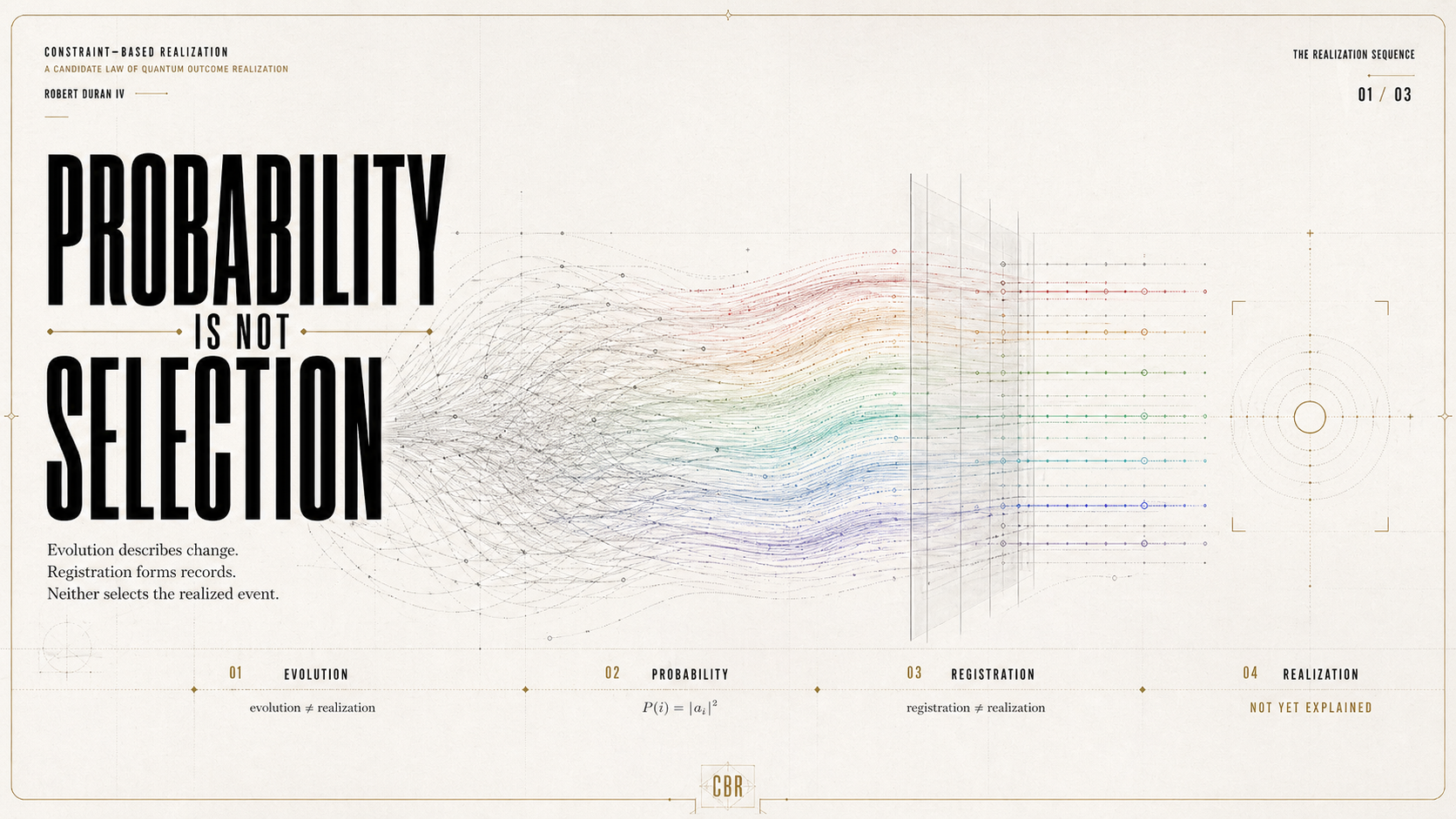
CBR argues that decoherence powerfully addresses registration, but does not by itself constitute a law of realization. The Born rule gives the weighting of possible outcomes. Decoherence explains the stabilization of records and the suppression of interference. Neither, without further interpretation or supplementation, specifies why one admissible outcome is the outcome that occurs.
If the measurement problem includes the problem of actualization, then quantum foundations faces a further question: whether the transition from admissible possibility to actual event requires its own law-form.
CBR formulates this transition as constrained selection within a physically specified measurement context. For each context C, there is an admissible class 𝒜(C) of realization-compatible candidates and a realization-burden functional ℛ_C defined over that class. The selected realization channel, or operational equivalence class of channels, Φ∗_C, is given by the canonical form:
Φ∗_C ∈ argmin{ℛ_C(Φ) : Φ ∈ 𝒜(C)}
In plain terms, CBR asks whether the actual outcome is the admissible realization structure that satisfies the full constraint burden of the physical context. It is not a consciousness-based account, not merely an observer update, not simply decoherence, and not an Everettian preservation of all branches as equally realized. It is a structured proposal for how one admissible possibility becomes actual.
Any serious law of outcome realization must satisfy a demanding burden standard. It must define its physical domain, specify the admissible candidates, avoid circularly selecting the already-realized outcome, remain compatible with Born-rule statistics, distinguish realization from record formation, provide uniqueness or uniqueness up to operational equivalence, and state what would count as empirical failure.
CBR is therefore significant not only because it proposes an answer, but because it makes the burden explicit. A theory of realization must say what is selected, from what class, by what rule, under what constraints, and how the proposal could fail.
A central requirement is Born-rule discipline. CBR does not seek to replace quantum probabilities with a selection rule. It asks whether lawful selection can be formulated while preserving the quadratic probability structure that quantum theory already gets right. If CBR merely smuggled in the Born rule, it would be circular. If it selected outcomes in a way that violated the Born rule, it would be empirically false. Its burden is severe: it must make realization lawful without breaking the operational probability structure of quantum mechanics.
CBR is also framed as empirically vulnerable. In accessibility-based interferometric or delayed-choice protocols, one may vary the accessibility of which-outcome records and compare a fixed CBR instantiation against a baseline consisting of standard quantum mechanics, decoherence, detector behavior, platform noise, and nuisance effects. If that fixed instantiation predicts a critical accessibility signature, such as a threshold or non-smooth feature in the relevant visibility behavior, and the experiment remains within the validated smooth baseline across the predicted regime, then that instantiation fails.
This gives failure an address: the tested object is defeated if its fixed commitments entail the failed prediction.
CBR reframes the measurement problem as a question about the lawhood of actualization. The issue is not merely whether the wavefunction collapses, branches, updates, hides variables, or functions instrumentally. The deeper structural question is whether quantum foundations contains, or requires, a law-form for how one admissible possibility becomes an actual event.
CBR is not presented as established physics. It is presented as a structured candidate framework for a missing object in quantum foundations: the actualization of one event from the space of physically admissible possibilities. If successful, CBR would identify realization as a lawful target of quantum foundations. If unsuccessful, it would still sharpen the standard by which future outcome-realization proposals are judged.
Its central thesis is simple: Probability gives the weights. Decoherence gives the records. Realization names the event.
Keywords: quantum foundations; measurement problem; outcome realization; decoherence; Born rule; lawhood; actualization; Constraint-Based Realization.
