

The Accessibility-Critical Residual: An Empirical Endpoint Theorem for Constraint-Based Realization
Abstract
Constraint-Based Realization, or CBR, proposes that individual quantum outcome realization is not supplied by probability assignment or decoherence alone, but by a context-fixed constrained-selection rule over admissible realization candidates. A central objection to any realization-law proposal is that realization itself is not directly observable. This paper answers that objection by separating the law-form from the empirical endpoint. A realization law need not be directly observed as an isolated object in order to be scientifically exposed. It must instead entail, through a registered empirical bridge, an operational consequence whose presence, absence, or indeterminacy can be judged under fixed conditions.
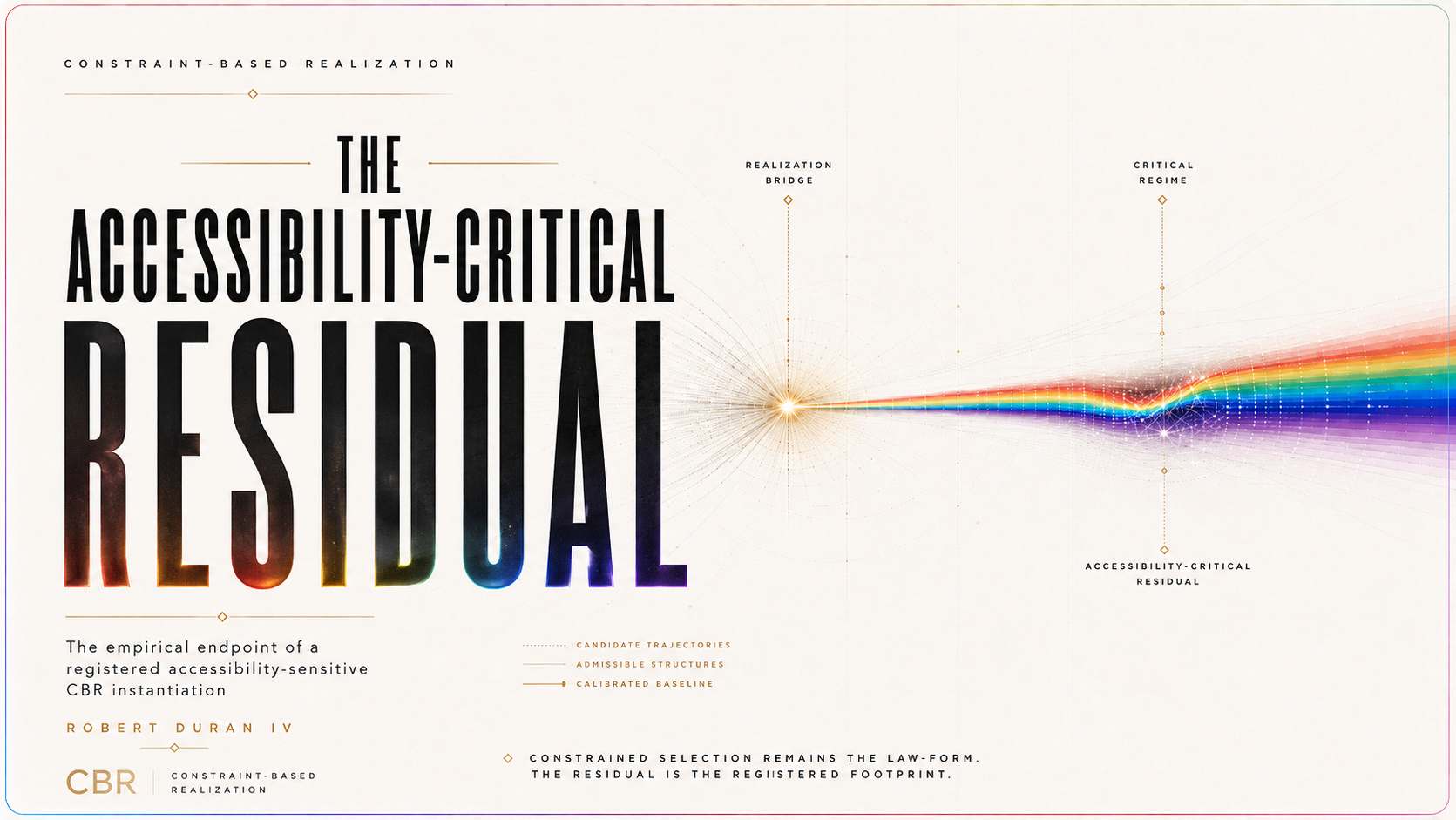
This paper identifies the accessibility-critical residual as the empirical endpoint of a registered CBR instantiation in record-accessibility interferometric contexts. The residual is the pre-registered deviation structure of observed visibility, V_obs(η), from a validated standard quantum/decoherence/nuisance baseline, V_ℬ(η), inside a declared critical record-accessibility regime I_c or N(η_c). It is not realization itself. It is not the law itself. It is not an unexplained anomaly retroactively elevated into theory. It is the operational footprint that a registered CBR instantiation becomes committed to only when its own bridge conditions connect record-accessibility η, the realization-burden functional ℛ_C, and the visibility observable V_obs(η).
The paper states an empirical endpoint theorem for CBR, defines the accessibility-critical residual and its admissibility conditions, distinguishes registered support, registered failure, and inconclusive exposure, and explains why a strong null defeats the registered instantiation without automatically defeating every possible realization-law thesis. The result is a sharper empirical bridge for CBR: constrained selection remains the law-form, while the accessibility-critical residual becomes the testable endpoint through which a registered accessibility-sensitive instantiation is exposed to support, failure, or disciplined non-adjudication.
SECTION 1. Introduction — The Direct-Observation Objection
1.1 The Objection
Any candidate law of quantum outcome realization faces an immediate objection: if realization itself is not directly observable, what exactly is being tested?
This objection is serious. A proposal that claims to address outcome realization cannot remain scientifically meaningful if it never specifies what would count as evidence, failure, or inconclusive exposure. If CBR only asserted that “something beyond probability and decoherence selects the realized event,” without specifying an operational consequence, it would remain at the level of interpretation rather than empirical law-candidate structure.
This paper therefore begins from the strongest version of the objection: If CBR is about realization, but realization itself is not directly observed, what is the measurable object of the theory?
The answer is not that realization is directly photographed, isolated, or detected as an independent observable. The answer is that a registered realization-law instantiation may be tested through the operational footprint it entails under fixed bridge conditions.
For the accessibility-sensitive interferometric setting considered here, that footprint is the accessibility-critical residual.
1.2 The Basic Answer
CBR does not test realization by directly observing realization. It tests whether a registered realization-law instantiation leaves a measurable accessibility-critical footprint when record-accessibility η is varied.
The law-form and the empirical endpoint must therefore be distinguished.
The law-form is the constrained-selection structure by which CBR represents outcome realization within a fixed measurement context. The empirical endpoint is the measurable consequence through which a particular registered instantiation of that law-form becomes exposed to support, failure, or inconclusive judgment.
In the empirical setting considered here, the endpoint is not “realization itself.” It is the residual structure of observed visibility against a validated baseline:
r(η) = V_obs(η) − V_ℬ(η)
evaluated inside a declared critical accessibility regime, after the accessibility bridge, nuisance envelope, detectability threshold, endpoint statistic, and verdict rule have been fixed.
1.3 Why the Distinction Matters
Without this distinction, CBR is vulnerable to two opposite errors.
The first error is direct-observation overreach: claiming or implying that the experiment directly measures realization itself. That would be too strong. Realization is the law-level target, not the immediate observable.
The second error is residual reduction: treating any leftover deviation from a baseline as if it were already evidence for CBR. That would be too weak and too permissive. A residual alone may be noise, drift, calibration error, incomplete decoherence modeling, ordinary detector behavior, or statistical fluctuation.
CBR avoids both errors by requiring the residual to be registered, localized, baseline-separated, nuisance-separated, detectable, and verdict-bearing. More importantly, the residual must be entailed by a registered empirical bridge. It is not enough to find an unexplained deviation; the instantiation must have already specified why that deviation, in that accessibility regime, is the operational consequence of the proposed realization-burden structure.
1.4 Main Claim
The main claim of this paper is: The empirical endpoint of a registered accessibility-sensitive CBR instantiation is the accessibility-critical residual: the pre-registered residual structure of V_obs(η) against the validated standard quantum/decoherence/nuisance baseline V_ℬ(η), evaluated inside a declared critical accessibility regime I_c or N(η_c), under fixed bridge, nuisance, detectability, and verdict conditions.
This endpoint does not replace the law-form. It exposes it.
The law is constrained selection.
The residual is the fingerprint.
The strong null is the wound.
1.5 Contributions
This paper makes seven contributions.
First, it separates CBR’s law-form from its measurable endpoint.
Second, it defines the accessibility-critical residual as the operational footprint of a registered accessibility-sensitive CBR instantiation.
Third, it introduces the bridge condition required to connect the realization-burden structure ℛ_C to the visibility observable V_obs(η).
Fourth, it states an empirical endpoint theorem showing how CBR can be testable without directly observing realization.
Fifth, it specifies the admissibility conditions under which a residual can count as CBR-relevant.
Sixth, it distinguishes registered support, registered failure, and inconclusive exposure.
Seventh, it preserves the jurisdiction of failure: a failed instantiation fails where its locked commitments applied, but the entire realization-law question is not automatically destroyed unless additional bridge arguments show that the failed instantiation exhausts the broader class.
This sets up the central distinction of the paper: CBR is not made empirical by claiming direct access to realization, but by specifying the endpoint through which a registered realization-law instantiation becomes vulnerable to experimental judgment.
SECTION 2. The Law / Endpoint Distinction
2.1 The Category Error
The direct-observation objection becomes damaging only if one assumes that a law must be directly observed in the same form in which it is formulated. That assumption is too strong.
A law-level structure can be empirically exposed through its consequences. What matters is not whether the law itself is directly visible, but whether a registered instantiation entails a measurable consequence under fixed and independently specified conditions.
For CBR, the category error is to demand: CBR must directly observe realization itself.
That is not the correct empirical standard.
The correct standard is: A registered CBR instantiation must entail a measurable operational consequence through a declared empirical bridge, and that consequence must be capable of supporting, defeating, or failing to adjudicate the instantiation under pre-declared conditions.
This distinction is essential. CBR does not become empirical by treating realization as a directly observed object. It becomes empirical by tying its law-form to an operational endpoint that cannot be selected, moved, or redefined after the data are known.
2.2 The Five-Level Hierarchy
The law / endpoint distinction can be stated as a five-level hierarchy.
Level 1 — Law-form.
CBR represents individual outcome realization as constrained selection within a fixed measurement context. The law-form concerns how an admissible realized candidate is selected, not merely how probabilities are assigned or records stabilize.
Level 2 — Registered instantiation.
A specific model fixes the context C, admissible candidate class 𝒜(C), realization-burden functional ℛ_C, and operational equivalence relation ≃_C. These objects must be specified before outcome comparison or empirical verdict.
Level 3 — Empirical bridge.
Record-accessibility η is introduced as an operational control variable. The instantiation must specify how η enters ℛ_C and how changes in η are expected to map into the registered observable. Without this bridge, the law-form may remain formally meaningful, but the empirical endpoint is not yet fixed.
Level 4 — Observable endpoint.
The observable is not realization itself. In the interferometric setting, the observable is visibility V_obs(η), compared against a validated standard quantum/decoherence/nuisance baseline V_ℬ(η).
Level 5 — Verdict.
The residual either appears under the registered conditions, fails to appear under detectability-valid conditions, or cannot be judged because calibration, baseline validation, nuisance control, sampling, bridge adequacy, or detectability is insufficient.
This hierarchy prevents two confusions: it prevents the empirical endpoint from being mistaken for the law, and it prevents the law from being shielded from failure by refusing to specify an endpoint.
2.3 Principle 1 — Endpoint Separation
Principle 1 — Endpoint Separation.
A realization law is not identical to its measured endpoint. A measured endpoint is the operational consequence by which a registered realization-law instantiation is exposed to support, failure, or inconclusive judgment.
This principle has three immediate consequences.
First, the accessibility-critical residual must not be described as realization itself. It is the measurable footprint of a registered realization-law instantiation.
Second, the residual must not be treated as evidence merely because it is unexplained. It becomes CBR-relevant only if it was entailed by the registered law-form through a declared empirical bridge and survives the baseline, nuisance, localization, and detectability requirements.
Third, the absence of the residual can matter. If a registered instantiation predicts a detectable residual and the experiment is capable of detecting it, then the absence of that residual is not merely neutral. It is a strong null against the registered instantiation.
The residual is therefore not the law. It is how the law is supported, wounded, or left unexposed.
This principle prepares the minimal formal statement of CBR needed for the endpoint theorem.
SECTION 3. Minimal Canonical CBR
This section states only the minimal canonical structure required for the endpoint theorem. It does not attempt to reconstruct the full CBR program. Its purpose is to identify the law-form whose empirical endpoint will later be defined.
3.1 Measurement Context
Let C denote a fixed measurement context.
C includes the operational arrangement in which outcome realization is being evaluated: the measurement basis, record structure, accessibility conditions, relevant apparatus constraints, and the observable through which the empirical endpoint will be assessed.
The context must be fixed because CBR is not a rule over unconstrained possibility. It is a rule over admissible realization candidates within a specified operational setting.
3.2 Admissible Candidate Class
Let 𝒜(C) denote the admissible candidate class for context C.
𝒜(C) contains the realization-compatible candidates available within C. These candidates are not arbitrary imagined alternatives. They must satisfy the physical, operational, and contextual constraints that define the measurement situation.
This requirement is central to CBR’s law-form. Realization is not represented as selection from everything formally describable. It is represented as selection from what remains admissible under the fixed constraints of the context.
3.3 Operational Equivalence
Let ≃_C denote operational equivalence within context C.
If two candidate descriptions differ formally but cannot be distinguished by any registered operation or record available within C, they are equivalent for purposes of the instantiation. This prevents the candidate space from being artificially inflated by distinctions that have no operational bearing on the test.
The relevant selection object is therefore not merely 𝒜(C), but 𝒜(C) considered up to ≃_C.
3.4 Realization-Burden Functional
Let ℛ_C denote the realization-burden functional for context C.
ℛ_C assigns the ordering by which admissible candidates are compared. It must be fixed before the realized outcome is known and before the empirical endpoint is evaluated. If ℛ_C is chosen or adjusted after the result, the model becomes circular and loses empirical exposure.
The function of ℛ_C is not to restate the observed outcome. Its function is to specify, within C, the pre-outcome burden structure under which a realized candidate is selected.
3.5 Canonical Selection Rule
The minimal canonical selection form is:
Φ∗C ∈ argmin{Φ ∈ 𝒜(C)} ℛ_C(Φ), up to ≃_C.
This expression states the law-form: the realized candidate is selected from the admissible class by minimizing the context-fixed realization burden, with operationally equivalent candidates identified under ≃_C.
This is the formal object CBR contributes at the level of realization-law structure. It does not by itself specify the empirical endpoint. The endpoint appears only when a registered instantiation of this law-form supplies an empirical bridge from the burden structure to an operational observable, such as an accessibility-critical residual in V_obs(η).
Thus, the selection rule is the law-form. The residual is the experimental footprint through which a registered, bridge-equipped instantiation of that law-form is tested.
SECTION 4. Endpoint Separation Theorem
4.1 Motivation
The preceding sections established a distinction between the law-form and the empirical endpoint. The present section states that distinction as a theorem, but with an essential qualification: the theorem does not claim that every abstract realization-law proposal automatically generates a visibility residual.
A critic may rightly ask why record-accessibility η entering ℛ_C should produce any determinate signature in V_obs(η). That question cannot be answered by the abstract law-form alone. It requires a registered empirical bridge connecting the burden structure to a platform observable.
The endpoint separation theorem is therefore conditional. It applies to registered CBR instantiations that specify how record-accessibility enters the realization burden and how the resulting accessibility-sensitive structure is to be evaluated through an observable endpoint.
4.2 Bridge Premise — Accessibility-to-Visibility Exposure
Bridge Premise — Accessibility-to-Visibility Exposure.
For a registered CBR instantiation in a record-accessibility interferometric context C, if record-accessibility η enters the realization-burden functional ℛ_C nontrivially, and if the platform maps changes in record-accessibility into the registered visibility observable V_obs(η), then the instantiation must entail a determinate prediction for the residual structure of V_obs(η) relative to the validated baseline V_ℬ(η) across the declared critical accessibility regime I_c or N(η_c).
This premise does not assert that every CBR instantiation must predict the same residual. It does not assert that the residual must be positive, large, or universal. It asserts that a registered accessibility-sensitive instantiation must say what residual behavior is expected, what magnitude would be detectable, and what absence would count as failure.
Without this bridge, CBR may remain a formal law-candidate, but the particular instantiation has not yet become empirically adjudicable in the visibility channel.
Theorem 1 — Endpoint Separation Theorem
A realization-law candidate need not make realization itself directly observable in order to be empirically exposed. For a registered CBR instantiation satisfying the accessibility-to-visibility bridge premise, empirical exposure is achieved through a fixed operational endpoint: the accessibility-critical residual of V_obs(η) relative to V_ℬ(η) inside the declared critical accessibility regime. If the registered residual appears under valid conditions, the instantiation receives support. If the registered residual is absent under detectability-valid conditions, the instantiation fails. If the bridge, calibration, baseline, nuisance, sampling, or detectability conditions are not satisfied, the exposure is inconclusive.
4.3 Proof Sketch
A law-level target and an empirical endpoint need not be identical. A theory may concern a structure that is not directly observed while still entailing consequences that are observed under specified conditions.
CBR’s law-level target is outcome realization, represented by a constrained-selection rule over admissible candidates within C. Realization itself is not treated as a direct observable. The empirical burden is therefore not to display realization as an isolated object, but to specify a consequence that follows from a registered realization-law instantiation.
In the accessibility-sensitive setting, η provides the operational bridge only if the instantiation states how η enters ℛ_C and how accessibility variation is mapped into a registered observable. In the interferometric case, that observable is V_obs(η), evaluated against the standard quantum/decoherence/nuisance baseline V_ℬ(η). The corresponding residual is:
r(η) = V_obs(η) − V_ℬ(η)
The endpoint is not r(η) everywhere and not every deviation from baseline. The endpoint is the registered residual structure inside I_c or N(η_c), assessed under fixed nuisance, detectability, validity, and verdict conditions.
Therefore, CBR can be empirically exposed without directly observing realization itself, provided the instantiation supplies the required bridge from law-form to observable endpoint. The test is not a direct inspection of realization. It is a registered test of the footprint a realization-law instantiation must leave if its accessibility-sensitive commitments are correct.
4.4 Referee Clarification
The theorem should not be read as deriving a universal empirical signature from the abstract CBR law-form alone. The abstract law-form supplies the constrained-selection structure. Empirical exposure requires an additional registered bridge from the realization burden to a platform observable.
In the delayed-choice record-accessibility setting, η supplies the accessibility variable and V_obs(η) supplies the observable response only after the instantiation specifies how changes in η are expected to affect the registered endpoint. The accessibility-critical residual becomes CBR-relevant only after that bridge has been fixed.
Without such a bridge, CBR remains a formal law-candidate but not an adjudicated empirical instantiation.
4.5 Consequences
The theorem has four consequences for the structure of CBR testing.
First, CBR need not overclaim direct access to realization. It can remain empirically meaningful by specifying measurable consequences of registered realization-law instantiations.
Second, CBR cannot rely on the abstract law-form alone to claim empirical exposure. A platform-specific bridge is required.
Third, a residual does not count merely because it is unexplained. The residual becomes CBR-relevant only if it is derived from the registered law-form through the declared bridge and evaluated under the baseline, nuisance, detectability, localization, and verdict rules.
Fourth, a null result can be meaningful. If the registered model predicts a detectable residual and the test satisfies its validity gates, the absence of the residual is a failure of that registered instantiation.
4.6 Payoff
The endpoint separation theorem blocks the objection: “If realization cannot be directly seen, CBR is not empirical.”
CBR’s reply is: The test is not a photograph of realization. The test is the registered footprint of a realization law.
The bridge premise blocks the deeper objection: “You have defined a residual, but you have not shown why the law-form entails that residual.”
CBR’s reply is: The abstract law-form does not automatically entail a universal residual. A registered empirical bridge is required. Once that bridge is fixed, the accessibility-critical residual becomes the endpoint through which the instantiation is supported, defeated, or left inconclusive.
This theorem prepares the next step: defining record-accessibility η as the operational bridge variable and specifying the conditions under which it can be used without collapsing into consciousness, subjective observation, or post hoc reinterpretation.
SECTION 5. Record-Accessibility as the Empirical Bridge
5.1 Definition of η
Let η denote the registered operational measure of accessible outcome-defining record information within a fixed measurement context C.
η is not a measure of consciousness, subjective awareness, observer attention, or metaphysical observation. It is an operational accessibility parameter. It measures the degree to which outcome-defining record information is physically available under the registered conditions of the experiment.
In a record-accessibility interferometric context, η may be instantiated through a platform-specific proxy such as which-path distinguishability, record-retention strength, polarization marking, erasure-basis accessibility, coincidence-conditioned record availability, or another experimentally registered measure of accessible record information. The precise construction of η is not universal. It is part of the registered model.
The governing requirement is therefore:
η must be operationally defined, calibrated, and fixed before residual evaluation.
Thus, η should be understood as calibrated record-accessibility.
It is not consciousness.
It is not subjective awareness.
It is not a synonym for observation.
It is not chosen after the outcome.
It is not adjusted after the visibility curve is known.
This distinction is essential. If η is left vague, observer-dependent, or post hoc, then the accessibility-critical residual loses its status as a disciplined empirical endpoint.
5.2 Why η Matters
CBR’s canonical law-form represents outcome realization as constrained selection within a fixed context. By itself, that law-form does not automatically yield a visibility-level prediction. Empirical exposure requires a bridge from the realization-burden structure to an operational observable.
η supplies that bridge only for registered CBR instantiations in which record-accessibility enters the realization-burden functional ℛ_C nontrivially.
The claim is conditional:
If η enters ℛ_C nontrivially, and if the registered platform maps accessibility variation into the chosen observable V_obs(η), then the instantiation must entail a determinate prediction for the residual behavior of V_obs(η) relative to V_ℬ(η).
This formulation avoids overclaiming. It does not assert that every possible CBR model predicts the same signature. It does not assert that every abstract realization-law proposal is automatically testable through visibility. It asserts that an accessibility-sensitive instantiation must specify how accessibility affects the registered endpoint, what residual behavior is predicted, what magnitude would be detectable, and what absence would count as failure.
In the interferometric context considered here, the chosen observable is visibility, V_obs(η), and the relevant endpoint is the accessibility-critical residual.
5.3 Critical Accessibility Regime
A registered CBR instantiation must identify the accessibility region in which its predicted effect is expected to be evaluated.
This region may be specified as:
η_c — a declared critical accessibility value,
I_c — a declared critical accessibility interval, or
N(η_c) — a declared neighborhood of η_c.
The critical regime is not a region selected because the residual later appears large there. It is part of the registered instantiation. It must be fixed before comparison with V_obs(η).
The rule is:
η_c, I_c, or N(η_c) must be declared before residual evaluation.
If the critical regime is chosen after inspecting V_obs(η), then the analysis becomes post hoc. The model can no longer claim that the residual appeared where it was predicted to appear. It can only claim that the data suggested a possible future hypothesis.
5.4 Bridge Premise — Accessibility Nontriviality
The empirical bridge can now be stated explicitly.
Bridge Premise — Accessibility Nontriviality
For a registered CBR instantiation in a record-accessibility measurement context C, if η enters the realization-burden functional ℛ_C nontrivially, and if the platform maps accessibility variation into the registered observable V_obs(η), then the instantiation must entail a determinate prediction for the accessibility-critical residual across the declared critical regime I_c or N(η_c).
This premise is not a universal empirical claim for all possible CBR models. It is a condition on a registered accessibility-sensitive instantiation.
It does not say that the residual must be large.
It does not say that the residual must have the same form in every platform.
It does not say that every CBR instantiation is testable in the visibility channel.
It does not say that η alone guarantees empirical exposure.
It says something narrower and stronger:
A registered accessibility-sensitive instantiation must make itself answerable to an operational endpoint.
If the instantiation predicts a detectable residual and the residual appears under valid conditions, the instantiation receives support. If it predicts a detectable residual and the residual is absent under valid conditions, the instantiation fails. If η is not calibrated, the bridge from η to V_obs(η) is not established, or detectability is insufficient, the exposure is inconclusive.
5.5 Transition
Record-accessibility η therefore becomes an empirical bridge only when it is operationally defined, pre-registered, calibrated, and connected to a platform observable. The next section defines the endpoint that this bridge makes possible: the accessibility-critical residual.
SECTION 6. Defining the Accessibility-Critical Residual
This section defines the central empirical endpoint of the paper. The accessibility-critical residual is not the law-form of CBR. It is the registered operational footprint through which an accessibility-sensitive CBR instantiation becomes testable.
6.1 Observed Visibility
Let V_obs(η) denote the observed visibility as record-accessibility η is varied under the registered measurement protocol.
V_obs(η) is not an unrestricted data curve. It must be produced by a fixed visibility estimator applied consistently across the registered η range. The estimator, phase-scan procedure, coincidence-window rules, data-inclusion rules, uncertainty treatment, and calibration method must be specified before final residual evaluation.
If the visibility estimator is changed after inspecting the data, the endpoint is no longer locked. The model may define a new analysis, but it cannot claim to have preserved the original registered endpoint.
6.2 Baseline Visibility
Let V_ℬ(η) denote the validated baseline visibility curve.
V_ℬ(η) represents the strongest ordinary baseline available for the platform. It must include the standard quantum prediction, decoherence effects, detector inefficiency, dark counts, alignment uncertainty, phase drift, finite sampling, calibration uncertainty, environmental noise, and other registered non-CBR contributions relevant to the experimental context.
The baseline cannot be an idealized straw man. CBR does not gain support by outperforming a simplified version of ordinary physics. It becomes empirically serious only by competing against the strongest standard quantum/decoherence/nuisance model the platform can justify.
Thus, V_ℬ(η) answers the question: What visibility behavior should be expected if no CBR-specific accessibility-critical residual is present?
6.3 Raw Residual
Define the raw residual:
r(η) = V_obs(η) − V_ℬ(η).
This expression identifies the observed departure from the registered baseline at each accessibility value η.
However, r(η) by itself is not yet a CBR result. A raw difference between observation and baseline may arise from statistical noise, calibration uncertainty, detector behavior, incomplete nuisance modeling, phase instability, estimator instability, or ordinary platform drift.
The raw residual becomes CBR-relevant only when it is evaluated inside the declared critical regime and tested against registered nuisance, detectability, endpoint, and verdict conditions.
6.4 Nuisance Envelope
Let B_𝓝(η) denote the registered nuisance envelope.
B_𝓝(η) bounds the range of residual behavior attributable to ordinary non-CBR sources, including detector drift, calibration error, phase instability, decoherence uncertainty, finite sampling, dark counts, alignment variation, estimator instability, and other platform-specific nuisance effects.
A residual that remains inside B_𝓝(η) does not support a CBR instantiation. It is already absorbable by the registered ordinary uncertainty structure.
The nuisance envelope therefore protects the analysis from false attribution. It prevents ordinary experimental imperfection from being mistaken for law-level evidence.
6.5 Detectability Threshold
Let ε_detect denote the registered detectability threshold.
ε_detect is the minimum residual magnitude required for the experiment to distinguish a CBR-relevant effect from baseline-plus-nuisance behavior. It may be expressed in visibility units, normalized residual units, confidence-threshold units, or another platform-specific standard fixed in the dossier.
A test cannot defeat a registered CBR instantiation if the predicted residual lies below ε_detect. In that case, the experiment lacks the sensitivity required for adjudication. The correct verdict is not failure. It is inconclusive exposure.
This requirement is essential to strong-null logic. A null result is scientifically meaningful only when the experiment was capable of detecting the predicted effect.
6.6 Endpoint Statistic
Let T_c denote the registered endpoint statistic for evaluating the residual inside the critical accessibility regime.
A simple endpoint statistic is:
T_c = sup_{η ∈ I_c} |V_obs(η) − V_ℬ(η)|.
A normalized version is:
T_c = sup_{η ∈ I_c} |V_obs(η) − V_ℬ(η)| / σ_total(η),
where σ_total(η) includes registered statistical and systematic uncertainty.
Other endpoint statistics may be appropriate in specific platforms, such as an integrated residual, localized kink statistic, slope-change statistic, curvature statistic, or model-comparison statistic. The decisive requirement is not that every CBR test use the same statistic. The requirement is that the primary endpoint statistic be fixed before residual evaluation.
6.7 Residual Decision Scale
For T_c to adjudicate a registered CBR instantiation, it must be evaluated against a registered decision scale.
Let B_c denote the nuisance bound across the declared critical regime:
B_c = sup_{η ∈ I_c} B_𝓝(η).
Where a normalized statistic is used, B_c denotes the corresponding registered bound in normalized units.
Let ε_detect denote the registered detectability threshold.
Define the decision threshold:
Θ_c = B_c + ε_detect.
The endpoint statistic T_c is interpreted relative to Θ_c.
If:
T_c > Θ_c,
then the observed residual exceeds the registered nuisance-plus-detectability threshold and may qualify as support, provided all validity gates are satisfied and the registered residual form, localization, or endpoint behavior is present.
If:
T_c ≤ Θ_c,
and the registered CBR instantiation predicted a detectable residual such that:
T_CBR > Θ_c,
then the result is a strong null and the registered instantiation fails, provided calibration, baseline validation, nuisance modeling, sampling, bridge adequacy, and detectability conditions are valid.
If the test cannot establish B_c, ε_detect, η calibration, baseline validity, bridge adequacy, or sufficient sampling inside I_c, then the result is inconclusive.
This decision scale is essential. A CBR residual test must not ask whether the curve “looks unusual.” It must ask whether the registered endpoint statistic exceeds a registered threshold under valid conditions.
6.8 Central Definition — Accessibility-Critical Residual
Definition — Accessibility-Critical Residual
The accessibility-critical residual is the registered residual structure of V_obs(η) − V_ℬ(η), evaluated inside the pre-declared critical accessibility regime I_c or N(η_c), after the empirical bridge, baseline, nuisance envelope, detectability threshold, endpoint statistic, decision threshold Θ_c, validity gates, and verdict rule have been fixed.
This definition has four consequences.
First, the accessibility-critical residual is not the same thing as any observed deviation from baseline.
Second, it is not realization itself.
Third, it is not independent evidence unless it is entailed by the registered CBR instantiation through the accessibility bridge.
Fourth, it becomes adjudicative only when evaluated against the registered decision threshold Θ_c.
The residual is the empirical endpoint only because the registered law-form commits itself to that endpoint.
6.9 Key Clarification
The accessibility-critical residual is not realization. It is not the law. It is not a free-floating anomaly.
It is the law-form’s operational footprint under a registered accessibility-sensitive test.
This clarification avoids both overclaiming and underclaiming. CBR does not claim to directly observe realization. But it also does not retreat into untestable language. It exposes a registered realization-law instantiation through the residual behavior that the instantiation itself declares to be empirically relevant.
The next section states the conditions under which such a residual is admissible as a CBR endpoint.
SECTION 7. Residual Admissibility Conditions
A residual is not CBR-relevant merely because it appears in the data. This section states the admissibility conditions required before a residual can function as an empirical endpoint for a registered CBR instantiation.
These conditions protect the framework from anomaly hunting, weak baselines, post hoc critical-region selection, uncontrolled nuisance attribution, and qualitative verdicts disguised as empirical adjudication.
7.1 Registration
The relevant objects must be fixed before data interpretation.
At minimum, the registered dossier must specify:
C, 𝒜(C), ≃_C, ℛ_C, η, I_c or N(η_c), V_ℬ(η), B_𝓝(η), B_c, ε_detect, Θ_c, T_c, T_CBR where applicable, the visibility estimator, validity gates, and the verdict rule.
Registration is what gives the test its scientific force. Without registration, the residual may be fitted after the fact, the critical regime may be moved, the nuisance envelope may be widened, the endpoint statistic may be selected because it gives the most favorable result, or the decision threshold may be adjusted after the outcome.
A post hoc residual is not a CBR endpoint. It is a hypothesis generator at most.
7.2 Localization
The residual must appear in the declared critical accessibility regime.
Localization matters because the CBR instantiation does not merely predict that “something unusual may occur somewhere.” It must identify where accessibility-sensitive behavior should be evaluated.
A residual outside I_c or N(η_c) may still be scientifically interesting, but it is not the registered accessibility-critical residual unless the model fixed that region in advance.
Localization distinguishes prediction from retrospective pattern selection.
7.3 Baseline Separation
The residual must not be absorbable into the validated baseline V_ℬ(η).
Baseline separation requires that standard quantum dynamics, decoherence, detector response, phase drift, sampling uncertainty, and other ordinary platform effects have already been included in the baseline model. If the residual disappears once the baseline is improved, it is not CBR support.
This condition is essential because CBR does not compete against a simplified or idealized version of ordinary physics. It competes against the strongest ordinary baseline justified by the platform.
7.4 Nuisance Separation
The residual must not be explained by the registered nuisance envelope B_𝓝(η).
Nuisance separation requires the residual to exceed the range attributable to detector drift, calibration uncertainty, finite sampling, estimator instability, alignment variation, and other registered non-CBR sources.
At the level of the critical regime, this means the endpoint statistic must be evaluated relative to the registered nuisance bound:
B_c = sup_{η ∈ I_c} B_𝓝(η).
A residual inside B_c is not a law-level signal. It is ordinary uncertainty.
7.5 Detectability
The residual must exceed ε_detect.
Detectability is required both for support and for failure. A positive residual below ε_detect is not support. A null result when the predicted residual lies below ε_detect is not failure.
The test is adjudicative only when the predicted residual is large enough, relative to the platform’s uncertainty structure, to be detected if present.
7.6 Decision-Threshold Adjudication
The residual must be evaluated against the registered decision threshold:
Θ_c = B_c + ε_detect.
This condition is what converts residual language into a decision rule.
A residual that does not exceed Θ_c cannot be treated as registered support. Likewise, a failure verdict requires more than the absence of a visible deviation; it requires that the registered instantiation predicted a detectable endpoint satisfying T_CBR > Θ_c, while the observed endpoint satisfies T_c ≤ Θ_c, under valid test conditions.
Without Θ_c, the verdict remains qualitative. With Θ_c, the test becomes operationally adjudicative.
7.7 Verdict Exposure
The residual must be tied to a verdict rule.
A CBR endpoint must specify what counts as registered support, what counts as registered failure, and what counts as inconclusive exposure. Without a verdict rule, the residual cannot wound the instantiation. It can be discussed, but it cannot adjudicate.
Verdict exposure is therefore part of the residual’s scientific status. A residual that cannot support, fail, or be declared inconclusive under fixed rules is not yet an empirical endpoint.
Proposition 1 — Residual Admissibility
A residual is admissible as a CBR empirical endpoint only if it is registered, localized, baseline-separated, nuisance-separated, detectable, adjudicated against a pre-declared decision threshold Θ_c = B_c + ε_detect, and verdict-bearing.
Proof Sketch
If the residual is not registered, it may be post hoc.
If it is not localized, it is not the predicted accessibility-critical signature.
If it is not baseline-separated, it may be ordinary quantum/decoherence behavior.
If it is not nuisance-separated, it may be experimental imperfection.
If it is not detectable, it cannot support or defeat the model.
If it is not evaluated against Θ_c, the verdict remains qualitative rather than adjudicative.
If it is not verdict-bearing, it does not expose the instantiation to failure.
Therefore, only a residual satisfying all seven conditions can function as the empirical endpoint of a registered CBR instantiation.
7.8 Transition
The admissibility conditions show why the accessibility-critical residual is not ordinary anomaly hunting. The next section states the stronger result: a residual becomes law-relevant only through its connection to a registered constrained-selection law-form and a pre-declared decision rule.
SECTION 8. Law-Relevance Theorem
This section states the second formal centerpiece of the paper. Its purpose is to prevent a misunderstanding: CBR is not significant because it searches for unexplained residuals. Residuals become CBR-relevant only when they are entailed by a registered law-form, connected to an observable by a declared empirical bridge, and adjudicated by a fixed decision rule.
Theorem 2 — Law-Relevance of the Accessibility-Critical Residual
A residual is not law-relevant merely because it is unexplained. It becomes law-relevant for CBR only when it is entailed by a registered constrained-selection law-form through a declared empirical bridge, survives the required admissibility conditions, and is adjudicated by a pre-declared decision rule comparing T_c against Θ_c = B_c + ε_detect.
Proof Sketch
An unexplained residual alone may have many sources: statistical fluctuation, detector drift, phase instability, calibration error, incomplete decoherence modeling, estimator instability, or an ordinary platform effect that has not yet been incorporated into V_ℬ(η) or B_𝓝(η).
CBR therefore cannot gain law-level significance from residuals in general. A residual becomes CBR-relevant only when it is linked to a registered instantiation of the CBR law-form:
Φ∗C ∈ argmin{Φ ∈ 𝒜(C)} ℛ_C(Φ), up to ≃_C.
That link requires an empirical bridge specifying how η enters ℛ_C and how accessibility variation is expected to appear in the registered observable V_obs(η). The residual must then appear in the declared critical regime, exceed baseline and nuisance explanations, satisfy detectability, and be adjudicated by the registered decision threshold:
Θ_c = B_c + ε_detect.
Therefore, the residual is law-relevant not because it is leftover, but because it is a pre-declared, threshold-adjudicated consequence of a registered constrained-selection instantiation.
8.1 Corollary — No Residual Without Registration
A residual observed without prior registration may motivate a new CBR instantiation, but it cannot by itself support the already registered one.
This corollary prevents retrospective conversion of anomalies into evidence. A post hoc residual may guide future model construction, but it does not count as registered support.
8.2 Corollary — No Law-Relevance Without a Decision Rule
A residual that is not evaluated against a pre-declared decision threshold Θ_c cannot function as an adjudicative CBR endpoint.
This corollary prevents qualitative interpretation from substituting for empirical exposure. A residual may be visually suggestive or scientifically interesting, but it becomes adjudicative only when T_c is compared against Θ_c under registered validity conditions.
8.3 Corollary — No Empirical Law Without Vulnerability
A CBR instantiation that cannot state what residual would support it, what absence would defeat it, and what conditions would make the test inconclusive is not yet empirically adjudicable.
This makes vulnerability to failure part of the empirical maturity of the program.
8.4 Key Formulation
CBR is not significant because it searches for a leftover signal.
CBR is significant because it specifies a law-form that, under registered accessibility-sensitive conditions, makes a particular residual structure necessary for that instantiation and accepts failure if that residual is absent under valid test conditions.
More exactly: A registered CBR instantiation becomes law-relevant at the empirical level only when it commits to T_CBR, Θ_c, and the verdict relation between T_CBR and T_c.
8.5 Transition
Once residual law-relevance is established, the paper must define the verdict structure. The next section states the only three disciplined outcomes of a CBR residual test: registered support, registered failure, or inconclusive exposure.
SECTION 9. Support, Failure, and Inconclusive Exposure
A CBR residual test must not permit ambiguous verdicts after the result is known. The same registered structure that defines the endpoint must also define what counts as support, failure, or inconclusive exposure.
This section states the three-verdict discipline for accessibility-critical residual testing.
9.1 Registered Support
A registered CBR instantiation receives support only if all of the following conditions are satisfied.
The residual appears inside I_c or N(η_c).
The residual has the registered form, localization, or endpoint-statistic behavior.
The observed endpoint statistic exceeds the registered decision threshold:
T_c > Θ_c.
The residual exceeds the registered nuisance bound B_c.
The residual exceeds ε_detect.
The residual is not absorbed by the validated baseline V_ℬ(η).
The visibility estimator, η calibration, bridge model, baseline validation, nuisance model, endpoint statistic, and validity gates remain stable.
Controls and robustness checks do not remove the effect.
This verdict must be stated carefully: Registered support is support for the tested instantiation. It is not proof that CBR is the final law of nature.
A positive residual under valid conditions may motivate stronger CBR claims, replication, rival-model comparison, or dedicated experimental tests. It does not by itself establish CBR universally.
9.2 Registered Failure
A registered CBR instantiation fails when all of the following conditions are satisfied.
The instantiation predicts a detectable accessibility-critical residual.
The registered predicted endpoint satisfies:
T_CBR > Θ_c.
η is properly calibrated.
The bridge from η to V_obs(η) is established.
The critical regime I_c or N(η_c) was fixed before data interpretation.
The baseline V_ℬ(η) is validated.
The nuisance envelope B_𝓝(η) and critical bound B_c are adequate.
The decision threshold Θ_c is fixed.
The endpoint statistic T_c is applied as registered.
The experiment is sensitive enough to detect the predicted residual.
The observed endpoint satisfies:
T_c ≤ Θ_c.
This is a strong null.
The failure is not a vague absence of excitement. It is the absence of a predicted detectable endpoint under conditions that should have revealed it if the registered instantiation were correct.
The proper verdict is: The registered instantiation fails in the domain and under the conditions it claimed to cover.
9.3 Inconclusive Exposure
A test is inconclusive when the conditions required for support or failure are not satisfied.
Inconclusive exposure includes cases where:
η calibration is inadequate.
The empirical bridge from η to V_obs(η) is not established.
The baseline V_ℬ(η) is not validated.
The nuisance envelope B_𝓝(η) is too wide or incomplete.
B_c cannot be fixed.
ε_detect cannot be justified.
Θ_c cannot be established.
The predicted residual T_CBR is not specified.
The predicted residual satisfies T_CBR ≤ Θ_c, making the test insufficiently sensitive for failure.
Sampling inside I_c or N(η_c) is insufficient.
The visibility estimator changes after data review.
The endpoint statistic T_c was not fixed.
Controls fail to isolate the relevant effect.
The data are too coarse to reconstruct the registered residual.
An inconclusive result does not support the instantiation. It also does not defeat it. It indicates that the test did not validly expose the model.
9.4 Decision Rule
The three verdicts are determined by the relation among three quantities:
T_c — the observed endpoint statistic inside the critical regime.
Θ_c = B_c + ε_detect — the registered nuisance-plus-detectability threshold.
T_CBR — the registered predicted residual magnitude or endpoint behavior under the CBR instantiation.
The verdicts are:
Registered support:
T_c > Θ_c, with the registered residual shape or localization present, and all validity gates satisfied.
Registered failure:
T_CBR > Θ_c, but T_c ≤ Θ_c, with all validity gates satisfied.
Inconclusive exposure:
The relation cannot be adjudicated because η calibration, bridge adequacy, baseline validation, nuisance bounds, detectability, sampling, endpoint registration, or data adequacy is insufficient.
This decision rule makes the verdict structure exact. It prevents the residual from being interpreted impressionistically and prevents failure from being declared when the test was not sensitive enough to expose the predicted endpoint.
Proposition 2 — Three-Verdict Discipline
A CBR residual test admits only three disciplined verdicts: registered support, registered failure, or inconclusive exposure. These verdicts are determined by the registered relation among T_c, T_CBR, and Θ_c = B_c + ε_detect. The test does not permit post hoc rescue by redefining η, I_c, V_ℬ(η), B_𝓝(η), B_c, ε_detect, Θ_c, T_c, T_CBR, the visibility estimator, validity gates, or the verdict rule after observing the result.
Proof Sketch
If the observed endpoint satisfies T_c > Θ_c, and the registered residual shape, localization, and validity gates are satisfied, the instantiation receives support.
If the registered model predicted a detectable endpoint satisfying T_CBR > Θ_c, but the observed endpoint satisfies T_c ≤ Θ_c under valid conditions, the instantiation fails.
If the quantities or conditions required to judge the relation among T_c, T_CBR, and Θ_c are not established, the exposure is inconclusive.
Any post hoc modification of η, I_c, V_ℬ(η), B_𝓝(η), B_c, ε_detect, Θ_c, T_c, T_CBR, the visibility estimator, validity gates, or verdict rule changes the tested object. Such a modification may define a new instantiation, but it cannot rescue the failed one.
Therefore, the three-verdict discipline preserves both empirical seriousness and scope control.
9.5 Transition
The three-verdict discipline gives the accessibility-critical residual its scientific force. The next step is to state the strong-null theorem: if a registered CBR instantiation predicts a detectable residual and a valid test finds none beyond Θ_c, the registered instantiation is defeated.
SECTION 10. Strong Null Failure Theorem
This section states the third formal centerpiece of the paper. Its purpose is to make failure exact. CBR becomes empirically serious only if a registered instantiation can be defeated by the absence of the endpoint it predicted under conditions capable of detecting that endpoint.
A strong null is not merely a quiet result. It is a registered failure event.
10.1 Registered Assumption Set
Before a strong null can defeat a CBR instantiation, the assumptions required for adjudication must be explicit.
Let A_CBR denote the fixed CBR instantiation:
A_CBR: C, 𝒜(C), ≃_C, and ℛ_C are registered before data interpretation.
Let A_bridge denote the empirical bridge assumption:
A_bridge: η is operationally calibrated and validly mapped to the registered observable V_obs(η).
Let A_crit denote the critical-regime assumption:
A_crit: η_c, I_c, or N(η_c) is fixed before residual evaluation.
Let A_base denote the baseline assumption:
A_base: the registered baseline model class 𝔅 is fixed, and V_ℬ(η) is selected or fitted from 𝔅 under registered rules.
Let A_noise denote the nuisance assumption:
A_noise: B_𝓝(η) and B_c bound the registered ordinary nuisance effects across the critical regime.
Let A_detect denote the detectability assumption:
A_detect: ε_detect is justified by the platform’s sensitivity, sampling, calibration, and uncertainty structure.
Let A_stat denote the statistical adjudication assumption:
A_stat: T_c, T_CBR, Θ_c, uncertainty conventions, confidence/error-control rules, and power requirements are fixed before data interpretation.
Let A_scope denote the scope assumption:
A_scope: any failure applies to the registered failure object, not automatically to every possible CBR model or every realization-law thesis.
A strong null is valid only when these assumptions are satisfied. If any of them fail, the result is not registered failure. It is inconclusive exposure.
10.2 Strong Null
A strong null occurs when a registered CBR instantiation predicts a detectable accessibility-critical endpoint, the test is capable of detecting that endpoint, and the observed endpoint remains within the registered baseline-plus-nuisance decision threshold.
Using the notation of the previous sections, a strong null requires the registered model to predict:
T_CBR > Θ_c
where T_CBR is the registered predicted endpoint magnitude or endpoint behavior, and:
Θ_c = B_c + ε_detect
is the nuisance-plus-detectability threshold.
The observed endpoint must then satisfy:
T_c ≤ Θ_c
under the registered statistical rule.
If the endpoint is shape-sensitive, the comparison must include not only magnitude but also the registered residual morphology. That morphology may include a localized deviation, kink, slope change, curvature feature, bounded non-baseline structure, or another pre-declared shape constraint. In such cases, T_CBR and T_c may be scalar, vector-valued, or function-valued, provided the endpoint statistic and comparison rule are fixed in advance.
A strong null therefore requires more than visual smoothness or subjective absence. It requires a registered prediction, a registered decision threshold, a valid test, and an observed endpoint that fails to exceed the threshold or fails to match the registered morphology under conditions that should have detected it.
Theorem 3 — Strong Null Failure
If a registered CBR instantiation satisfies A_CBR, A_bridge, A_crit, A_base, A_noise, A_detect, A_stat, and A_scope; predicts a detectable accessibility-critical endpoint such that T_CBR > Θ_c; and a valid experiment yields T_c ≤ Θ_c, or fails to exhibit the registered residual morphology, then the registered failure object associated with that instantiation fails in the domain and under the conditions it claimed to cover.
10.3 Proof Sketch
The registered instantiation fixes the law-form objects C, 𝒜(C), ≃_C, and ℛ_C. It also fixes the empirical bridge from η to V_obs(η), the critical accessibility regime, the baseline model class 𝔅, the baseline curve V_ℬ(η), the nuisance envelope B_𝓝(η), the critical nuisance bound B_c, the detectability threshold ε_detect, the decision threshold Θ_c, the endpoint statistic T_c, the predicted endpoint T_CBR, the uncertainty convention, and the verdict rule.
Under the registered instantiation, the predicted endpoint exceeds the threshold:
T_CBR > Θ_c.
If the instantiation is correct in the registered domain, and if the assumptions required for adjudication are satisfied, the observed endpoint should exceed Θ_c or exhibit the registered residual morphology.
The experiment is assumed valid. η is calibrated, the η-to-observable bridge is adequate, the baseline model class is fixed and applied according to registered rules, the nuisance envelope is adequate, the endpoint statistic is applied as registered, and the statistical decision rule has sufficient power to detect the predicted endpoint.
The observed endpoint nevertheless satisfies:
T_c ≤ Θ_c
or fails to exhibit the registered morphology.
The predicted residual is therefore absent under conditions that should have detected it. The absence cannot be attributed to insufficient sensitivity, invalid baseline, failed calibration, bridge failure, uncontrolled nuisance, endpoint switching, or statistical underpower.
Therefore, the registered commitments of the instantiation are false in the tested domain.
Thus, the registered failure object fails.
10.4 Scope of the Failure
The theorem defeats the registered failure object, not an undefined broader theory.
The failure applies to the specific collection of commitments that generated the prediction. It does not automatically defeat every possible CBR model, every possible accessibility-sensitive realization law, or the broader question of quantum outcome realization.
This limitation does not weaken the failure. It makes the failure exact.
A strong null has force because it defeats something definite.
10.5 Key Formulation
A theory that cannot be wounded by a strong null is not yet empirically serious.
For a registered CBR instantiation, the wound is precise:
T_CBR > Θ_c, but T_c ≤ Θ_c under valid statistical, baseline, nuisance, bridge, and detectability conditions.
If the predicted residual also has a registered morphology, the wound includes failure of the observed endpoint to match that morphology.
10.6 Transition
Once strong-null failure is defined, the next question is whether the failed model can be rescued by changing its commitments after the result. The answer must be no. A strong null has force only if the registered object remains fixed.
SECTION 11. No-Rescue and Jurisdiction of Failure
The strong-null theorem would lose its force if a failed instantiation could be saved by changing the test after the result is known. This section therefore states two complementary doctrines: the no-rescue rule, which prevents post hoc repair of a failed instantiation, and the jurisdiction of failure, which prevents overgeneralizing the failure beyond the object actually tested.
11.1 Failure Object
Define the registered failure object:
F_CBR = {C, 𝒜(C), ≃_C, ℛ_C, η, bridge, η_c/I_c/N(η_c), 𝔅, V_ℬ(η), B_𝓝(η), B_c, ε_detect, Θ_c, T_c, T_CBR, residual morphology, uncertainty convention, statistical rule, visibility estimator, data-inclusion rule, validity gates, verdict rule}.
This is the object exposed to failure.
A strong null does not defeat “CBR in general.” It defeats F_CBR, the registered object whose commitments generated the missing endpoint.
11.2 No-Rescue Rule
After a strong null, the failed instantiation cannot be rescued by changing any object in F_CBR.
This includes:
C,
𝒜(C),
≃_C,
ℛ_C,
η,
the empirical bridge,
η_c,
I_c,
N(η_c),
𝔅,
V_ℬ(η),
B_𝓝(η),
B_c,
ε_detect,
Θ_c,
T_c,
T_CBR,
the registered residual morphology,
the uncertainty convention,
the statistical decision rule,
the visibility estimator,
the data-inclusion rule,
the validity gates,
or the verdict rule.
Changing any of these objects after a failed test may define a new instantiation. It does not save the failed one.
This rule is not merely procedural. It is what makes the test meaningful. If the model can move the critical regime, revise η, change the bridge, alter the baseline class, widen the nuisance envelope, adjust detectability, replace the endpoint statistic, reinterpret morphology, or change the statistical rule after the result, then the test was never capable of defeating the instantiation.
The no-rescue rule protects CBR from post hoc accommodation.
11.3 Why No-Rescue Is Not Anti-Theoretical
The no-rescue rule does not forbid theoretical development. A failed instantiation may motivate a new model, a narrower admissible class, a different burden functional, a better η calibration, a stronger baseline model class, a revised bridge, or a more appropriate platform.
But those revisions do not retroactively alter the verdict on the failed instantiation.
The distinction is:
Revision may generate a new model.
Revision does not rescue the old model.
This is the price of empirical exposure. A registered instantiation becomes scientifically meaningful by accepting that its own fixed commitments can fail.
11.4 Jurisdiction of Failure
Failure must have an address.
A strong null defeats the registered failure object F_CBR. It does not automatically defeat every possible CBR instantiation, every possible accessibility-sensitive model, or the broader realization-law question.
The jurisdiction of failure is determined by the commitments that generated the prediction. A broader class fails only if additional bridge arguments show that F_CBR faithfully represented that broader class in the tested domain.
Without such bridge arguments, failure remains local.
Local failure is not weak failure. It is exact failure.
Corollary — Failure Has an Address
A strong null defeats the registered failure object F_CBR whose fixed commitments entailed the missing residual. It does not automatically defeat every possible realization-law thesis unless additional bridge arguments show that F_CBR exhausts the broader class in the tested domain.
Proof Sketch
The strong-null theorem applies to a registered failure object. The prediction that failed was generated by that object’s locked commitments. Therefore, the failure attaches to those commitments.
If another CBR instantiation uses a different admissible class, burden functional, accessibility bridge, baseline model class, critical regime, endpoint statistic, or residual morphology, it has not been defeated by the original strong null unless the failed object is shown to represent the broader class.
Therefore, failure is neither meaningless nor unlimited. It is exact.
11.5 Transition
The no-rescue rule protects failure from being escaped after the fact. The jurisdiction principle prevents failure from being exaggerated. The next section addresses a separate risk: that any claimed residual may be nothing more than incomplete decoherence or nuisance modeling.
SECTION 12. Non-Reduction to Decoherence
This section addresses a mandatory objection. A critic may accept the law / endpoint distinction, the decision rule, and the no-rescue doctrine, while still arguing that any apparent residual is merely imperfect modeling of decoherence, detector behavior, or ordinary platform noise.
CBR must accept this challenge. A residual has no CBR significance if it can be absorbed into a valid standard quantum/decoherence/nuisance account.
12.1 The Critic’s Challenge
The critic’s challenge can be stated directly:
Why should the residual be interpreted as a CBR endpoint rather than as incomplete decoherence modeling, detector drift, calibration error, or ordinary experimental imperfection?
This objection is not external to the framework. It is one of the framework’s own admissibility requirements.
CBR cannot claim support from a residual until ordinary explanations have been given their full registered force.
12.2 Baseline Model Class
The baseline should not be treated as a single fragile curve chosen for convenience. A stronger formulation uses a registered baseline model class.
Let 𝔅 denote the registered standard quantum/decoherence/nuisance baseline model class. This class includes the ordinary models permitted for the platform before CBR-specific residual structure is invoked.
Let V_ℬ(η) denote the baseline visibility curve selected, fitted, or bounded from 𝔅 under registered rules.
This distinction matters. A critic may rightly object if CBR compares itself against one artificially narrow baseline curve. A registered model class 𝔅 is stronger because it gives ordinary physics a fair opportunity to absorb the observed behavior before CBR support is considered.
The class 𝔅 should include, where relevant: standard quantum prediction, decoherence, detector inefficiency, dark counts, phase drift, thermal or environmental noise, alignment uncertainty, finite sampling, calibration uncertainty, visibility-estimator uncertainty, and platform-specific nuisance effects.
CBR does not receive support by defeating a weak baseline. It receives registered support only when the endpoint survives the strongest ordinary model class the platform can justify under locked rules.
12.3 Separation Condition
A CBR residual counts only if it cannot be absorbed into the registered ordinary baseline class 𝔅 or the nuisance envelope B_𝓝(η).
Formally, registered support requires at minimum:
T_c > Θ_c = B_c + ε_detect
under the registered statistical rule.
If the endpoint is shape-sensitive, support also requires that the residual match the registered morphology or localization.
Even then, the conclusion is limited. A positive residual supports the registered CBR instantiation relative to the registered baseline and nuisance class. It does not exclude every possible rival non-CBR explanation unless those rivals are included in the registered comparison set or later ruled out by additional analysis.
This rival-model clause is essential. CBR should not overclaim. A residual that survives 𝔅 and B_𝓝(η) is a reason for registered support, further testing, and rival-model comparison. It is not automatic proof of final theory status.
Proposition 3 — Decoherence Separation
An accessibility-critical residual supports a registered CBR instantiation only if it survives comparison with a decoherence-inclusive baseline model class 𝔅, exceeds the registered nuisance-plus-detectability threshold Θ_c, satisfies the registered statistical and morphological decision rules, and cannot be absorbed into the registered standard quantum/decoherence/nuisance model class under the locked conditions of the test.
Proof Sketch
A residual explainable by decoherence, detector behavior, calibration uncertainty, finite sampling, estimator instability, or another registered ordinary effect is not evidence for a new realization-law structure. It is already within the ordinary explanatory class.
CBR support requires that the observed endpoint exceed the ordinary residual allowance established by B_𝓝(η), B_c, ε_detect, and Θ_c. It must also survive the baseline model class 𝔅 under the registered fitting, selection, or bounding rules. If the residual is absorbed by any permitted ordinary model in 𝔅, then it is not CBR support.
Therefore, only a residual that remains outside the decoherence-inclusive baseline class and nuisance envelope can support the registered CBR instantiation.
12.4 Key Formulation
CBR does not compete against an idealized baseline. It competes against the strongest ordinary baseline model class the platform can justify.
This does not weaken CBR. It prevents CBR from mistaking ordinary decoherence, drift, or under-modeled noise for evidence of realization-law structure.
12.5 Transition
Once decoherence separation is established, the paper can address the broader philosophical question: if the residual is not the law itself, why does this remain law-level work?
SECTION 13. Why This Remains Law-Level Work
This section addresses the most important philosophical concern about the empirical endpoint strategy. If CBR does not directly measure realization, and if the residual is not the law itself, why does the project remain law-level work rather than anomaly classification?
13.1 A Residual Alone Is Not a Law
A residual by itself is not a law.
It may be noise, detector drift, calibration error, finite sampling, incomplete decoherence modeling, estimator instability, or an unrecognized ordinary physical effect. No unexplained deviation becomes a realization law merely because it is not yet explained.
CBR must therefore not be framed as the claim that residuals exist. That would be too weak. Residuals become scientifically meaningful only when they are derived from a registered law-form, connected to an observable by a declared empirical bridge, evaluated against a baseline model class, and adjudicated under fixed statistical and decision conditions.
13.2 Why CBR Is Different
CBR remains law-level because the residual is not free-floating.
The residual is connected to a structured claim about outcome realization. That claim begins with a fixed measurement context C, an admissible candidate class 𝒜(C), an operational equivalence relation ≃_C, and a realization-burden functional ℛ_C. The canonical law-form is:
Φ∗C ∈ argmin{Φ ∈ 𝒜(C)} ℛ_C(Φ), up to ≃_C.
This law-form is then connected to empirical exposure through a registered bridge. In the accessibility-sensitive setting, η supplies the operational record-accessibility variable, and V_obs(η) supplies the observable endpoint.
The residual becomes relevant only because the registered instantiation commits itself to a predicted relation among:
T_CBR, T_c, and Θ_c
inside the declared critical regime, under a registered statistical rule and baseline model class.
Thus, the residual is not the theory. It is the endpoint through which the theory’s registered commitments are tested.
13.3 Law-Level Structure
CBR’s law-level status rests on five features.
First, it identifies a law-level target: individual outcome realization, not probability assignment alone and not record stability alone.
Second, it gives that target a formal structure: constrained selection over admissible candidates within a fixed context.
Third, it requires non-circular registration: the objects that define selection and empirical exposure must be fixed before outcome comparison.
Fourth, it supplies a bridge condition: a registered instantiation must specify how η enters ℛ_C and how accessibility variation maps into an observable endpoint.
Fifth, it accepts thresholded failure: if the registered instantiation predicts T_CBR > Θ_c and a valid test returns T_c ≤ Θ_c, the registered failure object fails.
A residual without these features is not law-level. A residual embedded in this structure is an empirical endpoint of a law-candidate.
13.4 Rival-Model Limitation
A positive residual, even one satisfying T_c > Θ_c, does not by itself prove CBR uniquely.
It supports the registered CBR instantiation relative to the registered baseline class 𝔅 and nuisance envelope B_𝓝(η). Rival non-CBR explanations may remain possible unless they are included in the comparison set or ruled out by subsequent analysis.
This limitation is not a weakness. It is the correct scientific posture. The purpose of the accessibility-critical residual is not to bypass rival explanations, but to make the CBR instantiation empirically answerable.
13.5 Core Formulation
The hierarchy can be stated compactly:
The law is constrained selection.
The residual is the fingerprint.
The strong null is the wound.
This formulation is not a substitute for the formal structure. It compresses the structure.
The law is the context-fixed constrained-selection rule.
The bridge connects that rule to a platform observable.
The residual is the registered operational endpoint.
The decision rule adjudicates the endpoint.
The strong null defeats the registered failure object.
13.6 Main Claim
CBR remains a law-candidate because its primary claim is not:
“There may be a residual.”
Its primary claim is:
Outcome realization can be represented as a context-fixed constrained-selection rule, and some registered instantiations of that rule entail measurable residual structure under accessibility variation.
That claim is law-level because it addresses the structure of realization. It is empirical because the registered instantiation must expose itself through a measurable endpoint. It is disciplined because the endpoint is adjudicated by a fixed statistical decision rule. It is falsifiable at the instantiation level because strong nulls defeat the registered failure object.
13.7 Transition
The preceding sections establish the formal and empirical status of the accessibility-critical residual. The remaining objections can now be answered directly.
SECTION 14. Objections and Replies
This section collects the principal objections to the empirical endpoint strategy and gives concise replies. The purpose is not to claim that all technical burdens have been discharged, but to clarify what the paper does and does not assert.
Objection 1 — A residual is not a law.
Correct. A residual is not a law.
CBR does not claim otherwise. The law-form is the constrained-selection structure:
Φ∗C ∈ argmin{Φ ∈ 𝒜(C)} ℛ_C(Φ), up to ≃_C.
The residual is the empirical endpoint through which a registered instantiation of that law-form becomes testable. Confusing the residual with the law would weaken CBR. The correct hierarchy is:
law-form → empirical bridge → endpoint → decision rule → verdict.
Objection 2 — This is anomaly hunting.
No, not if the framework is applied as registered.
Anomaly hunting begins with an unexpected deviation and then searches for an interpretation. CBR residual testing requires the relevant objects to be fixed before data interpretation: η, I_c or N(η_c), 𝔅, V_ℬ(η), B_𝓝(η), B_c, ε_detect, Θ_c, T_c, T_CBR, residual morphology, uncertainty convention, statistical rule, visibility estimator, validity gates, and verdict rule.
A residual found after the fact may motivate a new hypothesis, but it cannot count as registered support for the original instantiation.
Objection 3 — Decoherence already explains visibility.
Then the registered CBR instantiation receives no support unless it predicts and obtains residual structure outside the decoherence-inclusive baseline model class and nuisance envelope.
CBR does not compete against a simplified baseline. It competes against the strongest ordinary standard quantum/decoherence/nuisance model class the platform can justify. If V_obs(η) remains inside that class and its nuisance allowance, there is no registered CBR support. If the model predicted a detectable residual beyond that structure, the registered instantiation fails.
Objection 4 — A positive residual would not prove CBR uniquely.
Correct.
A positive residual satisfying T_c > Θ_c under valid conditions would support the registered instantiation relative to the registered baseline and nuisance class. It would not prove that CBR is the final law of nature, nor would it eliminate every rival explanation by itself.
A positive result would require replication, rival-model comparison, platform checks, stronger nuisance analysis, and independent scrutiny. The claim here is registered support, not final confirmation.
Objection 5 — A null result can always be escaped.
Not under the no-rescue rule.
If the registered model predicted T_CBR > Θ_c and a valid test found T_c ≤ Θ_c, then the registered failure object fails. It cannot be saved by redefining η, moving I_c, changing 𝔅, changing V_ℬ(η), widening B_𝓝(η), altering ε_detect, changing Θ_c, replacing T_c, revising T_CBR, modifying the residual morphology, changing the statistical rule, modifying the visibility estimator, or rewriting the verdict rule after the result.
Such changes may define a new model. They do not save the failed one.
Objection 6 — Realization is philosophical, not measurable.
CBR does not claim to measure realization directly.
It claims that a registered realization-law instantiation can entail measurable operational consequences. In the accessibility-sensitive setting, the consequence is the accessibility-critical residual: the registered deviation structure of V_obs(η) from V_ℬ(η) inside a declared critical accessibility regime.
The empirical claim is therefore not:
“Realization has been directly seen.”
The empirical claim is:
“A registered realization-law instantiation has exposed itself through a measurable endpoint.”
Objection 7 — The η-to-visibility bridge may be underdeveloped.
That is a legitimate technical objection.
The present paper does not claim that every CBR instantiation automatically supplies a complete platform model. It states the conditions under which an accessibility-sensitive instantiation becomes empirically adjudicable. A concrete test must specify how η is calibrated, how η enters ℛ_C, and how accessibility variation maps into V_obs(η).
If that bridge is absent or underdeveloped, the result is not support or failure. It is inconclusive exposure or incomplete registration.
Objection 8 — Public data may not be sufficient for a decisive test.
Correct.
Existing quantum eraser or wave-particle data may help construct, illustrate, bound, or motivate an accessibility-critical residual analysis. But unless the data contain adequate η calibration, raw counts or reliable visibility estimates, baseline uncertainty, nuisance modeling, statistical uncertainty, and enough sampling inside I_c, they cannot provide decisive adjudication.
Such data may support a pilot reanalysis or test-design paper. They should not be overclaimed as confirmation.
Objection 9 — The decision threshold may be arbitrary.
It would be arbitrary if chosen after the result.
In a valid CBR residual test, the decision threshold is registered before analysis:
Θ_c = B_c + ε_detect.
B_c is derived from the nuisance envelope across the critical regime, and ε_detect is the registered detectability threshold. The threshold is therefore not a visual impression. It is part of the locked decision rule.
A critic may still challenge whether B_c or ε_detect was constructed properly. That is a valid technical challenge. But it is different from saying the framework lacks a decision rule.
Objection 10 — Thresholds are not enough without statistical discipline.
Correct.
The comparison between T_c, T_CBR, and Θ_c must be governed by a registered statistical rule. The uncertainty convention, confidence or error-control standard, power requirement, and treatment of multiple comparisons must be fixed before adjudication.
Without A_stat, the result is not registered support or registered failure. It is inconclusive or exploratory.
Objection 11 — A scalar endpoint may miss the predicted shape.
That is possible.
For some instantiations, the predicted endpoint may be shape-sensitive rather than merely magnitude-sensitive. The registered residual may involve localization, slope change, curvature, a kink, or another morphology. In such cases, T_c and T_CBR must encode the registered morphology, and support requires shape agreement as well as threshold exceedance.
The endpoint statistic must match the prediction. It cannot be selected after the data are known.
Objection 12 — Failure of one instantiation defeats the whole program.
Not automatically.
A strong null defeats the registered failure object F_CBR whose commitments entailed the missing endpoint. It defeats the broader CBR class only if additional bridge arguments show that F_CBR faithfully represented that broader class in the tested domain.
Failure has an address. It is neither meaningless nor unlimited.
14.1 Closing Reply
The objections clarify the central discipline of the paper. CBR is not defended by weakening the test. It is strengthened by making the test exact.
The law-form is constrained selection.
The empirical bridge connects that law-form to a platform observable.
The residual is the registered endpoint.
The baseline model class prevents straw-man comparison.
The decision rule adjudicates the endpoint.
The statistical rule controls the verdict.
The strong null wounds the registered failure object.
The no-rescue rule prevents post hoc escape.
The jurisdiction principle prevents overgeneralized defeat.
This is the sense in which CBR becomes empirically exposed without claiming to directly observe realization itself.
SECTION 15. Main Empirical Endpoint Theorem
This section states the formal heart of the paper. The preceding sections separated the law-form from the empirical endpoint, defined record-accessibility η, specified the accessibility-critical residual, introduced the decision threshold Θ_c, stated the conditions for residual admissibility, defined support/failure/inconclusive exposure, and clarified the no-rescue and jurisdiction rules. The present theorem consolidates those elements into the central result.
Theorem 4 — Empirical Endpoint Theorem for CBR
For a registered CBR instantiation satisfying A_CBR, A_bridge, A_crit, A_base, A_noise, A_detect, A_stat, and A_scope, in which record-accessibility η enters the realization-burden functional ℛ_C nontrivially, the empirical endpoint is not direct observation of realization but the accessibility-critical residual: the pre-registered residual structure of V_obs(η) from the validated baseline model class 𝔅, represented by V_ℬ(η), inside the declared critical accessibility regime I_c or N(η_c).
If the observed endpoint statistic T_c exceeds the registered decision threshold Θ_c = B_c + ε_detect, matches any registered residual morphology, survives the baseline model class 𝔅 and nuisance envelope B_𝓝(η), and satisfies all validity gates under the registered statistical rule, the instantiation receives registered support.
If the instantiation predicts a detectable endpoint T_CBR > Θ_c, but a valid test yields T_c ≤ Θ_c or fails to exhibit the registered residual morphology under the registered statistical rule, the registered failure object F_CBR fails in the domain and under the conditions it claimed to cover.
If bridge adequacy, η calibration, baseline validation, nuisance control, detectability, statistical adjudication, sampling, endpoint registration, or data adequacy is insufficient, the exposure is inconclusive.
Completeness Clause.
The theorem applies only when the registered failure object F_CBR is complete enough to adjudicate the endpoint. If T_CBR, Θ_c, η calibration, the baseline model class 𝔅, the nuisance envelope B_𝓝(η), B_c, ε_detect, the endpoint statistic T_c, residual morphology where applicable, or the statistical rule is not specified, then the instantiation is not yet exposed to support or failure. It remains incompletely registered.
15.1 Proof Sketch
CBR’s canonical law-form represents outcome realization as constrained selection within a fixed context:
Φ∗C ∈ argmin{Φ ∈ 𝒜(C)} ℛ_C(Φ), up to ≃_C.
This law-form concerns realization, but realization itself is not treated as a directly observed object. Empirical exposure therefore requires a bridge from the law-form to an operational observable.
In an accessibility-sensitive instantiation, η supplies the operational record-accessibility variable only if the bridge is registered: η must be calibrated, its entry into ℛ_C must be specified, and its mapping into V_obs(η) must be defined before data interpretation.
The observable endpoint is not realization itself. It is the registered residual structure of observed visibility against the validated baseline:
r(η) = V_obs(η) − V_ℬ(η).
The residual becomes accessibility-critical only when evaluated inside the declared critical regime I_c or N(η_c), under a locked baseline model class 𝔅, nuisance envelope B_𝓝(η), critical nuisance bound B_c, detectability threshold ε_detect, endpoint statistic T_c, predicted endpoint T_CBR, statistical rule, residual morphology condition where applicable, and verdict rule.
The decision threshold is:
Θ_c = B_c + ε_detect.
If the observed endpoint satisfies T_c > Θ_c, matches the registered endpoint form or morphology, and survives the registered baseline and nuisance class under valid conditions, the result supports the registered instantiation. It does not prove CBR universally. It supports the tested failure object relative to the registered comparison class.
If the registered instantiation predicted T_CBR > Θ_c, but the observed endpoint satisfies T_c ≤ Θ_c, or fails to exhibit the registered morphology under valid conditions, then the predicted residual is absent where it should have been detectable. The absence cannot be attributed to failed calibration, inadequate baseline, insufficient nuisance modeling, weak sampling, bridge failure, statistical underpower, or endpoint incompleteness, because those conditions are assumed satisfied by the registered assumption set.
Therefore, the registered failure object fails.
If any of the required conditions are not satisfied, the result cannot adjudicate the instantiation. The correct verdict is inconclusive exposure.
Therefore, the accessibility-critical residual is the empirical endpoint of a registered CBR instantiation, and the relation among T_CBR, T_c, and Θ_c determines whether the instantiation receives support, fails, or remains unadjudicated.
15.2 Referee Clarification
The theorem should not be read as claiming that the abstract CBR law-form alone entails a universal visibility anomaly. It does not.
The theorem applies only to a registered instantiation that supplies the required bridge from η and ℛ_C to V_obs(η). Without that bridge, CBR may remain a formal realization-law candidate, but the specific instantiation is not empirically adjudicable in the visibility channel.
Nor should the theorem be read as claiming that a positive residual proves CBR as the final law of nature. A positive result supplies registered support relative to the baseline model class 𝔅, nuisance envelope B_𝓝(η), and comparison rules. Rival explanations, replication, and platform checks remain necessary for stronger claims.
The baseline model class 𝔅 must be disciplined in both directions. It must be broad enough to include legitimate standard quantum/decoherence/nuisance explanations, but not so broad that it can absorb any possible residual by construction. A baseline class that is too narrow creates false support. A baseline class that is too elastic prevents failure. A valid 𝔅 must therefore be strong, registered, and non-adaptive after data interpretation.
Finally, the theorem should not be read as making failure unlimited. A strong null defeats the registered failure object:
F_CBR = {C, 𝒜(C), ≃_C, ℛ_C, η, bridge, η_c/I_c/N(η_c), 𝔅, V_ℬ(η), B_𝓝(η), B_c, ε_detect, Θ_c, T_c, T_CBR, residual morphology, uncertainty convention, statistical rule, visibility estimator, data-inclusion rule, validity gates, verdict rule}.
It does not automatically defeat every possible CBR model or every realization-law thesis unless additional bridge arguments show that F_CBR exhausts the broader class in the tested domain.
15.3 Consequence
The theorem gives CBR a precise empirical identity.
CBR does not ask an experiment to display realization directly. It asks whether a registered realization-law instantiation leaves the endpoint it committed itself to leaving.
The empirical endpoint is the accessibility-critical residual.
The decision structure is:
Registered support:
T_c > Θ_c under valid conditions, with registered morphology satisfied where applicable.
Registered failure:
T_CBR > Θ_c but T_c ≤ Θ_c under valid conditions, or registered morphology absent.
Inconclusive exposure:
The required bridge, calibration, baseline, nuisance, detectability, statistical, endpoint, or data conditions are not satisfied.
Incomplete registration:
The model has not specified enough of F_CBR to be adjudicated.
This completes the paper’s central argument: a realization-law candidate can be empirically exposed without direct observation of realization, provided it registers a bridge to an operational endpoint and accepts thresholded failure when that endpoint is absent.
SECTION 16. Conclusion
16.1 Restating the Core Distinction
CBR does not ask experiment to photograph realization.
It asks whether a registered realization-law instantiation leaves a measurable accessibility-critical footprint when record-accessibility η is varied under fixed conditions.
This distinction is the central result of the paper. Realization is the law-level target. The accessibility-critical residual is the empirical endpoint.
16.2 Final Claim
The accessibility-critical residual is the registered operational footprint of an accessibility-sensitive CBR instantiation.
It is not realization itself.
It is not the law itself.
It is not a free-floating anomaly.
It is not a post hoc deviation from an idealized baseline.
It is not adjudicative unless the registered failure object is complete enough to be tested.
It is the pre-registered residual structure of V_obs(η) from V_ℬ(η) inside I_c or N(η_c), adjudicated against Θ_c = B_c + ε_detect under a registered statistical rule and validity conditions.
16.3 Closing Statement
The law is not the residual. The law is the constrained-selection structure by which CBR represents outcome realization within a fixed measurement context:
Φ∗C ∈ argmin{Φ ∈ 𝒜(C)} ℛ_C(Φ), up to ≃_C.
The residual is the registered operational endpoint through which a bridge-equipped instantiation of that law-form becomes testable. The strong null is the condition under which that instantiation is defeated.
This distinction strengthens CBR. It prevents the program from mistaking anomalies for laws. It prevents direct-observation objections from blocking empirical exposure. It prevents weak baselines from generating false support. It prevents elastic baselines from avoiding failure. It prevents post hoc rescue after failure. It prevents local failure from being exaggerated into universal defeat.
CBR’s mature empirical claim is therefore not that realization itself has been seen. Its claim is that a realization-law instantiation, if registered with a valid accessibility bridge and complete failure object, must expose itself through an operational endpoint: an accessibility-critical residual that ordinary quantum/decoherence/nuisance physics cannot absorb under the locked conditions of the test.
The law is constrained selection.
The residual is the fingerprint.
The strong null is the wound.
APPENDIX A — Registry Template
A registered CBR residual test must specify the following objects before data interpretation. The purpose of the registry is to define the tested object, the empirical endpoint, the decision rule, and the jurisdiction of any support or failure.
If these objects are not specified, the model is not yet adjudicable. It may be conceptually meaningful, but it is not exposed to registered support or failure.
A.1 Law-Form Registry
C
Fixed measurement context.
𝒜(C)
Admissible candidate class in context C.
≃_C
Operational equivalence relation.
ℛ_C
Realization-burden functional.
Φ∗_C
Selected realized candidate/class under the registered selection form:
Φ∗C ∈ argmin{Φ ∈ 𝒜(C)} ℛ_C(Φ), up to ≃_C.
A.2 Accessibility Registry
η
Operational record-accessibility variable.
η calibration method
Procedure by which η is measured, estimated, or assigned.
η_c
Declared critical accessibility value, if applicable.
I_c
Declared critical accessibility interval, if applicable.
N(η_c)
Declared neighborhood of η_c, if applicable.
Justification of critical regime
Reason the critical region is selected before data interpretation.
A.3 Bridge Registry
Empirical bridge
Specification of how η enters ℛ_C and how variation in η maps into V_obs(η).
Bridge adequacy condition
Criteria under which the bridge is considered valid.
Bridge failure condition
Criteria under which the result becomes inconclusive because the bridge is not established.
A.4 Baseline Registry
𝔅
Registered standard quantum/decoherence/nuisance baseline model class.
Baseline-class guardrail
𝔅 must be broad enough to include legitimate standard quantum/decoherence/nuisance explanations, but not so broad that it can absorb any possible residual by construction.
V_ℬ(η)
Baseline visibility curve selected, fitted, or bounded from 𝔅 under registered rules.
Baseline validation method
Procedure for validating that the baseline is adequate.
Baseline exclusion rule
Condition under which a residual is considered absorbable by 𝔅.
A.5 Nuisance and Detectability Registry
B_𝓝(η)
Registered nuisance envelope.
B_c
Critical-region nuisance bound:
B_c = sup_{η ∈ I_c} B_𝓝(η)
or the corresponding registered bound for the chosen normalized or morphology-sensitive statistic.
ε_detect
Detectability threshold.
Θ_c
Decision threshold:
Θ_c = B_c + ε_detect.
σ_total(η)
Total registered uncertainty, where applicable.
A.6 Endpoint Registry
T_c
Observed endpoint statistic.
T_CBR
Registered predicted endpoint magnitude, structure, or morphology.
Residual morphology
Declared shape condition, if applicable: localized deviation, kink, slope change, curvature feature, bounded non-baseline structure, or other registered form.
Visibility estimator
Procedure used to estimate V_obs(η).
Data-inclusion rule
Rule defining which data enter the endpoint calculation.
Statistical rule
Registered uncertainty convention, confidence/error-control standard, power requirement, and multiple-comparison handling where applicable.
A.7 Verdict Registry
Support rule
Condition under which the instantiation receives registered support.
Failure rule
Condition under which the registered failure object fails.
Inconclusive rule
Condition under which exposure is non-adjudicative.
Incomplete-registration rule
Condition under which the model has not specified enough of F_CBR to be exposed to support or failure.
No-rescue rule
Objects that cannot be changed after data interpretation.
Jurisdiction rule
Scope of any support or failure.
A.8 Failure Object
The registered failure object is:
F_CBR = {C, 𝒜(C), ≃_C, ℛ_C, η, bridge, η_c/I_c/N(η_c), 𝔅, V_ℬ(η), B_𝓝(η), B_c, ε_detect, Θ_c, T_c, T_CBR, residual morphology, uncertainty convention, statistical rule, visibility estimator, data-inclusion rule, validity gates, verdict rule}.
This is the object exposed to support, failure, or inconclusive judgment.
If one or more elements of F_CBR is unspecified, the instantiation is not yet fully exposed. It remains incompletely registered.
APPENDIX B — Possible Endpoint Statistics
The endpoint statistic must match the registered prediction. No single statistic is required for every possible CBR instantiation, but the primary endpoint statistic must be fixed before data interpretation.
Possible endpoint statistics include:
Supremum residual
Maximum absolute deviation inside the critical regime:
T_c = sup_{η ∈ I_c} |V_obs(η) − V_ℬ(η)|.
Normalized supremum residual
Maximum uncertainty-normalized deviation:
T_c = sup_{η ∈ I_c} |V_obs(η) − V_ℬ(η)| / σ_total(η).
Integrated residual
Accumulated deviation across I_c.
Localized kink statistic
A statistic detecting a registered non-smooth or transition-like feature near η_c.
Slope-change statistic
A statistic detecting a registered change in derivative or local response rate.
Curvature statistic
A statistic detecting a registered second-order deviation in V_obs(η).
Morphology-sensitive statistic
A statistic comparing observed residual shape against a registered predicted morphology.
Model-comparison statistic
A registered comparison between the baseline model class 𝔅 and a CBR-augmented model class.
The decisive rule is:
Only one primary endpoint statistic may be registered for the decisive test.
Secondary statistics may be reported as exploratory or robustness checks, but they cannot replace the primary endpoint after the result is known.
If the registered CBR prediction is shape-sensitive, the endpoint statistic must encode that shape before data interpretation. A scalar magnitude threshold is insufficient when the prediction concerns localization, slope change, kink structure, or another morphology.
If no endpoint statistic is specified, the instantiation is not yet adjudicable. It remains incompletely registered.
APPENDIX C — Failure Logic
The failure logic of the paper can be summarized as follows.
C.1 Support Does Not Equal Proof
Registered support means that the observed endpoint satisfies the registered support rule:
T_c > Θ_c
under valid conditions, with the registered morphology satisfied where applicable.
This supports the tested instantiation relative to the registered baseline model class 𝔅 and nuisance envelope B_𝓝(η). It does not prove CBR as the final law of nature.
C.2 Failure Defeats the Registered Object
Registered failure occurs when:
T_CBR > Θ_c
but:
T_c ≤ Θ_c
under valid bridge, calibration, baseline, nuisance, statistical, sampling, and detectability conditions.
The failed object is F_CBR, not an undefined broader theory.
C.3 Inconclusive Exposure Does Not Support or Defeat
Exposure is inconclusive when the test lacks the conditions required for support or failure. This includes bridge failure, insufficient η calibration, weak baseline validation, inadequate nuisance control, insufficient detectability, underpowered sampling, unstable endpoint statistics, or inadequate public data.
Inconclusive exposure is not support.
Inconclusive exposure is not failure.
It is non-adjudication.
C.4 Incomplete Registration Is Not Exposure
Incomplete registration occurs when the model has not specified enough of F_CBR to be adjudicated.
If T_CBR, Θ_c, η calibration, 𝔅, B_𝓝(η), B_c, ε_detect, T_c, residual morphology where applicable, or the statistical rule is missing, the instantiation is not yet exposed to support or failure.
Incomplete registration is not a failed test.
It is also not empirical support.
It is a sign that the instantiation has not yet reached adjudicable form.
C.5 No-Rescue Prevents Post Hoc Alteration
After failure, the registered model cannot be rescued by changing η, I_c, 𝔅, V_ℬ(η), B_𝓝(η), B_c, ε_detect, Θ_c, T_c, T_CBR, residual morphology, the statistical rule, the visibility estimator, validity gates, or the verdict rule.
Such changes define a new object. They do not save the failed one.
C.6 Jurisdiction Prevents Overgeneralized Defeat
A strong null defeats the registered failure object. It defeats a broader CBR class only if additional bridge arguments show that the failed object exhausts that broader class in the tested domain.
Failure has an address.
APPENDIX D — Glossary
Realization
The law-level target of CBR: the actualization of one outcome from an admissible candidate structure within a fixed context.
Law-form
The formal constrained-selection structure by which CBR represents realization.
Measurement context C
The fixed operational setting in which realization is evaluated.
Admissible candidate class 𝒜(C)
The class of realization-compatible candidates available in context C.
Operational equivalence ≃_C
The relation identifying candidates that are formally distinct but operationally indistinguishable within C.
Realization-burden functional ℛ_C
The context-fixed functional that orders admissible candidates before outcome comparison.
Empirical endpoint
The measurable consequence through which a registered law-form instantiation is exposed to support, failure, or inconclusive judgment.
Record-accessibility η
An operational measure of accessible outcome-defining record information. It is not consciousness, subjective awareness, or metaphysical observation.
Critical accessibility regime
The declared region in η-space where the registered instantiation predicts accessibility-sensitive behavior. It may be η_c, I_c, or N(η_c).
Visibility V_obs(η)
The observed interference visibility as record-accessibility η is varied.
Baseline model class 𝔅
The registered standard quantum/decoherence/nuisance class against which the residual is tested. It must be broad enough to include legitimate ordinary explanations, but not so broad that it can absorb any possible residual by construction.
Baseline visibility V_ℬ(η)
The baseline curve selected, fitted, or bounded from 𝔅 under registered rules.
Nuisance envelope B_𝓝(η)
The registered range of ordinary non-CBR deviations.
Critical nuisance bound B_c
The nuisance bound across the critical regime, typically B_c = sup_{η ∈ I_c} B_𝓝(η) or its registered normalized analogue.
Detectability threshold ε_detect
The minimum residual magnitude required for the experiment to distinguish a CBR-relevant endpoint from baseline-plus-nuisance behavior.
Decision threshold Θ_c
The registered adjudication threshold:
Θ_c = B_c + ε_detect.
Observed endpoint statistic T_c
The registered statistic computed from V_obs(η) and V_ℬ(η) inside the critical regime.
Predicted endpoint T_CBR
The registered predicted residual magnitude, endpoint structure, or morphology under the CBR instantiation.
Residual morphology
The registered shape of the predicted endpoint, such as a localized deviation, kink, slope change, curvature feature, or bounded non-baseline structure.
Accessibility-critical residual
The registered residual structure of V_obs(η) − V_ℬ(η), evaluated inside I_c or N(η_c), under fixed bridge, baseline, nuisance, detectability, endpoint, statistical, and verdict conditions.
Registered instantiation
A CBR model whose law-form objects, empirical bridge, endpoint, baseline, nuisance structure, statistical rule, and verdict rule are fixed before data interpretation.
Incomplete registration
The condition in which a model lacks one or more objects required for adjudication, such as T_CBR, Θ_c, η calibration, 𝔅, B_𝓝(η), B_c, ε_detect, T_c, residual morphology where applicable, or the statistical rule.
Strong null
A failure condition in which T_CBR > Θ_c but T_c ≤ Θ_c under valid test conditions, or the registered endpoint morphology is absent when it should have been detectable.
No-rescue rule
The rule that a failed registered instantiation cannot be saved by changing its defining objects after the result.
Jurisdiction of failure
The principle that failure applies to the registered failure object and does not automatically defeat every possible CBR model or realization-law thesis.
Failure object F_CBR
The complete registered object exposed to failure:
F_CBR = {C, 𝒜(C), ≃_C, ℛ_C, η, bridge, η_c/I_c/N(η_c), 𝔅, V_ℬ(η), B_𝓝(η), B_c, ε_detect, Θ_c, T_c, T_CBR, residual morphology, uncertainty convention, statistical rule, visibility estimator, data-inclusion rule, validity gates, verdict rule}.
