

The Realization-Burden Functional in Constraint-Based Realization: A Necessity Argument for Quantum Outcome Selection
Abstract
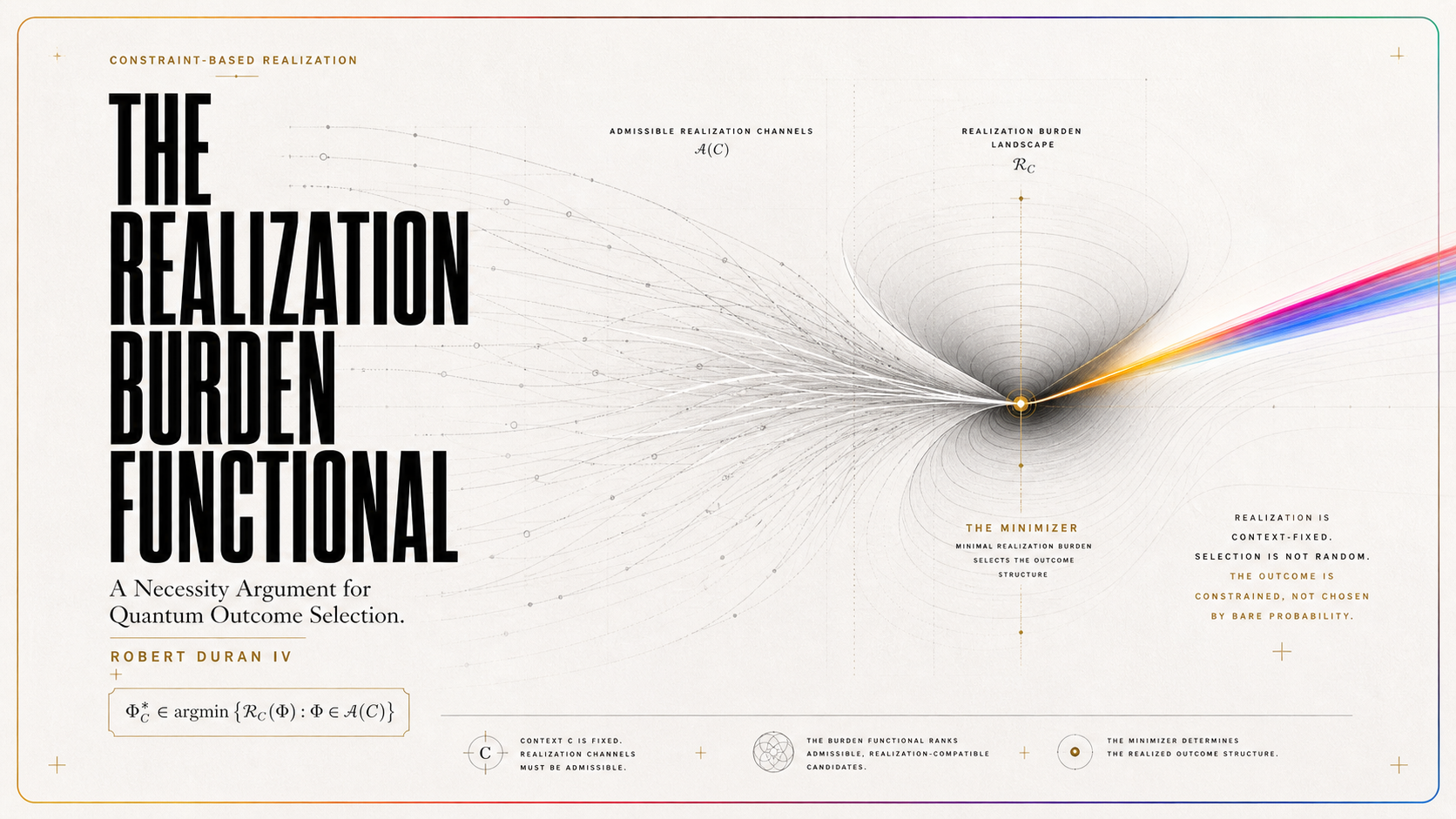
Constraint-Based Realization (CBR) formulates quantum outcome realization as a law-level selection problem within a fixed measurement context C. Given an admissible candidate class 𝒜(C), an operational equivalence relation ≃_C, and the quotient class 𝒜(C)/≃_C of operationally distinct admissible candidates, canonical CBR represents realized-outcome selection by
[Φ∗_C] ∈ argmin{[Φ] ∈ 𝒜(C)/≃_C} ℛ_C([Φ]).
The central question addressed here is whether the realization-burden functional ℛ_C is physically grounded or merely a discretionary scoring device. This paper argues that the burden-functional role is structurally required within any disciplined CBR-type realization law. If realization is distinct from unitary evolution, record formation, and probability assignment, then a candidate law of realization must supply a non-circular distinction between the realized candidate and the unrealized admissible candidates. Such a distinction must be fixed prior to the outcome, internal to the declared context, invariant under operational equivalence, disciplined by Born-compatible statistics, non-reducible to decoherence, and exposed to possible failure. These conditions force a physically constrained ordering over 𝒜(C)/≃_C. When that ordering is functionally representable, ℛ_C is its formal expression.
The result is a necessity argument for the burden-functional role, not a proof that any particular ℛ_C instantiation is correct and not a proof that CBR is nature’s final realization law. The paper establishes the narrower claim that, within a CBR-type law-candidate framework, ℛ_C is neither a decorative cost function nor a rival probability measure, neither decoherence renamed nor a post hoc scoring device. It is the functional representation of the burdened physical ordering required once admissible candidates, operational equivalence, probability discipline, decoherence separation, and failure exposure are fixed.
1. Introduction: The Burden at the Heart of CBR
The central pressure point in Constraint-Based Realization is the status of the realization-burden functional ℛ_C. If ℛ_C is merely an arbitrary scoring rule imposed on a space of possible outcomes, then CBR loses much of its force as a candidate law-form. If, however, ℛ_C is the functional representation of a structurally required and physically constrained ordering over admissible realization candidates, then its role is not optional. It becomes the formal point at which the problem of outcome realization is made accountable.
This paper develops the second claim. It does not attempt to prove that a particular instantiation of ℛ_C is correct for nature. Nor does it claim that CBR is experimentally confirmed, complete, or established as the final law of quantum outcome realization. Its aim is narrower and more foundational: to show that a disciplined CBR-type realization law cannot avoid the role played by ℛ_C. Once realization is treated as distinct from unitary evolution, record formation, and probability assignment, a candidate law must explain how one admissible candidate becomes actual rather than another. That explanation requires a non-circular distinction among admissible candidates. A non-circular distinction fixed before the outcome induces an ordering. A physically admissible ordering must be constrained by the measurement context, invariant under operational equivalence, disciplined by Born-compatible statistics, non-reducible to decoherence, and exposed to possible failure. When such an ordering is functionally representable, CBR denotes it by ℛ_C.
The point of departure is therefore not an invented optimization device, but the realization-law gap itself. Standard quantum dynamics describes state transformation. Decoherence helps explain the stabilization and accessibility of records. Probability assigns weights to possible outcomes. These structures are indispensable, but they do not by themselves supply a law of which admissible record-bearing candidate becomes the actual event. The distinction may be stated compactly as:
evolution ≠ registration ≠ realization.
Evolution concerns how the quantum state changes. Registration concerns how record-bearing structure forms, stabilizes, and becomes operationally accessible. Realization concerns which admissible candidate is actual. A theory that declines to address this final question may remain a successful predictive formalism, but it has not supplied a law of realization. CBR is proposed precisely as a candidate law-form for that remaining task.
The canonical CBR structure expresses realized-outcome selection within a fixed measurement context C. The context determines an admissible candidate class 𝒜(C), an operational equivalence relation ≃_C, and hence a quotient class 𝒜(C)/≃_C of operationally distinct admissible candidates. Canonical selection is then written as
[Φ∗_C] ∈ argmin{[Φ] ∈ 𝒜(C)/≃_C} ℛ_C([Φ]).
This formulation is important. CBR does not ask ℛ_C to choose from all imaginable outcomes, arbitrary labels, or unconstrained metaphysical possibilities. It asks ℛ_C to order only those candidate classes already admitted by the physical context. The object selected is not a superficial description, but an operational equivalence class [Φ∗_C]. A representative channel Φ∗_C may be used when convenient, but the selection claim is properly made at the quotient-class level.
The burden-functional question arises because this structure places ℛ_C at the center of the law-form. It is therefore not enough to say that ℛ_C ranks candidates. One must ask why a ranking of this kind is required, what makes it physically admissible, and what prevents it from becoming an unconstrained preference over outcomes. The answer developed here is that ℛ_C is not primitive in the order of justification. The primitive requirement is lawful selection. If realization is a genuine explanatory target and if multiple operationally distinct admissible candidates remain available within C, then a candidate law must distinguish the realized candidate class from the unrealized candidate classes. If that distinction is fixed only after the outcome, it is circular. If it is unconstrained by C, it is arbitrary. If it ignores ≃_C, it mistakes representational variation for physical difference. If it rewrites probability weights, it exits Born discipline. If it collapses into ordinary non-selective decoherence, it ceases to function as a realization law. If it cannot fail, it is not physically grounded; it is insulated.
The realization-burden functional is not an ornamental optimization device; it is the formal location where the burden of becoming actual is made physically accountable. Its legitimacy depends on the constraints under which it is defined. It must be pre-outcome fixed, context-internal, operationally invariant, Born-disciplined, decoherence-separating, and failure-exposed. These conditions do not prove that any specific ℛ_C is correct. They instead define what any admissible ℛ_C must satisfy if it is to function within canonical CBR.
This paper proceeds by deriving that requirement step by step. It first isolates the realization-law gap and the distinction between evolution, registration, and realization. It then defines the canonical objects C, 𝒜(C), ≃_C, 𝒜(C)/≃_C, and ℛ_C. From these, it establishes the no-free-realization lemma: where more than one operationally distinct admissible candidate remains, realization requires a lawfully fixed distinction. The paper then argues that such a distinction induces an ordering, that outcome-dependent ordering is circular, and that any valid ordering must respect operational equivalence. Only after this chain is in place does ℛ_C enter as the functional representation of the required ordering when such representation is admissible.
The central result is a necessity claim about the burden-functional role. Within a disciplined CBR-type law-candidate framework, the role played by ℛ_C cannot be eliminated without eliminating the law’s capacity to select non-circularly among admissible candidates. This is not a claim of empirical confirmation. It is not a claim of final physical truth. It is a structural claim about what a candidate law of realization must contain if it is to be more than a restatement that one outcome occurs.
2. The Realization-Law Gap
CBR begins from a separation that any law-level treatment of outcome actualization must either respect or explicitly deny:
evolution ≠ registration ≠ realization.
The distinction is structural. Evolution concerns state transformation: the dynamical development of the quantum state under the relevant closed- or open-system description. Registration concerns record formation: the stabilization, amplification, and accessibility of detector states, pointer structures, environmental traces, or other operational marks of a measurement interaction. Realization concerns a different question: which admissible candidate becomes the actual event.
Probability does not close this gap. Probability weights possible outcomes and constrains admissible statistical behavior. It supplies the measure structure under which outcome frequencies must be disciplined. But probability assignment is not itself outcome selection. To assign a weight to a candidate is not yet to identify why that candidate, rather than another admissible candidate, is the one realized.
Decoherence also does not close the gap. Decoherence helps explain the suppression of interference and the stability of record-bearing structures. It is indispensable to any serious account of registration. But registration is not realization. Decoherence can explain why alternatives become record-structured; it does not, by itself, supply the law by which one admissible record-bearing candidate becomes the realized event.
The realization-law gap therefore arises at the point where state transformation, record formation, and probability weighting have all been specified, but the law of actualization has not. A framework may avoid this gap by denying that unique realization is a fundamental target, by adopting a many-outcome ontology, by adding a collapse dynamics, or by treating outcomes pragmatically as records without further ontological commitment. CBR takes a different route. It treats realization as a candidate law-level target and asks what structure such a law must possess.
The first requirement is selection. If realization is a genuine explanatory target, then a candidate law must distinguish the realized admissible candidate from the unrealized admissible candidates. But selection is not made lawful merely by naming a selected result. A post-outcome selection rule is circular. A selection rule over an unspecified candidate space is undefined. A selection rule that ignores operational equivalence manufactures distinctions not supported by the context. A selection rule that alters Born-compatible statistics becomes a rival probability law. A selection rule that reduces to ordinary non-selective decoherence fails to address realization as distinct from registration.
Thus the realization-law gap imposes a burden before any burden functional is introduced. A law of realization must specify what the candidates are, which candidates are admissible, how operationally equivalent candidates are identified, what distinguishes the realized candidate, how probability discipline is preserved, how decoherence non-reduction is maintained, and what would count as failure. Without such structure, realization is not explained; it is only renamed.
This is the first step in the necessity chain. CBR does not begin by inventing ℛ_C. It begins with the claim that if realization is treated as a law-level target, then lawful selection is required. Lawful selection requires a pre-outcome distinction among admissible candidates. That distinction cannot be evaluated until the admissible domain has been fixed. The next section defines that domain.
3. The Canonical Objects
A realization law cannot operate over an unrestricted field of imaginable outcomes. Before selection can be lawful, the domain of selection must be fixed. CBR therefore introduces a measurement context C, an admissible candidate class 𝒜(C), and an operational equivalence relation ≃_C. Together, these determine the quotient class 𝒜(C)/≃_C of operationally distinct admissible candidates. Only at that level can the burden-functional role be stated without arbitrariness.
Definition 1: Measurement Context C.
A measurement context C is the fixed physical and operational setting in which a realization question is posed. It includes the relevant measurement arrangement, admissible dynamics, record structure, accessibility conditions, and comparison assumptions required to determine which candidate realization channels are eligible for consideration. C is fixed prior to the realized outcome. It is not an outcome label, nor a retrospective description of what occurred.
The role of C is domain fixation. A candidate cannot be admissible in the abstract. It is admissible only relative to the physical and operational conditions under which the realization question is posed.
Definition 2: Admissible Candidate Class 𝒜(C).
Given C, 𝒜(C) denotes the class of admissible candidate realization channels compatible with that context. Elements Φ, Ψ ∈ 𝒜(C) are not arbitrary possible outcomes. They are candidate realization channels satisfying the restrictions imposed by C.
This restriction is essential. CBR does not ask which imaginable outcome becomes real. It asks which candidate, among those admitted by the physical context, is selected as realized. Without 𝒜(C), any burden functional would risk becoming an unconstrained preference over possibilities.
Definition 3: Operational Equivalence ≃_C.
For Φ, Ψ ∈ 𝒜(C), the relation Φ ≃_C Ψ means that Φ and Ψ are equivalent for realization purposes within C. They may differ as mathematical representatives or descriptive presentations, but no admissible operational distinction inside C separates them for the realization question at issue.
Operational equivalence prevents false multiplicity. A lawful selection rule cannot depend on distinctions the context itself does not recognize as physically meaningful.
Definition 4: Quotient Candidate Class 𝒜(C)/≃_C.
The quotient class 𝒜(C)/≃_C is the class of operationally distinct admissible realization candidates. For Φ ∈ 𝒜(C), [Φ] denotes the operational equivalence class of Φ under ≃_C.
This quotient is the proper domain of canonical CBR selection. The law does not rank raw representatives. It ranks operationally distinct admissible candidate classes. The quotient formulation prevents artificial uniqueness from being generated by merely representational differences.
Definition 5: Realization-Burden Functional ℛ_C.
A realization-burden functional ℛ_C assigns a context-fixed burden to operationally distinct admissible candidate classes. Its proper domain is 𝒜(C)/≃_C:
ℛ_C([Φ]).
The subscript C is not decorative. It indicates that the burden functional is fixed relative to the measurement context. ℛ_C is not a free-standing numerical preference over outcomes, not a rival probability measure, and not decoherence renamed. It is the functional representation, when such representation is admissible, of a physically constrained ordering over admissible candidate classes.
Definition 6: Selected Realized Candidate Class [Φ∗_C].
The selected realized candidate class [Φ∗_C] is the operational equivalence class selected by the CBR law-form. Canonical selection is expressed as
[Φ∗_C] ∈ argmin{[Φ] ∈ 𝒜(C)/≃_C} ℛ_C([Φ]).
A representative channel Φ∗_C may be used when needed, but the selection claim properly concerns [Φ∗_C]. This is not a cosmetic refinement. It enforces that CBR ranks operationally distinct admissible candidate classes, not superficial descriptions, arbitrary labels, or raw representatives.
The canonical objects therefore perform three necessary functions. C fixes the context. 𝒜(C) fixes admissibility. ≃_C fixes operational identity. Only after these are in place can ℛ_C be introduced without appearing as an arbitrary score. CBR does not ask ℛ_C to choose from all imaginable outcomes; it asks ℛ_C to order only those candidates already admitted by the physical context. Probability constrains the admissible field; ℛ_C supplies the burdened ordering within that field.
The formal setup now turns the realization-law gap into a precise question. If C admits more than one operationally distinct admissible candidate, can a realization law avoid distinguishing one candidate class from the others? The next result shows that it cannot.
4. Lemma: No-Free-Realization
Once C, 𝒜(C), and ≃_C are fixed, the realization problem is no longer a question about an unrestricted space of possible outcomes. It is a question about the quotient class 𝒜(C)/≃_C: the operationally distinct admissible candidates that remain after the physical context, admissibility restrictions, and operational equivalence relation have done their work. If that quotient class has only one element, no nontrivial selection burden arises. If it has more than one element, and one candidate class becomes actual, then realization requires a lawfully fixed distinction.
Lemma 1: No-Free-Realization.
Let C be a fixed measurement context, let 𝒜(C) be a nonempty admissible candidate class, and let ≃_C be an operational equivalence relation on 𝒜(C). If 𝒜(C)/≃_C contains more than one operationally distinct admissible candidate, and one candidate class [Φ∗_C] is realized, then any candidate law of realization must supply a distinction between [Φ∗_C] and the unrealized admissible candidate classes.
Proof sketch.
If 𝒜(C)/≃_C contains a single element, admissibility and operational equivalence have already reduced the context to one relevant candidate class. At the quotient level, there is no remaining alternative from which the realized class must be selected.
If 𝒜(C)/≃_C contains more than one element, admissibility alone does not determine realization. Each element of the quotient class has already satisfied the conditions required to remain an admissible operational candidate within C. If [Φ∗_C] becomes actual rather than another admissible class, then the candidate law must supply a basis on which [Φ∗_C] is distinguished from the alternatives.
If no such basis is supplied, the law does not explain realization. It merely records that one admissible candidate became actual. If the basis is supplied only after [Φ∗_C] is known, then the realized candidate helps determine the explanatory condition that is supposed to account for its realization. That is circular. Therefore, where multiple operationally distinct admissible candidates remain, a realization law must provide a distinction fixed prior to the realized outcome.
There is no free realization: where multiple admissible candidates remain, actuality requires a lawfully fixed distinction.
The lemma does not yet require a numerical functional, a total ordering, or a unique minimizer. It establishes a more primitive constraint. A nontrivial realization law cannot remain silent about what differentiates the realized admissible class from the unrealized admissible classes. The next step is to show that any such non-circular distinction induces ordering structure over the quotient class.
5. Proposition: Selection Requires Ordering
The distinction required by Lemma 1 cannot remain formless. If it is to perform selection before the outcome is known, it must impose structure on the admissible domain. In CBR, that domain is not a set of raw representatives, informal possibilities, or outcome labels. It is the quotient class 𝒜(C)/≃_C of operationally distinct admissible realization candidates.
The relevant structure need not initially be numerical. It may be a selection relation, preorder, partial ranking, threshold condition, comparative priority relation, or burden ordering. What matters at this stage is not functional representation, but lawlike ordering. A law that selects must place admissible candidates into some relation by which one candidate class can be selected rather than another.
Proposition 1: Selection Requires Ordering.
Any non-circular candidate law of realization over a non-singleton quotient class 𝒜(C)/≃_C must induce a context-fixed selection relation, preorder, ranking, or burden ordering over that quotient class.
Proof sketch.
Let C be fixed, and suppose 𝒜(C)/≃_C contains more than one operationally distinct admissible candidate class. By Lemma 1, a candidate law of realization must distinguish the realized candidate class from the unrealized admissible classes.
For that distinction to be non-circular, it must be available prior to the realized outcome. For it to be lawlike, it must be fixed by the declared physical and operational structure of C rather than by retrospective labeling. A pre-outcome distinction over candidate classes thereby induces at least a selection relation among them: one class is selected over, prior to, less burdened than, compatible with a condition unmet by, or otherwise lawfully distinguished from the others. Such a relation is an ordering in the broad sense required for selection.
Therefore, any non-circular realization law over a non-singleton quotient class 𝒜(C)/≃_C must induce a context-fixed ordering or selection relation over that quotient class.
This proposition fixes the order of justification. CBR does not begin by positing ℛ_C as a scoring rule. It begins with the realization-law gap, which requires lawful selection. Lawful selection requires a pre-outcome distinction. A pre-outcome distinction over admissible candidates induces an ordering. ℛ_C enters only when that ordering is functionally representable.
Thus ℛ_C is not the primitive assumption; lawful ordering is the primitive requirement. The canonical minimization form,
[Φ∗_C] ∈ argmin{[Φ] ∈ 𝒜(C)/≃_C} ℛ_C([Φ]),
should be read accordingly. It is not an arbitrary numerical preference over outcomes. It is the functional representation, when available, of a prior burdened ordering over operationally distinct admissible candidates. Probability constrains the admissible field; ℛ_C supplies the burdened ordering within that field.
The next constraint is non-circularity. The ordering cannot depend on the candidate it is meant to select.
6. Proposition: Outcome-Dependent Ordering Is Circular
A realization law must fix its selection structure before the outcome. Otherwise, the explanatory direction is reversed. The realized candidate cannot be part of the basis by which the law determines that same candidate to be realized.
This requirement applies to every form of selection structure: relation, preorder, ranking, threshold rule, burden ordering, or functional representation. In CBR terms, it applies especially to ℛ_C. A burden functional constructed or adjusted after the realized class is known would not explain realization. It would merely restate the outcome in the language of burden minimization.
Proposition 2: Outcome-Dependent Ordering Is Circular.
If the ordering used to select the realized candidate depends on the realized outcome itself, then it cannot explain realization.
Proof sketch.
A candidate law of realization is meant to distinguish [Φ∗_C] from the other elements of 𝒜(C)/≃_C. If the ordering by which that distinction is made is fixed only after [Φ∗_C] is known, then [Φ∗_C] contributes to the rule under which it is selected. The law then presupposes, wholly or partly, the event it purports to explain.
Such a structure has the form of explanation but not its direction. It redescribes the outcome as selected, but it does not supply a pre-outcome basis for selection. Therefore, any admissible realization ordering must be fixed independently of the realized candidate.
In CBR, this means that ℛ_C, when introduced as the functional representation of the ordering, must be fixed by the declared context C, the admissible class 𝒜(C), the operational equivalence relation ≃_C, and the relevant physical constraints before realization. It cannot be revised after the outcome to preserve the selection claim.
A law that waits for the outcome before fixing the burden is not a law of realization; it is a post hoc description of realization.
The necessity chain now has three steps. Realization requires selection. Selection requires a pre-outcome distinction. A pre-outcome distinction over a non-singleton quotient class induces an ordering. The next constraint is operational: the ordering cannot distinguish candidates that the context itself identifies as equivalent.
7. Proposition: Operational Invariance
A realization law cannot allow selection to depend on distinctions that the measurement context itself does not recognize. Once C fixes the physical setting and ≃_C identifies candidates equivalent for the realization question, any admissible selection structure must respect that equivalence. Otherwise the law would not be selecting among physically distinct candidates; it would be selecting among representational variants.
This requirement is part of the anti-arbitrariness discipline of CBR. If Φ and Ψ differ only as representatives while Φ ≃_C Ψ, then no admissible operational feature of C separates them for purposes of realization. A burden that assigns different realization status to Φ and Ψ would therefore import structure not contained in the declared context.
Proposition 3: Operational Invariance.
A valid realization burden cannot distinguish candidates equivalent under ≃_C. If Φ ≃_C Ψ, then Φ and Ψ must be treated as the same candidate for purposes of realization-burden evaluation. Hence ℛ_C must be defined on 𝒜(C)/≃_C, not merely on raw representatives in 𝒜(C).
Proof sketch.
Let Φ, Ψ ∈ 𝒜(C), and suppose Φ ≃_C Ψ. By definition, Φ and Ψ are equivalent for the realization question within C. Any difference between them is not an operationally admissible distinction in that context.
If a realization burden assigns different burdens to Φ and Ψ, then the burden depends on representative-level structure rather than operationally meaningful candidate structure. The resulting selection rule could distinguish candidates that C itself identifies as equivalent. Such a rule would violate context-fixation and introduce artificial multiplicity.
Therefore a valid burden must be invariant under ≃_C. Its proper argument is the equivalence class [Φ], and its proper domain is the quotient class 𝒜(C)/≃_C. The canonical burden expression is
ℛ_C([Φ]),
and the canonical selection form is
[Φ∗_C] ∈ argmin{[Φ] ∈ 𝒜(C)/≃_C} ℛ_C([Φ]).
A realization law cannot make physical selection depend on distinctions the context itself declares operationally irrelevant.
Operational invariance fixes the level of the theory. The burden-functional role is not a ranking of descriptions, labels, or arbitrary representatives. It is a ranking, if functionally representable, of operationally distinct admissible candidate classes.
8. Theorem: Functional Representation of Realization Burden
The previous results establish an ordering requirement, not yet a functional one. Realization requires selection. Selection requires a pre-outcome distinction. A pre-outcome distinction over a non-singleton quotient class induces an ordering. Operational invariance requires that the ordering act on 𝒜(C)/≃_C. The realization-burden functional ℛ_C enters only at this point: as the functional representation of that ordering when such representation is admissible.
This order matters. CBR does not begin by scoring possible outcomes. It begins from the law-level requirement that realization be distinguished non-circularly within a fixed admissible domain. ℛ_C is introduced only when the required ordering can be represented as a burden functional over operational equivalence classes.
Theorem 1: Functional Representation.
Let C be fixed, and let 𝒜(C)/≃_C be the quotient class of operationally distinct admissible candidates. If a candidate realization law induces a context-fixed burden ordering over 𝒜(C)/≃_C, and if that ordering satisfies the relevant representability conditions, then there exists a realization-burden functional ℛ_C such that the selected realized class is represented as a minimizer of ℛ_C:
[Φ∗_C] ∈ argmin{[Φ] ∈ 𝒜(C)/≃_C} ℛ_C([Φ]).
Proof sketch.
By Proposition 1, any non-circular realization law over a non-singleton quotient class must induce a context-fixed selection relation, preorder, ranking, or burden ordering over 𝒜(C)/≃_C. By Proposition 2, that ordering must be fixed independently of the realized outcome. By Proposition 3, it must respect ≃_C and therefore act on equivalence classes [Φ], not arbitrary representatives Φ.
Assume that the ordering satisfies the relevant representability conditions. That is, assume that its comparative structure can be preserved by assigning burden values to elements of 𝒜(C)/≃_C. Then there exists a functional ℛ_C on the quotient class such that lower burden corresponds to priority under the realization ordering. The selected realized class is then represented as a minimizer of ℛ_C.
The theorem is conditional in the required sense. It does not claim that every ordering is automatically representable by a real-valued functional. It does not claim that every functional over 𝒜(C)/≃_C is physically admissible. It claims only that, when the ordering required by a candidate realization law is functionally representable, ℛ_C is the representation of that ordering.
ℛ_C is therefore the functional representation of the realization ordering, not a decorative score imposed after the fact. The theorem supplies the formal bridge from lawful selection to burden minimization. What remains is the physical question: which functionals are admissible as realization-burden functionals, and which are merely arbitrary scores?
9. Physical Admissibility Conditions on ℛ_C
A functional representation is not yet a physically admissible realization law. A formula can rank candidates without being grounded in the measurement context. ℛ_C becomes legitimate only when the ordering it represents satisfies the constraints required of a law of realization. These constraints are what prevent ℛ_C from becoming a hand-picked score.
A valid ℛ_C must satisfy the following admissibility conditions.
Pre-outcome fixation.
ℛ_C must be fixed before the outcome is realized. It cannot be chosen, adjusted, or reinterpreted after [Φ∗_C] is known. A burden functional modified in light of the result does not explain realization; it conforms retrospectively to it.
Context-internality.
ℛ_C may depend only on declared features of C, 𝒜(C), ≃_C, admissible dynamics, record structure, operational accessibility, baseline comparators, and nuisance structure. It cannot import undeclared variables, hidden preferences, or post hoc criteria not fixed by the context.
Operational invariance.
ℛ_C must be defined on 𝒜(C)/≃_C. If Φ ≃_C Ψ, no admissible burden evaluation may treat Φ and Ψ as distinct realization candidates. The burden attaches to [Φ], not to representative-level artifacts.
Born discipline.
ℛ_C is not a rival probability measure. It cannot secretly replace Born weighting, introduce non-Born outcome preferences, or alter statistical admissibility while remaining within canonical CBR. Probability constrains the admissible field; ℛ_C supplies the burdened ordering within that field.
Record sensitivity.
Where C concerns record-bearing outcomes, ℛ_C must be sensitive to the physical possibility of stable, accessible, or operationally meaningful records. A candidate unable to support the relevant record structure cannot be treated as equally realization-admissible in a context where registration is part of admissibility.
Decoherence separation.
ℛ_C must not collapse into ordinary non-selective decoherence. Decoherence helps explain record stabilization, but it is not by itself a law selecting which admissible record-bearing candidate becomes actual. If ℛ_C merely reproduces a non-selective decoherence-compatible mixture without realization-specific selection structure, it fails as a realization-burden functional.
Empirical vulnerability.
An instantiated ℛ_C must admit possible failure conditions. If no observation, comparison, constraint violation, or strong-null result could count against the instantiation, the burden functional is insulated rather than physically grounded. A burden functional that cannot fail is not physically grounded; it is insulated.
These conditions identify the source of physical grounding. The grounding of ℛ_C does not come from the mere possibility of writing a functional. It comes from the constraints any admissible realization candidate must satisfy before it can count as actual. A candidate ℛ_C is physically admissible only if it represents an ordering fixed prior to realization, internal to C, invariant under ≃_C, compatible with Born discipline, distinct from non-selective decoherence, and exposed to defeat.
The physical grounding of ℛ_C comes from the constraints any admissible realization candidate must satisfy before it can count as actual. With these conditions fixed, the burden-functional role can now be stated as a necessity result.
10. Theorem: Realization-Burden Necessity
The burden-functional role is not introduced as an independent postulate. It is forced by the preceding chain. If realization is treated as a law-level target, then a law must select. If multiple operationally distinct admissible candidates remain, selection requires a distinction. If the distinction is explanatory, it must be fixed before the outcome. If the distinction is lawlike, it induces an ordering over the admissible quotient class. If the ordering is physically admissible, it must respect context-fixation, operational equivalence, Born discipline, decoherence separation, record support where relevant, and failure exposure. When that ordering is functionally representable, it is ℛ_C.
Theorem 2: Realization-Burden Necessity.
Let C be a fixed measurement context. Let 𝒜(C) be a nonempty admissible candidate class, and let ≃_C be an operational equivalence relation over 𝒜(C). Suppose a candidate realization law satisfies context-fixation, admissibility restriction, non-circularity, operational invariance, Born discipline, record support, non-reduction to decoherence, and empirical vulnerability. Then the law must induce a physically constrained ordering over 𝒜(C)/≃_C. When that ordering is functionally representable, it can be written in CBR form as selection of a minimizer of a realization-burden functional ℛ_C:
[Φ∗_C] ∈ argmin{[Φ] ∈ 𝒜(C)/≃_C} ℛ_C([Φ]).
Proof sketch.
Let C fix the measurement context, 𝒜(C) fix the admissible candidate class, and ≃_C identify operational equivalence among candidates. The quotient 𝒜(C)/≃_C contains the operationally distinct admissible candidates.
If 𝒜(C)/≃_C has a single element, no nontrivial selection burden arises at the quotient level. If it has more than one element and one candidate class is realized, Lemma 1 requires a distinction between the realized class and the unrealized admissible classes.
By non-circularity, that distinction must be fixed independently of the realized outcome. By context-fixation and admissibility restriction, it must operate only over candidates admitted by C. By operational invariance, it must act on 𝒜(C)/≃_C rather than on raw representatives. By Born discipline, it cannot function as a hidden replacement probability law. By record support, where records are part of C, it must respect the conditions under which record-bearing candidates are admissible. By non-reduction to decoherence, it cannot collapse into ordinary non-selective decoherence. By empirical vulnerability, it must carry possible failure conditions.
These requirements force a physically constrained ordering over 𝒜(C)/≃_C. If that ordering is functionally representable, then by Theorem 1 it may be represented by ℛ_C, and the selected realized candidate class is expressed as a minimizer:
[Φ∗_C] ∈ argmin{[Φ] ∈ 𝒜(C)/≃_C} ℛ_C([Φ]).
Scope note.
This theorem does not prove that any particular ℛ_C is correct. It does not prove that CBR is experimentally confirmed, established physics, or nature’s final realization law. Its claim is narrower and structural: within a disciplined CBR-type realization-law framework, the burden-functional role is required. A law that eliminates that role must either deny the realization target, deny nontrivial selection, leave the selection distinction unexplained, or supply a different realization mechanism outside the CBR law-form.
The necessity result concerns the role of ℛ_C, not the final correctness of any particular instantiation. It establishes that ℛ_C is not a decorative cost function added after the theory is built. It is the functional representation, when available, of the physically constrained ordering that a non-circular realization law must provide.
11. Theorem: Anti-Arbitrariness
The necessity of the burden-functional role does not make every burden functional admissible. A functional may be defined on 𝒜(C)/≃_C, may produce a minimizer, and may still fail to qualify as a realization-burden functional within canonical CBR. The relevant question is not whether a ranking can be written. The question is whether the ranking is fixed by the physical and operational constraints that make realization selection lawful.
This is the point at which ℛ_C becomes a discipline on CBR rather than a device for protecting it. If ℛ_C may be chosen after the outcome, detached from C, insensitive to ≃_C, indifferent to Born discipline, reducible to decoherence, or insulated from failure, then it does not ground the theory. It defeats the canonical role it was introduced to play. A realization-burden functional is admissible only if it is itself constrained by the burden of realization.
Theorem 3: Anti-Arbitrariness.
A realization-burden functional ℛ_C is non-arbitrary within canonical CBR only if it is pre-outcome fixed, context-internal, operationally invariant, Born-disciplined, record-sensitive where records are required, decoherence-separating, and empirically vulnerable. If any of these conditions fails, the proposed ℛ_C loses canonical admissibility.
Proof sketch.
A functional is arbitrary in the relevant sense when its selection effect is not determined by the declared physical and operational structure of the measurement context. Canonical CBR excludes such arbitrariness by restricting both the domain and the permissible content of ℛ_C.
Pre-outcome fixation excludes retroactive construction. If ℛ_C is selected or revised after [Φ∗_C] is known, the functional conforms to the realized result rather than explaining it. Context-internality excludes undeclared structure. If ℛ_C depends on factors not fixed by C, 𝒜(C), ≃_C, admissible dynamics, record structure, operational accessibility, baseline comparators, or nuisance structure, then its selection effect is not determined by the declared context. Operational invariance excludes representative-level selection. If Φ ≃_C Ψ, then ℛ_C cannot assign different realization burdens to Φ and Ψ without violating the quotient structure 𝒜(C)/≃_C.
Born discipline excludes hidden probability replacement. ℛ_C cannot alter outcome weights while presenting itself as a realization-ordering functional. Record sensitivity excludes physically empty candidates in contexts where record-bearing structure is part of admissibility. Decoherence separation excludes reduction to ordinary non-selective decoherence. Empirical vulnerability excludes insulated functionals for which no admissible observation, comparison, constraint violation, or strong-null result could count as failure.
These conditions are not optional refinements. They are the conditions under which ℛ_C may play the role established by the realization-burden necessity theorem. A proposed functional that violates them may remain a formal ranking, but it is not canonically admissible as a realization-burden functional.
CBR is not protected by the burden functional; CBR is disciplined by it. ℛ_C does not give the framework permission to select conveniently. It identifies the precise place where the framework’s selection commitments must be fixed, constrained, and exposed to possible defeat. A burden functional that fails the anti-arbitrariness conditions is not a flexible version of CBR. It is a failed instantiation of the canonical law-form.
The theorem therefore supplies the negative standard of the paper: not every ℛ_C counts. Only a burden functional fixed before the outcome, internal to C, invariant under ≃_C, compatible with Born discipline, separated from decoherence, and exposed to failure can function as a canonical realization-burden functional. The next question is whether this burden-functional requirement is universal in form or universal only in role.
12. Universal Role, Context-Dependent Form
The necessity of ℛ_C should not be confused with the claim that one explicit burden formula must govern every possible measurement context. That stronger claim is unnecessary for the present argument and would misstate the structure of CBR. What is universal is the role: a non-circular realization law must provide a physically constrained ordering over operationally distinct admissible candidates. What is context-dependent is the physical form by which that role is instantiated.
This distinction is essential. The admissible candidates are fixed by C. The equivalence relation ≃_C is fixed by C. Record structure, accessibility conditions, baseline comparators, nuisance envelopes, and detectability standards are also context-relative. It would therefore be a mistake to demand that every context instantiate the same burden terms. The invariant requirement is not formulaic sameness. It is canonical discipline.
Corollary 1: Universal Role, Context-Dependent Form.
Within canonical CBR, ℛ_C is universal in role but context-dependent in form. Its role is universal because any non-circular realization law over a non-singleton quotient class must provide a physically constrained ordering over operationally distinct admissible candidates. Its form is context-dependent because the admissible candidates, equivalence classes, record structures, accessibility conditions, baseline comparators, nuisance classes, and failure conditions are fixed by C.
Proof sketch.
By Theorem 2, any disciplined CBR-type realization law over a non-singleton 𝒜(C)/≃_C must induce a physically constrained ordering. When that ordering is functionally representable, it is represented by ℛ_C. This establishes the universality of the burden-functional role within the CBR law-form.
The content of that ordering, however, depends on the context in which the realization question is posed. The admissible class 𝒜(C), the equivalence relation ≃_C, the operational record structure, the accessibility parameter η, any critical value η_c or interval I_c, the baseline comparator ℬ, the nuisance class 𝓝, the nuisance envelope B_𝓝, and the detectability threshold ε_detect are not fixed independently of C. Since the physical objects being ordered vary with C, the concrete form of the burden may vary with C.
Therefore, ℛ_C is universal in role but context-dependent in admissible form.
The universality of ℛ_C lies in the necessity of burdened selection; the context-dependence of ℛ_C lies in the physical content of the burden.
This corollary blocks two errors. The first is to infer arbitrariness from context-dependence. Context-dependence is not arbitrary when the context, candidate class, equivalence relation, admissible dynamics, record structure, and failure conditions are fixed before the outcome. The second error is to infer universality from context-independence. A burden functional detached from C would not be more fundamental; it would be less physically accountable.
The proper claim is narrower and stronger. CBR requires the burden-functional role wherever the realization problem is posed over a non-singleton quotient class. Each instantiation must then declare the measurement context, candidate class, equivalence relation, burden structure, and failure conditions. Context-dependence is legitimate only when it is fixed, constrained, and failure-exposed. It becomes inadmissible when used to revise the burden after the outcome or to evade a failed test.
This distinction also clarifies the status of accessibility-based instantiations. A delayed-choice record-accessibility context may instantiate ℛ_C through η, η_c or I_c, ℬ, 𝓝, B_𝓝, and ε_detect. That does not make the accessibility form the universal definition of ℛ_C. It makes it one possible context-dependent realization of the universal burden-functional role.
The next distinction is parallel. Since ℛ_C orders admissible candidates, it may be mistaken for a probability measure. Canonical CBR must exclude that reading.
13. ℛ_C Is Not a Probability Measure
ℛ_C is not a probability measure. It does not assign Born weights, replace Born weights, or introduce a hidden distribution over outcomes. Its role is not to determine how likely each candidate is. Its role is to represent, where admissible, the burdened ordering by which a realization law selects among operationally distinct admissible candidates.
This distinction follows from the separation between probability and realization. Probability weights possible outcomes. It constrains statistical admissibility, expected frequencies, and compatibility with quantum prediction. Realization concerns which admissible candidate becomes actual within a fixed context. A burden functional that silently changes probabilities is no longer merely a realization-burden functional. It has become a rival probability rule.
Corollary 2: No Probability Replacement.
Within canonical CBR, ℛ_C is not a probability measure. It is a physically constrained ordering over operationally distinct admissible realization candidates under Born discipline. A proposed ℛ_C that secretly replaces Born weighting or changes Born-compatible frequencies without declaring and surviving a new empirical theory is not canonically admissible.
Proof sketch.
By definition, ℛ_C is a realization-burden functional on 𝒜(C)/≃_C. Its role is to represent a physically constrained ordering among admissible candidate classes. That role is distinct from probability assignment.
Born-compatible statistics constrain the admissible field within which canonical CBR operates. If ℛ_C assigns outcome probabilities, or if its burden ordering covertly changes the statistical weights of outcomes while claiming to remain canonical, then it no longer functions solely as ℛ_C. It acts as a replacement probability law. Such a move violates Born discipline unless it is explicitly stated as a new empirical theory and exposed to the appropriate tests.
Therefore, within canonical CBR, ℛ_C operates under Born discipline rather than replacing it.
A lower realization burden is not automatically a higher probability. Burden and probability are different structures. Probability concerns statistical weight. Burden concerns realization selection among admissible candidates. If a proposed instantiation of ℛ_C entails observable statistical deviations, then those deviations must be declared, compared against the appropriate baseline ℬ and nuisance envelope B_𝓝, and evaluated under a detectability threshold ε_detect. They cannot be hidden inside the burden functional while CBR continues to claim ordinary Born compatibility.
Probability constrains the admissible field; ℛ_C supplies the burdened ordering within that field.
This division of labor is essential. Without Born discipline, CBR becomes an unconstrained probability-replacement theory. Without ℛ_C, CBR lacks the selection structure required by its own realization-law target. The two roles are therefore complementary but not interchangeable. CBR does not discard quantum probability in order to explain realization. It treats realization as a distinct law-level question that must be answered under probability discipline.
This corollary preserves the canonical scope of the proposal. ℛ_C is not introduced to reweight possible outcomes. It is introduced to represent the lawful ordering required once C has fixed the admissible field. The next distinction is parallel: just as ℛ_C is not probability renamed, it is also not decoherence renamed.
14. ℛ_C Is Not Decoherence Renamed
ℛ_C must not be identified with decoherence. Decoherence is essential to the physical analysis of measurement because it explains how interference between alternatives becomes suppressed and how record-bearing structures become stable, redundant, and operationally accessible. But its explanatory role is not the role assigned to ℛ_C. Decoherence belongs to the account of registration. CBR concerns realization.
The distinction follows from the organizing separation of the paper:
evolution ≠ registration ≠ realization.
Evolution concerns state transformation. Registration concerns the formation and stabilization of records. Realization concerns which admissible candidate becomes the actual event. Decoherence may be indispensable to registration, but registration is not realization. Decoherence can explain why alternatives become record-structured; it does not, by itself, supply the law by which one admissible record-bearing candidate becomes the realized event.
Corollary 3: Decoherence Non-Reduction.
Within canonical CBR, ℛ_C cannot be identified with ordinary non-selective decoherence. A proposed ℛ_C that merely reproduces a decoherence-compatible non-selective mixture, without supplying realization-specific selection structure over 𝒜(C)/≃_C, fails as a realization-burden functional.
Proof sketch.
By Theorem 2, ℛ_C represents, when functionally admissible, a physically constrained ordering over operationally distinct admissible realization candidates. That ordering is required because realization is treated as a law-level selection problem.
Ordinary non-selective decoherence does not perform this selection. It can account for interference suppression, record stabilization, and the effective robustness of branches or pointer structures. It does not select a realized class [Φ∗_C] from 𝒜(C)/≃_C. If a proposed ℛ_C collapses into that non-selective structure, then it does not provide the realization-specific ordering required by canonical CBR. It therefore fails as a realization-burden functional.
This does not make decoherence irrelevant to CBR. Decoherence may help define C, constrain 𝒜(C), determine which candidates are record-bearing, and shape the operational conditions under which candidate classes are admissible. But a realization law that reduces to decoherence no longer answers the realization question. It replaces the problem of actualization with the problem of record stabilization.
The boundary is therefore exact. CBR may depend on decoherence as part of the physical context, but ℛ_C cannot be decoherence renamed. It must remain compatible with decoherence while supplying a distinct burdened ordering over admissible realization candidates.
15. Accessibility-Based Instantiation
The preceding argument establishes the burden-functional role at the canonical level. It does not require that every measurement context instantiate ℛ_C through the same physical variables. Accessibility-based contexts provide one controlled example of how the abstract burden-functional role may acquire operational content.
In a delayed-choice record-accessibility setting, the context C may include an operational record-accessibility parameter η. A critical accessibility value η_c, or a critical interval I_c, may designate the regime in which an accessibility-sensitive instantiation predicts a distinctive realization-burden effect. The baseline comparator ℬ specifies the standard quantum-plus-decoherence-plus-instrumental expectation. The nuisance class 𝓝 and nuisance envelope B_𝓝 encode detector inefficiency, drift, calibration uncertainty, noise, and other platform-specific effects. The detectability threshold ε_detect specifies when a claimed deviation is operationally meaningful.
These quantities do not define ℛ_C in general. They define one possible context-dependent instantiation of the burden-functional role. The accessibility model is therefore not the universal meaning of ℛ_C. It is an applied realization of the canonical requirement that CBR provide a physically constrained ordering over 𝒜(C)/≃_C.
An accessibility-based ℛ_C is admissible only if it satisfies the same constraints as any other proposed burden functional. It must be fixed before the relevant outcome or data comparison. It must be internal to C. It must be defined over operational equivalence classes [Φ]. It must remain Born-disciplined. It must not collapse into ordinary decoherence. It must be evaluated against ℬ, 𝓝, B_𝓝, and ε_detect rather than against an idealized or retrospectively adjusted baseline.
The strong-null condition supplies the relevant exposure. If the declared accessibility-based instantiation predicts a pre-registered separation from the validated baseline-plus-nuisance envelope, and no such separation appears under detectability-valid conditions, that instantiation fails. The failure is not automatically a refutation of every possible realization-law program. Nor is it automatically a refutation of every possible CBR-type structure. It is a failure of the declared instantiation whose C, 𝒜(C), ≃_C, ℛ_C, ℬ, B_𝓝, and ε_detect generated the failed prediction.
This distinction preserves both empirical exposure and scope control. CBR cannot use context-dependence to evade a failed test. Once an accessibility-based ℛ_C is declared, its commitments are fixed. But the accessibility instantiation should not be mistaken for the universal definition of ℛ_C. It is one context-dependent realization of the universal burden-functional role.
The accessibility model is one context-dependent instantiation of the universal burden-functional role. It is not the definition of ℛ_C in all contexts.
16. Failure Conditions
The burden-functional role has scientific content only if proposed instantiations can fail. A framework that permits ℛ_C to be revised, reinterpreted, or insulated whenever its commitments become inconvenient does not possess a disciplined realization law. It possesses a movable description. Canonical CBR must therefore specify when a proposed ℛ_C loses admissibility.
Failure Criterion: Invalid ℛ_C Instantiation.
A proposed realization-burden functional ℛ_C fails as a canonical CBR instantiation if it violates the conditions required for a physically admissible realization ordering over 𝒜(C)/≃_C.
More explicitly, a proposed ℛ_C fails if it:
is chosen after the outcome;
depends on the realized result;
imports undeclared physical structure;
is not defined over the declared admissible class 𝒜(C);
fails to respect the quotient structure 𝒜(C)/≃_C;
distinguishes candidates equivalent under ≃_C;
violates Born discipline;
acts as a hidden replacement probability law;
collapses into ordinary non-selective decoherence;
has no possible empirical consequence;
changes after a failed test;
produces no stable minimizer or minimizer class where the context requires one;
lacks a physically interpretable role in C.
These failure modes are internal to the canonical law-form. A proposed ℛ_C chosen after the outcome violates non-circularity. A functional that imports undeclared structure violates context-fixation. A functional that distinguishes Φ and Ψ despite Φ ≃_C Ψ violates operational invariance. A functional that changes Born-compatible statistics without declaring a new empirical theory violates probability discipline. A functional that reduces to decoherence abandons realization as distinct from registration. A functional that cannot fail is insulated from the accountability required of a law-candidate.
A burden functional that cannot fail is not physically grounded; it is insulated.
The minimizer condition requires precision. Canonical CBR need not assume that every preliminary ordering is total or that every context automatically yields a unique representative channel. The requirement is narrower: where a context is claimed to deliver a complete realization verdict, the instantiation must identify a selected minimizer class [Φ∗_C] up to ≃_C, or else provide a pre-outcome admissible tie-breaking structure. If it cannot do either, it has not delivered a complete realization law for that context.
Failure also has jurisdiction. If a proposed ℛ_C violates the admissibility conditions, that instantiation fails. If an accessibility-based ℛ_C predicts a pre-registered separation from ℬ outside B_𝓝 above ε_detect and no such separation appears under valid conditions, that accessibility instantiation fails. If the burden is revised after the failed comparison, the revised object is not the tested object. It is a new proposal and must be registered as such.
Theorem 2 establishes why the burden-functional role is required. The failure criterion establishes when a proposed bearer of that role loses canonical admissibility. Together, they prevent ℛ_C from functioning as an escape hatch. The burden functional is the place where CBR’s selection commitments become precise enough to be judged.
17. Objections and Replies
The strongest objections to the burden-functional account concern arbitrariness, context-dependence, probability, decoherence, representational scope, and incompleteness. These objections are useful because they mark the exact limits of the present result. The paper does not claim that CBR is proven. It claims that, within a disciplined CBR-type realization-law framework, the burden-functional role is structurally required and canonically constrained.
Objection 1: ℛ_C is hand-picked.
Only an unconstrained ℛ_C is hand-picked. Canonical CBR does not permit an arbitrary score over outcomes. It requires ℛ_C to be pre-outcome fixed, context-internal, operationally invariant, Born-disciplined, decoherence-separating, and failure-exposed. A proposed functional that fails these conditions is not an admissible realization-burden functional. It is a failed instantiation.
The burden-functional role is therefore not a license to select conveniently. It is a discipline imposed on the selection claim. CBR is not protected by the burden functional; CBR is disciplined by it.
Objection 2: Different ℛ_C choices could select different candidates.
Yes. That is why not every ℛ_C is admissible. Canonical CBR requires a declared measurement context C, admissible candidate class 𝒜(C), operational equivalence relation ≃_C, burden structure over 𝒜(C)/≃_C, and failure conditions fixed before the relevant outcome or test.
If two proposed ℛ_C forms select different candidate classes in the same context, the disagreement cannot be hidden. It must be adjudicated by the admissibility conditions: which functional is context-internal, operationally invariant, Born-disciplined, decoherence-separating, physically interpretable, and failure-exposed. If neither satisfies those conditions, neither is canonically admissible.
Objection 3: Context-dependence weakens universality.
Context-dependence weakens universality only if universality is mistakenly identified with a single context-free formula. CBR does not require that. The role of ℛ_C is universal because non-circular realization requires a physically constrained ordering over operationally distinct admissible candidates. The form of ℛ_C is context-dependent because admissible candidates, record structures, accessibility conditions, baseline comparators, nuisance envelopes, and detectability standards are fixed by C.
The universality of ℛ_C lies in the necessity of burdened selection; the context-dependence of ℛ_C lies in the physical content of the burden. Context-dependence is admissible when it is declared, fixed, constrained, and exposed to failure. It becomes inadmissible when used to revise the burden after the outcome or to evade defeat.
Objection 4: ℛ_C replaces the Born rule.
It does not. ℛ_C is not a probability measure. It does not assign Born weights, replace Born weights, or introduce a hidden distribution over outcomes. It orders operationally distinct admissible candidate classes under Born discipline.
If a proposed ℛ_C changes Born-compatible frequencies, that change must be declared as an empirical claim and tested against ℬ, B_𝓝, and ε_detect. It cannot be smuggled into the theory while maintaining the status of canonical Born compatibility. Probability constrains the admissible field; ℛ_C supplies the burdened ordering within that field.
Objection 5: Decoherence already explains the records.
Decoherence helps explain registration: the stabilization, amplification, and accessibility of record-bearing alternatives. CBR can accept this while still denying that registration is identical to realization. Decoherence can explain why alternatives become record-structured; it does not, by itself, supply the law by which one admissible record-bearing candidate becomes the realized event.
If a proposed ℛ_C merely reproduces ordinary non-selective decoherence, then it fails as a realization-burden functional. The CBR claim is not that decoherence is irrelevant. The claim is that decoherence is not identical to a law of realization.
Objection 6: The theorem proves representation, not truth.
Correct. The paper proves the necessity of the burden-functional role inside a disciplined CBR-type realization-law framework. It does not prove that any particular ℛ_C is correct. It does not prove that CBR is established physics. It does not prove that CBR is nature’s final realization law.
This limitation is not a weakness in the argument. It is the proper scope of the argument. The result is structural: if one accepts the CBR-type aim of a non-circular realization law over operationally distinct admissible candidates, then the law must provide a physically constrained ordering. When functionally representable, that ordering is ℛ_C. The truth of any particular ℛ_C instantiation remains a further physical and empirical question.
Objection 7: A partial ordering may not yield a unique minimizer.
Then the instantiation is incomplete unless it supplies additional structure. Canonical CBR need not assume that every preliminary ordering is total. But a context claimed to deliver a realization verdict must identify a selected minimizer class [Φ∗_C] up to ≃_C, or provide a pre-outcome admissible tie-breaking rule. If it cannot do so, it has not delivered a complete realization law for that context.
This reply preserves both rigor and vulnerability. CBR does not succeed merely because an ordering exists. The ordering must support the selection claim the context requires. Where it does not, the instantiation fails or remains incomplete.
These objections clarify the paper’s modest but significant conclusion. The argument does not establish CBR as true. It establishes that the burden-functional role is not optional within a disciplined CBR-type realization law. ℛ_C is not a hand-picked scoring function when it is fixed, constrained, and failure-exposed. It is the functional representation of the physically admissible ordering that the realization problem itself requires.
18. Conclusion
This paper has defended a limited but central claim: within a disciplined CBR-type realization-law framework, the burden-functional role is not optional. The argument has not sought to prove that CBR is established physics, that any particular instantiation of ℛ_C is correct, or that CBR is nature’s final law of outcome realization. Its claim is structural. If realization is treated as a law-level target distinct from evolution, registration, and probability assignment, then a candidate law must provide a physically constrained means of selection.
The necessity chain is the spine of the result. Realization requires selection. Selection requires a distinction between the realized admissible candidate and the unrealized admissible candidates. If that distinction is to explain realization rather than redescribe it, it must be fixed before the outcome. If it is to be lawful, it must induce an ordering over the admissible domain. If it is to be physically admissible, that ordering must be context-fixed, operationally invariant, Born-disciplined, decoherence-separating, and exposed to failure. When the ordering is functionally representable, its representation is ℛ_C.
The quotient-class formulation is essential. Canonical CBR does not rank arbitrary outcome labels, informal alternatives, or raw representatives. It ranks operationally distinct admissible candidate classes in 𝒜(C)/≃_C. The selected object is [Φ∗_C], not a merely notational representative. This prevents the burden functional from manufacturing distinctions that the measurement context itself does not recognize as physically meaningful.
The boundaries of the burden-functional role are equally important. ℛ_C is not a probability measure. It does not assign, replace, or modify Born weights. Probability constrains the admissible field; ℛ_C supplies the burdened ordering within that field. ℛ_C is not decoherence renamed. Decoherence helps explain record stabilization and registration, but it does not, by itself, supply the law by which one admissible record-bearing candidate becomes the realized event. ℛ_C is not a post hoc scoring device. A burden functional chosen after the outcome, revised after failure, or insulated from possible defeat loses canonical admissibility.
The result is therefore double-edged. Positively, CBR requires a burden-functional role because realization, if treated as a law-level problem, requires a constrained ordering over admissible candidates. Negatively, not every proposed ℛ_C is admissible. A candidate realization-burden functional must be pre-outcome fixed, context-internal, operationally invariant, Born-disciplined, record-sensitive where records are required, decoherence-separating, physically interpretable, empirically exposed, and no-rescue stable.
The realization-burden functional is not an ornamental cost function added to CBR. It is the formal site at which the realization-law problem becomes accountable. If a context admits multiple operationally distinct admissible realization candidates, and if one becomes actual, a candidate law must explain how that candidate is selected without circularity, probability distortion, decoherence collapse, or post hoc rescue. ℛ_C names the required burdened ordering over admissible candidates. Its role is universal, its instantiation is context-dependent, and its legitimacy depends on whether it is fixed, physically interpretable, operationally invariant, Born-disciplined, decoherence-separating, and exposed to failure.
Appendix A: Notation Registry
C — measurement context. The fixed physical and operational setting in which a realization question is posed.
𝒜(C) — admissible candidate class. The class of candidate realization channels compatible with C.
Φ, Ψ — candidate realization channels. Elements of 𝒜(C), used as representatives where channel-level notation is required.
≃_C — operational equivalence relation. The context-relative relation identifying candidates equivalent for realization purposes within C.
[Φ] — operational equivalence class of Φ under ≃_C.
𝒜(C)/≃_C — quotient class of operationally distinct admissible candidates. The proper domain of canonical CBR selection.
ℛ_C — realization-burden functional. The context-fixed functional representation, where admissible, of the physically constrained ordering over 𝒜(C)/≃_C.
[Φ∗_C] — selected realized candidate class. The operational equivalence class selected by the CBR law-form.
Φ∗_C — representative selected channel, used only when a representative of [Φ∗_C] is needed.
η — operational record-accessibility parameter.
η_c — critical accessibility value.
I_c — critical accessibility interval.
ℬ — baseline comparator.
𝓝 — nuisance class.
B_𝓝 — nuisance envelope.
ε_detect — detectability threshold.
The canonical selection form is:
[Φ∗_C] ∈ argmin{[Φ] ∈ 𝒜(C)/≃_C} ℛ_C([Φ]).
Appendix B: Burden-Functional Admissibility Checklist
A proposed ℛ_C is canonically admissible only if it satisfies the following conditions.
Pre-outcome fixation.
ℛ_C is fixed before the realized outcome is known.
Context-internality.
ℛ_C depends only on declared features of C, 𝒜(C), ≃_C, admissible dynamics, record structure, operational accessibility, baseline comparators, nuisance structure, and failure conditions.
Quotient-domain definition.
ℛ_C is defined over 𝒜(C)/≃_C, not over raw representatives except as shorthand.
Operational invariance.
If Φ ≃_C Ψ, then ℛ_C does not treat Φ and Ψ as distinct realization candidates.
Born discipline.
ℛ_C does not secretly replace Born weighting, introduce non-Born outcome preferences, or alter Born-compatible statistics while remaining within canonical CBR.
Record sensitivity where records are required.
Where C concerns record-bearing outcomes, ℛ_C is sensitive to the physical possibility of stable, accessible, or operationally meaningful records.
Decoherence separation.
ℛ_C does not collapse into ordinary non-selective decoherence.
Physical interpretability.
ℛ_C has a physically interpretable role within C.
Empirical exposure.
The instantiation admits possible comparison, constraint violation, strong-null defeat, or other declared failure condition.
No-rescue stability.
Once fixed for a test or realization claim, ℛ_C is not revised after an unfavorable outcome while being treated as the same instantiation.
Appendix C: Minimal Theorem Spine
Definition: Measurement Context C.
C is the fixed physical and operational setting in which a realization question is posed.
Definition: Admissible Candidate Class 𝒜(C).
𝒜(C) is the class of candidate realization channels compatible with C.
Definition: Operational Equivalence ≃_C.
≃_C identifies candidates equivalent for realization purposes within C.
Definition: Quotient Candidate Class 𝒜(C)/≃_C.
𝒜(C)/≃_C is the class of operationally distinct admissible candidates.
Definition: Realization-Burden Functional ℛ_C.
ℛ_C is a context-fixed functional representing, where admissible, the physically constrained ordering over 𝒜(C)/≃_C.
Lemma: No-Free-Realization.
If 𝒜(C)/≃_C contains more than one operationally distinct admissible candidate, and one candidate class [Φ∗_C] is realized, then any candidate law of realization must supply a distinction between [Φ∗_C] and the unrealized admissible candidate classes.
Proposition: Selection Requires Ordering.
Any non-circular candidate law of realization over a non-singleton quotient class 𝒜(C)/≃_C must induce a context-fixed selection relation, preorder, ranking, or burden ordering over that quotient class.
Proposition: Outcome-Dependent Ordering Is Circular.
If the ordering used to select the realized candidate depends on the realized outcome itself, then it cannot explain realization.
Proposition: Operational Invariance.
A valid realization burden cannot distinguish candidates equivalent under ≃_C. Therefore ℛ_C must be defined over 𝒜(C)/≃_C.
Theorem: Functional Representation.
If a candidate realization law induces a context-fixed burden ordering over 𝒜(C)/≃_C, and if that ordering satisfies the relevant representability conditions, then there exists a realization-burden functional ℛ_C such that the selected realized class is represented as a minimizer of ℛ_C.
Theorem: Realization-Burden Necessity.
A disciplined CBR-type realization law satisfying context-fixation, admissibility restriction, non-circularity, operational invariance, Born discipline, record support, non-reduction to decoherence, and empirical vulnerability must induce a physically constrained ordering over 𝒜(C)/≃_C. When functionally representable, that ordering is ℛ_C.
Theorem: Anti-Arbitrariness.
A realization-burden functional ℛ_C is non-arbitrary within canonical CBR only if it is pre-outcome fixed, context-internal, operationally invariant, Born-disciplined, record-sensitive where records are required, decoherence-separating, and empirically vulnerable.
Corollary: Universal Role, Context-Dependent Form.
ℛ_C is universal in role but context-dependent in form.
Corollary: No Probability Replacement.
ℛ_C is not a probability measure. It orders admissible realization candidates under Born discipline.
Corollary: Decoherence Non-Reduction.
ℛ_C is not decoherence renamed. A proposed ℛ_C that collapses into ordinary non-selective decoherence fails as a realization-burden functional.
Failure Criterion: Invalid ℛ_C Instantiation.
A proposed ℛ_C fails if it violates canonical admissibility, lacks physical interpretation, collapses into probability replacement or decoherence, or is revised after outcome or test to preserve the theory.
Appendix D: Generic Cost Functions vs. Realization-Burden Functionals
A generic cost function and a realization-burden functional are not the same kind of object. Both may rank alternatives, but they do not derive their legitimacy from the same source.
A generic cost function optimizes a model. It may be chosen for convenience, tractability, empirical fit, regularization, or explanatory preference.
A realization-burden functional encodes the physical burden of becoming actual. It is introduced, within canonical CBR, as the functional representation of the ordering required by a non-circular law of realization over operationally distinct admissible candidate classes.
The distinction is exact.
A generic cost function may rank possibilities because ranking is useful.
A realization-burden functional ranks admissible candidate classes because realization requires lawful selection.
A generic cost function may be altered when the modeling objective changes.
A realization-burden functional fixed for a context cannot be revised after outcome or failed test while remaining the same instantiation.
A generic cost function may operate over arbitrary representations.
A realization-burden functional must operate over 𝒜(C)/≃_C.
A generic cost function may be judged by fit or utility.
A realization-burden functional must satisfy pre-outcome fixation, context-internality, operational invariance, Born discipline, decoherence separation, physical interpretability, and empirical exposure.
Thus ℛ_C is not justified because optimization is common in physics. It is justified, if at all, because a realization law requires a physically constrained ordering over admissible candidate classes. The burden functional is not a mathematical convenience. It is the formal representation of the selection burden imposed by the realization-law problem.
A generic cost function optimizes a model. A realization-burden functional encodes the physical burden of becoming actual.
Appendix E: Failure Modes of ℛ_C
A proposed ℛ_C fails as a canonical realization-burden functional if it violates the admissibility conditions required by the CBR law-form. The principal failure modes are as follows.
Post hoc construction.
ℛ_C is introduced only after the outcome or relevant data pattern is known.
Outcome dependence.
ℛ_C depends on the realized result it is supposed to explain.
Context externality.
ℛ_C imports undeclared structure not fixed by C, 𝒜(C), ≃_C, admissible dynamics, record structure, operational accessibility, baseline comparators, nuisance envelopes, or declared failure conditions.
Undefined candidate class.
𝒜(C) is not specified, leaving the functional without a fixed admissible domain.
Operational non-invariance.
ℛ_C distinguishes Φ and Ψ despite Φ ≃_C Ψ.
Quotient failure.
ℛ_C operates over raw representatives rather than over 𝒜(C)/≃_C.
Born violation.
ℛ_C alters Born-compatible statistics while claiming to remain within canonical CBR.
Hidden probability replacement.
ℛ_C functions as an undeclared probability measure rather than as a burdened ordering.
Decoherence collapse.
ℛ_C reduces to ordinary non-selective decoherence and supplies no realization-specific selection structure.
Record-insensitivity where records are required.
ℛ_C ignores the physical conditions required for stable or accessible record-bearing candidates in a context where registration is part of admissibility.
Lack of empirical exposure.
No observation, comparison, constraint violation, or strong-null result could count against the proposed instantiation.
Absence of stable minimizer.
The functional does not yield a selected minimizer class [Φ∗_C] up to ≃_C in a context where it is claimed to deliver a complete realization verdict, and no pre-outcome admissible tie-breaking rule is supplied.
Unphysical interpretation.
The functional has no physically interpretable role in C and functions only as a formal ranking.
Post-failure rescue.
ℛ_C is revised after a failed test or unfavorable comparison while being treated as if it were the same tested instantiation.
These failure modes define the vulnerability of the burden-functional role. They are not defects of the framework; they are part of its discipline. If ℛ_C is to serve as the functional representation of a physically constrained realization ordering, then proposed instantiations must be able to fail.
A burden functional that cannot fail is not physically grounded; it is insulated.
