

A Platform-Specific Numerical Instantiation of Constraint-Based Realization | A Simulation-Ready and Public-Data Pilot C_RAI Dossier for Record-Accessibility Interferometry
Abstract
Constraint-Based Realization (CBR) treats quantum outcome realization as a distinct explanatory target from probability assignment, decoherent record formation, and ordinary measurement registration. In canonical form, CBR represents realization as context-fixed constrained selection over an admissible candidate class, Φ∗C ∈ argmin{Φ ∈ 𝒜(C)} ℛ_C(Φ), up to operational equivalence ≃_C. This paper develops a platform-specific numerical instantiation of CBR for a record-accessibility interferometric context, denoted C_RAI. Its aim is not to claim empirical confirmation, direct observation of realization, or failure of ordinary quantum theory, but to construct a complete, version-bounded dossier that makes a declared CBR platform executable for simulation and testable in principle.
The dossier fixes the platform context C_RAI, admissible candidate structure 𝒜(C_RAI), platform burden proxy ℛ_C^plat, accessibility variable η, critical accessibility regime I_c, ordinary baseline class 𝔅, nuisance envelope B_𝓝(η), decision threshold Θ_c, predicted residual family Δ_CBR(η), endpoint functional 𝒯_sup, degeneracy operator Deg_C, statistical rule A_stat, scenario certificate Scert, and simulation export register. All synthetic v0.1 quantities are labeled as simulation-registered rather than empirically measured, and all verdict categories are restricted by provenance, validity gates, degeneracy checks, and version-control rules.
The central synthetic contribution is a locked C_RAI v0.1 Minimum Simulation Parameter Register, sufficient for generating baseline-only, CBR-positive, strong-null, inconclusive, non-identifiable, false-support, false-failure, and endpoint-shopping scenarios without adding new primary objects. The empirical-contact contribution is a public-data pilot reconstruction using Kim–Ham delayed-choice quantum-eraser data, with η_proxy(θ) = |cos 2θ|, V_ℬ^pilot(θ) = |sin 2θ|, and reconstructed endpoint T_c^pilot ≈ 0.016988.
This pilot endpoint demonstrates that CBR-style endpoint computation can be applied to real public interferometric data under an explicit proxy, baseline, and estimator. It does not constitute registered support or registered failure, because calibrated η, validated nuisance modeling, complete degeneracy adjudication, empirical A_stat, and a pre-registered T_CBR prediction are absent. The resulting status of the paper is therefore precise: simulation-ready, pilot-data grounded, version-bounded, and not empirically adjudicated.
1. Introduction
1.1 The Role of This Paper in the CBR Program
Constraint-Based Realization (CBR) is a candidate law-form for individual quantum outcome realization. Its central separation is: probability assignment ≠ decoherent record formation ≠ outcome realization.
Probability weights possible outcomes. Decoherence suppresses interference and stabilizes records. Registration makes records operationally accessible. CBR asks whether the final step — the realization of one admissible outcome rather than another — requires a context-fixed selection law.
In canonical form, CBR represents realization as constrained selection over an admissible class:
Φ∗C ∈ argmin{Φ ∈ 𝒜(C)} ℛ_C(Φ), up to ≃_C.
Here C is the fixed measurement context, 𝒜(C) is the admissible candidate class, ≃_C is operational equivalence, and ℛ_C is the realization-burden functional. The selected object Φ∗_C is not chosen from unrestricted possibility space. It is selected only from candidates that survive the physical and operational constraints of the registered context.
The preceding paper, The Locked Numerical Instantiation Standard for Constraint-Based Realization, defined the general requirements for a CBR numerical dossier: law-form objects, accessibility bridge, baseline class, nuisance envelope, endpoint functional, degeneracy operator, statistical adjudication rule, provenance discipline, validity gates, and verdict procedure. The present paper applies that standard to a declared platform class: C_RAI = record-accessibility interferometric context.
This paper is therefore not the general standard. It is not the simulation paper. It is not a decisive empirical test. It is a platform-specific numerical instantiation. Its purpose is to construct a complete, locked, executable dossier for C_RAI so that subsequent simulation and future empirical work can proceed without inventing new primary test objects after the fact.
The paper occupies a precise position in the CBR empirical-execution sequence: locked standard → platform-specific numerical instantiation → simulation scenarios → public-data reanalysis → registered experimental dossier.
The present work is the platform-specific numerical instantiation. It makes the declared platform class executable. It does not adjudicate CBR against nature.
All empirical claims in this paper are limited to pilot reconstruction unless explicitly stated otherwise.
1.2 The Declared Platform: C_RAI
The declared platform context is: C_RAI = record-accessibility interferometric context.
A record-accessibility interferometric context is an interferometric measurement context in which a visibility observable is evaluated while record-accessibility is varied, controlled, degraded, erased, reconstructed, or modeled. The class includes delayed-choice interferometry, quantum-eraser arrangements, which-path marking, wave-particle-duality tests, record-erasure protocols, and related arrangements in which interference visibility is linked to the operational availability of record information.
The relevant observable is fringe visibility. The relevant accessibility parameter is η ∈ [0,1], interpreted as an operational record-accessibility variable. In the public-data pilot portion of the paper, a derived proxy η_proxy is used when calibrated η is unavailable.
Neither η nor η_proxy denotes consciousness, awareness, subjective knowledge, or observer experience. Both are operational variables tied to platform structure.
This paper has two layers.
Layer A — Synthetic v0.1 dossier.
A complete simulation-ready register with declared values, ranges, endpoint, degeneracy rules, statistical rules, scenario classes, and export rules.
Layer B — Public-data pilot reconstruction.
A limited reconstruction from published Kim–Ham quantum-eraser data. Kim and Ham report a delayed-choice quantum eraser using coherent photon pairs and a polarizer placed outside the interferometer, with coherence solutions derived from a Mach–Zehnder interferometric model. The present paper uses that public record only to demonstrate pilot endpoint computability, not to claim registered CBR support.
Layer A makes the platform executable. Layer B gives the framework public-data contact. Neither layer is sufficient for registered support or registered failure.
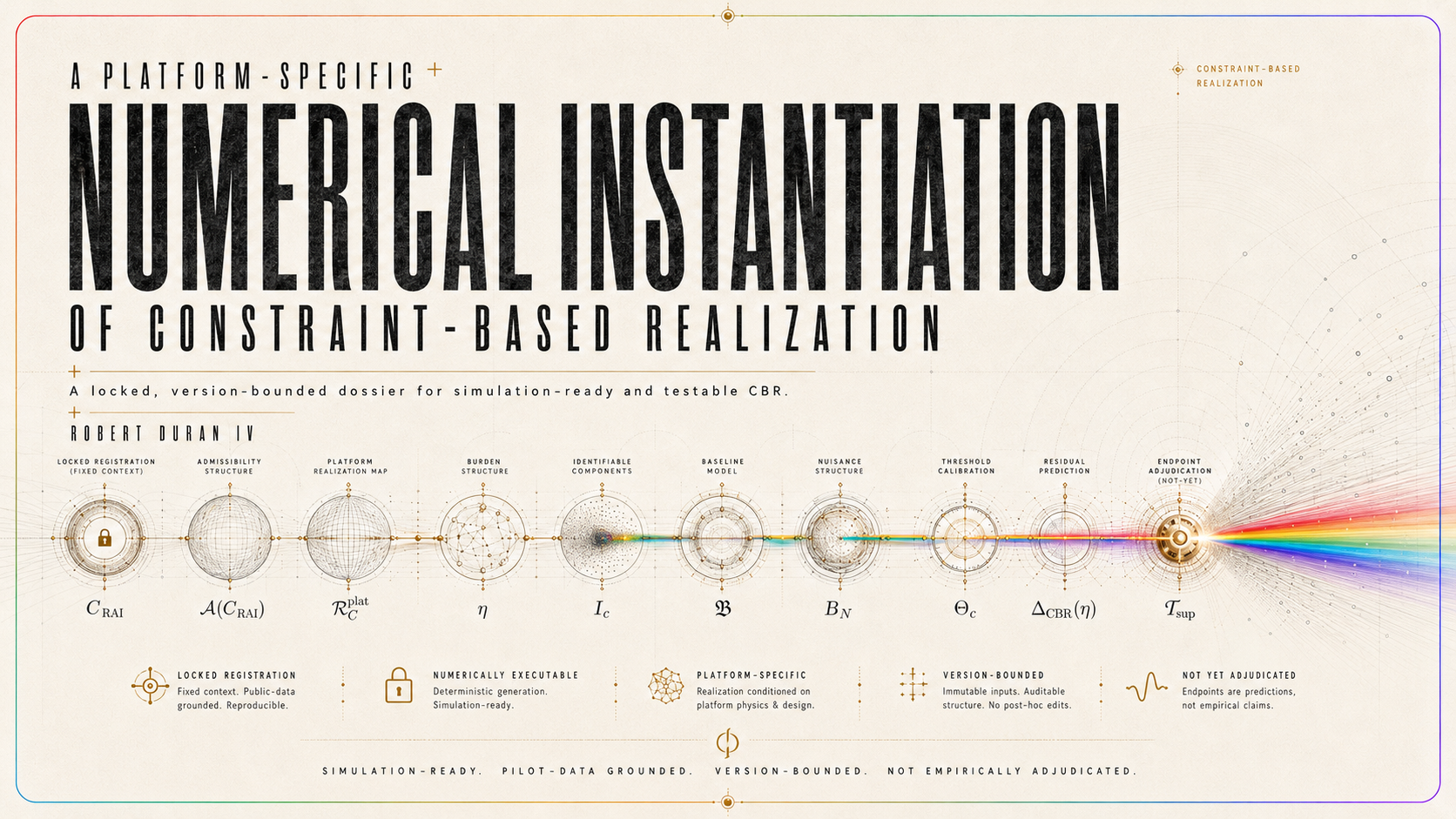
1.3 Core Computational Pathway
The numerical pathway for the platform dossier is:
C_RAI → 𝒜(C_RAI) → ℛ_C^plat → Φ∗_C(η) → V_CBR(η) → Δ_CBR(η) → T_CBR.
Each object has a distinct role.
C_RAI fixes the platform context.
𝒜(C_RAI) specifies the admissible candidate class.
ℛ_C^plat supplies the platform burden proxy that orders admissible candidates.
Φ∗_C(η) denotes the selected candidate class as accessibility varies.
V_CBR(η) is the visibility response predicted by the registered CBR instantiation.
Δ_CBR(η) = V_CBR(η) − V_ℬ(η) is the predicted CBR residual relative to the ordinary baseline.
T_CBR = 𝒯[Δ_CBR(η), η ∈ I_c] is the registered predicted endpoint.
This is the law-side pathway. It generates the predicted endpoint. It must be distinguished from simulation-side and data-side endpoint computation.
In simulation, the observed endpoint is:
T_c^sim = 𝒯[V_obs^sim(η) − V_ℬ(η), η ∈ I_c].
In public-data pilot reconstruction, the observed pilot endpoint is:
T_c^pilot = max_θ |V_obs^pilot(θ) − V_ℬ^pilot(θ)|.
In a future calibrated empirical test, the observed endpoint would be:
T_c = 𝒯[V_obs(η) − V_ℬ(η), η ∈ I_c].
These endpoint statuses must not be conflated. T_CBR is the registered prediction. T_c^sim is a synthetic simulation output. T_c^pilot is a reconstructed public-data endpoint. T_c is the observed endpoint of a future calibrated empirical test.
1.4 Endpoint Separation Principle
The empirical object in this paper is not realization itself.
CBR does not claim that realization can be directly observed as a visible laboratory object. It claims that a registered realization-law instantiation may entail an operational footprint. In this platform class, the footprint is an accessibility-critical residual in the visibility response.
Principle 1.1 — Endpoint Separation.
The visibility residual endpoint is an operational footprint of a registered CBR instantiation. It is not direct observation of realization, not the realization law itself, and not a substitute for the law-form.
This principle prevents a central category error. The law-form is constrained selection over admissible candidates. The endpoint is the registered measurable consequence through which a particular instantiation becomes testable. The residual is the fingerprint, not the law.
Thus, even if a residual were observed, the correct claim would not be “realization has been seen.” The correct claim would be that a registered CBR instantiation has produced an operational endpoint that may support, fail, or remain inconclusive under locked baseline, nuisance, degeneracy, statistical, and provenance rules.
1.5 Dual Status of the Paper
The paper has dual status.
First, it is simulation-ready by construction. It defines a synthetic v0.1 dossier containing a platform context, accessibility grid, critical accessibility regime, baseline model, nuisance envelope, decision threshold, predicted residual morphology, endpoint functional, degeneracy operator, statistical rule, scenario register, and simulation export register. This layer gives the next paper a complete object set for synthetic testing.
Second, it is pilot-data grounded by public reconstruction. The paper uses Kim–Ham quantum-eraser data to compute a pilot endpoint. The pilot mapping is:
η_proxy(θ) = |cos 2θ|,
with the analytical pilot baseline:
V_ℬ^pilot(θ) = |sin 2θ|.
Using the extracted visibility reconstruction, the pilot endpoint is:
T_c^pilot ≈ 0.016988.
This is a real-data contact point. It shows that the CBR endpoint machinery can be operationalized on public interferometric data. It does not show that the residual is a CBR effect. It does not provide registered support. It does not produce a strong-null failure. The original experiment was not designed as a CBR test, the accessibility variable is proxied rather than calibrated, the nuisance envelope is not fully validated, degeneracy is only partially evaluable, and no CBR prediction was registered before data collection.
The paper’s status is therefore: simulation-ready, pilot-data grounded, not empirically adjudicative.
1.6 Proposition — Status of the Present Dossier
Proposition 1.1 — Status of the Present Dossier.
The present C_RAI dossier is simulation-ready and pilot-data grounded, but not empirically adjudicative, because its synthetic v0.1 objects are simulation-registered and its public-data endpoint reconstruction lacks calibrated η, validated nuisance envelope, complete degeneracy evaluation, and a pre-registered CBR prediction.
Proof Sketch
The synthetic v0.1 layer defines all primary objects needed for simulation: platform context, accessibility grid, baseline class, nuisance envelope, threshold, endpoint, residual morphology, degeneracy operator, statistical rule, scenario register, and export rules. This is sufficient for simulation readiness. The public-data pilot layer computes an endpoint from published interferometric data, which grounds the framework in real data. However, the pilot layer uses η_proxy rather than calibrated η, lacks a validated nuisance envelope, lacks complete degeneracy adjudication, and was not preceded by a registered T_CBR prediction. Therefore, the dossier is simulation-ready and pilot-data grounded, but not empirically adjudicative.
1.7 What This Paper Does Not Claim
This paper does not claim that CBR is true.
It does not claim that CBR is experimentally confirmed.
It does not claim that realization has been directly observed.
It does not claim that the Kim–Ham pilot endpoint is a CBR signal.
It does not claim that ordinary quantum theory, decoherence, or detector-level baseline modeling is false.
It does not claim that the platform burden proxy ℛ_C^plat is the universal realization-burden functional ℛ_C.
It does not claim that the v0.1 numerical values are measured platform values.
It does not issue registered support.
It does not issue registered failure.
The paper’s contribution is more limited and more disciplined: it constructs a platform-class dossier that can be simulated without object invention, and it shows that a pilot endpoint can be reconstructed from public quantum-eraser data under explicitly limited conditions.
1.8 Main Contribution
The paper contributes four objects to the CBR empirical-execution program.
First, it provides a synthetic v0.1 C_RAI dossier. This dossier specifies the platform context, accessibility grid, critical accessibility regime, baseline class, nuisance structure, decision threshold, predicted residual family, endpoint functional, degeneracy operator, statistical rule, and verdict logic.
Second, it provides a Minimum Simulation Parameter Register v0.1. This register supplies concrete simulation-ready values and ranges. Its purpose is not to represent measured reality. Its purpose is to make the platform model executable.
Third, it provides a public-data pilot endpoint reconstruction. Using Kim–Ham quantum-eraser data, the paper computes T_c^pilot ≈ 0.016988 under a declared η_proxy and analytical pilot baseline.
Fourth, it provides a Simulation Export Register v0.1. This register tells the next paper exactly what may be simulated, what may vary, and what may not be added without creating a new dossier version.
These contributions strengthen CBR by moving from abstract law-form to executable platform dossier while preserving claim discipline.
1.9 Transition
With the paper’s role fixed, the first task is to classify the evidential status of its numerical values and public-data reconstruction.
2. Data Status and Evidence Tiers
2.1 Purpose
A central risk in a numerical-instantiation paper is evidential ambiguity. Numerical values can make a model appear more empirical than it is. Conversely, an insistence on full calibration before any numerical construction can prevent a theory from ever becoming executable. This paper avoids both errors by assigning every numerical object an explicit status.
The synthetic v0.1 dossier uses simulation-registered values. These values make the model runnable. They are not measurements. They do not establish empirical support. They define a controlled synthetic platform for testing the decision machinery.
The public-data layer uses published or reconstructed information from Kim–Ham quantum-eraser data. This layer provides real-data contact, but it is still pilot-level because the original experiment did not register a CBR endpoint, did not calibrate η as a CBR accessibility variable, and did not provide a full CBR nuisance, degeneracy, and statistical dossier.
The evidential purpose of this section is therefore to prevent category error. The paper contains numbers, but not all numbers have the same evidential status.
2.2 Evidence Tier Definitions
The paper distinguishes four evidence tiers.
Tier 0 — Synthetic Simulation Register.
A Tier 0 object is defined for controlled simulation. It may be symbolic, illustrative, assumed, or simulation-registered. It permits synthetic testing of the model’s decision machinery. It does not support empirical adjudication.
Tier 1 — Public-Data Pilot Reconstruction.
A Tier 1 object is reconstructed from published or public data. It may permit a pilot endpoint, pilot residual, or constraint. It is not decisive unless the dataset supplies or permits reconstruction of all critical CBR objects: calibrated accessibility, validated baseline, validated nuisance envelope, endpoint rule, degeneracy checks, statistical rule, and prediction status.
Tier 2 — Author-Supplied Raw-Data Reconstruction.
A Tier 2 object is obtained from raw counts, calibration metadata, uncertainty budgets, detector information, phase/control values, data-inclusion rules, and analysis scripts supplied by the original authors or laboratory. Tier 2 can support a stronger semi-empirical reconstruction, provided the missing CBR-specific objects are reconstructable.
Tier 3 — New Locked Experimental Dataset.
A Tier 3 object comes from an experiment designed under CBR registration rules before data collection. This is the strongest evidential tier. It permits registered support, registered failure, or inconclusive exposure if all validity gates are satisfied.
The present paper contains Tier 0 and Tier 1 objects only.
2.3 Status of This Paper
The synthetic dossier in this paper is Tier 0.
The public-data pilot reconstruction is Tier 1.
The paper does not contain Tier 2 author-supplied raw-data reconstruction.
The paper does not contain a Tier 3 newly registered CBR experiment.
Therefore, the paper can establish simulation readiness and pilot endpoint computability. It cannot establish empirical support or empirical failure.
The correct status is: synthetic v0.1 dossier plus public-data pilot reconstruction.
Not: registered empirical adjudication.
2.4 Provenance Classes
Every numerical or functional object in the paper must carry a provenance label.
The permitted labels are:
symbolic — introduced as a formal placeholder.
illustrative — used to explain a structure without claiming physical value.
assumed — selected as a modeling assumption.
simulation-registered — fixed for the synthetic v0.1 simulation dossier.
derived — mathematically derived from registered objects.
bridge-derived — derived from a declared CBR bridge assumption.
reconstructed — extracted or inferred from public data.
published — reported directly in a public source.
calibrated — tied to a platform calibration procedure.
validated — checked against a validation standard.
required for future testing — not yet available but necessary for higher evidential status.
The provenance label controls the claim that may be made from the object. A simulation-registered threshold may be used to test synthetic behavior. It may not be described as an experimentally validated threshold. A reconstructed public-data endpoint may demonstrate computability. It may not be promoted to registered support unless the missing adjudication objects are also supplied.
2.5 v0.1 Default Status
For the synthetic v0.1 dossier, the default status is as follows.
The η grid is simulation-registered.
The critical regime I_c is simulation-registered.
The baseline parameter values are simulation-registered or assumed.
The nuisance values are simulation-registered.
The detectability threshold ε_detect is simulation-registered.
The decision threshold Θ_c is derived from simulation-registered objects.
The predicted residual Δ_CBR(η) is a simulation-registered morphology.
The predicted endpoint T_CBR is derived from the simulation-registered residual and endpoint functional.
The degeneracy operator Deg_C is simulation-ready.
The statistical rule A_stat is simulation-ready.
The verdict rules are simulation-ready.
For the public-data pilot layer, the default status is different.
The polarizer-angle values θ are published or reconstructed.
The pilot accessibility proxy η_proxy(θ) is derived.
The pilot observed visibility V_obs^pilot(θ) is reconstructed from public count data.
The pilot baseline V_ℬ^pilot(θ) is analytically derived.
The pilot endpoint T_c^pilot is reconstructed and derived.
The nuisance envelope B_𝓝(η) is incomplete at pilot level.
The degeneracy operator Deg_C is only partially evaluable.
The statistical rule A_stat is pilot-level only.
These statuses determine the paper’s claim limits.
2.6 Provenance Discipline Principle
Principle 2.1 — Provenance Discipline.
All numerical values in this paper must be assigned a provenance status. Unless explicitly stated otherwise, v0.1 values are not measured platform values and do not support empirical adjudication. The public-data pilot endpoint demonstrates endpoint computability, not registered CBR support or registered CBR failure.
This principle prevents two errors.
The first error is overclaiming simulation values as empirical values.
The second error is overclaiming a public-data residual as a registered CBR prediction.
Neither is permitted.
2.7 Evidence-Tier Consequence
The evidential tier of an object limits the verdict it can support.
A Tier 0 object can support simulation claims.
A Tier 1 object can support pilot reconstruction claims.
A Tier 2 object may support semi-empirical reconstruction claims if enough metadata are supplied.
A Tier 3 object may support registered adjudication if all validity gates pass.
Thus, the strongest verdict available to the present paper is:
simulation-ready and pilot-data grounded.
The strongest unavailable verdicts are:
registered support and registered failure.
2.8 Transition
With the evidential status fixed, the paper can define the platform context whose synthetic dossier and pilot reconstruction will be built.
3. Platform Context C_RAI
3.1 Definition — Record-Accessibility Interferometric Context
Definition 3.1 — Record-Accessibility Interferometric Context.
A record-accessibility interferometric context C_RAI is a measurement context in which an interference visibility observable V is evaluated across variations in an operational record-accessibility variable η ∈ [0,1], with η = 0 representing minimal accessible record information and η = 1 representing maximal accessible record information under the registered platform convention.
The definition is intentionally operational. It does not refer to consciousness, awareness, observer experience, subjective knowledge, or mental access. The variable η is a platform-indexed parameter representing the operational availability of record information within the declared experimental or simulated context.
In the synthetic v0.1 dossier, η is a registered simulation variable. In the Kim–Ham pilot reconstruction, the paper uses a derived proxy η_proxy(θ) based on polarizer angle. These are not identical in evidential status. The synthetic η is a controlled modeling coordinate. The public-data η_proxy is a reconstruction device.
3.2 Platform Scope
The platform class includes interferometric contexts where visibility changes with record-accessibility structure. The basic observables and model functions are:
V_obs(η) — observed visibility in future empirical use.
V_obs^sim(η) — simulated observed visibility in the synthetic v0.1 dossier.
V_obs^pilot(η_proxy) — reconstructed pilot visibility from public data.
V_ℬ(η) — ordinary baseline visibility.
V_CBR(η) — CBR-side predicted visibility under the registered instantiation.
The ordinary baseline V_ℬ(η) includes standard quantum visibility behavior, decoherence, detector effects, loss, drift, calibration uncertainty, sampling effects, and other platform-ordinary effects to the extent they are registered. The CBR-side prediction does not replace the baseline. It is represented through a residual:
Δ_CBR(η) = V_CBR(η) − V_ℬ(η).
The empirical or simulated endpoint is not realization itself. It is the operational footprint that a registered CBR instantiation would leave in the visibility response.
3.3 Platform Boundary
The declared platform class excludes contexts that cannot support the required endpoint structure.
Excluded are non-interferometric platforms with no visibility endpoint, contexts where no operational accessibility variable can be defined or proxied, contexts where records are not meaningfully accessibility-varied, contexts where no ordinary baseline visibility model can be registered, and contexts where the endpoint cannot be expressed in a common unit with baseline, nuisance, and detectability quantities.
This boundary is not a claim that CBR cannot apply elsewhere. It is a restriction on the present paper. The present dossier tests the numerical executability of CBR only within C_RAI.
3.4 Platform Status
For v0.1, C_RAI has the following status:
registered platform class, not a single calibrated apparatus;
simulation-ready context, not empirical adjudication context;
public-data pilot compatible, through Kim–Ham θ-controlled record-erasure conditions;
not a universal platform claim for all possible CBR tests.
This status matters because a platform-class instantiation and a single-apparatus instantiation are different evidential objects. A platform-class dossier may be executable and simulation-ready. A single-apparatus dossier requires calibration, raw or reconstructable data, detector metadata, nuisance validation, and a locked endpoint comparison.
3.5 Platform Adequacy Condition
Condition 3.1 — Platform Adequacy.
The platform context C_RAI is adequate for this paper only if it supports all of the following: a visibility observable, an operational accessibility variable or proxy, an ordinary baseline visibility model, a residual definition relative to that baseline, a declared critical accessibility regime, a nuisance and detectability structure, an endpoint functional, and a degeneracy analysis.
If any of these are unavailable, the platform dossier is incomplete rather than failed. Incompleteness is not an empirical result. It is a registration status.
3.6 Transition
With C_RAI declared, the next task is to define the candidate class and burden proxy that make the platform a CBR instantiation rather than a generic visibility model.
4. Candidate Class and Admissibility Structure
4.1 Preliminary Candidate Space Ω_C^pre
Let Ω_C^pre denote the preliminary candidate space associated with the platform context C_RAI. Elements of Ω_C^pre are candidate realization-compatible maps, channels, or effective platform responses that could, prior to filtering, be considered possible CBR-side candidates for the declared context.
The preliminary candidate space is intentionally broader than the admissible candidate class. It is not yet the domain of selection. It is the domain from which admissibility filters construct the domain of selection.
Thus:
Ω_C^pre ≠ 𝒜(C_RAI).
The superscript pre is used to avoid any collision with later burden terms. CBR does not select from all formally imaginable maps. It selects only from candidates that satisfy the registered physical, operational, and platform-specific constraints.
4.2 Admissible Candidate Class 𝒜(C_RAI)
The admissible candidate class is defined by registered filters:
𝒜(C_RAI) = {Φ ∈ Ω_C^pre : Φ passes F₁, F₂, …, F_n}.
Each filter F_i must be specified before simulation, pilot reconstruction, or empirical endpoint interpretation. A filter cannot be introduced after a favorable or unfavorable residual is observed in order to rescue the model.
The admissible class must be nonempty for the instantiation to be meaningful. It must also be restrictive enough to exclude arbitrary post hoc candidates. A candidate class that is too broad invites anomaly hunting. A candidate class that is too narrow risks encoding the desired result.
The role of 𝒜(C_RAI) is therefore to define a constrained selection domain for the platform.
4.3 Nonempty Admissible Class Assumption
Assumption 4.1 — Nonempty Admissible Class.
For the declared C_RAI dossier, 𝒜(C_RAI) is assumed nonempty after application of the registered admissibility filters. If 𝒜(C_RAI) is empty, the platform instantiation is incomplete rather than empirically failed.
This assumption is necessary because the minimization problem:
Φ∗C ∈ argmin{Φ ∈ 𝒜(C_RAI)} ℛ_C^plat(Φ)
is not meaningful over an empty domain. An empty admissible class does not refute CBR. It shows that the declared platform dossier has failed to supply a viable selection domain.
In future work, nonemptiness should be replaced by an existence result for the relevant platform class. In the present v0.1 dossier, it is a registration assumption.
4.4 Candidate-Generation Filters
The v0.1 admissibility filters include the following.
Physical admissibility.
The candidate must be compatible with the physical structure of the declared interferometric context.
Context compatibility.
The candidate must be defined relative to C_RAI and cannot silently shift to another platform context.
Operational visibility compatibility.
The candidate must generate or correspond to a visibility response that can be compared with V_ℬ(η) under the registered endpoint functional.
Record-accessibility compatibility.
The candidate must make sense as a function of η or, in pilot reconstruction, η_proxy.
Decoherence consistency.
The candidate must not contradict ordinary decoherence effects already included in the baseline class.
Born-compatibility at ensemble level.
The candidate must not casually violate standard ensemble behavior unless the registered instantiation explicitly predicts and bounds such deviation.
Nontrivial accessibility dependence.
The candidate must not be independent of the accessibility structure if the tested CBR instantiation claims an accessibility-critical residual.
Baseline separability.
The candidate must not collapse into the ordinary baseline class 𝔅. If its residual is absorbable by ordinary baseline variation, it is non-identifiable.
Non-adaptivity.
The candidate must not be chosen, modified, or reweighted after endpoint inspection.
Together, these filters prevent the platform instantiation from becoming a flexible residual-fitting scheme.
4.5 Operational Equivalence
Define an operational equivalence relation ≃_C on 𝒜(C_RAI).
Definition 4.1 — Operational Equivalence.
For Φ₁, Φ₂ ∈ 𝒜(C_RAI), write:
Φ₁ ≃_C Φ₂
if the two candidates generate no operationally distinguishable difference under the registered observables, endpoint functional, platform resolution, degeneracy rules, and statistical adjudication rule.
The quotient domain is:
𝒜(C_RAI)/≃_C.
CBR selection is not required to distinguish candidates that make no operational difference under the registered context. The selected object is therefore defined up to operational equivalence.
This prevents fake multiplicity. If two candidates differ only in a mathematically representable but operationally irrelevant way, they should not count as distinct realized alternatives for the purposes of the platform endpoint.
4.6 Candidate-Class Status
For v0.1, 𝒜(C_RAI) has the following status:
formal / simulation-ready, because it is defined by registered filters;
not experimentally exhausted, because no full platform experiment has enumerated all candidate responses;
not directly inferred from Kim–Ham public data, because the pilot reconstruction computes an endpoint, not a full candidate-class selection.
This status is important. The public-data pilot can show that a visibility endpoint is computable. It cannot by itself validate the full admissible candidate class.
4.7 Transition
Once the admissible candidate class is fixed, the instantiation requires a platform burden proxy capable of ordering admissible candidates before endpoint comparison.
5. Platform Burden Proxy ℛ_C^plat
5.1 Definition
The canonical CBR law-form uses a realization-burden functional ℛ_C. In a fully mature physical theory, ℛ_C would be a law-level ordering over admissible realization-compatible candidates in context C. The present paper does not claim to provide the universal ℛ_C. It provides a platform-specific proxy sufficient for simulation-ready instantiation.
Define:
ℛ_C^plat(Φ) = αΞ_C(Φ) + βΒ_C(Φ) + γΛ_C(Φ),
where α, β, γ ≥ 0 are registered coefficients and:
Ξ_C(Φ) is the accessibility-structure burden,
Β_C(Φ) is the baseline/decoherence consistency burden,
Λ_C(Φ) is the stability and non-adaptivity burden.
The notation Β_C is used for the baseline/decoherence burden to avoid confusion with Ω_C^pre, the preliminary candidate space. The notation ℛ_C^plat marks the object as a platform proxy. It is not asserted to be the final law of realization. Its role is to produce a disciplined, computable ordering within the declared platform dossier.
5.2 Coefficient Registry
For v0.1, α, β, and γ are simulation-registered coefficients.
For normalized v0.1 simulations, they may be constrained by:
α + β + γ = 1.
This normalization is a simulation convention, not a universal CBR requirement.
The coefficients are not fitted after endpoint inspection. They are not adjusted to improve the Kim–Ham pilot residual. They are not varied after simulation outcomes are known unless the variation is declared in advance as a scenario class.
Changing α, β, or γ after simulation, pilot reconstruction, or endpoint comparison creates a new dossier version.
Principle 5.1 — Coefficient Lock.
The coefficients α, β, and γ are part of the registered platform burden proxy. They may not be changed after endpoint inspection to rescue, strengthen, or reinterpret the current dossier.
This registry prevents ℛ_C^plat from becoming an adjustable fitting device.
5.3 Accessibility Burden Ξ_C
The term Ξ_C(Φ) measures the candidate’s burden relative to the registered accessibility structure.
It penalizes candidates that lack nontrivial accessibility dependence when such dependence is required by the instantiation, generate unregistered accessibility behavior, produce residuals outside the declared critical regime I_c, fail to connect to the registered accessibility bridge, or fail to generate a computable endpoint.
For the synthetic v0.1 dossier, Ξ_C is simulation-ready. It ensures that the candidate response is meaningfully tied to η and that the predicted residual can be evaluated inside I_c.
For the public-data pilot layer, Ξ_C is not adjudicated. The Kim–Ham pilot endpoint uses η_proxy, not a calibrated η, and therefore cannot validate the accessibility burden as a physical ordering.
5.4 Baseline/Decoherence Consistency Burden Β_C
The term Β_C(Φ) measures the candidate’s burden relative to ordinary baseline and decoherence consistency.
It penalizes candidates that collapse into ordinary baseline behavior, violate ordinary decoherence structure without registration, conflict with Born-compatible ensemble behavior, or produce residuals absorbable by the baseline class 𝔅.
This term enforces a central discipline of CBR: a predicted residual cannot count as CBR-relevant merely because it is mathematically present. It must survive ordinary explanation. If a residual is reproduced by the baseline class, it is not identifiable. If it is swallowed by the nuisance envelope, it is not support. If it is generated by detector, phase, sampling, or calibration artifacts, it belongs to the ordinary comparison side.
Thus Β_C protects the platform model from treating ordinary physics as CBR evidence.
5.5 Stability and Non-Adaptivity Burden Λ_C
The term Λ_C(Φ) measures the candidate’s burden relative to stability, registration, and no-rescue discipline.
It penalizes post hoc endpoint adjustment, parameter instability, candidate switching after outcome inspection, dependence on unregistered data features, and violation of no-rescue rules.
This term is essential because the empirical-execution program depends on locked commitments. A candidate cannot be revised after a simulated or pilot residual is known in order to improve the result. A new candidate, new morphology, new endpoint, new baseline, or new statistical rule defines a new dossier version. It does not rescue the current one.
Thus Λ_C encodes the anti-elasticity requirement of the platform instantiation.
5.6 Selection Rule
The platform selection rule is:
Φ∗C ∈ argmin{Φ ∈ 𝒜(C_RAI)} ℛ_C^plat(Φ), up to ≃_C.
This means that the selected platform candidate is a minimizer of the registered burden proxy over the admissible class, modulo operational equivalence.
The selection rule is not applied to observed data after the fact. It is part of the registered law-side generation of Δ_CBR(η) and T_CBR. The data-side objects T_c^sim, T_c^pilot, and future T_c are comparisons against the prediction, not ingredients used to choose the prediction.
5.7 Proxy Status
For v0.1, ℛ_C^plat has the following status:
simulation-ready burden proxy, because it defines a computable ordering for the synthetic dossier;
not universal ℛ_C, because it is not claimed as the final realization law;
not empirically calibrated, because its coefficients and terms are not fitted to a locked experimental dataset;
not adjudicated by Kim–Ham pilot data, because the pilot endpoint reconstructs visibility residuals but does not validate the law-side burden ordering.
This status is not a weakness if stated correctly. The purpose of v0.1 is not to finalize ℛ_C. The purpose is to build the first executable platform dossier from which simulation and pilot reconstruction can proceed under strict claim limits.
5.8 Proposition — Burden Proxy Non-Adjudication
Proposition 5.1 — Burden Proxy Non-Adjudication.
The Kim–Ham pilot endpoint does not validate ℛ_C^plat as a physical realization-burden functional, because the pilot reconstruction computes an observed residual relative to an analytical baseline but does not adjudicate the registered law-side minimization over 𝒜(C_RAI)/≃_C.
Proof Sketch
Validation of ℛ_C^plat would require a locked admissible class, registered coefficients, a registered predicted residual, a calibrated accessibility bridge, an ordinary baseline and nuisance model, degeneracy evaluation, and statistical adjudication. The Kim–Ham pilot reconstruction supplies only a reconstructed endpoint relative to a pilot baseline under an η_proxy. Therefore, it can demonstrate endpoint computability, but it cannot validate the burden proxy.
5.9 Transition
With the platform burden proxy defined, the dossier must specify how record-accessibility η enters the numerical instantiation.
6. Accessibility Register
6.1 Definition of η
The record-accessibility variable is denoted:
η ∈ [0,1].
In the present dossier, η is an operational coordinate indexing the availability of record information within the declared platform context C_RAI. It is not a psychological, epistemic, or observer-dependent variable. It does not denote consciousness, awareness, subjective observation, knowledge, belief, or attention. It is a platform-indexed accessibility parameter.
The intended interpretation is:
η = 0 represents minimal operational accessibility of record information under the registered platform convention.
η = 1 represents maximal operational accessibility of record information under the registered platform convention.
Intermediate values represent controlled, reconstructed, or simulated degrees of record accessibility. In a future calibrated platform, η would have to be assigned by an explicit calibration procedure. In the present synthetic v0.1 dossier, η is simulation-registered. In the public-data pilot reconstruction, a distinct proxy η_proxy is used because calibrated η is not supplied by the Kim–Ham experiment.
The distinction between η and η_proxy is essential. The synthetic η is a registered model coordinate. The pilot η_proxy is a reconstruction device derived from publicly reported control settings. Neither should be confused with direct observation of realization.
Definition 6.1 — Operational Record-Accessibility.
η is an operational variable representing the registered accessibility of record information in C_RAI. It is admissible in the present dossier only to the extent that its calibration, proxy construction, uncertainty, sampling, and role in the endpoint functional are explicitly specified.
6.2 Default Synthetic η Grid
For the synthetic v0.1 dossier, define the default accessibility grid:
G = {η_j = j/(N_η − 1) : j = 0, …, N_η − 1}.
The default grid size is:
N_η = 101.
Thus:
G = {0, 0.01, 0.02, …, 0.99, 1}.
The status of this grid is:
simulation-registered.
It is not an empirical sampling grid. It is not claimed to match the sampling structure of any existing experiment. Its role is to make the synthetic dossier executable and to provide the simulation paper with a fixed accessibility domain.
The grid may be varied in later simulation scenarios only if the variation is explicitly registered. For example, Paper #14 may test coarse-grid, medium-grid, and dense-grid behavior. Such variations must be treated as simulation scenarios, not as changes to the underlying dossier after results are known.
6.3 Synthetic Critical Accessibility Regime
The critical accessibility regime is denoted I_c. It is the region of the accessibility axis in which the registered CBR instantiation predicts its primary endpoint-relevant residual.
Define:
I_c = [η_c − w_c, η_c + w_c] ∩ [0,1].
For the synthetic v0.1 central dossier, set:
η_c = 0.5,
w_c = 0.1,
so:
I_c = [0.4, 0.6].
The grid-restricted critical region is:
G_c = G ∩ I_c.
The status of η_c, w_c, I_c, and G_c is:
simulation-registered, not empirically calibrated.
This means that I_c is a synthetic region used to test endpoint behavior under a locked model. It is not claimed to be a measured critical region of nature. In a future empirical dossier, I_c would need to be justified by a registered CBR bridge, calibrated platform behavior, or predeclared theoretical construction.
Principle 6.1 — Critical-Regime Lock.
The critical accessibility regime I_c must be fixed before simulation, pilot reconstruction, or empirical endpoint interpretation. Changing I_c after inspecting residual behavior creates a new dossier version.
This prevents endpoint shopping. A residual cannot be made significant by moving the critical regime after the fact.
6.4 Public-Data η Proxy
For the Kim–Ham public-data pilot reconstruction, calibrated η is not available. The paper therefore defines a pilot accessibility proxy using the polarizer angle θ:
η_proxy(θ) = |cos 2θ|.
Unless otherwise stated, θ in the public-data pilot reconstruction is interpreted in degrees, matching the reported polarizer-angle conditions.
The interpretation is:
θ = ±45° → η_proxy = 0,
θ = 0° or 90° → η_proxy = 1.
This proxy is motivated by the polarizer-controlled quantum-eraser structure reported by Kim and Ham. Their experiment demonstrates a delayed-choice quantum eraser using coherent photon pairs, with a polarizer placed outside the interferometer, and derives coherence solutions from a Mach–Zehnder interferometric model.
The pilot proxy should be read conservatively. It is not a calibrated accessibility variable. It is not the same as the synthetic model coordinate η. It is a public-data reconstruction tool that allows the Kim–Ham polarizer-angle conditions to be mapped onto a CBR-style accessibility axis.
Definition 6.2 — Pilot Accessibility Proxy.
η_proxy(θ) = |cos 2θ| is a derived public-data accessibility proxy. It may be used to compute a pilot endpoint, but it does not by itself satisfy the calibration requirements for registered empirical adjudication.
This distinction matters for verdict status. A pilot endpoint computed under η_proxy may demonstrate operational endpoint computability. It cannot establish registered CBR support or failure unless the proxy is upgraded into a calibrated accessibility variable and the remaining validity conditions are met.
6.5 η Uncertainty
Let:
σ_η(η)
denote the accessibility-coordinate uncertainty.
In a calibrated experiment, σ_η(η) would represent uncertainty in the assignment of record-accessibility values. It could arise from calibration error, control-parameter instability, imperfect mapping between platform controls and accessibility, reconstruction error, or uncertainty in the physical proxy used to define η.
For the synthetic v0.1 dossier, the simulation paper may test several η-uncertainty regimes:
low η uncertainty,
moderate η uncertainty,
high η uncertainty,
η-axis shift,
η-axis rescaling,
η-axis warping.
These are simulation scenarios. They must be declared before the simulation result is interpreted.
For the Kim–Ham public-data pilot layer, define:
σ_η_proxy
as the uncertainty associated with the derived proxy η_proxy(θ). This quantity is not fully supplied by the public record and must therefore be treated as incomplete or reconstructed. Because σ_η_proxy is not fully validated, the public-data endpoint remains pilot-level.
Principle 6.2 — Accessibility-Uncertainty Discipline.
A residual cannot be treated as CBR-identifiable unless the accessibility-coordinate uncertainty is either validated, bounded, or shown not to absorb the residual morphology.
This principle links the accessibility register to the degeneracy operator introduced later. If allowed η-axis shifts, rescalings, or warpings can reproduce the residual, the endpoint is non-identifiable.
6.6 Sampling Adequacy
The accessibility grid must be dense enough to resolve the registered residual morphology. For the synthetic v0.1 dossier, the relevant grid inside the critical regime is:
G_c = G ∩ I_c.
If the default residual morphology is Gaussian with width w_r, the grid must satisfy a registered sampling condition. A suitable condition is:
max gap(G_c) ≤ w_r / m,
where m is a registered resolution factor.
For v0.1, allow:
m = 5
or, for stricter simulation:
m = 10.
This requirement ensures that the grid can resolve a localized residual rather than missing or distorting it. If the grid spacing is too coarse relative to w_r, the endpoint may be sampling-degenerate.
For the Kim–Ham public-data pilot reconstruction, the available θ conditions are sparse in η_proxy. The pilot reconstruction therefore does not constitute a dense accessibility scan. It can compute a pilot endpoint across the available public conditions, but it cannot test fine-grained morphology across I_c.
Condition 6.1 — Sampling Adequacy.
A synthetic or empirical accessibility grid is adequate only if it resolves the registered residual morphology in the declared critical regime. If the residual could be missed, created, or distorted by grid sparsity, the endpoint is sampling-degenerate or inconclusive.
6.7 Transition
With η, η_proxy, I_c, uncertainty, and sampling adequacy distinguished, the instantiation requires an ordinary visibility model against which synthetic and public-data residuals can be compared.
7. Baseline Model Class 𝔅
7.1 Definition
The ordinary baseline model class is denoted:
𝔅 = {V_ℬ(η; θ_ℬ) : θ_ℬ ∈ Θ_ℬ}.
Here θ_ℬ denotes ordinary baseline parameters. The notation θ_ℬ is used to avoid confusion with the Kim–Ham polarizer angle θ.
The baseline class represents the ordinary, non-CBR comparison side. It includes standard quantum visibility behavior, decoherence, detector effects, loss, drift, calibration effects, estimator behavior, and other registered ordinary contributions. The baseline must be strong enough to avoid straw-manning ordinary physics.
The CBR residual is not defined relative to an idealized empty comparator. It is defined relative to V_ℬ(η):
Δ_CBR(η) = V_CBR(η) − V_ℬ(η).
A CBR-relevant residual must therefore survive comparison with the registered ordinary baseline.
7.2 Default Synthetic v0.1 Baseline Form
For the synthetic v0.1 dossier, use the following simulation-ready baseline form:
V_ℬ(η; θ_ℬ) = V₀ · f_Q(η; q) · D_decoh(η; κ) · L_det(η; ρ) + d(η; λ).
The components are:
f_Q(η; q) = 1 − qη,
D_decoh(η; κ) = exp(−κη),
L_det(η; ρ) = 1 − ρη,
d(η; λ) = λ₀ + λ₁η.
The terms have the following roles.
V₀ sets the central visibility scale.
f_Q(η; q) represents ordinary visibility-accessibility dependence.
D_decoh(η; κ) represents decoherence-like visibility suppression.
L_det(η; ρ) represents detector, loss, or readout attenuation.
d(η; λ) represents low-order drift or calibration offset.
This is a synthetic baseline model. It is designed to support simulation scenarios, not to claim empirical calibration.
7.3 Synthetic Baseline Parameter Space Θ_ℬ
For the v0.1 synthetic dossier, define the baseline parameter space:
V₀ ∈ [0.75, 1.00],
q ∈ [0, 0.30],
κ ∈ [0, 0.50],
ρ ∈ [0, 0.10],
λ₀ ∈ [−0.01, 0.01],
λ₁ ∈ [−0.02, 0.02].
These ranges are: simulation-registered ranges, not empirical measurements.
They are allowed to generate ordinary baseline variation in synthetic scenarios. They do not constitute platform calibration. They do not validate the baseline for a real apparatus.
The simulation paper may vary θ_ℬ ∈ Θ_ℬ only under registered scenario rules. It may not expand Θ_ℬ after observing simulation or pilot residuals in order to absorb or create a desired result.
For all registered v0.1 simulations, V_ℬ(η; θ_ℬ) should remain within the physical visibility range:
0 ≤ V_ℬ(η; θ_ℬ) ≤ 1,
up to explicitly registered numerical tolerance. Parameter choices that drive the baseline outside the physical visibility range are inadmissible for the default dossier unless the violation is part of a separately registered stress test.
Principle 7.1 — Baseline Parameter Lock.
The baseline parameter space Θ_ℬ must be fixed before endpoint interpretation. Expanding, narrowing, or refitting Θ_ℬ after residual inspection creates a new dossier version.
7.4 Central Synthetic v0.1 Baseline Parameter Set
For the default synthetic central case, define:
V₀ = 0.90,
q = 0.10,
κ = 0.20,
ρ = 0.03,
λ₀ = 0,
λ₁ = 0.
The status of this parameter set is:
simulation-registered central case.
It gives Paper #14 a default baseline curve before stress tests are introduced. It is not an empirical estimate. It is not fitted to Kim–Ham data. It is not a claim about any laboratory platform.
The central case functions as a reference point. The broader range Θ_ℬ supports robustness and degeneracy simulations.
7.5 Public-Data Pilot Baseline
For the Kim–Ham pilot reconstruction, use the analytical pilot baseline:
V_ℬ^pilot(θ) = |sin 2θ|.
Under the proxy:
η_proxy(θ) = |cos 2θ|,
this can be written as:
V_ℬ^pilot(η_proxy) = √(1 − η_proxy²).
This baseline follows from treating the polarizer angle θ as the public-data control variable and using the θ-dependent interference structure of the reported quantum-eraser model. Kim and Ham describe a delayed-choice quantum eraser using coherent photons with a polarizer choice outside the interferometer and Mach–Zehnder-derived coherence solutions, which supports an analytical θ-baseline at pilot level.
The status of V_ℬ^pilot is: analytical / reconstructed pilot baseline.
It is not a fitted CBR baseline. It is not a validated full nuisance-inclusive ordinary baseline. It is a pilot comparator used to compute:
r_pilot(θ) = V_obs^pilot(θ) − V_ℬ^pilot(θ).
7.6 Baseline Selection Rule
For the synthetic v0.1 dossier, the default baseline selection rule is: fixed central baseline for default simulation,
with: bounded-envelope baseline for stress tests.
The fixed central baseline allows clean scenario generation. The bounded-envelope baseline allows robustness testing against ordinary baseline variation.
For the public-data pilot layer, the baseline selection rule is: analytical θ-baseline from the published model, not a fitted CBR baseline.
This is important. The pilot baseline is not selected to optimize the CBR residual. It is selected from the ordinary analytical structure of the Kim–Ham platform. The pilot residual is therefore a reconstruction exercise, not a fitted support claim.
7.7 Baseline Guardrail
The baseline must satisfy two competing requirements.
It must be broad enough to include legitimate ordinary explanations. A weak or idealized baseline would make ordinary deviations look artificially CBR-relevant.
It must not be so broad that it absorbs every possible residual by construction. A baseline that can fit anything cannot support identifiability.
Principle 7.2 — Baseline Guardrail.
The baseline class must include registered ordinary explanations without becoming an unrestricted residual absorber. If 𝔅 can reproduce any endpoint morphology by construction, the CBR residual is non-identifiable.
This guardrail prevents both straw-manning and overfitting.
7.8 Transition
With the ordinary baseline class specified, the instantiation must define ordinary deviations around the baseline that do not count as CBR support.
8. Nuisance and Detectability Register
8.1 Pointwise Synthetic Nuisance Envelope
The nuisance envelope represents ordinary deviations around the selected baseline that do not count as CBR support. It includes detector effects, phase instability, calibration uncertainty, sampling variation, estimator uncertainty, and accessibility-coordinate uncertainty.
For the synthetic v0.1 dossier, define:
B_𝓝(η) = [σ_det²(η) + σ_phase²(η) + σ_cal²(η) + σ_sample²(η) + σ_est²(η) + σ_η²(η)|∂_ηV_ℬ(η)|²]¹ᐟ².
The terms represent:
σ_det(η) — detector uncertainty,
σ_phase(η) — phase instability,
σ_cal(η) — calibration uncertainty,
σ_sample(η) — sampling uncertainty,
σ_est(η) — visibility-estimator uncertainty,
σ_η(η)|∂_ηV_ℬ(η)| — propagated accessibility-coordinate uncertainty.
This envelope is synthetic in v0.1. It provides a structured ordinary-error allowance for simulation. It is not a validated empirical nuisance model.
8.2 Default Synthetic Nuisance Regimes
Define three v0.1 nuisance regimes:
narrow nuisance:
B_𝓝(η) ≈ 0.005–0.010.
moderate nuisance:
B_𝓝(η) ≈ 0.010–0.025.
wide nuisance:
B_𝓝(η) ≈ 0.025–0.050.
The status of these regimes is:
simulation-ready, not validated.
The simulation paper may use these regimes to test sensitivity to ordinary variation. A CBR-like residual that appears only under narrow nuisance but disappears under moderate or wide nuisance should be classified accordingly. It may be support-like in one simulation regime and inconclusive in another.
The regimes are not empirical uncertainty claims. They are registered scenario bands for synthetic testing.
8.3 Central Synthetic v0.1 Nuisance Case
For the central synthetic case, define:
B_𝓝^moderate = 0.0175.
Alternatively, for weak η-dependence, define:
B_𝓝(η) = b₀ + b₁|η − η_c|,
with central values:
b₀ = 0.0175,
b₁ = 0.
The status of this case is: simulation-registered central nuisance case.
This central nuisance case gives the simulation paper a default threshold scale. The narrow and wide regimes provide stress tests.
8.4 Nuisance Accounting Discipline
The nuisance envelope must not become a second baseline. It should represent uncertainty, drift, estimator variation, and ordinary deviations around the selected baseline. It should not be used to reintroduce ordinary effects already built into V_ℬ(η) unless the decomposition is explicitly registered.
Principle 8.1 — Non-Duplicative Nuisance Accounting.
The same ordinary effect may not be counted both inside the baseline model V_ℬ and again inside B_𝓝 unless the two roles are separated by a registered uncertainty decomposition.
This principle prevents double-counting. Without it, a model could make the nuisance envelope artificially wide and render every residual inconclusive by construction.
8.5 Public-Data Pilot Nuisance Status
For the Kim–Ham public-data pilot reconstruction, the nuisance envelope is not fully validated.
Available public information supports only a pilot-level nuisance estimate. Kim and Ham report an experimental delayed-choice quantum eraser using coherent photons and make public the article record from which limited visibility behavior can be reconstructed, but the public record does not supply a full CBR nuisance budget with calibrated accessibility uncertainty, full covariance, validated drift model, and registered endpoint uncertainty.
A pilot nuisance envelope may include:
reported statistical error scale,
dark-count information where available,
phase-scan details,
digitization or extraction uncertainty,
visibility-estimator uncertainty,
and limited count reconstruction uncertainty.
Its status is:
pilot reconstructed / incomplete, not validated.
Therefore, the pilot endpoint cannot be used for registered support or registered failure. It can be used to demonstrate endpoint computability and to identify what additional nuisance information would be required for adjudication.
8.6 Critical Nuisance Bound
Define the critical nuisance bound:
B_c = sup_{η ∈ I_c} B_𝓝(η).
On the synthetic grid:
B_c^G = max_{η_j ∈ G_c} B_𝓝(η_j).
The critical nuisance bound translates the pointwise nuisance envelope into an endpoint-level ordinary allowance. It is part of the decision threshold:
Θ_c = B_c + ε_detect.
For pilot reconstruction, B_c cannot be treated as validated unless the pointwise nuisance envelope is validated or bounded with sufficient justification.
8.7 Detectability Threshold
Define the detectability threshold:
ε_detect = z_detect σ_T.
Here σ_T is the endpoint-level uncertainty scale, and z_detect is the registered detectability multiplier.
For the v0.1 central case:
z_detect = 2.
For conservative stress tests:
z_detect = 3.
The status of ε_detect is:
simulation-registered in v0.1.
It is not an experimentally validated detectability threshold. In a future empirical dossier, ε_detect must be tied to sampling density, visibility resolution, calibration uncertainty, detector sensitivity, statistical power, and endpoint uncertainty.
8.8 Decision Threshold
Define:
Θ_c = B_c + ε_detect.
This threshold is the minimum endpoint separation required for a residual to exceed ordinary nuisance plus detectability.
For support-like simulation behavior, the simulated endpoint must satisfy:
T_c^sim > Θ_c
under valid, non-degenerate conditions.
For strong-null simulation behavior, the registered prediction must satisfy:
T_CBR > Θ_c
and the simulated observed endpoint must satisfy:
T_c^sim ≤ Θ_c
under valid, non-degenerate, sufficiently powered conditions.
For pilot public data, Θ_c remains pilot-level unless B_c and ε_detect are validated.
8.9 Threshold Regimes for Simulation
Paper #14 may simulate the following threshold regimes:
subthreshold prediction,
borderline threshold prediction,
detectable prediction,
strong detectable prediction.
These regimes should be defined relative to Θ_c.
For example:
T_CBR < Θ_c gives a subthreshold prediction.
T_CBR ≈ Θ_c gives a borderline prediction.
T_CBR > Θ_c gives a detectable prediction.
T_CBR ≫ Θ_c gives a strong detectable prediction.
The simulation paper may use these regimes to test when the decision machinery returns support-like, failure-like, inconclusive, or non-identifiable outcomes. It may not change Θ_c after simulation outcomes are known.
8.10 Transition
With the ordinary baseline and threshold structure fixed, the dossier can define the predicted CBR residual that will be tested in simulation and compared with the public-data pilot residual.
9. Predicted CBR Residual Register
9.1 Residual Definition
The predicted CBR residual is defined as:
Δ_CBR(η) = V_CBR(η) − V_ℬ(η).
This is the registered difference between the CBR-side predicted visibility response and the ordinary baseline visibility response.
The residual is not the law itself. It is not direct observation of realization. It is the endpoint-bearing operational footprint predicted by a registered CBR platform instantiation.
This distinction is essential. The law-side selection rule produces the predicted residual. The residual is then compared with simulated or observed data. It is not selected after seeing the data.
9.2 Default Synthetic Residual Morphology
For the synthetic v0.1 dossier, use:
Δ_CBR(η) = A_CBR g_c(η; η_c, w_r, s).
The default morphology is:
g_c(η; η_c, w_r, s) = s exp[−(η − η_c)²/(2w_r²)].
Normalize:
sup_{η ∈ I_c}|g_c(η)| = 1.
If the peak lies inside I_c, then:
T_CBR = |A_CBR|
under the primary endpoint 𝒯_sup.
The Gaussian morphology is a simulation-registered choice. It is not claimed to be the unique CBR residual shape. It is selected because it provides a localized, controllable, endpoint-computable morphology for testing the decision machinery.
9.3 Central Synthetic v0.1 Residual Case
For the central synthetic v0.1 residual, set:
η_c = 0.5,
w_r = 0.05,
s = +1.
The default amplitude family is:
A_CBR ∈ {0, 0.5Θ_c, Θ_c, 1.5Θ_c, 2Θ_c, 3Θ_c}.
This amplitude family is defined relative to the decision threshold Θ_c, not as an empirical magnitude. It allows the simulation paper to test baseline-only, subthreshold, threshold-borderline, detectable, and high-separation cases.
9.4 Amplitude Interpretation
The amplitude cases have the following interpretation.
A_CBR = 0 gives the baseline-only condition. No CBR residual is present in the simulation.
A_CBR = 0.5Θ_c gives an undetectable residual. The predicted endpoint remains below the registered threshold.
A_CBR = Θ_c gives a threshold-borderline residual. The result should be treated carefully because strict support or failure may depend on the registered inequality convention.
A_CBR = 1.5Θ_c gives a detectable residual.
A_CBR = 2Θ_c gives a strong detectable residual.
A_CBR = 3Θ_c gives a high-separation stress case.
These are simulation regimes. They are not empirical claims about CBR effect size.
9.5 Width and Sign Ranges
The default width range is:
w_r ∈ {0.025, 0.05, 0.10}.
The default sign range is:
s ∈ {+1, −1}.
The width controls localization. A narrow residual may be sampling-sensitive. A broad residual may be easier to detect but may be more vulnerable to baseline or nuisance degeneracy. The sign controls whether the residual appears as a positive or negative visibility deviation.
Both width and sign must be registered before simulation. Choosing them after observing which morphology generates the strongest result would violate the no-rescue discipline.
9.6 Residual Provenance
For v0.1, the residual objects have the following provenance:
Δ_CBR(η): simulation-registered.
A_CBR: assumed / simulation-registered.
g_c: simulation-registered morphology.
The residual register does not claim that nature contains this residual. It defines the synthetic CBR-side signal used to test the decision machinery.
A future empirical dossier would need either a bridge-derived Δ_CBR(η) or a pre-registered law-side prediction that fixes the residual morphology and amplitude before comparison with data.
9.7 Public-Data Pilot Residual
For the Kim–Ham pilot reconstruction, define:
r_pilot(θ) = V_obs^pilot(θ) − V_ℬ^pilot(θ).
This is an observed pilot residual relative to an analytical baseline. It is not a registered CBR prediction.
It should not be equated with:
Δ_CBR(η)
unless a prior CBR prediction has been registered for the dataset.
This is a crucial distinction. A residual reconstructed from public data is not automatically a CBR residual. It becomes CBR-relevant only if it matches a registered prediction, survives nuisance and degeneracy checks, and passes the statistical rule under adequate provenance.
9.8 Residual Locking Principle
Principle 9.1 — Residual Lock.
The predicted CBR residual Δ_CBR(η), including its morphology, amplitude family, width, sign, and critical regime, must be registered before simulation or data comparison. Changing the residual after observing T_c^sim or T_c^pilot creates a new dossier version.
This principle prevents the residual register from becoming an anomaly-fitting device.
9.9 Transition
With predicted and pilot residuals distinguished, the paper can define the endpoint statistic that converts residual structure into a simulation or pilot endpoint quantity.
10. Endpoint Functional and Predicted Endpoint
10.1 Primary Endpoint
The primary endpoint functional is:
𝒯_sup[x(η), η ∈ I_c] = sup_{η ∈ I_c}|x(η)|.
On the synthetic grid, define:
𝒯_sup^G[x] = max_{η_j ∈ G_c}|x(η_j)|.
The endpoint takes a residual function and returns its largest absolute magnitude inside the declared critical accessibility regime. Its units are visibility units.
This endpoint is intentionally simple. It allows direct comparison among:
T_CBR,
T_c^sim,
T_c^pilot,
B_c,
ε_detect,
and Θ_c.
The primary endpoint must be fixed before simulation or data comparison. Secondary endpoints may be diagnostic, but they do not control the primary verdict unless registered in a new dossier version.
10.2 Simulated Observed Endpoint
Define the simulated observed endpoint:
T_c^sim = 𝒯_sup[V_obs^sim(η) − V_ℬ(η), η ∈ I_c].
This is the endpoint computed from synthetic simulated data. It is used by Paper #14 to test how the locked decision machinery behaves under baseline-only, CBR-positive, strong-null, inconclusive, non-identifiable, and degeneracy scenarios.
T_c^sim is not empirical. It is a simulation output. It may support simulation-only conclusions about decision behavior. It cannot support empirical claims about nature.
10.3 Predicted Endpoint
Define:
T_CBR = 𝒯_sup[Δ_CBR(η), η ∈ I_c].
For the normalized Gaussian morphology with peak inside I_c:
T_CBR = |A_CBR|.
The predicted endpoint is the law-side endpoint generated by the registered platform instantiation. It must be known before simulated or observed endpoint comparison.
If T_CBR ≤ Θ_c, the prediction is not detectable under the registered threshold and a failure verdict is unavailable. If T_CBR > Θ_c, the prediction is detectable in principle, but failure still requires non-degeneracy, adequate power, validity gates, and T_c ≤ Θ_c under the registered rule.
10.4 Public-Data Pilot Endpoint
For public-data pilot reconstruction, define:
T_c^pilot = max_θ |V_obs^pilot(θ) − V_ℬ^pilot(θ)|.
For the current Kim–Ham pilot reconstruction:
T_c^pilot ≈ 0.016988.
This value is an endpoint reconstruction under the declared pilot estimator, not a threshold-exceedance verdict, because B_𝓝^pilot, Θ_c^pilot, Deg_C, and A_stat are not fully validated for the public dataset.
Its status is:
public-data pilot endpoint reconstruction.
It is not:
registered support,
registered failure,
or empirical adjudication.
The value demonstrates that a CBR-style endpoint can be computed from public interferometric data using a declared proxy and baseline. It does not show that the endpoint is CBR-generated.
10.5 Pilot Estimator Declaration
For the Kim–Ham pilot reconstruction, V_obs^pilot(θ) is estimated from the extracted visibility contrast for each available θ condition.
Where full phase-scan data are unavailable in machine-readable form, the estimator is treated as a pilot reconstruction rather than a calibrated visibility fit. A future Tier 2 reconstruction should replace this with a sinusoidal fit to raw phase-scan counts, accompanied by pointwise uncertainty, covariance or fit-error estimates, detector metadata, nuisance modeling, and an explicit endpoint uncertainty budget.
Definition 10.1 — Pilot Visibility Estimator.
The pilot visibility estimator is a reconstruction-level estimator used to compute T_c^pilot from public data. It is sufficient for endpoint computability, but not sufficient for registered empirical adjudication.
10.6 Endpoint Units
For v0.1, all primary endpoint quantities are expressed in visibility units.
Thus the following must be unit-compatible:
B_c,
ε_detect,
Θ_c,
T_c^sim,
T_c^pilot,
and T_CBR.
No comparison is meaningful unless these quantities are expressed in the same endpoint units. A threshold in one unit cannot adjudicate a residual in another.
Principle 10.1 — Endpoint Congruence.
T_CBR, T_c^sim, T_c^pilot, B_c, ε_detect, and Θ_c must be expressed under the same endpoint convention before they are compared.
If endpoint congruence fails, the result is incomplete or inconclusive rather than support or failure.
10.7 Secondary Endpoints
Secondary endpoints may include:
integrated residual,
slope-change statistic,
curvature statistic,
localized kink statistic,
morphology-correlation statistic.
For v0.1:
secondary endpoints are diagnostic only.
They may be used to understand simulated behavior or pilot structure, but they do not control the primary verdict. A secondary endpoint cannot be promoted to the decisive endpoint after the primary endpoint fails to produce a favorable result.
Principle 10.2 — Primary Endpoint Discipline.
Only the registered primary endpoint controls the primary verdict. Secondary endpoints may inform diagnosis but cannot retroactively replace the primary endpoint.
10.8 No Pilot Threshold Verdict
The public-data endpoint T_c^pilot is computable, but it is not adjudicative. It cannot be classified as support or failure until the threshold, nuisance, degeneracy, and statistical objects are sufficiently reconstructed or validated.
Principle 10.3 — No Pilot Threshold Verdict.
A public-data endpoint T_c^pilot cannot be classified as support or failure unless a validated or sufficiently reconstructed B_𝓝^pilot, ε_detect^pilot, Θ_c^pilot, Deg_C, and A_stat are available.
This principle prevents the numerical value T_c^pilot ≈ 0.016988 from being misread as a CBR verdict. It is an endpoint-reconstruction result. It is not a support/failure result.
10.9 Endpoint Status Distinctions
The paper uses four endpoint statuses.
T_CBR is the registered predicted endpoint.
It is generated by the law-side CBR platform instantiation.
T_c^sim is the simulated observed endpoint.
It is generated by synthetic simulation in Paper #14.
T_c^pilot is the public-data pilot endpoint.
It is reconstructed from published data using a proxy and pilot baseline.
T_c is the future empirical observed endpoint.
It would require a calibrated dataset, validated baseline, nuisance envelope, degeneracy analysis, statistical rule, and registered CBR prediction.
These objects must remain distinct. Confusing them would collapse prediction, simulation, pilot reconstruction, and empirical adjudication into one category.
10.10 Proposition — Endpoint Computability
Proposition 10.1 — Endpoint Computability.
Given G, I_c, V_ℬ(η), Δ_CBR(η), and 𝒯_sup, the synthetic predicted endpoint T_CBR and simulated endpoint T_c^sim are computable without adding new primary test objects. Given θ, η_proxy(θ), V_obs^pilot(θ), V_ℬ^pilot(θ), and the pilot endpoint rule, T_c^pilot is computable as a public-data pilot endpoint.
Proof Sketch
The endpoint functional maps a registered residual to a scalar in visibility units. The synthetic register supplies the grid, critical regime, baseline, residual, and endpoint functional. The public-data pilot reconstruction supplies finite θ-indexed residuals through η_proxy(θ), V_obs^pilot(θ), and V_ℬ^pilot(θ). Therefore the endpoints are computable. Their computability does not imply empirical adjudication, because support and failure require validated threshold, nuisance, degeneracy, and statistical objects.
10.11 Transition
A predicted endpoint can guide simulation only if it is distinguishable from ordinary baseline, nuisance, sampling, and statistical look-alikes. A pilot endpoint can be informative only if its reconstruction limits are explicitly stated.
11. Degeneracy Operator Deg_C
11.1 Definition
A predicted CBR endpoint is not identifiable merely because it is mathematically defined, numerically nonzero, or larger than a threshold. It must also be distinguishable from ordinary mechanisms that can reproduce, absorb, obscure, or mimic the same endpoint structure.
The ordinary-degeneracy operator is denoted:
Deg_C = Deg_𝔅 ∪ Deg_𝓝 ∪ Deg_η ∪ Deg_est ∪ Deg_post ∪ Deg_phase ∪ Deg_samp ∪ Deg_stat ∪ Deg_end.
Each component identifies a distinct way in which an apparent residual may fail to be CBR-specific.
Deg_𝔅 tests baseline degeneracy.
Deg_𝓝 tests nuisance degeneracy.
Deg_η tests accessibility-coordinate degeneracy.
Deg_est tests visibility-estimator degeneracy.
Deg_post tests postselection or data-inclusion degeneracy.
Deg_phase tests phase, timing, alignment, and drift degeneracy.
Deg_samp tests sampling or grid-resolution degeneracy.
Deg_stat tests statistical indistinguishability.
Deg_end tests endpoint-definition degeneracy.
The condition:
Δ_CBR ∉ Deg_C
means that the predicted residual is not absorbed by any registered ordinary-degeneracy class under the locked rules of the dossier. This condition is necessary for endpoint identifiability.
It is not enough for T_CBR > Θ_c. Threshold separation only shows that the predicted endpoint is large enough to be detectable under the registered threshold. Degeneracy exclusion is what shows that the endpoint is not merely an ordinary look-alike.
Definition 11.1 — Ordinary-Degeneracy Operator.
Deg_C is the registered union of ordinary mechanisms, modeling freedoms, calibration uncertainties, estimator choices, sampling limitations, statistical fluctuations, and endpoint-definition freedoms that can reproduce, absorb, or render non-identifiable the predicted residual Δ_CBR(η).
11.2 Degeneracy Tolerance
Degeneracy must be evaluated against a registered tolerance. Define:
τ_deg ≥ 0
as the registered degeneracy tolerance in endpoint units.
For a distance-like degeneracy test d_X(Δ_CBR), the rule is:
Δ_CBR ∈ Deg_X if d_X(Δ_CBR) ≤ τ_deg.
The tolerance τ_deg must be fixed before simulation or data comparison. It cannot be adjusted after observing whether a residual appears degenerate or non-degenerate.
Principle 11.1 — Degeneracy Tolerance Lock.
The tolerance τ_deg is part of the registered degeneracy rule. Changing τ_deg after endpoint inspection creates a new dossier version.
Without τ_deg, degeneracy remains a qualitative label. With τ_deg, the dossier has a definite rule for deciding when ordinary mimicry is close enough to defeat endpoint identifiability.
11.3 Degeneracy Severity Classes
Not every degeneracy has the same consequence. The dossier distinguishes three severity classes.
Type-I degeneracy — fatal to identifiability.
A Type-I degeneracy occurs when an ordinary registered mechanism can reproduce the residual closely enough to prevent CBR-specific interpretation. Example: an allowed baseline parameter shift fully reproduces Δ_CBR(η) within τ_deg.
Type-II degeneracy — verdict downgrading.
A Type-II degeneracy occurs when available information is incomplete enough that support or failure cannot be issued. Example: η calibration uncertainty or covariance information is insufficient to determine whether the residual is ordinary or nonordinary. The result is downgraded to inconclusive or not evaluable.
Type-III degeneracy — diagnostic concern.
A Type-III degeneracy affects interpretation or secondary diagnostics but does not defeat the registered primary endpoint. Example: a secondary endpoint is sensitive to morphology details while the primary endpoint remains unchanged under the locked rule.
Principle 11.2 — Degeneracy Severity Discipline.
Degeneracy findings must be classified by consequence. A fatal identifiability degeneracy, a verdict-downgrading uncertainty, and a diagnostic concern are not the same adjudicative object.
This prevents the degeneracy operator from becoming either too weak or too punitive. It avoids the mistake of treating every imperfection as fatal, while also preventing ordinary mimicry from being ignored.
11.4 Synthetic Versus Pilot Degeneracy Status
The degeneracy operator applies differently to the synthetic and pilot layers.
For the synthetic v0.1 dossier, Deg_C is fully defined as part of the simulation register. Paper #14 may evaluate baseline, nuisance, η, estimator, postselection, phase/drift, sampling, statistical, and endpoint degeneracy under declared synthetic conditions.
For the Kim–Ham public-data pilot layer, Deg_C is only partially evaluable. The pilot reconstruction computes an endpoint, but it does not supply a full calibrated accessibility variable, nuisance envelope, covariance model, postselection registry, or pre-registered CBR prediction.
Therefore:
synthetic layer: Deg_C is simulation-evaluable.
pilot layer: Deg_C is partially evaluable and verdict-limiting.
future empirical layer: Deg_C must be calibrated, validated, and fully adjudicable before support or failure can be issued.
This distinction is essential. It explains why the synthetic dossier can test degeneracy scenarios while the public-data pilot cannot produce registered adjudication.
11.5 Baseline Degeneracy
Baseline degeneracy asks whether an ordinary baseline parameter shift can reproduce the predicted CBR residual.
Let θ₀ denote the selected central baseline parameter and let θ′ ∈ Θ_ℬ denote an allowed alternative baseline parameter. Define:
d_𝔅(Δ_CBR) = inf_{θ′ ∈ Θ_ℬ} 𝒯[((V_ℬ(η; θ′) − V_ℬ(η; θ₀)) − Δ_CBR(η)), η ∈ I_c].
Then:
Δ_CBR ∈ Deg_𝔅 if d_𝔅(Δ_CBR) ≤ τ_deg.
If this condition holds, the residual morphology can be reproduced by allowed ordinary baseline variation. The endpoint is therefore non-identifiable in the current dossier.
Baseline degeneracy does not refute CBR. It means that the selected endpoint, baseline class, or platform configuration is not discriminating enough to separate the registered residual from ordinary baseline freedom.
Criterion 11.1 — Baseline Degeneracy.
Δ_CBR ∈ Deg_𝔅 if an allowed baseline parameter shift θ′ ∈ Θ_ℬ reproduces the predicted residual within the registered degeneracy tolerance τ_deg.
11.6 Nuisance Degeneracy
Nuisance degeneracy asks whether an allowed nuisance deformation inside the envelope B_𝓝(η) can reproduce the residual.
Let 𝓝 be the registered nuisance class. Define:
d_𝓝(Δ_CBR) = inf_{δ_𝓝 ∈ 𝓝} 𝒯[δ_𝓝(η) − Δ_CBR(η), η ∈ I_c].
Then:
Δ_CBR ∈ Deg_𝓝 if d_𝓝(Δ_CBR) ≤ τ_deg.
Nuisance degeneracy is distinct from being below threshold. A residual may exceed Θ_c in magnitude and still be non-identifiable if its morphology is reproducible by ordinary nuisance. Conversely, a residual may be nondegenerate but too small to detect. Identifiability requires both threshold separation and non-degeneracy.
Criterion 11.2 — Nuisance Degeneracy.
Δ_CBR ∈ Deg_𝓝 if a registered nuisance deformation δ_𝓝 ∈ 𝓝 can reproduce the predicted residual within τ_deg across I_c.
The nuisance envelope must not be widened after residual inspection. If widening B_𝓝(η) changes the verdict, the revised model is a new dossier version.
11.7 η Degeneracy
η degeneracy asks whether accessibility-coordinate uncertainty can mimic the residual.
Possible η degeneracies include:
η-axis shift,
η-axis rescaling,
η-axis warping,
η-proxy misassignment,
critical-regime displacement,
and uncertainty propagation through V_ℬ(η).
A small change in the accessibility axis can produce a residual-like difference:
V_ℬ(η + δη) − V_ℬ(η).
If such a permitted accessibility deformation reproduces Δ_CBR(η) inside I_c, then the residual is η-degenerate.
This is especially important for the Kim–Ham pilot layer because η_proxy(θ) = |cos 2θ| is not a calibrated accessibility variable. It is a derived public-data proxy based on the polarizer-angle structure of the experiment. Kim and Ham report a delayed-choice quantum eraser using coherent photon pairs and a polarizer placed outside the interferometer, with a Mach–Zehnder-based coherence model.
Criterion 11.3 — Accessibility Degeneracy.
Δ_CBR ∈ Deg_η if an allowed shift, rescaling, warping, or proxy uncertainty in η can reproduce the residual morphology under the registered baseline and endpoint rule.
11.8 Estimator Degeneracy
Estimator degeneracy asks whether the residual depends on how visibility is estimated.
Visibility can be estimated by several procedures:
fringe contrast,
sinusoidal fit,
Fourier amplitude,
maximum-minus-minimum estimator,
normalized count contrast,
or model-based likelihood estimation.
Each estimator has its own finite-sample behavior, bias, noise sensitivity, fit-window dependence, and normalization convention. A residual that appears under one estimator but disappears under another may be estimator-degenerate unless the decisive estimator was registered before analysis.
For the public-data pilot reconstruction, V_obs^pilot(θ) is estimated at reconstruction level. Where full machine-readable phase-scan data are unavailable, the estimator cannot be treated as a calibrated visibility fit. This limits the public-data result to pilot status.
Criterion 11.4 — Estimator Degeneracy.
A residual is estimator-degenerate if its existence, magnitude, or morphology depends on an unregistered choice of visibility estimator, fit window, normalization rule, or finite-count correction.
11.9 Postselection Degeneracy
Postselection degeneracy asks whether data-inclusion choices can reproduce the residual.
Relevant postselection choices include:
coincidence-window selection,
timing-window selection,
event-pairing rules,
background subtraction,
dark-count correction,
dead-time correction,
phase-bin inclusion,
visibility-fit inclusion,
and removal of outlier points.
If a residual appears only under one unregistered data-inclusion rule, it is not CBR-identifiable. It may be an artifact of the analysis pipeline.
For any future empirical dossier, the postselection and data-inclusion rules must be registered before endpoint interpretation. For the public-data pilot layer, the available public data do not supply a full CBR-compatible postselection registry. Therefore Deg_post is only partially evaluable.
Criterion 11.5 — Postselection Degeneracy.
A residual is postselection-degenerate if it can be produced, removed, or materially changed by allowed or unregistered data-inclusion, timing, coincidence, or event-pairing choices.
11.10 Phase/Drift Degeneracy
Phase and drift degeneracy asks whether ordinary phase instability, timing drift, alignment drift, detector drift, or environmental variation can reproduce the residual.
In interferometric platforms, residual visibility structure can be sensitive to phase control, path-length stability, detector response, alignment, temperature, vibration, or calibration drift. If these effects are not modeled or bounded, a visibility residual cannot be confidently assigned to a CBR endpoint.
Kim and Ham’s Figure 2 reports θ-dependent conditions with fringes at θ = ±45° and no fringes at θ = 0° or 90°. The article states that photon counts are for 0.1 s, with 360 data points for each θ in each panel, and measured statistical error below 1%; these details support pilot reconstruction, but they do not supply a complete CBR drift, covariance, and nuisance registry.
Criterion 11.6 — Phase/Drift Degeneracy.
A residual is phase/drift-degenerate if registered phase instability, timing drift, alignment drift, detector drift, or environmental drift can reproduce or erase the endpoint morphology.
11.11 Sampling Degeneracy
Sampling degeneracy asks whether the accessibility grid or phase/control sampling can miss, distort, or artificially create the residual.
For the synthetic v0.1 dossier, the relevant condition is:
max gap(G_c) ≤ w_r / m.
If this condition fails, a localized residual may be missed or misestimated.
For the public-data pilot reconstruction, the available θ conditions are sparse in η_proxy. The pilot endpoint is therefore not a dense accessibility scan. It can show that endpoint reconstruction is possible, but it cannot establish morphology across a continuous critical regime.
Criterion 11.7 — Sampling Degeneracy.
A residual is sampling-degenerate if the registered grid, phase scan, accessibility sampling, or control-point distribution is too sparse to resolve the residual morphology in I_c.
11.12 Statistical Degeneracy
Statistical degeneracy asks whether ordinary random variation can generate the same endpoint.
A residual may exceed a raw visual threshold but still be statistically indistinguishable from ordinary variation. Conversely, a real simulated residual may be missed if sampling is underpowered. The statistical rule must therefore define uncertainty, coverage, power, and verdict logic before interpretation.
For simulation, Deg_stat can be tested by repeated baseline-only and CBR-positive simulations. For public-data pilot reconstruction, statistical degeneracy is only partially evaluable because the full endpoint covariance and CBR-specific nuisance envelope are not available.
Criterion 11.8 — Statistical Degeneracy.
A residual is statistically degenerate if it can be generated, erased, or rendered indistinguishable by ordinary statistical variation under the registered uncertainty and power model.
11.13 Endpoint Degeneracy
Endpoint degeneracy asks whether the claimed result depends on changing the endpoint definition.
Examples include changing:
𝒯,
I_c,
endpoint units,
primary-versus-secondary endpoint status,
morphology-agreement rule,
or threshold convention
after inspecting results.
Endpoint degeneracy is especially dangerous because it can convert a failed or inconclusive endpoint into a favorable one by changing the question being asked.
Criterion 11.9 — Endpoint Degeneracy.
A residual is endpoint-degenerate if its apparent significance depends on an unregistered change to the endpoint functional, critical regime, endpoint units, morphology rule, or primary-endpoint designation.
The primary endpoint in v0.1 is 𝒯_sup. Secondary endpoints are diagnostic only unless registered as primary in a new dossier version.
11.14 Degeneracy Certificate
Define the degeneracy certificate:
Dcert(Δ_CBR).
The certificate may take one of four statuses:
non-degenerate — the residual survives all registered degeneracy checks.
degenerate — at least one registered degeneracy class absorbs or reproduces the residual.
not evaluable — required information is missing.
requires future testing — the degeneracy check can be defined but not performed with current data.
A support-like or failure-like simulation requires:
Dcert(Δ_CBR) = non-degenerate.
A public-data pilot endpoint usually cannot reach this status unless raw data, calibration metadata, validated nuisance, and full statistical information are available.
11.15 Public-Data Pilot Degeneracy Status
For the Kim–Ham public-data pilot reconstruction, Deg_C is only partially evaluable.
The pilot endpoint cannot claim:
Δ_CBR ∉ Deg_C
because:
η is proxied, not calibrated;
nuisance is reconstructed, not validated;
baseline flexibility is not fully explored;
postselection and drift uncertainties are incomplete;
statistical covariance is incomplete;
the original experiment was not pre-registered for CBR;
and no prior T_CBR prediction was locked for that dataset.
Therefore, the correct pilot status is:
endpoint computable, degeneracy incomplete, not adjudicative.
11.16 Proposition — Degeneracy Blocks Adjudication
Proposition 11.1 — Degeneracy Blocks Adjudication.
A CBR endpoint cannot produce registered support or registered failure unless Δ_CBR ∉ Deg_C under the registered degeneracy rules.
Proof Sketch
If Δ_CBR ∈ Deg_C, then ordinary baseline variation, nuisance deformation, accessibility miscalibration, estimator choice, postselection, drift, sampling, statistical variation, or endpoint-definition freedom can reproduce or absorb the residual. In that case, the endpoint is not uniquely CBR-relevant. Therefore, degeneracy exclusion is necessary for registered support and for strong-null failure.
11.17 Transition
With degeneracy defined, the simulation-ready dossier requires a statistical rule that assigns support-like, failure-like, inconclusive, and non-identifiable outcomes under synthetic data, while limiting public-data claims to pilot status.
12. Statistical Adjudication Rule A_stat v0.1
12.1 Definition
The statistical adjudication rule for v0.1 is denoted:
A_stat = {𝒯_sup, I_c, G_c, E_V, U_T, COV, α_stat, π_min, Θ_c, Deg_C, R_verdict}.
The components are:
𝒯_sup — primary endpoint functional.
I_c — critical accessibility regime.
G_c — grid-restricted critical regime.
E_V — visibility estimator.
U_T — endpoint uncertainty model.
COV — coverage convention.
α_stat — registered error-control level.
π_min — minimum power requirement.
Θ_c — decision threshold.
Deg_C — ordinary-degeneracy operator.
R_verdict — verdict rule.
The statistical rule is not an afterthought. It is part of the locked dossier. Without A_stat, a numerical endpoint is merely a scalar. It becomes a verdict only under a registered statistical procedure.
12.2 Default Statistical Convention
For v0.1, the default convention is the envelope-threshold rule:
Θ_c = B_c + ε_detect.
A simulated endpoint is compared to Θ_c after nuisance, detectability, degeneracy, sampling, and validity conditions have been checked.
This convention is deliberately simple. It is suitable for a first synthetic dossier because it makes threshold logic transparent. It may be replaced in future dossier versions by likelihood-based, Bayesian, frequentist, model-comparison, bootstrap, or hierarchical uncertainty rules, but such replacement creates a new statistical registry.
Principle 12.1 — Statistical Rule Lock.
A_stat must be fixed before endpoint interpretation. Changing the statistical rule after seeing T_c^sim or T_c^pilot creates a new dossier version.
12.3 Central v0.1 Statistical Settings
For the central v0.1 setting, register:
z_detect = 2,
π_min = 0.80 or π_min = 0.90,
secondary endpoints: diagnostic only,
morphology: diagnostic unless explicitly registered decisive.
All are:
simulation-registered.
The choice between π_min = 0.80 and π_min = 0.90 should be fixed before simulation. If both are explored, they must be labeled as separate simulation scenarios rather than silently interchangeable rules.
The central setting is not an empirical statistical calibration. It is a synthetic convention for testing the decision machinery.
12.4 Minimum Validity Gates
For v0.1, support-like and strong-null-like classifications require the following validity gates to pass:
endpoint congruence,
sampling adequacy,
baseline admissibility,
nuisance non-duplication,
threshold computability,
degeneracy evaluability,
registered statistical rule,
provenance consistency,
and version consistency.
Endpoint congruence requires T_CBR, T_c^sim, B_c, ε_detect, and Θ_c to be expressed under the same endpoint convention.
Sampling adequacy requires the grid to resolve the registered morphology inside I_c.
Baseline admissibility requires V_ℬ(η; θ_ℬ) to remain physically meaningful and registered.
Nuisance non-duplication prevents ordinary effects from being counted both in V_ℬ and B_𝓝 without a registered uncertainty decomposition.
Threshold computability requires B_c, ε_detect, and Θ_c to be defined before verdict classification.
Degeneracy evaluability requires Dcert(Δ_CBR) to be available.
Provenance consistency requires simulation objects to remain simulation objects and pilot objects to remain pilot objects.
Version consistency requires all primary objects to belong to the same registered dossier version.
If any validity gate fails, the result is inconclusive, incomplete, or exploratory rather than support-like or strong-null-like.
12.5 Threshold Equality Convention
The default inequality convention is strict for support-like exceedance:
T_c^sim > Θ_c
and conservative for non-exceedance:
T_c^sim ≤ Θ_c.
Thus, the equality case:
T_c^sim = Θ_c
is classified as non-exceedance unless a separate equality convention is registered before simulation.
Principle 12.2 — Conservative Boundary Rule.
At the decision boundary, equality with Θ_c is not support-like exceedance under v0.1.
This prevents borderline numerical cases from being promoted by interpretation.
12.6 Support-Like Simulation
A simulation is classified as support-like if:
T_c^sim > Θ_c,
Δ_CBR ∉ Deg_C,
and all validity gates pass.
The verdict label is:
simulation-only support-like scenario.
This label is mandatory. The result is not empirical support. It says only that, under the registered synthetic conditions, the simulated observed endpoint exceeded the ordinary-plus-detectability threshold and was not absorbed by registered degeneracies.
A support-like simulation answers:
Would the locked decision machinery recognize this synthetic residual as support-like if such a pattern were observed under valid empirical conditions?
It does not answer:
Has nature produced such a residual?
12.7 Strong-Null Simulation
A simulation is classified as strong-null-like if:
T_CBR > Θ_c,
Δ_CBR ∉ Deg_C,
power is adequate,
and:
T_c^sim ≤ Θ_c.
The verdict label is:
simulation-only strong-null scenario.
This is the synthetic analogue of failure. It tests whether the decision machinery would wound a registered instantiation when a detectable, nondegenerate predicted residual fails to appear.
The strong-null rule requires a detectable prediction. If T_CBR ≤ Θ_c, failure is not available because the predicted effect was below the registered detectability threshold.
12.8 Inconclusive Simulation
A simulation is inconclusive if any of the following holds:
T_CBR ≤ Θ_c,
power is inadequate,
Deg_C is not evaluable,
nuisance is too wide,
sampling is inadequate,
endpoint comparison is invalid,
validity gates fail,
or endpoint units are incongruent.
An inconclusive simulation is not a failure of CBR. It is a failure of the registered simulation conditions to create a decisive endpoint comparison.
The distinction matters. A theory is not wounded by an underpowered or non-identifiable simulation. It is wounded only when a detectable, nondegenerate prediction fails under valid conditions.
12.9 Non-Identifiable Simulation
A simulation is non-identifiable if:
Δ_CBR ∈ Deg_C.
This classification applies even if T_CBR > Θ_c. A large residual is not useful if it is ordinary-degenerate.
A non-identifiable simulation teaches something important: the selected endpoint, morphology, baseline, or platform is not discriminating under the registered rules. Such a result motivates a new dossier version or a different platform, but it does not support or fail the current instantiation.
12.10 Public-Data Pilot Statistical Status
For the Kim–Ham pilot layer, define:
A_stat^pilot
as reconstruction-level only.
It may support:
pilot endpoint computation,
pilot residual comparison,
public-data constraint,
or inconclusive exposure.
It may not support:
registered support,
registered failure,
or strong-null adjudication.
The reason is structural. The public data were not generated under a CBR registry, η is proxied, I_c is not pre-registered, B_𝓝(η) is not validated, Deg_C is incomplete, and T_CBR was not registered before the experiment.
Therefore:
T_c^pilot ≈ 0.016988
is a pilot endpoint value, not a verdict.
12.11 Verdict Rule Summary
The v0.1 statistical rule yields the following classifications.
Simulation-only support-like:
T_c^sim > Θ_c, Δ_CBR ∉ Deg_C, validity gates pass.
Simulation-only strong-null:
T_CBR > Θ_c, Δ_CBR ∉ Deg_C, adequate power, and T_c^sim ≤ Θ_c.
Simulation-only inconclusive:
threshold, power, nuisance, validity, sampling, endpoint, or data adequacy is insufficient.
Simulation-only non-identifiable:
Δ_CBR ∈ Deg_C.
Pilot reconstruction:
T_c^pilot is computed from public data but does not satisfy adjudication requirements.
These categories prevent the paper from collapsing simulation, pilot reconstruction, and empirical adjudication into a single verdict class.
12.12 Proposition — Statistical Adjudication Requires A_stat
Proposition 12.1 — Statistical Adjudication Requires A_stat.
A CBR endpoint cannot be classified as support-like, strong-null-like, inconclusive, or non-identifiable unless the endpoint functional, threshold, degeneracy rule, validity gates, and statistical rule are fixed before endpoint interpretation.
Proof Sketch
A scalar endpoint has no adjudicative meaning unless the comparison rule is already fixed. If the endpoint functional, threshold, degeneracy rule, or statistical test is selected after inspection, the result is exploratory. Therefore, statistical adjudication requires a locked A_stat.
12.13 Transition
The statistical rule defines how simulated and pilot endpoints are classified. The next section gathers all synthetic default values and ranges into a minimum simulation parameter register.
13. Minimum Simulation Parameter Register v0.1
13.1 Purpose
The Minimum Simulation Parameter Register v0.1 supplies the default synthetic parameter set exported to the simulation paper.
The values in this register are not empirical measurements. They are simulation-registered quantities used to test the locked CBR decision machinery.
The register has three purposes.
First, it makes the platform dossier executable.
Second, it prevents Paper #14 from inventing new primary test objects.
Third, it preserves version control: changing registered objects creates a new dossier version.
13.2 Register Status
The register status is:
Status: simulation-ready.
Empirical status: not adjudicative.
Purpose: synthetic scenario generation.
No-rescue condition: parameters may vary only within registered scenario ranges.
The register does not claim that its central values are physically measured. It supplies a clean synthetic platform for testing baseline-only, CBR-positive, strong-null, inconclusive, non-identifiable, underpowered, and degeneracy scenarios.
13.3 v0.1 Register Lock
The v0.1 register is treated as a fixed dossier object. Its registered values, ranges, endpoint functional, degeneracy operator, statistical rule, provenance labels, and verdict rules define the version boundary.
Changing any primary object creates a new dossier version, such as v0.2, unless the change was already listed as a registered scenario variation.
Primary objects include:
η grid,
critical regime,
baseline class,
baseline parameter space,
nuisance regimes,
threshold rule,
residual morphology,
endpoint functional,
degeneracy rule,
statistical rule,
validity gates,
and verdict rules.
Principle 13.1 — Register Version Lock.
The v0.1 register is a fixed dossier object. A simulation using changed primary objects is not a simulation of v0.1 unless those changes were registered as v0.1 scenario variations.
This principle functions like a conceptual register hash. It ensures that later simulations are traceable to the exact object set exported by this paper.
13.4 Registered η Objects
The registered accessibility objects are:
η ∈ [0,1],
N_η = 101,
G = {η_j = j/(N_η − 1)},
η_c = 0.5,
w_c = 0.1,
I_c = [0.4, 0.6].
The grid-restricted critical region is:
G_c = G ∩ I_c.
All of these are:
simulation-registered.
They may be varied in scenario analysis only if the variation is declared before simulation.
13.5 Registered Baseline Objects
The registered synthetic baseline form is:
V_ℬ(η; θ_ℬ) = V₀(1 − qη)exp(−κη)(1 − ρη) + λ₀ + λ₁η.
The central v0.1 values are:
V₀ = 0.90,
q = 0.10,
κ = 0.20,
ρ = 0.03,
λ₀ = 0,
λ₁ = 0.
The registered ranges are:
V₀ ∈ [0.75, 1.00],
q ∈ [0, 0.30],
κ ∈ [0, 0.50],
ρ ∈ [0, 0.10],
λ₀ ∈ [−0.01, 0.01],
λ₁ ∈ [−0.02, 0.02].
The baseline must remain in the physical visibility interval [0,1] up to registered tolerance. Parameter values violating the physical range are inadmissible for default simulations unless explicitly treated as stress-test failures.
13.6 Registered Nuisance Objects
The registered nuisance regimes are:
B_𝓝^narrow = 0.0075,
B_𝓝^moderate = 0.0175,
B_𝓝^wide = 0.0375.
An optional weakly η-dependent nuisance form is:
B_𝓝(η) = b₀ + b₁|η − η_c|.
For the central case:
b₀ = 0.0175,
b₁ = 0.
These values are simulation-registered. They are not validated nuisance estimates for any existing experiment.
13.7 Registered Threshold Objects
For each nuisance regime, define:
B_c = sup_{η ∈ I_c} B_𝓝(η).
The detectability threshold is:
ε_detect = z_detect σ_T.
Default settings are:
z_detect = 2 for central simulations,
z_detect = 3 for conservative stress tests.
The decision threshold is:
Θ_c = B_c + ε_detect.
For each simulation scenario, B_c, ε_detect, and Θ_c must be computed under the registered nuisance and detectability assumptions. The threshold cannot be chosen after seeing simulated outcomes.
13.8 Registered Residual Objects
Define the registered synthetic CBR residual:
Δ_CBR(η) = A_CBR s exp[−(η − η_c)²/(2w_r²)].
The default amplitude family is:
A_CBR ∈ {0, 0.5Θ_c, Θ_c, 1.5Θ_c, 2Θ_c, 3Θ_c}.
The default width values are:
w_r ∈ {0.025, 0.05, 0.10}.
The default signs are:
s ∈ {+1, −1}.
The residual morphology, amplitude family, width, and sign are all simulation-registered. They are not empirical claims about nature.
13.9 Registered Endpoint Objects
The primary endpoint is:
𝒯_sup.
The computed endpoints are:
T_CBR = 𝒯_sup[Δ_CBR],
T_c^sim = 𝒯_sup[V_obs^sim − V_ℬ].
The endpoint unit is visibility. All threshold, nuisance, predicted, and simulated endpoint quantities must be expressed in the same unit.
Secondary endpoints are diagnostic only unless a new dossier version registers them as primary before simulation.
13.10 Registered Degeneracy Objects
The required degeneracy checks are:
baseline,
nuisance,
η,
estimator,
postselection,
phase/drift,
sampling,
statistical,
endpoint-definition.
These checks implement Deg_C. A simulation cannot be classified as support-like or strong-null-like unless the residual is non-degenerate under the registered checks.
The registered degeneracy tolerance is:
τ_deg.
Its value or computation rule must be fixed before simulation. If a scenario varies τ_deg, that scenario must be labeled as a degeneracy-tolerance sensitivity test.
13.11 Registered Statistical Objects
The default rule is:
A_stat v0.1 = envelope-threshold rule.
The default power requirement is:
π_min = 0.80
or:
π_min = 0.90.
The chosen value must be registered before simulation. If both are explored, they must be treated as separate statistical scenarios.
The equality convention is conservative:
T_c^sim = Θ_c
is non-exceedance unless an alternative equality rule is registered before simulation.
13.12 Provenance Labels
Every object in the Minimum Simulation Parameter Register must be labeled as one of:
simulation-ready,
assumed,
symbolic,
derived,
or required for future testing.
No object in this register is measured unless explicitly stated. No object in this register is validated for empirical adjudication unless upgraded in a later dossier version.
13.13 Register Completeness Statement
Proposition 13.1 — Minimum Simulation Register Completeness.
The v0.1 register is complete for simulation if Paper #14 can generate baseline-only, CBR-positive, strong-null, inconclusive, non-identifiable, underpowered, and degeneracy scenarios without adding new primary test objects.
Proof Sketch
The register supplies the accessibility grid, critical regime, baseline, nuisance regimes, threshold rule, residual family, endpoint functional, degeneracy checks, statistical rule, validity gates, equality convention, version lock, and provenance labels. These are the primary objects required for simulation. If Paper #14 can use them without adding new primary machinery, the register is simulation-complete.
13.14 Transition
The synthetic parameter register makes the platform dossier executable. The next section gives the paper real-data contact by reconstructing a pilot endpoint from public Kim–Ham data.
14. Public-Data Pilot Reconstruction: Kim–Ham Quantum-Eraser Data
14.1 Purpose
This section demonstrates that the CBR endpoint machinery can be applied to real public interferometric data at pilot level.
It does not claim registered support.
It does not claim registered failure.
It does not claim empirical confirmation.
It does not claim direct observation of realization.
Its purpose is narrower: to show that public quantum-eraser data can be mapped into a CBR-style pilot endpoint under an explicitly declared proxy, baseline, and visibility estimator.
14.2 Source Selection
The selected public-data source is Kim and Ham’s 2023 Scientific Reports paper, “Observations of the delayed-choice quantum eraser using coherent photons.” The article reports an experimental delayed-choice quantum eraser using coherent photon pairs, with a polarizer placed outside the interferometer and coherence solutions derived from a Mach–Zehnder interferometric model.
This source is selected because it lies in the C_RAI platform class:
delayed-choice quantum eraser,
interferometric visibility,
polarizer-controlled record-erasure conditions,
phase-scan structure,
published count behavior,
and analytical baseline equations.
Kim and Ham report θ-dependent conditions in Figure 2, including θ = ±45°, θ = 0°, and θ = 90°, with fringes appearing for θ = ±45° and no fringes for θ = 0° or 90°.
14.3 Public Data Used
The pilot reconstruction uses the available public count information for the θ conditions:
θ = 90°,
θ = 45°,
θ = −45°,
θ = 0°.
The provenance status is:
public / reconstructed / pilot.
The reconstruction uses the publicly available figure/supplementary-derived count information available to the present analysis. It does not claim access to a complete author-supplied raw-data package, full covariance, full calibration logs, or a CBR-specific pre-registration.
Therefore, the data support pilot endpoint computation, not empirical adjudication.
14.4 η-Proxy Definition
Define the pilot accessibility proxy:
η_proxy(θ) = |cos 2θ|.
Thus:
θ = ±45° → η_proxy = 0,
θ = 0°, 90° → η_proxy = 1.
Unless otherwise stated, θ is interpreted in degrees.
This proxy is a CBR reconstruction device. It reflects the role of polarizer angle as the public control variable in the Kim–Ham delayed-choice quantum-eraser arrangement. It is not a calibrated η variable and does not satisfy by itself the requirements for registered empirical adjudication.
14.5 Analytical Baseline Visibility
Use the pilot analytical baseline:
V_ℬ^pilot(θ) = |sin 2θ|.
Equivalently, under η_proxy(θ) = |cos 2θ|:
V_ℬ^pilot(η_proxy) = √(1 − η_proxy²).
This baseline is motivated by the θ-dependent interference term in Kim and Ham’s analytical intensity expressions. Their analysis gives mean intensities containing terms of the form sin2θ cosφ, with full fringe forms at θ = ±45°.
The pilot baseline is:
analytical / reconstructed.
It is not a fitted CBR baseline. It is not a full validated ordinary baseline with nuisance envelope. It is sufficient for pilot endpoint reconstruction.
14.6 Observed Visibility Reconstruction
Define the pilot visibility estimator:
V_obs^pilot(θ) = (N_max(θ) − N_min(θ)) / (N_max(θ) + N_min(θ)).
This estimator is used when the available public reconstruction supports extracted maximum and minimum count contrast for each θ condition.
If full phase-scan data are later obtained in machine-readable form, a stronger Tier 2 reconstruction should replace this estimator with a sinusoidal-fit visibility:
N(φ; θ) = a(θ) + b(θ)cos(φ + φ₀(θ)),
with:
V_obs(θ) = |b(θ)| / a(θ),
together with fit uncertainty and covariance.
For the present paper, the estimator status is:
pilot visibility estimator.
It is adequate for endpoint computability. It is not adequate for registered empirical adjudication.
14.7 Pilot Residual
Define the pilot residual:
r_pilot(θ) = V_obs^pilot(θ) − V_ℬ^pilot(θ).
This residual is public-data reconstructed. It is not the same object as the registered CBR prediction Δ_CBR(η).
The pilot residual asks:
How far does the reconstructed public visibility depart from the analytical pilot baseline under the declared proxy and estimator?
It does not ask:
Did CBR predict this residual before data collection?
Because no CBR prediction was registered before the Kim–Ham experiment, r_pilot(θ) cannot be promoted to Δ_CBR(η).
14.8 Pilot Endpoint
Define:
T_c^pilot = max_θ |r_pilot(θ)|.
For the present pilot reconstruction:
T_c^pilot ≈ 0.016988.
This value is:
a public-data pilot endpoint reconstruction.
It is not:
registered support,
registered failure,
empirical confirmation,
or empirical refutation.
It demonstrates that the endpoint machinery can be applied to public interferometric data under an explicit reconstruction protocol.
14.9 No Synthetic-Threshold Comparison
The Kim–Ham T_c^pilot should not be compared to the synthetic v0.1 Θ_c as an adjudicative threshold.
The reason is structural: the synthetic Θ_c belongs to the simulation register, while the Kim–Ham pilot endpoint belongs to a public-data reconstruction layer. A pilot threshold would require a Kim–Ham-specific B_𝓝^pilot, ε_detect^pilot, Θ_c^pilot, Deg_C, and A_stat^pilot that are sufficiently reconstructed or validated.
Principle 14.1 — No Synthetic-Threshold Transfer.
T_c^pilot may not be adjudicated against the synthetic v0.1 Θ_c. A public-data threshold verdict requires a dataset-specific pilot or empirical threshold.
This principle prevents the numerical pilot endpoint from being overread.
14.10 Pilot Reconstruction Summary
The reconstructed pilot endpoint values are:
θ = 90°:
η_proxy = 1, V_ℬ = 0, V_obs ≈ 0.016988, residual ≈ 0.016988.
θ = 45°:
η_proxy = 0, V_ℬ = 1, V_obs ≈ 0.989563, residual ≈ −0.010437.
θ = −45°:
η_proxy = 0, V_ℬ = 1, V_obs ≈ 0.996982, residual ≈ −0.003018.
θ = 0°:
η_proxy = 1, V_ℬ = 0, V_obs ≈ 0.016242, residual ≈ 0.016242.
The maximum absolute residual is therefore:
T_c^pilot ≈ 0.016988.
This value should be read as a pilot endpoint. It is not a threshold verdict.
14.11 Interpretation
The Kim–Ham public data permit a pilot CBR endpoint reconstruction.
The result shows that:
a public interferometric dataset can be mapped onto an accessibility-proxy axis,
an analytical baseline can be declared,
an observed visibility proxy can be reconstructed,
a residual can be computed,
and a scalar endpoint can be obtained.
This is a meaningful methodological result for CBR. It demonstrates that the empirical machinery is operationally executable on real public data.
It does not show that CBR is supported.
It does not show that CBR has failed.
It does not show that the residual is CBR-generated.
It does not satisfy registered adjudication conditions.
The value of the pilot reconstruction is that it identifies exactly what is missing for decisive adjudication.
14.12 Pilot Limitations
The pilot reconstruction is limited in several ways.
η is proxied, not calibrated.
The proxy η_proxy(θ) is a reconstruction device, not an experimentally calibrated accessibility variable.
I_c was not pre-registered.
The original experiment was not designed to test a CBR critical accessibility regime.
The nuisance envelope is reconstructed, not validated.
A full B_𝓝(η) requires calibrated statistical, detector, drift, phase, estimator, and accessibility uncertainties.
The extracted data are limited.
The pilot uses available public count reconstruction, not a complete author-supplied raw-data package.
No locked CBR T_CBR prediction was registered before the experiment.
Therefore the pilot residual cannot be treated as confirmation of a prior CBR prediction.
Degeneracy checks are partial.
Baseline, nuisance, η, estimator, postselection, phase/drift, sampling, and statistical degeneracies are not fully excluded.
The statistical rule is pilot-level.
A_stat^pilot permits endpoint computation, but not support or failure.
The dataset was not designed as a CBR test.
This alone prevents registered support or strong-null failure.
14.13 Proposition — Public-Data Endpoint Computability
Proposition 14.1 — Public-Data Endpoint Computability.
Given θ, η_proxy(θ), V_obs^pilot(θ), V_ℬ^pilot(θ), and the pilot endpoint rule, T_c^pilot is computable from the Kim–Ham public-data reconstruction.
Proof Sketch
The public-data pilot supplies finite θ-indexed visibility estimates. The proxy η_proxy(θ) maps those conditions onto an accessibility-style axis. The analytical baseline V_ℬ^pilot(θ) supplies the ordinary comparator. The residual r_pilot(θ) is therefore computable for each θ, and the endpoint T_c^pilot = max_θ |r_pilot(θ)| follows directly. Computability does not imply registered support or failure.
14.14 Transition
The pilot endpoint demonstrates public-data computability. The next section states the verdict status of that computation and prevents it from being overstated.
15. Public-Data Verdict Status
15.1 Verdict
The correct verdict status of the Kim–Ham reconstruction is:
pilot public-data endpoint reconstruction / inconclusive exposure.
It is not:
registered support,
registered failure,
empirical confirmation,
or empirical refutation.
The endpoint value T_c^pilot ≈ 0.016988 is real-data contact for the CBR framework. It is not an adjudicative verdict.
15.2 Controlled Wording
The following wording should be used in the paper:
The Kim–Ham public data permit a pilot CBR endpoint reconstruction with T_c^pilot ≈ 0.016988. This result demonstrates operational endpoint computability on real interferometric data, but it does not constitute registered support or registered failure because η calibration, nuisance validation, degeneracy evaluation, statistical adjudication, and pre-registered CBR prediction are incomplete.
This is the strongest accurate claim.
It acknowledges the value of the result without overstating it.
15.3 Pilot Endpoint Non-Adjudication Theorem
Theorem 15.1 — Pilot Endpoint Non-Adjudication.
A public-data pilot endpoint reconstruction does not yield registered support or registered failure unless η calibration, baseline validation, nuisance-envelope validation, degeneracy evaluation, statistical rule, critical regime, and CBR prediction were all sufficiently registered or reconstructable for the dataset.
Proof Sketch
The pilot endpoint computes a residual from public data, but the original experiment was not designed as a CBR test. Because η is only proxied, I_c is not pre-registered, B_𝓝(η) is reconstructed rather than validated, Deg_C is only partially evaluable, and T_CBR was not fixed before the experiment, the result cannot be promoted to registered support or failure. It remains a pilot endpoint reconstruction.
15.4 Consequence for the C_RAI Dossier
The pilot endpoint strengthens the dossier methodologically, not evidentially.
It strengthens the dossier because it shows that:
public interferometric data can be mapped into the CBR endpoint framework,
an accessibility proxy can be declared,
an analytical baseline can be used,
a residual can be computed,
and a pilot endpoint can be reported.
It does not strengthen the dossier as empirical confirmation because it does not satisfy the registered adjudication requirements.
The correct programmatic conclusion is:
The C_RAI dossier is simulation-ready and pilot-data grounded, but not empirically adjudicated.
15.5 Upgrade Path
To upgrade the Kim–Ham pilot reconstruction toward Tier 2 status, the following would be needed:
raw phase-scan counts for each θ condition,
machine-readable count files,
detector efficiencies,
dark-count corrections,
dead-time corrections,
phase-control metadata,
calibration logs,
drift estimates,
postselection and event-inclusion rules,
visibility-estimation scripts,
uncertainty and covariance estimates,
validated nuisance envelope,
and a registered CBR prediction.
To reach Tier 3 status, a new experiment would need to be designed under CBR registration rules before data collection.
15.6 Verdict Discipline Principle
Principle 15.1 — Pilot Verdict Discipline.
A pilot endpoint may demonstrate computability, constrain future modeling, and motivate a registered test, but it may not be described as support, failure, confirmation, or refutation unless the missing adjudication objects are supplied.
This principle preserves the value of the pilot while preventing overclaim.
15.7 Transition
With the public-data pilot properly limited, the paper can define the simulation scenarios authorized by the synthetic v0.1 dossier.
16. Authorized Simulation Scenario Register
16.1 Purpose
This section defines the scenario classes that Paper #14 may simulate using the locked C_RAI v0.1 dossier.
The purpose of the scenario register is not merely organizational. It is a no-rescue device. If the authorized scenario classes are fixed before simulation, then later simulation results cannot be reinterpreted by inventing new regimes, new thresholds, new residual morphologies, new baseline freedoms, or new verdict categories.
Each simulation scenario must state:
objects held fixed,
objects varied,
variation range,
provenance status,
reason for variation,
expected verdict class,
observed simulation verdict,
validity-gate status,
degeneracy status,
whether the scenario remains inside v0.1,
and whether the scenario creates a new dossier version.
A scenario remains inside v0.1 only if it uses the exported platform context, accessibility register, baseline class, nuisance structure, threshold rule, residual family, endpoint functional, degeneracy operator, statistical rule, validity gates, and verdict logic defined in this paper.
Definition 16.1 — Authorized Simulation Scenario.
An authorized simulation scenario is a synthetic test case generated using only the registered v0.1 objects and declared parameter variations. A scenario that requires a new primary object is not a v0.1 simulation; it is a new dossier version.
The scenario register therefore defines what Paper #14 is allowed to do.
16.2 Scenario Declaration Template
Every scenario S_i must be declared in the following form:
S_i = {F_i, V_i, R_i, P_i, E_i, G_i, D_i, O_i, Scert(S_i)}.
Here:
F_i = objects held fixed.
V_i = objects varied.
R_i = allowed variation range.
P_i = provenance status of all fixed and varied objects.
E_i = expected verdict class.
G_i = validity-gate status.
D_i = degeneracy status under Deg_C.
O_i = observed simulation outcome.
Scert(S_i) = scenario certificate.
This template prevents simulation improvisation. Paper #14 may explore the authorized scenario space, but it must identify which objects remain fixed, which objects vary, and whether the scenario remains inside v0.1.
16.3 Scenario Certificate
Define:
Scert(S_i)
as the registered certificate for simulation scenario S_i.
Definition 16.2 — Scenario Certificate.
Scert(S_i) is the certificate recording the fixed objects, varied objects, variation range, provenance labels, expected verdict class, observed verdict class, validity-gate status, degeneracy status, and version status of scenario S_i.
The possible Scert statuses are:
valid v0.1 scenario,
v0.1 stress scenario,
exploratory variation,
new dossier version required,
or invalid scenario declaration.
A simulation scenario without Scert(S_i) is incomplete. It may be exploratory, but it is not part of the registered v0.1 simulation program.
16.4 Scenario S₀ — Baseline-Only
Scenario S₀ is the baseline-only scenario.
It is defined by:
Δ_CBR(η) = 0.
In this scenario, the simulated data are generated from ordinary baseline and nuisance structure only. No CBR residual is present.
The purpose of S₀ is to test false-support risk. A well-disciplined decision rule should not frequently classify baseline-only simulations as support-like.
The expected verdict class is:
simulation-only baseline / no-support,
unless ordinary noise or nuisance produces a false-support stress case.
If T_c^sim > Θ_c occurs in S₀, the result must be classified as a false-support event or false-support risk, not as CBR support.
Principle 16.1 — Baseline-Only Control.
A baseline-only simulation cannot produce CBR support. It can only test whether the registered decision machinery falsely reports support-like behavior under ordinary conditions.
16.5 Scenario S₁ — CBR-Positive Detectable
Scenario S₁ is the CBR-positive detectable scenario.
It is defined by:
A_CBR > Θ_c,
with:
Δ_CBR ∉ Deg_C.
Equivalently:
T_CBR > Θ_c
and the residual is non-degenerate under the registered degeneracy operator.
The purpose of S₁ is to test support-like behavior under ideal synthetic conditions. If the simulated data contain a detectable, non-degenerate residual and the validity gates pass, then the expected verdict is:
simulation-only support-like.
This does not establish empirical support. It demonstrates that the decision machinery is capable of recognizing a synthetic residual when one is present, detectable, and non-degenerate.
Criterion 16.1 — Support-Like Synthetic Recognition.
S₁ is successful if the locked decision rule classifies the simulated detectable, non-degenerate residual as support-like without changing endpoint, threshold, baseline, nuisance, or degeneracy rules.
16.6 Scenario S₂ — CBR-Positive Undetectable
Scenario S₂ is the CBR-positive but undetectable scenario.
It is defined by:
T_CBR ≤ Θ_c.
In this scenario, the residual may exist synthetically, but it does not exceed the registered decision threshold. Therefore, the simulation cannot produce a valid support-like or strong-null-like verdict under the v0.1 rule.
The equality case:
T_CBR = Θ_c
is treated as threshold-borderline and not sufficient for strong-null failure unless a separate equality convention is registered before simulation.
The expected verdict class is:
simulation-only inconclusive for failure.
This scenario tests the discipline of not failing a registered instantiation when the predicted residual is below or merely equal to the registered detectability threshold.
Principle 16.2 — No Failure Below Detectability.
If T_CBR ≤ Θ_c, the simulation cannot generate a strong-null failure verdict. The prediction is below or at the registered threshold, so non-observation is inconclusive for failure under v0.1.
16.7 Scenario S₃ — Strong Null
Scenario S₃ is the strong-null scenario.
The prediction side satisfies:
T_CBR > Θ_c,
and:
Δ_CBR ∉ Deg_C.
The simulated observation side satisfies:
T_c^sim ≤ Θ_c.
Power must be adequate, endpoint units must be congruent, validity gates must pass, and the residual must remain non-degenerate.
The purpose of S₃ is to test the failure logic of the dossier. A detectable, non-degenerate residual is predicted, but the simulated observation remains inside the ordinary baseline-plus-nuisance threshold.
The expected verdict class is:
simulation-only strong-null.
This is not empirical failure. It is a synthetic test of the rule that would generate failure if the same conditions occurred in a calibrated empirical dossier.
A simulation-only strong-null result tests the failure logic of the registered synthetic dossier; it does not fail CBR, the C_RAI platform class, or the broader realization-law thesis.
Criterion 16.2 — Strong-Null Synthetic Failure Condition.
S₃ produces a simulation-only strong-null verdict only when a detectable, non-degenerate prediction fails to appear under valid, adequately powered simulation conditions.
16.8 Scenario S₄ — Wide Nuisance
Scenario S₄ tests wide-nuisance behavior.
In this scenario, a residual may be present, but the nuisance envelope or decision threshold is sufficiently wide that the residual is swallowed by ordinary allowance:
T_CBR ≤ Θ_c
or the observed endpoint cannot be separated from B_𝓝(η).
The expected verdict class is:
simulation-only inconclusive.
The purpose of S₄ is to test whether the decision machinery refuses to overclaim when nuisance is too broad. A residual that disappears into a legitimate nuisance envelope is not support. It is an inconclusive exposure.
Principle 16.3 — Wide-Nuisance Inconclusiveness.
If the registered nuisance envelope is broad enough to absorb the residual, the correct verdict is inconclusive or non-identifiable, not support.
16.9 Scenario S₅ — Baseline-Degenerate
Scenario S₅ tests baseline degeneracy.
It is defined by the condition that an allowed baseline parameter shift reproduces the residual:
d_𝔅(Δ_CBR) ≤ τ_deg.
Equivalently:
Δ_CBR ∈ Deg_𝔅.
The purpose of S₅ is to test whether ordinary baseline flexibility can mimic the CBR residual. If it can, the endpoint is not CBR-identifiable.
The expected verdict class is:
simulation-only non-identifiable.
This remains true even if T_CBR > Θ_c. A large residual is not decisive if it is reproducible by an allowed ordinary baseline shift.
Criterion 16.3 — Baseline-Degenerate Non-Identifiability.
If Δ_CBR ∈ Deg_𝔅, the simulation must be classified as non-identifiable unless a new dossier version narrows or revalidates the baseline class before analysis.
16.10 Scenario S₆ — η-Miscalibration
Scenario S₆ tests accessibility-coordinate degeneracy.
It asks whether a shift, scaling, or warping of the η-axis can mimic the residual:
Δ_CBR ∈ Deg_η.
Examples include:
η-axis shift,
η-axis rescaling,
η-axis warping,
critical-regime displacement,
and proxy misassignment.
The expected verdict class is:
simulation-only non-identifiable
or
simulation-only inconclusive,
depending on whether the η deformation is fatal to identifiability or merely not evaluable under available information.
The purpose of S₆ is to test whether the platform’s accessibility bridge is strong enough to support residual interpretation.
Principle 16.4 — Accessibility Calibration Burden.
A residual cannot be treated as CBR-identifiable if allowed accessibility-coordinate uncertainty can reproduce it.
16.11 Scenario S₇ — Sampling-Degenerate
Scenario S₇ tests sampling degeneracy.
It asks whether the grid, control-point distribution, or phase/accessibility sampling is too sparse to resolve the residual morphology.
The key synthetic condition is failure of the sampling adequacy criterion:
max gap(G_c) ≤ w_r / m.
If this condition fails, a localized residual may be missed, distorted, or artificially exaggerated.
The expected verdict class is:
simulation-only inconclusive
or
simulation-only non-identifiable.
The purpose of S₇ is to test whether the endpoint depends on adequate sampling. A residual that exists only because the grid undersamples morphology is not support-like.
16.12 Scenario S₈ — False-Support Stress Test
Scenario S₈ tests false-support control.
It is defined by ordinary baseline-plus-noise data producing:
T_c^sim > Θ_c
even though no CBR residual is present or the residual is ordinary-degenerate.
This scenario is not support-like. It is a stress test for the decision rule.
The expected verdict class is:
simulation-only false-support risk.
The purpose of S₈ is to measure how often the registered machinery would incorrectly produce a support-like endpoint under ordinary conditions.
Principle 16.5 — False-Support Classification.
If ordinary baseline-plus-noise data produce T_c^sim > Θ_c, the result is a false-support stress event, not evidence for CBR.
16.13 Scenario S₉ — False-Failure Stress Test
Scenario S₉ tests false-failure risk.
In this scenario, a real synthetic residual is present, but the test is underpowered, undersampled, over-nuisanced, or otherwise unable to detect it.
The predicted residual may satisfy:
T_CBR > Θ_c
under ideal conditions, but the simulated observation fails to exceed threshold because of inadequate power, sampling, or validity failure.
The expected verdict class is:
simulation-only inconclusive due to underpowering
or
simulation-only false-failure risk.
A valid strong-null verdict must not be issued if the test lacks adequate power or violates validity gates.
Principle 16.6 — No Failure Under Invalid Exposure.
A detectable prediction cannot be declared failed if the simulated test is underpowered, invalid, or unable to resolve the registered residual morphology.
16.14 Scenario S₁₀ — Endpoint-Shopping Stress Test
Scenario S₁₀ tests endpoint-shopping discipline.
It is defined by a case in which a secondary endpoint appears favorable, but the registered primary endpoint does not.
For example, a morphology-correlation statistic may look favorable while:
𝒯_sup
does not exceed the registered threshold.
The expected verdict class is:
simulation-only no-support under primary endpoint, with diagnostic secondary structure.
The purpose of S₁₀ is to test the no-rescue rule for endpoints. The primary endpoint controls the verdict. Secondary endpoints may explain or motivate future versions, but they cannot retroactively replace the registered endpoint.
Principle 16.7 — No Endpoint Shopping.
A secondary endpoint cannot be promoted to decisive status after the primary endpoint fails to produce a favorable verdict.
16.15 Scenario Register Completeness
The authorized v0.1 scenario register includes:
S₀ baseline-only,
S₁ CBR-positive detectable,
S₂ CBR-positive undetectable,
S₃ strong null,
S₄ wide nuisance,
S₅ baseline-degenerate,
S₆ η-miscalibration,
S₇ sampling-degenerate,
S₈ false-support stress test,
S₉ false-failure stress test,
S₁₀ endpoint-shopping stress test.
These scenarios are sufficient for the first simulation paper because they cover the main outcome classes required by the CBR empirical-execution program:
support-like behavior,
strong-null behavior,
inconclusive exposure,
non-identifiability,
false-support risk,
false-failure risk,
and endpoint-shopping control.
16.16 Transition
The scenario register defines what Paper #14 may simulate. The next section fixes the handoff rules that prevent the simulation paper from adding new primary machinery.
17. Simulation Export Register v0.1
17.1 Purpose
This section defines the formal export from the platform-specific numerical instantiation to the simulation paper.
The export register specifies:
what Paper #14 inherits,
what Paper #14 may vary,
what Paper #14 must preserve,
and what Paper #14 may not add without creating a new dossier version.
The export register is the boundary between platform instantiation and simulation. It prevents the simulation paper from completing, repairing, or reinterpreting the dossier after simulation outcomes are known.
Definition 17.1 — Simulation Export Register.
The Simulation Export Register is the fixed object set passed from the platform-specific numerical instantiation to the simulation paper. Paper #14 may test the exported machinery; it may not complete or revise it without declaring a new dossier version.
17.2 Locked Export Discipline
A simulation paper tests the behavior of the registered dossier. It does not complete, repair, rescue, or empirically validate the dossier by simulation.
Simulation can show:
how the decision rule behaves,
when support-like outcomes occur,
when strong-null outcomes occur,
when nuisance produces inconclusive exposure,
when degeneracy blocks identifiability,
and when false-support or false-failure risks arise.
Simulation cannot show:
that CBR is true,
that nature contains the registered residual,
that public data support CBR,
or that a platform instantiation has empirically failed.
Principle 17.1 — Locked Export Discipline.
Paper #14 may test the exported v0.1 dossier, but it may not complete, repair, rescue, or empirically validate it by simulation.
17.3 Export Provenance Discipline
Every exported object must retain its provenance label in the simulation paper.
Simulation may use symbolic, illustrative, assumed, derived, or simulation-ready quantities. It may not promote them to calibrated, measured, validated, or empirical status merely because they were used in simulation.
Thus:
a simulation-ready baseline remains simulation-ready,
a synthetic nuisance envelope remains synthetic,
a simulated endpoint remains simulated,
a support-like simulation remains simulation-only,
and a strong-null simulation remains simulation-only.
Principle 17.2 — Export Provenance Discipline.
Simulation may preserve, vary, or stress-test exported objects, but it may not upgrade their evidential status.
This principle prevents a common error: mistaking the internal consistency of a simulation for empirical confirmation.
17.4 First-Use Export Rule
The simulation paper must begin by declaring the imported export register.
No simulation scenario may be introduced before the inherited objects are identified.
At minimum, Paper #14 must first identify:
platform context,
accessibility variable,
critical regime,
endpoint functional,
baseline class,
nuisance envelope,
threshold rule,
residual family,
degeneracy operator,
statistical rule,
validity gates,
scenario register,
and verdict rules.
Principle 17.3 — First-Use Export Rule.
Paper #14 must declare the imported v0.1 export register before introducing simulation scenarios.
This ensures that the simulation paper begins from the locked dossier rather than quietly inventing a more convenient model.
17.5 Exported Objects
The v0.1 export must include:
C_RAI,
η,
G,
G_c,
I_c,
V_ℬ(η; θ_ℬ),
𝔅,
Θ_ℬ,
B_𝓝(η),
B_c,
ε_detect,
Θ_c,
Δ_CBR(η),
T_CBR,
𝒯_sup,
T_c^sim,
Deg_C,
Dcert,
A_stat,
Scert,
validity gates,
verdict rules,
provenance labels,
and scenario classes S₀–S₁₀.
These objects constitute the executable v0.1 dossier. If Paper #14 requires a new primary object not listed here, then Paper #13 has not exported enough machinery, or Paper #14 is no longer simulating v0.1.
17.6 Exported Statistical-Object Status
The exported statistical rule includes:
U_T,
COV,
α_stat,
π_min,
Θ_c,
and R_verdict.
For v0.1, U_T and COV are simulation-registered uncertainty objects. If they are not explicitly instantiated in a scenario, the envelope-threshold rule remains primary and U_T/COV remain declared but inactive placeholders.
α_stat is not used to replace Θ_c unless a separate statistical version is registered. The v0.1 primary rule is the envelope-threshold convention:
Θ_c = B_c + ε_detect.
This clarification prevents the statistical register from appearing underspecified. The v0.1 dossier names the objects required for more sophisticated statistical versions, but it does not silently use them to override the registered envelope-threshold rule.
17.7 Simulation Deviation Log
Every simulation scenario must include a deviation log.
The log must state:
objects held fixed,
objects varied,
variation range,
provenance status,
reason for variation,
expected verdict category,
observed simulation verdict,
validity-gate status,
Dcert status,
Scert status,
whether the scenario remains within v0.1,
and whether the scenario creates a new dossier version.
The deviation log is not optional. It is part of the no-rescue machinery.
Definition 17.2 — Simulation Deviation Log.
A simulation deviation log is the record of all fixed and varied objects in a simulation scenario, including whether the scenario remains inside the exported dossier version.
Without this log, simulation results cannot be audited.
17.8 Prohibited Simulation Additions
Paper #14 may not introduce any of the following as new primary objects while still claiming to simulate the v0.1 dossier:
new platform context,
new accessibility variable,
new critical regime,
new baseline class,
new nuisance envelope,
new detectability threshold,
new decision threshold,
new endpoint functional,
new predicted residual morphology,
new degeneracy class,
new statistical rule,
new support rule,
new failure rule,
new no-rescue rule,
or new jurisdiction rule.
If any of these are introduced, the result is not a v0.1 simulation. It is a new dossier version or a new paper object.
Principle 17.4 — No Export Completion by Simulation.
A simulation paper may not add missing primary objects and then treat the result as if it came from the exported v0.1 dossier.
17.9 Export Status
For v0.1, the export status is:
simulation-ready.
It is not:
empirically adjudicated,
empirically supported,
empirically failed,
or experimentally confirmed.
The export register therefore provides executability, not empirical warrant.
17.10 Theorem — Simulation Export Completeness
Theorem 17.1 — Simulation Export Completeness.
A platform-specific CBR numerical instantiation is simulation-export complete only if the simulation paper can generate baseline-only, CBR-positive, strong-null, inconclusive, non-identifiable, underpowered, false-support, false-failure, and degeneracy scenarios using only the objects exported by the locked dossier, while preserving the provenance status of every exported object.
Proof Sketch
A simulation paper tests the behavior of the registered decision machinery. If the simulation paper must introduce a new baseline, endpoint, nuisance envelope, residual morphology, degeneracy operator, statistical rule, or verdict rule, then the platform instantiation did not export a complete simulation object. If the simulation paper upgrades synthetic objects into empirical ones, it changes the evidential status of the dossier. Therefore, export completeness requires both object sufficiency and provenance preservation.
17.11 Corollary — Simulation Export Is Not Empirical Adjudication
Corollary 17.1 — Simulation Export Is Not Empirical Adjudication.
Simulation-export completeness makes the dossier ready for synthetic testing, not empirical confirmation.
Simulation can test the behavior of the decision machinery. It cannot establish that nature realizes the registered residual.
17.12 Transition
With the export register complete, the paper can state the version boundary that separates the v0.1 dossier from future empirical upgrades.
18. Version Boundary v0.1
18.1 Purpose
This section defines what counts as the current dossier version and what changes create a new version.
Version control is necessary because the CBR empirical-execution program depends on locked commitments. If the platform context, baseline, nuisance envelope, endpoint, residual, degeneracy operator, or verdict rule can be changed after results are known, then the dossier is not registered. It is exploratory.
The version boundary protects against post hoc rescue.
18.2 v0.1 Status
The v0.1 dossier is:
synthetic,
simulation-ready,
platform-class based,
not empirical,
not calibrated to a named apparatus,
not public-data adjudicative.
The Kim–Ham layer is:
pilot-data grounded,
reconstructed,
not decisive,
not part of the locked synthetic parameter register unless explicitly incorporated into a new version.
This distinction matters. The synthetic v0.1 register and the Kim–Ham public-data pilot are two different layers. They may coexist in the same paper, but they do not have the same status.
The synthetic layer is exported to Paper #14.
The Kim–Ham layer demonstrates pilot endpoint computability.
Neither layer issues empirical support or failure.
18.3 Changes That Create v0.2 or a New Dossier
A new version is required if any of the following are changed:
platform context,
η definition,
η calibration method,
η grid,
critical regime I_c,
baseline functional form,
baseline parameter space,
nuisance envelope,
detectability threshold,
decision threshold,
predicted residual morphology,
endpoint functional,
degeneracy operator,
statistical rule,
scenario register,
verdict rule,
provenance status,
or version-lock rule.
These objects are primary dossier commitments. Changing them changes the test.
A new version is not a failure. It may be scientifically appropriate. But it cannot retroactively rescue, reinterpret, or validate the previous version.
Principle 18.1 — Version Boundary Discipline.
Changing a primary dossier object creates a new dossier version. It does not revise the meaning of v0.1 after the fact.
18.4 Empirical Upgrade Boundary
Replacing simulation-registered values with calibrated, measured, published, author-supplied, or validated values creates an empirical or semi-empirical successor dossier.
For example:
replacing synthetic η with calibrated η,
replacing η_proxy with a validated accessibility variable,
replacing synthetic B_𝓝(η) with a platform nuisance envelope,
replacing reconstructed visibility with raw phase-scan counts,
replacing pilot A_stat with a validated statistical rule,
or replacing synthetic T_CBR with a bridge-derived prediction
creates a new dossier status.
It does not retroactively alter v0.1.
Upgrading the Kim–Ham pilot layer with author-supplied raw data creates a Tier-2 successor dossier. It does not convert the current Tier-1 pilot endpoint into a registered adjudication.
Definition 18.1 — Empirical Upgrade.
An empirical upgrade occurs when simulation-registered or pilot-reconstructed objects are replaced by calibrated, measured, validated, author-supplied, or newly registered empirical objects. Such an upgrade creates a successor dossier rather than modifying v0.1.
18.5 No-Retroactive-Rescue Rule
The no-retroactive-rescue rule applies across all versions.
If v0.1 simulation shows non-identifiability, underpowering, or strong-null-like behavior under its own rules, a later v0.2 may improve the model but cannot change what v0.1 produced.
Likewise, if a public-data pilot reconstruction is inconclusive, later author-supplied data may upgrade the analysis, but the pilot result remains pilot-level.
Principle 18.2 — No Retroactive Rescue.
A new version may supersede v0.1 prospectively, but it may not retroactively convert v0.1 outcomes into support, failure, or adjudication.
This is the core version-discipline rule.
18.6 Transition
With the version boundary fixed, the paper can state the formal results that follow from the completed v0.1 dossier and the pilot reconstruction.
19. Theorem Spine
19.1 Dependency Ordering
The formal results of this paper have a dependency structure.
Theorem 19.1 establishes simulation completeness.
Theorem 19.2 depends on the completeness of the registered object set.
Theorem 19.3 depends on endpoint computability plus the registered threshold and degeneracy rules.
Theorem 19.4 depends on the completeness and identifiability machinery exported to Paper #14.
Theorem 19.5 is independent of the synthetic simulation chain and governs the status of the public-data pilot reconstruction.
This ordering matters because the theorem spine is not a list of slogans. It is the dependency map of the paper.
Theorem 19.1 — Platform Instantiation Completeness
A C_RAI platform instantiation is complete for simulation only if its platform context, accessibility variable, baseline class, nuisance envelope, decision threshold, predicted residual, endpoint statistic, degeneracy operator, statistical rule, provenance labels, validity gates, and verdict rules are fixed before simulation.
Proof Sketch
A simulation requires a complete object set. If the platform context is missing, the model has no declared domain. If the accessibility variable is missing, the endpoint has no registered coordinate. If the baseline, nuisance envelope, and threshold are missing, ordinary comparison cannot be made. If the residual and endpoint statistic are missing, prediction and observation cannot be compared. If degeneracy, statistics, provenance, validity gates, or verdict rules are missing, the scalar endpoint has no adjudicative status. Therefore, simulation completeness requires prior registration of all primary objects.
Theorem 19.2 — Synthetic Endpoint Computability
Given the Minimum Simulation Parameter Register v0.1, the predicted endpoint T_CBR and simulated observed endpoint T_c^sim are computable under the registered endpoint functional 𝒯_sup.
Proof Sketch
The register supplies G, I_c, V_ℬ(η), Δ_CBR(η), B_𝓝(η), Θ_c, and 𝒯_sup. The predicted endpoint is computed as:
T_CBR = 𝒯_sup[Δ_CBR(η), η ∈ I_c].
The simulated observed endpoint is computed as:
T_c^sim = 𝒯_sup[V_obs^sim(η) − V_ℬ(η), η ∈ I_c].
No new primary object is required. Therefore, both endpoints are computable within the v0.1 register.
Theorem 19.3 — Simulation Identifiability Condition
A simulated CBR endpoint is identifiable only if T_CBR > Θ_c and Δ_CBR ∉ Deg_C under the registered degeneracy and statistical rules.
Proof Sketch
If T_CBR ≤ Θ_c, the predicted endpoint is below or at the registered decision threshold and cannot support decisive exposure under the conservative v0.1 convention. If Δ_CBR ∈ Deg_C, the residual is reproduced, absorbed, or rendered non-identifiable by an ordinary degeneracy class. Therefore, identifiability requires both strict threshold separation and non-degeneracy.
Theorem 19.4 — Simulation Export Completeness
The C_RAI dossier is simulation-export complete only if Paper #14 can generate all authorized scenario classes using only the exported objects and registered parameter variations.
Proof Sketch
The authorized scenarios require baseline-only, CBR-positive, strong-null, inconclusive, non-identifiable, wide-nuisance, baseline-degenerate, η-miscalibrated, sampling-degenerate, false-support, false-failure, and endpoint-shopping cases. If Paper #14 needs a new baseline, endpoint, nuisance envelope, degeneracy operator, statistical rule, verdict rule, scenario certificate, or scenario class to run these cases, then Paper #13 did not fully export the simulation machinery. Therefore, export completeness requires scenario sufficiency without object invention.
Theorem 19.5 — Pilot Endpoint Non-Adjudication
A public-data pilot endpoint reconstruction does not yield registered support or registered failure unless η calibration, baseline validation, nuisance-envelope validation, degeneracy evaluation, statistical rule, critical regime, and CBR prediction were all sufficiently registered or reconstructable for the dataset.
Proof Sketch
The pilot endpoint computes a residual from public data. However, the Kim–Ham experiment was not designed as a CBR test. In the present reconstruction, η is proxied, I_c is not pre-registered, B_𝓝(η) is reconstructed rather than validated, Deg_C is only partially evaluable, and T_CBR was not fixed before the experiment. Therefore, the result cannot be promoted to registered support or failure. It remains a pilot endpoint reconstruction.
Corollary 19.1 — Simulation and Pilot Reconstruction Are Not Empirical Adjudication
The simulation-ready C_RAI dossier can test the behavior of the decision machinery, and the public-data pilot can demonstrate endpoint computability, but neither establishes empirical support or empirical failure.
Proof Sketch
Simulation uses synthetic registered objects. Pilot reconstruction uses public data without a full CBR registry. Neither supplies the calibrated, validated, pre-registered object set required for empirical adjudication. Therefore, both remain non-adjudicative.
19.6 Theorem-Spine Summary
The theorem spine establishes five things.
First, the dossier is complete for simulation only if all primary objects are locked.
Second, the predicted and simulated endpoints are computable from the v0.1 register.
Third, identifiability requires strict threshold separation and non-degeneracy.
Fourth, the export is complete only if Paper #14 can simulate all authorized scenarios without object invention.
Fifth, the Kim–Ham pilot endpoint is computable but not adjudicative.
Together, these results define the mathematical and procedural status of the paper.
20. Adjudication Status of the C_RAI v0.1 Dossier
20.1 Status Statement
The C_RAI v0.1 dossier is:
simulation-ready
and
public-data pilot grounded.
It is not:
adjudication-ready for empirical data,
empirically supported,
empirically failed,
public-data decisive,
experimentally confirmed,
or experimentally falsified.
The dossier’s central achievement is not adjudication. Its achievement is executable registration. It supplies a complete synthetic platform object for simulation and a pilot public-data endpoint demonstrating that the machinery can touch real interferometric data without overclaiming.
20.2 What Would Be Required for Empirical Adjudication
Empirical adjudication would require the following objects:
calibrated η,
validated I_c,
measured or reconstructable V_obs(η),
validated V_ℬ(η),
validated B_𝓝(η),
computed Θ_c,
bridge-derived or otherwise registered T_CBR,
evaluable Deg_C,
implemented A_stat,
adequate sampling,
validity gates,
and sufficient provenance.
Each object has a specific role.
Calibrated η is required so that accessibility is not merely proxied.
Validated I_c is required so that the critical regime is not chosen after seeing data.
Measured V_obs(η) is required for an observed endpoint.
Validated V_ℬ(η) and B_𝓝(η) are required so that ordinary physics is not straw-manned.
Computed Θ_c is required for threshold comparison.
Registered T_CBR is required for prediction-side exposure.
Evaluable Deg_C is required for identifiability.
Implemented A_stat is required for verdict classification.
Without these objects, a dataset may support pilot reconstruction, but not empirical adjudication.
20.3 Author-Data Upgrade Path
To upgrade the public-data pilot to Tier 2, the following should be requested from the relevant experimental authors or laboratory:
raw counts,
phase/control values,
shot counts or accumulation records,
visibility calculation scripts,
detector efficiencies,
dark counts,
timing information,
calibration logs,
drift records,
data-inclusion rules,
postselection rules,
uncertainty and covariance estimates,
and author-confirmed baseline model.
For the Kim–Ham case, the most valuable additions would be:
machine-readable phase-scan count data for each θ condition,
full visibility-estimation procedure,
detector and dark-count correction details,
phase stability information,
uncertainty or covariance estimates for fitted visibility,
and metadata sufficient to reconstruct a dataset-specific nuisance envelope.
With these objects, the pilot reconstruction could become a stronger semi-empirical successor dossier. It would still not become retroactive v0.1 adjudication. It would become a new version or upgrade layer.
20.4 Tier-3 Experimental Path
The strongest empirical path is not retrospective public-data reconstruction. It is a new locked experiment designed under CBR registration rules.
A Tier-3 experiment would require:
pre-registered C_RAI,
pre-registered η calibration,
pre-registered I_c,
pre-registered V_ℬ(η),
pre-registered B_𝓝(η),
pre-registered ε_detect and Θ_c,
pre-registered Δ_CBR(η) and T_CBR,
pre-registered 𝒯,
pre-registered Deg_C,
pre-registered A_stat,
pre-registered validity gates,
and a pre-registered verdict rule.
Only under such conditions could the platform dossier issue registered support, registered failure, or inconclusive exposure with full force.
20.5 Claim Boundary
The present paper may claim:
the C_RAI v0.1 dossier is simulation-ready,
the Minimum Simulation Parameter Register is complete for synthetic testing,
the authorized scenario register is sufficient for Paper #14,
the simulation export register prevents object invention,
the Kim–Ham pilot endpoint is computable,
and the public-data layer demonstrates methodological contact with real interferometric data.
The present paper may not claim:
CBR is true,
CBR is empirically confirmed,
realization has been directly observed,
the Kim–Ham endpoint is CBR support,
the Kim–Ham endpoint is CBR failure,
standard quantum theory is false,
or the platform proxy ℛ_C^plat is the universal realization law.
This claim boundary is not a retreat. It is what makes the dossier scientifically usable.
20.6 Final Status Principle
Principle 20.1 — Status Discipline.
A CBR dossier may be simulation-ready, pilot-data grounded, semi-empirical, or empirically adjudicative, but those statuses are not interchangeable. The C_RAI v0.1 dossier has the first two statuses only.
This principle fixes the final interpretive boundary of the paper.
20.7 Transition
This status discipline determines what the paper may and may not claim. It also prepares the conclusion: the paper establishes a locked, simulation-ready, pilot-data-grounded platform dossier, not an empirical adjudication of CBR.
21. What This Paper Establishes
21.1 Establishment Statement
This paper establishes a platform-specific numerical dossier for Constraint-Based Realization in the declared context:
C_RAI = record-accessibility interferometric context.
The dossier is not a universal theory of realization. It is not a completed empirical test. It is not a claim that CBR is true. Its accomplishment is narrower and more concrete: it converts the locked numerical standard into a complete, auditable, simulation-ready platform object and supplements that object with a limited public-data pilot endpoint reconstruction.
The paper establishes the following primary objects:
a declared platform class C_RAI,
a simulation-ready accessibility grid,
a critical accessibility regime I_c,
a simulation-ready baseline model class 𝔅,
a central baseline parameter set,
a simulation-ready nuisance structure,
a critical nuisance bound B_c,
a detectability threshold ε_detect,
a decision threshold Θ_c,
a predicted residual family Δ_CBR(η),
a primary endpoint functional 𝒯_sup,
a predicted endpoint T_CBR,
a simulated endpoint definition T_c^sim,
a public-data pilot endpoint T_c^pilot,
a degeneracy operator Deg_C,
a degeneracy certificate Dcert,
a statistical adjudication rule A_stat,
a scenario certificate Scert,
a central v0.1 parameter register,
an authorized simulation scenario register,
a simulation export register,
and a version-boundary rule.
Together, these objects establish that the platform dossier is: synthetic, locked, executable, auditable, simulation-ready, and pilot-data grounded.
21.2 What “Simulation-Ready” Means
The paper establishes simulation readiness in a precise sense.
A dossier is simulation-ready when Paper #14 can generate authorized synthetic scenarios without adding new primary objects. The present dossier supplies the platform, accessibility coordinate, baseline, nuisance, threshold, residual, endpoint, degeneracy, statistics, validity gates, verdict classes, scenario register, and export rules needed to do so.
The phrase simulation-ready does not mean empirical. It means that the decision machinery can now be tested under controlled synthetic conditions.
Thus, the paper establishes:
C_RAI v0.1 can be simulated.
It does not establish:
C_RAI v0.1 has been empirically adjudicated.
21.3 What “Pilot-Data Grounded” Means
The paper also establishes pilot-data grounding.
The public-data layer uses Kim–Ham quantum-eraser data to compute a pilot endpoint under a declared reconstruction protocol:
η_proxy(θ) = |cos 2θ|,
V_ℬ^pilot(θ) = |sin 2θ|,
r_pilot(θ) = V_obs^pilot(θ) − V_ℬ^pilot(θ),
and:
T_c^pilot = max_θ |r_pilot(θ)|.
The computed pilot endpoint is:
T_c^pilot ≈ 0.016988.
This establishes that CBR-style endpoint computation can be performed on real public interferometric data. That is a methodological result. It shows that the framework is not merely verbal or diagrammatic; it can be mapped into a quantitative endpoint reconstruction.
However, pilot-data grounding is not empirical adjudication. The public-data reconstruction lacks calibrated η, validated B_𝓝(η), full Deg_C, implemented empirical A_stat, and a pre-registered T_CBR prediction.
Therefore, the paper establishes public-data contact, not public-data confirmation.
21.4 What the Paper Establishes for Paper #14
This paper gives Paper #14 a complete inherited object set.
Paper #14 may now simulate:
baseline-only behavior,
CBR-positive detectable behavior,
CBR-positive undetectable behavior,
strong-null behavior,
wide-nuisance inconclusiveness,
baseline degeneracy,
η miscalibration,
sampling degeneracy,
false-support risk,
false-failure risk,
and endpoint-shopping discipline.
These are the authorized scenario classes S₀–S₁₀.
Because the scenario classes are locked, Paper #14 does not need to invent its own baseline, endpoint, nuisance rule, residual morphology, degeneracy operator, statistical rule, or verdict categories.
That is the main structural achievement of the present paper.
21.5 Proposition — Dossier Establishment Boundary
Proposition 21.1 — Dossier Establishment Boundary.
The C_RAI v0.1 dossier establishes simulation readiness and pilot endpoint computability, but it does not establish empirical support, empirical failure, or the truth of CBR.
Proof Sketch
The dossier establishes simulation readiness because it provides the registered platform context, accessibility grid, baseline, nuisance envelope, residual family, endpoint rule, degeneracy operator, statistical rule, scenario register, export register, and version boundary required for controlled synthetic testing. It establishes pilot endpoint computability because the Kim–Ham reconstruction yields T_c^pilot ≈ 0.016988 under a declared proxy, baseline, and estimator. However, empirical support or failure would require calibrated η, validated B_𝓝(η), full Deg_C, implemented A_stat, and a pre-registered T_CBR prediction. Those conditions are not satisfied here. Therefore, the dossier establishes executability and pilot computability, not empirical adjudication.
21.6 Establishment Principle
Principle 21.1 — Establishment Boundary.
This paper establishes a complete simulation-ready and pilot-data-grounded C_RAI dossier. It does not establish empirical support, empirical failure, or the truth of CBR.
This boundary is essential. The paper’s strength comes from exactness, not overstatement.
22. What This Paper Does Not Establish
22.1 Non-Establishment Statement
This paper does not establish that CBR is true.
It does not establish that CBR is empirically confirmed.
It does not establish that realization has been directly observed.
It does not establish direct access to realization.
It does not establish that the residual exists in nature.
It does not establish that the synthetic parameter values are measured.
It does not establish that the platform is adjudication-ready for empirical data.
It does not establish that the Kim–Ham pilot endpoint is registered CBR support.
It does not establish that the Kim–Ham pilot endpoint is registered CBR failure.
It does not establish that standard quantum theory is false.
It does not establish that decoherence is wrong.
It does not establish that the platform burden proxy ℛ_C^plat is the universal realization-burden functional ℛ_C.
It does not establish registered support.
It does not establish registered failure.
It does not establish empirical adjudication.
22.2 Non-Establishment of Direct Realization Access
The paper does not establish direct access to realization.
It establishes only an endpoint framework through which a registered realization-law instantiation could, in principle, expose an operational footprint. The footprint in this platform class is a visibility residual evaluated against a registered ordinary baseline, nuisance envelope, degeneracy operator, and statistical rule.
The endpoint is therefore not realization itself. It is not the law. It is not direct observation of selection. It is a measurable consequence that a registered CBR instantiation may entail.
The correct interpretation is: CBR realization-law object → registered endpoint consequence → possible empirical exposure.
Not: endpoint residual = direct observation of realization.
This distinction protects the paper from the strongest possible category error.
22.3 Why These Limits Matter
These limits are not cosmetic. They are part of the logic of the dossier.
A simulation-ready dossier is not an empirical test. A public-data pilot reconstruction is not a registered experiment. A computable endpoint is not automatically evidence. A residual is not automatically a CBR residual. A baseline comparison is not sufficient unless nuisance, degeneracy, statistics, and provenance are also controlled.
The paper therefore refuses three common overclaims.
First, it refuses to equate simulation with confirmation.
Second, it refuses to equate a pilot residual with empirical support.
Third, it refuses to equate an endpoint with direct observation of realization.
These refusals make the paper stronger. They show that the dossier is built to be auditable, vulnerable, and upgradeable.
22.4 Non-Establishment of Empirical Support
The paper does not establish registered support because the public-data pilot does not satisfy the support conditions.
Registered support would require:
calibrated η,
validated I_c,
validated baseline V_ℬ(η),
validated nuisance envelope B_𝓝(η),
computed Θ_c,
pre-registered or bridge-derived T_CBR,
evaluable Deg_C,
implemented A_stat,
adequate sampling,
validity gates,
and provenance sufficient for adjudication.
The Kim–Ham pilot endpoint does not supply all of these. It supplies endpoint computability under a declared reconstruction.
Therefore, the correct status is: pilot public-data endpoint reconstruction / inconclusive exposure.
22.5 Non-Establishment of Empirical Failure
The paper also does not establish registered failure.
A strong-null failure would require a detectable, non-degenerate, pre-registered prediction:
T_CBR > Θ_c,
Δ_CBR ∉ Deg_C,
adequate power,
validity gates,
and an observed endpoint satisfying:
T_c ≤ Θ_c.
The Kim–Ham pilot reconstruction was not preceded by a registered CBR prediction for that dataset. Therefore, even if the pilot endpoint were small, it could not count as a strong-null failure.
No pre-registered T_CBR was locked for the Kim–Ham data. No validated Θ_c^pilot was constructed. No full Deg_C was adjudicated.
Thus, registered failure is unavailable.
22.6 Non-Establishment of Universal ℛ_C
The paper defines:
ℛ_C^plat(Φ) = αΞ_C(Φ) + βΒ_C(Φ) + γΛ_C(Φ).
This is a platform burden proxy. It is useful for the simulation-ready dossier. It is not claimed to be the universal realization-burden functional.
The universal ℛ_C, if CBR is developed further, would require broader theoretical grounding, cross-platform consistency, and empirical exposure beyond the present C_RAI dossier.
Therefore, this paper establishes a platform proxy, not a final law.
22.7 Non-Establishment Principle
Principle 22.1 — Non-Overclaim Discipline.
A CBR dossier may establish executability, computability, and pilot-data contact without establishing empirical truth, empirical support, empirical failure, direct access to realization, or universal law status.
This principle should govern the abstract, introduction, conclusion, figures, appendices, and public-facing description of the paper.
23. Figure Plan
Figure 1 — Platform Instantiation Pipeline
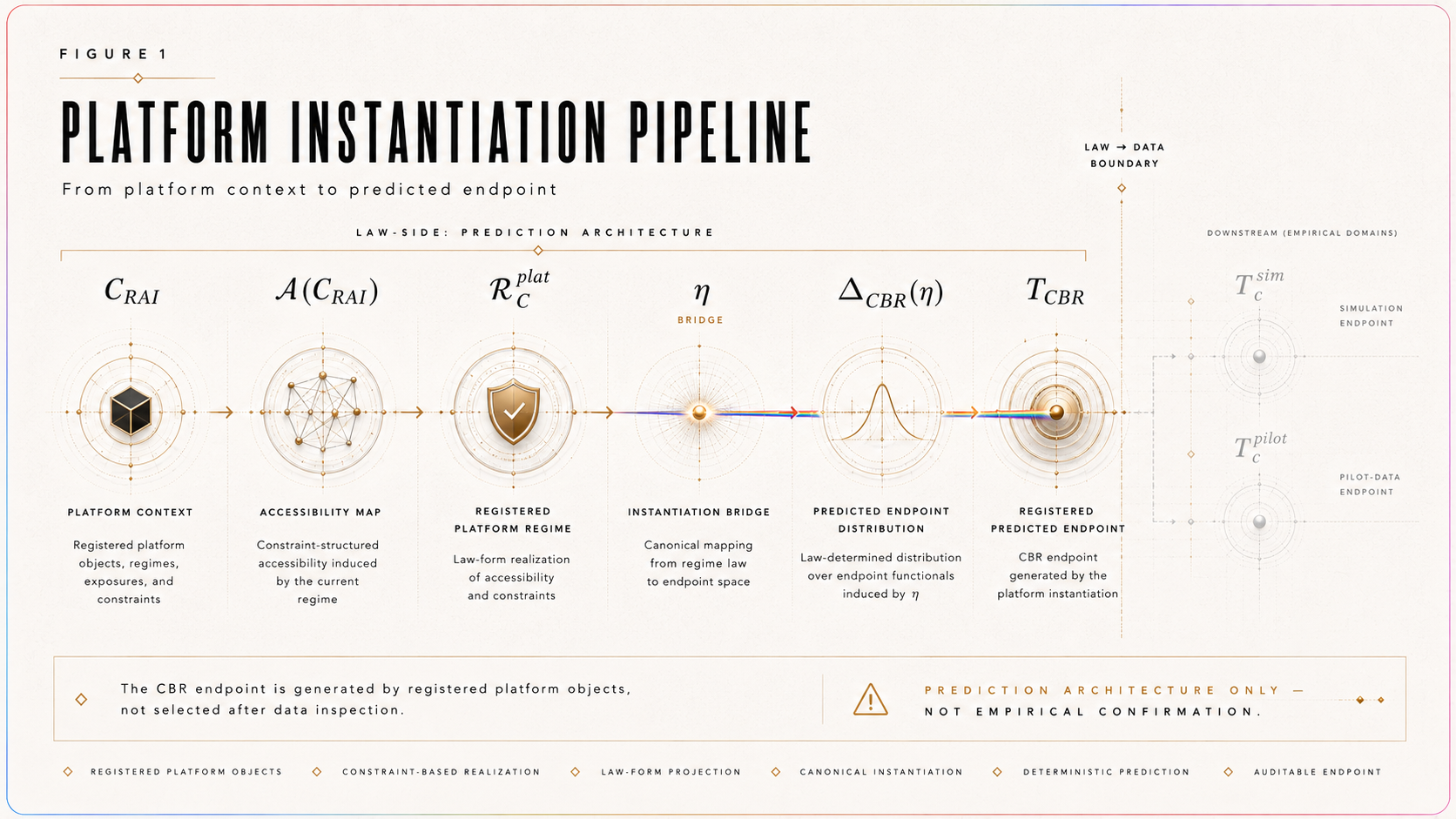
Figure 2 — Evidence Tier Structure
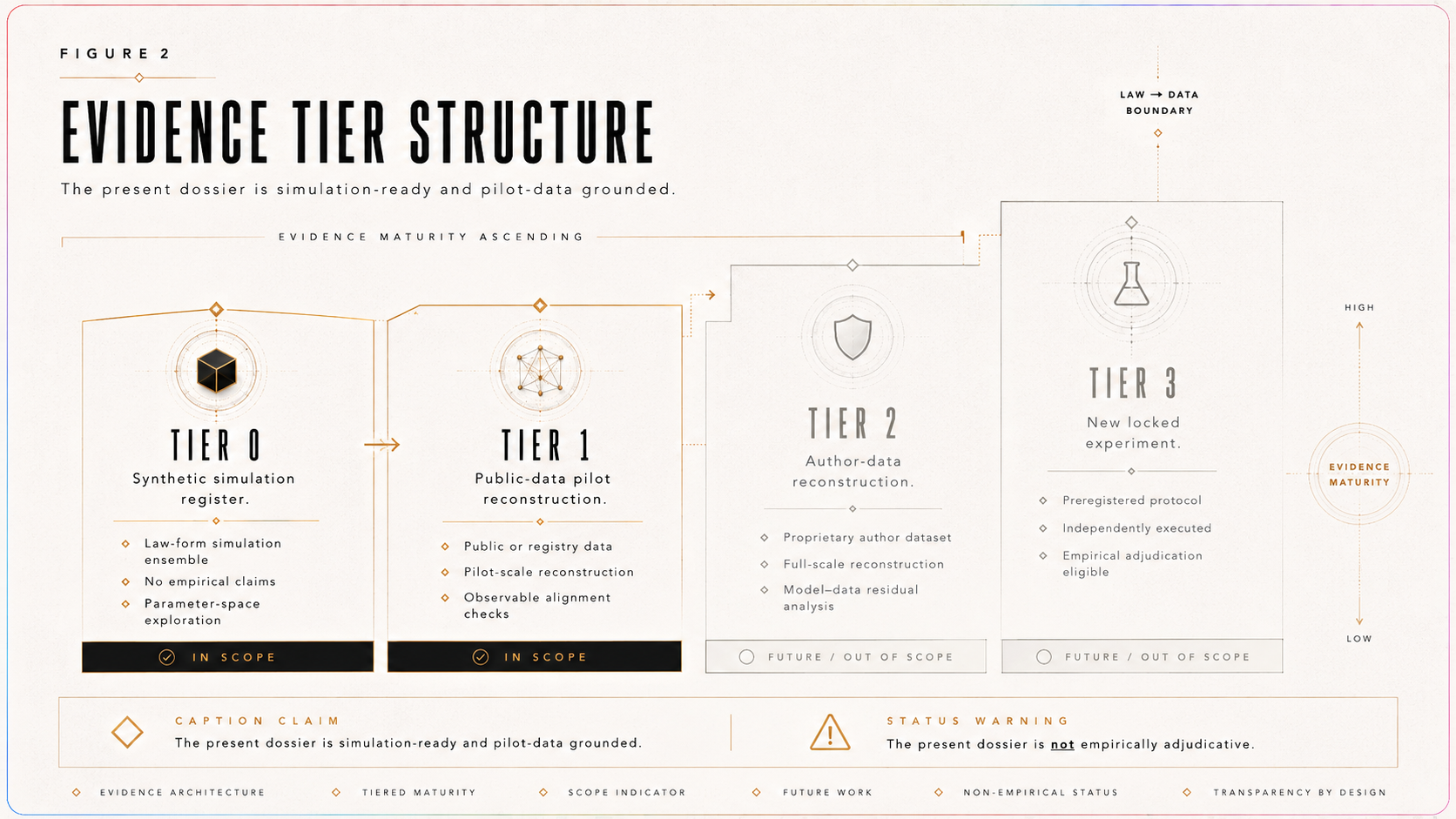
Figure 3 — η Grid and Critical Regime
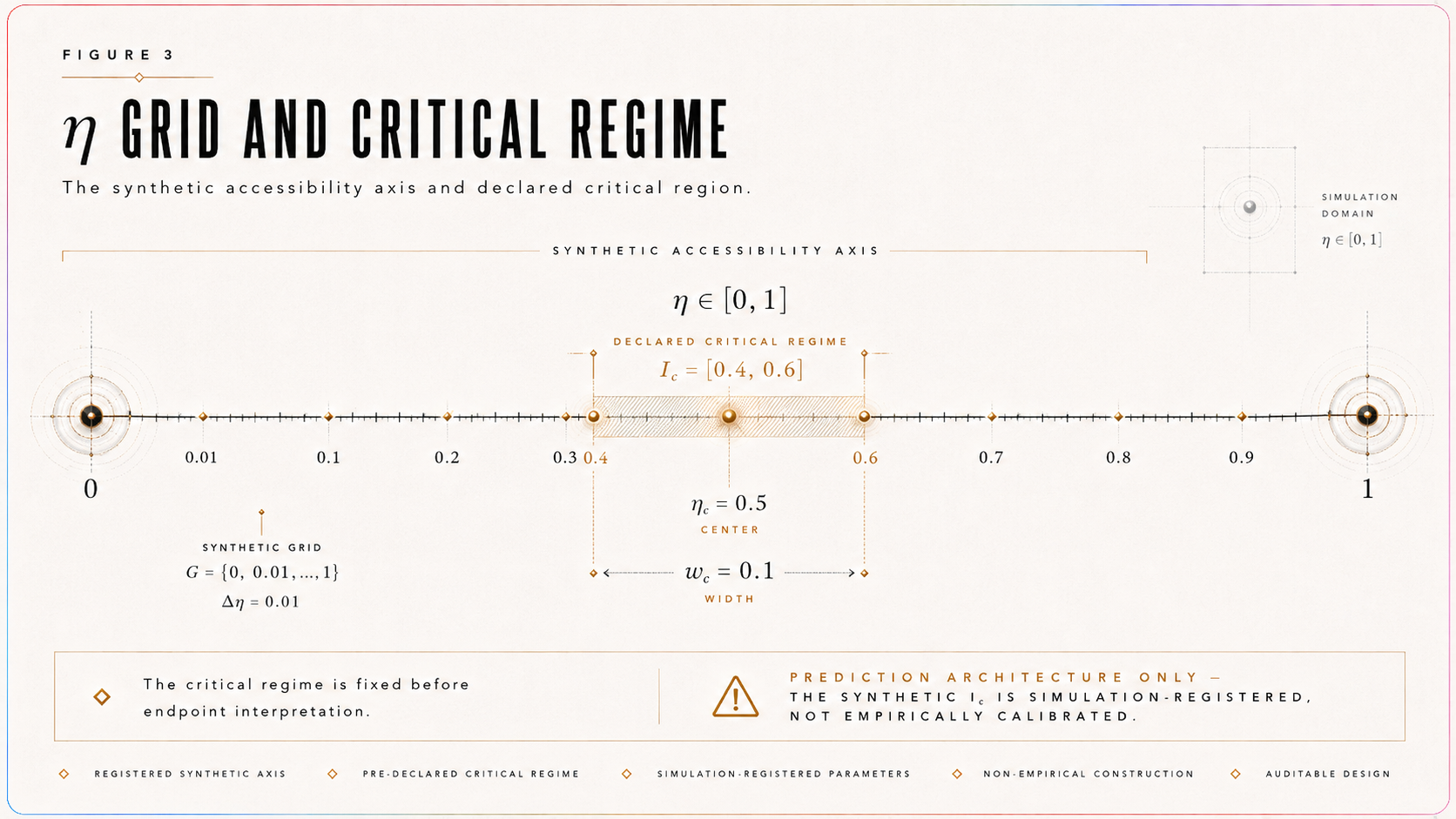
Figure 4 — Kim–Ham η_proxy Mapping
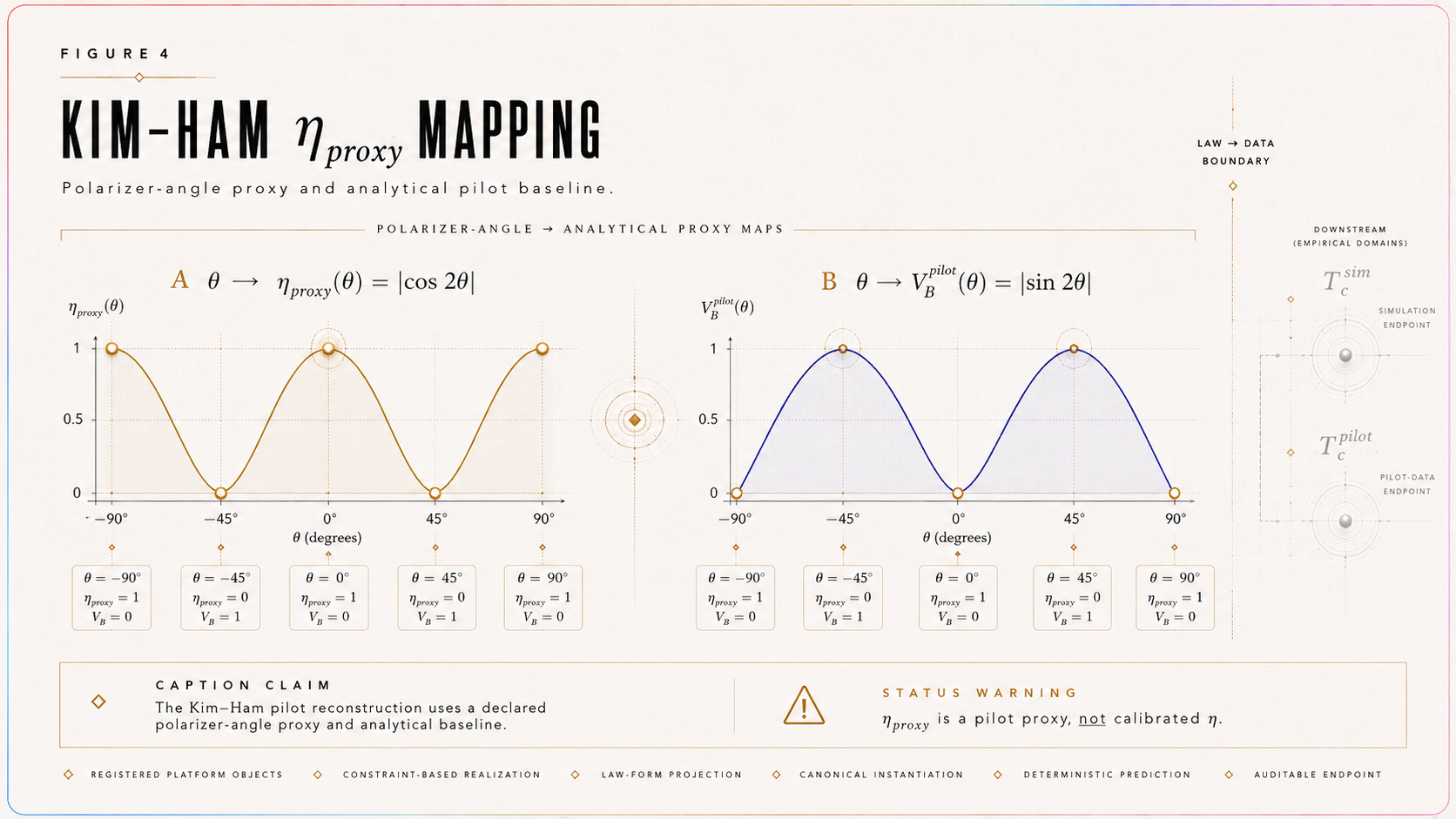
Figure 5 — Baseline Model Class 𝔅
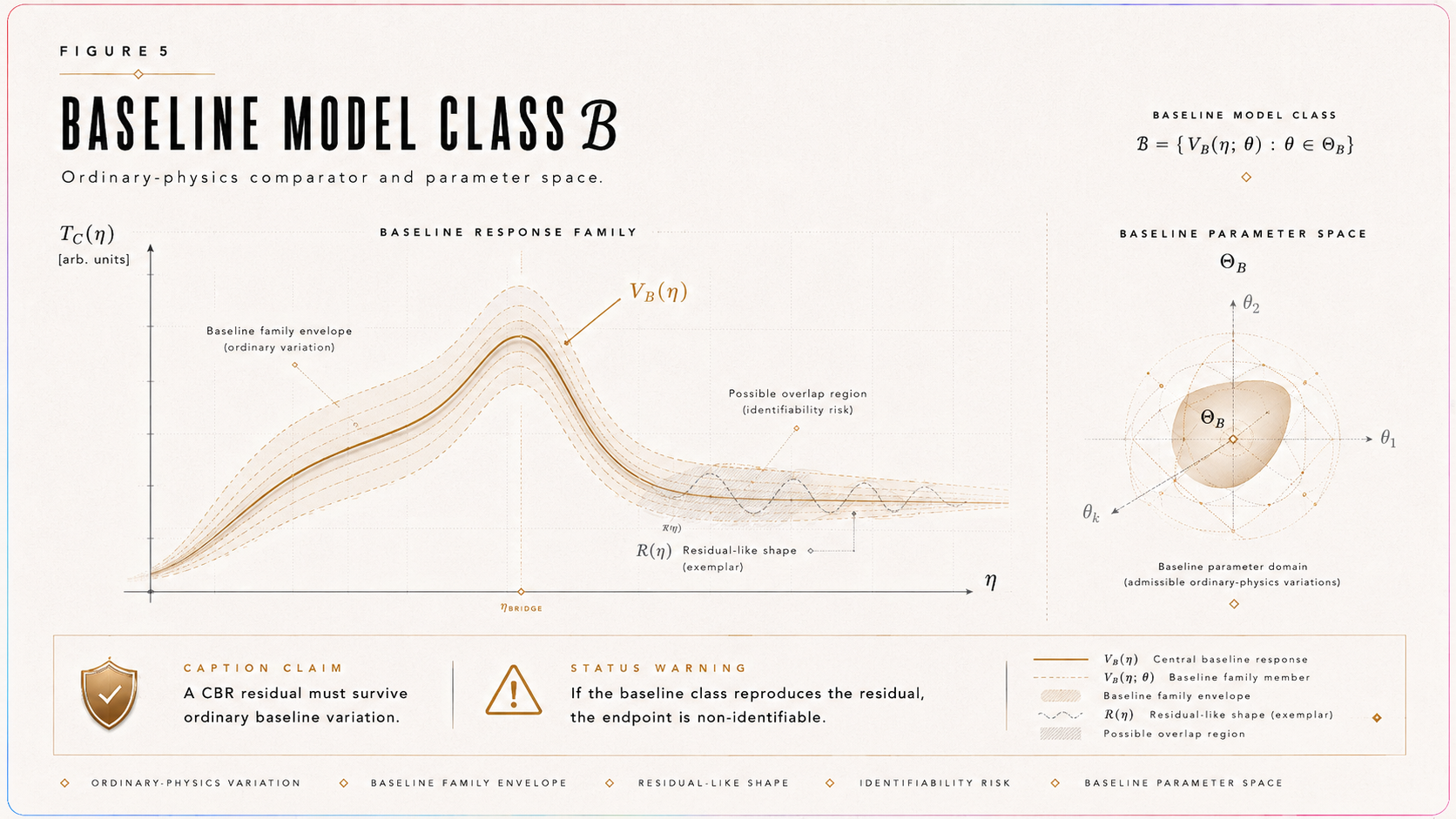
Figure 6 — Central v0.1 Baseline
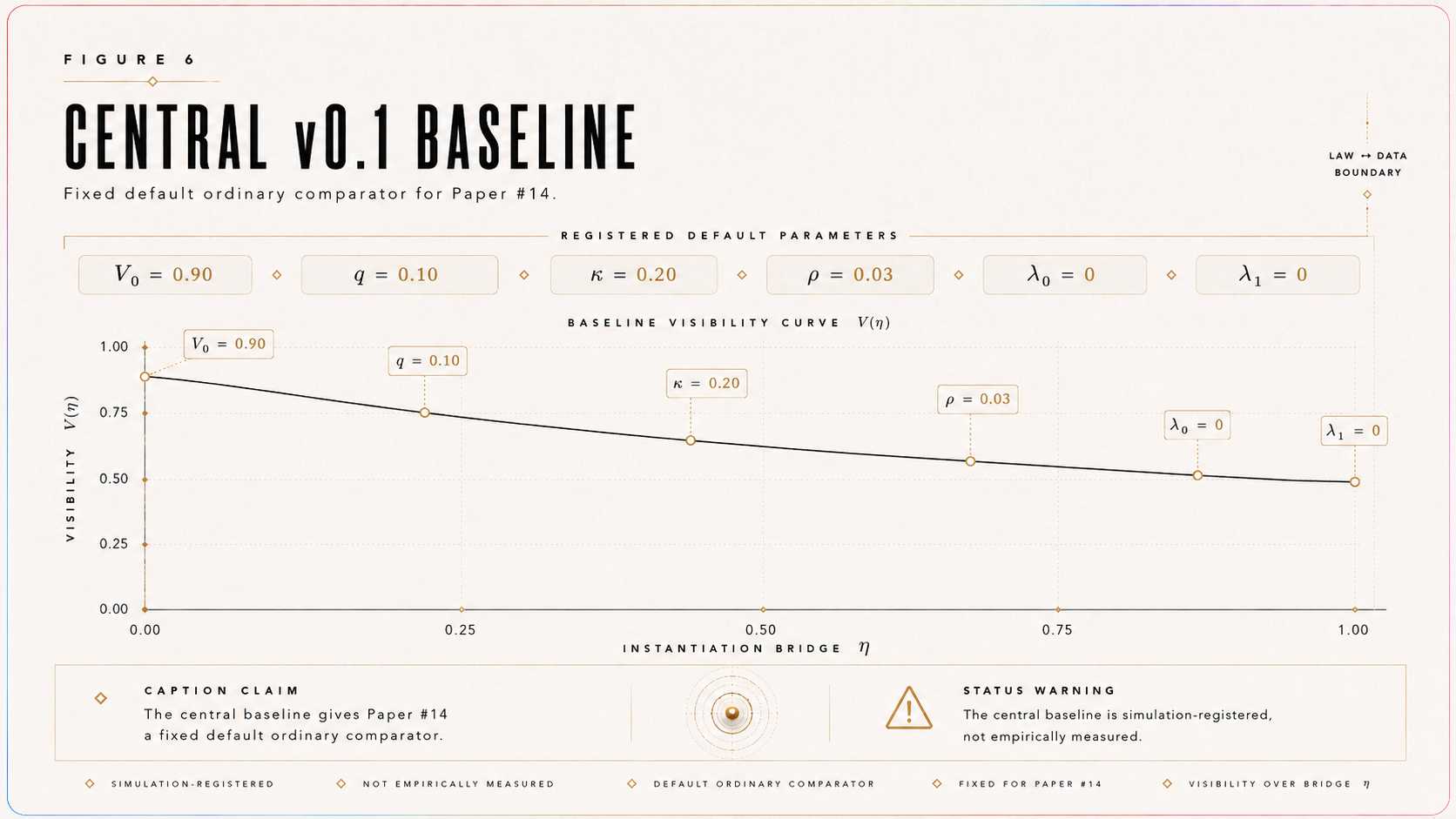
Figure 7 — Nuisance Envelope and Threshold
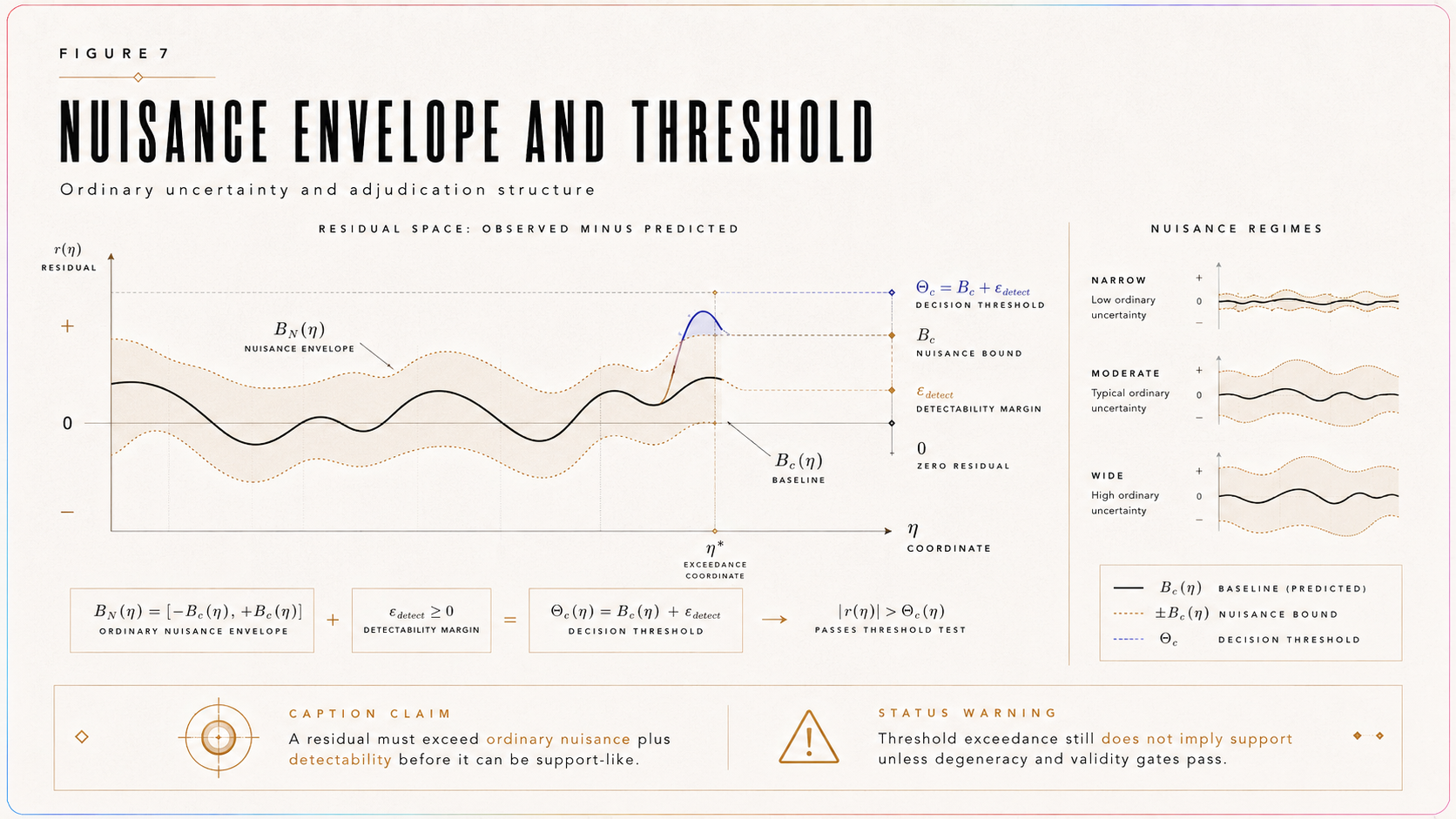
Figure 8 — Predicted Residual Morphology
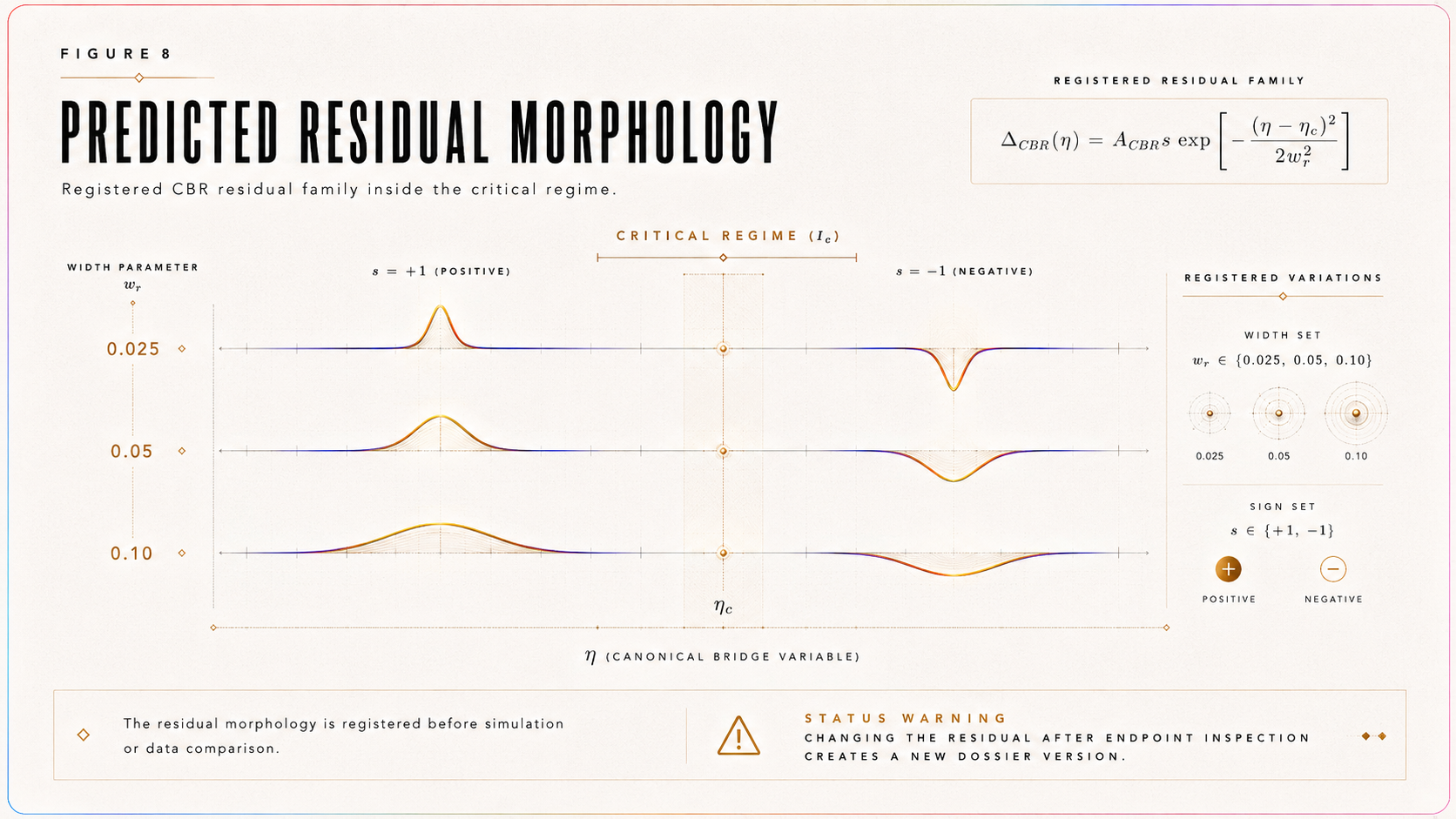
Figure 9 — Endpoint Computation
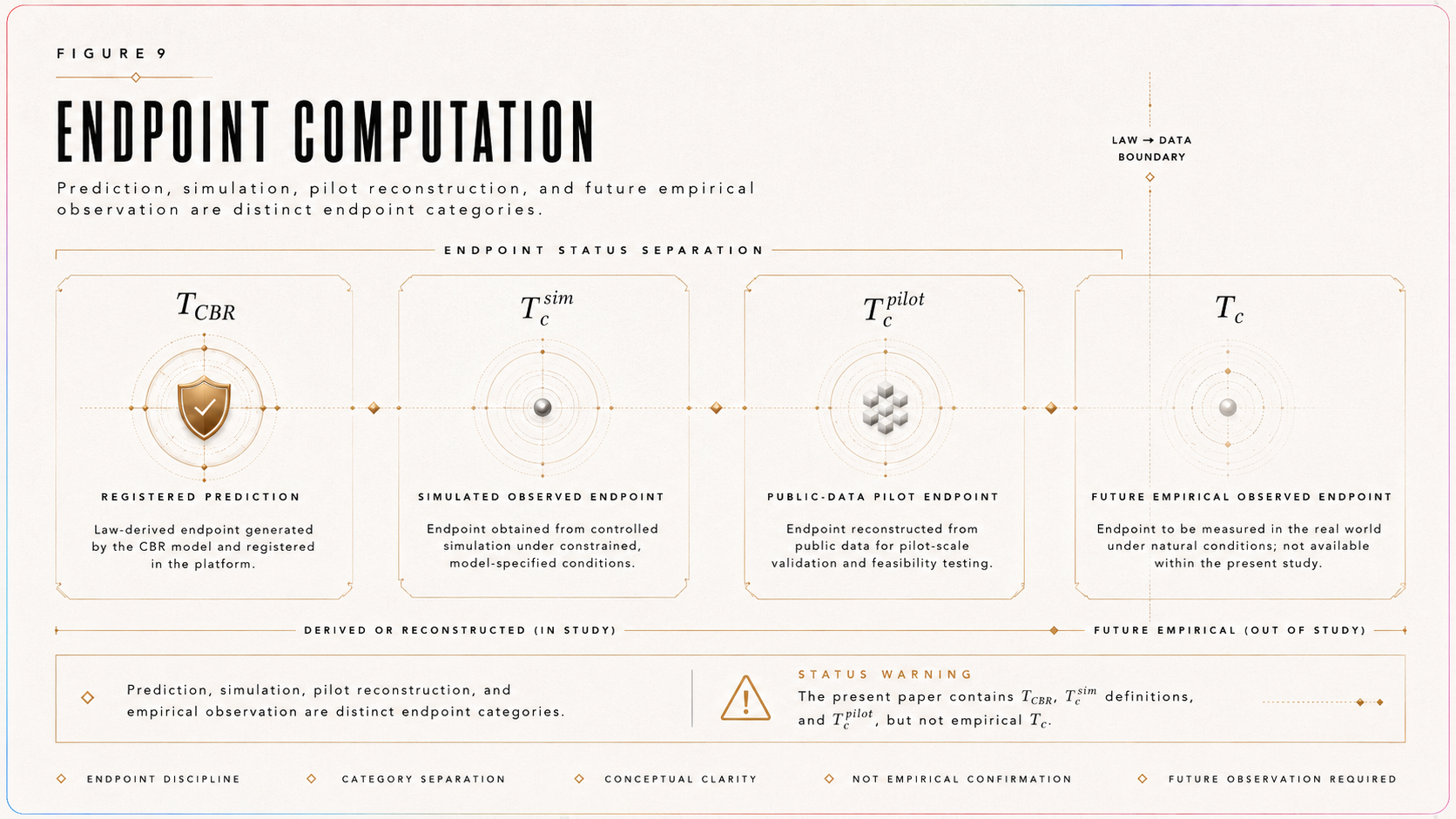
Figure 10 — Kim–Ham Pilot Residual
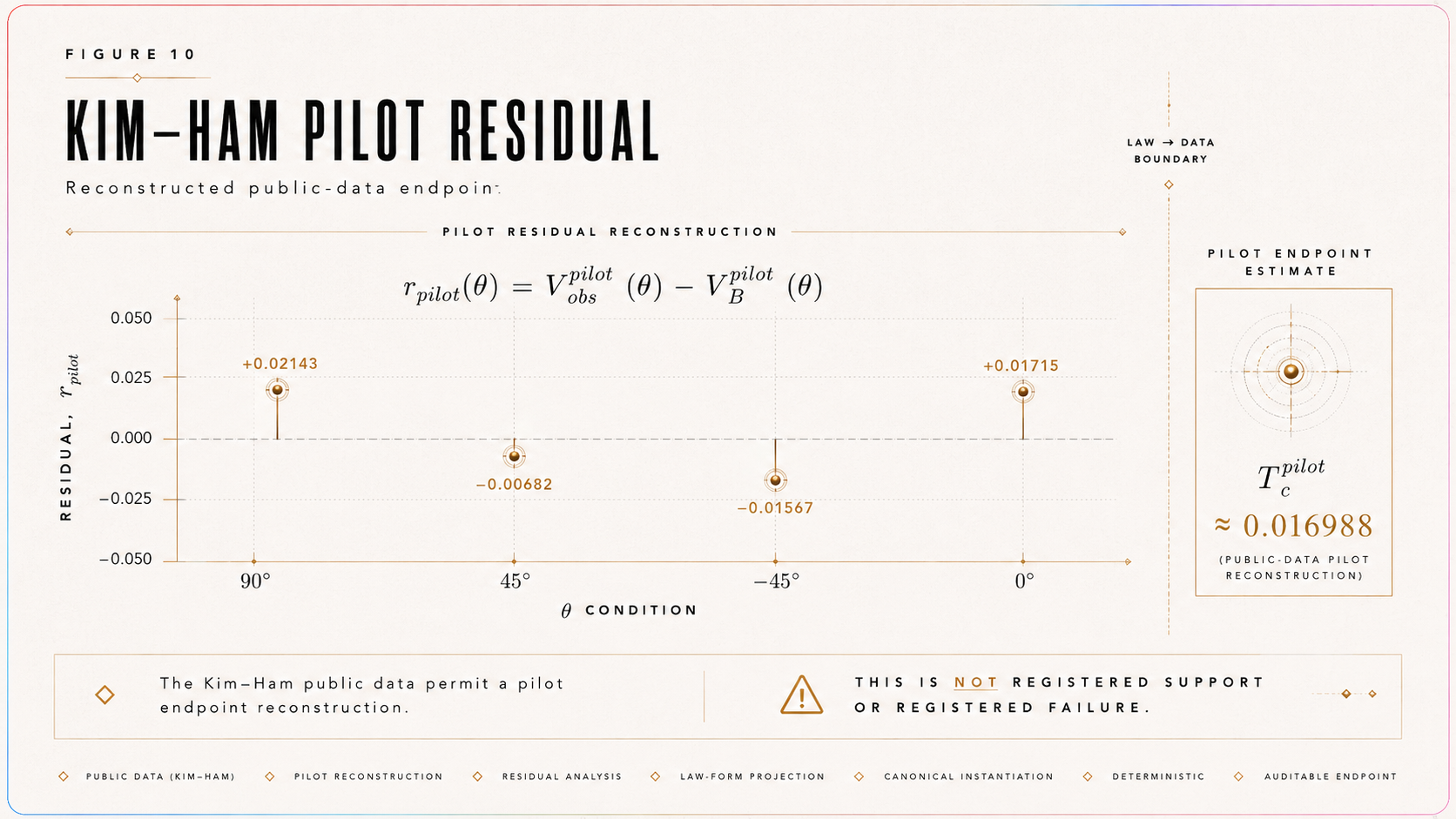
Figure 11 — Degeneracy Map
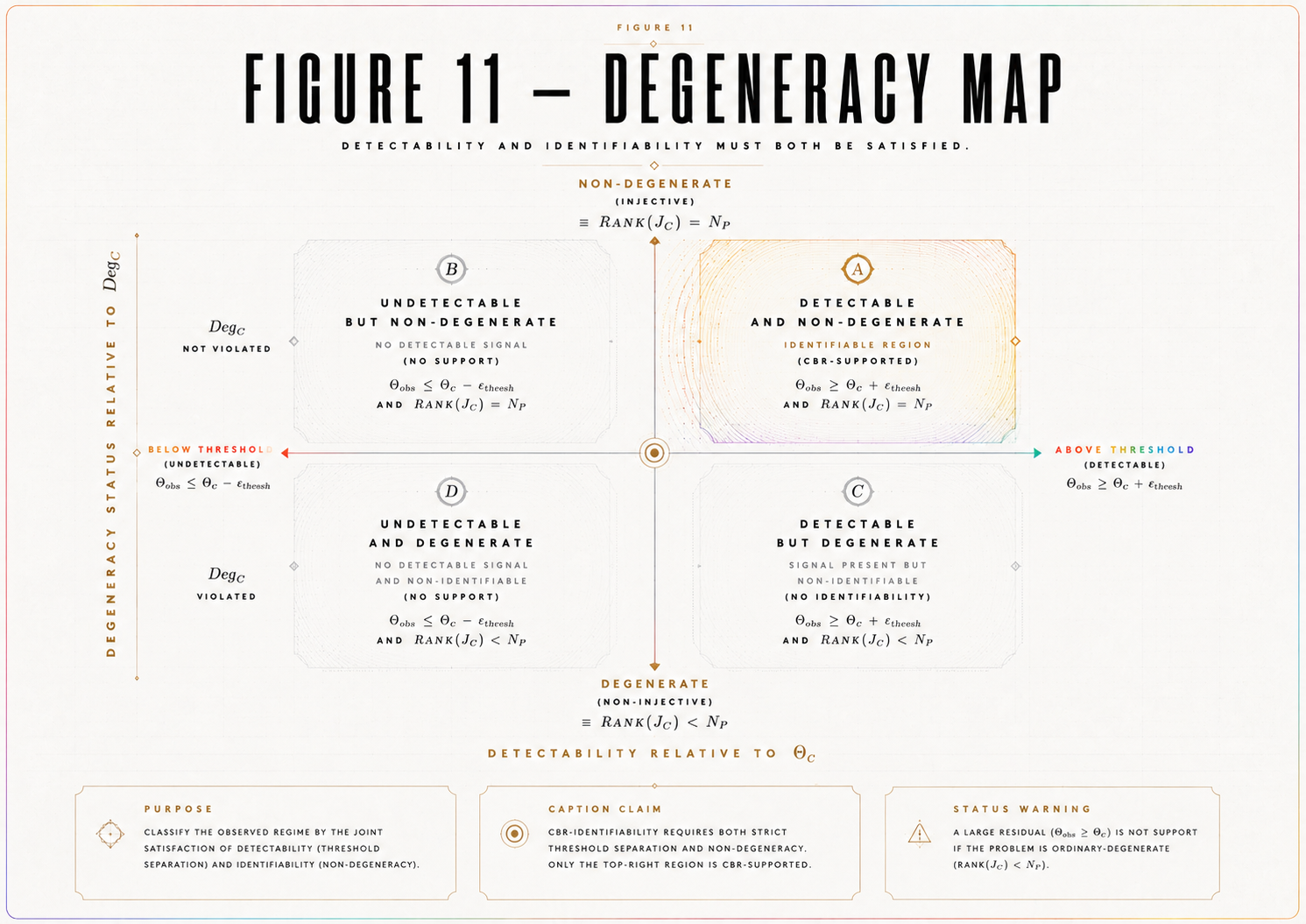
Figure 12 — Scenario Registion
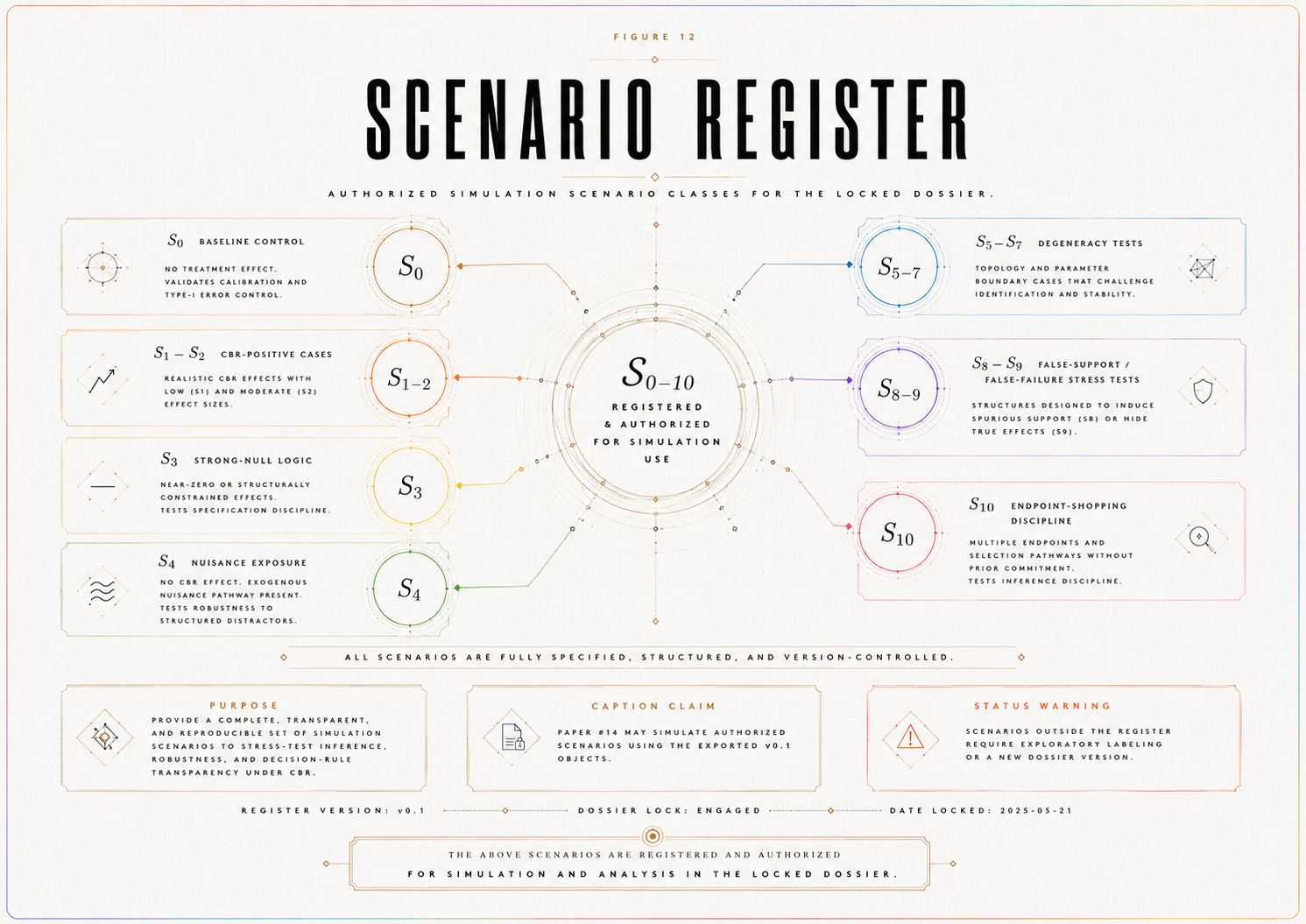
Figure 13 — Simulation Export Register
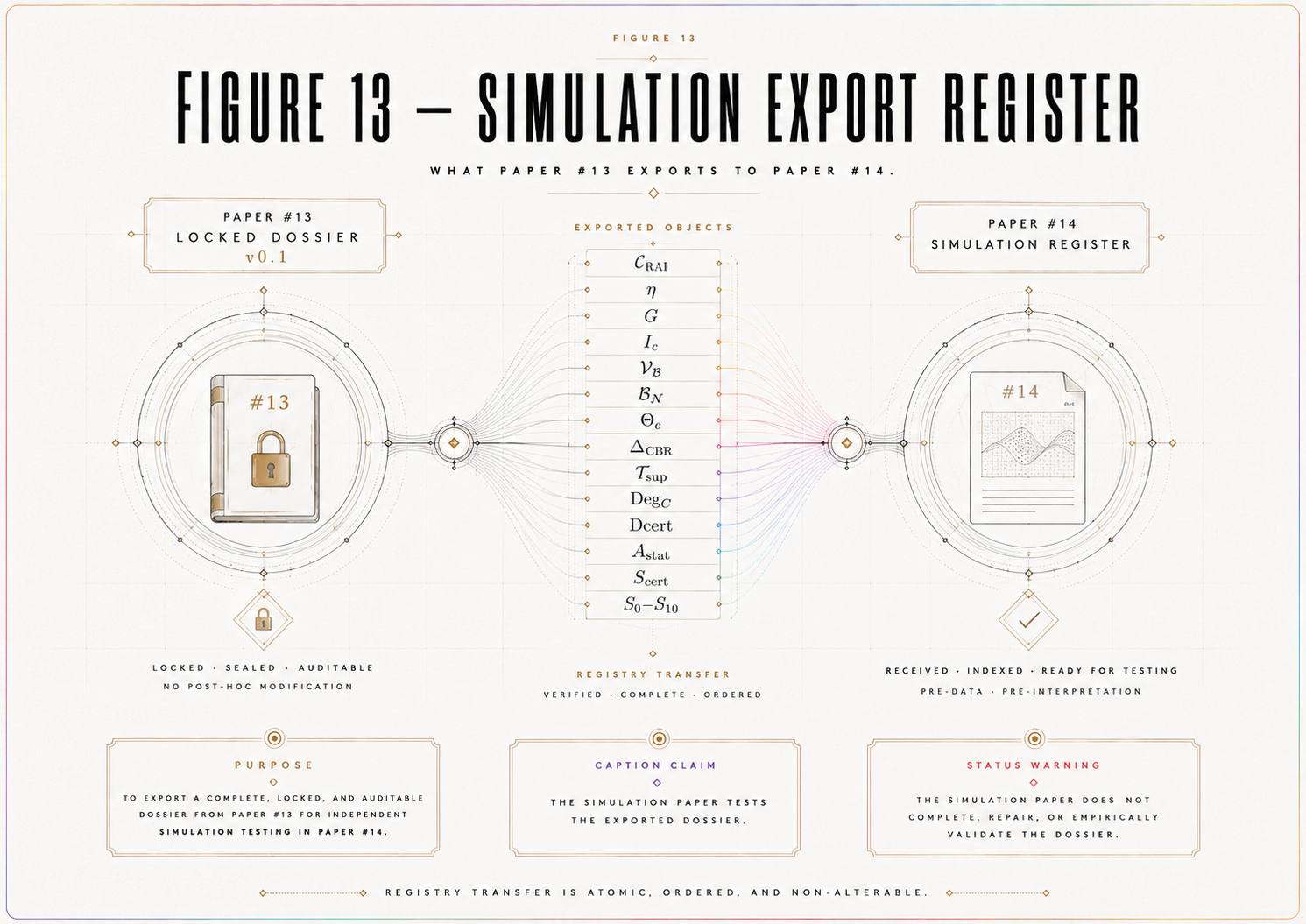
Figure 14 — Verdict Status Map
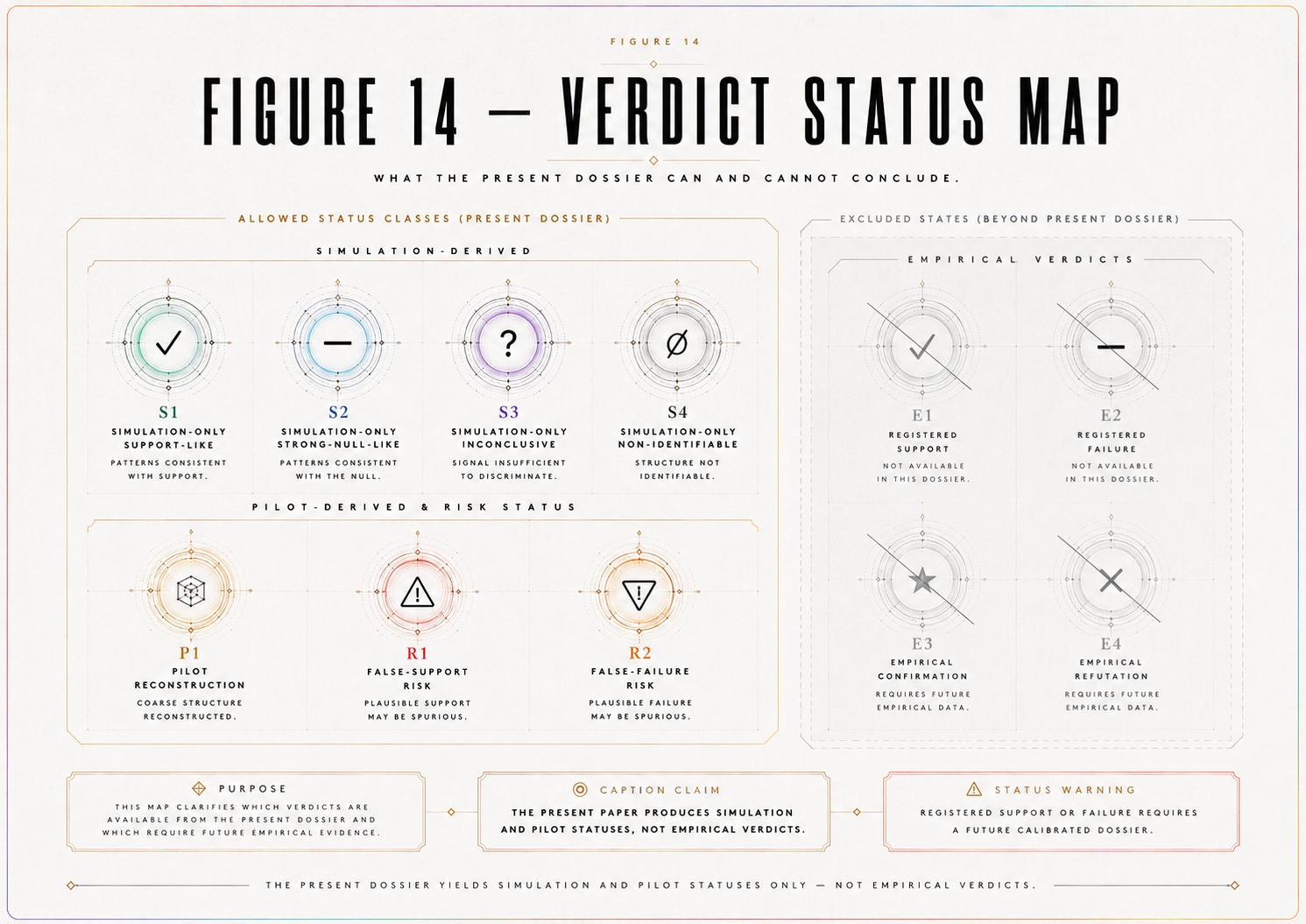
Figure 15 — Version Boundary Map
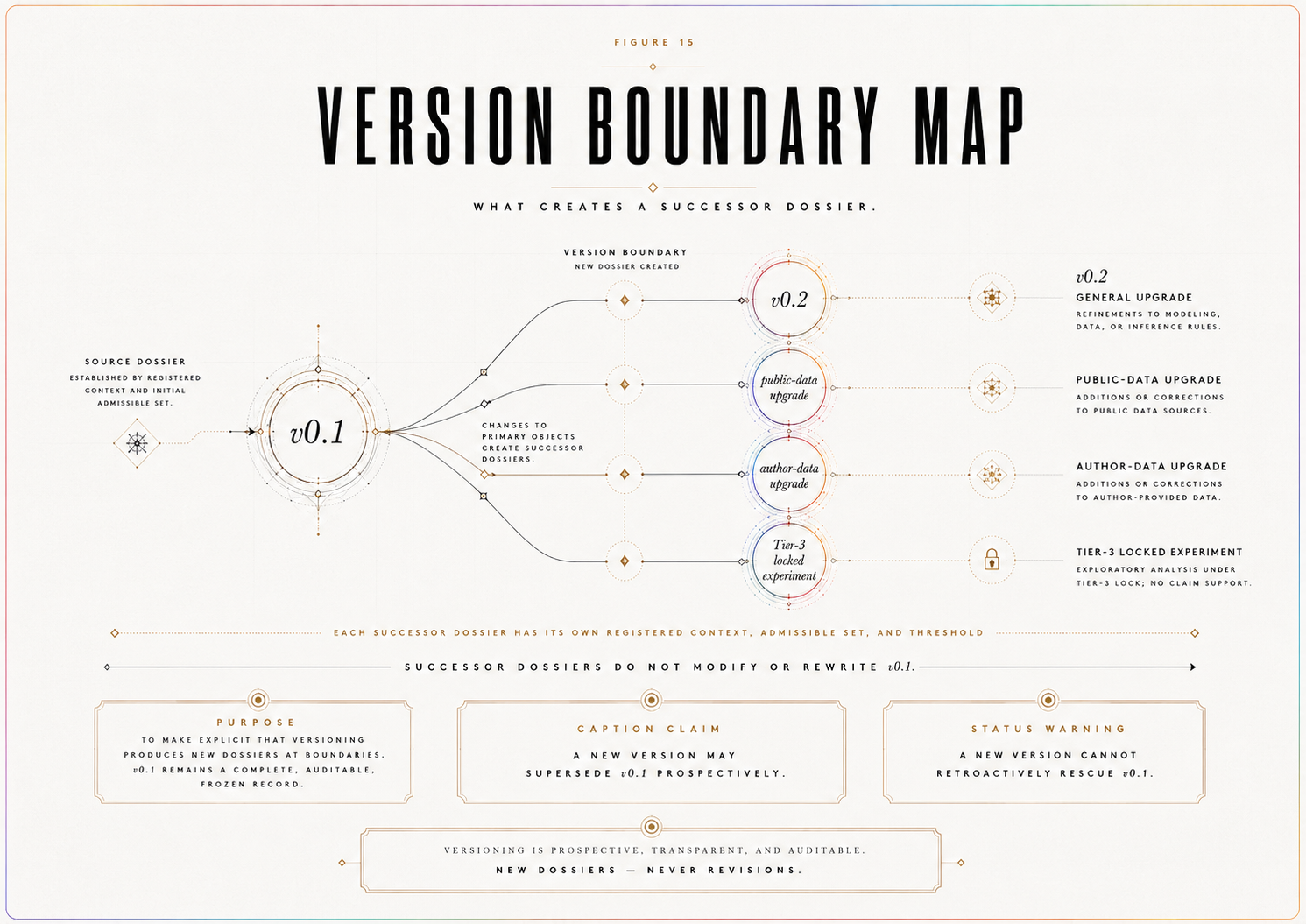
24. Conclusion
24.1 Summary of the Paper
This paper constructs a complete synthetic, simulation-ready C_RAI numerical dossier for Constraint-Based Realization and supplements it with a public-data pilot endpoint reconstruction.
The declared platform is:
C_RAI = record-accessibility interferometric context.
The synthetic v0.1 dossier supplies:
a registered accessibility grid,
a critical accessibility regime,
a baseline model class,
a nuisance structure,
a decision threshold,
a predicted residual family,
an endpoint functional,
a degeneracy operator,
a statistical rule,
a scenario register,
a simulation export register,
and a version boundary.
The public-data layer supplies:
a Kim–Ham pilot reconstruction,
a derived accessibility proxy,
an analytical pilot baseline,
a reconstructed residual,
and a computed pilot endpoint:
T_c^pilot ≈ 0.016988.
The result is a dossier that is: synthetic, locked, executable, auditable, simulation-ready, and pilot-data grounded.
24.2 Main Achievement
The main achievement is not empirical confirmation.
The main achievement is exact operationalization.
This paper converts the locked numerical standard into a concrete platform-class model with enough structure to be simulated without object invention. It also shows that CBR-style endpoint reconstruction can be performed on real public quantum-eraser data under explicit pilot limitations.
The paper’s central contribution is not a claimed discovery of a CBR effect, but the construction of a locked platform dossier capable of generating, simulating, reconstructing, limiting, and upgrading CBR endpoint claims without post hoc rescue.
The paper therefore advances CBR from law-form and standard-setting into platform execution.
It gives the next paper a complete simulation object.
It gives future empirical work a clear upgrade path.
It gives the public-data pilot a disciplined status.
24.3 What the Paper Does Not Do
This paper does not test nature decisively.
It does not confirm CBR.
It does not refute CBR.
It does not show that realization has been directly observed.
It does not show that the Kim–Ham endpoint is a CBR signal.
It does not show that ordinary quantum theory is false.
It does not establish ℛ_C^plat as the universal realization-burden functional.
It does not issue registered support.
It does not issue registered failure.
These limits are not incidental. They are the conditions under which the dossier remains scientifically usable.
24.4 Why the Pilot Result Matters
The pilot result matters because it demonstrates endpoint computability on real public data.
The Kim–Ham reconstruction shows that the CBR empirical machinery can be brought into contact with an actual quantum-eraser platform. It allows one to define:
η_proxy(θ),
V_ℬ^pilot(θ),
V_obs^pilot(θ),
r_pilot(θ),
and:
T_c^pilot.
This is not confirmation. It is methodological grounding.
It shows that CBR can be prepared for empirical work without pretending that a retrospective public-data reconstruction is already a decisive test.
24.5 Why the Simulation Register Matters
The simulation register matters because it prevents Paper #14 from becoming an informal demonstration.
Paper #14 now inherits:
fixed objects,
authorized scenarios,
validity gates,
degeneracy rules,
statistical rules,
endpoint conventions,
provenance labels,
and version boundaries.
That means Paper #14 can test the behavior of the CBR decision machinery under controlled synthetic conditions while preserving strict claim discipline.
The simulations may show support-like behavior, strong-null-like behavior, inconclusive exposure, non-identifiability, false-support risk, false-failure risk, and endpoint-shopping risk.
They will not constitute empirical adjudication.
24.6 Closing Statement
The next paper may now simulate the locked C_RAI dossier under baseline-only, CBR-positive, strong-null, inconclusive, non-identifiable, underpowered, false-support, false-failure, and degeneracy scenarios.
Those simulations test the behavior of the decision machinery.
They do not constitute empirical adjudication.
The Kim–Ham public-data pilot demonstrates endpoint computability.
It does not constitute registered support or registered failure.
Decisive CBR adjudication requires calibrated η, validated nuisance modeling, full degeneracy analysis, an implemented statistical rule, and a registered CBR prediction.
The final status of the present paper is therefore: simulation-ready, pilot-data grounded, not empirically adjudicated.
25. References
25.1 Reference Note
The references are organized by function: primary public-data pilot source, delayed-choice and quantum-eraser foundations, complementarity and visibility theory, decoherence and ordinary-baseline context, model-rich future platform references, and internal CBR program works. The Kim–Ham paper is the primary public-data source for the pilot reconstruction because it reports a delayed-choice quantum eraser using coherent photon pairs, a polarizer placed outside the interferometer, Mach–Zehnder-derived coherence solutions, θ-dependent fringe/no-fringe conditions, and public measurement details used for endpoint reconstruction.
Where DOI or journal identifiers are available, they are included. Internal CBR works are cited as official self-hosted manuscripts unless or until a DOI, HAL, Zenodo, OSF, SSRN, or arXiv identifier is assigned.
25.2 Primary Public-Data Pilot Source
Kim, S., & Ham, B. S. (2023). Observations of the delayed-choice quantum eraser using coherent photons. Scientific Reports, 13, Article 9758. doi: 10.1038/s41598-023-36590-7.
25.3 Delayed-Choice and Quantum-Eraser Foundations
Wheeler, J. A. (1978). The “past” and the “delayed-choice” double-slit experiment. In A. R. Marlow (Ed.), Mathematical Foundations of Quantum Theory (pp. 9–48). Academic Press. doi: 10.1016/B978-0-12-473250-6.50006-6.
Scully, M. O., & Drühl, K. (1982). Quantum eraser: A proposed photon correlation experiment concerning observation and “delayed choice” in quantum mechanics. Physical Review A, 25(4), 2208–2213. doi: 10.1103/PhysRevA.25.2208.
Kim, Y.-H., Yu, R., Kulik, S. P., Shih, Y. H., & Scully, M. O. (2000). Delayed “choice” quantum eraser. Physical Review Letters, 84(1), 1–5. doi: 10.1103/PhysRevLett.84.1.
Jacques, V., Wu, E., Grosshans, F., Treussart, F., Grangier, P., Aspect, A., & Roch, J.-F. (2007). Experimental realization of Wheeler’s delayed-choice Gedanken experiment. Science, 315(5814), 966–968. doi: 10.1126/science.1136303.
25.4 Complementarity, Visibility, and Which-Path Information
Englert, B.-G. (1996). Fringe visibility and which-way information: An inequality. Physical Review Letters, 77(11), 2154–2157. doi: 10.1103/PhysRevLett.77.2154.
Cruz, P. M. Q., & Fernández-Rossier, J. (2021). Testing complementarity on a transmon quantum processor. Physical Review A, 104, Article 032223. doi: 10.1103/PhysRevA.104.032223.
25.5 Decoherence and Ordinary-Baseline Context
Zurek, W. H. (2003). Decoherence, einselection, and the quantum origins of the classical. Reviews of Modern Physics, 75(3), 715–775. doi: 10.1103/RevModPhys.75.715.
25.6 Internal CBR Program References
Duran, R. IV. (2026a). Probability Is Not Selection: Why Quantum Probability Does Not Select the Realized Outcome. Version 1.0, April 2026. Official self-hosted manuscript, RobertDuranIV.com.
Duran, R. IV. (2026b). The Realization-Law Burden: Why Quantum Outcome Realization Requires More Than Probability and Decoherence. Version 1.0, April 2026. Official self-hosted manuscript, RobertDuranIV.com.
Duran, R. IV. (2026c). A Minimal Reconstruction of Constraint-Based Realization from the Burdens of a Quantum Outcome Law. Version 1.0, April 2026. Official self-hosted manuscript, RobertDuranIV.com.
Duran, R. IV. (2026d). The Law-Candidate Test for Quantum Outcome Realization. Version 1.0, April 2026. Official self-hosted manuscript, RobertDuranIV.com.
Duran, R. IV. (2026e). A No-Internal-Alternative Theorem for Outcome Realization: Constraint-Based Realization. Version 1.0, April 2026. Official self-hosted manuscript, RobertDuranIV.com.
Duran, R. IV. (2026f). Constraint-Based Realization: Canonical Closure and Exact Empirical Exposure. Version 1.0, April 2026. Official self-hosted manuscript, RobertDuranIV.com.
Duran, R. IV. (2026g). Constraint-Based Realization: Canonical Law Form, Operational Uniqueness, and an Accessibility-Based Failure Criterion. Version 1.0, April 2026. Official self-hosted manuscript, RobertDuranIV.com.
Duran, R. IV. (2026h). The Quadratic-Weighting Barrier and Constraint-Based Realization: Born Rule Discipline in Canonical CBR. Version 1.0, April 2026. Official self-hosted manuscript, RobertDuranIV.com.
Duran, R. IV. (2026i). The Necessity of Quadratic Weighting in Constraint-Based Realization. Version 1.0, April 2026. Official self-hosted manuscript, RobertDuranIV.com.
Duran, R. IV. (2026j). The Accessibility Signature Test: A Strong-Null Interferometric Protocol for Constraint-Based Realization. Version 1.0, April 2026. Official self-hosted manuscript, RobertDuranIV.com.
Duran, R. IV. (2026k). Exact Operational Signature and Binary Invalidation in Constraint-Based Realization. Version 1.0, April 2026. Official self-hosted manuscript, RobertDuranIV.com.
Duran, R. IV. (2026l). The Canonical Execution Standard for Constraint-Based Realization. Version 1.0, April 2026. Official self-hosted manuscript, RobertDuranIV.com.
Duran, R. IV. (2026m). Exactness, Separation, and Failure Discipline in Constraint-Based Realization. Version 1.0, April 2026. Official self-hosted manuscript, RobertDuranIV.com.
Duran, R. IV. (2026n). The Jurisdiction of Failure in Quantum Outcome Realization: Constraint-Based Realization and the Law-Form Burden. Version 1.0, April 2026. Official self-hosted manuscript, RobertDuranIV.com.
Duran, R. IV. (2026o). From Canonical Constraint-Based Realization to Adversarial Exposure Closure. Version 1.0, April 2026. Official self-hosted manuscript, RobertDuranIV.com.
Duran, R. IV. (2026p). The Realization-Burden Functional in Constraint-Based Realization: A Necessity Argument for Quantum Outcome Selection. Version 1.0, May 2026. Official self-hosted manuscript, RobertDuranIV.com.
Duran, R. IV. (2026q). Locked-Dossier Standard for Testing Canonical CBR in a Delayed-Choice Record-Accessibility Interferometer. Version 1.0, May 2026. Official self-hosted manuscript, RobertDuranIV.com.
Duran, R. IV. (2026r). The Accessibility-Critical Residual: An Empirical Endpoint Theorem for Constraint-Based Realization. Version 1.0, May 2026. Official self-hosted manuscript, RobertDuranIV.com.
Duran, R. IV. (2026s). The Locked Numerical Instantiation Standard for Constraint-Based Realization: Completeness, Identifiability, Simulation Readiness, and Empirical Adjudication in a Platform-Specific CBR Dossier. Version 1.0, May 2026. Official self-hosted manuscript, RobertDuranIV.com.
Duran, R. IV. (2026t). A Platform-Specific Numerical Instantiation of Constraint-Based Realization: A Simulation-Ready and Public-Data Pilot C_RAI Dossier for Record-Accessibility Interferometry. Version 1.0, May 2026. Present manuscript.
Duran, R. IV. (2026u). Simulation Scenarios for Constraint-Based Realization. Planned successor manuscript.
Appendix A — Full C_RAI Dossier Registry
A.1 Purpose
This appendix collects the locked synthetic and pilot objects used in the C_RAI v0.1 dossier.
The purpose is auditability. A reader should be able to inspect this appendix and identify every primary object needed to reproduce the dossier’s simulation-ready and pilot-data-grounded status.
A.2 Platform Registry
Platform context: C_RAI
Definition: record-accessibility interferometric context.
Status: registered platform class.
Provenance: simulation-ready / platform-declared.
Empirical status: not calibrated to a named apparatus.
A.3 Accessibility Registry
Accessibility variable: η ∈ [0,1]
Synthetic grid: G = {η_j = j/(N_η − 1)}
Grid size: N_η = 101
Critical center: η_c = 0.5
Critical half-width: w_c = 0.1
Critical regime: I_c = [0.4, 0.6]
Grid-restricted critical regime: G_c = G ∩ I_c
Status: simulation-registered.
Empirical status: not calibrated.
A.4 Pilot Accessibility Proxy Registry
Pilot source: Kim–Ham public quantum-eraser data.
Pilot control variable: polarizer angle θ.
Degree convention: θ interpreted in degrees.
Pilot proxy: η_proxy(θ) = |cos 2θ|.
Mapping: θ = ±45° → η_proxy = 0; θ = 0°, 90° → η_proxy = 1.
Status: pilot reconstructed / derived proxy.
Empirical status: not calibrated η.
A.5 Baseline Registry
Synthetic baseline class: 𝔅 = {V_ℬ(η; θ_ℬ) : θ_ℬ ∈ Θ_ℬ}.
Synthetic baseline form:
V_ℬ(η; θ_ℬ) = V₀(1 − qη)exp(−κη)(1 − ρη) + λ₀ + λ₁η.
Central values:
V₀ = 0.90, q = 0.10, κ = 0.20, ρ = 0.03, λ₀ = 0, λ₁ = 0.
Status: simulation-registered.
Empirical status: not measured.
Pilot baseline: V_ℬ^pilot(θ) = |sin 2θ|.
Status: analytical / pilot reconstructed.
Empirical status: not a validated nuisance-inclusive empirical baseline.
A.6 Nuisance and Threshold Registry
Narrow nuisance: B_𝓝^narrow = 0.0075.
Moderate nuisance: B_𝓝^moderate = 0.0175.
Wide nuisance: B_𝓝^wide = 0.0375.
Optional form: B_𝓝(η) = b₀ + b₁|η − η_c|.
Central values: b₀ = 0.0175, b₁ = 0.
Critical nuisance bound: B_c = sup_{η ∈ I_c} B_𝓝(η).
Detectability threshold: ε_detect = z_detect σ_T.
Decision threshold: Θ_c = B_c + ε_detect.
Status: simulation-registered.
Empirical status: not validated.
A.7 Residual and Endpoint Registry
Synthetic residual:
Δ_CBR(η) = A_CBR s exp[−(η − η_c)²/(2w_r²)].
Amplitude family:
A_CBR ∈ {0, 0.5Θ_c, Θ_c, 1.5Θ_c, 2Θ_c, 3Θ_c}.
Width family:
w_r ∈ {0.025, 0.05, 0.10}.
Sign family:
s ∈ {+1, −1}.
Primary endpoint: 𝒯_sup.
Predicted endpoint: T_CBR = 𝒯_sup[Δ_CBR].
Simulated endpoint: T_c^sim = 𝒯_sup[V_obs^sim − V_ℬ].
Pilot endpoint: T_c^pilot ≈ 0.016988.
Status: synthetic endpoint objects are simulation-registered; pilot endpoint is reconstructed.
Empirical status: not adjudicative.
A.8 Degeneracy and Statistical Registry
Degeneracy operator:
Deg_C = Deg_𝔅 ∪ Deg_𝓝 ∪ Deg_η ∪ Deg_est ∪ Deg_post ∪ Deg_phase ∪ Deg_samp ∪ Deg_stat ∪ Deg_end.
Degeneracy tolerance: τ_deg.
Degeneracy certificate: Dcert(Δ_CBR).
Statistical rule: A_stat v0.1 = envelope-threshold rule.
Scenario certificate: Scert(S_i).
Status: simulation-ready.
Pilot status: only partially evaluable.
A.9 Version Registry
Current version: v0.1.
Status: synthetic, simulation-ready, pilot-data grounded.
No-retroactive-rescue rule: active.
Empirical upgrade: creates successor dossier.
Pilot upgrade: author-supplied data creates Tier-2 successor, not retroactive v0.1 adjudication.
Appendix B — Baseline Parameter Register
B.1 Synthetic Baseline Form
The synthetic v0.1 baseline is:
V_ℬ(η; θ_ℬ) = V₀(1 − qη)exp(−κη)(1 − ρη) + λ₀ + λ₁η.
The baseline parameter vector is:
θ_ℬ = (V₀, q, κ, ρ, λ₀, λ₁).
B.2 Central Values
The central v0.1 baseline values are:
V₀ = 0.90,
q = 0.10,
κ = 0.20,
ρ = 0.03,
λ₀ = 0,
λ₁ = 0.
Provenance: simulation-registered.
Empirical status: not measured, not calibrated, not fitted to Kim–Ham data.
B.3 Parameter Ranges
The registered baseline parameter ranges are:
V₀ ∈ [0.75, 1.00],
q ∈ [0, 0.30],
κ ∈ [0, 0.50],
ρ ∈ [0, 0.10],
λ₀ ∈ [−0.01, 0.01],
λ₁ ∈ [−0.02, 0.02].
Provenance: simulation-registered ranges.
Empirical status: not empirical confidence intervals.
B.4 Physical Visibility Constraint
For default v0.1 simulations:
0 ≤ V_ℬ(η; θ_ℬ) ≤ 1
for all registered η values, up to explicitly registered numerical tolerance.
Parameter choices that violate the physical visibility range are inadmissible unless used as a separately labeled stress-test failure.
B.5 Baseline Lock
Principle B.1 — Baseline Lock.
The baseline functional form, central values, and parameter ranges are fixed v0.1 objects. Changing them after endpoint inspection creates a new dossier version.
B.6 Pilot Baseline
The Kim–Ham pilot baseline is:
V_ℬ^pilot(θ) = |sin 2θ|.
Equivalently:
V_ℬ^pilot(η_proxy) = √(1 − η_proxy²).
Provenance: analytical / pilot reconstructed.
Empirical status: not a full validated ordinary baseline.
Version status: not part of the locked synthetic baseline register unless incorporated into a successor version.
Appendix C — Nuisance Parameter Register
C.1 Synthetic Nuisance Envelope
The pointwise nuisance envelope is:
B_𝓝(η) = [σ_det²(η) + σ_phase²(η) + σ_cal²(η) + σ_sample²(η) + σ_est²(η) + σ_η²(η)|∂_ηV_ℬ(η)|²]¹ᐟ².
Provenance: simulation-ready structure.
Empirical status: not validated for a named apparatus.
C.2 Nuisance Regimes
The registered nuisance regimes are:
B_𝓝^narrow = 0.0075,
B_𝓝^moderate = 0.0175,
B_𝓝^wide = 0.0375.
Provenance: simulation-registered.
Empirical status: not empirical uncertainty estimates.
C.3 Optional η-Dependent Form
The optional weakly η-dependent nuisance form is:
B_𝓝(η) = b₀ + b₁|η − η_c|.
For the central case:
b₀ = 0.0175,
b₁ = 0.
Provenance: simulation-registered central nuisance case.
C.4 Critical Nuisance Bound
The critical nuisance bound is:
B_c = sup_{η ∈ I_c} B_𝓝(η).
On the grid:
B_c^G = max_{η_j ∈ G_c} B_𝓝(η_j).
Provenance: derived from registered nuisance envelope.
Empirical status: not validated unless B_𝓝(η) is validated.
C.5 Detectability and Decision Threshold
The detectability threshold is:
ε_detect = z_detect σ_T.
The central setting is:
z_detect = 2.
The conservative stress-test setting is:
z_detect = 3.
The decision threshold is:
Θ_c = B_c + ε_detect.
Provenance: derived / simulation-registered.
Empirical status: not adjudicative.
C.6 Non-Duplicative Nuisance Accounting
Principle C.1 — Non-Duplicative Nuisance Accounting.
The same ordinary effect may not be counted both inside V_ℬ and inside B_𝓝 unless the two roles are separated by a registered uncertainty decomposition.
C.7 Kim–Ham Nuisance Status
For the Kim–Ham pilot layer, nuisance information is:
pilot reconstructed / incomplete / not validated.
A Kim–Ham-specific B_𝓝^pilot, ε_detect^pilot, and Θ_c^pilot would require author-supplied raw data, uncertainty estimates, detector metadata, drift information, and covariance or fit-error structure.
Appendix D — Residual Morphology Register
D.1 Synthetic Residual
The synthetic v0.1 residual is:
Δ_CBR(η) = A_CBR s exp[−(η − η_c)²/(2w_r²)].
Provenance: simulation-registered residual morphology.
Empirical status: not a measured effect.
D.2 Registered Amplitude Family
The amplitude family is:
A_CBR ∈ {0, 0.5Θ_c, Θ_c, 1.5Θ_c, 2Θ_c, 3Θ_c}.
Interpretation:
0 = baseline-only.
0.5Θ_c = undetectable residual.
Θ_c = threshold-borderline.
1.5Θ_c = detectable residual.
2Θ_c = strong detectable residual.
3Θ_c = high-separation stress case.
D.3 Registered Width and Sign Families
The width family is:
w_r ∈ {0.025, 0.05, 0.10}.
The sign family is:
s ∈ {+1, −1}.
Provenance: simulation-registered scenario variation.
D.4 Residual Lock
Principle D.1 — Residual Lock.
The residual morphology, amplitude family, width, sign, and critical regime must be registered before simulation or data comparison. Changing them after endpoint inspection creates a new dossier version.
D.5 Pilot Residual Distinction
The public-data pilot residual is:
r_pilot(θ) = V_obs^pilot(θ) − V_ℬ^pilot(θ).
Provenance: pilot reconstructed.
Empirical status: not a registered CBR prediction.
The paper must not identify r_pilot(θ) with Δ_CBR(η) unless a prior CBR prediction is registered for the dataset.
Appendix E — Degeneracy Checks
E.1 Degeneracy Operator
The full degeneracy operator is:
Deg_C = Deg_𝔅 ∪ Deg_𝓝 ∪ Deg_η ∪ Deg_est ∪ Deg_post ∪ Deg_phase ∪ Deg_samp ∪ Deg_stat ∪ Deg_end.
E.2 Degeneracy Tolerance
The registered degeneracy tolerance is:
τ_deg ≥ 0.
For a distance-like degeneracy test:
Δ_CBR ∈ Deg_X if d_X(Δ_CBR) ≤ τ_deg.
Provenance: simulation-registered.
Empirical status: not validated unless tied to calibrated uncertainty.
E.3 Baseline Degeneracy
d_𝔅(Δ_CBR) = inf_{θ′ ∈ Θ_ℬ} 𝒯[((V_ℬ(η; θ′) − V_ℬ(η; θ₀)) − Δ_CBR(η)), η ∈ I_c].
If:
d_𝔅(Δ_CBR) ≤ τ_deg,
then:
Δ_CBR ∈ Deg_𝔅.
E.4 Nuisance Degeneracy
d_𝓝(Δ_CBR) = inf_{δ_𝓝 ∈ 𝓝} 𝒯[δ_𝓝(η) − Δ_CBR(η), η ∈ I_c].
If:
d_𝓝(Δ_CBR) ≤ τ_deg,
then:
Δ_CBR ∈ Deg_𝓝.
E.5 Other Degeneracy Classes
Deg_η covers η-axis shift, rescaling, warping, proxy error, and critical-regime displacement.
Deg_est covers estimator choice, fit-window selection, normalization, finite-count bias, and reconstruction estimator dependence.
Deg_post covers coincidence windows, timing windows, event pairing, background subtraction, dark-count correction, and data-inclusion choices.
Deg_phase covers phase instability, timing drift, alignment drift, detector drift, and environmental variation.
Deg_samp covers accessibility-grid sparsity and phase/control undersampling.
Deg_stat covers ordinary statistical variation, underpowering, and random endpoint generation.
Deg_end covers endpoint-function changes, I_c changes, unit changes, and primary/secondary endpoint substitution.
E.6 Degeneracy Certificate
The degeneracy certificate is:
Dcert(Δ_CBR).
Possible statuses:
non-degenerate,
degenerate,
not evaluable,
requires future testing.
Support-like and strong-null simulation require:
Dcert(Δ_CBR) = non-degenerate.
E.7 Degeneracy Severity Classes
Type-I degeneracy: fatal to identifiability.
Type-II degeneracy: downgrades verdict to inconclusive or not evaluable.
Type-III degeneracy: diagnostic concern only.
E.8 Kim–Ham Pilot Degeneracy Limits
For the Kim–Ham pilot layer, Deg_C is only partially evaluable because:
η is proxied, not calibrated;
nuisance is reconstructed, not validated;
baseline flexibility is not fully explored;
postselection and drift uncertainties are incomplete;
statistical covariance is incomplete;
and no prior T_CBR prediction was locked.
Therefore, the Kim–Ham pilot endpoint cannot support Δ_CBR ∉ Deg_C.
Appendix F — Statistical Rule A_stat v0.1
F.1 Statistical Rule
The v0.1 statistical adjudication rule is:
A_stat = {𝒯_sup, I_c, G_c, E_V, U_T, COV, α_stat, π_min, Θ_c, Deg_C, R_verdict}.
F.2 Primary Convention
The primary v0.1 convention is the envelope-threshold rule:
Θ_c = B_c + ε_detect.
F.3 Central Settings
z_detect = 2 for central simulations.
z_detect = 3 for conservative stress tests.
π_min = 0.80 or π_min = 0.90, registered before simulation.
Secondary endpoints are diagnostic only.
Morphology is diagnostic unless explicitly registered as decisive.
F.4 U_T, COV, and α_stat Status
For v0.1, U_T and COV are simulation-registered uncertainty objects.
If they are not explicitly instantiated in a scenario, the envelope-threshold rule remains primary and U_T/COV remain declared but inactive placeholders.
α_stat is not used to replace Θ_c unless a separate statistical version is registered.
F.5 Validity Gates
The validity gates are:
endpoint congruence,
sampling adequacy,
baseline admissibility,
nuisance non-duplication,
threshold computability,
degeneracy evaluability,
registered statistical rule,
provenance consistency,
and version consistency.
If any gate fails, support-like or strong-null-like classification is unavailable.
F.6 Equality Convention
The v0.1 equality convention is conservative:
T_c^sim = Θ_c
is non-exceedance.
Likewise:
T_CBR = Θ_c
is threshold-borderline and not sufficient for strong-null failure.
F.7 Verdict Rules
Support-like simulation:
T_c^sim > Θ_c, Δ_CBR ∉ Deg_C, validity gates pass.
Strong-null simulation:
T_CBR > Θ_c, Δ_CBR ∉ Deg_C, adequate power, validity gates pass, and T_c^sim ≤ Θ_c.
Inconclusive simulation:
threshold, power, nuisance, validity, sampling, endpoint, or data adequacy is insufficient.
Non-identifiable simulation:
Δ_CBR ∈ Deg_C.
Pilot reconstruction:
T_c^pilot is computable but non-adjudicative.
F.8 No Synthetic-Threshold Transfer
T_c^pilot may not be compared to synthetic Θ_c as an adjudicative threshold.
A Kim–Ham-specific verdict would require B_𝓝^pilot, ε_detect^pilot, Θ_c^pilot, Deg_C, and A_stat^pilot.
Appendix G — Minimum Simulation Parameter Register v0.1
G.1 Accessibility Objects
η ∈ [0,1]
N_η = 101
G = {η_j = j/(N_η − 1)}
η_c = 0.5
w_c = 0.1
I_c = [0.4, 0.6]
G_c = G ∩ I_c
Provenance: simulation-registered.
G.2 Baseline Objects
V_ℬ(η; θ_ℬ) = V₀(1 − qη)exp(−κη)(1 − ρη) + λ₀ + λ₁η.
Central values:
V₀ = 0.90
q = 0.10
κ = 0.20
ρ = 0.03
λ₀ = 0
λ₁ = 0
Ranges:
V₀ ∈ [0.75, 1.00]
q ∈ [0, 0.30]
κ ∈ [0, 0.50]
ρ ∈ [0, 0.10]
λ₀ ∈ [−0.01, 0.01]
λ₁ ∈ [−0.02, 0.02]
Provenance: simulation-registered.
G.3 Nuisance Objects
B_𝓝^narrow = 0.0075
B_𝓝^moderate = 0.0175
B_𝓝^wide = 0.0375
B_𝓝(η) = b₀ + b₁|η − η_c|
b₀ = 0.0175
b₁ = 0
Provenance: simulation-registered.
G.4 Threshold Objects
B_c = sup_{η ∈ I_c} B_𝓝(η)
ε_detect = z_detect σ_T
z_detect = 2 central
z_detect = 3 conservative stress test
Θ_c = B_c + ε_detect
Provenance: derived from simulation-registered objects.
G.5 Residual Objects
Δ_CBR(η) = A_CBR s exp[−(η − η_c)²/(2w_r²)].
A_CBR ∈ {0, 0.5Θ_c, Θ_c, 1.5Θ_c, 2Θ_c, 3Θ_c}
w_r ∈ {0.025, 0.05, 0.10}
s ∈ {+1, −1}
Provenance: simulation-registered.
G.6 Endpoint Objects
𝒯_sup
T_CBR = 𝒯_sup[Δ_CBR]
T_c^sim = 𝒯_sup[V_obs^sim − V_ℬ]
Provenance: registered / derived.
G.7 Degeneracy and Statistical Objects
Deg_C
τ_deg
Dcert(Δ_CBR)
A_stat
Scert(S_i)
validity gates
verdict rules
Provenance: simulation-ready.
G.8 Export Status
The register is exported to Paper #14 as the exact v0.1 simulation object package.
Appendix H — Public-Data Extraction Register
H.1 Source
The public-data pilot source is:
Kim and Ham, “Observations of the delayed-choice quantum eraser using coherent photons,” Scientific Reports, 2023.
Provenance: published source / public-data pilot.
H.2 θ Conditions
The pilot reconstruction uses:
θ = 90°,
θ = 45°,
θ = −45°,
θ = 0°.
θ is interpreted in degrees.
H.3 η-Proxy Rule
η_proxy(θ) = |cos 2θ|.
Thus:
θ = ±45° → η_proxy = 0,
θ = 0°, 90° → η_proxy = 1.
Provenance: derived pilot proxy.
Status: not calibrated η.
H.4 Baseline Rule
V_ℬ^pilot(θ) = |sin 2θ|.
Equivalently:
V_ℬ^pilot(η_proxy) = √(1 − η_proxy²).
Provenance: analytical / pilot reconstructed.
H.5 Visibility Estimator
The pilot estimator is:
V_obs^pilot(θ) = (N_max(θ) − N_min(θ)) / (N_max(θ) + N_min(θ)).
Provenance: pilot reconstructed.
Status: not a calibrated sinusoidal fit.
H.6 Residual Values
θ = 90°:
η_proxy = 1, V_ℬ = 0, V_obs ≈ 0.016988, r_pilot ≈ 0.016988.
θ = 45°:
η_proxy = 0, V_ℬ = 1, V_obs ≈ 0.989563, r_pilot ≈ −0.010437.
θ = −45°:
η_proxy = 0, V_ℬ = 1, V_obs ≈ 0.996982, r_pilot ≈ −0.003018.
θ = 0°:
η_proxy = 1, V_ℬ = 0, V_obs ≈ 0.016242, r_pilot ≈ 0.016242.
H.7 Pilot Endpoint
T_c^pilot = max_θ |r_pilot(θ)|.
Therefore:
T_c^pilot ≈ 0.016988.
Provenance: pilot reconstructed / derived.
Status: endpoint computable, not adjudicative.
H.8 Limitations
The pilot reconstruction lacks:
calibrated η,
validated B_𝓝^pilot,
validated Θ_c^pilot,
full Deg_C,
implemented A_stat^pilot,
author-supplied raw data,
full covariance,
and pre-registered T_CBR.
Therefore, T_c^pilot is not registered support or failure.
Appendix I — Authorized Simulation Scenario Register
I.1 Scenario Declaration
Every scenario is declared as:
S_i = {F_i, V_i, R_i, P_i, E_i, G_i, D_i, O_i, Scert(S_i)}.
Where:
F_i = fixed objects,
V_i = varied objects,
R_i = variation range,
P_i = provenance status,
E_i = expected verdict,
G_i = validity-gate status,
D_i = degeneracy status,
O_i = observed simulation outcome,
Scert(S_i) = scenario certificate.
I.2 Scenario Classes
S₀ — Baseline-only: Δ_CBR(η) = 0.
Purpose: false-support risk.
S₁ — CBR-positive detectable: A_CBR > Θ_c, Δ_CBR ∉ Deg_C.
Purpose: support-like behavior.
S₂ — CBR-positive undetectable: T_CBR ≤ Θ_c.
Purpose: inconclusive-for-failure behavior.
S₃ — Strong null: T_CBR > Θ_c, Δ_CBR ∉ Deg_C, and T_c^sim ≤ Θ_c.
Purpose: strong-null logic.
S₄ — Wide nuisance: residual swallowed by B_𝓝(η) or Θ_c.
Purpose: inconclusive exposure.
S₅ — Baseline-degenerate: d_𝔅(Δ_CBR) ≤ τ_deg.
Purpose: Deg_𝔅.
S₆ — η-miscalibration: η-axis shift or warp mimics residual.
Purpose: Deg_η.
S₇ — Sampling-degenerate: grid misses or distorts residual morphology.
Purpose: Deg_samp.
S₈ — False-support stress test: ordinary baseline-plus-noise produces T_c^sim > Θ_c.
Purpose: false-support control.
S₉ — False-failure stress test: residual is present but test is underpowered.
Purpose: false-failure control.
S₁₀ — Endpoint-shopping stress test: secondary endpoint favorable, primary endpoint not.
Purpose: no endpoint-shopping discipline.
I.3 Version Status
Scenarios outside S₀–S₁₀ must be labeled:
exploratory,
stress-test outside v0.1,
or new dossier version.
They may not be silently treated as registered v0.1 scenarios.
Appendix J — Simulation Export Register v0.1
J.1 Exported Objects
The v0.1 export includes:
C_RAI,
η,
G,
G_c,
I_c,
V_ℬ,
𝔅,
Θ_ℬ,
B_𝓝,
B_c,
ε_detect,
Θ_c,
Δ_CBR,
T_CBR,
𝒯_sup,
T_c^sim,
Deg_C,
Dcert,
A_stat,
Scert,
validity gates,
verdict rules,
provenance labels,
and S₀–S₁₀.
J.2 Prohibited Additions
Paper #14 may not introduce a new:
platform context,
accessibility variable,
critical regime,
baseline class,
nuisance envelope,
threshold,
endpoint functional,
residual morphology,
degeneracy class,
statistical rule,
support rule,
failure rule,
no-rescue rule,
or jurisdiction rule
while claiming to simulate v0.1.
J.3 Simulation Deviation Log
Every simulation must log:
objects held fixed,
objects varied,
variation range,
provenance status,
reason for variation,
expected verdict,
observed verdict,
validity-gate status,
Dcert,
Scert,
v0.1 status,
and version impact.
J.4 Export Status
The export is:
simulation-ready.
It is not:
empirical,
adjudicative,
confirmatory,
or falsifying.
Appendix K — Version Boundary and Upgrade Path
K.1 Current Version
The current dossier is:
C_RAI v0.1.
Status:
synthetic,
simulation-ready,
platform-class based,
pilot-data grounded,
not empirically adjudicated.
K.2 Changes Creating a New Version
A new version is required if any primary object changes:
platform context,
η definition,
η calibration,
η grid,
critical regime,
baseline,
nuisance,
threshold,
residual,
endpoint,
degeneracy,
statistics,
scenario register,
verdict rule,
or provenance status.
K.3 Upgrade Types
v0.2 upgrade: revised synthetic dossier.
Public-data upgrade: stronger reconstruction from public sources.
Author-data upgrade: Tier-2 successor using raw data and calibration metadata.
Tier-3 upgrade: new locked experiment under CBR registration rules.
K.4 No-Retroactive-Rescue Rule
Principle K.1 — No Retroactive Rescue.
A successor dossier may supersede v0.1 prospectively, but it may not retroactively convert v0.1 outcomes into support, failure, or adjudication.
K.5 Kim–Ham Upgrade Boundary
Upgrading the Kim–Ham pilot with author-supplied raw data creates a Tier-2 successor dossier.
It does not convert the current Tier-1 pilot endpoint into registered adjudication.
Appendix L — Author-Data Request Register
L.1 Purpose
This appendix lists the information required to upgrade the public-data pilot reconstruction to a Tier-2 author-data reconstruction.
L.2 Requested Data Objects
The requested data package should include:
raw phase-scan counts,
phase/control values,
shot counts or accumulation records,
machine-readable count files,
visibility calculation scripts,
detector efficiencies,
dark-count records,
dead-time corrections,
timing information,
phase-control metadata,
calibration logs,
drift records,
data-inclusion rules,
postselection rules,
uncertainty estimates,
covariance estimates,
author-confirmed baseline model,
and detector/readout metadata.
L.3 Requested CBR-Reconstruction Objects
To upgrade the pilot into a stronger CBR-compatible reconstruction, the data package should allow construction of:
calibrated or better-supported η,
dataset-specific V_obs(η),
dataset-specific V_ℬ(η),
dataset-specific B_𝓝^pilot(η),
dataset-specific ε_detect^pilot,
dataset-specific Θ_c^pilot,
evaluable Deg_C,
implemented A_stat^pilot,
and a clear verdict-status boundary.
L.4 Upgrade Status
A successful author-data upgrade would strengthen the public-data reconstruction.
It would not retroactively convert the present v0.1 paper into empirical adjudication.
It would create a Tier-2 successor dossier.
L.5 Closing Appendix Principle
Principle L.1 — Data Upgrade Discipline.
Additional data may upgrade the reconstruction, but upgraded data create a successor evidential status. They do not retroactively change the status of the current simulation-ready and pilot-data-grounded v0.1 dossier.
